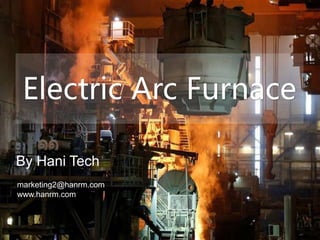
Electric Arc Furnace
By Hani Tech
marketing2@hanrm.com
www.hanrm.com
www.hanrm.com marketing2@hanrm.com
Introduction
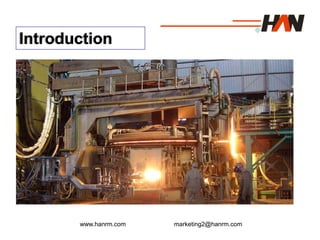
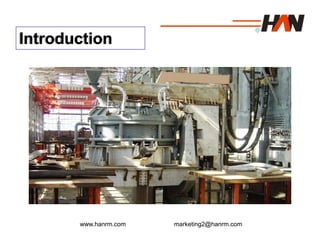
Electric arc furnace is an electric
furnace which uses high temperature
produced by electrode arc to smelt ore
and metal. When the arc is formed by
gas discharge, the energy is
concentrated and the temperature of
the arc zone is above 3000 ℃.
www.hanrm.com marketing2@hanrm.com
Introduction
www.hanrm.com marketing2@hanrm.com
Introduction
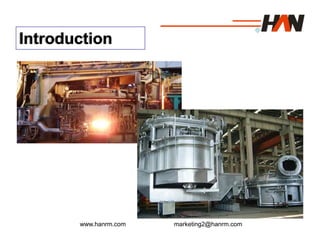
For smelting metals, EAF is more flexible
than other steelmaking furnaces, which
can effectively remove sulfur, phosphorus
and other impurities. The furnace
temperature is easy to control, and the
equipment covers a small area. It is
suitable for smelting high-quality alloy
steel.
www.hanrm.com marketing2@hanrm.com
Introduction
www.hanrm.com marketing2@hanrm.com
Introduction
The invention of EAF steelmaking was used to smelting
alloy steel and has been developed greatly. With the
improvement of EAF equipment and smelting
technology, the development of electric power industry,
the cost of EAF steelmaking is decreasing. Now EAF
steelmaking is not only used to produce alloy steel, but
also used to produce ordinary carbon steel in large
quantities. Its output in the total steel production in
major industrial countries has been increasing.
www.hanrm.com marketing2@hanrm.com
Introduction
www.hanrm.com marketing2@hanrm.com
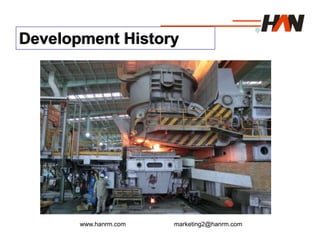
Development History
In 1888-1892, p.l.t.h é roult developed coal
instead of energy by using high temperature
of electrode arc, and invented an arc furnace
for direct smelting. At first, the EAF was only
used for the production of calcium carbide
and ferroalloy, and it was developed to make
steel in 1906, and thus the scrap steel could
be recycled economically and in scale.
www.hanrm.com marketing2@hanrm.com
Development History
www.hanrm.com marketing2@hanrm.com
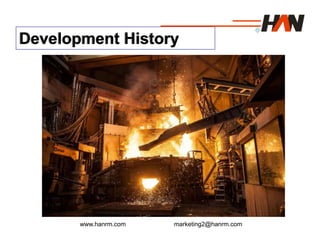
Development History
With the development of power industry, the
continuous improvement of process equipment and
the improvement of smelting technology, arc furnace
is widely used and its production capacity and scale
are increasing. The maximum capacity of EAF was
100t in 1930s, 200t in 1950s and 400t in early 1970s.
Especially in the past 50 years, the technical
performance of EAF has been gradually improved,
and the production cost has decreased significantly.
www.hanrm.com marketing2@hanrm.com
Development History
www.hanrm.com marketing2@hanrm.com
Classification
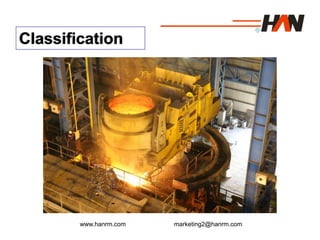
There are many types of EAF. According to the melting
form of electrode, it can be divided into non consumable
electrode type and consumable electrode type; according
to the control mode of arc length, it can be divided into
constant arc voltage automatic control type, constant arc
length automatic control type and droplet pulse automatic
control type; according to the operation form, it can be
divided into periodic operation type and continuous
operation type; According to the structure of the furnace
body, it can be divided into fixed arc furnace and rotary
arc furnace.
www.hanrm.com marketing2@hanrm.com
Classification
www.hanrm.com marketing2@hanrm.com
Advantages
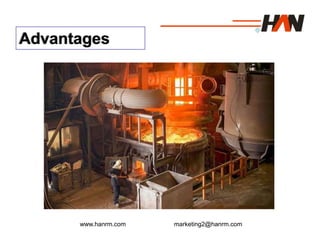
EAF steelmaking process is short, simple equipment, easy to operate,
relatively easy to control pollution, less investment in construction,
small area, and does not need to rely on complex ironmaking system
like converter steelmaking. EAF steelmaking has strong adaptability to
burden. It uses scrap as the main raw material, but it can also use
molten iron (blast furnace or chemical iron furnace), sponge iron (DRI),
Hot Briquette (HBI), pig iron and other solid and liquid iron containing
raw materials. EAF steelmaking can be produced intermittently, and
the varieties can be changed flexibly within a certain range. In addition,
modern electric arc furnace can also use a lot of auxiliary energy,
such as injection of heavy (light) oil, coal powder, natural gas and so
on. Therefore, EAF steelmaking process has strong adaptability,
flexible operation and wide application.
www.hanrm.com marketing2@hanrm.com
Advantages
www.hanrm.com marketing2@hanrm.com
Disadvantages
Due to the problems of scrap and electricity
price cost, EAF steelmaking cannot compete
with converter steelmaking in common steel and
long-term products. EAF steelmaking only plays
a leading role in the production of special steel
with small batch, multi variety and high alloy to
metal ratio. At present, some short process EAF
manufacturers generally use high output power
EAF.

Electrric arc furnace

  • 1.
    Electric Arc Furnace ByHani Tech marketing2@hanrm.com www.hanrm.com
  • 2.
    www.hanrm.com marketing2@hanrm.com Introduction Electric arcfurnace is an electric furnace which uses high temperature produced by electrode arc to smelt ore and metal. When the arc is formed by gas discharge, the energy is concentrated and the temperature of the arc zone is above 3000 ℃.
  • 3.
  • 4.
    www.hanrm.com marketing2@hanrm.com Introduction For smeltingmetals, EAF is more flexible than other steelmaking furnaces, which can effectively remove sulfur, phosphorus and other impurities. The furnace temperature is easy to control, and the equipment covers a small area. It is suitable for smelting high-quality alloy steel.
  • 5.
  • 6.
    www.hanrm.com marketing2@hanrm.com Introduction The inventionof EAF steelmaking was used to smelting alloy steel and has been developed greatly. With the improvement of EAF equipment and smelting technology, the development of electric power industry, the cost of EAF steelmaking is decreasing. Now EAF steelmaking is not only used to produce alloy steel, but also used to produce ordinary carbon steel in large quantities. Its output in the total steel production in major industrial countries has been increasing.
  • 7.
  • 8.
    www.hanrm.com marketing2@hanrm.com Development History In1888-1892, p.l.t.h é roult developed coal instead of energy by using high temperature of electrode arc, and invented an arc furnace for direct smelting. At first, the EAF was only used for the production of calcium carbide and ferroalloy, and it was developed to make steel in 1906, and thus the scrap steel could be recycled economically and in scale.
  • 9.
  • 10.
    www.hanrm.com marketing2@hanrm.com Development History Withthe development of power industry, the continuous improvement of process equipment and the improvement of smelting technology, arc furnace is widely used and its production capacity and scale are increasing. The maximum capacity of EAF was 100t in 1930s, 200t in 1950s and 400t in early 1970s. Especially in the past 50 years, the technical performance of EAF has been gradually improved, and the production cost has decreased significantly.
  • 11.
  • 12.
    www.hanrm.com marketing2@hanrm.com Classification There aremany types of EAF. According to the melting form of electrode, it can be divided into non consumable electrode type and consumable electrode type; according to the control mode of arc length, it can be divided into constant arc voltage automatic control type, constant arc length automatic control type and droplet pulse automatic control type; according to the operation form, it can be divided into periodic operation type and continuous operation type; According to the structure of the furnace body, it can be divided into fixed arc furnace and rotary arc furnace.
  • 13.
  • 14.
    www.hanrm.com marketing2@hanrm.com Advantages EAF steelmakingprocess is short, simple equipment, easy to operate, relatively easy to control pollution, less investment in construction, small area, and does not need to rely on complex ironmaking system like converter steelmaking. EAF steelmaking has strong adaptability to burden. It uses scrap as the main raw material, but it can also use molten iron (blast furnace or chemical iron furnace), sponge iron (DRI), Hot Briquette (HBI), pig iron and other solid and liquid iron containing raw materials. EAF steelmaking can be produced intermittently, and the varieties can be changed flexibly within a certain range. In addition, modern electric arc furnace can also use a lot of auxiliary energy, such as injection of heavy (light) oil, coal powder, natural gas and so on. Therefore, EAF steelmaking process has strong adaptability, flexible operation and wide application.
  • 15.
  • 16.
    www.hanrm.com marketing2@hanrm.com Disadvantages Due tothe problems of scrap and electricity price cost, EAF steelmaking cannot compete with converter steelmaking in common steel and long-term products. EAF steelmaking only plays a leading role in the production of special steel with small batch, multi variety and high alloy to metal ratio. At present, some short process EAF manufacturers generally use high output power EAF.