PROCEDURES & MACROS
While writing programs, sometimes it may be required to use same set of
instructions repeatedly. If these instructions are actually written again & again, the
program size increases and occupies more memory space. To avoid this, these
instructions can be written as a separate program (subprogram) and whenever this set
of instructions is required, an instruction can be written in the main program CALL
this subprogram. This saves the memory space. Such a subprogram which is called
from the main program to execute certain set of instructions is called subroutine or
procedure.
Concepts related to Procedures:
Stack operations:
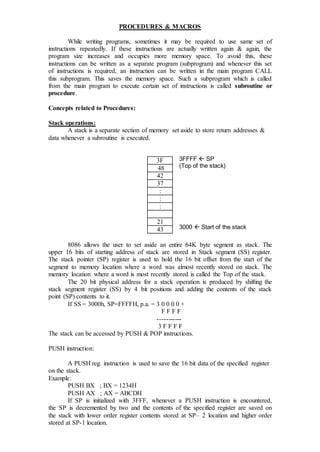
A stack is a separate section of memory set aside to store return addresses &
data whenever a subroutine is executed.
3F
48
42
37
:
:
:
21
43
8086 allows the user to set aside an entire 64K byte segment as stack. The
upper 16 bits of starting address of stack are stored in Stack segment (SS) register.
The stack pointer (SP) register is used to hold the 16 bit offset from the start of the
segment to memory location where a word was almost recently stored on stack. The
memory location where a word is most recently stored is called the Top of the stack.
The 20 bit physical address for a stack operation is produced by shifting the
stack segment register (SS) by 4 bit positions and adding the contents of the stack
point (SP) contents to it.
If SS = 3000h, SP=FFFFH, p.a. = 3 0 0 0 0 +
F F F F
-----------
3 F F F F
The stack can be accessed by PUSH & POP instructions.
PUSH instruction:
A PUSH reg. instruction is used to save the 16 bit data of the specified register
on the stack.
Example:
PUSH BX ; BX = 1234H
PUSH AX ; AX = ABCDH
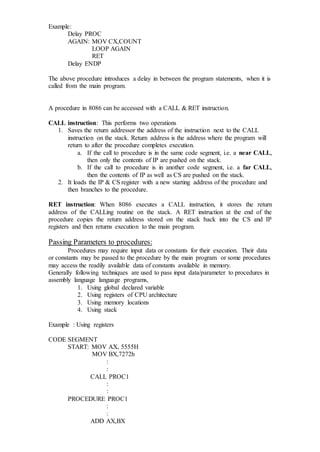
If SP is initialized with 3FFF, whenever a PUSH instruction is encountered,
the SP is decremented by two and the contents of the specified register are saved on
the stack with lower order register contents stored at SP– 2 location and higher order
stored at SP-1 location.
3FFFF  SP
(Top of the stack)
3000  Start of the stack
SP  3FFF
3FFE 12
3FFD 34
3FFC AB
SP  3FFB CD
:
:
:
3001
3002
A POP reg. instruction is used to retrieve data back to the contents of the
specified 16 bit register. Whenever a POP instruction is executed, the contents of the
SP & SP+1 locations are stored in the lower order and higher order register
respectively and stack pointer is incremented by 2. The last word PUSHed in the stack
if POPed out first. Thus stack operation is on LIFO basis.
Example:
POP BX
POP AX
3FFF
3FFE 12
3FFD 34
3FFC AB
SP  3FFB CD
:
:
:
3001
3002
After execution, BX = ABCD H & AX = 1234 H. Thus the contents of the registers
are exchanged due to the order in which the contents are POPed back from the stack.
Declaring PROCEDURES:
The syntax for procedure declaration:
name PROC [NEAR/FAR]
; Instructions of the procedures
; are written here.
RET
name ENDP
Example:
Delay PROC
AGAIN: MOV CX,COUNT
LOOP AGAIN
RET
Delay ENDP
The above procedure introduces a delay in between the program statements, when it is
called from the main program.
A procedure in 8086 can be accessed with a CALL & RET instruction.
CALL instruction: This performs two operations
1. Saves the return addressor the address of the instruction next to the CALL
instruction on the stack. Return address is the address where the program will
return to after the procedure completes execution.
a. If the call to procedure is in the same code segment, i.e. a near CALL,
then only the contents of IP are pushed on the stack.
b. If the call to procedure is in another code segment, i.e. a far CALL,
then the contents of IP as well as CS are pushed on the stack.
2. It loads the IP & CS register with a new starting address of the procedure and
then branches to the procedure.
RET instruction: When 8086 executes a CALL instruction, it stores the return
address of the CALLing routine on the stack. A RET instruction at the end of the
procedure copies the return address stored on the stack back into the CS and IP
registers and then returns execution to the main program.
Passing Parameters to procedures:
Procedures may require input data or constants for their execution. Their data
or constants may be passed to the procedure by the main program or some procedures
may access the readily available data of constants available in memory.
Generally following techniques are used to pass input data/parameter to procedures in
assembly language language programs,
1. Using global declared variable
2. Using registers of CPU architecture
3. Using memory locations
4. Using stack
Example : Using registers
CODE SEGMENT
START: MOV AX, 5555H
MOV BX,7272h
:
:
CALL PROC1
:
:
PROCEDURE PROC1
:
:
ADD AX,BX
:
:
RET
PROC1 ENDP
CODE ENDS
END START
Re-entrant Procedures :
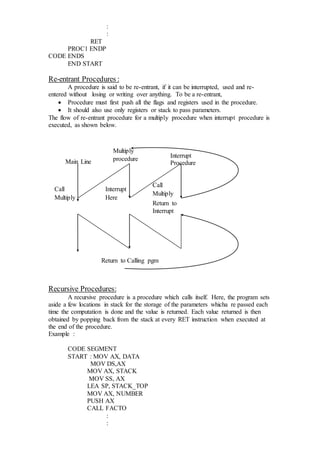
A procedure is said to be re-entrant, if it can be interrupted, used and re-
entered without losing or writing over anything. To be a re-entrant,
 Procedure must first push all the flags and registers used in the procedure.
 It should also use only registers or stack to pass parameters.
The flow of re-entrant procedure for a multiply procedure when interrupt procedure is
executed, as shown below.
Recursive Procedures:
A recursive procedure is a procedure which calls itself. Here, the program sets
aside a few locations in stack for the storage of the parameters whicha re passed each
time the computation is done and the value is returned. Each value returned is then
obtained by popping back from the stack at every RET instruction when executed at
the end of the procedure.
Example :
CODE SEGMENT
START : MOV AX, DATA
MOV DS,AX
MOV AX, STACK
MOV SS, AX
LEA SP, STACK_TOP
MOV AX, NUMBER
PUSH AX
CALL FACTO
:
:
Call
Multiply
Interrupt
Here
Call
Multiply
Main Line
Interrupt
Procedure
Return to
Interrupt
Multiply
procedure
Return to Calling pgm
PROCEDURE FACTO
PUSH AX
:
:
:
;Code for checking the number in AX =1 or not
;If AX <>1
CALL FACTO ; calling FACTO within FACTO.
If AX =1
:
:
POP AX
RET ; ret to calling program
FACTO ENDP
CODE ENDS
END START
Advantages of Procedures:
1. Simple modular programming
2. Reduced workload and development time
3. Debugging of program and procedure is easier
4. Reduction in the size of the main program
5. Reuse of procedures in the same program many times or in another program.
Macros :
Small sequences of codes of the same pattern repeated frequently at different
places which perform the same operation on the different data of the same data type
are called MACRO.
Macro is also called as an Open subroutine. When Called, the code written
within macro are executed automatically. Macros should be used when it has few
program statements. This simplifies the programming process.
Advantages
 Simplify and reduce the amount of repetitive coding
 Reduce errors caused by repetitive coding
 Makes program more readable
 Execution time is less as compared to procedures as no extra instructions
required
Defining Macros
 The Directive MACRO indicates the beginning of a MACRO
 Name of the Macro followed by MACRO and arguments if any are specified.
 ENDM is always associated with MACRO which ends the macro.
General Form :
Macro_name MACRO [Arguement1, arguement2…]
:
:
ENDM
Example:
PRINT MACRO MES
MOV AX,09H
LEA DX, MES
INT 21H
ENDM
The above macro is used to display a string specified in the argument MES on
the screen, when evoked by the main program as given below
DATA SEGEMENT
STR DB 0DH,0AH,”Hello World$”
DATA ENDS
CODE SEGMENT
ASSUME DS:DATA, CS:CODE
START: MOV AX, DATA
MOV DS, AX
PRINT STR ; Calls Macro PRINT to display STR
; STR is the parameter passed which is
;taken as MES in the Macro PRINT.
:
:
CODE ENDS
END START
Note : Main difference between Macro and Procedure is that A call to Macro
will be replaced with its body during assembly time, whereas the call to procedure is
explicit transfer of control during run-time.

Chapter 5 notes

  • 1.
    PROCEDURES & MACROS Whilewriting programs, sometimes it may be required to use same set of instructions repeatedly. If these instructions are actually written again & again, the program size increases and occupies more memory space. To avoid this, these instructions can be written as a separate program (subprogram) and whenever this set of instructions is required, an instruction can be written in the main program CALL this subprogram. This saves the memory space. Such a subprogram which is called from the main program to execute certain set of instructions is called subroutine or procedure. Concepts related to Procedures: Stack operations: A stack is a separate section of memory set aside to store return addresses & data whenever a subroutine is executed. 3F 48 42 37 : : : 21 43 8086 allows the user to set aside an entire 64K byte segment as stack. The upper 16 bits of starting address of stack are stored in Stack segment (SS) register. The stack pointer (SP) register is used to hold the 16 bit offset from the start of the segment to memory location where a word was almost recently stored on stack. The memory location where a word is most recently stored is called the Top of the stack. The 20 bit physical address for a stack operation is produced by shifting the stack segment register (SS) by 4 bit positions and adding the contents of the stack point (SP) contents to it. If SS = 3000h, SP=FFFFH, p.a. = 3 0 0 0 0 + F F F F ----------- 3 F F F F The stack can be accessed by PUSH & POP instructions. PUSH instruction: A PUSH reg. instruction is used to save the 16 bit data of the specified register on the stack. Example: PUSH BX ; BX = 1234H PUSH AX ; AX = ABCDH If SP is initialized with 3FFF, whenever a PUSH instruction is encountered, the SP is decremented by two and the contents of the specified register are saved on the stack with lower order register contents stored at SP– 2 location and higher order stored at SP-1 location. 3FFFF  SP (Top of the stack) 3000  Start of the stack
  • 2.
    SP  3FFF 3FFE12 3FFD 34 3FFC AB SP  3FFB CD : : : 3001 3002 A POP reg. instruction is used to retrieve data back to the contents of the specified 16 bit register. Whenever a POP instruction is executed, the contents of the SP & SP+1 locations are stored in the lower order and higher order register respectively and stack pointer is incremented by 2. The last word PUSHed in the stack if POPed out first. Thus stack operation is on LIFO basis. Example: POP BX POP AX 3FFF 3FFE 12 3FFD 34 3FFC AB SP  3FFB CD : : : 3001 3002 After execution, BX = ABCD H & AX = 1234 H. Thus the contents of the registers are exchanged due to the order in which the contents are POPed back from the stack. Declaring PROCEDURES: The syntax for procedure declaration: name PROC [NEAR/FAR] ; Instructions of the procedures ; are written here. RET name ENDP
  • 3.
    Example: Delay PROC AGAIN: MOVCX,COUNT LOOP AGAIN RET Delay ENDP The above procedure introduces a delay in between the program statements, when it is called from the main program. A procedure in 8086 can be accessed with a CALL & RET instruction. CALL instruction: This performs two operations 1. Saves the return addressor the address of the instruction next to the CALL instruction on the stack. Return address is the address where the program will return to after the procedure completes execution. a. If the call to procedure is in the same code segment, i.e. a near CALL, then only the contents of IP are pushed on the stack. b. If the call to procedure is in another code segment, i.e. a far CALL, then the contents of IP as well as CS are pushed on the stack. 2. It loads the IP & CS register with a new starting address of the procedure and then branches to the procedure. RET instruction: When 8086 executes a CALL instruction, it stores the return address of the CALLing routine on the stack. A RET instruction at the end of the procedure copies the return address stored on the stack back into the CS and IP registers and then returns execution to the main program. Passing Parameters to procedures: Procedures may require input data or constants for their execution. Their data or constants may be passed to the procedure by the main program or some procedures may access the readily available data of constants available in memory. Generally following techniques are used to pass input data/parameter to procedures in assembly language language programs, 1. Using global declared variable 2. Using registers of CPU architecture 3. Using memory locations 4. Using stack Example : Using registers CODE SEGMENT START: MOV AX, 5555H MOV BX,7272h : : CALL PROC1 : : PROCEDURE PROC1 : : ADD AX,BX
  • 4.
    : : RET PROC1 ENDP CODE ENDS ENDSTART Re-entrant Procedures : A procedure is said to be re-entrant, if it can be interrupted, used and re- entered without losing or writing over anything. To be a re-entrant,  Procedure must first push all the flags and registers used in the procedure.  It should also use only registers or stack to pass parameters. The flow of re-entrant procedure for a multiply procedure when interrupt procedure is executed, as shown below. Recursive Procedures: A recursive procedure is a procedure which calls itself. Here, the program sets aside a few locations in stack for the storage of the parameters whicha re passed each time the computation is done and the value is returned. Each value returned is then obtained by popping back from the stack at every RET instruction when executed at the end of the procedure. Example : CODE SEGMENT START : MOV AX, DATA MOV DS,AX MOV AX, STACK MOV SS, AX LEA SP, STACK_TOP MOV AX, NUMBER PUSH AX CALL FACTO : : Call Multiply Interrupt Here Call Multiply Main Line Interrupt Procedure Return to Interrupt Multiply procedure Return to Calling pgm
  • 5.
    PROCEDURE FACTO PUSH AX : : : ;Codefor checking the number in AX =1 or not ;If AX <>1 CALL FACTO ; calling FACTO within FACTO. If AX =1 : : POP AX RET ; ret to calling program FACTO ENDP CODE ENDS END START Advantages of Procedures: 1. Simple modular programming 2. Reduced workload and development time 3. Debugging of program and procedure is easier 4. Reduction in the size of the main program 5. Reuse of procedures in the same program many times or in another program. Macros : Small sequences of codes of the same pattern repeated frequently at different places which perform the same operation on the different data of the same data type are called MACRO. Macro is also called as an Open subroutine. When Called, the code written within macro are executed automatically. Macros should be used when it has few program statements. This simplifies the programming process. Advantages  Simplify and reduce the amount of repetitive coding  Reduce errors caused by repetitive coding  Makes program more readable  Execution time is less as compared to procedures as no extra instructions required Defining Macros  The Directive MACRO indicates the beginning of a MACRO  Name of the Macro followed by MACRO and arguments if any are specified.  ENDM is always associated with MACRO which ends the macro. General Form : Macro_name MACRO [Arguement1, arguement2…] : : ENDM
  • 6.
    Example: PRINT MACRO MES MOVAX,09H LEA DX, MES INT 21H ENDM The above macro is used to display a string specified in the argument MES on the screen, when evoked by the main program as given below DATA SEGEMENT STR DB 0DH,0AH,”Hello World$” DATA ENDS CODE SEGMENT ASSUME DS:DATA, CS:CODE START: MOV AX, DATA MOV DS, AX PRINT STR ; Calls Macro PRINT to display STR ; STR is the parameter passed which is ;taken as MES in the Macro PRINT. : : CODE ENDS END START Note : Main difference between Macro and Procedure is that A call to Macro will be replaced with its body during assembly time, whereas the call to procedure is explicit transfer of control during run-time.