REPORT ON
Error Detection & Correction
of
Burst Error
Assigned by,
Ashraful Hoque
Lecturer
CSE Department
Southeast University
Submitted by,
Tanzila Islam
Section : 01
30th Batch of CSE
Date of Submission: 25,April 2015
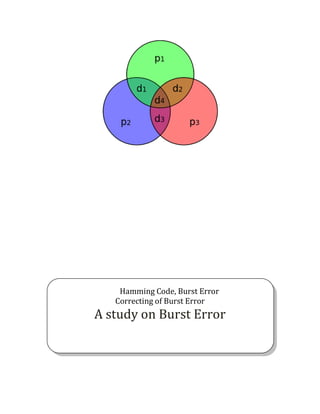
Hamming Code, Burst Error
Correcting of Burst Error
A study on Burst Error
April, 2015
Ashraful Hoque
Lecturer, Department of CSE,
Southeast University.
Dear Sir,
Here is the Term Paper on Error correction & detection of Burst Error that you
asked us to submit on April, 2015.
In this report the concept of Hamming Code, Burst Error, and how to detect &
correct it are discussed first. Then described those using figure.
It was my pleasure to complete this report. I have prepared this report with my
utmost earnestness and sincere effort. Please let me know, if you have any query
concerning the report.
Thank you.
Sincerely yours,
Tanzila Islam
ID#2012000000022
30th Batch, Sec-01
Dept. of CSE
Southeast University
Abstract
The codes we have considered so far have been designed to correct random errors.
In general, a t-error correcting code corrects all error patterns of weight t or less in a
codeword of block length n. It may be, however, that certain channels introduce
errors localized in short intervals rather than at random. For example, in storage
mediums, errors resulting from physical irregularities or structural alteration,
perhaps flaws in the original medium or damage due to wear and tear, are not
independent, but rather tend to be spatially concentrated. Similarly, interference
over short time intervals in serially transmitted radio signals causes errors to occur in
bursts. There exist codes for correcting such burst errors. Many of these codes are
cyclic. We briefly consider burst-error correcting codes in this section.
Hamming code:
Hamming code is a set of error-correction code s that can be used to detect and
correct bit errors that can occur when computer data is moved or stored. Reliable
communication is assured if the hamming distance between the transmitter and
receiver is less than or equal to one. Error coding is a method of detecting and
correcting these errors to ensure information is transferred intact from its source to
its destination. Error coding is used for fault tolerant computing in computer
memory, magnetic and optical data storage media, satellite and deep space
communications, network communications, cellular telephone networks, and almost
any other form of digital data communication.
Types of Errors:
Whenever bits flow from one point to another, they are subject to unpredictable
changes because of interference. This interference can change the shape of the
signal. In a single-bit error, a 0 is changed to a 1 or a 1 to a 0. The term single-bit
error means that only 1 bit of a given data unit (such as a byte, character, or packet)
is changed from 1 to 0 or from 0 to 1. The term burst error means that 2 or more bits
in the data unit have changed from 1 to 0 or from 0 to 1.
Burst error:
The term burst error means that two or more bits in the data unit have changed
from 0 to 1 or vice-versa. Even if we know what type of errors can occur, we can’t
simple recognize them. We can do this simply by comparing this copy received with
another copy of intended transmission. In this mechanism the source data block is
send twice. The receiver compares them with the help of a comparator and if those
two blocks differ, a request for re-transmission is made. To achieve forward error
correction, three sets of the same data block are sent and majority decision selects
the correct block. These methods are very inefficient and increase the traffic two or
three times. Fortunately there are more efficient error detection and correction
codes. There are two basic strategies for dealing with errors. One way is to include
enough redundant information (extra bits are introduced into the data stream at the
transmitter on a regular and logical basis) along with each block of data sent to
enable the receiver to deduce what the transmitted character must have been. The
term burst errors suggest that those errors are cor-related, i.e. if one bit is
erroneous; it is quite likely that the adjacent bits have also been corrupted. When
one refers to the term burst error of size m, what is meant is that the distance in bits
from the first to the last error in the frame is at most m – 1 while the intermediate
bits may or may not be corrupted.
Redundancy:
The central concept in detecting or correcting errors is redundancy. To be able to
detect or correct errors, we need to send some extra bits with our data. These
redundant bits are added by the sender and removed by the receiver. Their presence
allows the receiver to detect or correct corrupted bits. The concept of including extra
information in the transmission for error detection is a good one. But instead of
repeating the entire data stream, a shorter group of bits may be appended to the
end of each unit. This technique is called redundancy because the extra bits are
redundant to the information: they are discarded as soon as the accuracy of the
transmission has been determined. Figure 8 shows the process of using redundant
bits to check the accuracy of a data unit. Once the data stream has been generated,
it passes through a device that analyses it and adds on an appropriately coded
redundancy check. The data unit, now enlarged by several hits, travels over the link
to the receiver. The receiver puts the entire stream through a checking function. If
the received hit stream passes the checking criteria, the data portion of the data
unit.
Correcting Burst Errors:
Consider a linear code C. If all burst errors of length t or less occur in distinct cosets
of a standard array for C, then each can be uniquely identified by its syndrome, and
all such errors are then correctable. Furthermore, if C is a linear code capable of
correcting all burst errors of length t or less, then all such errors must occur in
distinct cosets. To see this, suppose C can correct two such distinct errors e1 and e2
which lie in some coset Ci of C. Then e1- e2 = c is a non-zero codeword. Now suppose
e1 is a received vector. How should it be decoded? The codeword 0 could have been
altered to e1 by the error e1, or the codeword c could have been altered to e1 by the
error e2. We get a contradiction, since the code cannot correct this burst error of
length t or less. Thus, we conclude that these errors must lie in distinct cosets.
Theorem: A linear code C can correct all burst errors of length t or less if and only if
all such errors occur in distinct cosets of C.
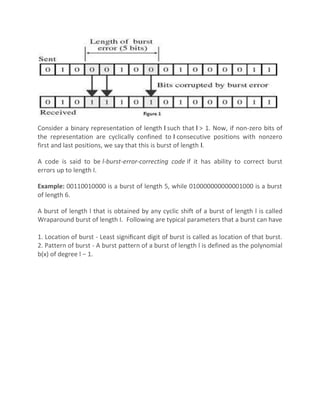
Consider a binary representation of length l such that l > 1. Now, if non-zero bits of
the representation are cyclically confined to l consecutive positions with nonzero
first and last positions, we say that this is burst of length l.
A code is said to be l-burst-error-correcting code if it has ability to correct burst
errors up to length I.
Example: 00110010000 is a burst of length 5, while 010000000000001000 is a burst
of length 6.
A burst of length l that is obtained by any cyclic shift of a burst of length l is called
Wraparound burst of length I. Following are typical parameters that a burst can have
1. Location of burst - Least significant digit of burst is called as location of that burst.
2. Pattern of burst - A burst pattern of a burst of length l is defined as the polynomial
b(x) of degree l − 1.

Error Correction of Burst error

  • 1.
    REPORT ON Error Detection& Correction of Burst Error Assigned by, Ashraful Hoque Lecturer CSE Department Southeast University Submitted by, Tanzila Islam Section : 01 30th Batch of CSE Date of Submission: 25,April 2015
  • 2.
    Hamming Code, BurstError Correcting of Burst Error A study on Burst Error
  • 3.
    April, 2015 Ashraful Hoque Lecturer,Department of CSE, Southeast University. Dear Sir, Here is the Term Paper on Error correction & detection of Burst Error that you asked us to submit on April, 2015. In this report the concept of Hamming Code, Burst Error, and how to detect & correct it are discussed first. Then described those using figure. It was my pleasure to complete this report. I have prepared this report with my utmost earnestness and sincere effort. Please let me know, if you have any query concerning the report. Thank you. Sincerely yours, Tanzila Islam ID#2012000000022 30th Batch, Sec-01 Dept. of CSE Southeast University
  • 4.
    Abstract The codes wehave considered so far have been designed to correct random errors. In general, a t-error correcting code corrects all error patterns of weight t or less in a codeword of block length n. It may be, however, that certain channels introduce errors localized in short intervals rather than at random. For example, in storage mediums, errors resulting from physical irregularities or structural alteration, perhaps flaws in the original medium or damage due to wear and tear, are not independent, but rather tend to be spatially concentrated. Similarly, interference over short time intervals in serially transmitted radio signals causes errors to occur in bursts. There exist codes for correcting such burst errors. Many of these codes are cyclic. We briefly consider burst-error correcting codes in this section.
  • 5.
    Hamming code: Hamming codeis a set of error-correction code s that can be used to detect and correct bit errors that can occur when computer data is moved or stored. Reliable communication is assured if the hamming distance between the transmitter and receiver is less than or equal to one. Error coding is a method of detecting and correcting these errors to ensure information is transferred intact from its source to its destination. Error coding is used for fault tolerant computing in computer memory, magnetic and optical data storage media, satellite and deep space communications, network communications, cellular telephone networks, and almost any other form of digital data communication. Types of Errors: Whenever bits flow from one point to another, they are subject to unpredictable changes because of interference. This interference can change the shape of the signal. In a single-bit error, a 0 is changed to a 1 or a 1 to a 0. The term single-bit error means that only 1 bit of a given data unit (such as a byte, character, or packet) is changed from 1 to 0 or from 0 to 1. The term burst error means that 2 or more bits in the data unit have changed from 1 to 0 or from 0 to 1. Burst error: The term burst error means that two or more bits in the data unit have changed from 0 to 1 or vice-versa. Even if we know what type of errors can occur, we can’t simple recognize them. We can do this simply by comparing this copy received with another copy of intended transmission. In this mechanism the source data block is send twice. The receiver compares them with the help of a comparator and if those two blocks differ, a request for re-transmission is made. To achieve forward error correction, three sets of the same data block are sent and majority decision selects the correct block. These methods are very inefficient and increase the traffic two or three times. Fortunately there are more efficient error detection and correction codes. There are two basic strategies for dealing with errors. One way is to include enough redundant information (extra bits are introduced into the data stream at the transmitter on a regular and logical basis) along with each block of data sent to enable the receiver to deduce what the transmitted character must have been. The term burst errors suggest that those errors are cor-related, i.e. if one bit is erroneous; it is quite likely that the adjacent bits have also been corrupted. When
  • 6.
    one refers tothe term burst error of size m, what is meant is that the distance in bits from the first to the last error in the frame is at most m – 1 while the intermediate bits may or may not be corrupted. Redundancy: The central concept in detecting or correcting errors is redundancy. To be able to detect or correct errors, we need to send some extra bits with our data. These redundant bits are added by the sender and removed by the receiver. Their presence allows the receiver to detect or correct corrupted bits. The concept of including extra information in the transmission for error detection is a good one. But instead of repeating the entire data stream, a shorter group of bits may be appended to the end of each unit. This technique is called redundancy because the extra bits are redundant to the information: they are discarded as soon as the accuracy of the transmission has been determined. Figure 8 shows the process of using redundant bits to check the accuracy of a data unit. Once the data stream has been generated, it passes through a device that analyses it and adds on an appropriately coded redundancy check. The data unit, now enlarged by several hits, travels over the link to the receiver. The receiver puts the entire stream through a checking function. If the received hit stream passes the checking criteria, the data portion of the data unit. Correcting Burst Errors: Consider a linear code C. If all burst errors of length t or less occur in distinct cosets of a standard array for C, then each can be uniquely identified by its syndrome, and all such errors are then correctable. Furthermore, if C is a linear code capable of correcting all burst errors of length t or less, then all such errors must occur in distinct cosets. To see this, suppose C can correct two such distinct errors e1 and e2 which lie in some coset Ci of C. Then e1- e2 = c is a non-zero codeword. Now suppose e1 is a received vector. How should it be decoded? The codeword 0 could have been altered to e1 by the error e1, or the codeword c could have been altered to e1 by the error e2. We get a contradiction, since the code cannot correct this burst error of length t or less. Thus, we conclude that these errors must lie in distinct cosets. Theorem: A linear code C can correct all burst errors of length t or less if and only if all such errors occur in distinct cosets of C.
  • 7.
    Consider a binaryrepresentation of length l such that l > 1. Now, if non-zero bits of the representation are cyclically confined to l consecutive positions with nonzero first and last positions, we say that this is burst of length l. A code is said to be l-burst-error-correcting code if it has ability to correct burst errors up to length I. Example: 00110010000 is a burst of length 5, while 010000000000001000 is a burst of length 6. A burst of length l that is obtained by any cyclic shift of a burst of length l is called Wraparound burst of length I. Following are typical parameters that a burst can have 1. Location of burst - Least significant digit of burst is called as location of that burst. 2. Pattern of burst - A burst pattern of a burst of length l is defined as the polynomial b(x) of degree l − 1.