Error Detection 
• CRC Calculation 
• Frame rate error v/s Bit rate error 
Presented by : Divya Dihuliya 
Ishan Sharma 
Riva 
Modith
Content: 
• Introduction 
• Types of Errors 
• Error Detection 
• Cyclic Redundancy Check (CRC) 
• Bit Rate Error 
• Frame Rate Error 
• Bit Rate Error v/s Frame Rate Error
Introduction 
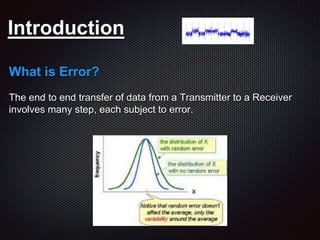
What is Error? 
The end to end transfer of data from a Transmitter to a Receiver 
involves many step, each subject to error.
Types of Errors 
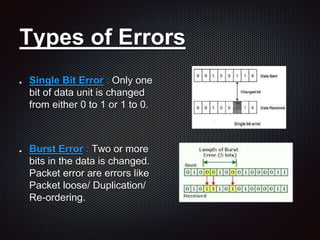
Single Bit Error : Only one 
bit of data unit is changed 
from either 0 to 1 or 1 to 0. 
Burst Error : Two or more 
bits in the data is changed. 
Packet error are errors like 
Packet loose/ Duplication/ 
Re-ordering.
Error Detection 
Process of detecting errors between sender and 
receiver. 
Error Detection 
Parity 
Check 
Check 
sum 
CRC
Cyclic Redundancy Check 
CRCs are so called because the check (data verification) value is 
a redundancy (it expands the message without adding 
information) and the algorithm is based on cyclic codes. 
Cyclic redundancy check (CRC) is an error-detecting code 
commonly used in digital networks and storage devices to detect 
accidental changes to raw data. 
CRCs are popular because they are simple to implement in 
binary hardware, easy to analyse mathematically, and particularly 
good at detecting common errors caused by noise in 
transmission channels.
CRC Calculation 
View data bits (D) as a binary number. 
Example : D = 101101101 
Represent n bit message as (n-1) degree polynomial. 
D(x) = x8 + x6 + x5 + x3 + x2 + 1 
XOR operation 
Data before sending. 
Data after sending. 
Receiver Test (To check if the data transmitted is non-corrupt).
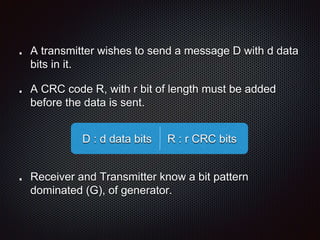
A transmitter wishes to send a message D with d data 
bits in it. 
A CRC code R, with r bit of length must be added 
before the data is sent. 
D : d data bits R : r CRC bits 
Receiver and Transmitter know a bit pattern 
dominated (G), of generator.
Types of CRC’s: 
Standard for CRC with 8,12,16 and 32 bits. 
CRC-32 used by IEEE link protocols i.e. Ethernet. 
CRC-8 used in ATM’s data communication.
BIT RATE ERROR 
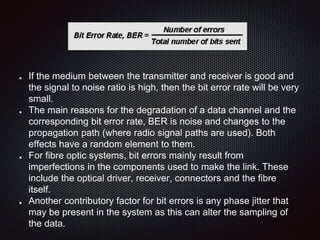
A bit error rate is defined as the rate at which errors 
occur in a transmission system. This can be directly 
translated into the number of errors that occur in a 
string of a stated number of bits.
Bit error rate, in assessing systems. 
Systems for which bit error rate, BER is applicable 
include radio data links as well as fibre optic data 
systems, Ethernet. 
Bit error rate, BER, provides an ideal way in which the 
necessary to assess the performance of the system can 
be achieved. 
Unlike many other forms of assessment, bit error rate, 
BER assesses the full end to end performance of a 
system including the transmitter, receiver and the 
medium between the two.
If the medium between the transmitter and receiver is good and 
the signal to noise ratio is high, then the bit error rate will be very 
small. 
The main reasons for the degradation of a data channel and the 
corresponding bit error rate, BER is noise and changes to the 
propagation path (where radio signal paths are used). Both 
effects have a random element to them. 
For fibre optic systems, bit errors mainly result from 
imperfections in the components used to make the link. These 
include the optical driver, receiver, connectors and the fibre 
itself. 
Another contributory factor for bit errors is any phase jitter that 
may be present in the system as this can alter the sampling of 
the data.
BER and Eb/No 
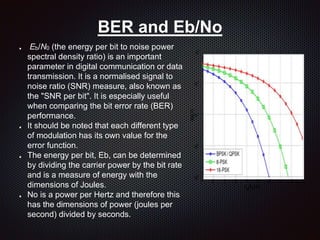
Eb/N0 (the energy per bit to noise power 
spectral density ratio) is an important 
parameter in digital communication or data 
transmission. It is a normalised signal to 
noise ratio (SNR) measure, also known as 
the "SNR per bit". It is especially useful 
when comparing the bit error rate (BER) 
performance. 
It should be noted that each different type 
of modulation has its own value for the 
error function. 
The energy per bit, Eb, can be determined 
by dividing the carrier power by the bit rate 
and is a measure of energy with the 
dimensions of Joules. 
No is a power per Hertz and therefore this 
has the dimensions of power (joules per 
second) divided by seconds.
Factors affecting the bit error rate 
It can be seen from using Eb/No, that the bit error rate, BER can be affected by a 
number of factors. By manipulating the variables that can be controlled it is 
possible to optimise a system to provide the performance levels that are required. 
Interference: By reducing the bandwidth the level of interference can be 
reduced. However reducing the bandwidth limits the data throughput that can be 
achieved. 
Increase transmitter power: It is also possible to increase the power level of the 
system so that the power per bit is increased. This has to be balanced against 
factors including the interference levels . 
Lower order modulation: Lower order modulation schemes can be used, but 
this is at the expense of data throughput. 
Reduce bandwidth: Another approach that can be adopted to reduce the bit 
error rate is to reduce the bandwidth. Lower levels of noise will be received and 
therefore the signal to noise ratio will improve. Again this results in a reduction of 
the data throughput attainable.
Bit error rate testing 
A data stream is sent through the communications channel, 
whether a radio link, a fibre optic link or whatever, and the resulting 
data stream is compared with the original. Any changes are noted 
as data errors and logged. Using this information a bit error rate 
can be determined. 
The basic concept of a bit error rate test is straightforward, but the 
actual implementation requires a little more thought, and is not as 
simple. There are a number of issues that need to be addressed. 
As data errors occur in a random fashion it can take some while 
before an accurate reading can be gained using normal data. In 
order to shorten the time required for measurements, a 
pseudorandom data sequence can be used.
System simulation for BER 
testing 
In addition using a pseudo-random data source, it is often necessary to 
simulate the transmission path. To simulate the transmission path it is 
necessary to set up a "medium" that is representative of the actual data 
transmission path to be used. In terms of a radio transmission, this includes 
noise and propagation fading. 
Noise: The receiver noise will be present regardless of whether the system 
is in a simulated or real environment. The remaining noise can be simulated 
and introduced to the receiver using a noise diode generator. 
Fading characteristics for radio communications systems: It is very 
important to simulate the real life characteristics of the transmission path in 
as realistic a way as possible. To achieve this for a radio link it is necessary 
to use a fading simulator that adds Rayleigh fading characteristics to the 
signal.
Frame Rate Error 
Ratio of data received with errors to the total data received. Used to determine the 
quality of a signal connection. If the FER is too high (too many errors), the connection 
may be dropped. 
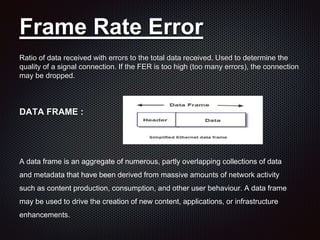
DATA FRAME : 
A data frame is an aggregate of numerous, partly overlapping collections of data 
and metadata that have been derived from massive amounts of network activity 
such as content production, consumption, and other user behaviour. A data frame 
may be used to drive the creation of new content, applications, or infrastructure 
enhancements.
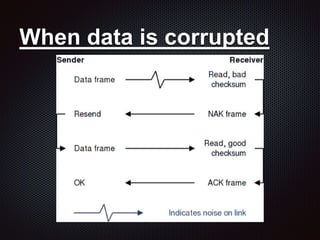
When data is corrupted
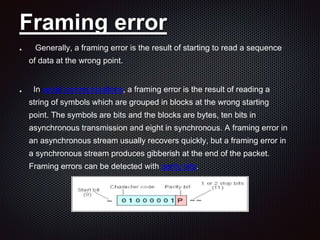
Framing error 
Generally, a framing error is the result of starting to read a sequence 
of data at the wrong point. 
In serial communications, a framing error is the result of reading a 
string of symbols which are grouped in blocks at the wrong starting 
point. The symbols are bits and the blocks are bytes, ten bits in 
asynchronous transmission and eight in synchronous. A framing error in 
an asynchronous stream usually recovers quickly, but a framing error in 
a synchronous stream produces gibberish at the end of the packet. 
Framing errors can be detected with parity bits.
Estimation of BER and FER 
A method for estimating the performance of low-density parity-check 
(LDPC) codes decoded by hard-decision iterative 
decoding algorithms on binary symmetric channels (BSC) is 
proposed. 
Based on the enumeration of the smallest weight error patterns 
that cannot be all corrected by the decoder, this method 
estimates both the frame error rate (FER) and the bit error rate 
(BER) of a given LDPC code with very good precision for all 
crossover probabilities of practical interest.
FER estimation
BER estimation
Thank you!!

Error detection in Data Communication System

  • 1.
    Error Detection •CRC Calculation • Frame rate error v/s Bit rate error Presented by : Divya Dihuliya Ishan Sharma Riva Modith
  • 2.
    Content: • Introduction • Types of Errors • Error Detection • Cyclic Redundancy Check (CRC) • Bit Rate Error • Frame Rate Error • Bit Rate Error v/s Frame Rate Error
  • 3.
    Introduction What isError? The end to end transfer of data from a Transmitter to a Receiver involves many step, each subject to error.
  • 4.
    Types of Errors Single Bit Error : Only one bit of data unit is changed from either 0 to 1 or 1 to 0. Burst Error : Two or more bits in the data is changed. Packet error are errors like Packet loose/ Duplication/ Re-ordering.
  • 5.
    Error Detection Processof detecting errors between sender and receiver. Error Detection Parity Check Check sum CRC
  • 6.
    Cyclic Redundancy Check CRCs are so called because the check (data verification) value is a redundancy (it expands the message without adding information) and the algorithm is based on cyclic codes. Cyclic redundancy check (CRC) is an error-detecting code commonly used in digital networks and storage devices to detect accidental changes to raw data. CRCs are popular because they are simple to implement in binary hardware, easy to analyse mathematically, and particularly good at detecting common errors caused by noise in transmission channels.
  • 7.
    CRC Calculation Viewdata bits (D) as a binary number. Example : D = 101101101 Represent n bit message as (n-1) degree polynomial. D(x) = x8 + x6 + x5 + x3 + x2 + 1 XOR operation Data before sending. Data after sending. Receiver Test (To check if the data transmitted is non-corrupt).
  • 8.
    A transmitter wishesto send a message D with d data bits in it. A CRC code R, with r bit of length must be added before the data is sent. D : d data bits R : r CRC bits Receiver and Transmitter know a bit pattern dominated (G), of generator.
  • 9.
    Types of CRC’s: Standard for CRC with 8,12,16 and 32 bits. CRC-32 used by IEEE link protocols i.e. Ethernet. CRC-8 used in ATM’s data communication.
  • 10.
    BIT RATE ERROR A bit error rate is defined as the rate at which errors occur in a transmission system. This can be directly translated into the number of errors that occur in a string of a stated number of bits.
  • 11.
    Bit error rate,in assessing systems. Systems for which bit error rate, BER is applicable include radio data links as well as fibre optic data systems, Ethernet. Bit error rate, BER, provides an ideal way in which the necessary to assess the performance of the system can be achieved. Unlike many other forms of assessment, bit error rate, BER assesses the full end to end performance of a system including the transmitter, receiver and the medium between the two.
  • 12.
    If the mediumbetween the transmitter and receiver is good and the signal to noise ratio is high, then the bit error rate will be very small. The main reasons for the degradation of a data channel and the corresponding bit error rate, BER is noise and changes to the propagation path (where radio signal paths are used). Both effects have a random element to them. For fibre optic systems, bit errors mainly result from imperfections in the components used to make the link. These include the optical driver, receiver, connectors and the fibre itself. Another contributory factor for bit errors is any phase jitter that may be present in the system as this can alter the sampling of the data.
  • 13.
    BER and Eb/No Eb/N0 (the energy per bit to noise power spectral density ratio) is an important parameter in digital communication or data transmission. It is a normalised signal to noise ratio (SNR) measure, also known as the "SNR per bit". It is especially useful when comparing the bit error rate (BER) performance. It should be noted that each different type of modulation has its own value for the error function. The energy per bit, Eb, can be determined by dividing the carrier power by the bit rate and is a measure of energy with the dimensions of Joules. No is a power per Hertz and therefore this has the dimensions of power (joules per second) divided by seconds.
  • 14.
    Factors affecting thebit error rate It can be seen from using Eb/No, that the bit error rate, BER can be affected by a number of factors. By manipulating the variables that can be controlled it is possible to optimise a system to provide the performance levels that are required. Interference: By reducing the bandwidth the level of interference can be reduced. However reducing the bandwidth limits the data throughput that can be achieved. Increase transmitter power: It is also possible to increase the power level of the system so that the power per bit is increased. This has to be balanced against factors including the interference levels . Lower order modulation: Lower order modulation schemes can be used, but this is at the expense of data throughput. Reduce bandwidth: Another approach that can be adopted to reduce the bit error rate is to reduce the bandwidth. Lower levels of noise will be received and therefore the signal to noise ratio will improve. Again this results in a reduction of the data throughput attainable.
  • 15.
    Bit error ratetesting A data stream is sent through the communications channel, whether a radio link, a fibre optic link or whatever, and the resulting data stream is compared with the original. Any changes are noted as data errors and logged. Using this information a bit error rate can be determined. The basic concept of a bit error rate test is straightforward, but the actual implementation requires a little more thought, and is not as simple. There are a number of issues that need to be addressed. As data errors occur in a random fashion it can take some while before an accurate reading can be gained using normal data. In order to shorten the time required for measurements, a pseudorandom data sequence can be used.
  • 16.
    System simulation forBER testing In addition using a pseudo-random data source, it is often necessary to simulate the transmission path. To simulate the transmission path it is necessary to set up a "medium" that is representative of the actual data transmission path to be used. In terms of a radio transmission, this includes noise and propagation fading. Noise: The receiver noise will be present regardless of whether the system is in a simulated or real environment. The remaining noise can be simulated and introduced to the receiver using a noise diode generator. Fading characteristics for radio communications systems: It is very important to simulate the real life characteristics of the transmission path in as realistic a way as possible. To achieve this for a radio link it is necessary to use a fading simulator that adds Rayleigh fading characteristics to the signal.
  • 17.
    Frame Rate Error Ratio of data received with errors to the total data received. Used to determine the quality of a signal connection. If the FER is too high (too many errors), the connection may be dropped. DATA FRAME : A data frame is an aggregate of numerous, partly overlapping collections of data and metadata that have been derived from massive amounts of network activity such as content production, consumption, and other user behaviour. A data frame may be used to drive the creation of new content, applications, or infrastructure enhancements.
  • 18.
    When data iscorrupted
  • 19.
    Framing error Generally,a framing error is the result of starting to read a sequence of data at the wrong point. In serial communications, a framing error is the result of reading a string of symbols which are grouped in blocks at the wrong starting point. The symbols are bits and the blocks are bytes, ten bits in asynchronous transmission and eight in synchronous. A framing error in an asynchronous stream usually recovers quickly, but a framing error in a synchronous stream produces gibberish at the end of the packet. Framing errors can be detected with parity bits.
  • 20.
    Estimation of BERand FER A method for estimating the performance of low-density parity-check (LDPC) codes decoded by hard-decision iterative decoding algorithms on binary symmetric channels (BSC) is proposed. Based on the enumeration of the smallest weight error patterns that cannot be all corrected by the decoder, this method estimates both the frame error rate (FER) and the bit error rate (BER) of a given LDPC code with very good precision for all crossover probabilities of practical interest.
  • 21.
  • 22.
  • 23.