Submitted To:- Mr. Nisar
Submitted By:- Ranjodh Singh Binning - A00071783
Vishal Sood -A00067113
Parmeet Singh -A00071276
Stages of Childbirth
stages of labour
There are three distinct stages of labour :
First stage: when contractions (‘Braxton-Hicks’) gradually open up the cervix,
which is the neck of womb (uterus). It consists of early labour, active labour
and the transitional phase.
Second stage: when baby is pushed out into the world.
Third stage: when placenta is delivered.
Note- There is also a phase called pre-labour, which occures before the first
stage of labour.
The three stages of labour
pre-labour
During pregnancy, cervix is closed and plugged with mucus.
cervix is long and firm, giving a strong base to womb. It's also in
a position that points slightly towards back (posterior position).
Before labour can start properly, cervix has to go through some
changes. It has to move forward (anterior position), soften and
shorten. The softening of cervix is often called ripening
In this image, the baby has dropped. Once baby has dropped (or engaged)
it is easier to breathe for mother, but that mother also have more pressure
on her bladder.
(Opening) first stage
In the first stage of labour, cervix has to open , so baby can be born. The muscles
of womb tighten with each contraction and then release, drawing cervix up into
the lower section of womb.
In the early phase of first stage labour, cervix may open very gradually so that it
may seem as if no changes are happening. Early labour can be slow and
contractions may not last for long and have lengthy gaps between them. They
may even stop for a while before starting again.
In the active phase of first stage labour, the contractions usually last longer, and
become more frequent and powerful. Towards the end of the first stage, labour
may become much more intense. This phase of labour is called transition.
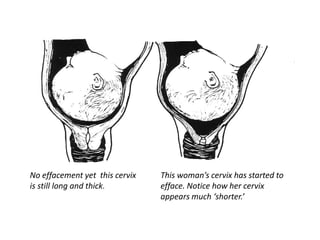
No effacement yet this cervix
is still long and thick.
This woman’s cervix has started to
efface. Notice how her cervix
appears much ‘shorter.’
Latent
During this stage contractions might be as much as 20 minutes apart as cervix is
beginning to open and widen to around 3cm.
contractions at this stage may not be very noticeable, feeling like mild cramps or
menstrual pains.
Active Stage
At this stage of labour contractions will begin to be more powerful and more
frequent. cervix is continuing to open from around 3cm to fully dilated at 10cm.
Unlike the latent stage, contractions will now be a lot more often, close to every
three to four minutes and they will last anywhere from 60 to 90 seconds.
The early stage of labour has three
phases:
As mother advance through the active stage of labour and cervix
continues to dilate, contractions will become stronger. Mother will need
to focus on breathing and trying relaxation techniques to help control her
breathing.
Mother may lose appetite and start to feel sick during the active stage of
labour as her body prepares itself for the delivery of baby by clearing out
her digestive system.
Transitional Stage
This stage occurs when cervix is about 8cm dilated and it’s also when
mother may have the first urge to start pushing. mother may feel shaky,
cold or even sick. contractions may be less frequent now, but they will
also be a lot stronger and longer-lasting each time. It may be at this point
that mother require pain relief .
(pushing) second stage
This is the stage when baby is born. During the second stage of labour, baby will
descend into the birth canal and baby is pushed down
mother will feel the pressure of baby's head low down in pelvis, and with each
contraction, mother may feel strong urges to bear down.
With every push, baby will move further through pelvis, but at the end of the
contraction, baby will probably slip back a little again. This is normal and gives the
muscles of pelvic floor time to stretch gradually.
When baby's head is visible at the entrance to birth canal and stays there when
the contraction has ended, it's called crowning.
Once baby is born, he’ll be dried off with a clean towel and then placed onto
mothers chest for skin-to-skin.
Pushing stage
semi-sitting position and an upright position.
The pushing stage can take anywhere from 20 minutes to 2 or 3 hours, but it
is usually shorter if mother have had a baby before.
(birthing the Placenta) third stage
Once baby is born, the third stage begins. Contractions, weaker this time, will
start up again. These will make the placenta gradually peel away from the wall of
uterus. mother may get the urge to push again. The placenta, with the
membranes of the empty bag of waters attached, will drop to the bottom of
uterus and out through your birth canal.
Many hospitals routinely give an injection which makes the placenta come out.
This is called a managed third stage. This speeds up the third stage and mother
won't have to do any pushing.
doctor will examine the placenta and membranes to make sure that nothing has
been left behind. She will also feel mothers chest to check that uterus is
contracting hard to stop the bleeding from the place where the placenta was
attached.
Birthing the Placenta (The Third Stage)
Maternal Side Fetal Side
Once the baby is born, mother will have a bit of a break, and then it will be time
to push out the placenta.
This will feel to be easy after the job of pushing out baby, but mother will have
to give some good pushes.The birth isn’t over until mother pushes out her
placenta!
Internet
http://www.babycenter.ca
http://www.bounty.com

Birth stages

  • 1.
    Submitted To:- Mr.Nisar Submitted By:- Ranjodh Singh Binning - A00071783 Vishal Sood -A00067113 Parmeet Singh -A00071276 Stages of Childbirth
  • 2.
    stages of labour Thereare three distinct stages of labour : First stage: when contractions (‘Braxton-Hicks’) gradually open up the cervix, which is the neck of womb (uterus). It consists of early labour, active labour and the transitional phase. Second stage: when baby is pushed out into the world. Third stage: when placenta is delivered. Note- There is also a phase called pre-labour, which occures before the first stage of labour.
  • 3.
  • 4.
    pre-labour During pregnancy, cervixis closed and plugged with mucus. cervix is long and firm, giving a strong base to womb. It's also in a position that points slightly towards back (posterior position). Before labour can start properly, cervix has to go through some changes. It has to move forward (anterior position), soften and shorten. The softening of cervix is often called ripening
  • 5.
    In this image,the baby has dropped. Once baby has dropped (or engaged) it is easier to breathe for mother, but that mother also have more pressure on her bladder.
  • 6.
    (Opening) first stage Inthe first stage of labour, cervix has to open , so baby can be born. The muscles of womb tighten with each contraction and then release, drawing cervix up into the lower section of womb. In the early phase of first stage labour, cervix may open very gradually so that it may seem as if no changes are happening. Early labour can be slow and contractions may not last for long and have lengthy gaps between them. They may even stop for a while before starting again. In the active phase of first stage labour, the contractions usually last longer, and become more frequent and powerful. Towards the end of the first stage, labour may become much more intense. This phase of labour is called transition.
  • 7.
    No effacement yetthis cervix is still long and thick. This woman’s cervix has started to efface. Notice how her cervix appears much ‘shorter.’
  • 8.
    Latent During this stagecontractions might be as much as 20 minutes apart as cervix is beginning to open and widen to around 3cm. contractions at this stage may not be very noticeable, feeling like mild cramps or menstrual pains. Active Stage At this stage of labour contractions will begin to be more powerful and more frequent. cervix is continuing to open from around 3cm to fully dilated at 10cm. Unlike the latent stage, contractions will now be a lot more often, close to every three to four minutes and they will last anywhere from 60 to 90 seconds. The early stage of labour has three phases:
  • 9.
    As mother advancethrough the active stage of labour and cervix continues to dilate, contractions will become stronger. Mother will need to focus on breathing and trying relaxation techniques to help control her breathing. Mother may lose appetite and start to feel sick during the active stage of labour as her body prepares itself for the delivery of baby by clearing out her digestive system. Transitional Stage This stage occurs when cervix is about 8cm dilated and it’s also when mother may have the first urge to start pushing. mother may feel shaky, cold or even sick. contractions may be less frequent now, but they will also be a lot stronger and longer-lasting each time. It may be at this point that mother require pain relief .
  • 10.
    (pushing) second stage Thisis the stage when baby is born. During the second stage of labour, baby will descend into the birth canal and baby is pushed down mother will feel the pressure of baby's head low down in pelvis, and with each contraction, mother may feel strong urges to bear down. With every push, baby will move further through pelvis, but at the end of the contraction, baby will probably slip back a little again. This is normal and gives the muscles of pelvic floor time to stretch gradually. When baby's head is visible at the entrance to birth canal and stays there when the contraction has ended, it's called crowning. Once baby is born, he’ll be dried off with a clean towel and then placed onto mothers chest for skin-to-skin.
  • 11.
    Pushing stage semi-sitting positionand an upright position. The pushing stage can take anywhere from 20 minutes to 2 or 3 hours, but it is usually shorter if mother have had a baby before.
  • 12.
    (birthing the Placenta)third stage Once baby is born, the third stage begins. Contractions, weaker this time, will start up again. These will make the placenta gradually peel away from the wall of uterus. mother may get the urge to push again. The placenta, with the membranes of the empty bag of waters attached, will drop to the bottom of uterus and out through your birth canal. Many hospitals routinely give an injection which makes the placenta come out. This is called a managed third stage. This speeds up the third stage and mother won't have to do any pushing. doctor will examine the placenta and membranes to make sure that nothing has been left behind. She will also feel mothers chest to check that uterus is contracting hard to stop the bleeding from the place where the placenta was attached.
  • 13.
    Birthing the Placenta(The Third Stage) Maternal Side Fetal Side Once the baby is born, mother will have a bit of a break, and then it will be time to push out the placenta. This will feel to be easy after the job of pushing out baby, but mother will have to give some good pushes.The birth isn’t over until mother pushes out her placenta!
  • 14.