Physiology of Parturition and
Lactation
Dr. Nabeel Beeran MBBS, MD
Department of Physiology
23/08/2019
2
Specific Learning Objectives
At the end of the class you should be able to:
• Define and describe stages of labor
• Understand the mechanism of parturition
• Understand mechanism of lactogenesis and lactation
3
Physiology of Parturition
• Parturition means birth of the baby.
• “Childbirth” or “Labour” or “”Labor”.
• Towards the end of pregnancy, the uterus becomes
progressively more excitable, until finally it develops
strong rhythmic contractions so that the baby is
expelled.
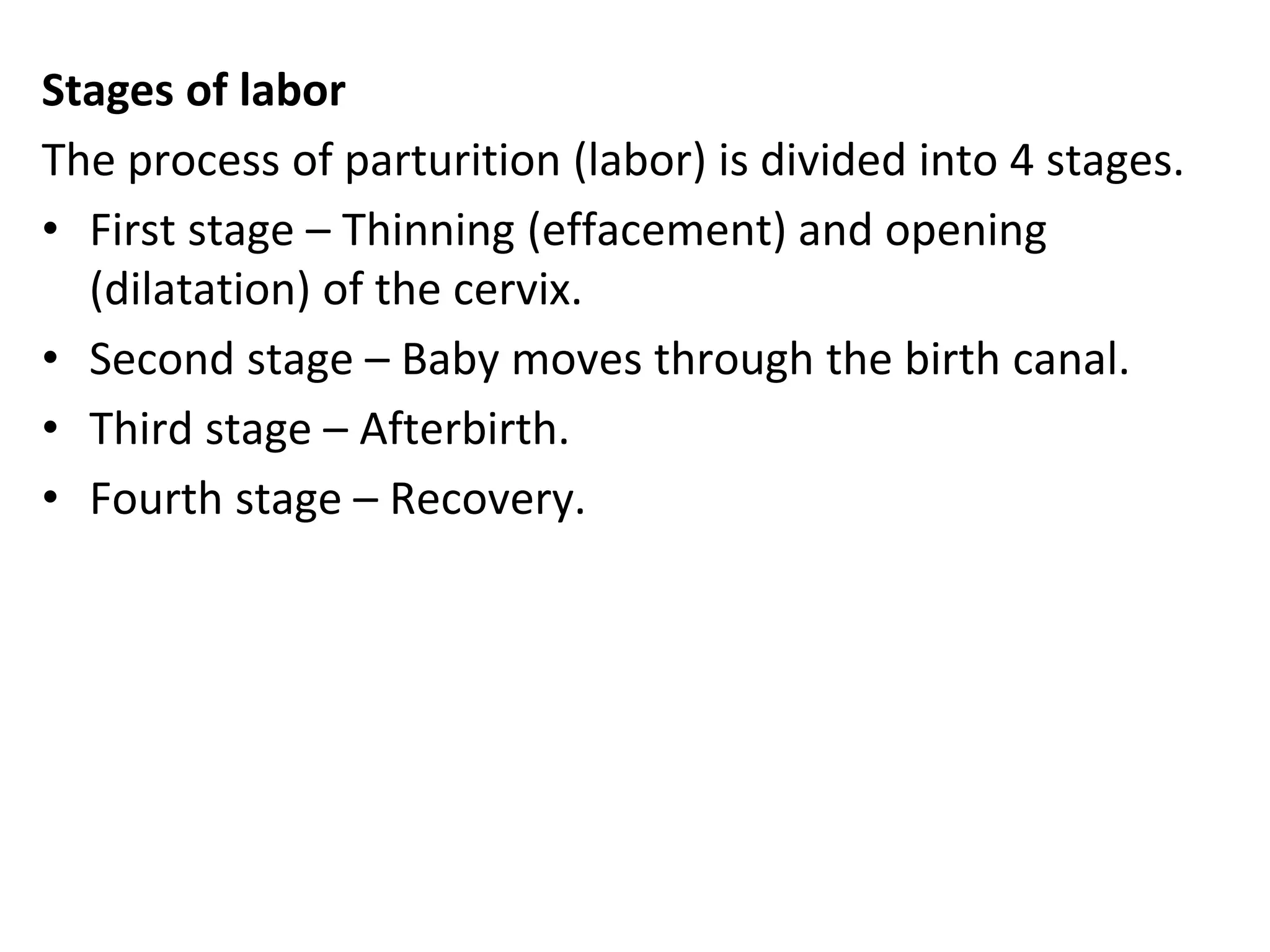
Stages of labor
The process of parturition (labor) is divided into 4 stages.
• First stage – Thinning (effacement) and opening
(dilatation) of the cervix.
• Second stage – Baby moves through the birth canal.
• Third stage – Afterbirth.
• Fourth stage – Recovery.
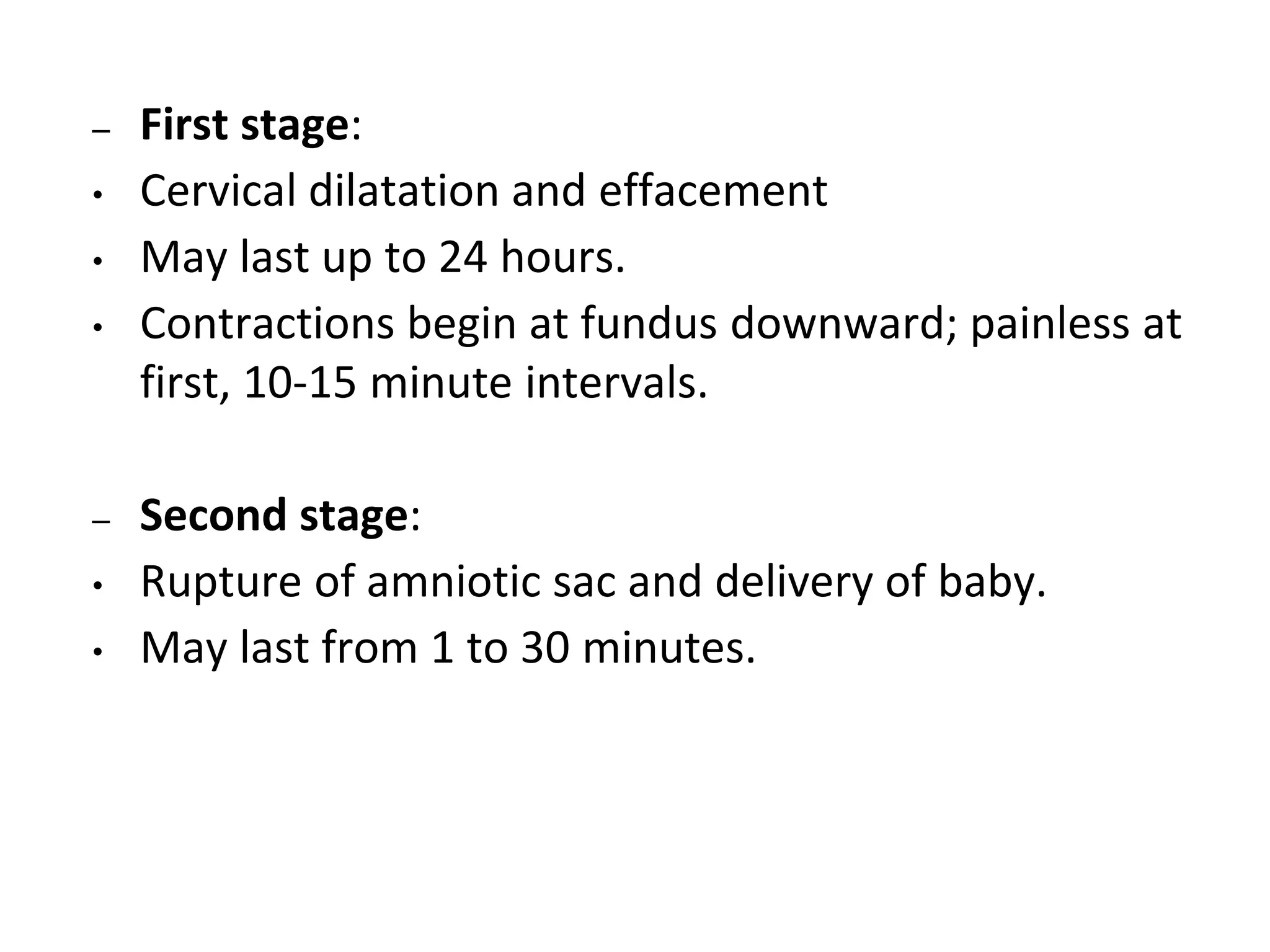
– First stage:
• Cervical dilatation and effacement
• May last up to 24 hours.
• Contractions begin at fundus downward; painless at
first, 10-15 minute intervals.
– Second stage:
• Rupture of amniotic sac and delivery of baby.
• May last from 1 to 30 minutes.
- Third stage:
• Delivery of placenta.
• 15 - 45 minutes.
• Shearing effect between wall of uterus and
placenta.
• Blood loss about 350 ml,
- limited by constriction of blood vessels as
uterus contracts.
- prostaglandins at placental site cause
vasospasm.
Control of Parturition
• Hormonal factors
• Mechanical factors
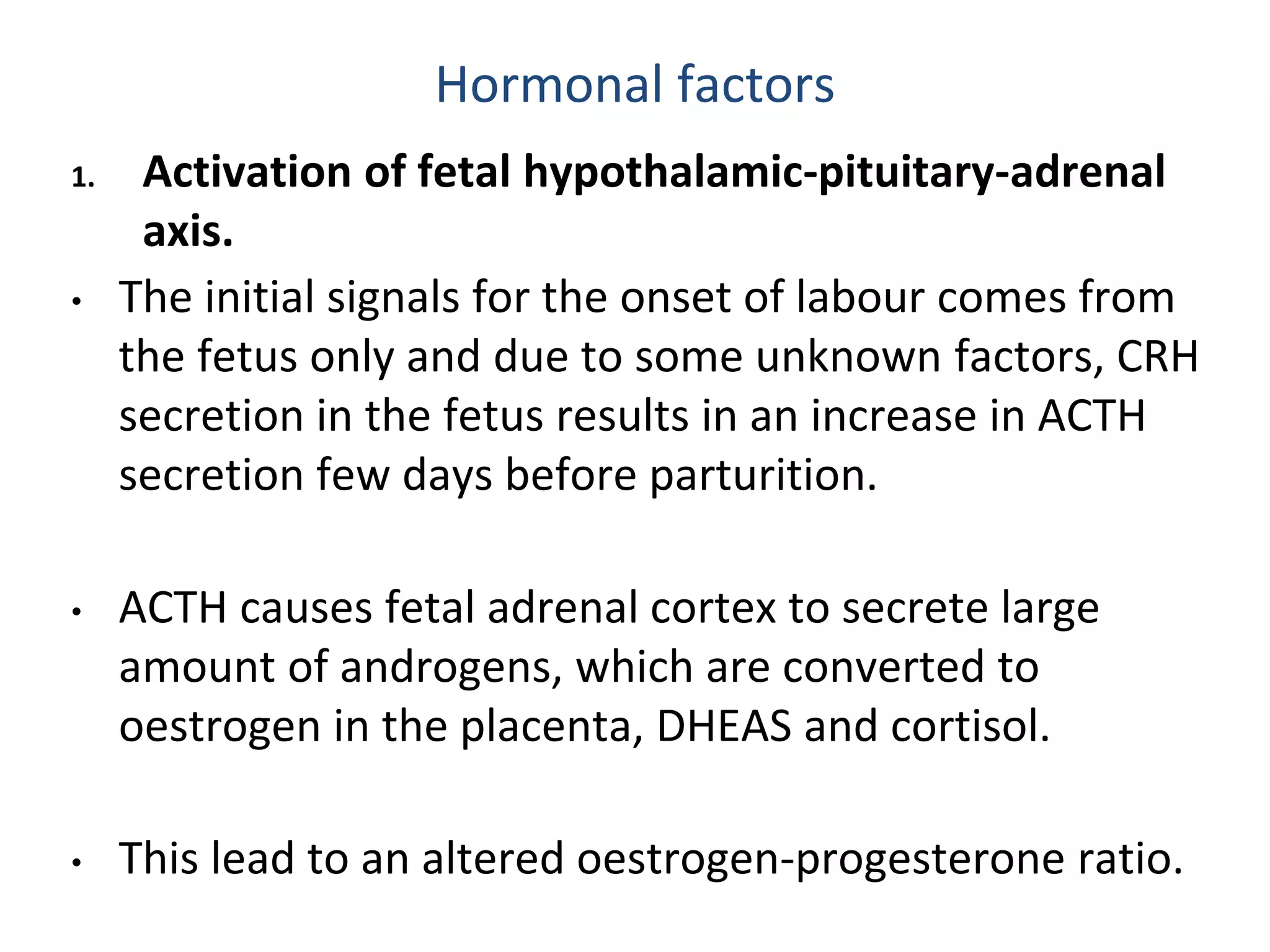
Hormonal factors
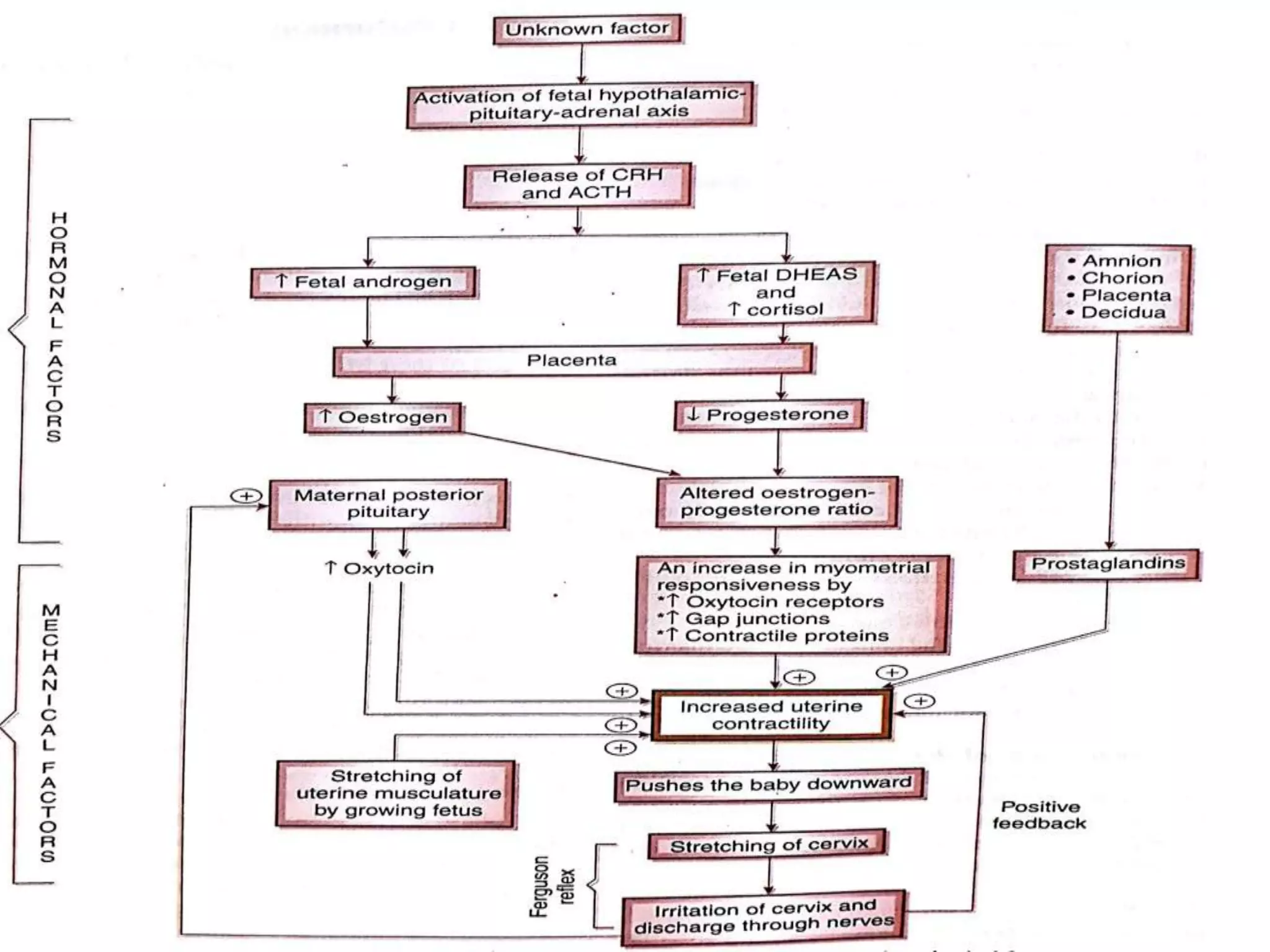
1. Activation of fetal hypothalamic-pituitary-adrenal
axis.
• The initial signals for the onset of labour comes from
the fetus only and due to some unknown factors, CRH
secretion in the fetus results in an increase in ACTH
secretion few days before parturition.
• ACTH causes fetal adrenal cortex to secrete large
amount of androgens, which are converted to
oestrogen in the placenta, DHEAS and cortisol.
• This lead to an altered oestrogen-progesterone ratio.
2. Role of altered oestrogen-progesterone ratio.
• The altered oestrogen-progesterone ratio also causes:
 An increase in release of oxytocin from maternal
posterior pituitary.
 An increase in number of oxytocin receptors in
myometrium.
 An increase in prostaglandin synthesis.
 An increase in synthesis of myometrial contractile
proteins.
3. Role of oxytocin and prostaglandins.
• Prostaglandins enhance the force of oxytocin- induced
uterine contractions.
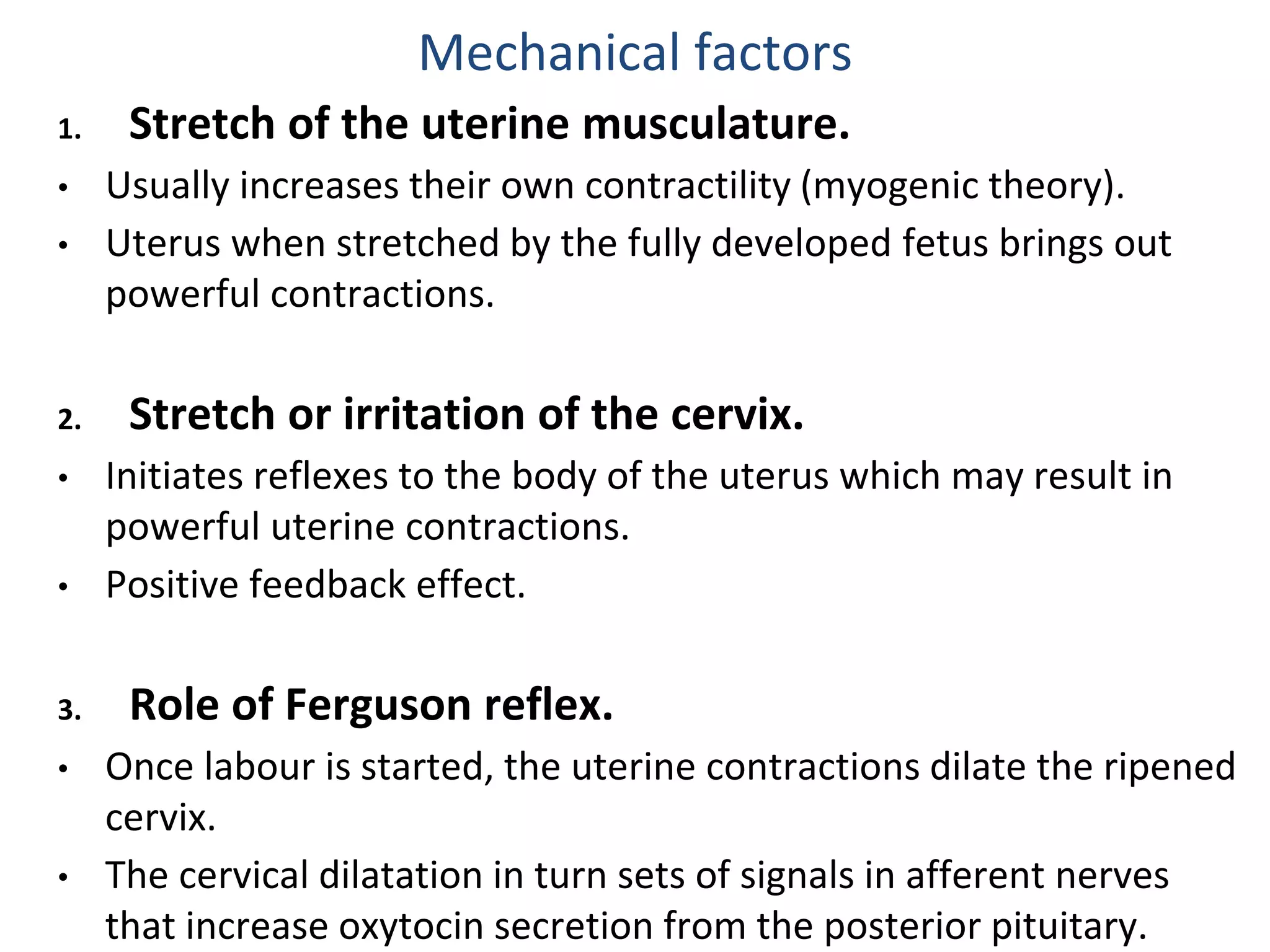
Mechanical factors
1. Stretch of the uterine musculature.
• Usually increases their own contractility (myogenic theory).
• Uterus when stretched by the fully developed fetus brings out
powerful contractions.
2. Stretch or irritation of the cervix.
• Initiates reflexes to the body of the uterus which may result in
powerful uterine contractions.
• Positive feedback effect.
3. Role of Ferguson reflex.
• Once labour is started, the uterine contractions dilate the ripened
cervix.
• The cervical dilatation in turn sets of signals in afferent nerves
that increase oxytocin secretion from the posterior pituitary.
Control of breast development and growth
• Estrogen
• Progesterone
• Other hormones
– Growth hormone
– Thyroxine
– Cortisol, insulin
• Placental hormones
• Prolactin
Prolactin
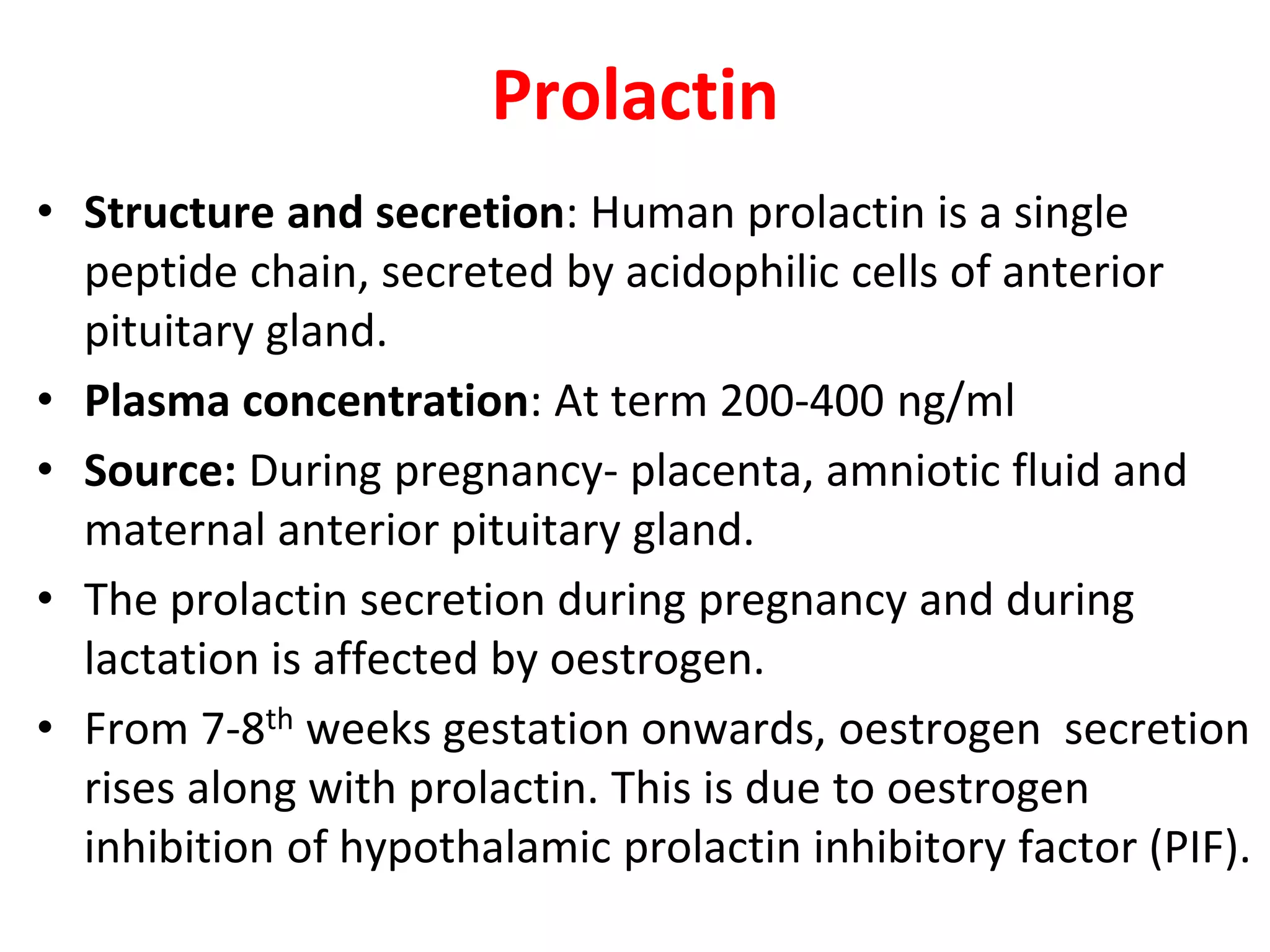
• Structure and secretion: Human prolactin is a single
peptide chain, secreted by acidophilic cells of anterior
pituitary gland.
• Plasma concentration: At term 200-400 ng/ml
• Source: During pregnancy- placenta, amniotic fluid and
maternal anterior pituitary gland.
• The prolactin secretion during pregnancy and during
lactation is affected by oestrogen.
• From 7-8th weeks gestation onwards, oestrogen secretion
rises along with prolactin. This is due to oestrogen
inhibition of hypothalamic prolactin inhibitory factor (PIF).
• Physiological effects:
– Breast growth
– Lactogenic effect
– Suppression of ovarian cycle- Lactational
amenorrhoea
Physiology of Lactation
Lactation
• Lactation is the process of milk output from
mammary gland.
• It is divided into 2 stages:
1. Milk secretion
2. Milk Ejection
Content Human milk
Water 87%
Lipids 5gm%
Protein 2.5gm%
Carbohydrates (Lactose) 6 gm%
Sodium 15mg%
Potassium 55- 60mg%
Chloride 43 mg%
Calcium 40mg %
Vitamin A 5μg%
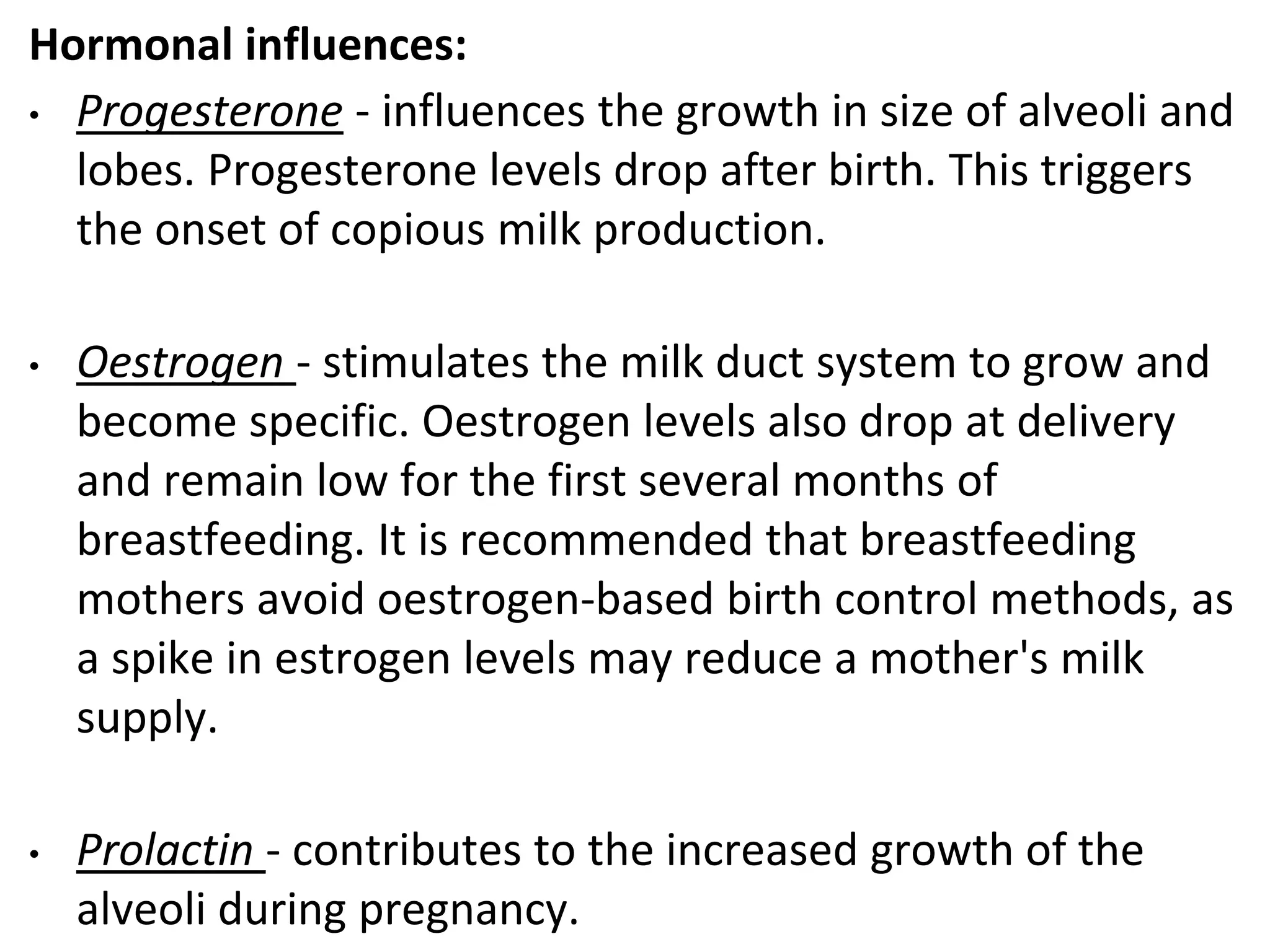
Hormonal influences:
• Progesterone - influences the growth in size of alveoli and
lobes. Progesterone levels drop after birth. This triggers
the onset of copious milk production.
• Oestrogen - stimulates the milk duct system to grow and
become specific. Oestrogen levels also drop at delivery
and remain low for the first several months of
breastfeeding. It is recommended that breastfeeding
mothers avoid oestrogen-based birth control methods, as
a spike in estrogen levels may reduce a mother's milk
supply.
• Prolactin - contributes to the increased growth of the
alveoli during pregnancy.
• Oxytocin - contracts the smooth muscle of the uterus
during and after birth, and during orgasm. After birth,
oxytocin contracts the smooth muscle layer of band-
like cells surrounding the alveoli to squeeze the
newly-produced milk into the duct system. Oxytocin is
necessary for the milk ejection reflex, or let-down to
occur.
• Human placental lactogen (HPL) - From the second
month of pregnancy, the placenta releases large
amounts of HPL. This hormone appears to be
instrumental in breast, nipple, and areola growth
before birth.
Galactokinesis & Galactopoiesis:
• Suckling reflex / Neuroendocrine reflex
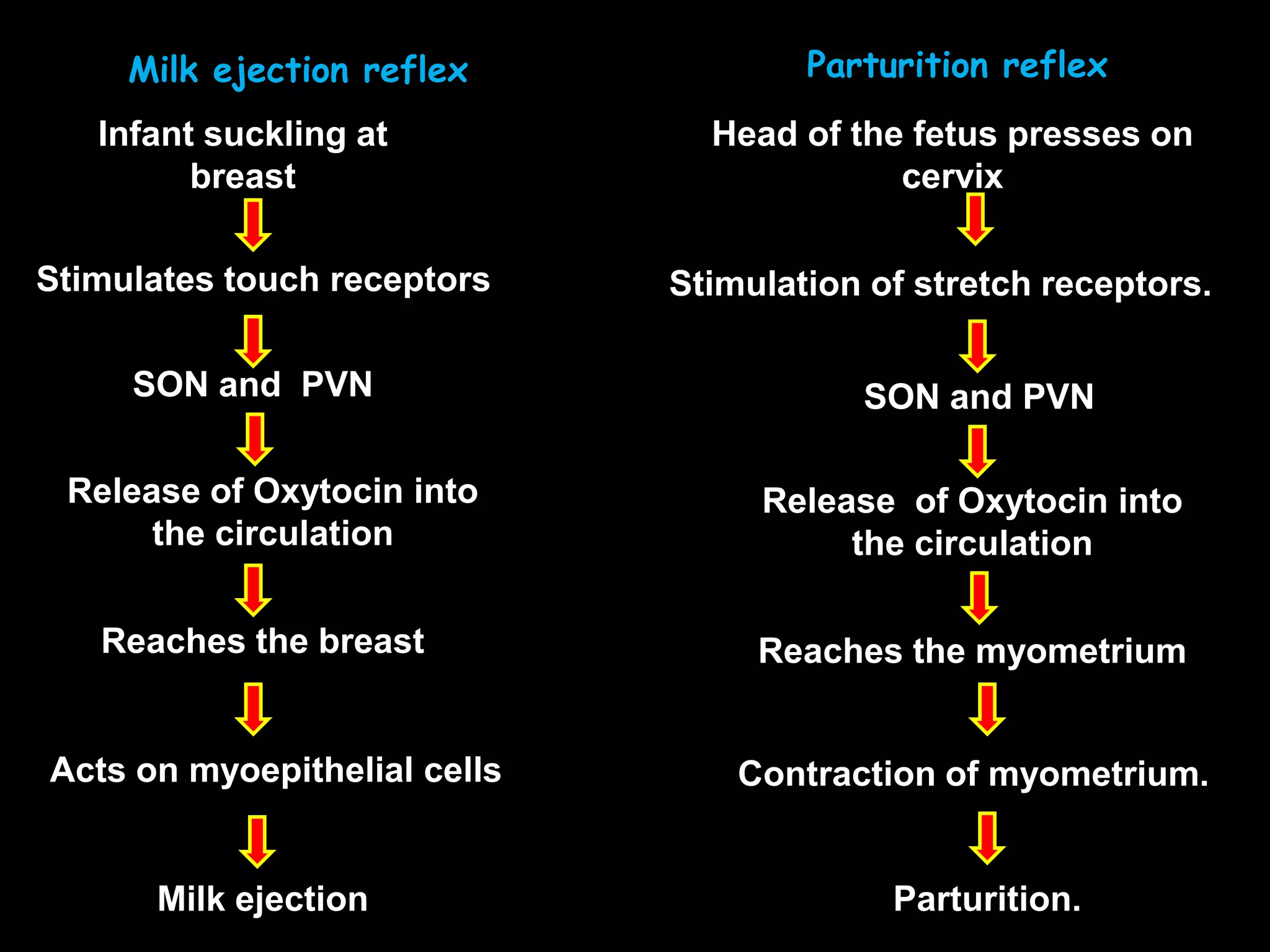
Milk ejection reflex
Infant suckling at
breast
Stimulates touch receptors
Head of the fetus presses on
cervix
Contraction of myometrium.
Reaches the myometrium
Release of Oxytocin into
the circulation
SON and PVN
Stimulation of stretch receptors.
Parturition reflex
SON and PVN
Release of Oxytocin into
the circulation
Reaches the breast
Acts on myoepithelial cells
Milk ejection Parturition.
Advantages of breastfeeding
To the baby
• Balanced diet
• Protection against
infections
• Easily digestible
• Growth factors
• Miscellaneous
advantages
To the mother
• Lactational amenorhoea
• Involution of uterus
• Protection against breast
cancer
• Emotional bonding
• Protection against obesity
Thank

Physiology of Parturition & Lactation

  • 2.
    Physiology of Parturitionand Lactation Dr. Nabeel Beeran MBBS, MD Department of Physiology 23/08/2019 2
  • 3.
    Specific Learning Objectives Atthe end of the class you should be able to: • Define and describe stages of labor • Understand the mechanism of parturition • Understand mechanism of lactogenesis and lactation 3
  • 4.
    Physiology of Parturition •Parturition means birth of the baby. • “Childbirth” or “Labour” or “”Labor”. • Towards the end of pregnancy, the uterus becomes progressively more excitable, until finally it develops strong rhythmic contractions so that the baby is expelled.
  • 5.
    Stages of labor Theprocess of parturition (labor) is divided into 4 stages. • First stage – Thinning (effacement) and opening (dilatation) of the cervix. • Second stage – Baby moves through the birth canal. • Third stage – Afterbirth. • Fourth stage – Recovery.
  • 6.
    – First stage: •Cervical dilatation and effacement • May last up to 24 hours. • Contractions begin at fundus downward; painless at first, 10-15 minute intervals. – Second stage: • Rupture of amniotic sac and delivery of baby. • May last from 1 to 30 minutes.
  • 7.
    - Third stage: •Delivery of placenta. • 15 - 45 minutes. • Shearing effect between wall of uterus and placenta. • Blood loss about 350 ml, - limited by constriction of blood vessels as uterus contracts. - prostaglandins at placental site cause vasospasm.
  • 8.
    Control of Parturition •Hormonal factors • Mechanical factors
  • 9.
    Hormonal factors 1. Activationof fetal hypothalamic-pituitary-adrenal axis. • The initial signals for the onset of labour comes from the fetus only and due to some unknown factors, CRH secretion in the fetus results in an increase in ACTH secretion few days before parturition. • ACTH causes fetal adrenal cortex to secrete large amount of androgens, which are converted to oestrogen in the placenta, DHEAS and cortisol. • This lead to an altered oestrogen-progesterone ratio.
  • 10.
    2. Role ofaltered oestrogen-progesterone ratio. • The altered oestrogen-progesterone ratio also causes:  An increase in release of oxytocin from maternal posterior pituitary.  An increase in number of oxytocin receptors in myometrium.  An increase in prostaglandin synthesis.  An increase in synthesis of myometrial contractile proteins. 3. Role of oxytocin and prostaglandins. • Prostaglandins enhance the force of oxytocin- induced uterine contractions.
  • 11.
    Mechanical factors 1. Stretchof the uterine musculature. • Usually increases their own contractility (myogenic theory). • Uterus when stretched by the fully developed fetus brings out powerful contractions. 2. Stretch or irritation of the cervix. • Initiates reflexes to the body of the uterus which may result in powerful uterine contractions. • Positive feedback effect. 3. Role of Ferguson reflex. • Once labour is started, the uterine contractions dilate the ripened cervix. • The cervical dilatation in turn sets of signals in afferent nerves that increase oxytocin secretion from the posterior pituitary.
  • 15.
    Control of breastdevelopment and growth • Estrogen • Progesterone • Other hormones – Growth hormone – Thyroxine – Cortisol, insulin • Placental hormones • Prolactin
  • 16.
    Prolactin • Structure andsecretion: Human prolactin is a single peptide chain, secreted by acidophilic cells of anterior pituitary gland. • Plasma concentration: At term 200-400 ng/ml • Source: During pregnancy- placenta, amniotic fluid and maternal anterior pituitary gland. • The prolactin secretion during pregnancy and during lactation is affected by oestrogen. • From 7-8th weeks gestation onwards, oestrogen secretion rises along with prolactin. This is due to oestrogen inhibition of hypothalamic prolactin inhibitory factor (PIF).
  • 17.
    • Physiological effects: –Breast growth – Lactogenic effect – Suppression of ovarian cycle- Lactational amenorrhoea
  • 18.
  • 19.
    Lactation • Lactation isthe process of milk output from mammary gland. • It is divided into 2 stages: 1. Milk secretion 2. Milk Ejection
  • 20.
    Content Human milk Water87% Lipids 5gm% Protein 2.5gm% Carbohydrates (Lactose) 6 gm% Sodium 15mg% Potassium 55- 60mg% Chloride 43 mg% Calcium 40mg % Vitamin A 5μg%
  • 21.
    Hormonal influences: • Progesterone- influences the growth in size of alveoli and lobes. Progesterone levels drop after birth. This triggers the onset of copious milk production. • Oestrogen - stimulates the milk duct system to grow and become specific. Oestrogen levels also drop at delivery and remain low for the first several months of breastfeeding. It is recommended that breastfeeding mothers avoid oestrogen-based birth control methods, as a spike in estrogen levels may reduce a mother's milk supply. • Prolactin - contributes to the increased growth of the alveoli during pregnancy.
  • 22.
    • Oxytocin -contracts the smooth muscle of the uterus during and after birth, and during orgasm. After birth, oxytocin contracts the smooth muscle layer of band- like cells surrounding the alveoli to squeeze the newly-produced milk into the duct system. Oxytocin is necessary for the milk ejection reflex, or let-down to occur. • Human placental lactogen (HPL) - From the second month of pregnancy, the placenta releases large amounts of HPL. This hormone appears to be instrumental in breast, nipple, and areola growth before birth.
  • 23.
    Galactokinesis & Galactopoiesis: •Suckling reflex / Neuroendocrine reflex
  • 24.
    Milk ejection reflex Infantsuckling at breast Stimulates touch receptors Head of the fetus presses on cervix Contraction of myometrium. Reaches the myometrium Release of Oxytocin into the circulation SON and PVN Stimulation of stretch receptors. Parturition reflex SON and PVN Release of Oxytocin into the circulation Reaches the breast Acts on myoepithelial cells Milk ejection Parturition.
  • 25.
    Advantages of breastfeeding Tothe baby • Balanced diet • Protection against infections • Easily digestible • Growth factors • Miscellaneous advantages To the mother • Lactational amenorhoea • Involution of uterus • Protection against breast cancer • Emotional bonding • Protection against obesity
  • 26.