PHYSIOLOGICAL CHANGES
DURING PREGNANCY
Dr.Fadi Alfaqawi
Medical Officer
UNRWA
11th DEC 2012
OBJECTIVES:
What! Where! Why!
Pregnancy causes physiologic
changes nearly in all maternal
organ systems,
Most return to normal after
delivery.
In general, the changes are more
dramatic in multifetal than in
single pregnancies.
Major adaptations in maternal
anatomy, physiology, and
metabolism are required for
successful pregnancy
To distinguish normal physiology
from pathological disease
states..
Hormonal Changes:
Hormonal changes:
Progesterone synthesized by the corpus luteum until 35 post-
conception days and by the placenta mainly thereafter, it
deceases smooth muscle excitability (uterus,gut,ureters) and
rise body temp.
Oestrogens (90%)oesteiol) increase breast and nipple
growth, water retention and protein synthesis.
TSH may be slightly low in the first trimester due to high hCG
levels. Increased total T4 is often seen. However, Free
hormone remain normal. The thyroid is functioning normally if
the TSH, Free T4 and Free T3 are all normal throughout
pregnancy.
Pituitary secretion of prolactin rises throughout pregnancy.
Maternal cortisol output is increased unbound level remain
constant.
Pancreas and Fuel
Metabolism
Diabetogenic effects of pregnancy anti-insulin (Cortisol
Prolactin Estrogen and Progesterone )
Maternal response to feeding:
-Hyperglycemia
-Hyperinsulinemia
-Hyperlipidemia
-Resistance to insulin
-Insulin resistance increases to 50-80% in third trimester
-Borderline pancreas function leads to GDM.
Fetal glucose levels are 20 mg/dl less than maternal
values.
Genital Changes:
Uterus:100g non-pregnant uterus weights
1100g by term. Muscle hyperplasia occurs up
to 20 weeks, with stretching after that .
Cervix: may develop ectropion .Late in
pregnancy cervical collagen reduces.
Vagina: discharge increases due to cervical
ectopy, cell desquamation increase production
on mucous from vasocongested vagina.
Haemodynamic changes:
BLOOD: From 10 weeks the plasma volume rises until
32 weeks (50% > non-pregnant).
Red cell volume rises increase by 18% if iron
supplementation not taken and by 30% if iron
supplementation is taken.
Hence Hb falls due to dilution (Physiological Anemia).
CV:{ COP= SVxHR } rises from 5 L/m to 6.5-7 L/m in the
first 10 week.
Peripheral resistance falls BP particularly diastolic falls
during the 1st and 2nd trimesters by 10-20 mmHg.
Venous distensiblity and raised venous
pressure,Varicose veins.
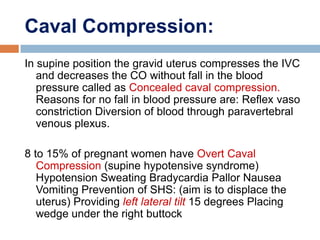
Caval Compression:
In supine position the gravid uterus compresses the IVC
and decreases the CO without fall in the blood
pressure called as Concealed caval compression.
Reasons for no fall in blood pressure are: Reflex vaso
constriction Diversion of blood through paravertebral
venous plexus.
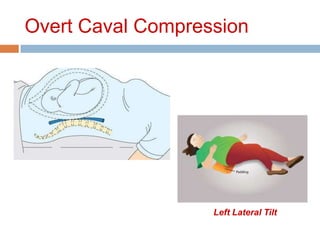
8 to 15% of pregnant women have Overt Caval
Compression (supine hypotensive syndrome)
Hypotension Sweating Bradycardia Pallor Nausea
Vomiting Prevention of SHS: (aim is to displace the
uterus) Providing left lateral tilt 15 degrees Placing
wedge under the right buttock
Overt Caval Compression
Left Lateral Tilt
Respiratory system Changes:
Tidal volume: + 40% (rises from 500mL to
700mL)
Breathing rate: + 10%
Oxygen consumption: + 20%
Breathlessness is common as maternal PaCO2 is
set lower to allow the fetus to offload CO2.
Others:
 Gut motility is reduced, resulting in constipation,
delayed gastric emptying, and with a lax cardiac
sphincter, heartburn .
 Renal size increases by 1 cm in length.
 Frequency of micturation emerges early (GFR
increases by 60%) . Later from bladder pressure
by the fetal head .
 Skin pigmentation : linea nigra, nipples, or as
chloasma, palmar erythema , striae are common.
 Hair shedding from the head is reduced in
pregnancy but increases in the puerperium .
Weight:
On a Trimester Basis:
 First trimester: Most women put on around 1.6kg
in the first three months.
 Second trimester: around 0.5kg a week for the
next three months (5.5 - 6.4kg) in total.
 Third trimester: and only around 5kg over the
last three months.
But remember, these are average figures for large numbers of
women so just because your weight gain pattern is different, it
doesn't mean anything is wrong.
Weight.. Where do the pregnancy Kilos
go?
Where do the pregnancy Kilos go?
Maternal stores of nutrients
and muscle development
3 Kg
Increased body fluid 2 Kg
Increased blood 1.5 - 2 Kg
Breast growth 600g
Enlarged uterus 1 Kg
Amniotic fluid 1 Kg
Placenta 600g
Baby 3.4 - 4 Kg
Total 11 - 16 Kg
Physiological Changes During Pregnancy

Physiological Changes During Pregnancy

  • 1.
    PHYSIOLOGICAL CHANGES DURING PREGNANCY Dr.FadiAlfaqawi Medical Officer UNRWA 11th DEC 2012
  • 2.
    OBJECTIVES: What! Where! Why! Pregnancycauses physiologic changes nearly in all maternal organ systems, Most return to normal after delivery. In general, the changes are more dramatic in multifetal than in single pregnancies. Major adaptations in maternal anatomy, physiology, and metabolism are required for successful pregnancy To distinguish normal physiology from pathological disease states..
  • 3.
  • 4.
    Hormonal changes: Progesterone synthesizedby the corpus luteum until 35 post- conception days and by the placenta mainly thereafter, it deceases smooth muscle excitability (uterus,gut,ureters) and rise body temp. Oestrogens (90%)oesteiol) increase breast and nipple growth, water retention and protein synthesis. TSH may be slightly low in the first trimester due to high hCG levels. Increased total T4 is often seen. However, Free hormone remain normal. The thyroid is functioning normally if the TSH, Free T4 and Free T3 are all normal throughout pregnancy. Pituitary secretion of prolactin rises throughout pregnancy. Maternal cortisol output is increased unbound level remain constant.
  • 5.
    Pancreas and Fuel Metabolism Diabetogeniceffects of pregnancy anti-insulin (Cortisol Prolactin Estrogen and Progesterone ) Maternal response to feeding: -Hyperglycemia -Hyperinsulinemia -Hyperlipidemia -Resistance to insulin -Insulin resistance increases to 50-80% in third trimester -Borderline pancreas function leads to GDM. Fetal glucose levels are 20 mg/dl less than maternal values.
  • 6.
    Genital Changes: Uterus:100g non-pregnantuterus weights 1100g by term. Muscle hyperplasia occurs up to 20 weeks, with stretching after that . Cervix: may develop ectropion .Late in pregnancy cervical collagen reduces. Vagina: discharge increases due to cervical ectopy, cell desquamation increase production on mucous from vasocongested vagina.
  • 7.
  • 8.
    Haemodynamic changes: BLOOD: From10 weeks the plasma volume rises until 32 weeks (50% > non-pregnant). Red cell volume rises increase by 18% if iron supplementation not taken and by 30% if iron supplementation is taken. Hence Hb falls due to dilution (Physiological Anemia). CV:{ COP= SVxHR } rises from 5 L/m to 6.5-7 L/m in the first 10 week. Peripheral resistance falls BP particularly diastolic falls during the 1st and 2nd trimesters by 10-20 mmHg. Venous distensiblity and raised venous pressure,Varicose veins.
  • 9.
    Caval Compression: In supineposition the gravid uterus compresses the IVC and decreases the CO without fall in the blood pressure called as Concealed caval compression. Reasons for no fall in blood pressure are: Reflex vaso constriction Diversion of blood through paravertebral venous plexus. 8 to 15% of pregnant women have Overt Caval Compression (supine hypotensive syndrome) Hypotension Sweating Bradycardia Pallor Nausea Vomiting Prevention of SHS: (aim is to displace the uterus) Providing left lateral tilt 15 degrees Placing wedge under the right buttock
  • 10.
  • 11.
    Respiratory system Changes: Tidalvolume: + 40% (rises from 500mL to 700mL) Breathing rate: + 10% Oxygen consumption: + 20% Breathlessness is common as maternal PaCO2 is set lower to allow the fetus to offload CO2.
  • 12.
    Others:  Gut motilityis reduced, resulting in constipation, delayed gastric emptying, and with a lax cardiac sphincter, heartburn .  Renal size increases by 1 cm in length.  Frequency of micturation emerges early (GFR increases by 60%) . Later from bladder pressure by the fetal head .  Skin pigmentation : linea nigra, nipples, or as chloasma, palmar erythema , striae are common.  Hair shedding from the head is reduced in pregnancy but increases in the puerperium .
  • 14.
    Weight: On a TrimesterBasis:  First trimester: Most women put on around 1.6kg in the first three months.  Second trimester: around 0.5kg a week for the next three months (5.5 - 6.4kg) in total.  Third trimester: and only around 5kg over the last three months. But remember, these are average figures for large numbers of women so just because your weight gain pattern is different, it doesn't mean anything is wrong.
  • 15.
    Weight.. Where dothe pregnancy Kilos go? Where do the pregnancy Kilos go? Maternal stores of nutrients and muscle development 3 Kg Increased body fluid 2 Kg Increased blood 1.5 - 2 Kg Breast growth 600g Enlarged uterus 1 Kg Amniotic fluid 1 Kg Placenta 600g Baby 3.4 - 4 Kg Total 11 - 16 Kg