Ethics & ethical issues in
Psychiatry
History of medical ethics
Hippocratic Oath- Classic Version
I swear by Apollo, the Physician and Aesculepius and Hygeia and Panacea and all the gods and
goddesses, making them my witnesses, that I will fulfill according to my ability and judgment this oath
and this covenant:
To hold him who has taught me this art as equal to my parents and to live my life in partnership with
him, and if he is in need of money to give him a share of mine, and to regard his offspring as equal to
my brothers in male lineage and to teach them this art - if they desire to learn it - without fee and
covenant; to give a share of precepts and oral instruction and all the other learning to my sons and to
the sons of him who has instructed me and to pupils who have signed the covenant and have taken an
oath according to the medical law, but no one else.
I will apply dietetic measures for the benefit of the sick according to my ability and judgment; I will keep
them from harm and injustice.
I will neither give a deadly drug to anybody who asked for it, nor will I make a suggestion to this effect.
Similarly I will not give to a woman an abortive remedy. In purity and holiness I will guard my life and
my art.
I will not use the knife, not even on sufferers from stone, but will withdraw in favor of such men as are
engaged in this work.
Whatever houses I may visit, I will come for the benefit of the sick, remaining free of all intentional
injustice, of all mischief and in particular of sexual relations with both female and male persons, be
they free or slaves.
What I may see or hear in the course of the treatment or even outside of the treatment in regard to the
life of men, which on no account one must spread abroad, I will keep to myself, holding such things
shameful to be spoken about.
What are medical ethics?
 Medical ethics is a system of moral
principles that apply values and
judgments to the practice of medicine.
What are the objectives of
learning?
 Discuss essential components of traditional &
modern principles of medical ethics
 Abide by the principles in common clinical
situations/dilemmas
 Communication of the rights & responsibilities of
patients
 Choose correct doctor-patient relationship &
actions according to situational demands in clinic
 Adopt the standard of professionalism.
Branches of Ethics
 Normative Ethics: Concerned with the established
norms of conduct, that provide theoretical
framework & principles to deal with a practical
problem.
 Descriptive Ethics: Concerned with the study &
compilation of data on the moral behavior &
beliefs expected by society regarding behavior of
doctors, dilemmas & medical issues.
Principles of Ethics
•Autonomy
•Non-maleficence
•Beneficence
•Justice/Equity
There are four basic principles of medical
ethics. The principles address the issue of
fairness, honesty, and respect for fellow human
beings.
Autonomy:
 People have the right to control
what happens to their bodies.
This principle simply means that
an informed, competent adult
patient can refuse or accept
treatments, drugs, and surgeries
according to their wishes.
 These decisions must be
respected by everyone, even if
those decisions aren’t in the best
interest of the patient.
Nonmaleficence:
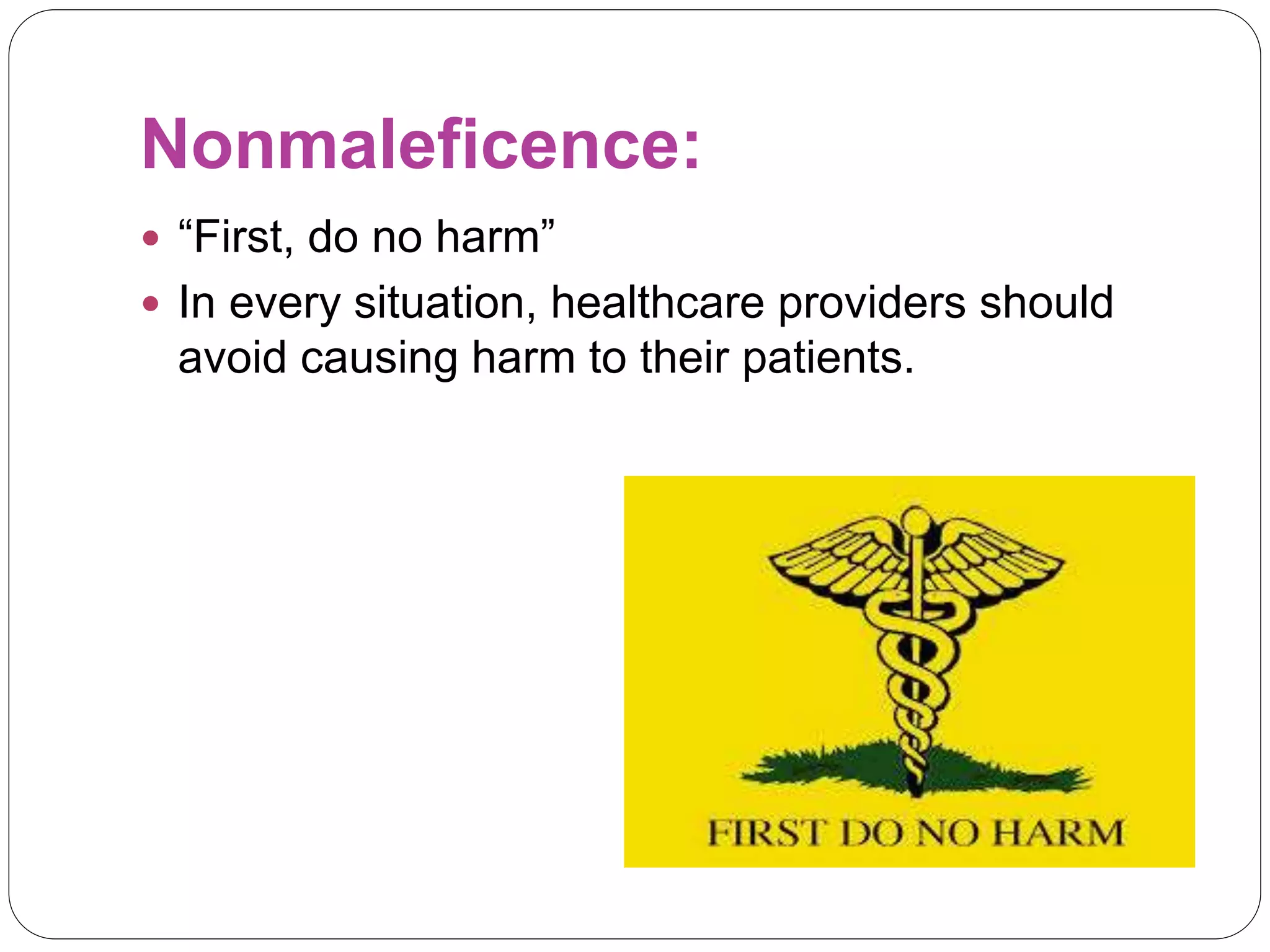
 “First, do no harm”
 In every situation, healthcare providers should
avoid causing harm to their patients.
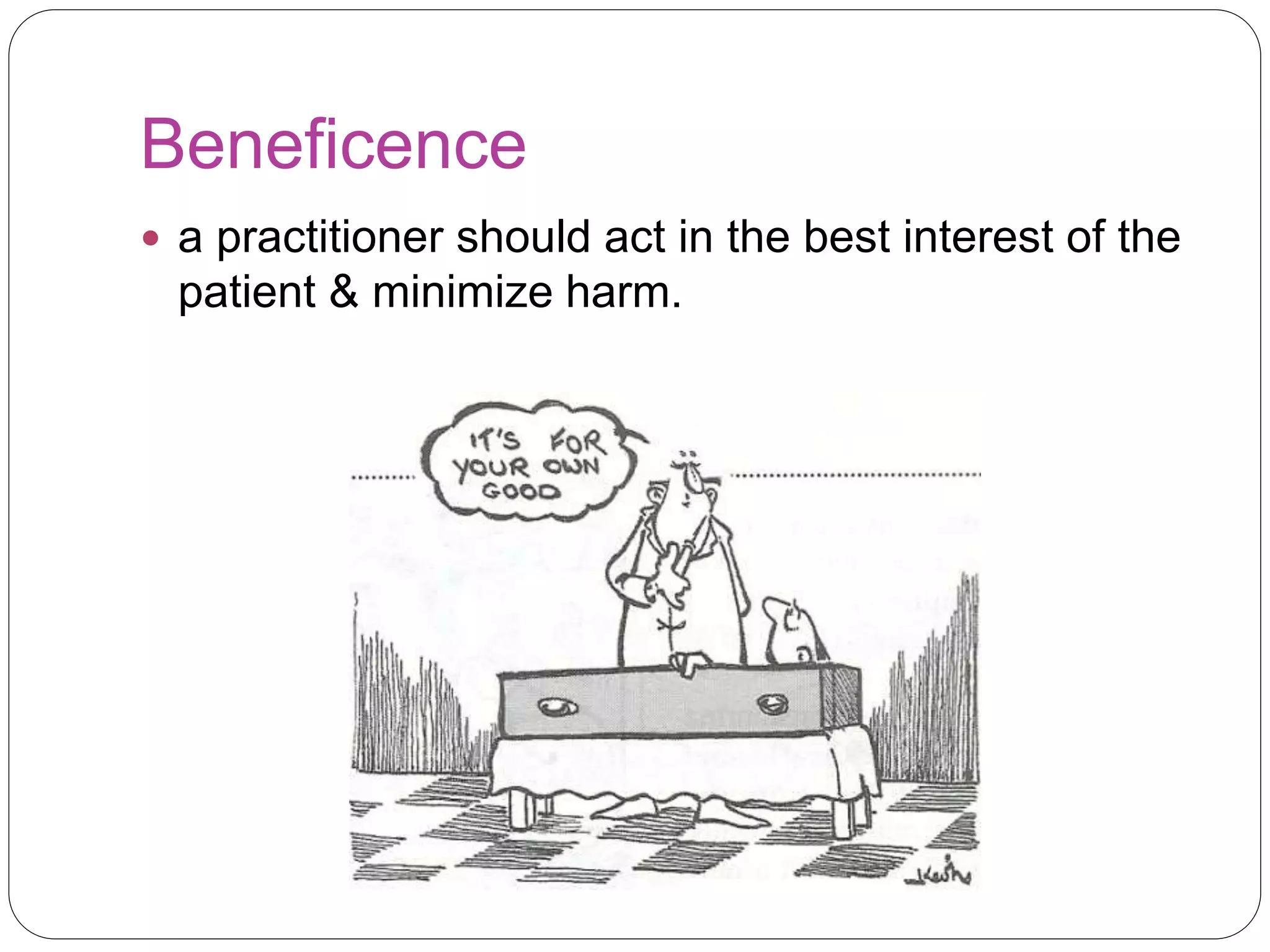
Beneficence
 a practitioner should act in the best interest of the
patient & minimize harm.
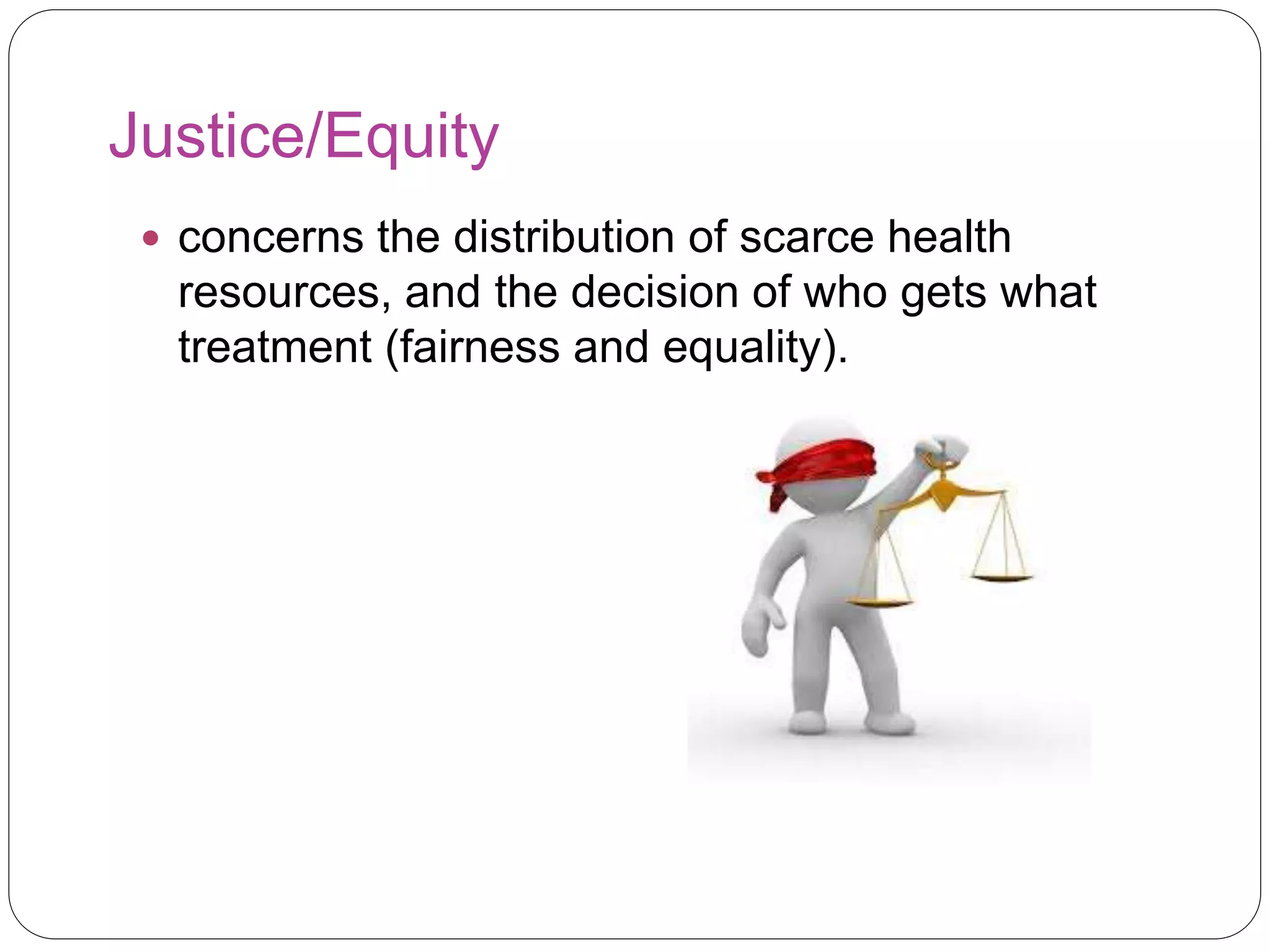
Justice/Equity
 concerns the distribution of scarce health
resources, and the decision of who gets what
treatment (fairness and equality).
Ethical Issues: Informed Consent
 Informed Consent: refers to the idea that a person
must be fully informed about and understand the potential
benefits and risks of their choice of treatment.
Properties of informed consent
 Taken in advance, Free-will (no coercion/threat), Must be
given the options, Should be completely informed about
the treatment/procedures/success rates/side-effects.
 If the patient is incapacitated, laws around the world
designate different processes for obtaining informed
consent, typically by having a person appointed by the
patient or their next of kin make decisions for them.
 Exception: Medical emergencies when patient is
unconscious & alone. Or children under the age of 16.
Ethical Issues:
 Confidentiality is commonly applied to conversations
between doctors and patients protected by Law. It is an
important issue in primary care ethics, where physicians care for
many patients from the same family and community, and where
third parties often request information from the considerable
medical database typically gathered in primary health care.
Breaching of confidentiality exceptions:
 When patient authorizes to do so (e.g. employment)
 Information shared between a health care team (e.g. HIV
precautions)
 Disclosure in favor of patient (e.g. harassment)
 Disclosure in favor of public interest (e.g. STI, unfit to drive)
 Research purpose but in form of data
 Legislative requirements (Law on Public Health & Control of
Ethical Dilemmas
 Accepting gifts from patients
 Sexual boundaries violation
 Charges & Fee: Colleagues, teachers, medical
students
 E-consultations
 Relationship with media
 Relationship with Pharmaceuticals
Patient’s rights & responsibilities
 To be treated with respect & care.
 Informed consent of treatment, procedure, risks, side-effects,
costs, alternate treatments & details of support care. (Can
withdraw consent & refuse research treatment at any time)
 Obtain second opinion
 Have complete information about their issues & can request for
personal files.
 They can obtain legal advice regarding any matter arising from
treatment.
 Contact their loved ones or inform nursing staff to restrict
someone’s visits/calls.
 Leave the hospital at any time (except when at high risk of
injury).
 Responsible for keeping appointments, compliance to treatment,
inform doctor of second opinion, conduct themselves in a
manner not disruptive to the well-being or rights of other patients
or staff.
Doctor-Patient Relationship
 A unique relationship between doctor-patient
based on trust the patient poises in his doctor &
the unconditional positive regard that a doctor
holds for his patient in return. The relationship
can take 3 forms:
 Vertical Model: Doctor in complete control
without role of the patient
(unconscious/immobilized/incapaciatated)
 Teacher-Student: Doctor plays role similar to
authority (teacher/ parent) who dominates, guides
& controls.
 Horizontal Model: There is mutual participation
where they behave as partners in healing & care.
Issues in doctor-patient relationship
 The relationship should be based on empathy &
not friendship, love or affection. These can lead to
possible complications:
 Doctor assuming role of savior wanting to rescue
patient.
 Doctor’s inability to shut-off patient’s problems in
personal life.
 A need to control everything & prevent death.
 Doctor becomes judgmental & passes value
judgments.
 Doctor visualizes his own troubles in his patients
& avoids discussion or gets overly involved when
unnecessary.
Issues –Psychological reactions
The 3 important issues in doctor-patient
relationship are:
 Transference
 Counter-transference
 Resistance
Psychological issues
Transference is the redirection of feelings and
desires and especially of those unconsciously
retained from childhood toward a new object.”
There can be positive or negative transference &
needs to be addressed instead of finding it
threatening. It is only inappropriate when patterns of
transference lead to maladaptive thoughts, feelings or behaviors.
as important in a person's childhood.
 This allows the client to experience feelings that would
otherwise be inaccessible
 ANALYSIS OF TRANSFERENCE — allows the client to
achieve insight into the influence of the past
Psychological issues
 Counter-transference is defined as redirection
of a psychotherapist's feelings toward a client—
or, more generally, as a therapist's emotional
entanglement with a client.
Psychological issues
 Resistance is the phenomenon often
encountered in clinical practice in which patients
either directly or indirectly oppose changing their
behavior or refuse to discuss, remember, or think
about presumably clinically relevant experiences.
 Analysis of Resistance
 Helps the client to see that cancelling appointments,
fleeing from therapy prematurely, etc., are ways of
defending against anxiety
 These acts interfere with the ability to
accept changes which could lead to a
more satisfying life
Professionalism in healthcare
A healthy doctor-patient relationship is dependent
upon the standard of professionalism &
excellence of the doctor.
 Knowledge
 Skills- written/verbal communication
 Patient management skills
 Skills in Research
 Attitudes:
 Towards patients
 Towards Self-development
 Towards Society
Professionalism
 Professional attire/manner
 Respect for time & punctuality
 Grasp knowledge about patients under care
 Conscientiousness
 Integrity in reporting patient’s finding
 Availability to the patients
 Relationships with colleagues, hospital staff &
patients.
Ethics & ethical issues in psychiatry

Ethics & ethical issues in psychiatry

  • 1.
    Ethics & ethicalissues in Psychiatry
  • 2.
    History of medicalethics Hippocratic Oath- Classic Version I swear by Apollo, the Physician and Aesculepius and Hygeia and Panacea and all the gods and goddesses, making them my witnesses, that I will fulfill according to my ability and judgment this oath and this covenant: To hold him who has taught me this art as equal to my parents and to live my life in partnership with him, and if he is in need of money to give him a share of mine, and to regard his offspring as equal to my brothers in male lineage and to teach them this art - if they desire to learn it - without fee and covenant; to give a share of precepts and oral instruction and all the other learning to my sons and to the sons of him who has instructed me and to pupils who have signed the covenant and have taken an oath according to the medical law, but no one else. I will apply dietetic measures for the benefit of the sick according to my ability and judgment; I will keep them from harm and injustice. I will neither give a deadly drug to anybody who asked for it, nor will I make a suggestion to this effect. Similarly I will not give to a woman an abortive remedy. In purity and holiness I will guard my life and my art. I will not use the knife, not even on sufferers from stone, but will withdraw in favor of such men as are engaged in this work. Whatever houses I may visit, I will come for the benefit of the sick, remaining free of all intentional injustice, of all mischief and in particular of sexual relations with both female and male persons, be they free or slaves. What I may see or hear in the course of the treatment or even outside of the treatment in regard to the life of men, which on no account one must spread abroad, I will keep to myself, holding such things shameful to be spoken about.
  • 3.
    What are medicalethics?  Medical ethics is a system of moral principles that apply values and judgments to the practice of medicine.
  • 4.
    What are theobjectives of learning?  Discuss essential components of traditional & modern principles of medical ethics  Abide by the principles in common clinical situations/dilemmas  Communication of the rights & responsibilities of patients  Choose correct doctor-patient relationship & actions according to situational demands in clinic  Adopt the standard of professionalism.
  • 5.
    Branches of Ethics Normative Ethics: Concerned with the established norms of conduct, that provide theoretical framework & principles to deal with a practical problem.  Descriptive Ethics: Concerned with the study & compilation of data on the moral behavior & beliefs expected by society regarding behavior of doctors, dilemmas & medical issues.
  • 6.
    Principles of Ethics •Autonomy •Non-maleficence •Beneficence •Justice/Equity Thereare four basic principles of medical ethics. The principles address the issue of fairness, honesty, and respect for fellow human beings.
  • 7.
    Autonomy:  People havethe right to control what happens to their bodies. This principle simply means that an informed, competent adult patient can refuse or accept treatments, drugs, and surgeries according to their wishes.  These decisions must be respected by everyone, even if those decisions aren’t in the best interest of the patient.
  • 8.
    Nonmaleficence:  “First, dono harm”  In every situation, healthcare providers should avoid causing harm to their patients.
  • 9.
    Beneficence  a practitionershould act in the best interest of the patient & minimize harm.
  • 10.
    Justice/Equity  concerns thedistribution of scarce health resources, and the decision of who gets what treatment (fairness and equality).
  • 11.
    Ethical Issues: InformedConsent  Informed Consent: refers to the idea that a person must be fully informed about and understand the potential benefits and risks of their choice of treatment. Properties of informed consent  Taken in advance, Free-will (no coercion/threat), Must be given the options, Should be completely informed about the treatment/procedures/success rates/side-effects.  If the patient is incapacitated, laws around the world designate different processes for obtaining informed consent, typically by having a person appointed by the patient or their next of kin make decisions for them.  Exception: Medical emergencies when patient is unconscious & alone. Or children under the age of 16.
  • 12.
    Ethical Issues:  Confidentialityis commonly applied to conversations between doctors and patients protected by Law. It is an important issue in primary care ethics, where physicians care for many patients from the same family and community, and where third parties often request information from the considerable medical database typically gathered in primary health care. Breaching of confidentiality exceptions:  When patient authorizes to do so (e.g. employment)  Information shared between a health care team (e.g. HIV precautions)  Disclosure in favor of patient (e.g. harassment)  Disclosure in favor of public interest (e.g. STI, unfit to drive)  Research purpose but in form of data  Legislative requirements (Law on Public Health & Control of
  • 13.
    Ethical Dilemmas  Acceptinggifts from patients  Sexual boundaries violation  Charges & Fee: Colleagues, teachers, medical students  E-consultations  Relationship with media  Relationship with Pharmaceuticals
  • 14.
    Patient’s rights &responsibilities  To be treated with respect & care.  Informed consent of treatment, procedure, risks, side-effects, costs, alternate treatments & details of support care. (Can withdraw consent & refuse research treatment at any time)  Obtain second opinion  Have complete information about their issues & can request for personal files.  They can obtain legal advice regarding any matter arising from treatment.  Contact their loved ones or inform nursing staff to restrict someone’s visits/calls.  Leave the hospital at any time (except when at high risk of injury).  Responsible for keeping appointments, compliance to treatment, inform doctor of second opinion, conduct themselves in a manner not disruptive to the well-being or rights of other patients or staff.
  • 15.
    Doctor-Patient Relationship  Aunique relationship between doctor-patient based on trust the patient poises in his doctor & the unconditional positive regard that a doctor holds for his patient in return. The relationship can take 3 forms:  Vertical Model: Doctor in complete control without role of the patient (unconscious/immobilized/incapaciatated)  Teacher-Student: Doctor plays role similar to authority (teacher/ parent) who dominates, guides & controls.  Horizontal Model: There is mutual participation where they behave as partners in healing & care.
  • 16.
    Issues in doctor-patientrelationship  The relationship should be based on empathy & not friendship, love or affection. These can lead to possible complications:  Doctor assuming role of savior wanting to rescue patient.  Doctor’s inability to shut-off patient’s problems in personal life.  A need to control everything & prevent death.  Doctor becomes judgmental & passes value judgments.  Doctor visualizes his own troubles in his patients & avoids discussion or gets overly involved when unnecessary.
  • 17.
    Issues –Psychological reactions The3 important issues in doctor-patient relationship are:  Transference  Counter-transference  Resistance
  • 18.
    Psychological issues Transference isthe redirection of feelings and desires and especially of those unconsciously retained from childhood toward a new object.” There can be positive or negative transference & needs to be addressed instead of finding it threatening. It is only inappropriate when patterns of transference lead to maladaptive thoughts, feelings or behaviors. as important in a person's childhood.  This allows the client to experience feelings that would otherwise be inaccessible  ANALYSIS OF TRANSFERENCE — allows the client to achieve insight into the influence of the past
  • 19.
    Psychological issues  Counter-transferenceis defined as redirection of a psychotherapist's feelings toward a client— or, more generally, as a therapist's emotional entanglement with a client.
  • 20.
    Psychological issues  Resistanceis the phenomenon often encountered in clinical practice in which patients either directly or indirectly oppose changing their behavior or refuse to discuss, remember, or think about presumably clinically relevant experiences.  Analysis of Resistance  Helps the client to see that cancelling appointments, fleeing from therapy prematurely, etc., are ways of defending against anxiety  These acts interfere with the ability to accept changes which could lead to a more satisfying life
  • 21.
    Professionalism in healthcare Ahealthy doctor-patient relationship is dependent upon the standard of professionalism & excellence of the doctor.  Knowledge  Skills- written/verbal communication  Patient management skills  Skills in Research  Attitudes:  Towards patients  Towards Self-development  Towards Society
  • 22.
    Professionalism  Professional attire/manner Respect for time & punctuality  Grasp knowledge about patients under care  Conscientiousness  Integrity in reporting patient’s finding  Availability to the patients  Relationships with colleagues, hospital staff & patients.