Major
Depressive
Disorder
Kriti Lodh
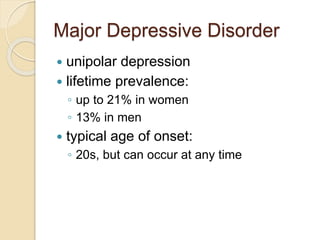
Major Depressive Disorder
 unipolar depression
 lifetime prevalence:
◩ up to 21% in women
◩ 13% in men
 typical age of onset:
◩ 20s, but can occur at any time
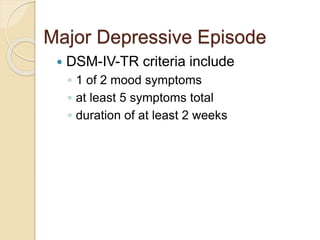
Major Depressive Episode
 DSM-IV-TR criteria include
◩ 1 of 2 mood symptoms
◩ at least 5 symptoms total
◩ duration of at least 2 weeks
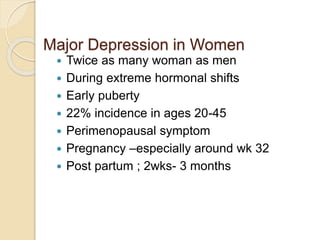
Major Depression in Women
 Twice as many woman as men
 During extreme hormonal shifts
 Early puberty
 22% incidence in ages 20-45
 Perimenopausal symptom
 Pregnancy –especially around wk 32
 Post partum ; 2wks- 3 months
Major Depression in Men
 Commonly occurs with attempts to self-
medicate with alcohol, drugs, food,
gambling or sex;
 Men often do not experience these
behaviors as signs of depression and have
more reluctance to ask for professional
help.
 Depression may be precipitated by loss of
ability to function in an impt or especially
valued area of life.
Depression & Life Changes
 Even happy & eagerly anticipated events
(birth of a baby, retirement, new job, etc.)
can precipitate a mild depression;
 The chronicity of other stressors can have a
profound impact on a at-risk individual
(caring for an aging parent, aftermath of
divorce, job lay-off, problematic family
issues)
Mood Symptoms of
Depression
 persistent sad, depressed mood
 loss of interest or pleasure in
previously enjoyable activities
 DSM-IV criteria specify that person
must have 1 of above plus 4 additional
sx for at least 2 weeks
Physical Symptoms of
Depression
 Sleep disturbance
◩ too much or too little
 loss of energy, fatigue
 appetite disturbance/weight change
◩ loss of appetite or increase in appetite
 changes in activity level
◩ psychomotor retardation or agitation
Cognitive Symptoms of
Depression
 difficulty concentrating, thinking, and
making decisions
 feelings of worthlessness, guilt, or
hopelessness
 recurrent thoughts of death or suicide
Course of Depression
 if untreated, average duration of first
episode is 6-9 months
 often recur
Major depressive disorder

Major depressive disorder

  • 1.
  • 2.
    Major Depressive Disorder unipolar depression  lifetime prevalence: ◩ up to 21% in women ◩ 13% in men  typical age of onset: ◩ 20s, but can occur at any time
  • 3.
    Major Depressive Episode DSM-IV-TR criteria include ◩ 1 of 2 mood symptoms ◩ at least 5 symptoms total ◩ duration of at least 2 weeks
  • 4.
    Major Depression inWomen  Twice as many woman as men  During extreme hormonal shifts  Early puberty  22% incidence in ages 20-45  Perimenopausal symptom  Pregnancy –especially around wk 32  Post partum ; 2wks- 3 months
  • 5.
    Major Depression inMen  Commonly occurs with attempts to self- medicate with alcohol, drugs, food, gambling or sex;  Men often do not experience these behaviors as signs of depression and have more reluctance to ask for professional help.  Depression may be precipitated by loss of ability to function in an impt or especially valued area of life.
  • 6.
    Depression & LifeChanges  Even happy & eagerly anticipated events (birth of a baby, retirement, new job, etc.) can precipitate a mild depression;  The chronicity of other stressors can have a profound impact on a at-risk individual (caring for an aging parent, aftermath of divorce, job lay-off, problematic family issues)
  • 7.
    Mood Symptoms of Depression persistent sad, depressed mood  loss of interest or pleasure in previously enjoyable activities  DSM-IV criteria specify that person must have 1 of above plus 4 additional sx for at least 2 weeks
  • 8.
    Physical Symptoms of Depression Sleep disturbance ◩ too much or too little  loss of energy, fatigue  appetite disturbance/weight change ◩ loss of appetite or increase in appetite  changes in activity level ◩ psychomotor retardation or agitation
  • 9.
    Cognitive Symptoms of Depression difficulty concentrating, thinking, and making decisions  feelings of worthlessness, guilt, or hopelessness  recurrent thoughts of death or suicide
  • 10.
    Course of Depression if untreated, average duration of first episode is 6-9 months  often recur