Why is sleep important?
Sleep is Essential to Our Overall
Health and Well-Being
0 Key to our health, performance, safety
and quality of life.
0 Essential to our ability to perform both
cognitive and physical tasks, engage fully in life and
function in an effective, safe and productive way.
Normal Sleep
NREM
75 to 80%
4 stages
Decrease in
HR/BP/Muscle tone
Awake
REM
20-25%
Dreaming
0 Humans sleep more than
25 years of their life.
0 Average requirement of
sleep varies with age:
0 Infants: 16-20 hrs
0 Adolescents: 7-9 hrs
0 Adults: 6-8 hrs
Awake
Stages
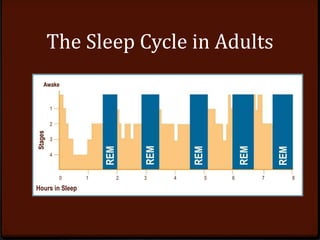
The Sleep Cycle in Adults
REM
REM
REM
REM
REM
1
2
3
4
0 1 2 3 4 5 6 7 8
Hours in Sleep
Normal Sleep and Normal Aging:
Less Deep Sleep
Normal Sleep and Normal Aging:
Sleep Efficiency
Men
Women Age
SleepEfficiency
(%TimeinBedSleeping)
Changes with age
Factors affecting Sleep
0 Regulated by internal and external
factors-
0 Internal- Emotions, homeostasis
(hunger/temp), hormones,
Neurotransmitters.
0 External- Temperature, Noise, Stress
etc.
0 Sleep Need is built up during the day.
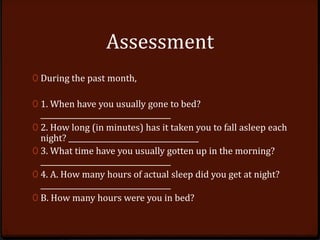
Assessment
0 During the past month,
0 1. When have you usually gone to bed?
____________________________________
0 2. How long (in minutes) has it taken you to fall asleep each
night? ____________________________________
0 3. What time have you usually gotten up in the morning?
____________________________________
0 4. A. How many hours of actual sleep did you get at night?
____________________________________
0 B. How many hours were you in bed?
Assessment
Scoring
0 Component 1 #9 Score C1
___________
0 Component 2 #2 Score (<15min
(0), 16-30min (1), 31-60 min (2),
>60min (3))
0 + #5a Score (if sum is equal 0=0;
1-2=1; 3-4=2; 5-6=3) C2
___________
0 Component 3 #4 Score (>7(0),
6-7 (1), 5-6 (2), <5 (3) C3
___________
0 Component 4 (total # of hours
asleep) / (total # of hours in
bed) x 100
>85%=0, 75%-84%=!, 65%-
74%=2, <65%=3 C4 ___________
0 Component 5 # sum of scores
5b to 5j (0=0; 1-9=1; 10-18=2;
19-27=3) C5 ___________
0 Component 6 #6 Score C6
___________
0 Component 7 #7 Score + #8
score (0=0; 1-2=1; 3-4=2; 5-6=3)
C7 ___________
A total score of “5” or greater is indicative of poor sleep quality. It is
suggested that you discuss your sleep habits with a healthcare provider
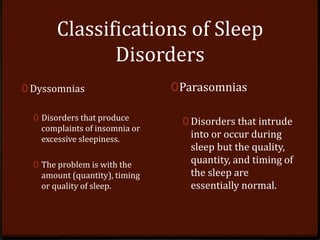
Classifications of Sleep
Disorders
0 Dyssomnias
0 Disorders that produce
complaints of insomnia or
excessive sleepiness.
0 The problem is with the
amount (quantity), timing
or quality of sleep.
0Parasomnias
0 Disorders that intrude
into or occur during
sleep but the quality,
quantity, and timing of
the sleep are
essentially normal.
Types of Sleep disorders
Insomnia - too little sleep
Characteristics
0Difficulty initiating or
maintaining sleep
0Persists for 1 month
or longer
Effects of insomnia
0 Reduced productivity,
0 Increased absenteeism,
0 Accidents,
0 Hospitalization & increased medical costs.
0 Depression
0 Increased alcohol consumption
0 Weight gain
0 Forgetfulness- Poor concentration
0 Hormonal Imbalance
0 Aging of skin
0 Headaches
Circadian Rhythm Disorders
0Definition:
0Malfunctioning of the
biological clock within the
conventional environment
Types of sleep disorders
0 Primary Hypersomnia:
Sleeping too much, as well as
being drowsy at times when
patient should be alert.
Characteristics
0Excessive sleepiness
0Persists for 1 month or
longer.
Narcolepsy
Narcolepsy
Narcolepsy (Sleeping at the wrong time)
0 Sleep intrudes into wakefulness, causing clients to fall
asleep almost instantly
0 Sleep is brief but refreshing
0 May also have sleep paralysis, sudden loss of strength,
and hallucinations as fall asleep or awaken.
Parasomnias
0 The parasomnias are undesirable physical or
experiential events that accompany sleep.
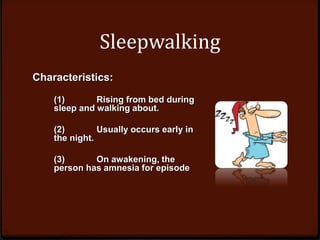
Sleepwalking
Characteristics:
(1) Rising from bed during
sleep and walking about.
(2) Usually occurs early in
the night.
(3) On awakening, the
person has amnesia for episode
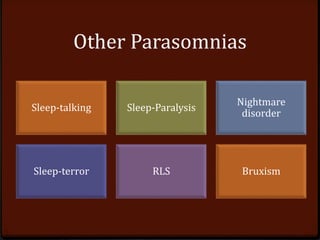
Other Parasomnias
Sleep-talking Sleep-Paralysis
Nightmare
disorder
Sleep-terror RLS Bruxism
Sleep disorders (secondary)
• General
medical
conditions
DM/Asthma/Heart
disease
• Substance
induced sleep
disorders
Alcohol,
Benzodiazepines,
Cannabis.
• Sleep disorders
due to
developmental
disorders.
MR, Autism.
Treatment of sleep disorders
0 Address the specific cause (e.g.
physical cause)
0 Treat the Medical or psychiatric
conditions.
0 Non-Pharmacological:
 Life style modification- Behavioral
treatments
 Sleep Hygiene
 Cognitive behavioral Therapy
 Sleep Restriction Therapy
.
Treatment of Sleep disorders
Pharmacological
0 Benzodiazepine use- follow up
0 Dependence – Misuse
0 Not more than 2 week usage.
0 Alternative sleeping aids
0 Z drugs, anti-histamines, anti-depressants
Psychotherapy for Sleep Disorders
Ms. Anam Bashir
Ms. Sobia Ahmed
5 Areas to explore
Looking at these 5 areas in your life will help you identify any sleep problems
and may lead to getting a better night’s sleep.
Environment
2.
. Exercise
Thoughts
0 Behaviours
0 Diet
• Cut down on caffeine
• Don’t go to bed hungry
• Avoid moderate to heavy alcohol use in the late evening
• Avoid excessive liquids in the evening
Sleep Hygiene
Sleep Hygiene
Avoid smoking before bed or during the night
Make sure bedroom is quiet (except perhaps for some
white noise), very dark, and comfortable in terms of
mattress, pillow, and temperature
Sleep disorders

Sleep disorders

  • 2.
    Why is sleepimportant?
  • 3.
    Sleep is Essentialto Our Overall Health and Well-Being 0 Key to our health, performance, safety and quality of life. 0 Essential to our ability to perform both cognitive and physical tasks, engage fully in life and function in an effective, safe and productive way.
  • 4.
    Normal Sleep NREM 75 to80% 4 stages Decrease in HR/BP/Muscle tone Awake REM 20-25% Dreaming 0 Humans sleep more than 25 years of their life. 0 Average requirement of sleep varies with age: 0 Infants: 16-20 hrs 0 Adolescents: 7-9 hrs 0 Adults: 6-8 hrs
  • 5.
    Awake Stages The Sleep Cyclein Adults REM REM REM REM REM 1 2 3 4 0 1 2 3 4 5 6 7 8 Hours in Sleep
  • 6.
    Normal Sleep andNormal Aging: Less Deep Sleep
  • 7.
    Normal Sleep andNormal Aging: Sleep Efficiency Men Women Age SleepEfficiency (%TimeinBedSleeping) Changes with age
  • 8.
    Factors affecting Sleep 0Regulated by internal and external factors- 0 Internal- Emotions, homeostasis (hunger/temp), hormones, Neurotransmitters. 0 External- Temperature, Noise, Stress etc. 0 Sleep Need is built up during the day.
  • 9.
    Assessment 0 During thepast month, 0 1. When have you usually gone to bed? ____________________________________ 0 2. How long (in minutes) has it taken you to fall asleep each night? ____________________________________ 0 3. What time have you usually gotten up in the morning? ____________________________________ 0 4. A. How many hours of actual sleep did you get at night? ____________________________________ 0 B. How many hours were you in bed?
  • 10.
  • 11.
    Scoring 0 Component 1#9 Score C1 ___________ 0 Component 2 #2 Score (<15min (0), 16-30min (1), 31-60 min (2), >60min (3)) 0 + #5a Score (if sum is equal 0=0; 1-2=1; 3-4=2; 5-6=3) C2 ___________ 0 Component 3 #4 Score (>7(0), 6-7 (1), 5-6 (2), <5 (3) C3 ___________ 0 Component 4 (total # of hours asleep) / (total # of hours in bed) x 100 >85%=0, 75%-84%=!, 65%- 74%=2, <65%=3 C4 ___________ 0 Component 5 # sum of scores 5b to 5j (0=0; 1-9=1; 10-18=2; 19-27=3) C5 ___________ 0 Component 6 #6 Score C6 ___________ 0 Component 7 #7 Score + #8 score (0=0; 1-2=1; 3-4=2; 5-6=3) C7 ___________ A total score of “5” or greater is indicative of poor sleep quality. It is suggested that you discuss your sleep habits with a healthcare provider
  • 12.
    Classifications of Sleep Disorders 0Dyssomnias 0 Disorders that produce complaints of insomnia or excessive sleepiness. 0 The problem is with the amount (quantity), timing or quality of sleep. 0Parasomnias 0 Disorders that intrude into or occur during sleep but the quality, quantity, and timing of the sleep are essentially normal.
  • 13.
    Types of Sleepdisorders Insomnia - too little sleep Characteristics 0Difficulty initiating or maintaining sleep 0Persists for 1 month or longer
  • 15.
    Effects of insomnia 0Reduced productivity, 0 Increased absenteeism, 0 Accidents, 0 Hospitalization & increased medical costs. 0 Depression 0 Increased alcohol consumption 0 Weight gain 0 Forgetfulness- Poor concentration 0 Hormonal Imbalance 0 Aging of skin 0 Headaches
  • 18.
    Circadian Rhythm Disorders 0Definition: 0Malfunctioningof the biological clock within the conventional environment
  • 19.
    Types of sleepdisorders 0 Primary Hypersomnia: Sleeping too much, as well as being drowsy at times when patient should be alert. Characteristics 0Excessive sleepiness 0Persists for 1 month or longer.
  • 20.
  • 21.
    Narcolepsy Narcolepsy (Sleeping atthe wrong time) 0 Sleep intrudes into wakefulness, causing clients to fall asleep almost instantly 0 Sleep is brief but refreshing 0 May also have sleep paralysis, sudden loss of strength, and hallucinations as fall asleep or awaken.
  • 22.
    Parasomnias 0 The parasomniasare undesirable physical or experiential events that accompany sleep.
  • 23.
    Sleepwalking Characteristics: (1) Rising frombed during sleep and walking about. (2) Usually occurs early in the night. (3) On awakening, the person has amnesia for episode
  • 24.
  • 25.
    Sleep disorders (secondary) •General medical conditions DM/Asthma/Heart disease • Substance induced sleep disorders Alcohol, Benzodiazepines, Cannabis. • Sleep disorders due to developmental disorders. MR, Autism.
  • 26.
    Treatment of sleepdisorders 0 Address the specific cause (e.g. physical cause) 0 Treat the Medical or psychiatric conditions. 0 Non-Pharmacological:  Life style modification- Behavioral treatments  Sleep Hygiene  Cognitive behavioral Therapy  Sleep Restriction Therapy .
  • 27.
    Treatment of Sleepdisorders Pharmacological 0 Benzodiazepine use- follow up 0 Dependence – Misuse 0 Not more than 2 week usage. 0 Alternative sleeping aids 0 Z drugs, anti-histamines, anti-depressants
  • 28.
    Psychotherapy for SleepDisorders Ms. Anam Bashir Ms. Sobia Ahmed
  • 29.
    5 Areas toexplore Looking at these 5 areas in your life will help you identify any sleep problems and may lead to getting a better night’s sleep. Environment 2. . Exercise Thoughts 0 Behaviours 0 Diet
  • 30.
    • Cut downon caffeine • Don’t go to bed hungry • Avoid moderate to heavy alcohol use in the late evening • Avoid excessive liquids in the evening Sleep Hygiene
  • 31.
    Sleep Hygiene Avoid smokingbefore bed or during the night Make sure bedroom is quiet (except perhaps for some white noise), very dark, and comfortable in terms of mattress, pillow, and temperature