Bioversity
Priorities
Feeding 180 million Ethiopians by 2050 will
require a doubling of food availability. While
continued investments in research on staple
grains are essential in providing a large share of
global calories, complementary approaches—
using and safeguarding agricultural and tree
biodiversity—are needed to meet new
challenges relating to climate change,
malnutrition, land degradation and sustainable
intensification.
Progress
Bioversity characterized—phenotypically and
genotypically—373 farmer seed varieties and 27
improved wheat varieties, and using a crowd-sourcing
approach, helped more than 1700 farmers identify the
most suitable varieties. Bioversity also developed over
6000 recombinant inbred lines, and in collaboration
with farmers built a community genebank to overcome
bottlenecks in accessing seed varieties.
Using participatory tools to help farmers improve their
understanding of their community resources and
challenges in a number of Ethiopian regions, Bioversity
developed actions plans to combat land degradation.
Taking a food system approach to leverage the potential
of biodiversity to improve dietary quality and
sustainability, Bioversity developed tools to optimize
agrobiodiversity management for better diets, income,
and environmental resilience.
Bioversity improved intercropping by evaluating shade
tolerant forage legumes, assessed the impact of enset
wilt and identified tolerant varieties, and evaluated the
consequences of entomo-pathogenic nematode against
enset root mealy bugs.
CGIAR is a global research partnership for a food secure future
Projects
• Seeds for needs: helping Ethiopian farmers
adapt to climate change
• Agrobiodiversity for ecosystem services
restoration in Ethiopia
• Nutrition-sensitive landscapes
• Enset system intensification
I nte r n at i o n a l in Ethiopia
National research partners
International research partners
Development partners
We are grateful to GIZ, FAO, the Italian government, the World Bank, IFAD, The Carasso Foundation, ADA, VLIR and DGD
(Belgium) and all partners which supported our work through CGIAR Research Programs.
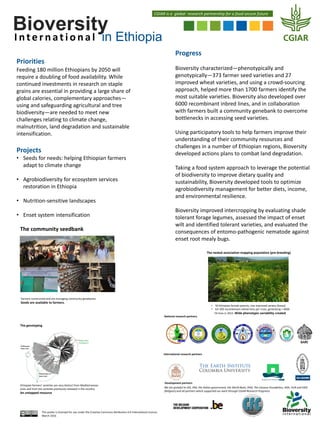
The nested association mapping population (pre-breeding)
• 50 Ethiopian female parents, one improved variety (Asasa).
• 63–205 recombinant inbred lines per cross, generating > 6000
F6 lines in 2015. Wide phenotypic variability created
The community seedbank
Farmers constructed and are managing community genebanks.
Seeds are available to farmers.
The genotyping
Ethiopian farmers’ varieties are very distinct from Mediterranean
ones and from the varieties previously released in the country.
An untapped resource
This poster is licensed for use under the Creative Commons Attribution 4.0 International Licence.
March 2016

Bioversity International in Ethiopia

  • 1.
    Bioversity Priorities Feeding 180 millionEthiopians by 2050 will require a doubling of food availability. While continued investments in research on staple grains are essential in providing a large share of global calories, complementary approaches— using and safeguarding agricultural and tree biodiversity—are needed to meet new challenges relating to climate change, malnutrition, land degradation and sustainable intensification. Progress Bioversity characterized—phenotypically and genotypically—373 farmer seed varieties and 27 improved wheat varieties, and using a crowd-sourcing approach, helped more than 1700 farmers identify the most suitable varieties. Bioversity also developed over 6000 recombinant inbred lines, and in collaboration with farmers built a community genebank to overcome bottlenecks in accessing seed varieties. Using participatory tools to help farmers improve their understanding of their community resources and challenges in a number of Ethiopian regions, Bioversity developed actions plans to combat land degradation. Taking a food system approach to leverage the potential of biodiversity to improve dietary quality and sustainability, Bioversity developed tools to optimize agrobiodiversity management for better diets, income, and environmental resilience. Bioversity improved intercropping by evaluating shade tolerant forage legumes, assessed the impact of enset wilt and identified tolerant varieties, and evaluated the consequences of entomo-pathogenic nematode against enset root mealy bugs. CGIAR is a global research partnership for a food secure future Projects • Seeds for needs: helping Ethiopian farmers adapt to climate change • Agrobiodiversity for ecosystem services restoration in Ethiopia • Nutrition-sensitive landscapes • Enset system intensification I nte r n at i o n a l in Ethiopia National research partners International research partners Development partners We are grateful to GIZ, FAO, the Italian government, the World Bank, IFAD, The Carasso Foundation, ADA, VLIR and DGD (Belgium) and all partners which supported our work through CGIAR Research Programs. The nested association mapping population (pre-breeding) • 50 Ethiopian female parents, one improved variety (Asasa). • 63–205 recombinant inbred lines per cross, generating > 6000 F6 lines in 2015. Wide phenotypic variability created The community seedbank Farmers constructed and are managing community genebanks. Seeds are available to farmers. The genotyping Ethiopian farmers’ varieties are very distinct from Mediterranean ones and from the varieties previously released in the country. An untapped resource This poster is licensed for use under the Creative Commons Attribution 4.0 International Licence. March 2016