Tsehay Gashaw, ILRI
Second ACGG Program Management Team
Meeting, Arusha, 27-28 January 2016
Communications and Knowledge management
in the African Chicken Genetic Gains program
Primary audiences
Farmers and producers (especially women)
• Farmers (and producers), and the wider communities around them are the
intended beneficiaries of this program. They, or their representatives, will
play a major role in the innovation platforms and are expected to contribute
to a number of the program outcomes
Private sector actors
• An essential dimension of ACGG to ensure sustainability.
Ministry and governmental agencies
• Ministries of livestock and/or agriculture for policy uptake and aider scaling
and uptake. Important for regulatory aspects.
Research and development community in-country
• To mobilize and deliver the in-country research (especially). International
and regional research for spillovers and wider uptake/replication
Donor community
• For wider scaling and uptake
Internal audiences
Country project teams
Consortium technical partners
• Wageningen UR, PICO east africa, Koepon
and ILRI
Scientific and industrial advisory committee
The program activity areas
• Outreach, engagement and influence for wider impact – Help put
research into use and support uptake of results, technologies and
practices developed through or with the program.
• Collecting, publishing and disseminating – Ensure that research
products and outputs (also data) are properly documented,
organized and published in ways that maximize their visibility and
accessibility.
• Engaging, learning and documentation – Stimulate, enrich and
expand interactions, engagement and learning with key actors,
partners, stakeholders, influential individuals.
• Internal communications and learning– Support interactions,
collaboration and connections within and across different program
teams.
• Presence and branding – Develop visual identity and online and
offline presence through public awareness activities.
Example activities
1. Engagement & influence: Industry briefs,
private sector cocktails, policy briefs, IP work
2. Publish & disseminate: Web updates, quarterly
newsletter, info sheets, CG Space
3. Learn & document: Engagement campaigns,
field visits, peer-assists, process documentation
4. Internal comms: PMT, SIAC meetings, monthly
team meetings, collective work spaces
5. Presence & branding: Brochure, poster, logo,
give-aways, templates, media attention
Principles
• The knowledge we generate is open and public
• We value the knowledge of our clients and partners
• We publish and communicate using multiple formats for multiple
purposes
• We support knowledge collecting, connecting and conversing
• Face‐to‐face communications are as important as other
communication channels
• Communications is everyone’s responsibility
• Communications is inextricably linked to research outputs and
development outcomes
• Internal communication is part of our communication strategy
• Communications partnerships are key to our impacts
• We innovate in the ways we share knowledge and use ICTs.
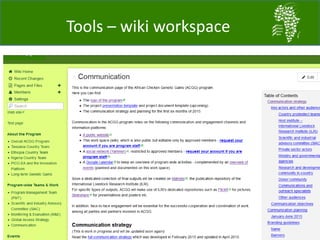
Tools – wiki workspace
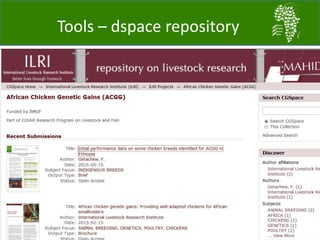
Tools – dspace repository
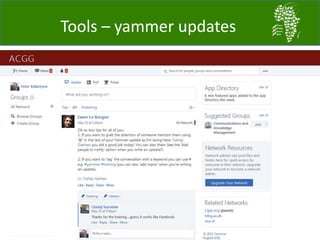
Tools – yammer updates
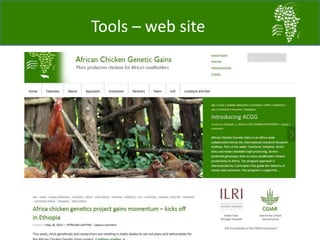
Tools – web site
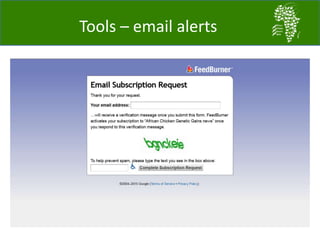
Tools – email alerts
Questions?
Partners
more productive chickens for
Africa’s smallholders
http://africacgg.net
The presentation has a Creative Commons licence. You are free to re-use or distribute this work, provided credit is given to ILRI.

Communications and knowledge management in the African Chicken Genetic Gains program

  • 1.
    Tsehay Gashaw, ILRI SecondACGG Program Management Team Meeting, Arusha, 27-28 January 2016 Communications and Knowledge management in the African Chicken Genetic Gains program
  • 2.
    Primary audiences Farmers andproducers (especially women) • Farmers (and producers), and the wider communities around them are the intended beneficiaries of this program. They, or their representatives, will play a major role in the innovation platforms and are expected to contribute to a number of the program outcomes Private sector actors • An essential dimension of ACGG to ensure sustainability. Ministry and governmental agencies • Ministries of livestock and/or agriculture for policy uptake and aider scaling and uptake. Important for regulatory aspects. Research and development community in-country • To mobilize and deliver the in-country research (especially). International and regional research for spillovers and wider uptake/replication Donor community • For wider scaling and uptake
  • 3.
    Internal audiences Country projectteams Consortium technical partners • Wageningen UR, PICO east africa, Koepon and ILRI Scientific and industrial advisory committee
  • 4.
    The program activityareas • Outreach, engagement and influence for wider impact – Help put research into use and support uptake of results, technologies and practices developed through or with the program. • Collecting, publishing and disseminating – Ensure that research products and outputs (also data) are properly documented, organized and published in ways that maximize their visibility and accessibility. • Engaging, learning and documentation – Stimulate, enrich and expand interactions, engagement and learning with key actors, partners, stakeholders, influential individuals. • Internal communications and learning– Support interactions, collaboration and connections within and across different program teams. • Presence and branding – Develop visual identity and online and offline presence through public awareness activities.
  • 5.
    Example activities 1. Engagement& influence: Industry briefs, private sector cocktails, policy briefs, IP work 2. Publish & disseminate: Web updates, quarterly newsletter, info sheets, CG Space 3. Learn & document: Engagement campaigns, field visits, peer-assists, process documentation 4. Internal comms: PMT, SIAC meetings, monthly team meetings, collective work spaces 5. Presence & branding: Brochure, poster, logo, give-aways, templates, media attention
  • 6.
    Principles • The knowledgewe generate is open and public • We value the knowledge of our clients and partners • We publish and communicate using multiple formats for multiple purposes • We support knowledge collecting, connecting and conversing • Face‐to‐face communications are as important as other communication channels • Communications is everyone’s responsibility • Communications is inextricably linked to research outputs and development outcomes • Internal communication is part of our communication strategy • Communications partnerships are key to our impacts • We innovate in the ways we share knowledge and use ICTs.
  • 7.
    Tools – wikiworkspace
  • 8.
    Tools – dspacerepository
  • 9.
  • 10.
  • 11.
  • 12.
  • 13.
  • 14.
    more productive chickensfor Africa’s smallholders http://africacgg.net The presentation has a Creative Commons licence. You are free to re-use or distribute this work, provided credit is given to ILRI.