BIOSAFETY
POOJA VERMA
MSB/14/120
M.SC BIOTECH 2ND
SEMESTER
BIOSAFETY: Preventing
lab-acquired infections
 Bacteria
 Viruses
 Fungi
 Human blood, unfixed tissue
 Human cell lines
 Recombinant DNA
Guidelines
 NIH Guidelines for Experiments
Involving Recombinant DNA Molecules
 Large Scale > 10 liters
 Biosafety in Microbiological and
Biomedical Laboratories-NIH/CDC
 UM Biosafety Manual
 On DES webpage
www.inform.umd.edu/des
Regulations
 OSHA Bloodborne Pathogens Standard
 Maryland Waste Regulations
 Shipping and packaging infectious substances
 DOT, UN, CDC, IATA
Levels of Containment
 BL1 - microorganisms that don’t consistently cause
disease in healthy adults
 E. coli K12, S. cerevisiae, polyomavirus
 Basic laboratory
 Standard Microbiological Practices
Levels of Containment
 BL2 - microorganisms of moderate potential hazard,
transmitted by contact, ingestion, puncture
 Salmonella, herpesvirus, human blood
 Basic laboratory
 Standard Practices PLUS
Levels of Containment
 BL2 - Standard Microbiological Practices Plus:
 Training in handling pathogens
 Access to lab limited
 Extreme sharps precautions
 Use of BSC for aerosols
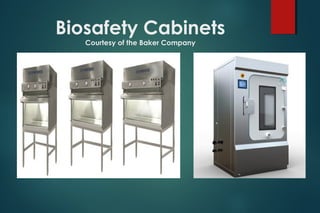
Biosafety Cabinets
Courtesy of the Baker Company
Use of Biosafety Cabinet
 Turn on fan 15 min before starting
 Don’t block grille
 Disinfect work surface With 70%
etohnal
 Discard pipets inside cabinet
 Minimize movement of hands
 Avoid use of flame unless necessary
 Have cabinet certified annually
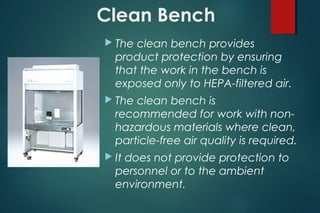
Clean Bench
 The clean bench provides
product protection by ensuring
that the work in the bench is
exposed only to HEPA-filtered air.
 The clean bench is
recommended for work with non-
hazardous materials where clean,
particle-free air quality is required.
 It does not provide protection to
personnel or to the ambient
environment.
Levels of Containment
 BL3 - microorganisms that cause serious disease,
transmitted by inhalation
 M. tuberculosis, yellow fever virus, hantavirus, Y. pestis
(plague)
 Containment lab: double door entry; directional airflow; all
work in biosafety cabinet
Levels of Containment
 BL4 - microorganisms that cause lethal disease, with no
known treatment or vaccine
Ebola virus, Marburg virus
Maximum containment lab; positive pressure ventilated suits
(moon suits)
OSHA(occupational safety and health
administration) Bloodborne Pathogens
Standard
 Human blood, unfixed tissue, primary human cell culture,
other potentially infectious materials
 HIV,HBV, HCV
OSHA Standard requires:
 Annual training
 Web-based program/DES homepage
 Free HBV vaccine
 Use of Universal Precautions
Universal Precautions
 Treat ALL human blood and unfixed tissue as if it
contains HIV and HBV
Routes of Occupational
Transmission Puncture or cut (needlestick, contaminated broken glass)
 Contact with broken skin
 Splash to mucous membranes of eyes, nose, mouth
Precautions for First Aid
 Wear gloves
 If conscious, have patient put pressure on wound
 Use one-way valve for CPR
Standard Microbiological
Practices
 NOT permitted in laboratories:
Eating
Drinking
Smoking
Handling contact lenses
Pipetting by mouth
Storing food and drink
Standard Microbiological
Practices
 ALWAYS wash hands:
After handling microorganisms and animals
After removing gloves
Before leaving laboratory
Standard Microbiological
Practices Discard needles, razor blades, and scalpel blades into red,
puncture resistant sharps containers
 Dispose of broken glass into “broken glass” containers,
never regular trash
Standard Microbiological
Practices
 NEVER
 recap, bend, or break needles
 discard needles or sharps into biological waste bags
 discard needles into regular trash
Standard Microbiological
Practices
 Decontaminate all biological waste (including BL1)
before disposal
 Solid waste (Petri dishes, cultures): autoclave and put in
dumpster
 Liquid waste: add disinfectant (bleach to 10%) and pour
down drain
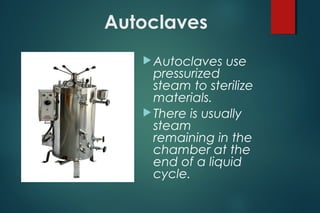
Autoclaves
Autoclaves use
pressurized
steam to sterilize
materials.
There is usually
steam
remaining in the
chamber at the
end of a liquid
cycle.
Autoclave Safety
 Opening door at end of liquid cycle:
 Wear eye and face protection.
 Stand behind door when opening it.
 Slowly open door only a crack to allow residual steam to
escape.
 Keep face away from door as it opens.
Autoclave Safety
 Removing liquids at end of cycle:
 Wait 5 min. before removing liquids.
 Liquids removed too soon may be super-heated and boil
up and out of container.
 Aim mouth of flask away from face.
 Don’t knock flask against bench.
Standard Microbiological
Practices
 Decontaminate work surfaces daily and after any spill of
viable material
 Report accidents to the PI
 Tell Health Care Provider that you work with infectious
agents or chemicals
THANK YOU

Biosafety

  • 1.
  • 2.
    BIOSAFETY: Preventing lab-acquired infections Bacteria  Viruses  Fungi  Human blood, unfixed tissue  Human cell lines  Recombinant DNA
  • 3.
    Guidelines  NIH Guidelinesfor Experiments Involving Recombinant DNA Molecules  Large Scale > 10 liters  Biosafety in Microbiological and Biomedical Laboratories-NIH/CDC  UM Biosafety Manual  On DES webpage www.inform.umd.edu/des
  • 4.
    Regulations  OSHA BloodbornePathogens Standard  Maryland Waste Regulations  Shipping and packaging infectious substances  DOT, UN, CDC, IATA
  • 5.
    Levels of Containment BL1 - microorganisms that don’t consistently cause disease in healthy adults  E. coli K12, S. cerevisiae, polyomavirus  Basic laboratory  Standard Microbiological Practices
  • 6.
    Levels of Containment BL2 - microorganisms of moderate potential hazard, transmitted by contact, ingestion, puncture  Salmonella, herpesvirus, human blood  Basic laboratory  Standard Practices PLUS
  • 7.
    Levels of Containment BL2 - Standard Microbiological Practices Plus:  Training in handling pathogens  Access to lab limited  Extreme sharps precautions  Use of BSC for aerosols
  • 8.
  • 9.
    Use of BiosafetyCabinet  Turn on fan 15 min before starting  Don’t block grille  Disinfect work surface With 70% etohnal  Discard pipets inside cabinet  Minimize movement of hands  Avoid use of flame unless necessary  Have cabinet certified annually
  • 10.
    Clean Bench  Theclean bench provides product protection by ensuring that the work in the bench is exposed only to HEPA-filtered air.  The clean bench is recommended for work with non- hazardous materials where clean, particle-free air quality is required.  It does not provide protection to personnel or to the ambient environment.
  • 11.
    Levels of Containment BL3 - microorganisms that cause serious disease, transmitted by inhalation  M. tuberculosis, yellow fever virus, hantavirus, Y. pestis (plague)  Containment lab: double door entry; directional airflow; all work in biosafety cabinet
  • 12.
    Levels of Containment BL4 - microorganisms that cause lethal disease, with no known treatment or vaccine Ebola virus, Marburg virus Maximum containment lab; positive pressure ventilated suits (moon suits)
  • 13.
    OSHA(occupational safety andhealth administration) Bloodborne Pathogens Standard  Human blood, unfixed tissue, primary human cell culture, other potentially infectious materials  HIV,HBV, HCV
  • 14.
    OSHA Standard requires: Annual training  Web-based program/DES homepage  Free HBV vaccine  Use of Universal Precautions
  • 15.
    Universal Precautions  TreatALL human blood and unfixed tissue as if it contains HIV and HBV
  • 16.
    Routes of Occupational TransmissionPuncture or cut (needlestick, contaminated broken glass)  Contact with broken skin  Splash to mucous membranes of eyes, nose, mouth
  • 17.
    Precautions for FirstAid  Wear gloves  If conscious, have patient put pressure on wound  Use one-way valve for CPR
  • 18.
    Standard Microbiological Practices  NOTpermitted in laboratories: Eating Drinking Smoking Handling contact lenses Pipetting by mouth Storing food and drink
  • 19.
    Standard Microbiological Practices  ALWAYSwash hands: After handling microorganisms and animals After removing gloves Before leaving laboratory
  • 20.
    Standard Microbiological Practices Discardneedles, razor blades, and scalpel blades into red, puncture resistant sharps containers  Dispose of broken glass into “broken glass” containers, never regular trash
  • 21.
    Standard Microbiological Practices  NEVER recap, bend, or break needles  discard needles or sharps into biological waste bags  discard needles into regular trash
  • 22.
    Standard Microbiological Practices  Decontaminateall biological waste (including BL1) before disposal  Solid waste (Petri dishes, cultures): autoclave and put in dumpster  Liquid waste: add disinfectant (bleach to 10%) and pour down drain
  • 23.
    Autoclaves Autoclaves use pressurized steam tosterilize materials. There is usually steam remaining in the chamber at the end of a liquid cycle.
  • 24.
    Autoclave Safety  Openingdoor at end of liquid cycle:  Wear eye and face protection.  Stand behind door when opening it.  Slowly open door only a crack to allow residual steam to escape.  Keep face away from door as it opens.
  • 25.
    Autoclave Safety  Removingliquids at end of cycle:  Wait 5 min. before removing liquids.  Liquids removed too soon may be super-heated and boil up and out of container.  Aim mouth of flask away from face.  Don’t knock flask against bench.
  • 26.
    Standard Microbiological Practices  Decontaminatework surfaces daily and after any spill of viable material  Report accidents to the PI  Tell Health Care Provider that you work with infectious agents or chemicals
  • 27.

Editor's Notes

  • #3 Biosafety is the section of Environmental Safety that addresses working safely in the laboratory with microorganisms and rDNA (organisms whose genetic material has been altered). Its goal is to help prevent lab-acquired infections while allowing researchers to work with organisms of various levels of hazard. This is done by advising researchers of the containment practices that are appropriate for the organisms they are handling, based on the level of risk presented by the organism.
  • #4 Various regulations and guidelines have been developed to protect workers and the environment. They define work practices required to work safely with biological material of all levels of hazard. All Principal Investigators must register their experiments that involve the use of rDNA, infectious microorganisms, and human blood, unfixed human tissue, and primary human cell lines with DES.
  • #6 There are 4 levels of biological containment that allow laboratory researchers to work safely with infectious agents of various levels of risk. They are designed to prevent lab-associated infections. BL1 is the lowest level of containment. At UM there are many BL1 labs, most of which are molecular biology labs that use non-pathogenic strains of E. coli for cloning. .
  • #7 BL2 is used for infectious agents that are transmitted by contact, ingestion, or puncture with contaminated sharp object. There are several BL2 labs at UM.
  • #8 BL2 labs are similar to BL1 laboratories, with the addition of these specific practices.
  • #12 BL3 containment is used for work with infectious agents that are transmitted by inhalation. We have 2 BL3 labs at UM, but neither is currently in use.
  • #13 There are only a very few BL4 labs in the country: CDC in Atlanta; NIH and Ft. Detrick in MD. BL4 is used for work with the most hazardous microorganisms. Hot Zone described BL4 containment.
  • #14 The OSHA BBP standard was published in 1991 to address concerns over occupational transmission of HIV to healthcare workers. BBPs are microorganisms present in the blood of infected persons, which are transmitted by blood-to-blood contact. Not casual contact or by inhalation. If you work with human material, you are covered by the BBP Standard.
  • #15 If you work with human material, OSHA requires: annual training of employees. If you work with human material, please take the interactive web based training available on our web page. provision of HBV vaccine by employer at no cost to employee; use of Universal Precautions when handling human material treating ALL material as if it may contain BBPs
  • #16 Even if material has been tested for BBPs such as HIV and HBV, it is possible that the test was performed before a detectable level of antibodies were produced, and the virus may be present. Therefore, ALL human material should be treated as infectious. Even if it is from your lab partner, because you can’t tell if someone is infected. If you work with human material, please take the interactive web based training available on our web page. (Copy of page in handout).
  • #17 Routes of occupational transmission of BBP. Optional: Routes of transmission in the general population: Sexual, both homosexual and heterosexual Sharing needles among injecting drug users. Blood transfusions prior to screening of blood supply (1980s??). Mother to unborn child.
  • #19 These are the basic practices when working with any microorganisms, and are the foundation for BL1 containment. They are designed to prevent transmission by contact, ingestion, and puncture. These practices are appropriate for ALL laboratories that work with radioisotopes and chemicals as well as microorganisms.
  • #20 Gloves are not a substitute for hand washing.
  • #21 In your handouts there is an information sheet on handling sharps safely. Sharps containers are available from Chemistry Stores and scientific distributors such as Fisher and VWR. Sharps containers are usually red, puncture-resistant plastic. Do not overfill sharps containers. Please call DES for pick-up of filled sharps containers. They do not need to be autoclaved before pick-up.
  • #22 Most needle sticks occur when recapping needles. If you must recap the needle, use a one-handed technique. If you get stuck by a needle, wash the area with soap and water, then go to the University Health Center for follow-up as soon as possible. Anti-retroviral drugs are more effective if given within 2-3 hours after needle stick.
  • #23 Use only autoclavable bags in autoclave. Put bags of waste in stainless steel or polypropylene tray during autoclaving to contain any leaks. There is information on autoclave safety and Biological Waste Disposal in the handout.
  • #27 Inform your healthcare provided that you work in a laboratory, and describe the types of hazardous materials you handle.