Safety precautions in laboratories
Dr NIVEDITA
LABORATORY SAFETY PROTECTS
 Personnel - working with various chemical, fire hazard, electrical shock
and biological hazards.
 Your colleague
 Your Organization / Lab
 Your Work
SO to Plan and conduct each operation considering :
 Hazards
 Laboratory Safety
 Good Laboratory Practices
HAZARD IN THE LAB CAN BE:
 CHEMICAL: Acid, alkali , and toxic chemicals.
 BIOLOGICAL: Like exposure to blood and body fluid (HIV, HBV, HCV etc).
 FIRE
 SHARPS
 SPILLAGES
 EXTREMES OF HEAT AND COLD
 ELECTRICAL ACCIDENT
6
7
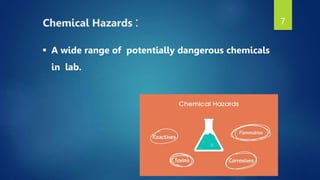
Chemical Hazards :
 A wide range of potentially dangerous chemicals
in lab.
Chemical Hazard Identification
 Understand the hazards of the chemicals that you are handling
 Read the Material Safety Data Sheet (MSDS)
 Ensure all the containers are labelled with the Chemical or Product name.
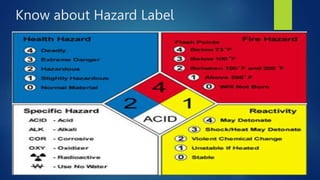
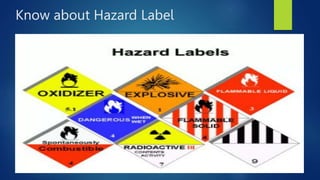
 Hazardous Chemicals must be labelled with the appropriate warning such
as corrosive, toxic, flammable etc….
Safety Measures :
 Exposure should be minimized - even for substances with no known
significant hazard.
 Assume all substances of unknown toxicity are hazardous.
 Toxic, flammable and hazardous chemical keep in minimum.
 Chemical stored based on compatibility.
 Avoid storing or handling food or beverages in storage areas,
refrigerators, glassware or utensils which are used for laboratory
operations.
9
Know about Hazard Label
 Stored chemicals should be examined periodically for replacement.
 Store acid separately with containment
12
CHEMICAL STORAGE
 Identify chemicals that can be disposed of safely in
normal trash or sewer systems and other chemicals
must be recycled or reduced when possible, or placed
in appropriate containers to be picked up by safety
services
13
CHEMICAL STORAGE
 Flammable material stored in protected cupboard.
 Store in tightly closed container
 Deteriorated or expired chemical should be disposed of properly.
CHEMICAL STORAGE
 Do not store chemical in lab office.
 Avoid storing in direct sunlight or near heat sources.
 Do not store flammables with water reactive explosive, self igniting or
oxidizing agents.
 Corrosive chemical shall be stored below eye level properly.
CHEMICAL STORAGE
 Beakers and bottles containing volatile material shall not be left open.
 Do not use unlabelled containers without verifying contents.
CHEMICAL STORAGE
PERSONAL PROTECTION
USE CORRECT PPEs
 Eye protection
 Safety glass- Flying particles, chemical splashes, dust .
 Splash goggles- Corrosive liquids, solvents, powders.
 Face shield- High pressure systems.
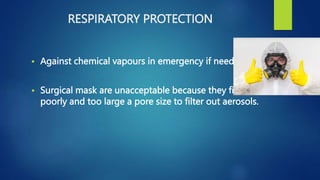
RESPIRATORY PROTECTION
 Against chemical vapours in emergency if needed.
 Surgical mask are unacceptable because they fit
poorly and too large a pore size to filter out aerosols.
SKIN AND BODY PROTECTION
 Gloves- compatible gloves (nitrile and neoprene)
 Aprons- Strong acid and bases resistant.
 Shoes– Always wear safety shoes in lab.
BIOLOGICAL HAZARDS:
 Infectious agents (bacteria, viruses and other microbes)
transmitted through body secretion or tissue.
 Corona virus, HIV ,Hepatitis B and C , mycobacterium
tuberculosis etc.
 Diseases carried by humans can be transmitted by the team,
who then may become carriers.
 So Biological hazards are massive risk to lab professionals as
well as to contacts from outside of lab.
21
BIOSAFETY PRECAUTIONS LEVELS
Laboratory facilities are designated as Basic :
Biosafety level 1
Low risk agent that are not known to cause human disease. pathogen/
disease like E coli.
Level 2 - Infectious agent of moderate risk with ingestion or mucous
membrane transmission like- influenza, lyme disease, salmonella, measles
and Mumps.
 Level 3 -Infectious aerosol transmission that may cause serious or lethal
infections like- Coronavirus , mycobacterium tuberculosis, yersinia pestis
(plague).
 Level 4 - Infectious aerosol transmission that may cause serious or lethal
infections with no treatment available like – Ebola virus, small pox
BIOLOGICAL HAZARDS:
CLASSIFICATION OF INFECTIVE
MICROORGANISM BY RISK GROUP
RISK GROUP 1( No or low individual and community risk)
RISK GROUP 2 (Moderate individual risk, low community
risk)
RISK GROUP 3 (High individual risk, low community risk)
RISK GROUP 4 ( High individual and community risk)
BIOLOGICAL HAZARDS:Prevention 25
 Proper storage and protection
 Wearing appropriate protective clothing
 keeping biological agents contained in the
correct areas for minimizing exposure.
 Systems and procedures for safe use, handling,
storage and transport of biological hazards .
Biohazard Prevention : 26
 Appropriate housekeeping, such as disinfecting work surfaces and properly
disposing of waste.
 Emergency procedures should be prepared in advance to contain, minimize risk
to people and the environment.
 Informing others, isolating the area, evacuation, seeking assistance, preventing
the spread of contamination or spills, or decontaminating the work area.
GENERAL SAFETY MEASURES
 Follow laboratory safety policies and procedure.
 Hazardous material should be accounted periodically.
 Use biohazard symbol in all biohazard container.
 Eye wash facility should be available.
 Train for managing fire , large spillage and gas leakage etc.
 Fire extinguisher.
 Don’t smoke eat or drink in lab.
 Laboratory glassware should never be utilised for food and beverage.
 Chemical resistant lab coat or aprons recommended.
 Handle needle, syringes any sharps carefully and disposed in appropriate container.
 Do not dispose chemical down the drain but it should be disposed as hazardous
waste.
 Cylinder should be capped properly.
 Accident splashing of chemical in eye or skin, should be flushed with running water for
for 20 min.
Spill procedure
 Ensure spill kits are available in the lab and replace
after use.
 If the spill is small place newspapers and let it soak and
after that pour1%-5% hypochlorite on it and leave for
10 minute and mop the area with disinfectant
 Be familiar with spill clean up equipment and know the
location
Electrical safety
Electrical safety prevent misuse of electronic instrument
,shocks and injuries and any issue are reported to
authorities .
 Earthing check annually.
 Make sure all electrical panels are unobstructed and
easily accessible.
 Avoid using extension cord.
 Never use electrical appliances near water
LABORATORY HYGIENE AND SANITATION
 Laboratory should be restricted area for visitors.
 Practices hand washing wearing protective clothing , gloves , eye
protection etc.
 Do not suction the pipette with mouth.
 Workbench cleaning before starting and finishing work
with sodium hypochlorite.
 Equipment should be cleaned every time.
 Effective pest control.
 Staff should be vaccinated for hepatitis B.
 Any spills or accumulation of chemicals on work surface
must be removed and cleaned ASAP.
 Never touch your face, mouth or eyes with chemical
hand.
PERSONAL HYGIENE
 Never smell , inhale or taste laboratory chemicals.
 Always wash hand with soap after removing gloves before leaving work
place.
 Never eat drink , chew gum or tobacco, smoke or apply cosmetics.
 Remove PPE before leaving lab.
 Remove gloves before handling phones ,instrument
door knobs etc.
 Do not block emergency showers, eye washes , exits
or hallways.
LABORATORY WORKING AREAS
 Keep neat ,clean and unclutter.
 Work surface must be decontaminated after any spill.
 All contaminated material , specimens and culture must
be decontaminated before disposal or cleaning for
reuse.
PERSONAL PROTECTION
 Laboratory coveralls gowns or uniform.
 Appropriate gloves –direct or accidental contacts
with blood, body fluids and infectious material.
 Washing hand frequently.
 Safety glasses , face shield or protective device, when
necessary
 Eating, drinking, smoking , etc prohibited.
DESIGN FEATURES OF LABORATORY
 Ample space for cleaning and housekeeping.
 Wall, ceilings floors resistant to chemicals and disinfectant.
 Silp resistant floor.
 Bench tops resistant to water, disinfectants, acid,
alkalis, organic solvent and moderate heat.
 Proper lighting and glare free.
 Hand washing basin near exit door with door vision
panels, and self closing.
DESIGN FEATURES OF LABORATORY
 Autoclaves and other decontamination in appropriate proximity.
 Safety system should cover fire, electrical emergencies shower facilities.
 Mechanical ventilation system that provide inward
flow of air without recirculation.
 No cross connection lab and drinking water supplies.
 Emergency electrical backup .
Health and medical surveillance.
 The objective of such surveillance is to monitor for
occupationally acquired disease.
Guidelines for the surveillance of laboratory
workers handling microorganisms
 Biosafety level 1 - Unlikely to cause human disease however should
undergo pre-employment health check and record medical history
 Biosafety Level 2 – Pre–employment health check and targeted
occupational health assessment , women of childbearing aware of risk to
an unborn child of occupational exposure. E g Rubella virus.
Waste handling
 Determine how to dispose of waste lab material safely
 Solvent and oil must be segregated into the correct waste
bottle or drum.
 Segregate chemical and biological materials.
 Detoxified the potent / hazards material.
 Do not mix incompatible waste material.
 Do not put material down the drain or in with normal
waste unless authorised to do so.
DISPOSAL
 Identification and separation for infectious material
and there containers should be adopted. National
and international regulation must be followed.
 Non contaminated – can be reused or recycled or
disposed of as general “household” waste.
Contaminated- hypodermic needle, scalpel, knives,
and broken glass should always be collected filled
with covers decontamination by autoclaving and
disposed.
FIRST AID MEASURE
 EYE CONTACT: Rinse immediately with
plenty of water for at least 15 minutes.
Obtain medical attention if needed.
 SKIN CONTACT : Remove any
contamination clothing wash off
immediately with plenty of water for at
least 15 minutes. Obtain medical attention.
47
 INHALATION : Move to fresh air . If breathing is
difficult give oxygen. If not breathing, give artificial
respiration. Obtain medical attention.
 INGESTION : Do not induce vomit. Obtain medical
attention
THANK YOU

SAFETY PRECAUTION in pathology lab while handling samples

  • 1.
    Safety precautions inlaboratories Dr NIVEDITA
  • 4.
    LABORATORY SAFETY PROTECTS Personnel - working with various chemical, fire hazard, electrical shock and biological hazards.  Your colleague  Your Organization / Lab  Your Work
  • 5.
    SO to Planand conduct each operation considering :  Hazards  Laboratory Safety  Good Laboratory Practices
  • 6.
    HAZARD IN THELAB CAN BE:  CHEMICAL: Acid, alkali , and toxic chemicals.  BIOLOGICAL: Like exposure to blood and body fluid (HIV, HBV, HCV etc).  FIRE  SHARPS  SPILLAGES  EXTREMES OF HEAT AND COLD  ELECTRICAL ACCIDENT 6
  • 7.
    7 Chemical Hazards : A wide range of potentially dangerous chemicals in lab.
  • 8.
    Chemical Hazard Identification Understand the hazards of the chemicals that you are handling  Read the Material Safety Data Sheet (MSDS)  Ensure all the containers are labelled with the Chemical or Product name.  Hazardous Chemicals must be labelled with the appropriate warning such as corrosive, toxic, flammable etc….
  • 9.
    Safety Measures : Exposure should be minimized - even for substances with no known significant hazard.  Assume all substances of unknown toxicity are hazardous.  Toxic, flammable and hazardous chemical keep in minimum.  Chemical stored based on compatibility.  Avoid storing or handling food or beverages in storage areas, refrigerators, glassware or utensils which are used for laboratory operations. 9
  • 10.
  • 11.
  • 12.
     Stored chemicalsshould be examined periodically for replacement.  Store acid separately with containment 12 CHEMICAL STORAGE
  • 13.
     Identify chemicalsthat can be disposed of safely in normal trash or sewer systems and other chemicals must be recycled or reduced when possible, or placed in appropriate containers to be picked up by safety services 13 CHEMICAL STORAGE
  • 14.
     Flammable materialstored in protected cupboard.  Store in tightly closed container  Deteriorated or expired chemical should be disposed of properly. CHEMICAL STORAGE
  • 15.
     Do notstore chemical in lab office.  Avoid storing in direct sunlight or near heat sources.  Do not store flammables with water reactive explosive, self igniting or oxidizing agents.  Corrosive chemical shall be stored below eye level properly. CHEMICAL STORAGE
  • 16.
     Beakers andbottles containing volatile material shall not be left open.  Do not use unlabelled containers without verifying contents. CHEMICAL STORAGE
  • 17.
  • 18.
    USE CORRECT PPEs Eye protection  Safety glass- Flying particles, chemical splashes, dust .  Splash goggles- Corrosive liquids, solvents, powders.  Face shield- High pressure systems.
  • 19.
    RESPIRATORY PROTECTION  Againstchemical vapours in emergency if needed.  Surgical mask are unacceptable because they fit poorly and too large a pore size to filter out aerosols.
  • 20.
    SKIN AND BODYPROTECTION  Gloves- compatible gloves (nitrile and neoprene)  Aprons- Strong acid and bases resistant.  Shoes– Always wear safety shoes in lab.
  • 21.
    BIOLOGICAL HAZARDS:  Infectiousagents (bacteria, viruses and other microbes) transmitted through body secretion or tissue.  Corona virus, HIV ,Hepatitis B and C , mycobacterium tuberculosis etc.  Diseases carried by humans can be transmitted by the team, who then may become carriers.  So Biological hazards are massive risk to lab professionals as well as to contacts from outside of lab. 21
  • 22.
    BIOSAFETY PRECAUTIONS LEVELS Laboratoryfacilities are designated as Basic : Biosafety level 1 Low risk agent that are not known to cause human disease. pathogen/ disease like E coli. Level 2 - Infectious agent of moderate risk with ingestion or mucous membrane transmission like- influenza, lyme disease, salmonella, measles and Mumps.
  • 23.
     Level 3-Infectious aerosol transmission that may cause serious or lethal infections like- Coronavirus , mycobacterium tuberculosis, yersinia pestis (plague).  Level 4 - Infectious aerosol transmission that may cause serious or lethal infections with no treatment available like – Ebola virus, small pox BIOLOGICAL HAZARDS:
  • 24.
    CLASSIFICATION OF INFECTIVE MICROORGANISMBY RISK GROUP RISK GROUP 1( No or low individual and community risk) RISK GROUP 2 (Moderate individual risk, low community risk) RISK GROUP 3 (High individual risk, low community risk) RISK GROUP 4 ( High individual and community risk)
  • 25.
    BIOLOGICAL HAZARDS:Prevention 25 Proper storage and protection  Wearing appropriate protective clothing  keeping biological agents contained in the correct areas for minimizing exposure.  Systems and procedures for safe use, handling, storage and transport of biological hazards .
  • 26.
    Biohazard Prevention :26  Appropriate housekeeping, such as disinfecting work surfaces and properly disposing of waste.  Emergency procedures should be prepared in advance to contain, minimize risk to people and the environment.  Informing others, isolating the area, evacuation, seeking assistance, preventing the spread of contamination or spills, or decontaminating the work area.
  • 27.
    GENERAL SAFETY MEASURES Follow laboratory safety policies and procedure.  Hazardous material should be accounted periodically.  Use biohazard symbol in all biohazard container.  Eye wash facility should be available.  Train for managing fire , large spillage and gas leakage etc.  Fire extinguisher.  Don’t smoke eat or drink in lab.
  • 28.
     Laboratory glasswareshould never be utilised for food and beverage.  Chemical resistant lab coat or aprons recommended.  Handle needle, syringes any sharps carefully and disposed in appropriate container.  Do not dispose chemical down the drain but it should be disposed as hazardous waste.  Cylinder should be capped properly.  Accident splashing of chemical in eye or skin, should be flushed with running water for for 20 min.
  • 29.
    Spill procedure  Ensurespill kits are available in the lab and replace after use.  If the spill is small place newspapers and let it soak and after that pour1%-5% hypochlorite on it and leave for 10 minute and mop the area with disinfectant  Be familiar with spill clean up equipment and know the location
  • 30.
    Electrical safety Electrical safetyprevent misuse of electronic instrument ,shocks and injuries and any issue are reported to authorities .  Earthing check annually.  Make sure all electrical panels are unobstructed and easily accessible.  Avoid using extension cord.  Never use electrical appliances near water
  • 31.
    LABORATORY HYGIENE ANDSANITATION  Laboratory should be restricted area for visitors.  Practices hand washing wearing protective clothing , gloves , eye protection etc.  Do not suction the pipette with mouth.
  • 32.
     Workbench cleaningbefore starting and finishing work with sodium hypochlorite.  Equipment should be cleaned every time.  Effective pest control.  Staff should be vaccinated for hepatitis B.  Any spills or accumulation of chemicals on work surface must be removed and cleaned ASAP.  Never touch your face, mouth or eyes with chemical hand.
  • 33.
    PERSONAL HYGIENE  Neversmell , inhale or taste laboratory chemicals.  Always wash hand with soap after removing gloves before leaving work place.  Never eat drink , chew gum or tobacco, smoke or apply cosmetics.
  • 34.
     Remove PPEbefore leaving lab.  Remove gloves before handling phones ,instrument door knobs etc.  Do not block emergency showers, eye washes , exits or hallways.
  • 35.
    LABORATORY WORKING AREAS Keep neat ,clean and unclutter.  Work surface must be decontaminated after any spill.  All contaminated material , specimens and culture must be decontaminated before disposal or cleaning for reuse.
  • 36.
    PERSONAL PROTECTION  Laboratorycoveralls gowns or uniform.  Appropriate gloves –direct or accidental contacts with blood, body fluids and infectious material.
  • 37.
     Washing handfrequently.  Safety glasses , face shield or protective device, when necessary  Eating, drinking, smoking , etc prohibited.
  • 38.
    DESIGN FEATURES OFLABORATORY  Ample space for cleaning and housekeeping.  Wall, ceilings floors resistant to chemicals and disinfectant.  Silp resistant floor.
  • 39.
     Bench topsresistant to water, disinfectants, acid, alkalis, organic solvent and moderate heat.  Proper lighting and glare free.  Hand washing basin near exit door with door vision panels, and self closing.
  • 40.
    DESIGN FEATURES OFLABORATORY  Autoclaves and other decontamination in appropriate proximity.  Safety system should cover fire, electrical emergencies shower facilities.
  • 41.
     Mechanical ventilationsystem that provide inward flow of air without recirculation.  No cross connection lab and drinking water supplies.  Emergency electrical backup .
  • 42.
    Health and medicalsurveillance.  The objective of such surveillance is to monitor for occupationally acquired disease.
  • 43.
    Guidelines for thesurveillance of laboratory workers handling microorganisms  Biosafety level 1 - Unlikely to cause human disease however should undergo pre-employment health check and record medical history  Biosafety Level 2 – Pre–employment health check and targeted occupational health assessment , women of childbearing aware of risk to an unborn child of occupational exposure. E g Rubella virus.
  • 44.
    Waste handling  Determinehow to dispose of waste lab material safely  Solvent and oil must be segregated into the correct waste bottle or drum.  Segregate chemical and biological materials.  Detoxified the potent / hazards material.  Do not mix incompatible waste material.  Do not put material down the drain or in with normal waste unless authorised to do so.
  • 45.
    DISPOSAL  Identification andseparation for infectious material and there containers should be adopted. National and international regulation must be followed.  Non contaminated – can be reused or recycled or disposed of as general “household” waste.
  • 46.
    Contaminated- hypodermic needle,scalpel, knives, and broken glass should always be collected filled with covers decontamination by autoclaving and disposed.
  • 47.
    FIRST AID MEASURE EYE CONTACT: Rinse immediately with plenty of water for at least 15 minutes. Obtain medical attention if needed.  SKIN CONTACT : Remove any contamination clothing wash off immediately with plenty of water for at least 15 minutes. Obtain medical attention. 47
  • 48.
     INHALATION :Move to fresh air . If breathing is difficult give oxygen. If not breathing, give artificial respiration. Obtain medical attention.  INGESTION : Do not induce vomit. Obtain medical attention
  • 49.

Editor's Notes

  • #5 soooooo
  • #8 HEALTH HAZARD, CARCINOGENS
  • #27 First aid or medical treatment may be required in some situations Biohazardous waste should be incinerated onsite or hauled away. Potentially infectious waste ought to be segregated from chemical or non-regulated waste.