

Arab Medical Center
Lean Thinking
by: Wafa AlAhmed
BSc, PgD, MLS(ASCP)cm
Senior Quality Assurance Officer
Arab Medical Center-Jordan
walahmad@amc-hospital.com
1
Definition
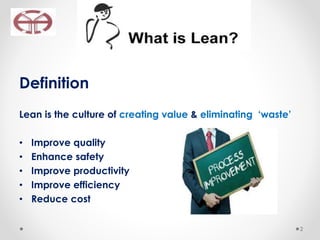
Lean is the culture of creating value & eliminating ‘waste’
• Improve quality
• Enhance safety
• Improve productivity
• Improve efficiency
• Reduce cost
2
Lean Thinking
• Lean thinking was derived from
Toyota organization in 1950
• Healthcare sector adopted lean in 2000
to improve the quality of its services
3
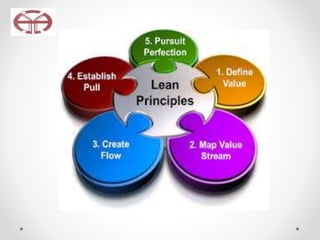
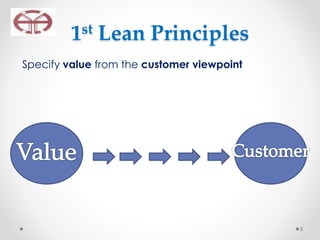
1st Lean Principles
Specify value from the customer viewpoint
5
2nd Lean Principles
• Identify the value stream
and eliminate waste
• Value Stream: A set of activities necessary to
bring a service to the customer
6
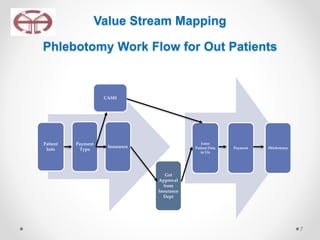
Value Stream Mapping
Phlebotomy Work Flow for Out Patients
7
Enter
Patient Data
in LIs
Payment Phlebotomy
Patient
Info
Payment
Type
Get
Approval
from
Insurance
Dept
CASH
Insurance
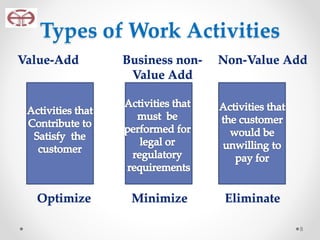
Types of Work Activities
8
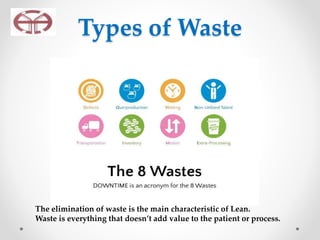
Types of Waste
The elimination of waste is the main characteristic of Lean.
Waste is everything that doesn’t add value to the patient or process.
Defects
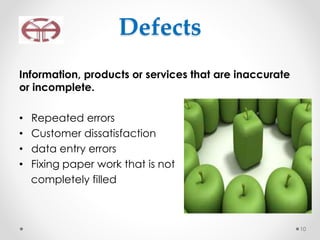
Information, products or services that are inaccurate
or incomplete.
• Repeated errors
• Customer dissatisfaction
• data entry errors
• Fixing paper work that is not
completely filled
10
Overproduction
11
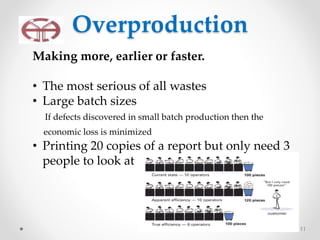
Making more, earlier or faster.
• The most serious of all wastes
• Large batch sizes
If defects discovered in small batch production then the
economic loss is minimized
• Printing 20 copies of a report but only need 3
people to look at
Waiting
Involves waiting for man, machine,
materials or information.
• Excessive cycle time
• High amount of wait time vs.
work time
• Waiting for files or information
• Delays due to needing a signature
12
Not utilizing people’s experience, skills
knowledge, or creativity.
• Lack of empowerment
• Not utilizing employees’ brains
• Lack of suggestions
• “That’s not my job” attitude
• Lack of cross training
13
Non-Utilized Talent
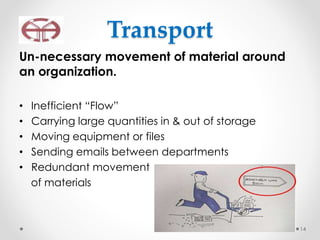
Transport
Un-necessary movement of material around
an organization.
• Inefficient “Flow”
• Carrying large quantities in & out of storage
• Moving equipment or files
• Sending emails between departments
• Redundant movement
of materials
14
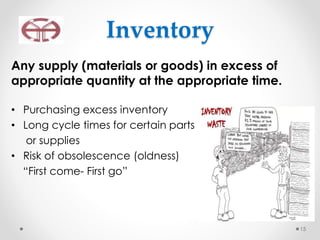
Inventory
Any supply (materials or goods) in excess of
appropriate quantity at the appropriate time.
• Purchasing excess inventory
• Long cycle times for certain parts
or supplies
• Risk of obsolescence (oldness)
“First come- First go”
15
Motion
Any movement that does not add value to the
product or service.
• Inefficient workplace organization
• Inefficient placement of frequently used supplies,
tools,….etc.
• Opening up multiple software applications
• How far does the paperwork travel?
• Where are critical resources located?
16
Extra-Processing
17
Any effort that does not add value to the
product or service
• Re-work loops or work-around
• Redundant process steps
• Multiple signature
• Extra fields requiring unused
information
• Un-necessary completion of templates,
forms, documents
Over-processing is often inserted into a process as a result of
dealing with defects, overproduction or excess inventory.
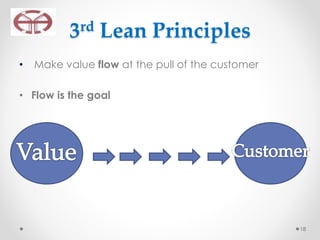
3rd Lean Principles
• Make value flow at the pull of the customer
• Flow is the goal
18
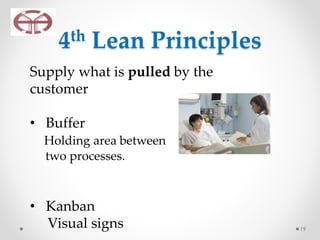
4th Lean Principles
19
Supply what is pulled by the
customer
• Buffer
Holding area between
two processes.
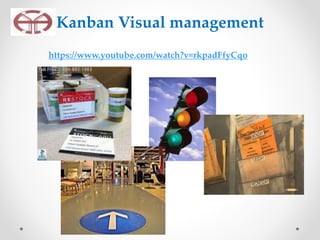
• Kanban
Visual signs
Kanban Visual management
https://www.youtube.com/watch?v=rkpadFfyCqo
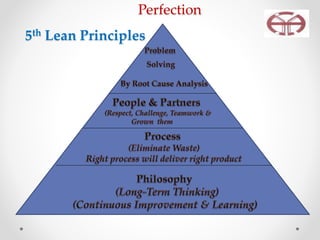
Perfection
5th Lean Principles
Patient Wait Time
• Definition
Wait time from the patients’ arrival to the laboratory reception
area and the time at which the blood collected.
• Problem
Patient waiting time in the reception area seem to be higher
between 10:30 AM – 12:00 PM.
• Consequences
-Excessive time spent away from work or personal activities.
-Patients might leave and seek care elsewhere.
22
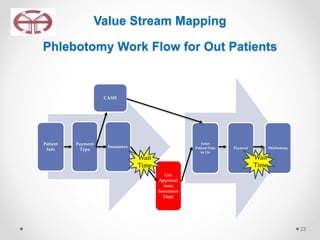
Value Stream Mapping
Phlebotomy Work Flow for Out Patients
23
Enter
Patient Data
in LIs
Payment Phlebotomy
Patient
Info
Payment
Type
Get
Approval
from
Insurance
Dept
CASH
Insurance
Wait
Time
Wait
Time
How to minimize Patient
Wait Time
24
How to minimize Patient Wait Time
• Insurance approval in the lab reception area
• Two med tech for registering the patients’ data,
answering phone calls, delivering patients’ results.
• Two phlebotomists dedicated only for blood
collection.
• Educate the patient by signs, posts, or through their
physicians to get the approval for lab tests before
visiting the lab.
25
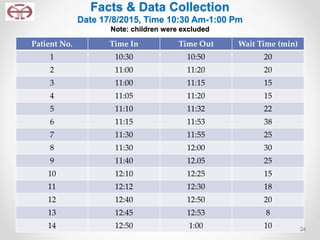
Facts & Data Collection
Date 17/8/2015, Time 10:30 Am-1:00 Pm
Note: children were excluded
Patient No. Time In Time Out Wait Time (min)
1 10:30 10:50 20
2 11:00 11:20 20
3 11:00 11:15 15
4 11:05 11:20 15
5 11:10 11:32 22
6 11:15 11:53 38
7 11:30 11:55 25
8 11:30 12:00 30
9 11:40 12.05 25
10 12:10 12:25 15
11 12:12 12:30 18
12 12:40 12:50 20
13 12:45 12:53 8
14 12:50 1:00 10 26
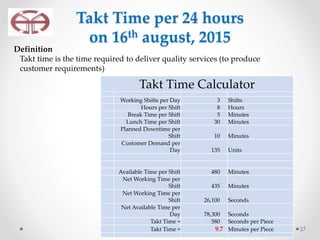
Takt Time per 24 hours
on 16th august, 2015
27
Takt Time Calculator
Working Shifts per Day 3 Shifts
Hours per Shift 8 Hours
Break Time per Shift 5 Minutes
Lunch Time per Shift 30 Minutes
Planned Downtime per
Shift 10 Minutes
Customer Demand per
Day 135 Units
Available Time per Shift 480 Minutes
Net Working Time per
Shift 435 Minutes
Net Working Time per
Shift 26,100 Seconds
Net Available Time per
Day 78,300 Seconds
Takt Time = 580 Seconds per Piece
Takt Time = 9.7 Minutes per Piece
Definition
Takt time is the time required to deliver quality services (to produce
customer requirements)
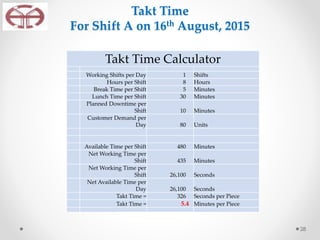
Takt Time
For Shift A on 16th August, 2015
28
Takt Time Calculator
Working Shifts per Day 1 Shifts
Hours per Shift 8 Hours
Break Time per Shift 5 Minutes
Lunch Time per Shift 30 Minutes
Planned Downtime per
Shift 10 Minutes
Customer Demand per
Day 80 Units
Available Time per Shift 480 Minutes
Net Working Time per
Shift 435 Minutes
Net Working Time per
Shift 26,100 Seconds
Net Available Time per
Day 26,100 Seconds
Takt Time = 326 Seconds per Piece
Takt Time = 5.4 Minutes per Piece
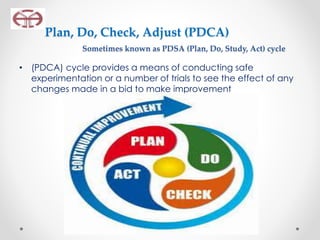
Plan, Do, Check, Adjust (PDCA)
Sometimes known as PDSA (Plan, Do, Study, Act) cycle
• (PDCA) cycle provides a means of conducting safe
experimentation or a number of trials to see the effect of any
changes made in a bid to make improvement
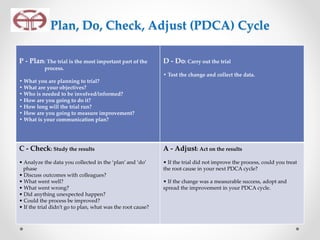
Plan, Do, Check, Adjust (PDCA) Cycle
P - Plan: The trial is the most important part of the
process.
• What you are planning to trial?
• What are your objectives?
• Who is needed to be involved/informed?
• How are you going to do it?
• How long will the trial run?
• How are you going to measure improvement?
• What is your communication plan?
D - Do: Carry out the trial
• Test the change and collect the data.
C - Check: Study the results
• Analyze the data you collected in the ‘plan’ and ‘do’
phase
• Discuss outcomes with colleagues?
• What went well?
• What went wrong?
• Did anything unexpected happen?
• Could the process be improved?
• If the trial didn’t go to plan, what was the root cause?
A - Adjust: Act on the results
• If the trial did not improve the process, could you treat
the root cause in your next PDCA cycle?
• If the change was a measurable success, adopt and
spread the improvement in your PDCA cycle.
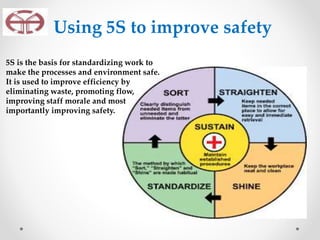
Using 5S to improve safety
5S is the basis for standardizing work to
make the processes and environment safe.
It is used to improve efficiency by
eliminating waste, promoting flow,
improving staff morale and most
importantly improving safety.
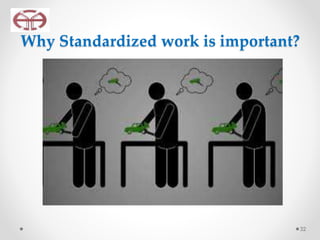
Why Standardized work is important?
32
Why Standardized work is important?
• Employee involvement and empowerment,
• Consistency (reduction of variation) among staff
members performing the work,
• Improved productivity without added stress,
• Improved, consistent quality,
• Reduction or elimination of errors and mistakes (causes
of defects),
• Work process stability,
• Increased employee safety,
• Improved cost management as wastes are removed,
• Availability of a great tool for staff training,
• Visual management--managers and supervisors can
see when processes are not operating normally.
33
Medical Technologist Task
• To implement lean in each department.
• Each medical technologist need to do a change in his/her
department that will improve AMC services.
• It is recommended to discuss the idea of change by
27/8/2015 with the laboratory Director Mrs Randa Al-Ahmad &
the senior QA officer Mrs Wafa Al-Ahmed & QA & Safety
officer & Aphaeresis specialist Mrs Tasneem Al-Nsour for
approval.
• You have two weeks time to perform a trial for your idea
starting from 29/8/2015 to 12/9/2015.
• Measure the effect of the change you made.
• Then demonstrate your work to your colleagues.
34
References
• Improvement, N. H. S. Bringing lean to life. Leicester,
UK: NHS Improvement. 2010.
• https://leansixsigmahealthcare.wordpress.com/201
5/06/24/using-lean-six-sigma-analytics-to-improve-
patient-wait-times/
• http://www.6ixconsulting.co.uk/IGLC-Application-
of-Batch-size-reduction-in-construction.pdf
36

Lean presentation amc

  • 1.
    Arab Medical Center LeanThinking by: Wafa AlAhmed BSc, PgD, MLS(ASCP)cm Senior Quality Assurance Officer Arab Medical Center-Jordan walahmad@amc-hospital.com 1
  • 2.
    Definition Lean is theculture of creating value & eliminating ‘waste’ • Improve quality • Enhance safety • Improve productivity • Improve efficiency • Reduce cost 2
  • 3.
    Lean Thinking • Leanthinking was derived from Toyota organization in 1950 • Healthcare sector adopted lean in 2000 to improve the quality of its services 3
  • 5.
    1st Lean Principles Specifyvalue from the customer viewpoint 5
  • 6.
    2nd Lean Principles •Identify the value stream and eliminate waste • Value Stream: A set of activities necessary to bring a service to the customer 6
  • 7.
    Value Stream Mapping PhlebotomyWork Flow for Out Patients 7 Enter Patient Data in LIs Payment Phlebotomy Patient Info Payment Type Get Approval from Insurance Dept CASH Insurance
  • 8.
    Types of WorkActivities 8
  • 9.
    Types of Waste Theelimination of waste is the main characteristic of Lean. Waste is everything that doesn’t add value to the patient or process.
  • 10.
    Defects Information, products orservices that are inaccurate or incomplete. • Repeated errors • Customer dissatisfaction • data entry errors • Fixing paper work that is not completely filled 10
  • 11.
    Overproduction 11 Making more, earlieror faster. • The most serious of all wastes • Large batch sizes If defects discovered in small batch production then the economic loss is minimized • Printing 20 copies of a report but only need 3 people to look at
  • 12.
    Waiting Involves waiting forman, machine, materials or information. • Excessive cycle time • High amount of wait time vs. work time • Waiting for files or information • Delays due to needing a signature 12
  • 13.
    Not utilizing people’sexperience, skills knowledge, or creativity. • Lack of empowerment • Not utilizing employees’ brains • Lack of suggestions • “That’s not my job” attitude • Lack of cross training 13 Non-Utilized Talent
  • 14.
    Transport Un-necessary movement ofmaterial around an organization. • Inefficient “Flow” • Carrying large quantities in & out of storage • Moving equipment or files • Sending emails between departments • Redundant movement of materials 14
  • 15.
    Inventory Any supply (materialsor goods) in excess of appropriate quantity at the appropriate time. • Purchasing excess inventory • Long cycle times for certain parts or supplies • Risk of obsolescence (oldness) “First come- First go” 15
  • 16.
    Motion Any movement thatdoes not add value to the product or service. • Inefficient workplace organization • Inefficient placement of frequently used supplies, tools,….etc. • Opening up multiple software applications • How far does the paperwork travel? • Where are critical resources located? 16
  • 17.
    Extra-Processing 17 Any effort thatdoes not add value to the product or service • Re-work loops or work-around • Redundant process steps • Multiple signature • Extra fields requiring unused information • Un-necessary completion of templates, forms, documents Over-processing is often inserted into a process as a result of dealing with defects, overproduction or excess inventory.
  • 18.
    3rd Lean Principles •Make value flow at the pull of the customer • Flow is the goal 18
  • 19.
    4th Lean Principles 19 Supplywhat is pulled by the customer • Buffer Holding area between two processes. • Kanban Visual signs
  • 20.
  • 21.
  • 22.
    Patient Wait Time •Definition Wait time from the patients’ arrival to the laboratory reception area and the time at which the blood collected. • Problem Patient waiting time in the reception area seem to be higher between 10:30 AM – 12:00 PM. • Consequences -Excessive time spent away from work or personal activities. -Patients might leave and seek care elsewhere. 22
  • 23.
    Value Stream Mapping PhlebotomyWork Flow for Out Patients 23 Enter Patient Data in LIs Payment Phlebotomy Patient Info Payment Type Get Approval from Insurance Dept CASH Insurance Wait Time Wait Time
  • 24.
    How to minimizePatient Wait Time 24
  • 25.
    How to minimizePatient Wait Time • Insurance approval in the lab reception area • Two med tech for registering the patients’ data, answering phone calls, delivering patients’ results. • Two phlebotomists dedicated only for blood collection. • Educate the patient by signs, posts, or through their physicians to get the approval for lab tests before visiting the lab. 25
  • 26.
    Facts & DataCollection Date 17/8/2015, Time 10:30 Am-1:00 Pm Note: children were excluded Patient No. Time In Time Out Wait Time (min) 1 10:30 10:50 20 2 11:00 11:20 20 3 11:00 11:15 15 4 11:05 11:20 15 5 11:10 11:32 22 6 11:15 11:53 38 7 11:30 11:55 25 8 11:30 12:00 30 9 11:40 12.05 25 10 12:10 12:25 15 11 12:12 12:30 18 12 12:40 12:50 20 13 12:45 12:53 8 14 12:50 1:00 10 26
  • 27.
    Takt Time per24 hours on 16th august, 2015 27 Takt Time Calculator Working Shifts per Day 3 Shifts Hours per Shift 8 Hours Break Time per Shift 5 Minutes Lunch Time per Shift 30 Minutes Planned Downtime per Shift 10 Minutes Customer Demand per Day 135 Units Available Time per Shift 480 Minutes Net Working Time per Shift 435 Minutes Net Working Time per Shift 26,100 Seconds Net Available Time per Day 78,300 Seconds Takt Time = 580 Seconds per Piece Takt Time = 9.7 Minutes per Piece Definition Takt time is the time required to deliver quality services (to produce customer requirements)
  • 28.
    Takt Time For ShiftA on 16th August, 2015 28 Takt Time Calculator Working Shifts per Day 1 Shifts Hours per Shift 8 Hours Break Time per Shift 5 Minutes Lunch Time per Shift 30 Minutes Planned Downtime per Shift 10 Minutes Customer Demand per Day 80 Units Available Time per Shift 480 Minutes Net Working Time per Shift 435 Minutes Net Working Time per Shift 26,100 Seconds Net Available Time per Day 26,100 Seconds Takt Time = 326 Seconds per Piece Takt Time = 5.4 Minutes per Piece
  • 29.
    Plan, Do, Check,Adjust (PDCA) Sometimes known as PDSA (Plan, Do, Study, Act) cycle • (PDCA) cycle provides a means of conducting safe experimentation or a number of trials to see the effect of any changes made in a bid to make improvement
  • 30.
    Plan, Do, Check,Adjust (PDCA) Cycle P - Plan: The trial is the most important part of the process. • What you are planning to trial? • What are your objectives? • Who is needed to be involved/informed? • How are you going to do it? • How long will the trial run? • How are you going to measure improvement? • What is your communication plan? D - Do: Carry out the trial • Test the change and collect the data. C - Check: Study the results • Analyze the data you collected in the ‘plan’ and ‘do’ phase • Discuss outcomes with colleagues? • What went well? • What went wrong? • Did anything unexpected happen? • Could the process be improved? • If the trial didn’t go to plan, what was the root cause? A - Adjust: Act on the results • If the trial did not improve the process, could you treat the root cause in your next PDCA cycle? • If the change was a measurable success, adopt and spread the improvement in your PDCA cycle.
  • 31.
    Using 5S toimprove safety 5S is the basis for standardizing work to make the processes and environment safe. It is used to improve efficiency by eliminating waste, promoting flow, improving staff morale and most importantly improving safety.
  • 32.
    Why Standardized workis important? 32
  • 33.
    Why Standardized workis important? • Employee involvement and empowerment, • Consistency (reduction of variation) among staff members performing the work, • Improved productivity without added stress, • Improved, consistent quality, • Reduction or elimination of errors and mistakes (causes of defects), • Work process stability, • Increased employee safety, • Improved cost management as wastes are removed, • Availability of a great tool for staff training, • Visual management--managers and supervisors can see when processes are not operating normally. 33
  • 34.
    Medical Technologist Task •To implement lean in each department. • Each medical technologist need to do a change in his/her department that will improve AMC services. • It is recommended to discuss the idea of change by 27/8/2015 with the laboratory Director Mrs Randa Al-Ahmad & the senior QA officer Mrs Wafa Al-Ahmed & QA & Safety officer & Aphaeresis specialist Mrs Tasneem Al-Nsour for approval. • You have two weeks time to perform a trial for your idea starting from 29/8/2015 to 12/9/2015. • Measure the effect of the change you made. • Then demonstrate your work to your colleagues. 34
  • 36.
    References • Improvement, N.H. S. Bringing lean to life. Leicester, UK: NHS Improvement. 2010. • https://leansixsigmahealthcare.wordpress.com/201 5/06/24/using-lean-six-sigma-analytics-to-improve- patient-wait-times/ • http://www.6ixconsulting.co.uk/IGLC-Application- of-Batch-size-reduction-in-construction.pdf 36