Health and Safety in
Microbiological Practices
Dr. Diganta Dey
Ashok Laboratory Clinical Testing Centre Pvt. Ltd.
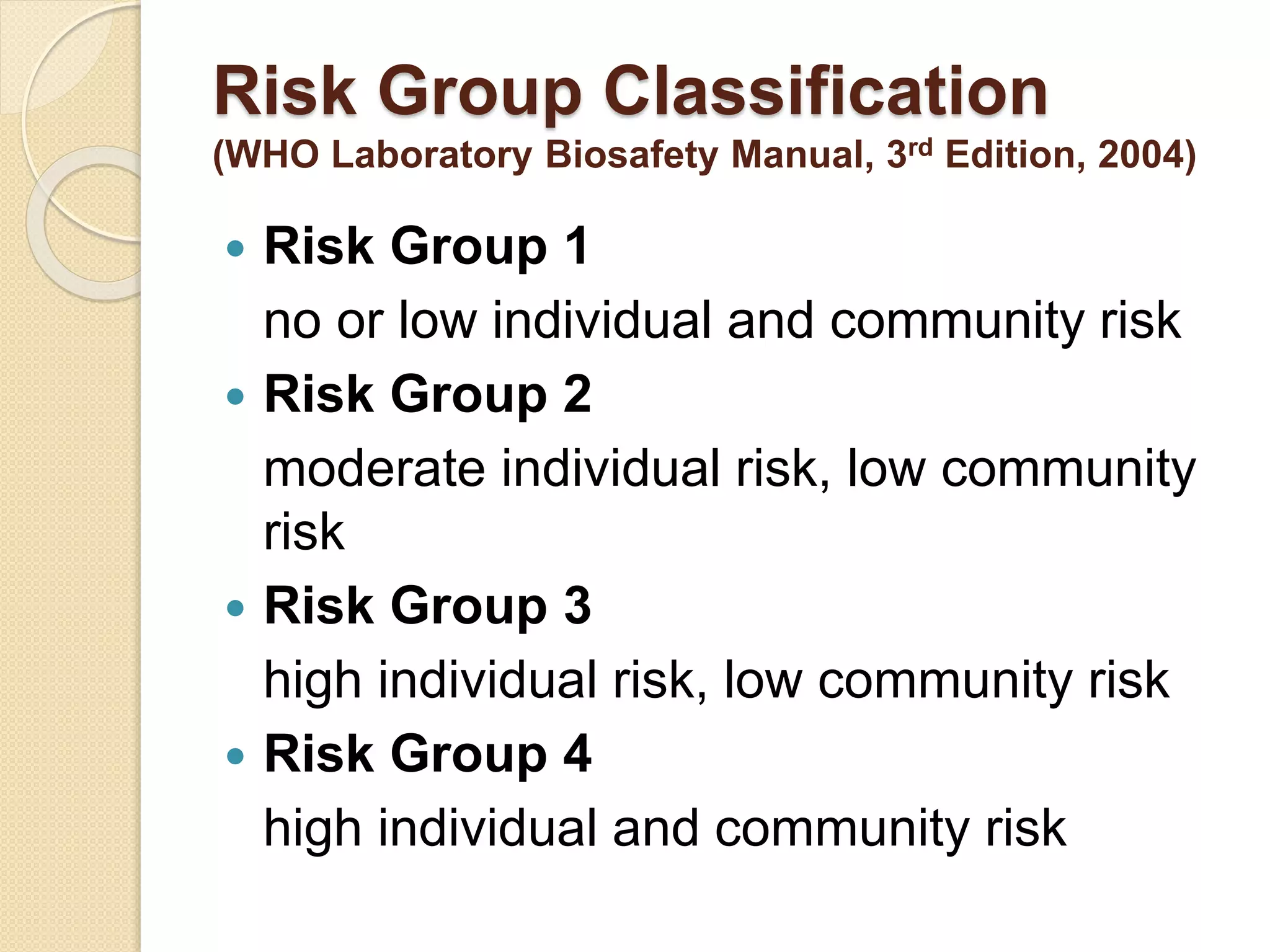
Risk Group Classification
(WHO Laboratory Biosafety Manual, 3rd Edition, 2004)
 Risk Group 1
no or low individual and community risk
 Risk Group 2
moderate individual risk, low community
risk
 Risk Group 3
high individual risk, low community risk
 Risk Group 4
high individual and community risk
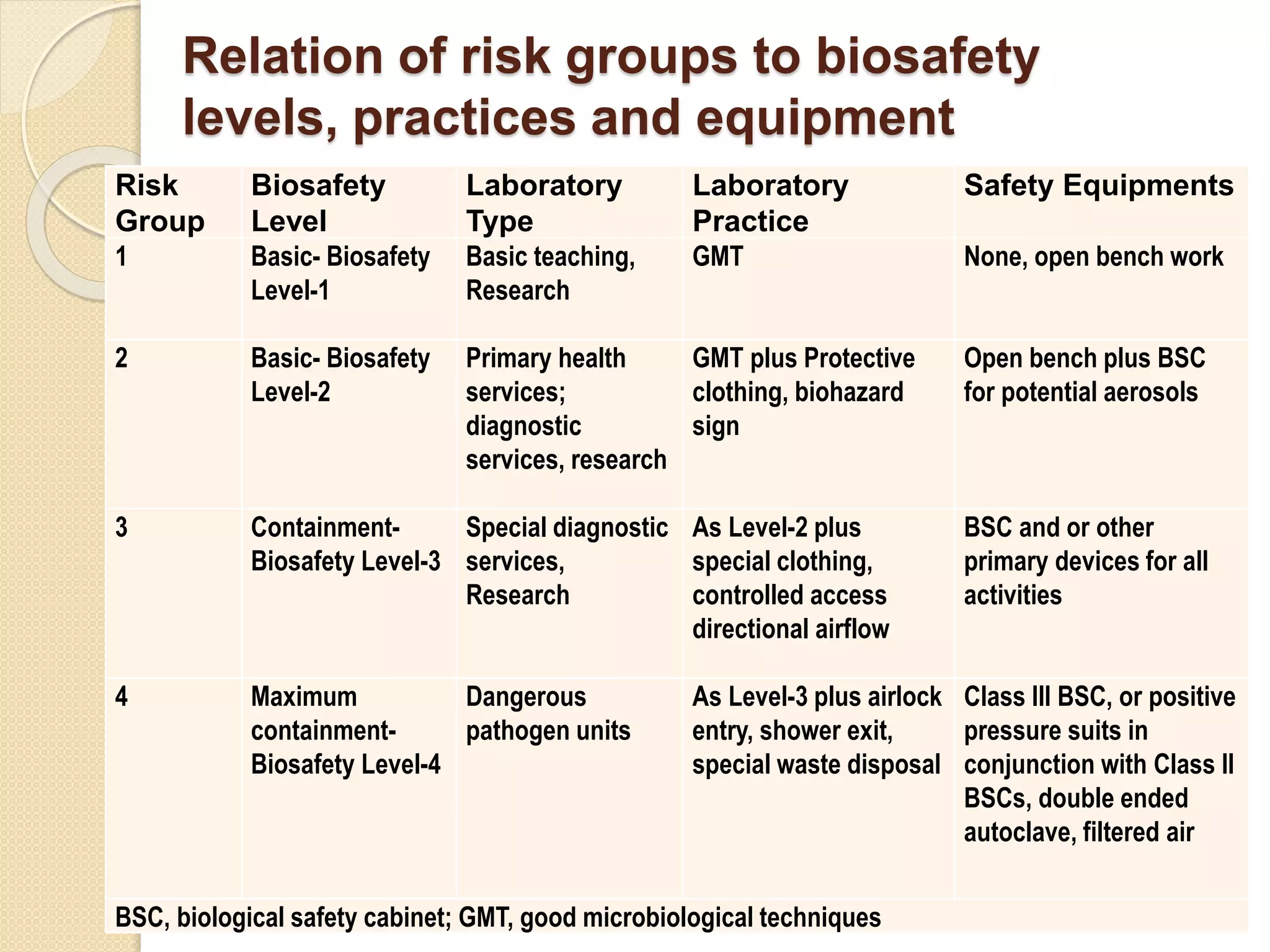
Relation of risk groups to biosafety
levels, practices and equipment
Risk
Group
Biosafety
Level
Laboratory
Type
Laboratory
Practice
Safety Equipments
1 Basic- Biosafety
Level-1
Basic teaching,
Research
GMT None, open bench work
2 Basic- Biosafety
Level-2
Primary health
services;
diagnostic
services, research
GMT plus Protective
clothing, biohazard
sign
Open bench plus BSC
for potential aerosols
3 Containment-
Biosafety Level-3
Special diagnostic
services,
Research
As Level-2 plus
special clothing,
controlled access
directional airflow
BSC and or other
primary devices for all
activities
4 Maximum
containment-
Biosafety Level-4
Dangerous
pathogen units
As Level-3 plus airlock
entry, shower exit,
special waste disposal
Class III BSC, or positive
pressure suits in
conjunction with Class II
BSCs, double ended
autoclave, filtered air
BSC, biological safety cabinet; GMT, good microbiological techniques
Selection of a Safety Cabinet
through Risk Assessment
Protection Provided
Biological
Risk
Assessed
Personnel Product Environmental BSC Class
BSL 1 – 3 Yes No Yes I
BSL 1 – 3 Yes Yes Yes II (A1, A2, B1,
B2)
BSL – 4 Yes Yes Yes III; II—When
used in suit
room with suit
Biosafety Cabinet – Class I
 (A) front opening
 (B) sash
 (C) exhaust HEPA filter
 (D) exhaust plenum
 Does not provide
product protection
HEPA, an air filter must
remove 99.97% of particles
that have a size of 0.3 µm
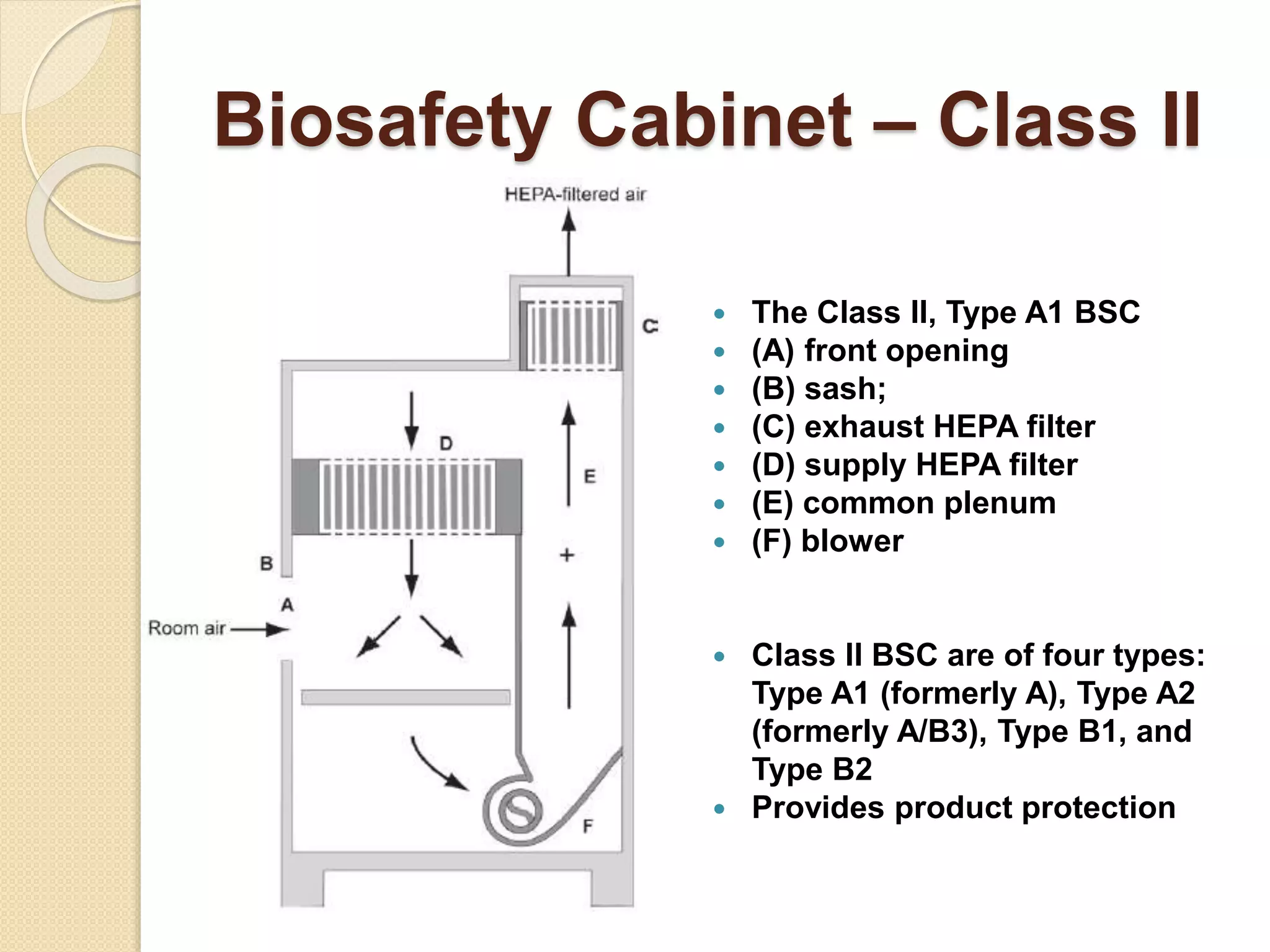
Biosafety Cabinet – Class II
 The Class II, Type A1 BSC
 (A) front opening
 (B) sash;
 (C) exhaust HEPA filter
 (D) supply HEPA filter
 (E) common plenum
 (F) blower
 Class II BSC are of four types:
Type A1 (formerly A), Type A2
(formerly A/B3), Type B1, and
Type B2
 Provides product protection
Biosafety Cabinet – Class III
 (A) glove ports with
O-ring for attaching
arm-length gloves to
cabinet
 (B) sash
 (C) exhaust HEPA
filter
 (D) supply HEPA
filter
 (E) double-ended
autoclave or pass-
through box
Horizontal
Laminar Flow
Vertical
Laminar Flow
Personal Protective
Equipment
 “Specialized clothing or equipment worn by an
employee for protection against infectious
materials” (OSHA)
 Gloves: Protect hands
 Gowns/aprons: Protect skin and/or clothing
 Masks and respirators: Protect mouth/nose
 Respirators: Protect respiratory tract from
airborne infectious agents
 Goggles: Protect eyes
 Face shields: Protect face, mouth, nose and
eyes
 Overshoes
Hand Protection: Gloves
 Minimise the risk of
acquiring infections from
patients
 Prevent microbial flora
from being transmitted
from health care providers
to patients
 Glove material - vinyl,
latex, nitrile
 Sterile or non-sterile
 One or two pair
 Single use or reusable
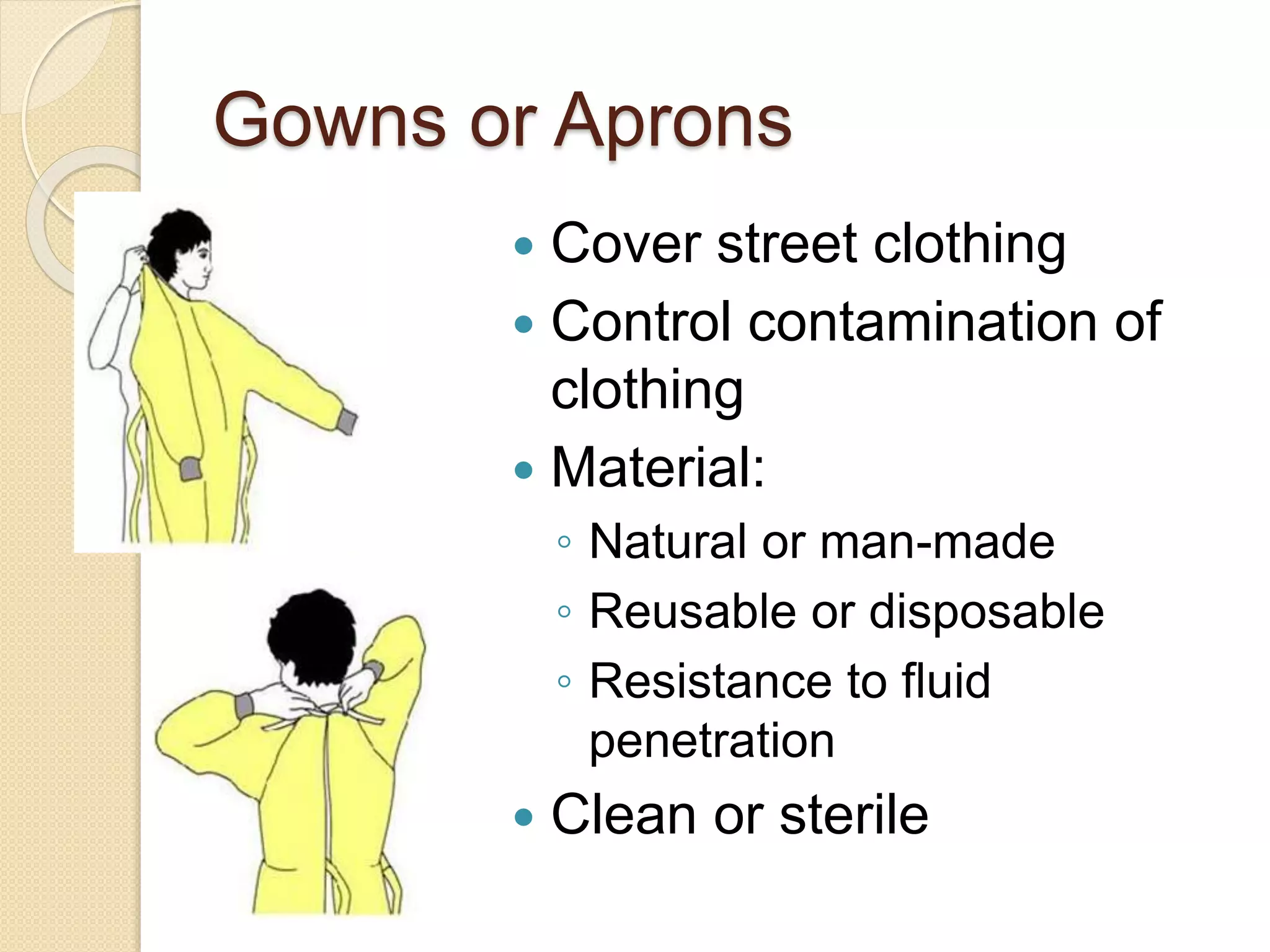
Gowns or Aprons
 Cover street clothing
 Control contamination of
clothing
 Material:
◦ Natural or man-made
◦ Reusable or disposable
◦ Resistance to fluid
penetration
 Clean or sterile
How to Don Eye and Face
Protection
 Masks - protect nose and mouth
 Place over nose, mouth and chin.
Fit
flexible nose piece over nose
bridge.
Secure on head with ties or
elastic and adjust to fit
 Should fully cover nose and
mouth
and prevent fluid penetration
 Goggles - protect eyes
 Should fit snuggly over and
around eyes
 Personal glasses not a substitute
for goggles
Respiratory Protection
 Respirators that filter the air before it is inhaled
should be used for respiratory protection.
 The most commonly used respirators in healthcare
settings are the N95, N99, or N100 particulate
respirators.
 The device has a sub-micron filter capable of
excluding particles that are less than 5 microns in
diameter.
 Respirators are approved by the CDC’s National
Institute for Occupational Safety and Health.
 Like other PPE, the selection of a respirator type
must consider the nature of the exposure and risk
involved. For example, N95 particulate respirators
might be worn by personnel entering the room of a
patient with infectious tuberculosis. However, if a
bronchoscopy is performed on the patient, the
healthcare provider might wear a higher level of
respiratory protection, such as a powered air-
purifying respirator or PAPR.
Sequence for Donning PPE
 Gown first
 Mask
 Goggles or face shield
 Gloves
Sequence for Removing PPE
 Gloves
 Goggles or face shield
 Gown
 Mask
Hand Hygiene
Hand Hygiene
Procedures for routine hand
wash
Needle Stick Injury
 Most common dangers: HIV, HBV, HCV
 Exposure:
◦ Percutaneous- penetrating injury e.g. NSI
(most common)
◦ Mucocutaneous- mucus membrane (eyes,
mouth) e.g. splashes
◦ Cutaneous (skin)- Intact or Broken
 Infectious material: Blood, CSF, sterile
fluid, sputum, vaginal discharge, semen
 Not infectious: Tear, urine, stool, saliva
 Dictum- all material is infectious
Needle Stick Injury
Best approach is
prevention
 Vaccination- HBV
 Keep Lab clean
 Good spill
management
 Wipe work benches
with 1% hypochlorite
or 70% alcohol after
work
 Standard precautions
 PPE - gloves, apron,
goggles
 No mouth pipetting
 Apply band-aid over cuts
 No
eating/drinking/cosmetics
 Safe sharp handling
 Safe disposal
 Careful work
 Never recap
 Never break
 Never reuse
Post exposure prophylaxis
 First aid
 Inform authority
 Counseling
 PEP
◦ HIV, HBV
◦ BEST WITHIN 2HRS.
◦ Not effective after 72 hrs, so take within 72 hrs.
◦ Baseline tests- HIV (antibody), HBV (HBsAg, antibody), HCV (antibody).
◦ PEP taken for HIV - at least 4 weeks (HAART: zidovudine + lamivudine)
◦ If injured is HIV pos- no PEP
◦ PEP taken for HBV – Intramuscular HBIg (0.6 mIU/mL) within 24 hrs
Dos Don’ts
Wash with soap and water
Wash mouth with NS
Eyes-Lean back on chair and ask
friend to wash with NS/ use eye
washing station
Panic
Put finger in mouth
Squeeze
Apply disinfectant
Post exposure prophylaxis
 Follow up: After-2,4 & 6 weeks 3 & 6 months
HIV HBV
Management of Laboratory Spillage
 Best approach is to avoid spillage- know the position of all
chemicals, don’t keep bottles at the edge, wear PPE.
 First step is First Aid, alerting everyone and evacuation if
needed.
 Person involved in cleaning must wear PPE.
 Towels and gloves should be disposed of in a yellow clinical
waste bag for an autoclave if in a laboratory.
 Wash hands after the process.
 Keep hypo for 10 mins in case of large spill.
 After microbiological spill treat with 1% hypochlorite, and
autoclave towel before discarding.
 Discard jars must contain-
◦ 1% hypochlorite.
◦ In case of AFB- 2% phenol
 1% Hypochlorite is prepared from commercially available 4%
hypochlorite
Management of Laboratory
Spillage
Disposal of Biomedical Wastes
 BMW: Waste generated by any health care
facility. Example- gloves, cotton, needles,
syringe, test tubes etc.
 Most of the generated waste is infectious and
can injure or infect workers
 Segregation at site: Puncture proof container,
Yellow, blue, and black plastic bags
 Liquid waste: Pre-treat with 10% hypochlorite
and discharge through drains
 Microbiological waste: Autoclave for 60 mins
and discard in yellow bags
Disposal of Biomedical Wastes
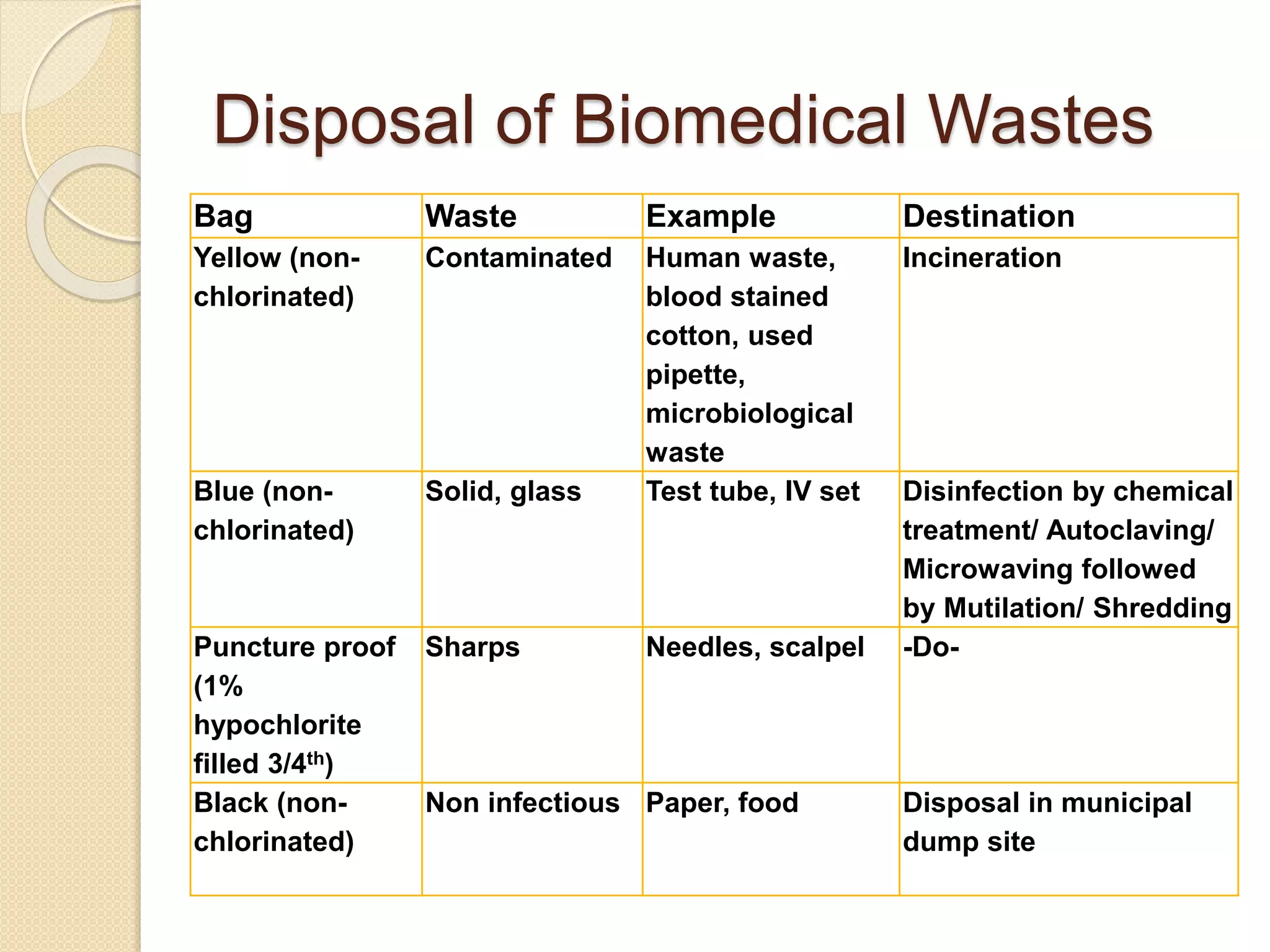
Bag Waste Example Destination
Yellow (non-
chlorinated)
Contaminated Human waste,
blood stained
cotton, used
pipette,
microbiological
waste
Incineration
Blue (non-
chlorinated)
Solid, glass Test tube, IV set Disinfection by chemical
treatment/ Autoclaving/
Microwaving followed
by Mutilation/ Shredding
Puncture proof
(1%
hypochlorite
filled 3/4th)
Sharps Needles, scalpel -Do-
Black (non-
chlorinated)
Non infectious Paper, food Disposal in municipal
dump site
Disposal of Biomedical Wastes
Fire Hazards
 Fire-fighting equipment should be placed near room
doors and at strategic points in corridors and hallways.
 Fire extinguishers should be regularly inspected and
maintained, and their shelf-life kept up to date.
TYPE USE FOR DO NOT USE FOR
Water Paper, wood, fabric Electrical fires,
flammable liquids,
burning metals
Carbon dioxide
(CO2) extinguisher
gases
Flammable liquids
and gases, electrical
fires
Alkali metals, paper
Dry powder Flammable liquids
and gases, alkali
metals, electrical
fires
Reusable equipment
and instruments, as
residues are very
difficult to remove
Foam Flammable liquids Electrical fires
Types and uses of fire extinguishers
Thank you…

Health and safety in microbiological practices

  • 1.
    Health and Safetyin Microbiological Practices Dr. Diganta Dey Ashok Laboratory Clinical Testing Centre Pvt. Ltd.
  • 2.
    Risk Group Classification (WHOLaboratory Biosafety Manual, 3rd Edition, 2004)  Risk Group 1 no or low individual and community risk  Risk Group 2 moderate individual risk, low community risk  Risk Group 3 high individual risk, low community risk  Risk Group 4 high individual and community risk
  • 3.
    Relation of riskgroups to biosafety levels, practices and equipment Risk Group Biosafety Level Laboratory Type Laboratory Practice Safety Equipments 1 Basic- Biosafety Level-1 Basic teaching, Research GMT None, open bench work 2 Basic- Biosafety Level-2 Primary health services; diagnostic services, research GMT plus Protective clothing, biohazard sign Open bench plus BSC for potential aerosols 3 Containment- Biosafety Level-3 Special diagnostic services, Research As Level-2 plus special clothing, controlled access directional airflow BSC and or other primary devices for all activities 4 Maximum containment- Biosafety Level-4 Dangerous pathogen units As Level-3 plus airlock entry, shower exit, special waste disposal Class III BSC, or positive pressure suits in conjunction with Class II BSCs, double ended autoclave, filtered air BSC, biological safety cabinet; GMT, good microbiological techniques
  • 4.
    Selection of aSafety Cabinet through Risk Assessment Protection Provided Biological Risk Assessed Personnel Product Environmental BSC Class BSL 1 – 3 Yes No Yes I BSL 1 – 3 Yes Yes Yes II (A1, A2, B1, B2) BSL – 4 Yes Yes Yes III; II—When used in suit room with suit
  • 5.
    Biosafety Cabinet –Class I  (A) front opening  (B) sash  (C) exhaust HEPA filter  (D) exhaust plenum  Does not provide product protection HEPA, an air filter must remove 99.97% of particles that have a size of 0.3 µm
  • 6.
    Biosafety Cabinet –Class II  The Class II, Type A1 BSC  (A) front opening  (B) sash;  (C) exhaust HEPA filter  (D) supply HEPA filter  (E) common plenum  (F) blower  Class II BSC are of four types: Type A1 (formerly A), Type A2 (formerly A/B3), Type B1, and Type B2  Provides product protection
  • 7.
    Biosafety Cabinet –Class III  (A) glove ports with O-ring for attaching arm-length gloves to cabinet  (B) sash  (C) exhaust HEPA filter  (D) supply HEPA filter  (E) double-ended autoclave or pass- through box
  • 8.
  • 9.
    Personal Protective Equipment  “Specializedclothing or equipment worn by an employee for protection against infectious materials” (OSHA)  Gloves: Protect hands  Gowns/aprons: Protect skin and/or clothing  Masks and respirators: Protect mouth/nose  Respirators: Protect respiratory tract from airborne infectious agents  Goggles: Protect eyes  Face shields: Protect face, mouth, nose and eyes  Overshoes
  • 10.
    Hand Protection: Gloves Minimise the risk of acquiring infections from patients  Prevent microbial flora from being transmitted from health care providers to patients  Glove material - vinyl, latex, nitrile  Sterile or non-sterile  One or two pair  Single use or reusable
  • 11.
    Gowns or Aprons Cover street clothing  Control contamination of clothing  Material: ◦ Natural or man-made ◦ Reusable or disposable ◦ Resistance to fluid penetration  Clean or sterile
  • 12.
    How to DonEye and Face Protection  Masks - protect nose and mouth  Place over nose, mouth and chin. Fit flexible nose piece over nose bridge. Secure on head with ties or elastic and adjust to fit  Should fully cover nose and mouth and prevent fluid penetration  Goggles - protect eyes  Should fit snuggly over and around eyes  Personal glasses not a substitute for goggles
  • 13.
    Respiratory Protection  Respiratorsthat filter the air before it is inhaled should be used for respiratory protection.  The most commonly used respirators in healthcare settings are the N95, N99, or N100 particulate respirators.  The device has a sub-micron filter capable of excluding particles that are less than 5 microns in diameter.  Respirators are approved by the CDC’s National Institute for Occupational Safety and Health.  Like other PPE, the selection of a respirator type must consider the nature of the exposure and risk involved. For example, N95 particulate respirators might be worn by personnel entering the room of a patient with infectious tuberculosis. However, if a bronchoscopy is performed on the patient, the healthcare provider might wear a higher level of respiratory protection, such as a powered air- purifying respirator or PAPR.
  • 14.
    Sequence for DonningPPE  Gown first  Mask  Goggles or face shield  Gloves
  • 15.
    Sequence for RemovingPPE  Gloves  Goggles or face shield  Gown  Mask
  • 16.
  • 17.
  • 18.
  • 19.
    Needle Stick Injury Most common dangers: HIV, HBV, HCV  Exposure: ◦ Percutaneous- penetrating injury e.g. NSI (most common) ◦ Mucocutaneous- mucus membrane (eyes, mouth) e.g. splashes ◦ Cutaneous (skin)- Intact or Broken  Infectious material: Blood, CSF, sterile fluid, sputum, vaginal discharge, semen  Not infectious: Tear, urine, stool, saliva  Dictum- all material is infectious
  • 20.
    Needle Stick Injury Bestapproach is prevention  Vaccination- HBV  Keep Lab clean  Good spill management  Wipe work benches with 1% hypochlorite or 70% alcohol after work  Standard precautions  PPE - gloves, apron, goggles  No mouth pipetting  Apply band-aid over cuts  No eating/drinking/cosmetics  Safe sharp handling  Safe disposal  Careful work  Never recap  Never break  Never reuse
  • 21.
    Post exposure prophylaxis First aid  Inform authority  Counseling  PEP ◦ HIV, HBV ◦ BEST WITHIN 2HRS. ◦ Not effective after 72 hrs, so take within 72 hrs. ◦ Baseline tests- HIV (antibody), HBV (HBsAg, antibody), HCV (antibody). ◦ PEP taken for HIV - at least 4 weeks (HAART: zidovudine + lamivudine) ◦ If injured is HIV pos- no PEP ◦ PEP taken for HBV – Intramuscular HBIg (0.6 mIU/mL) within 24 hrs Dos Don’ts Wash with soap and water Wash mouth with NS Eyes-Lean back on chair and ask friend to wash with NS/ use eye washing station Panic Put finger in mouth Squeeze Apply disinfectant
  • 22.
    Post exposure prophylaxis Follow up: After-2,4 & 6 weeks 3 & 6 months HIV HBV
  • 23.
    Management of LaboratorySpillage  Best approach is to avoid spillage- know the position of all chemicals, don’t keep bottles at the edge, wear PPE.  First step is First Aid, alerting everyone and evacuation if needed.  Person involved in cleaning must wear PPE.  Towels and gloves should be disposed of in a yellow clinical waste bag for an autoclave if in a laboratory.  Wash hands after the process.  Keep hypo for 10 mins in case of large spill.  After microbiological spill treat with 1% hypochlorite, and autoclave towel before discarding.  Discard jars must contain- ◦ 1% hypochlorite. ◦ In case of AFB- 2% phenol  1% Hypochlorite is prepared from commercially available 4% hypochlorite
  • 24.
  • 25.
    Disposal of BiomedicalWastes  BMW: Waste generated by any health care facility. Example- gloves, cotton, needles, syringe, test tubes etc.  Most of the generated waste is infectious and can injure or infect workers  Segregation at site: Puncture proof container, Yellow, blue, and black plastic bags  Liquid waste: Pre-treat with 10% hypochlorite and discharge through drains  Microbiological waste: Autoclave for 60 mins and discard in yellow bags
  • 26.
    Disposal of BiomedicalWastes Bag Waste Example Destination Yellow (non- chlorinated) Contaminated Human waste, blood stained cotton, used pipette, microbiological waste Incineration Blue (non- chlorinated) Solid, glass Test tube, IV set Disinfection by chemical treatment/ Autoclaving/ Microwaving followed by Mutilation/ Shredding Puncture proof (1% hypochlorite filled 3/4th) Sharps Needles, scalpel -Do- Black (non- chlorinated) Non infectious Paper, food Disposal in municipal dump site
  • 27.
  • 28.
    Fire Hazards  Fire-fightingequipment should be placed near room doors and at strategic points in corridors and hallways.  Fire extinguishers should be regularly inspected and maintained, and their shelf-life kept up to date. TYPE USE FOR DO NOT USE FOR Water Paper, wood, fabric Electrical fires, flammable liquids, burning metals Carbon dioxide (CO2) extinguisher gases Flammable liquids and gases, electrical fires Alkali metals, paper Dry powder Flammable liquids and gases, alkali metals, electrical fires Reusable equipment and instruments, as residues are very difficult to remove Foam Flammable liquids Electrical fires Types and uses of fire extinguishers
  • 29.