1
Biorefinery
The role of fast pyrolysis
Wolter Prins
BTG Biomass Technology Group BV
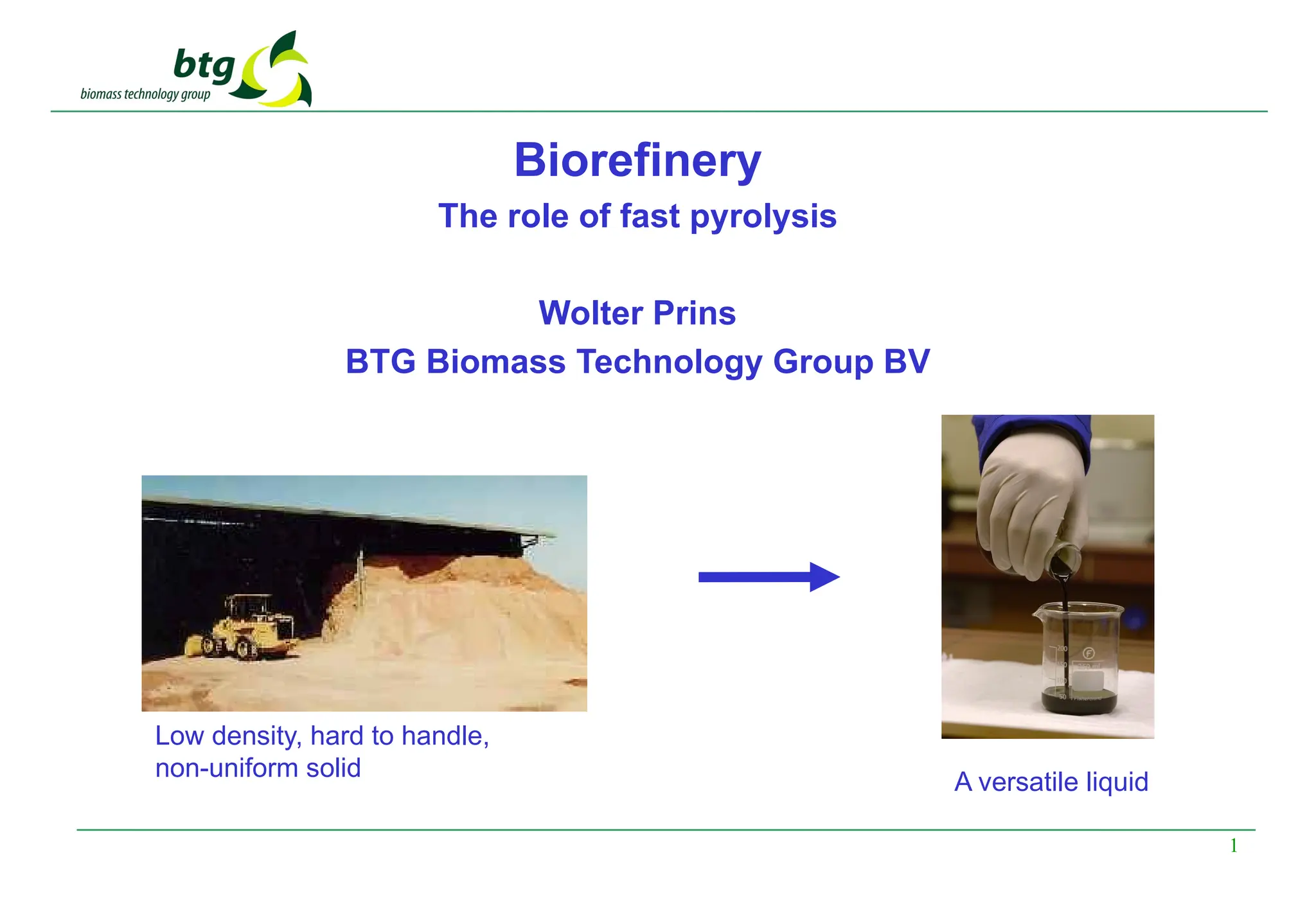
Low density, hard to handle,
non-uniform solid
A versatile liquid
2
1. Resources
2. Biomass based industries
3. Biorefinery definition
4. Biorefinery opportunities
5. From biomass sugars to residues
6. Fast pyrolysis’ possible role
8. Conclusions
Contents
3
Origin: forestry, energy crops, agriculture, plantations
Availability: about the current crude oil production (100 EJ)
Use: 12 % of the world energy consumption
(but mainly traditional!)
Barriers: transport, bio-diversity / landscape, food
competition, minerals and water, political issues,
public acceptance, costs
Resources
4
Biomass-based industries
Timber / Pulp and paper
Food / Pharmaceutics
Heat and power (4 % of the world energy consumption)
Sugar based bio-chemicals (corn, potato, soybean, wheat)
Bio-ethanol from sugar and starch
Bio-diesel from plant oils (pressing)
5
Biomass-refinery definition
First Google hits
Cluster of biobased industries producing chemicals, fuels,
power, products, and materials (Iowa State University)
A biorefinery is a facility that integrates biomass conversion
processes and equipment to produce fuels, power, and value-
added chemicals from biomass. The biorefinery concept is
analogous to today's petroleum refinery, which produce
multiple fuels and products from petroleum. (Wikipedia)
6
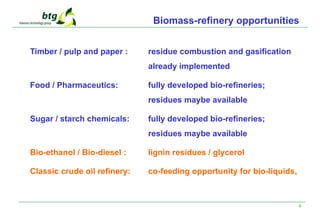
Biomass-refinery opportunities
Timber / pulp and paper : residue combustion and gasification
already implemented
Food / Pharmaceutics: fully developed bio-refineries;
residues maybe available
Sugar / starch chemicals: fully developed bio-refineries;
residues maybe available
Bio-ethanol / Bio-diesel : lignin residues / glycerol
Classic crude oil refinery: co-feeding opportunity for bio-liquids,
7
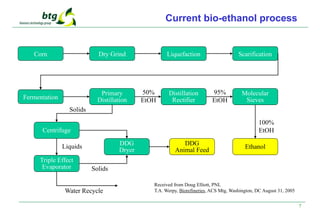
Current bio-ethanol process
Corn Dry Grind Liquefaction Scarification
Fermentation
Primary
Distillation
Distillation
Rectifier
Molecular
Sieves
Centrifuge
Triple Effect
Evaporator
DDG
Dryer
DDG
Animal Feed
Ethanol
Solids
50%
EtOH
95%
EtOH
100%
EtOH
Liquids
Water Recycle
Solids
Received from Doug Elliott, PNL
T.A. Werpy, Biorefineries, ACS Mtg, Washington, DC August 31, 2005
8
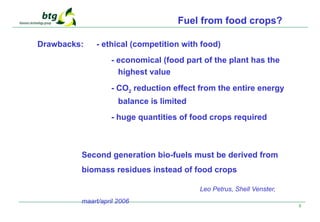
Fuel from food crops?
Drawbacks: - ethical (competition with food)
- economical (food part of the plant has the
highest value
- CO2 reduction effect from the entire energy
balance is limited
- huge quantities of food crops required
Second generation bio-fuels must be derived from
biomass residues instead of food crops
Leo Petrus, Shell Venster,
maart/april 2006
9
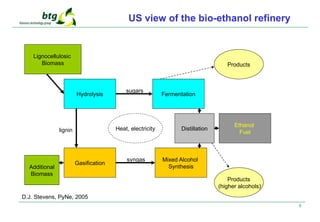
Lignocellulosic
Biomass
Hydrolysis Fermentation
Mixed Alcohol
Synthesis
Gasification
Ethanol
Fuel
Distillation
Products
Products
(higher alcohols)
lignin
sugars
syngas
Additional
Biomass
Heat, electricity
D.J. Stevens, PyNe, 2005
US view of the bio-ethanol refinery
10
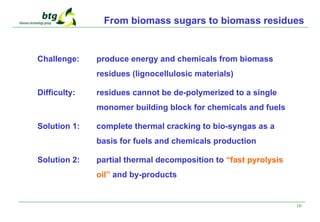
From biomass sugars to biomass residues
Challenge: produce energy and chemicals from biomass
residues (lignocellulosic materials)
Difficulty: residues cannot be de-polymerized to a single
monomer building block for chemicals and fuels
Solution 1: complete thermal cracking to bio-syngas as a
basis for fuels and chemicals production
Solution 2: partial thermal decomposition to “fast pyrolysis
oil” and by-products
11
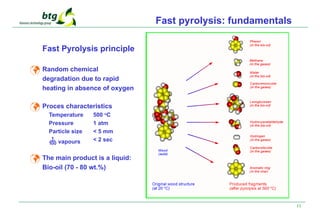
Fast pyrolysis: fundamentals
Fast Pyrolysis principle
Random chemical
degradation due to rapid
heating in absence of oxygen
Proces characteristics
Temperature
Pressure
Particle size
 vapours
The main product is a liquid:
Bio-oil (70 - 80 wt.%)
500 o
C
1 atm
< 5 mm
< 2 sec



12
Fast pyrolysis: drivers
Drivers
Simple biomass liquefaction process
• de-coupling of production and utilization
• favorable liquid properties
• energy densification
• homogenization/ purification
13
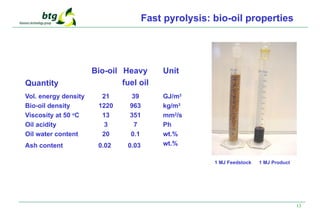
Fast pyrolysis: bio-oil properties
1 MJ Product
1 MJ Feedstock
Vol. energy density
Bio-oil density
Viscosity at 50 o
C
Oil acidity
Oil water content
Ash content
21
1220
13
3
20
0.02
Quantity
39
963
351
7
0.1
0.03
Bio-oil Heavy
fuel oil
Unit
GJ/m3
kg/m3
mm2
/s
Ph
wt.%
wt.%
14
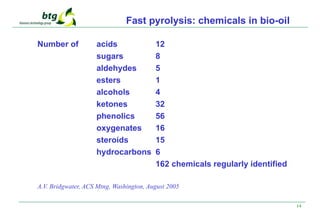
Fast pyrolysis: chemicals in bio-oil
Number of acids 12
sugars 8
aldehydes 5
esters 1
alcohols 4
ketones 32
phenolics 56
oxygenates 16
steroids 15
hydrocarbons 6
162 chemicals regularly identified
A.V. Bridgwater, ACS Mtng, Washington, August 2005
15
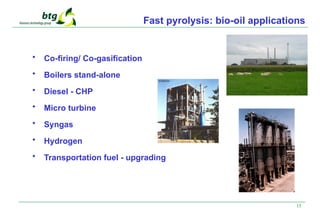
Fast pyrolysis: bio-oil applications
• Co-firing/ Co-gasification
• Boilers stand-alone
• Diesel - CHP
• Micro turbine
• Syngas
• Hydrogen
• Transportation fuel - upgrading
16
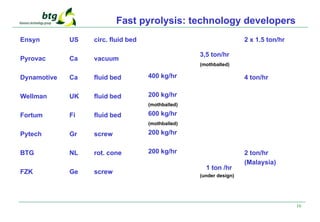
Fast pyrolysis: technology developers
Ensyn
Pyrovac
Dynamotive
Wellman
Fortum
Pytech
BTG
FZK
US
Ca
Ca
UK
Fi
Gr
NL
Ge
400 kg/hr
200 kg/hr
(mothballed) X
600 kg/hr
(mothballed) X
200 kg/hr
X
200 kg/hr
circ. fluid bed
vacuum
fluid bed
fluid bed
fluid bed
screw
rot. cone
screw
X
3,5 ton/hr
(mothballed)
X 1 ton /hr
(under design)
X
XX
XX
2 x 1.5 ton/hr
4 ton/hr
2 ton/hr
(Malaysia)
17
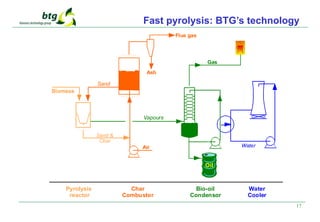
Biomass
Oil
Vapours
Sand
Pyrolysis
reactor
Char
Combustor
Bio-oil
Condensor
Water
Cooler
Sand &
Char
Ash
Flue gas
Water
Gas
Air
Fast pyrolysis: BTG’s technology
18
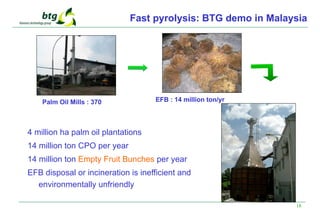
4 million ha palm oil plantations
14 million ton CPO per year
14 million ton Empty Fruit Bunches per year
EFB disposal or incineration is inefficient and
environmentally unfriendly
Palm Oil Mills : 370 EFB : 14 million ton/yr
Fast pyrolysis: BTG demo in Malaysia
19
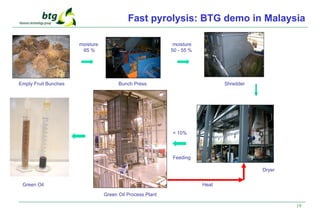
Shredder
Feeding
Bunch Press
Green Oil Process Plant
Dryer
Empty Fruit Bunches
Green Oil
Fast pyrolysis: BTG demo in Malaysia
Heat
moisture
65 %
moisture
50 - 55 %
< 10%
20
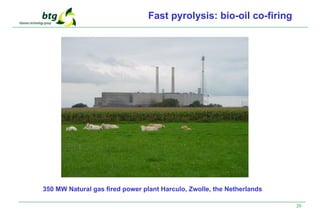
350 MW Natural gas fired power plant Harculo, Zwolle, the Netherlands
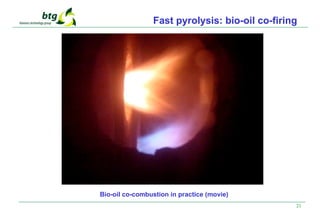
Fast pyrolysis: bio-oil co-firing
21
Bio-oil co-combustion in practice (movie)
Fast pyrolysis: bio-oil co-firing
22
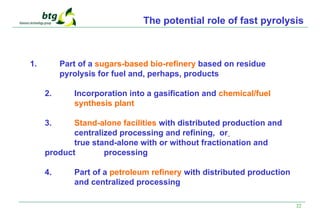
The potential role of fast pyrolysis
1. Part of a sugars-based bio-refinery based on residue
pyrolysis for fuel and, perhaps, products
2. Incorporation into a gasification and chemical/fuel
synthesis plant
3. Stand-alone facilities with distributed production and
centralized processing and refining, or
true stand-alone with or without fractionation and
product processing
4. Part of a petroleum refinery with distributed production
and centralized processing
23
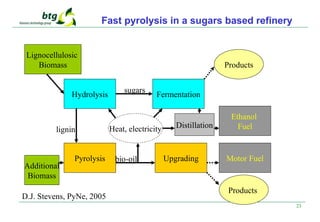
Fast pyrolysis in a sugars based refinery
Lignocellulosic
Biomass
Hydrolysis Fermentation
Upgrading
Pyrolysis
Ethanol
Fuel
Distillation
Products
Products
lignin
sugars
bio-oil
Additional
Biomass
Motor Fuel
D.J. Stevens, PyNe, 2005
Heat, electricity
24
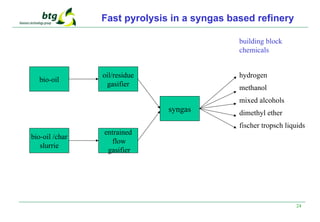
Fast pyrolysis in a syngas based refinery
bio-oil
bio-oil /char
slurrie
oil/residue
gasifier
entrained
flow
gasifier
syngas
building block
chemicals
hydrogen
methanol
mixed alcohols
dimethyl ether
fischer tropsch liquids
25
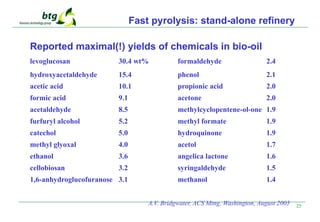
Fast pyrolysis: stand-alone refinery
Reported maximal(!) yields of chemicals in bio-oil
levoglucosan 30.4 wt% formaldehyde 2.4
hydroxyacetaldehyde 15.4 phenol 2.1
acetic acid 10.1 propionic acid 2.0
formic acid 9.1 acetone 2.0
acetaldehyde 8.5 methylcyclopentene-ol-one 1.9
furfuryl alcohol 5.2 methyl formate 1.9
catechol 5.0 hydroquinone 1.9
methyl glyoxal 4.0 acetol 1.7
ethanol 3.6 angelica lactone 1.6
cellobiosan 3.2 syringaldehyde 1.5
1,6-anhydroglucofuranose 3.1 methanol 1.4
A.V. Bridgwater, ACS Mtng, Washington, August 2005
26
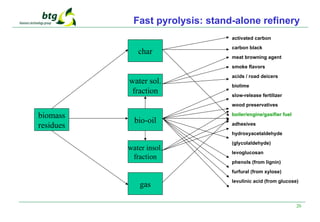
Fast pyrolysis: stand-alone refinery
activated carbon
carbon black
meat browning agent
smoke flavors
acids / road deicers
biolime
slow-release fertilizer
wood preservatives
boiler/engine/gasifier fuel
adhesives
hydroxyacetaldehyde
(glycolaldehyde)
levoglucosan
phenols (from lignin)
furfural (from xylose)
levulinic acid (from glucose)
biomass
residues
char
water sol.
fraction
bio-oil
water insol.
fraction
gas
27
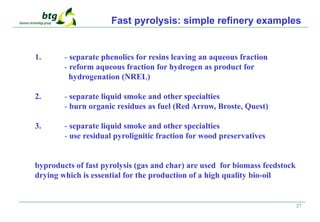
Fast pyrolysis: simple refinery examples
1. - separate phenolics for resins leaving an aqueous fraction
- reform aqueous fraction for hydrogen as product for
hydrogenation (NREL)
2. - separate liquid smoke and other specialties
- burn organic residues as fuel (Red Arrow, Broste, Quest)
3. - separate liquid smoke and other specialties
- use residual pyrolignitic fraction for wood preservatives
byproducts of fast pyrolysis (gas and char) are used for biomass feedstock
drying which is essential for the production of a high quality bio-oil
28
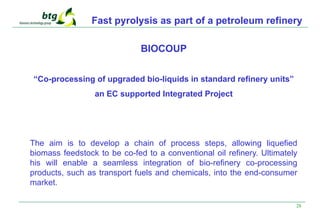
Fast pyrolysis as part of a petroleum refinery
BIOCOUP
“Co-processing of upgraded bio-liquids in standard refinery units”
an EC supported Integrated Project
The aim is to develop a chain of process steps, allowing liquefied
biomass feedstock to be co-fed to a conventional oil refinery. Ultimately
his will enable a seamless integration of bio-refinery co-processing
products, such as transport fuels and chemicals, into the end-consumer
market.
29
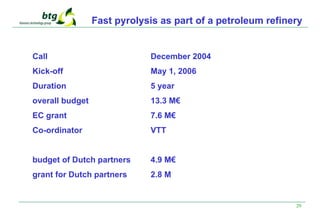
Fast pyrolysis as part of a petroleum refinery
Call December 2004
Kick-off May 1, 2006
Duration 5 year
overall budget 13.3 M€
EC grant 7.6 M€
Co-ordinator VTT
budget of Dutch partners 4.9 M€
grant for Dutch partners 2.8 M
30
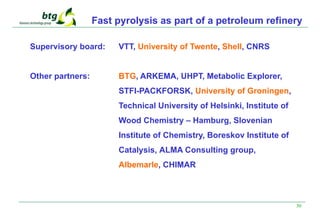
Fast pyrolysis as part of a petroleum refinery
Supervisory board: VTT, University of Twente, Shell, CNRS
Other partners: BTG, ARKEMA, UHPT, Metabolic Explorer,
STFI-PACKFORSK, University of Groningen,
Technical University of Helsinki, Institute of
Wood Chemistry – Hamburg, Slovenian
Institute of Chemistry, Boreskov Institute of
Catalysis, ALMA Consulting group,
Albemarle, CHIMAR
31
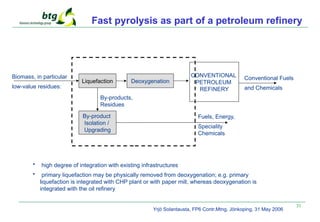
Fast pyrolysis as part of a petroleum refinery
CONVENTIONAL
PETROLEUM
REFINERY
Biomass, in particular
low-value residues:
Conventional Fuels
and Chemicals
Liquefaction Deoxygenation
By-products,
Residues
By-product
Isolation /
Upgrading
Fuels, Energy,
Speciality
Chemicals
• high degree of integration with existing infrastructures
• primary liquefaction may be physically removed from deoxygenation; e.g. primary
liquefaction is integrated with CHP plant or with paper mill, whereas deoxygenation is
integrated with the oil refinery
Yrjö Solantausta, FP6 Contr.Mtng, Jönkoping, 31 May 2006
32
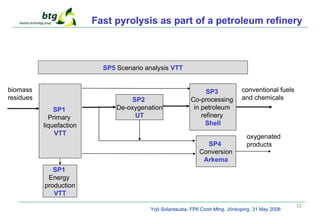
Fast pyrolysis as part of a petroleum refinery
SP1
Primary
liquefaction
VTT
SP1
Energy
production
VTT
SP2
De-oxygenation
UT
SP4
Conversion
Arkema
SP3
Co-processing
in petroleum
refinery
Shell
SP5 Scenario analysis VTT
biomass
residues
conventional fuels
and chemicals
oxygenated
products
Yrjö Solantausta, FP6 Contr.Mtng, Jönkoping, 31 May 2006
33
Conclusions
US have their own biorefinery strategy (bioethanol based)
Second generation processes must be developed (non-food
Chemicals from biomass can be produced from sugars/starch,
bio-syngas or fast-pyrolysis products
Biomass based industries often are fully developed bio
refineries (AVEBE, Unilever, etc. )
Numerous opportunities exist for fast pyrolyis-oil chemicals, but
they all still need to be developed
34
Conclusions
Two decades of science and technology development have shown
fast pyrolysis oil to be an attractive intermediate bio-fuel and source
of chemicals
The production technology is mature. BTG and Genting are
demonstrating EFB pyrolysis at a scale of 10 MWth (2 tons/hr).
Gasification of 8 tons bio-oil and co-combustion of 15 tons bio-oil
has been demonstrated.
The investment costs are estimated at 2.5 million €. Bio-oil
production costs are approximately 100 €/ton or 6 €/GJ.
35
Conclusions
THANK YOU

Biomass pyrolysis Wolter Prins presentation

  • 1.
    1 Biorefinery The role offast pyrolysis Wolter Prins BTG Biomass Technology Group BV Low density, hard to handle, non-uniform solid A versatile liquid
  • 2.
    2 1. Resources 2. Biomassbased industries 3. Biorefinery definition 4. Biorefinery opportunities 5. From biomass sugars to residues 6. Fast pyrolysis’ possible role 8. Conclusions Contents
  • 3.
    3 Origin: forestry, energycrops, agriculture, plantations Availability: about the current crude oil production (100 EJ) Use: 12 % of the world energy consumption (but mainly traditional!) Barriers: transport, bio-diversity / landscape, food competition, minerals and water, political issues, public acceptance, costs Resources
  • 4.
    4 Biomass-based industries Timber /Pulp and paper Food / Pharmaceutics Heat and power (4 % of the world energy consumption) Sugar based bio-chemicals (corn, potato, soybean, wheat) Bio-ethanol from sugar and starch Bio-diesel from plant oils (pressing)
  • 5.
    5 Biomass-refinery definition First Googlehits Cluster of biobased industries producing chemicals, fuels, power, products, and materials (Iowa State University) A biorefinery is a facility that integrates biomass conversion processes and equipment to produce fuels, power, and value- added chemicals from biomass. The biorefinery concept is analogous to today's petroleum refinery, which produce multiple fuels and products from petroleum. (Wikipedia)
  • 6.
    6 Biomass-refinery opportunities Timber /pulp and paper : residue combustion and gasification already implemented Food / Pharmaceutics: fully developed bio-refineries; residues maybe available Sugar / starch chemicals: fully developed bio-refineries; residues maybe available Bio-ethanol / Bio-diesel : lignin residues / glycerol Classic crude oil refinery: co-feeding opportunity for bio-liquids,
  • 7.
    7 Current bio-ethanol process CornDry Grind Liquefaction Scarification Fermentation Primary Distillation Distillation Rectifier Molecular Sieves Centrifuge Triple Effect Evaporator DDG Dryer DDG Animal Feed Ethanol Solids 50% EtOH 95% EtOH 100% EtOH Liquids Water Recycle Solids Received from Doug Elliott, PNL T.A. Werpy, Biorefineries, ACS Mtg, Washington, DC August 31, 2005
  • 8.
    8 Fuel from foodcrops? Drawbacks: - ethical (competition with food) - economical (food part of the plant has the highest value - CO2 reduction effect from the entire energy balance is limited - huge quantities of food crops required Second generation bio-fuels must be derived from biomass residues instead of food crops Leo Petrus, Shell Venster, maart/april 2006
  • 9.
    9 Lignocellulosic Biomass Hydrolysis Fermentation Mixed Alcohol Synthesis Gasification Ethanol Fuel Distillation Products Products (higheralcohols) lignin sugars syngas Additional Biomass Heat, electricity D.J. Stevens, PyNe, 2005 US view of the bio-ethanol refinery
  • 10.
    10 From biomass sugarsto biomass residues Challenge: produce energy and chemicals from biomass residues (lignocellulosic materials) Difficulty: residues cannot be de-polymerized to a single monomer building block for chemicals and fuels Solution 1: complete thermal cracking to bio-syngas as a basis for fuels and chemicals production Solution 2: partial thermal decomposition to “fast pyrolysis oil” and by-products
  • 11.
    11 Fast pyrolysis: fundamentals FastPyrolysis principle Random chemical degradation due to rapid heating in absence of oxygen Proces characteristics Temperature Pressure Particle size  vapours The main product is a liquid: Bio-oil (70 - 80 wt.%) 500 o C 1 atm < 5 mm < 2 sec   
  • 12.
    12 Fast pyrolysis: drivers Drivers Simplebiomass liquefaction process • de-coupling of production and utilization • favorable liquid properties • energy densification • homogenization/ purification
  • 13.
    13 Fast pyrolysis: bio-oilproperties 1 MJ Product 1 MJ Feedstock Vol. energy density Bio-oil density Viscosity at 50 o C Oil acidity Oil water content Ash content 21 1220 13 3 20 0.02 Quantity 39 963 351 7 0.1 0.03 Bio-oil Heavy fuel oil Unit GJ/m3 kg/m3 mm2 /s Ph wt.% wt.%
  • 14.
    14 Fast pyrolysis: chemicalsin bio-oil Number of acids 12 sugars 8 aldehydes 5 esters 1 alcohols 4 ketones 32 phenolics 56 oxygenates 16 steroids 15 hydrocarbons 6 162 chemicals regularly identified A.V. Bridgwater, ACS Mtng, Washington, August 2005
  • 15.
    15 Fast pyrolysis: bio-oilapplications • Co-firing/ Co-gasification • Boilers stand-alone • Diesel - CHP • Micro turbine • Syngas • Hydrogen • Transportation fuel - upgrading
  • 16.
    16 Fast pyrolysis: technologydevelopers Ensyn Pyrovac Dynamotive Wellman Fortum Pytech BTG FZK US Ca Ca UK Fi Gr NL Ge 400 kg/hr 200 kg/hr (mothballed) X 600 kg/hr (mothballed) X 200 kg/hr X 200 kg/hr circ. fluid bed vacuum fluid bed fluid bed fluid bed screw rot. cone screw X 3,5 ton/hr (mothballed) X 1 ton /hr (under design) X XX XX 2 x 1.5 ton/hr 4 ton/hr 2 ton/hr (Malaysia)
  • 17.
  • 18.
    18 4 million hapalm oil plantations 14 million ton CPO per year 14 million ton Empty Fruit Bunches per year EFB disposal or incineration is inefficient and environmentally unfriendly Palm Oil Mills : 370 EFB : 14 million ton/yr Fast pyrolysis: BTG demo in Malaysia
  • 19.
    19 Shredder Feeding Bunch Press Green OilProcess Plant Dryer Empty Fruit Bunches Green Oil Fast pyrolysis: BTG demo in Malaysia Heat moisture 65 % moisture 50 - 55 % < 10%
  • 20.
    20 350 MW Naturalgas fired power plant Harculo, Zwolle, the Netherlands Fast pyrolysis: bio-oil co-firing
  • 21.
    21 Bio-oil co-combustion inpractice (movie) Fast pyrolysis: bio-oil co-firing
  • 22.
    22 The potential roleof fast pyrolysis 1. Part of a sugars-based bio-refinery based on residue pyrolysis for fuel and, perhaps, products 2. Incorporation into a gasification and chemical/fuel synthesis plant 3. Stand-alone facilities with distributed production and centralized processing and refining, or true stand-alone with or without fractionation and product processing 4. Part of a petroleum refinery with distributed production and centralized processing
  • 23.
    23 Fast pyrolysis ina sugars based refinery Lignocellulosic Biomass Hydrolysis Fermentation Upgrading Pyrolysis Ethanol Fuel Distillation Products Products lignin sugars bio-oil Additional Biomass Motor Fuel D.J. Stevens, PyNe, 2005 Heat, electricity
  • 24.
    24 Fast pyrolysis ina syngas based refinery bio-oil bio-oil /char slurrie oil/residue gasifier entrained flow gasifier syngas building block chemicals hydrogen methanol mixed alcohols dimethyl ether fischer tropsch liquids
  • 25.
    25 Fast pyrolysis: stand-alonerefinery Reported maximal(!) yields of chemicals in bio-oil levoglucosan 30.4 wt% formaldehyde 2.4 hydroxyacetaldehyde 15.4 phenol 2.1 acetic acid 10.1 propionic acid 2.0 formic acid 9.1 acetone 2.0 acetaldehyde 8.5 methylcyclopentene-ol-one 1.9 furfuryl alcohol 5.2 methyl formate 1.9 catechol 5.0 hydroquinone 1.9 methyl glyoxal 4.0 acetol 1.7 ethanol 3.6 angelica lactone 1.6 cellobiosan 3.2 syringaldehyde 1.5 1,6-anhydroglucofuranose 3.1 methanol 1.4 A.V. Bridgwater, ACS Mtng, Washington, August 2005
  • 26.
    26 Fast pyrolysis: stand-alonerefinery activated carbon carbon black meat browning agent smoke flavors acids / road deicers biolime slow-release fertilizer wood preservatives boiler/engine/gasifier fuel adhesives hydroxyacetaldehyde (glycolaldehyde) levoglucosan phenols (from lignin) furfural (from xylose) levulinic acid (from glucose) biomass residues char water sol. fraction bio-oil water insol. fraction gas
  • 27.
    27 Fast pyrolysis: simplerefinery examples 1. - separate phenolics for resins leaving an aqueous fraction - reform aqueous fraction for hydrogen as product for hydrogenation (NREL) 2. - separate liquid smoke and other specialties - burn organic residues as fuel (Red Arrow, Broste, Quest) 3. - separate liquid smoke and other specialties - use residual pyrolignitic fraction for wood preservatives byproducts of fast pyrolysis (gas and char) are used for biomass feedstock drying which is essential for the production of a high quality bio-oil
  • 28.
    28 Fast pyrolysis aspart of a petroleum refinery BIOCOUP “Co-processing of upgraded bio-liquids in standard refinery units” an EC supported Integrated Project The aim is to develop a chain of process steps, allowing liquefied biomass feedstock to be co-fed to a conventional oil refinery. Ultimately his will enable a seamless integration of bio-refinery co-processing products, such as transport fuels and chemicals, into the end-consumer market.
  • 29.
    29 Fast pyrolysis aspart of a petroleum refinery Call December 2004 Kick-off May 1, 2006 Duration 5 year overall budget 13.3 M€ EC grant 7.6 M€ Co-ordinator VTT budget of Dutch partners 4.9 M€ grant for Dutch partners 2.8 M
  • 30.
    30 Fast pyrolysis aspart of a petroleum refinery Supervisory board: VTT, University of Twente, Shell, CNRS Other partners: BTG, ARKEMA, UHPT, Metabolic Explorer, STFI-PACKFORSK, University of Groningen, Technical University of Helsinki, Institute of Wood Chemistry – Hamburg, Slovenian Institute of Chemistry, Boreskov Institute of Catalysis, ALMA Consulting group, Albemarle, CHIMAR
  • 31.
    31 Fast pyrolysis aspart of a petroleum refinery CONVENTIONAL PETROLEUM REFINERY Biomass, in particular low-value residues: Conventional Fuels and Chemicals Liquefaction Deoxygenation By-products, Residues By-product Isolation / Upgrading Fuels, Energy, Speciality Chemicals • high degree of integration with existing infrastructures • primary liquefaction may be physically removed from deoxygenation; e.g. primary liquefaction is integrated with CHP plant or with paper mill, whereas deoxygenation is integrated with the oil refinery Yrjö Solantausta, FP6 Contr.Mtng, Jönkoping, 31 May 2006
  • 32.
    32 Fast pyrolysis aspart of a petroleum refinery SP1 Primary liquefaction VTT SP1 Energy production VTT SP2 De-oxygenation UT SP4 Conversion Arkema SP3 Co-processing in petroleum refinery Shell SP5 Scenario analysis VTT biomass residues conventional fuels and chemicals oxygenated products Yrjö Solantausta, FP6 Contr.Mtng, Jönkoping, 31 May 2006
  • 33.
    33 Conclusions US have theirown biorefinery strategy (bioethanol based) Second generation processes must be developed (non-food Chemicals from biomass can be produced from sugars/starch, bio-syngas or fast-pyrolysis products Biomass based industries often are fully developed bio refineries (AVEBE, Unilever, etc. ) Numerous opportunities exist for fast pyrolyis-oil chemicals, but they all still need to be developed
  • 34.
    34 Conclusions Two decades ofscience and technology development have shown fast pyrolysis oil to be an attractive intermediate bio-fuel and source of chemicals The production technology is mature. BTG and Genting are demonstrating EFB pyrolysis at a scale of 10 MWth (2 tons/hr). Gasification of 8 tons bio-oil and co-combustion of 15 tons bio-oil has been demonstrated. The investment costs are estimated at 2.5 million €. Bio-oil production costs are approximately 100 €/ton or 6 €/GJ.
  • 35.