Bioprinting Vessel-like Constructs
Using Hyaluronan Hydrogels
Crosslinked With Tetrahedral
Polyethylene Glycol Tetracrylates
Aleksander Skardal, Jianxing Zhang, Glenn D.
Prestwich
by,
Syed Baseeruddin Alvi
BM16RESCH11005
Sub: Bio fabrication
Content
• Introduction
• Literature
• Materials & Method
• Results
• Importance
• Drawbacks
• Conclusion
Introduction
• Tissue engineering is an emerging field which allows us to generate
tissues mimicking that of a natural system.
• The ultimate goal of tissue engineering is to fabricate a fully functional
organ, that can perform all the complex functions.
• Mimicking the vascular architecture of a tissue is a mile stone in tissue
engineering.
• An engineered blood vessel that posses compliance, lack of
thrombogenicity, ability to heal, contract, remodel, secret normal blood
vessel products can be of great importance.
• Problem statement: fabrication of a miniaturized blood vessel is
difficult with the existing modalities.
Literature review
• Electrospinning of collagen, elastin, and synthetic polymer nano- fibers into
lumenized scaffolds and centrifugal casting of hyaluronic acid (HA) hydrogels into
cellularized hydrogel tubes have yielded tubular structures
• In a related approach, smooth muscle cells and fibroblasts were cultured in the
presence of ascorbic acid to create cohesive cellular sheets, which were then
wrapped around a mandrel and seeded with endothelial cells to form three-layered
tubes (Cytograft’s Lifeline)
Materials & Method
• Chemical synthesis of TetraPEG intermediates and
TetraPAc crosslinkers
– four-armed PEG derivatives, TetraPEG8 with four PEG 2000
chains and TetraPEG13 with four PEG 3400 chains
– TetraPEG tetra-acrylate deriva- tives (TetraPAcs) to co-
crosslink thiolated hyaluronic acid
• Rheology: Rheometer
• Biocompatibility:
– Murine fibroblasts (NIH 3T3), human hepatoma cells (HepG2
C3A), and human intestinal epithelial cells (Int 407).
– cell viability was determined using MTS assays at day 3 and
day 7.
• Bioprinting of hydrogel macrofilaments
– 1 million (M), 5 M, 10 M, 25 M, 100 M, 250, M, and 500 M
cells of each type were added to hydrogel and gelation was
observed after 1h incubation.
Materials & Method
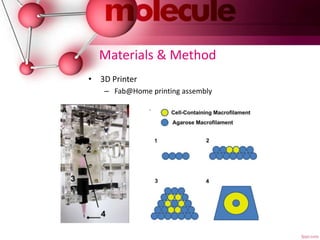
• 3D Printer
– Fab@Home printing assembly
Results
• Rheology:
– The TetraPAc crosslinked hydrogels were significantly stiffer than the
corresponding PEGDA-crosslinked hydrogels at weight/volume percentages
of 1.0%, 1.5%, and 2% for both TetraPAc8 or TetraPac13 gels.
Biocompatibility
Cell growth and proliferation were
assessed on day 3 and day 7 after
encapsulation in the PEGDA, TetraPAc8,
and TetraPAc13 hydrogels using an MTS
assay. Three cell types were evaluated in
each hydrogel, and increased proliferation
was observed at day 7 compared to day 3
for each experimental group.
Cell viability
Cross-sectional views of the bioprinted construct taken (A) immediately after
printing with encapsulated a fluorescent HA-BODIPY tracer for increased
visualization, (B) at 14 days, and (C) at 28 days of culture using LIVE/DEAD
staining to highlight viable and dead cells. Green fluorescence indicates calcein
AM-stained live cells and red fluorescence indicates ethidium homodimer-1-
stained dead cells
Importance of the work
• Engineering of tissue-like constructs on a human-relevant size scale
is limited by diffusion of nutrients and oxygen to the cells within the
construct. By incorporating functional vasculature into engineered
tissue constructs, the size and complexity of engineered constructs
can be increased and viability can be maintained
• HA-based sECM exhibits necessary physical and mechanical
properties to be easily printable
• Fab@Home system can be customizable and comparatively
economical alternative to conventional bio printers.
Drawbacks
• Medium-resolution printing of millimeter to
centimeter scale geometries.
• Time-consuming
• lacks efficiency
Conclusion
HA sECM hydrogels are easy to prepare and fully biocompatible
and allows higher cell entrapment, extruded cellularized sECM
macrofilaments held their shape both during and after
bioprinting. These structures maintained viability in culture for
up to 4 weeks. Thus providing an alternative to existing
modalities.

Vascular Biofabrication using 3D Bioprinting

  • 1.
    Bioprinting Vessel-like Constructs UsingHyaluronan Hydrogels Crosslinked With Tetrahedral Polyethylene Glycol Tetracrylates Aleksander Skardal, Jianxing Zhang, Glenn D. Prestwich by, Syed Baseeruddin Alvi BM16RESCH11005 Sub: Bio fabrication
  • 2.
    Content • Introduction • Literature •Materials & Method • Results • Importance • Drawbacks • Conclusion
  • 3.
    Introduction • Tissue engineeringis an emerging field which allows us to generate tissues mimicking that of a natural system. • The ultimate goal of tissue engineering is to fabricate a fully functional organ, that can perform all the complex functions. • Mimicking the vascular architecture of a tissue is a mile stone in tissue engineering. • An engineered blood vessel that posses compliance, lack of thrombogenicity, ability to heal, contract, remodel, secret normal blood vessel products can be of great importance. • Problem statement: fabrication of a miniaturized blood vessel is difficult with the existing modalities.
  • 4.
    Literature review • Electrospinningof collagen, elastin, and synthetic polymer nano- fibers into lumenized scaffolds and centrifugal casting of hyaluronic acid (HA) hydrogels into cellularized hydrogel tubes have yielded tubular structures • In a related approach, smooth muscle cells and fibroblasts were cultured in the presence of ascorbic acid to create cohesive cellular sheets, which were then wrapped around a mandrel and seeded with endothelial cells to form three-layered tubes (Cytograft’s Lifeline)
  • 5.
    Materials & Method •Chemical synthesis of TetraPEG intermediates and TetraPAc crosslinkers – four-armed PEG derivatives, TetraPEG8 with four PEG 2000 chains and TetraPEG13 with four PEG 3400 chains – TetraPEG tetra-acrylate deriva- tives (TetraPAcs) to co- crosslink thiolated hyaluronic acid • Rheology: Rheometer • Biocompatibility: – Murine fibroblasts (NIH 3T3), human hepatoma cells (HepG2 C3A), and human intestinal epithelial cells (Int 407). – cell viability was determined using MTS assays at day 3 and day 7. • Bioprinting of hydrogel macrofilaments – 1 million (M), 5 M, 10 M, 25 M, 100 M, 250, M, and 500 M cells of each type were added to hydrogel and gelation was observed after 1h incubation.
  • 6.
    Materials & Method •3D Printer – Fab@Home printing assembly
  • 7.
    Results • Rheology: – TheTetraPAc crosslinked hydrogels were significantly stiffer than the corresponding PEGDA-crosslinked hydrogels at weight/volume percentages of 1.0%, 1.5%, and 2% for both TetraPAc8 or TetraPac13 gels.
  • 8.
    Biocompatibility Cell growth andproliferation were assessed on day 3 and day 7 after encapsulation in the PEGDA, TetraPAc8, and TetraPAc13 hydrogels using an MTS assay. Three cell types were evaluated in each hydrogel, and increased proliferation was observed at day 7 compared to day 3 for each experimental group.
  • 9.
    Cell viability Cross-sectional viewsof the bioprinted construct taken (A) immediately after printing with encapsulated a fluorescent HA-BODIPY tracer for increased visualization, (B) at 14 days, and (C) at 28 days of culture using LIVE/DEAD staining to highlight viable and dead cells. Green fluorescence indicates calcein AM-stained live cells and red fluorescence indicates ethidium homodimer-1- stained dead cells
  • 10.
    Importance of thework • Engineering of tissue-like constructs on a human-relevant size scale is limited by diffusion of nutrients and oxygen to the cells within the construct. By incorporating functional vasculature into engineered tissue constructs, the size and complexity of engineered constructs can be increased and viability can be maintained • HA-based sECM exhibits necessary physical and mechanical properties to be easily printable • Fab@Home system can be customizable and comparatively economical alternative to conventional bio printers.
  • 11.
    Drawbacks • Medium-resolution printingof millimeter to centimeter scale geometries. • Time-consuming • lacks efficiency
  • 12.
    Conclusion HA sECM hydrogelsare easy to prepare and fully biocompatible and allows higher cell entrapment, extruded cellularized sECM macrofilaments held their shape both during and after bioprinting. These structures maintained viability in culture for up to 4 weeks. Thus providing an alternative to existing modalities.