Presentation
Topic:
Binomial Probability
Distribution
By: Muhammad Tufail
R.No: 34
Class: BCS(Open)- 3rd
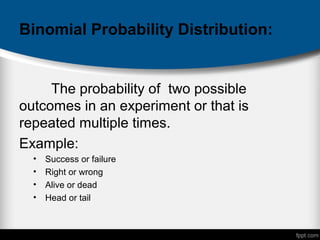
Binomial Probability Distribution:
The probability of two possible
outcomes in an experiment or that is
repeated multiple times.
Example:
• Success or failure
• Right or wrong
• Alive or dead
• Head or tail
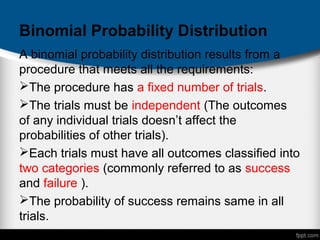
Binomial Probability Distribution
A binomial probability distribution results from a
procedure that meets all the requirements:
The procedure has a fixed number of trials.
The trials must be independent (The outcomes
of any individual trials doesn’t affect the
probabilities of other trials).
Each trials must have all outcomes classified into
two categories (commonly referred to as success
and failure ).
The probability of success remains same in all
trials.
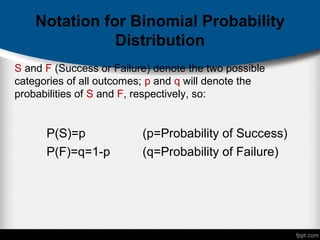
Notation for Binomial Probability
Distribution
S and F (Success or Failure) denote the two possible
categories of all outcomes; p and q will denote the
probabilities of S and F, respectively, so:
P(S)=p (p=Probability of Success)
P(F)=q=1-p (q=Probability of Failure)
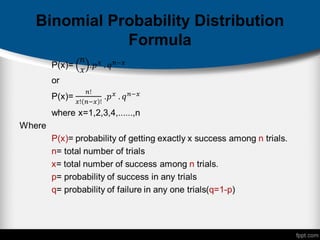
Binomial Probability Distribution
Formula
Binomial Probability Distribution
Question-1: Toss a coin for 12 times. What
is the probability of getting exactly 7 heads?
Question-2: A fair is tossed 5 times. Find the
probability of obtaining various numbers of
heads.
Binomial Probability Distribution
Question-1: Toss a coin for 12 times. What
is the probability of getting exactly 7 heads?
Question-2: A fair is tossed 5 times. Find the
probability of obtaining various numbers of
heads.

Binomial Probability Distribution

  • 1.
  • 2.
    Binomial Probability Distribution: Theprobability of two possible outcomes in an experiment or that is repeated multiple times. Example: • Success or failure • Right or wrong • Alive or dead • Head or tail
  • 3.
    Binomial Probability Distribution Abinomial probability distribution results from a procedure that meets all the requirements: The procedure has a fixed number of trials. The trials must be independent (The outcomes of any individual trials doesn’t affect the probabilities of other trials). Each trials must have all outcomes classified into two categories (commonly referred to as success and failure ). The probability of success remains same in all trials.
  • 4.
    Notation for BinomialProbability Distribution S and F (Success or Failure) denote the two possible categories of all outcomes; p and q will denote the probabilities of S and F, respectively, so: P(S)=p (p=Probability of Success) P(F)=q=1-p (q=Probability of Failure)
  • 5.
  • 6.
    Binomial Probability Distribution Question-1:Toss a coin for 12 times. What is the probability of getting exactly 7 heads? Question-2: A fair is tossed 5 times. Find the probability of obtaining various numbers of heads.
  • 7.
    Binomial Probability Distribution Question-1:Toss a coin for 12 times. What is the probability of getting exactly 7 heads? Question-2: A fair is tossed 5 times. Find the probability of obtaining various numbers of heads.