BINOMIAL
PROBABILITY
DISTRIBUTION
BASICS & TERMINOLOGY:
> Outcome:- The end result of an experiment.
> Random experiment
predictable.
> Random Event:- A
Experiments whose outcomes are not
random event is an outcome or set of
outcomes of a random experiment that share a common attribute.
> Sample space:- The sample space is an exhaustive list of all the
possible outcomes of an experiment, which is usually denoted
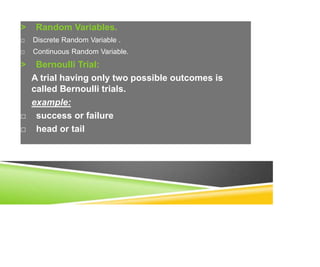
> Random Variables.
□ Discrete Random Variable .
□ Continuous Random Variable.
> Bernoulli Trial:
A trial having only two possible outcomes is
called Bernoulli trials.
example:
□ success or failure
□ head or tail
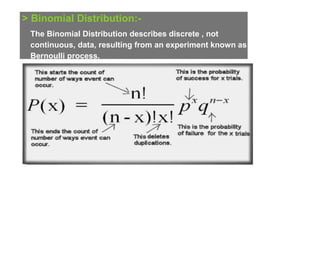
> Binomial Distribution:-
The Binomial Distribution describes discrete , not
continuous, data, resulting from an experiment known as
Bernoulli process.
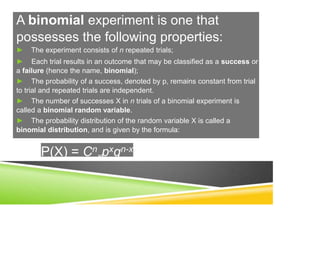
A binomial experiment is one that
possesses the following properties:
► The experiment consists of n repeated trials;
► Each trial results in an outcome that may be classified as a success or
a failure (hence the name, binomial);
► The probability of a success, denoted by p, remains constant from trial
to trial and repeated trials are independent.
► The number of successes X in n trials of a binomial experiment is
called a binomial random variable.
► The probability distribution of the random variable X is called a
binomial distribution, and is given by the formula:
P(X) = Cn
xpxqn-x
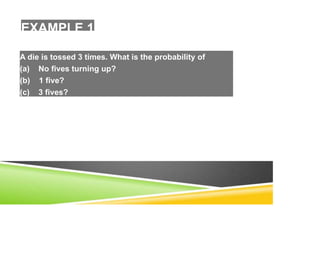
EXAMPLE 1
A die is tossed 3 times. What is the probability of
(a) No fives turning up?
(b) 1 five?
(c) 3 fives?
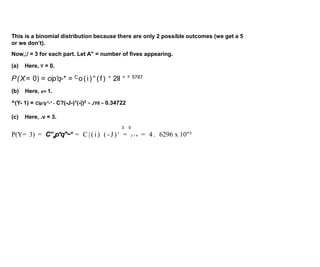
This is a binomial distribution because there are only 2 possible outcomes (we get a 5
or we don’t).
Now,;/ = 3 for each part. Let A" = number of fives appearing.
(a) Here, Y = 0.
P(X= 0) = cip'q-* = Co(i)°(f) = 2ll = ° 5787
(b) Here, x= 1.
^(Y- 1) = Clp'q”-* - C?(-J-)1(-|)2 ~ JY6 ~ 0.34722
(c) Here, .v = 3.
3 0
P(Y= 3) = C”xp*q"~* = C | ( i ) ( - J ) ' = 2 1 6 = 4 . 6296 x 10"3
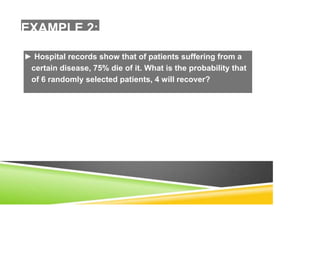
EXAMPLE 2:
► Hospital records show that of patients suffering from a
certain disease, 75% die of it. What is the probability that
of 6 randomly selected patients, 4 will recover?
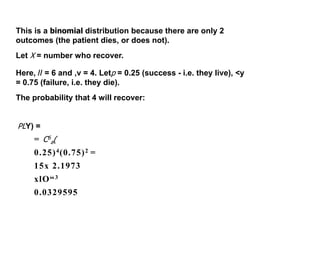
This is a binomial distribution because there are only 2
outcomes (the patient dies, or does not).
Let X = number who recover.
Here, // = 6 and ,v = 4. Letp = 0.25 (success - i.e. they live), <y
= 0.75 (failure, i.e. they die).
The probability that 4 will recover:
PLY) =
= C6
a(
0.25)4(0.75)2 =
15x 2.1973
xlO“3
0.0329595
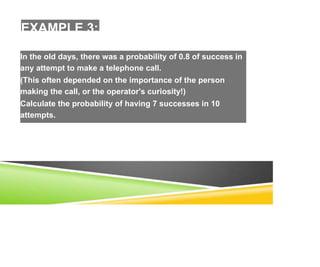
EXAMPLE 3:
In the old days, there was a probability of 0.8 of success in
any attempt to make a telephone call.
(This often depended on the importance of the person
making the call, or the operator's curiosity!)
Calculate the probability of having 7 successes in 10
attempts.
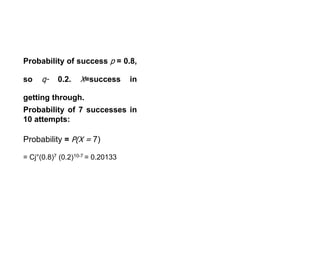
Probability of success p = 0.8,
so q- 0.2. X=success in
getting through.
Probability of 7 successes in
10 attempts:
Probability = P(X = 7)
= Cj°(0.8)7 (0.2)10-7 = 0.20133
EXAMPLE 4:
The ratio of boys to girls at birth in Singapore is quite high at
1.09:1.
What proportion of Singapore families with exactly 6 children
will have at least 3 boys?
(Ignore the probability of multiple births.)
[Interesting and disturbing trivia: In most countries the
ratio of boys to girls is about 1.04:1, but in China it is
1.15:1.]
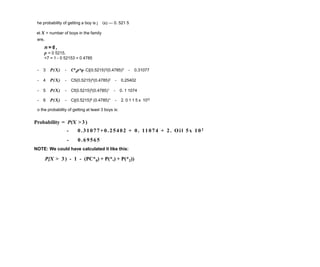
he probability of getting a boy is j QQ — 0. 521 5
et X = number of boys in the family
ere,
n = 6 ,
p = 0 5215,
<7 = 1 - 0 52153 = 0 4785
- 3 P(X) - Cn
xp*q- C|(0.5215)3(0.4785)3 - 0.31077
- 4 P(X) - C5(0.5215)4(0.4785)2 - 0.25402
- 5 P(X) - Cf(0.5215)5(0.4785)1 - 0. 1 1074
- 6 P(X) - C|(0.5215)6 (0.4785)° - 2. 0 1 1 5 x 10'2
o the probability of getting at least 3 boys is:
Probability = P(X >3)
- 0.31077+0.25402 + 0. 11074 + 2. Oil 5x 10²
- 0.69565
NOTE: We could have calculated it like this:
P{X > 3) - 1 - (PC*0) + P(*,) + P(*2))
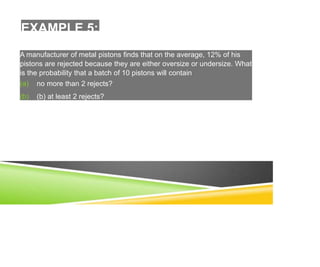
EXAMPLE 5:
A manufacturer of metal pistons finds that on the average, 12% of his
pistons are rejected because they are either oversize or undersize. What
is the probability that a batch of 10 pistons will contain
(a) no more than 2 rejects?
(b) (b) at least 2 rejects?
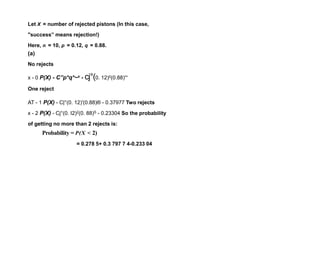
Let X = number of rejected pistons (In this case,
"success” means rejection!)
Here, n = 10, p = 0.12, q = 0.88.
(a)
No rejects
x - 0 P(X) - C”p*q*~x - cj°(0. 12)0(0.88)'°
One reject
AT - 1 P(X) - C|°(0. 12)'(0.88)® - 0.37977 Two rejects
x - 2 P(X) - Cj°(0. I2)2(0. 88)S - 0.23304 So the probability
of getting no more than 2 rejects is:
Probability = P(X < 2)
= 0.278 5+ 0.3 797 7 4-0.233 04
ptoceed 3$ Mows.
probabilityofatleast 2 reject*
.t-(PW+PW)
3 -(0W+0.3WT)
- 0.24H2
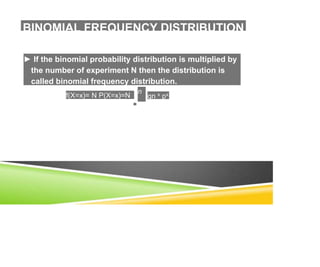
BINOMIAL FREQUENCY DISTRIBUTION
► If the binomial probability distribution is multiplied by
the number of experiment N then the distribution is
called binomial frequency distribution.
f(X=x)= N P(X=x)=N
v.
n
x
qn x px
MEAN & VARIANCE:
Mean, p = n*p
Std. Dev. s = V ” * P
Variance, s2 =n*p*q
Where
n = number of fixed trials p = probability of
success in one of the n trials q = probability of
failure in one of the n trials
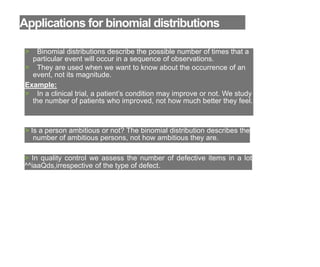
Applications for binomial distributions
> Binomial distributions describe the possible number of times that a
particular event will occur in a sequence of observations.
> They are used when we want to know about the occurrence of an
event, not its magnitude.
Example:
> In a clinical trial, a patient’s condition may improve or not. We study
the number of patients who improved, not how much better they feel.
> Is a person ambitious or not? The binomial distribution describes the
number of ambitious persons, not how ambitious they are.
> In quality control we assess the number of defective items in a lot
^^iaaQds,irrespective of the type of defect.
binomialprobabilitydistribution-160303055131.ppt

binomialprobabilitydistribution-160303055131.ppt

  • 1.
  • 2.
    BASICS & TERMINOLOGY: >Outcome:- The end result of an experiment. > Random experiment predictable. > Random Event:- A Experiments whose outcomes are not random event is an outcome or set of outcomes of a random experiment that share a common attribute. > Sample space:- The sample space is an exhaustive list of all the possible outcomes of an experiment, which is usually denoted
  • 3.
    > Random Variables. □Discrete Random Variable . □ Continuous Random Variable. > Bernoulli Trial: A trial having only two possible outcomes is called Bernoulli trials. example: □ success or failure □ head or tail
  • 4.
    > Binomial Distribution:- TheBinomial Distribution describes discrete , not continuous, data, resulting from an experiment known as Bernoulli process.
  • 5.
    A binomial experimentis one that possesses the following properties: ► The experiment consists of n repeated trials; ► Each trial results in an outcome that may be classified as a success or a failure (hence the name, binomial); ► The probability of a success, denoted by p, remains constant from trial to trial and repeated trials are independent. ► The number of successes X in n trials of a binomial experiment is called a binomial random variable. ► The probability distribution of the random variable X is called a binomial distribution, and is given by the formula: P(X) = Cn xpxqn-x
  • 6.
    EXAMPLE 1 A dieis tossed 3 times. What is the probability of (a) No fives turning up? (b) 1 five? (c) 3 fives?
  • 7.
    This is abinomial distribution because there are only 2 possible outcomes (we get a 5 or we don’t). Now,;/ = 3 for each part. Let A" = number of fives appearing. (a) Here, Y = 0. P(X= 0) = cip'q-* = Co(i)°(f) = 2ll = ° 5787 (b) Here, x= 1. ^(Y- 1) = Clp'q”-* - C?(-J-)1(-|)2 ~ JY6 ~ 0.34722 (c) Here, .v = 3. 3 0 P(Y= 3) = C”xp*q"~* = C | ( i ) ( - J ) ' = 2 1 6 = 4 . 6296 x 10"3
  • 8.
    EXAMPLE 2: ► Hospitalrecords show that of patients suffering from a certain disease, 75% die of it. What is the probability that of 6 randomly selected patients, 4 will recover?
  • 9.
    This is abinomial distribution because there are only 2 outcomes (the patient dies, or does not). Let X = number who recover. Here, // = 6 and ,v = 4. Letp = 0.25 (success - i.e. they live), <y = 0.75 (failure, i.e. they die). The probability that 4 will recover: PLY) = = C6 a( 0.25)4(0.75)2 = 15x 2.1973 xlO“3 0.0329595
  • 10.
    EXAMPLE 3: In theold days, there was a probability of 0.8 of success in any attempt to make a telephone call. (This often depended on the importance of the person making the call, or the operator's curiosity!) Calculate the probability of having 7 successes in 10 attempts.
  • 11.
    Probability of successp = 0.8, so q- 0.2. X=success in getting through. Probability of 7 successes in 10 attempts: Probability = P(X = 7) = Cj°(0.8)7 (0.2)10-7 = 0.20133
  • 13.
    EXAMPLE 4: The ratioof boys to girls at birth in Singapore is quite high at 1.09:1. What proportion of Singapore families with exactly 6 children will have at least 3 boys? (Ignore the probability of multiple births.) [Interesting and disturbing trivia: In most countries the ratio of boys to girls is about 1.04:1, but in China it is 1.15:1.]
  • 14.
    he probability ofgetting a boy is j QQ — 0. 521 5 et X = number of boys in the family ere, n = 6 , p = 0 5215, <7 = 1 - 0 52153 = 0 4785 - 3 P(X) - Cn xp*q- C|(0.5215)3(0.4785)3 - 0.31077 - 4 P(X) - C5(0.5215)4(0.4785)2 - 0.25402 - 5 P(X) - Cf(0.5215)5(0.4785)1 - 0. 1 1074 - 6 P(X) - C|(0.5215)6 (0.4785)° - 2. 0 1 1 5 x 10'2 o the probability of getting at least 3 boys is: Probability = P(X >3) - 0.31077+0.25402 + 0. 11074 + 2. Oil 5x 10² - 0.69565 NOTE: We could have calculated it like this: P{X > 3) - 1 - (PC*0) + P(*,) + P(*2))
  • 15.
    EXAMPLE 5: A manufacturerof metal pistons finds that on the average, 12% of his pistons are rejected because they are either oversize or undersize. What is the probability that a batch of 10 pistons will contain (a) no more than 2 rejects? (b) (b) at least 2 rejects?
  • 16.
    Let X =number of rejected pistons (In this case, "success” means rejection!) Here, n = 10, p = 0.12, q = 0.88. (a) No rejects x - 0 P(X) - C”p*q*~x - cj°(0. 12)0(0.88)'° One reject AT - 1 P(X) - C|°(0. 12)'(0.88)® - 0.37977 Two rejects x - 2 P(X) - Cj°(0. I2)2(0. 88)S - 0.23304 So the probability of getting no more than 2 rejects is: Probability = P(X < 2) = 0.278 5+ 0.3 797 7 4-0.233 04
  • 17.
    ptoceed 3$ Mows. probabilityofatleast2 reject* .t-(PW+PW) 3 -(0W+0.3WT) - 0.24H2
  • 18.
    BINOMIAL FREQUENCY DISTRIBUTION ►If the binomial probability distribution is multiplied by the number of experiment N then the distribution is called binomial frequency distribution. f(X=x)= N P(X=x)=N v. n x qn x px
  • 19.
    MEAN & VARIANCE: Mean,p = n*p Std. Dev. s = V ” * P Variance, s2 =n*p*q Where n = number of fixed trials p = probability of success in one of the n trials q = probability of failure in one of the n trials
  • 20.
    Applications for binomialdistributions > Binomial distributions describe the possible number of times that a particular event will occur in a sequence of observations. > They are used when we want to know about the occurrence of an event, not its magnitude. Example: > In a clinical trial, a patient’s condition may improve or not. We study the number of patients who improved, not how much better they feel. > Is a person ambitious or not? The binomial distribution describes the number of ambitious persons, not how ambitious they are. > In quality control we assess the number of defective items in a lot ^^iaaQds,irrespective of the type of defect.