Binomial
Distribution
CONTENTS
 Introduction
 What is binomial distribution?
 Formula of binomial distribution
 Problem
 Applications of binomial distribution
INTRODUCTION
 Binomial distribution was discovered by JAMES
BERNOILLI in 1738.
 This is a discrete probability distribution.
 Binomial Distribution in Probability can be
implemented when there are two possible
outcomes i.e. Success or Failure
What is binomial distribution?
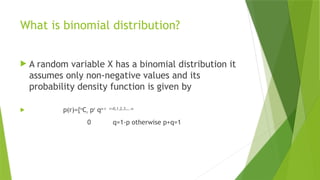
 A random variable X has a binomial distribution it
assumes only non-negative values and its
probability density function is given by
 p(r)={n
Cr pr
qn-r r=0,1,2,3…..n
0 q=1-p otherwise p+q=1
Formulas of binomial distributions
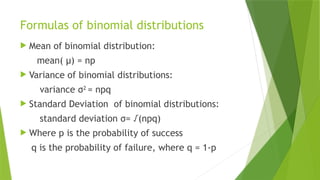
 Mean of binomial distribution:
mean( μ) = np
 Variance of binomial distributions:
variance σ2
= npq
 Standard Deviation of binomial distributions:
standard deviation σ= √(npq)
 Where p is the probability of success
q is the probability of failure, where q = 1-p
 Q: 8 coins are tossed . Find the probability of getting heads
p(x=3)
Solution: Given that n=8
p=1/2,q=1/2
p(r)= n
Cr pr
qn-r
= 8
C3 (1/2)3
(1/2)8-3
= 8
C3 (1/2)3
(1/2)5
= 8
C3 (1/8)(1/32)
= 56(1/8)(1/32)
=7/32=0.21875
 Applications of binomial distribution :
 There are a fixed number of trials or experiments.
 Each trial has two possible outcomes (success or
failure).
 The probability of success is constant across trials.
 The trials are independent of one another.
Thank you
k.Deepthisree
23P61A67A2
CSD-B

Binomial Distribution deepthi.pptxpptx12

  • 1.
  • 2.
    CONTENTS  Introduction  Whatis binomial distribution?  Formula of binomial distribution  Problem  Applications of binomial distribution
  • 3.
    INTRODUCTION  Binomial distributionwas discovered by JAMES BERNOILLI in 1738.  This is a discrete probability distribution.  Binomial Distribution in Probability can be implemented when there are two possible outcomes i.e. Success or Failure
  • 4.
    What is binomialdistribution?  A random variable X has a binomial distribution it assumes only non-negative values and its probability density function is given by  p(r)={n Cr pr qn-r r=0,1,2,3…..n 0 q=1-p otherwise p+q=1
  • 5.
    Formulas of binomialdistributions  Mean of binomial distribution: mean( μ) = np  Variance of binomial distributions: variance σ2 = npq  Standard Deviation of binomial distributions: standard deviation σ= √(npq)  Where p is the probability of success q is the probability of failure, where q = 1-p
  • 6.
     Q: 8coins are tossed . Find the probability of getting heads p(x=3) Solution: Given that n=8 p=1/2,q=1/2 p(r)= n Cr pr qn-r = 8 C3 (1/2)3 (1/2)8-3 = 8 C3 (1/2)3 (1/2)5 = 8 C3 (1/8)(1/32) = 56(1/8)(1/32) =7/32=0.21875
  • 7.
     Applications ofbinomial distribution :  There are a fixed number of trials or experiments.  Each trial has two possible outcomes (success or failure).  The probability of success is constant across trials.  The trials are independent of one another.
  • 8.