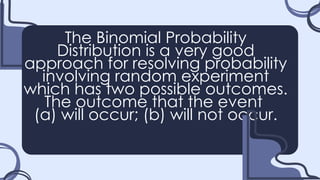
The Binomial Probability
Distributionis a very good
approach for resolving probability
involving random experiment
which has two possible outcomes.
The outcome that the event
(a) will occur; (b) will not occur.
3.
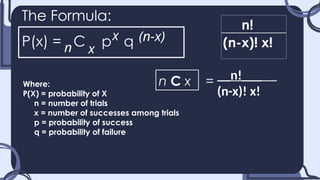
The Formula:
P(x) =C p q
n
x (n-x)
Where:
P(X) = probability of X
n = number of trials
x = number of successes among trials
p = probability of success
q = probability of failure
x
n C x =
n!
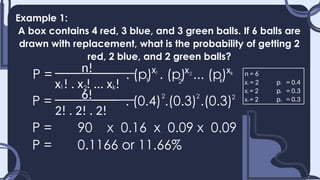
(n-x)! x!
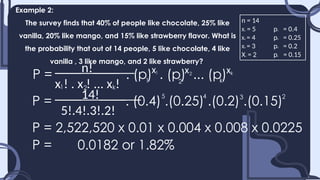
__n!___
(n-x)! x!
4.
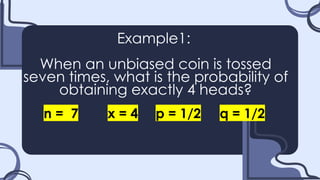
Example1:
When an unbiasedcoin is tossed
seven times, what is the probability of
obtaining exactly 4 heads?
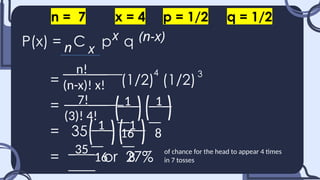
n = 7 x = 4 p = 1/2 q = 1/2
5.
P(x) = Cp q
= (1/2) (1/2)
=
= 35
= or 27%
n
x (n-x)
x
n = 7 x = 4 p = 1/2 q = 1/2
4 3
__n!___
(n-x)! x!
__7!___
(3)! 4!
_1_
16
_1_
8
_1_
16
_1_
8
_35_ of chance for the head to appear 4 times
in 7 tosses
6.
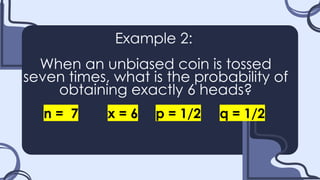
Example 2:
When anunbiased coin is tossed
seven times, what is the probability of
obtaining exactly 6 heads?
n = 7 x = 6 p = 1/2 q = 1/2
7.
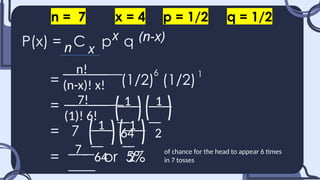
P(x) = Cp q
= (1/2) (1/2)
=
= 7
= or 5%
n
x (n-x)
x
n = 7 x = 4 p = 1/2 q = 1/2
6 1
__n!___
(n-x)! x!
__7!___
(1)! 6!
_1_
64
_1_
2
_1_
64
_1_
2
_7_ of chance for the head to appear 6 times
in 7 tosses
8.
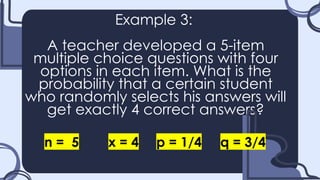
Example 3:
A teacherdeveloped a 5-item
multiple choice questions with four
options in each item. What is the
probability that a certain student
who randomly selects his answers will
get exactly 4 correct answers?
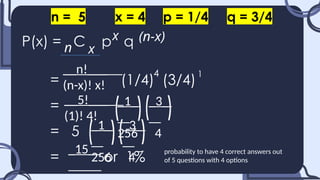
n = 5 x = 4 p = 1/4 q = 3/4
9.
P(x) = Cp q
= (1/4) (3/4)
=
= 5
= or 1%
n
x (n-x)
x
n = 5 x = 4 p = 1/4 q = 3/4
4 1
__n!___
(n-x)! x!
__5!___
(1)! 4!
_1_
256
_3_
4
_1_
256
_3_
4
_15_ probability to have 4 correct answers out
of 5 questions with 4 options
10.
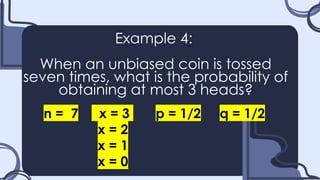
Example 4:
When anunbiased coin is tossed
seven times, what is the probability of
obtaining at most 3 heads?
n = 7 x = 3 p = 1/2 q = 1/2
x = 2
x = 1
x = 0
11.
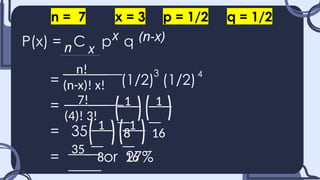
P(x) = Cp q
= (1/2) (1/2)
=
= 35
= or 27%
n
x (n-x)
x
n = 7 x = 3 p = 1/2 q = 1/2
3 4
__n!___
(n-x)! x!
__7!___
(4)! 3!
_1_
8
_1_
16
_1_
8
_1_
16
35_
12.
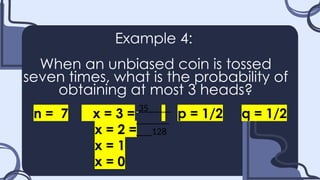
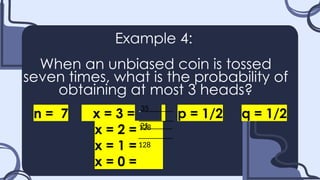
Example 4:
When anunbiased coin is tossed
seven times, what is the probability of
obtaining at most 3 heads?
n = 7 x = 3 = p = 1/2 q = 1/2
x = 2 =
x = 1
x = 0
35_
128
13.
P(x) = Cp q
= (1/2) (1/2)
=
= 21
= or 16%
n
x (n-x)
x
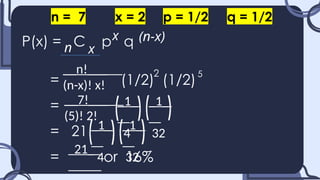
n = 7 x = 2 p = 1/2 q = 1/2
2 5
__n!___
(n-x)! x!
__7!___
(5)! 2!
_1_
4
_1_
32
_1_
4
_1_
32
21_
14.
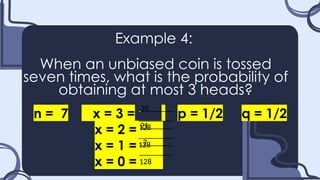
Example 4:
When anunbiased coin is tossed
seven times, what is the probability of
obtaining at most 3 heads?
n = 7 x = 3 = p = 1/2 q = 1/2
x = 2 =.......
x = 1 =.......
x = 0 =.......
35_
128
21_
128
15.
P(x) = Cp q
= (1/2) (1/2)
=
= 7
= or 5%
n
x (n-x)
x
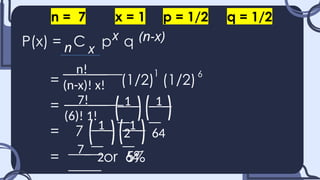
n = 7 x = 1 p = 1/2 q = 1/2
1 6
__n!___
(n-x)! x!
__7!___
(6)! 1!
_1_
2
_1_
64
_1_
2
_1_
64
7_
16.
Example 4:
When anunbiased coin is tossed
seven times, what is the probability of
obtaining at most 3 heads?
n = 7 x = 3 = p = 1/2 q = 1/2
x = 2 =.......
x = 1 =.......
x = 0 =.......
35_
128
21_
128
7_
128
17.
P(x) = Cp q
= (1/2) (1/2)
= 1
= 1 1
= or 1%
n
x (n-x)
x
n = 7 x = 0 p = 1/2 q = 1/2
0 7
__n!___
(n-x)! x!
__7!___
(7)! 0!
_1_
128
_1_
128
1_
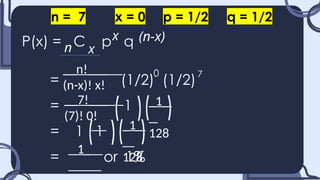
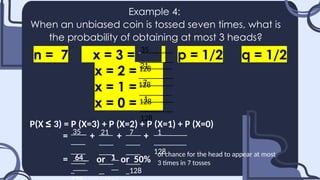
18.
Example 4:
When anunbiased coin is tossed seven times, what is
the probability of obtaining at most 3 heads?
n = 7 x = 3 = p = 1/2 q = 1/2
x = 2 =.......
x = 1 =.......
x = 0 =.......
35_
128
21_
128
7_
128
1_
128
P(X ≤ 3) = P (X=3) + P (X=2) + P (X=1) + P (X=0)
= + + +
= or or 50%
35_ 21_ 7_
128
1_
128
64_ 1 of chance for the head to appear at most
3 times in 7 tosses
19.
The Multinomial ProbabilityDistribution
has more than 2 possible outcomes. It
deals with experiments where each trial
results in one of K possible outcomes. If
there an N independent trials and each
outcome has a constant probability, we
can calculate the probability of
observing specific counts for each
outcome.
20.
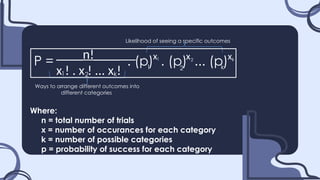
____n!____
x ! .x ! ... x !
P = . (p) . (p) ... (p)
1 2 k
1 2 k
Likelihood of seeing a specific outcomes
Ways to arrange different outcomes into
different categories
Where:
n = total number of trials
x = number of occurances for each category
k = number of possible categories
p = probability of success for each category
21.
Example 1:
A boxcontains 4 red, 3 blue, and 3 green balls. If 6 balls are
drawn with replacement, what is the probability of getting 2
red, 2 blue, and 2 green balls?
____n!____
x ! . x ! ... x !
P = . (p) . (p) ... (p)
1 2 k
1 2 k
P = . (0.4) .(0.3) .(0.3)
____6!____
2! . 2! . 2!
2
n = 6
X1 = 2 p1 = 0.4
X2 = 2 p2 = 0.3
X3 = 2 p3 = 0.3
2 2
P = 90 x 0.16 x 0.09 x 0.09
P = 0.1166 or 11.66%
22.
Example 2:
The surveyfinds that 40% of people like chocolate, 25% like
vanilla, 20% like mango, and 15% like strawberry flavor. What is
the probability that out of 14 people, 5 like chocolate, 4 like
vanilla , 3 like mango, and 2 like strawberry?
____n!____
x ! . x ! ... x !
P = . (p) . (p) ... (p)
1 2 k
1 2 k
P = . (0.4) .(0.25) .(0.2) .(0.15)
____14!____
5!.4!.3!.2!
5
n = 14
X1 = 5 p1 = 0.4
X2 = 4 p2 = 0.25
X3 = 3 p3 = 0.2
X4 = 2 p4 = 0.15
4 3
P = 2,522,520 x 0.01 x 0.004 x 0.008 x 0.0225
P = 0.0182 or 1.82%
2