Sensors for Biomedical
Devices and systems
Gunjan Patel (MS, BME)
MCIS, Manipal UNiversity
Outline
 Differentiate between the terms “Sensor”,
“Transducer” & “Actuator”
 Active and Passive Transducers/Sensors
 Sensors used in Biomedical Instruments
 Sensor Error Sources
 Sensor Terminology
 The Wheatstone Bridge
 Displacement Transducers (Resistive, Inductive, or
Capacitive type)
 Piezoelectric Transducers
Definitions
Transducer:
A transducer is a device which converts
energy from one form to another.
Sensor:
A sensor is a device which converts a physical
parameter to an electrical output
Actuator
An actuator is a device which converts an
electrical energy to a mechanical or physical output.
Active sensors
 Active sensors generate electrical output directly
in response to an applied stimulation or
measurand.
 An active sensor doesn’t require an external
voltage source to produce electrical output.
 Example: Solar Cell, Piezoelectric Material,
Thermocouple, etc.
PASSIVE SENSORS
 Passive sensors produce a change in some passive
electrical quantity, such as capacitance, resistance,
or inductance, in response to an applied stimulus or
measurand.
 Therefore, a passive sensor does require an
external ac or dc voltage source in order to convert
passive electrical quantity such as capacitance,
resistance, or inductance in to electrical output
 Example: Photo Diode, Thermistor, Strain Gauge,
etc.
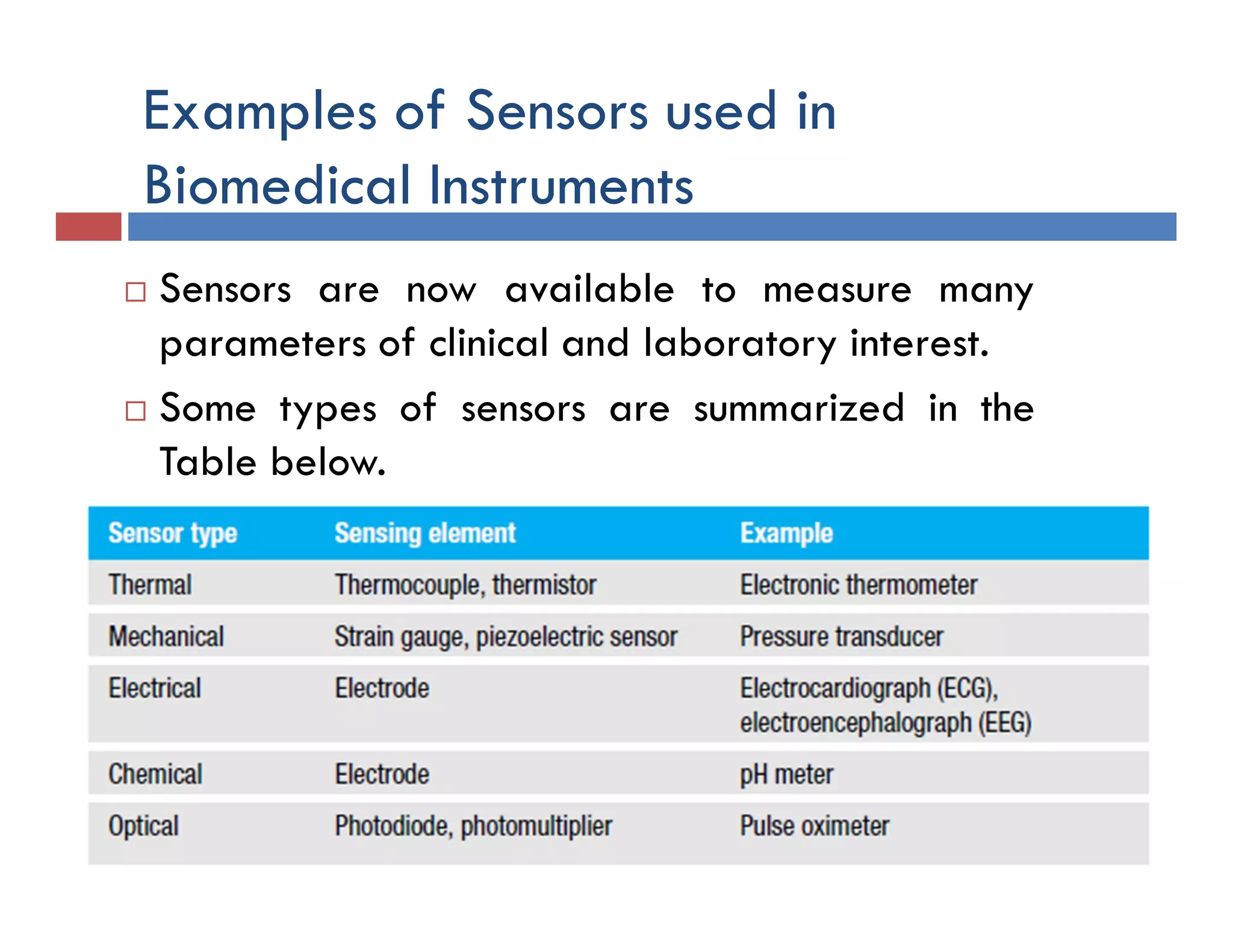
Examples of Sensors used in
Biomedical Instruments
 Sensors are now available to measure many
parameters of clinical and laboratory interest.
 Some types of sensors are summarized in the
Table below.
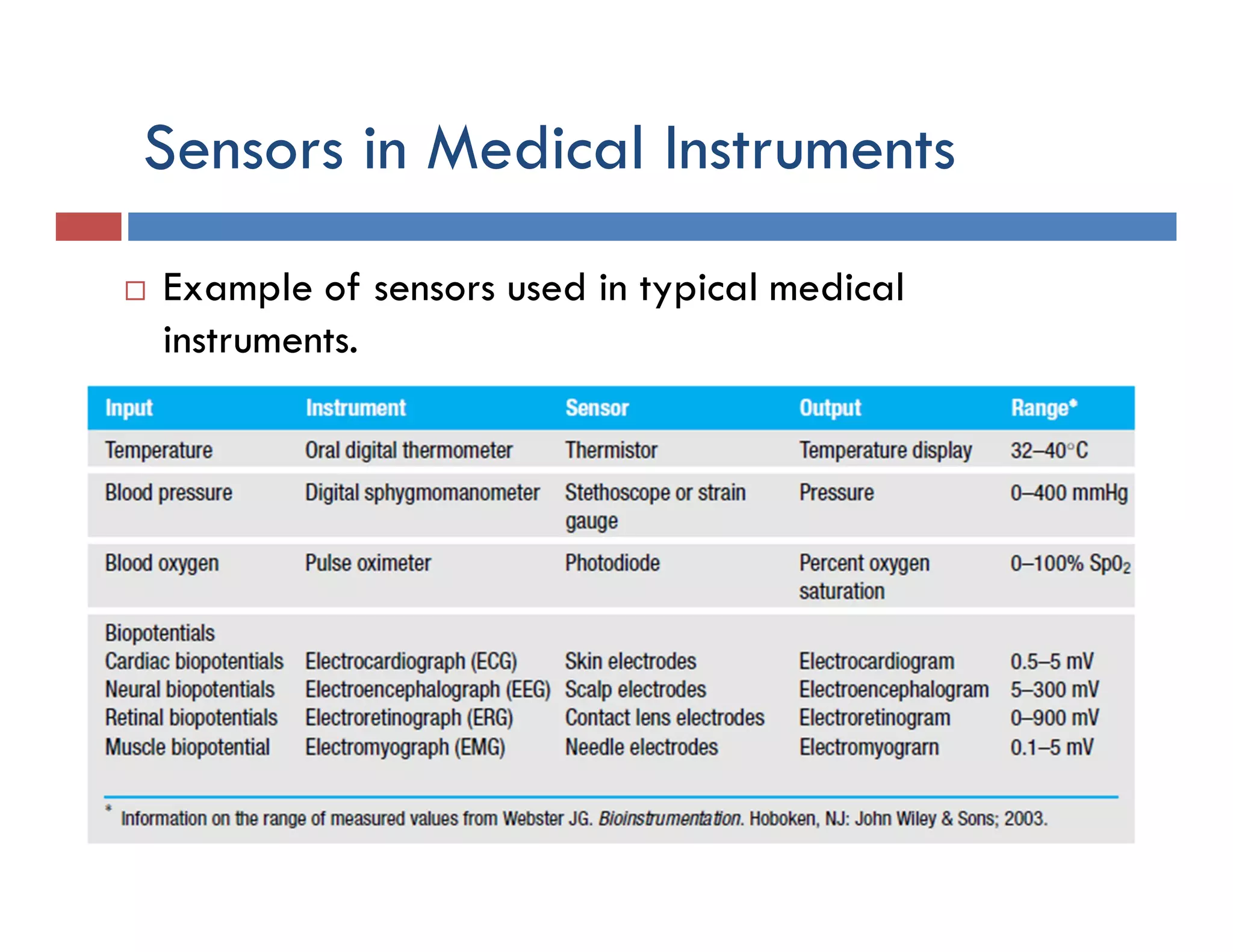
Sensors in Medical Instruments
 Example of sensors used in typical medical
instruments.
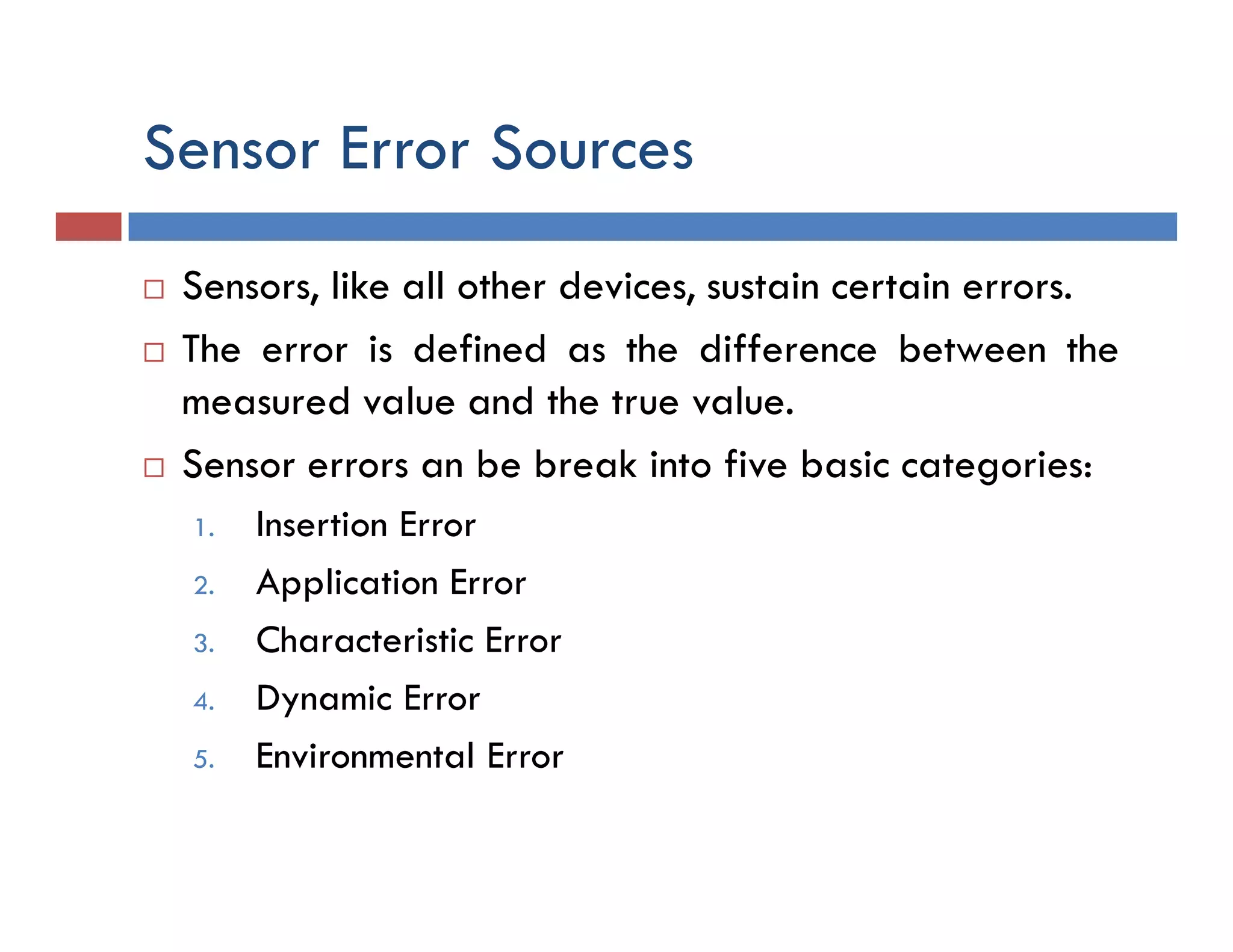
Sensor Error Sources
 Sensors, like all other devices, sustain certain errors.
 The error is defined as the difference between the
measured value and the true value.
 Sensor errors an be break into five basic categories:
1. Insertion Error
2. Application Error
3. Characteristic Error
4. Dynamic Error
5. Environmental Error
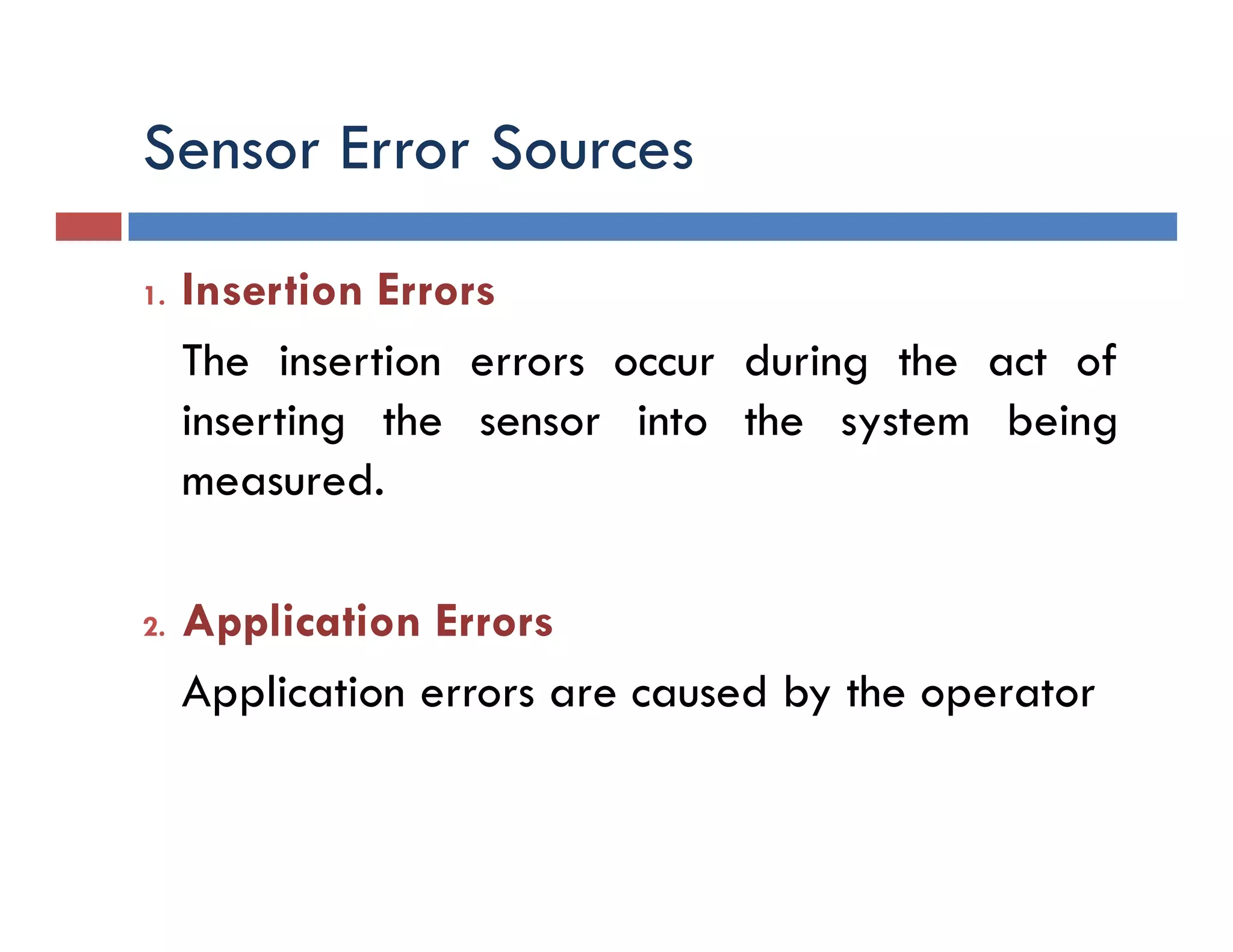
Sensor Error Sources
1. Insertion Errors
The insertion errors occur during the act of
inserting the sensor into the system being
measured.
2. Application Errors
Application errors are caused by the operator
Cont…
3. Characteristic Errors
The characteristic errors are inherent in the device
itself. i.e., the difference between the ideal
characteristic transfer function of the device and the
actual characteristic.
This form of error may include a dc off-set value (a
false pressure head), an incorrect slope, or a slope
that is not perfectly linear.
4. Dynamic Errors
 Many sensors are characterized and
calibrated in a static condition. i.e., with an
input parameter that is either static or quasi-
static.
 Many sensors are heavily damped so that they
will not respond to rapid changes in the input
parameter.
 Dynamic errors include response time,
amplitude distortion, and phase distortion.
5. Environmental Errors
 These errors are derived from the environment in
which the sensor is used.
 They most often include temperature but may also
include vibration. shock, altitude, chemical exposure,
or other factors.
 These factor most often affect the characteristic
errors of the sensor, so are often combined with that
category in practical application.
Sensor Terminology
1. Sensitivity
2. Sensitivity Error
3. Range
4. Dynamic Range
5. Precision
6. Resolution
7. Accuracy
8. Offset
9. Linearity
10. Hysteresis
11. Response time
12. Dynamic linearity
13. Transfer function
14. Noise
15. Bandwidth
Sensor Terminology
1. Sensitivity
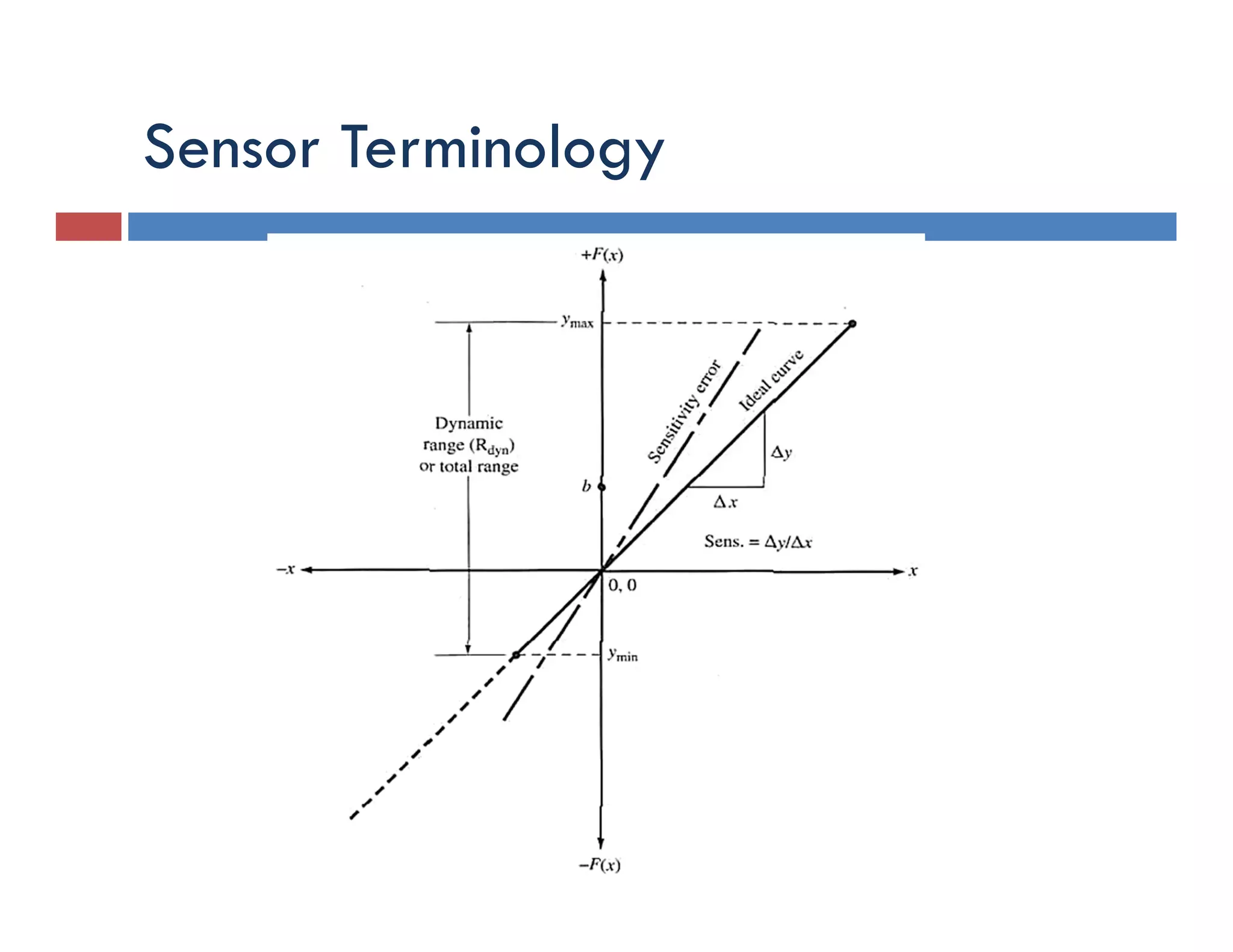
 The sensitivity of the sensor is defined as the slope
of the output characteristic curve (ΔY/ΔX).
 More generally, the minimum input of physical
parameter that will create a detectable output
change.
 In some sensor, the sensitivity is defined as the input
parameter change required to produce a
standardized output change.
 In others, it is defined as an output voltage change
for a given change in input parameter.
Sensor Terminology
Sensor Terminology
4. Dynamic Range
• The dynamic range is the total range of the sensor
from minimum to maximum.
5. Precision
• The precision refers to the degree of reproducibility
of a measurement.
6. Resolution
• The resolution is define as the smallest detectable
incremental change of input parameter that can be
detected in the output signal.
7. Accuracy
 The accuracy of the sensor is the maximum difference
that will exist between the actual value (which must
be measured by a primary or good secondary
standard) and the indicated value at the output of
the sensor.
Sensor Terminology
8. Offset
 The offset error of a transducer is defined as the
output that will exist when it should be zero.
 Alternatively, the difference between the actual output
value and the specified output value under some
particular set of conditions.
9. Linearity
 The linearity of the transducer is an expression of the
extent to which the actual measured curve of a sensor
departs from the ideal curve.
Sensor Terminology
Ideal versus measured curve showing linearity error
Sensor Terminology
10. Hysteresis
• A transducer should be capable of following the
changes of the input parameter regardless in which
direction the change is made, hysteresis is the measure
of this property.
Sensor Terminology
11. Response Time
 Sensors do not change output state immediately when
an input parameter change occur. Rather, it will
change to the new state over a period of time, called
the response time.
 The response time can be defined as the time
required for a sensor output to change from its
previous state to a final settled value within a
tolerance band of the correct new value.
Sensor Terminology
12. Dynamic Linearity
 The dynamic linearity of the sensor is a measure of
its ability to follow rapid changes in the input
parameter.
 Amplitude distortion characteristics. phase
distortion characteristics, and response time are
important in determining dynamic linearity.
Sensor Terminology
13. Transfer Function
 The functional relationship between physical input
signal and electrical output signal.
14. Noise
• Almost all type of sensors produce some output noise
in addition to the output signal.
• The noise of the sensor limits the performance of the
system.
• Most common types of noise are 50 Hz supply noise,
and white noise which is generally distributed across
the frequency spectrum.
Sensor Terminology
15. Bandwidth
 All sensors have finite response times to an
instantaneous change in physical signal.
 In addition, many sensors have decay times, which
would represent the time after a step change in
physical signal for the sensor output to decay to its
original value.
 The reciprocal of these times correspond to the upper
and lower cutoff frequencies, respectively.
 The bandwidth of a sensor is the frequency range
between these two frequencies.
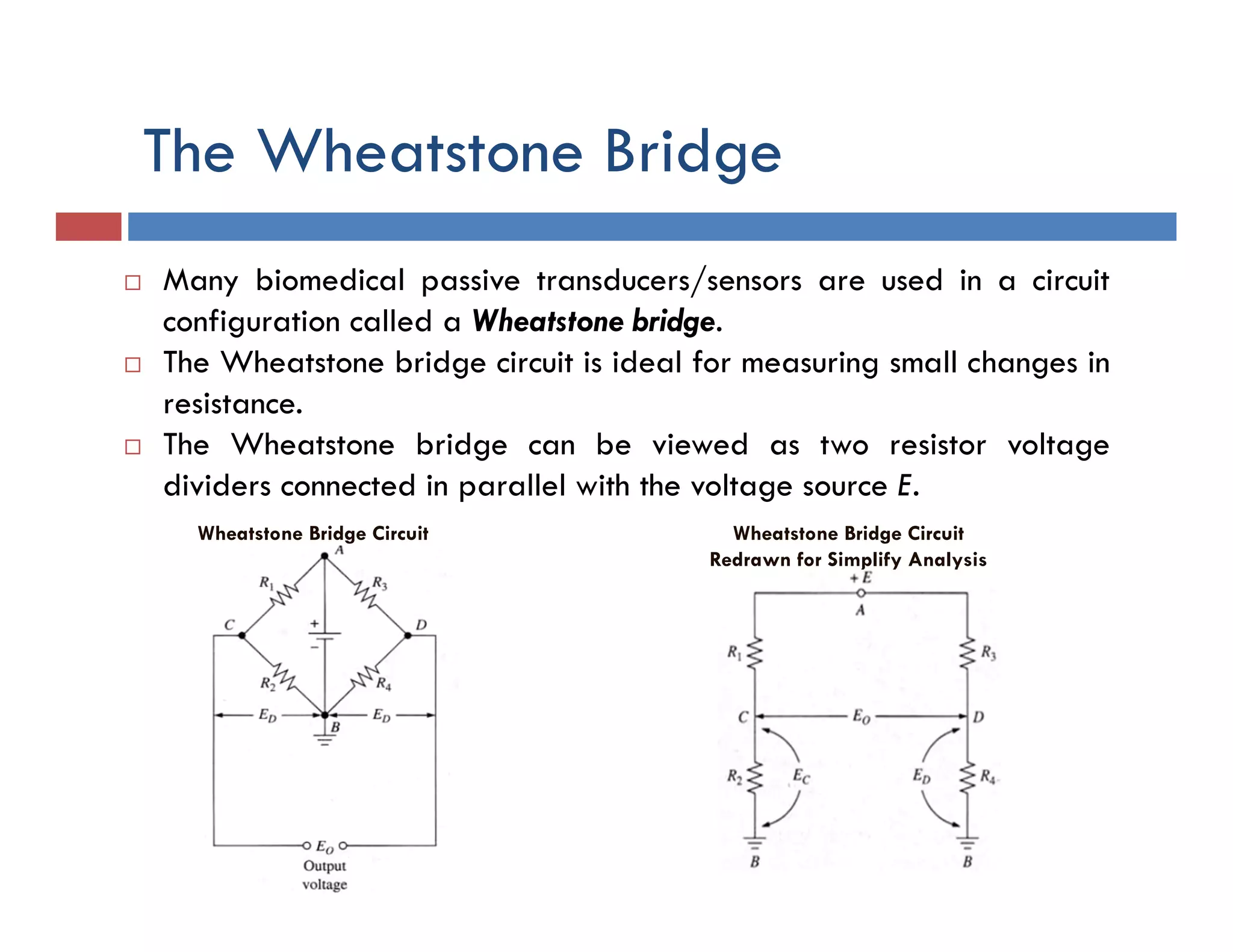
The Wheatstone Bridge
 Many biomedical passive transducers/sensors are used in a circuit
configuration called a Wheatstone bridge.
 The Wheatstone bridge circuit is ideal for measuring small changes in
resistance.
 The Wheatstone bridge can be viewed as two resistor voltage
dividers connected in parallel with the voltage source E.
Wheatstone Bridge Circuit Wheatstone Bridge Circuit
Redrawn for Simplify Analysis
The Wheatstone Bridge
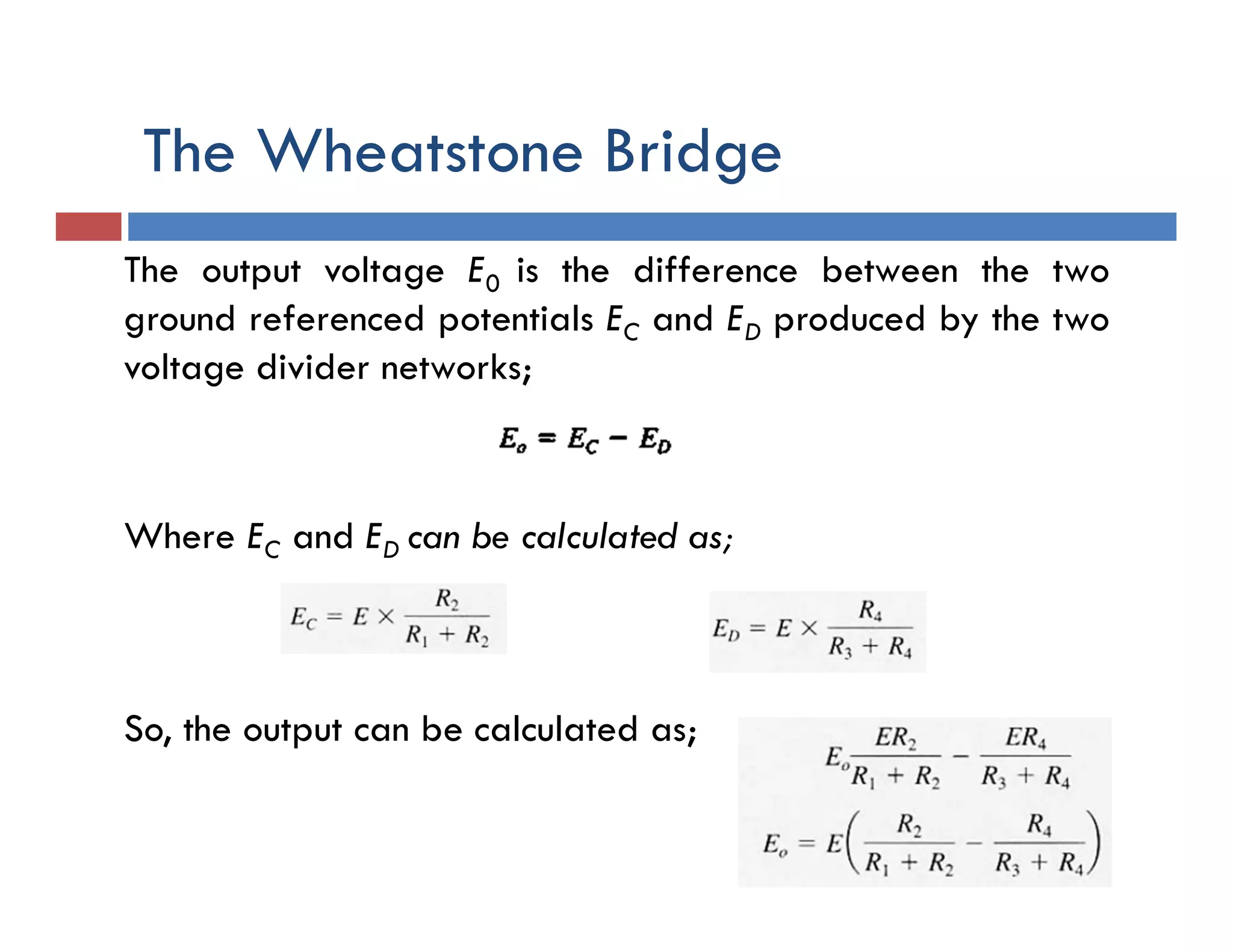
The output voltage E0 is the difference between the two
ground referenced potentials EC and ED produced by the two
voltage divider networks;
Where EC and ED can be calculated as;
So, the output can be calculated as;
Cont…
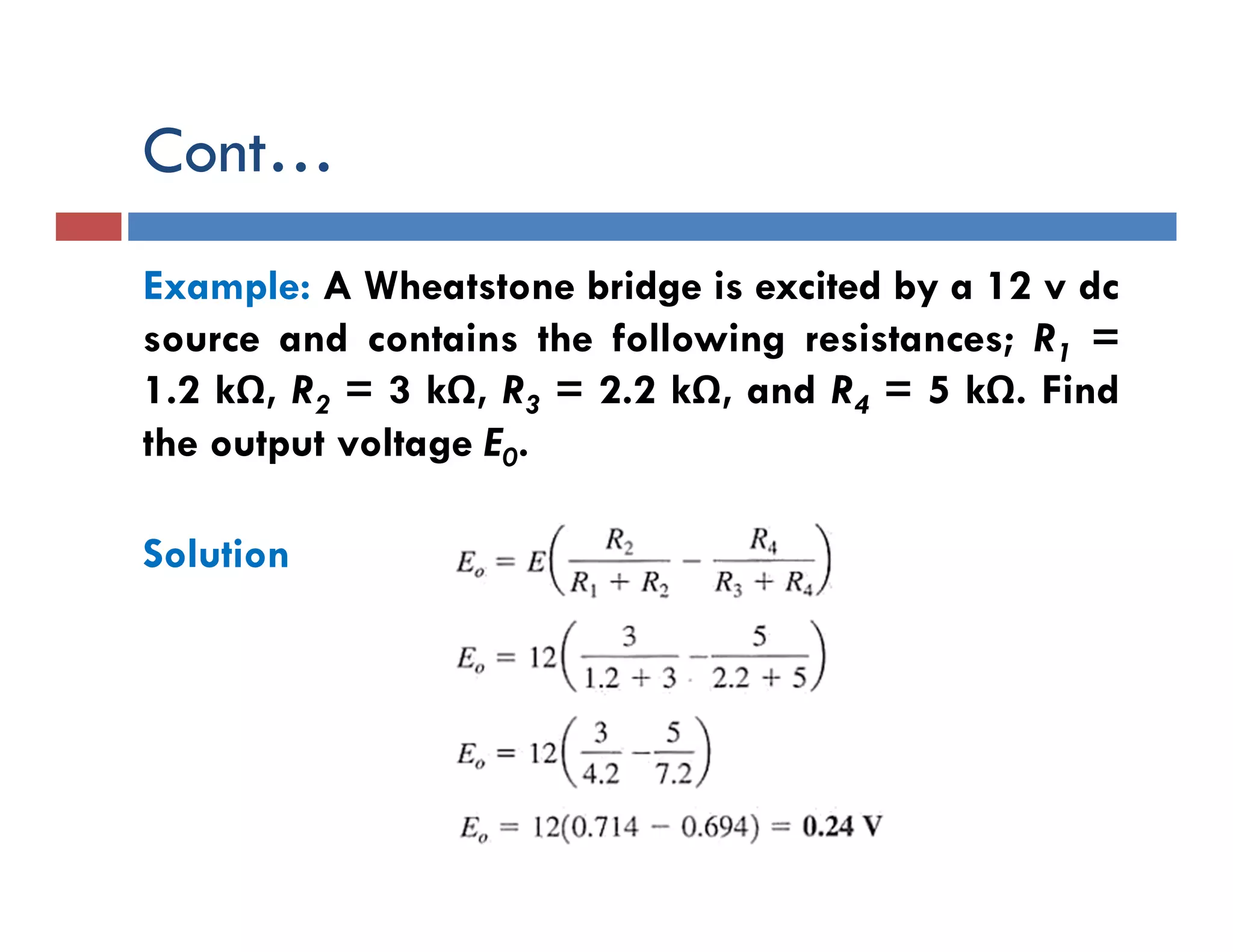
Example: A Wheatstone bridge is excited by a 12 v dc
source and contains the following resistances; R1 =
1.2 kΩ, R2 = 3 kΩ, R3 = 2.2 kΩ, and R4 = 5 kΩ. Find
the output voltage E0.
Solution
Null Condition
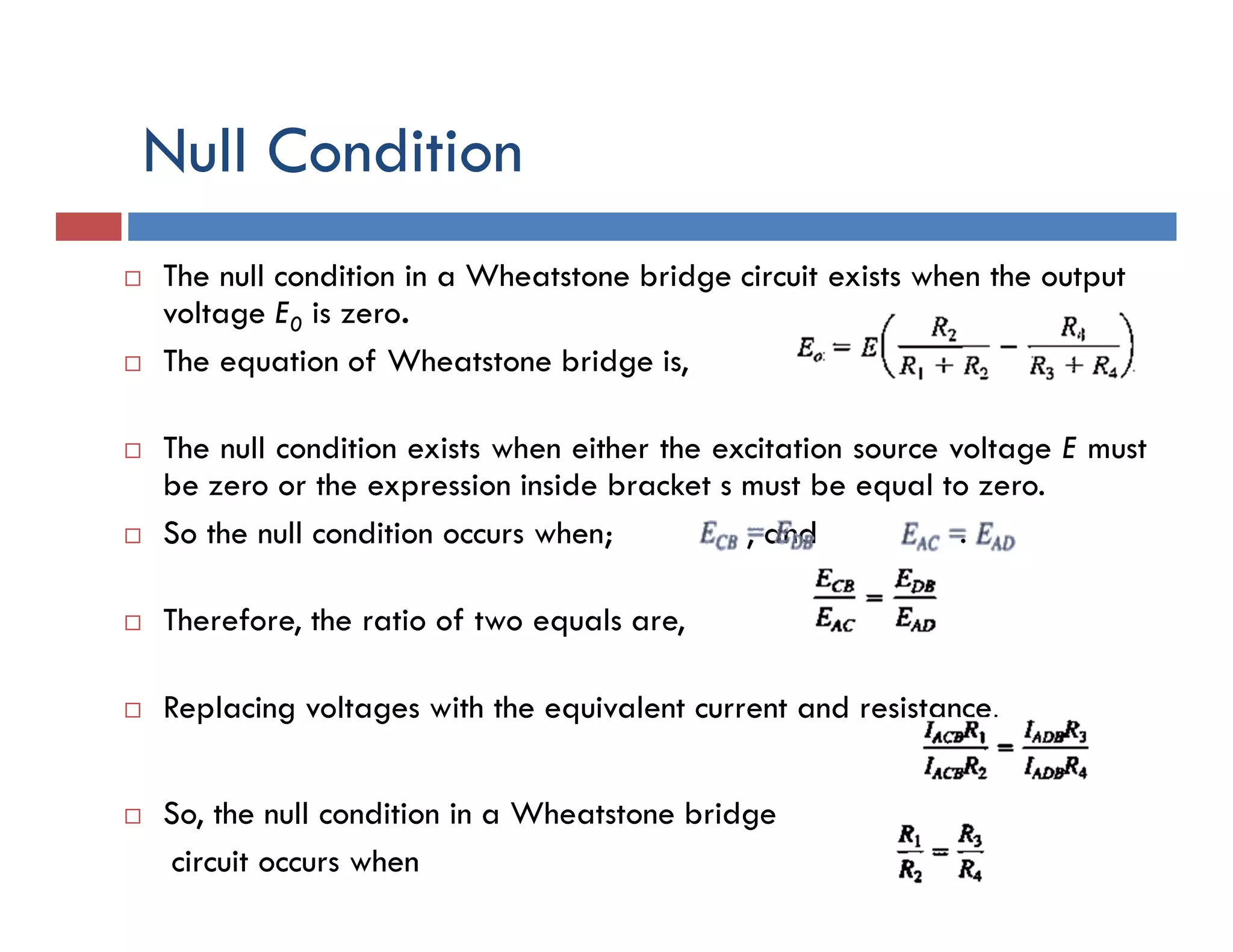
 The null condition in a Wheatstone bridge circuit exists when the output
voltage E0 is zero.
 The equation of Wheatstone bridge is,
 The null condition exists when either the excitation source voltage E must
be zero or the expression inside bracket s must be equal to zero.
 So the null condition occurs when; , and .
 Therefore, the ratio of two equals are,
 Replacing voltages with the equivalent current and resistance,
 So, the null condition in a Wheatstone bridge
circuit occurs when
Cont…
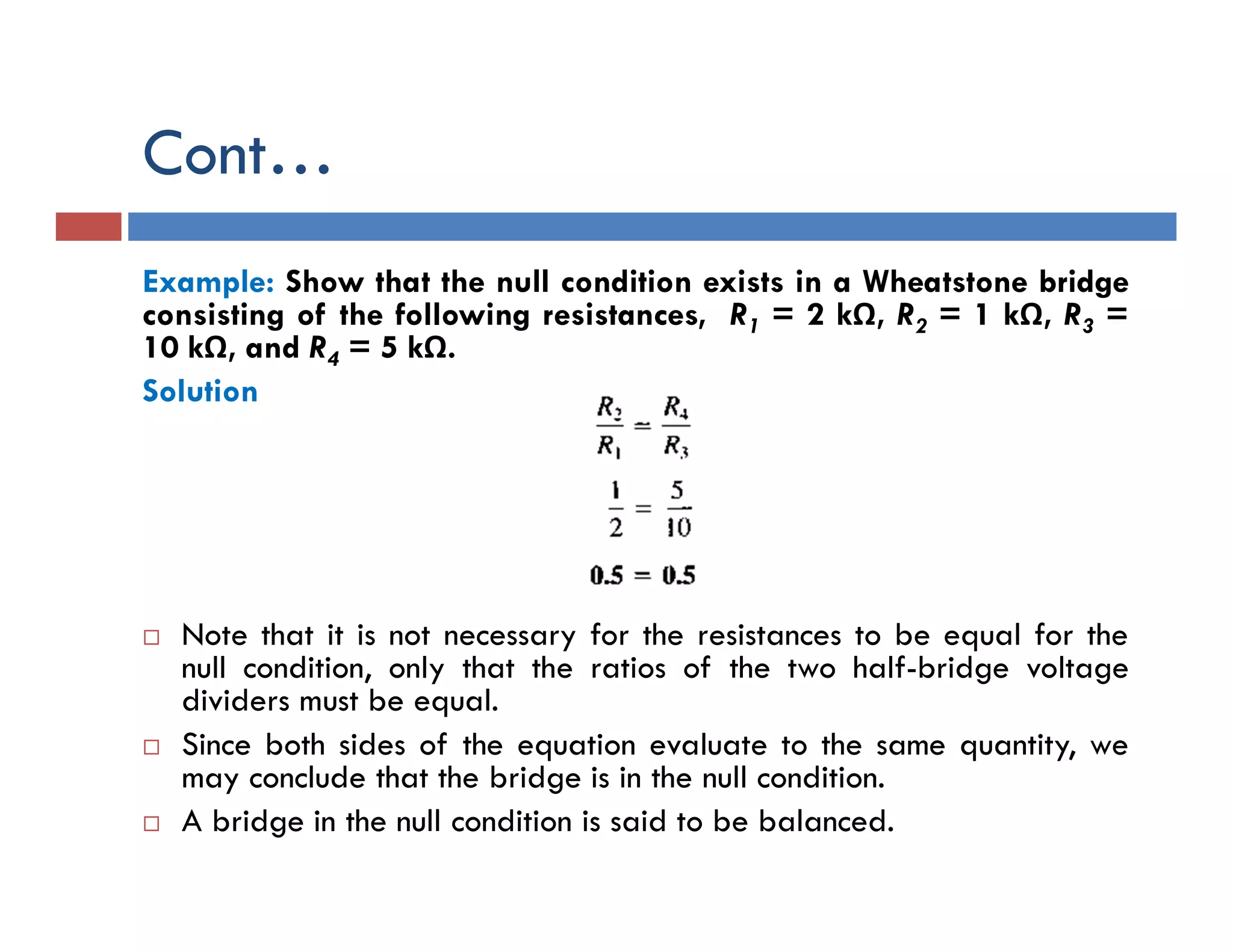
Example: Show that the null condition exists in a Wheatstone bridge
consisting of the following resistances, R1 = 2 kΩ, R2 = 1 kΩ, R3 =
10 kΩ, and R4 = 5 kΩ.
Solution
 Note that it is not necessary for the resistances to be equal for the
null condition, only that the ratios of the two half-bridge voltage
dividers must be equal.
 Since both sides of the equation evaluate to the same quantity, we
may conclude that the bridge is in the null condition.
 A bridge in the null condition is said to be balanced.
Strain Gauge
 Strain gauges are displacement-type transducers that
measure changes in the length of an object as a result of an
applied force.
 A strain gauge is a resistive element that produces a change
in its resistance proportional to an applied mechanical strain.
 A strain is a force applied in either compression (a push
along the axis to-word the center) or tension (a pull along
the axis away from the center).
 The piezoresistive effect describes change in the electrical
resistivity of a semiconductor when mechanical stress (force)
is applied.
Mechanism for Piezoresistivity
Figure (a): shows a small metallic bar with no
force applied.
 It will have a length L and a cross-sectional
area A.
 Changes in length are given by ΔL and
changes in area are given by ΔA.
Figure (b): shows the result of applying a
compression force to the ends of the bar.
 The length reduces to L – ΔL, and the cross-
sectional area increases to A + ΔA.
Figure (c): shows the result of applying a tension
force of the same magnitude to the bar.
 The length increases to L + ΔL, and the
cross-sectional area reduces to A – ΔA.
Strain Gauge Resistance
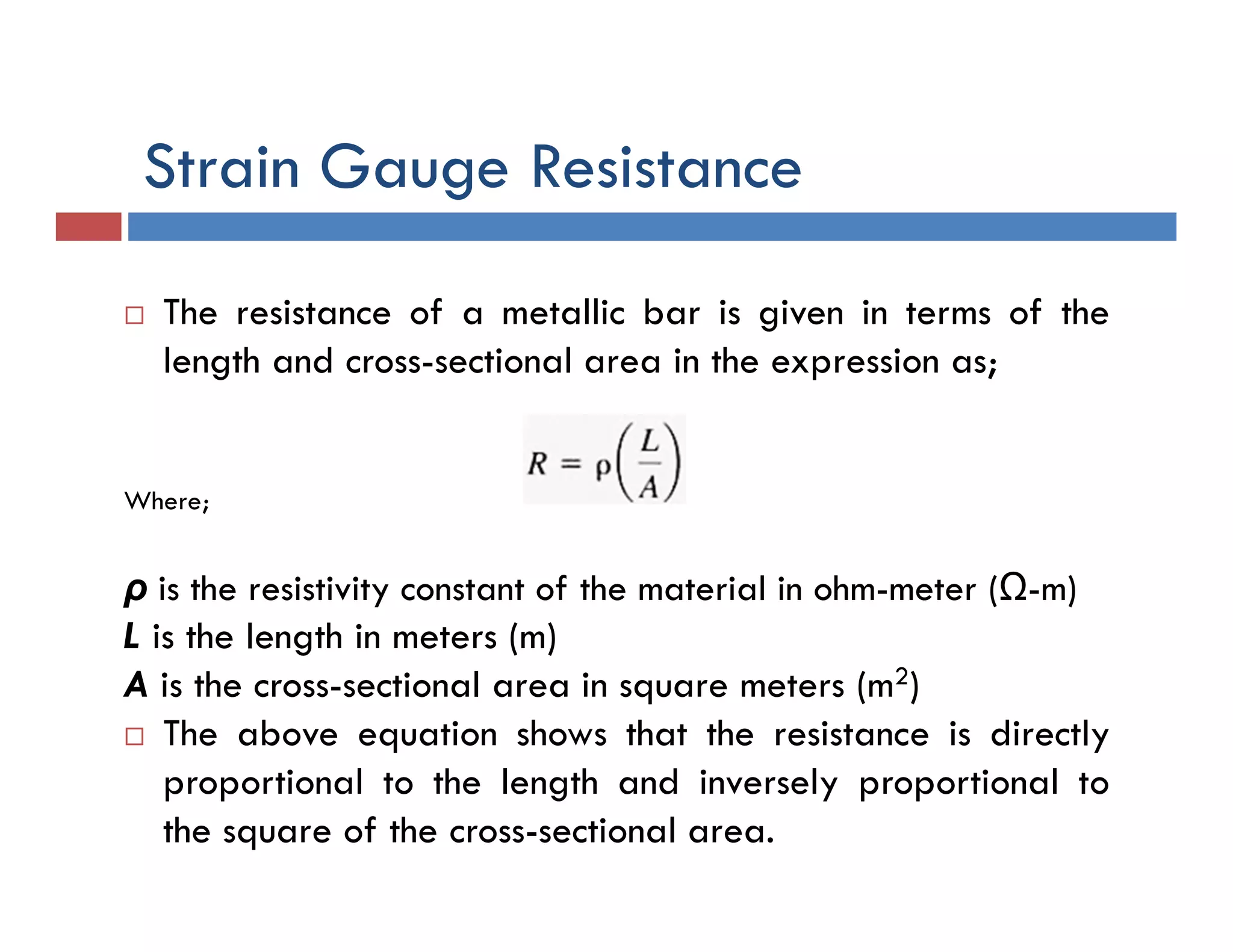
 The resistance of a metallic bar is given in terms of the
length and cross-sectional area in the expression as;
Where;
ρ is the resistivity constant of the material in ohm-meter (Ω-m)
L is the length in meters (m)
A is the cross-sectional area in square meters (m2)
 The above equation shows that the resistance is directly
proportional to the length and inversely proportional to
the square of the cross-sectional area.
Strain Gauge
Strain Gauge
Piezoresistivity:
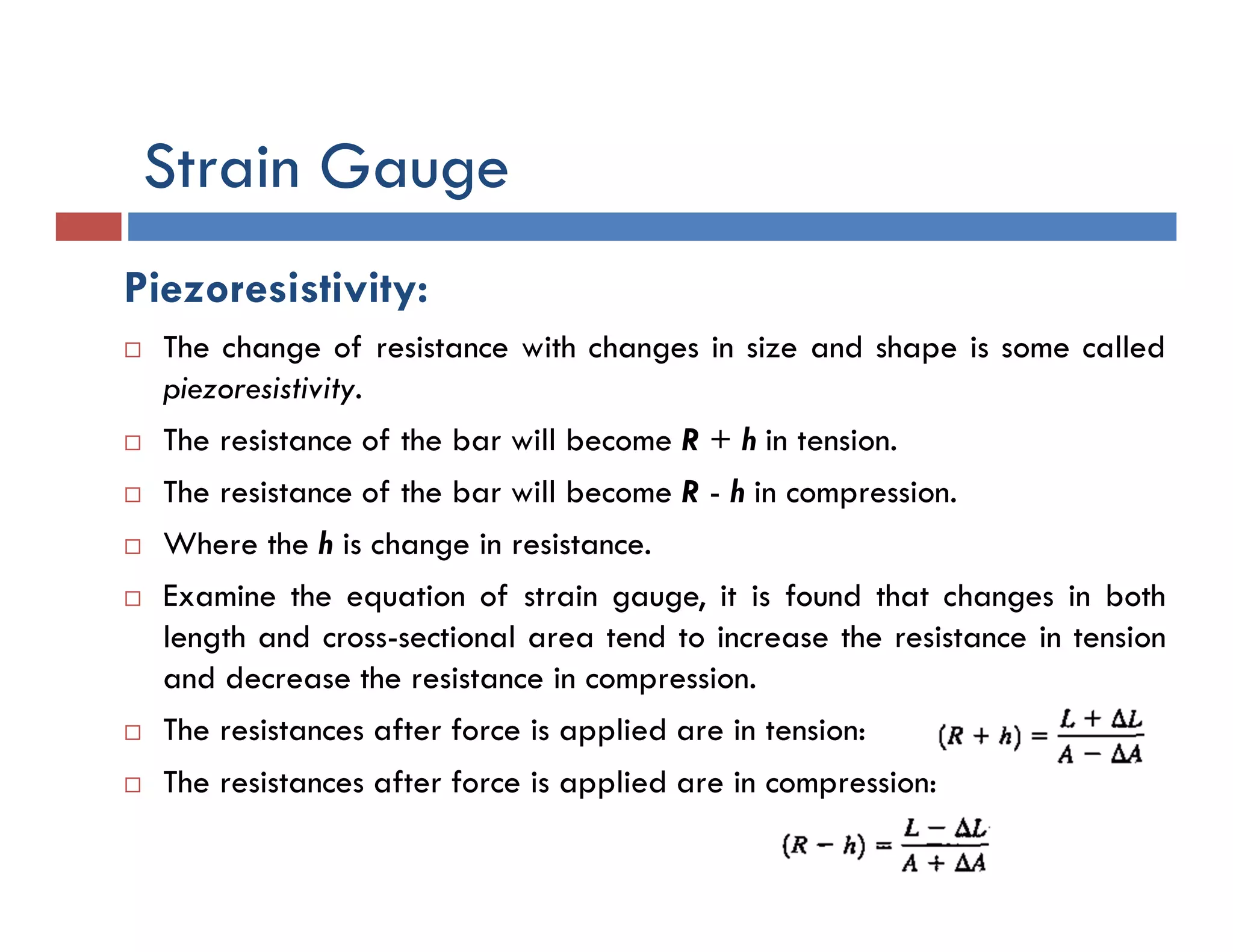
 The change of resistance with changes in size and shape is some called
piezoresistivity.
 The resistance of the bar will become R + h in tension.
 The resistance of the bar will become R - h in compression.
 Where the h is change in resistance.
 Examine the equation of strain gauge, it is found that changes in both
length and cross-sectional area tend to increase the resistance in tension
and decrease the resistance in compression.
 The resistances after force is applied are in tension:
 The resistances after force is applied are in compression:
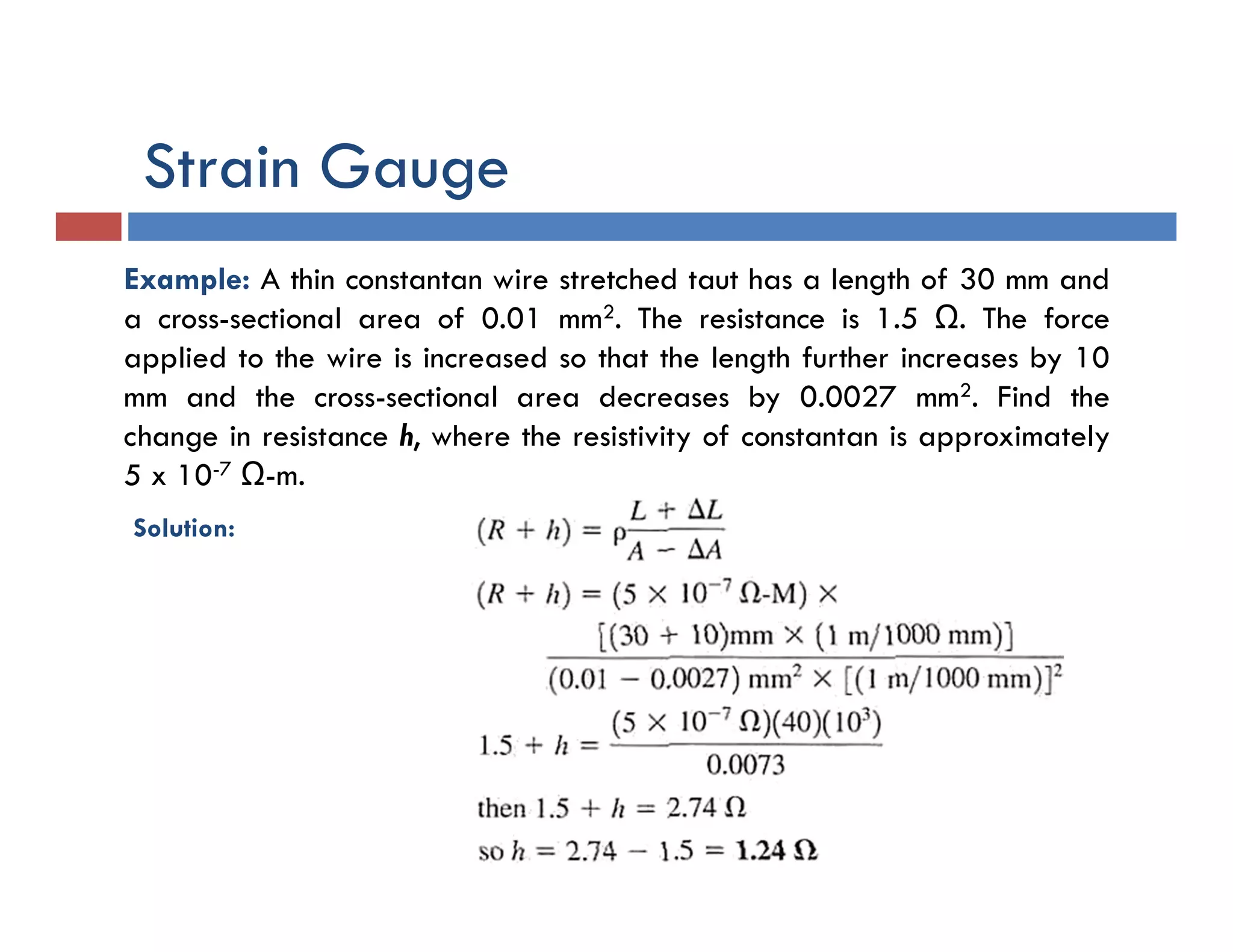
Example: A thin constantan wire stretched taut has a length of 30 mm and
a cross-sectional area of 0.01 mm2. The resistance is 1.5 Ω. The force
applied to the wire is increased so that the length further increases by 10
mm and the cross-sectional area decreases by 0.0027 mm2. Find the
change in resistance h, where the resistivity of constantan is approximately
5 x 10⁻⁷ Ω-m.
Solution:
Strain Gauge
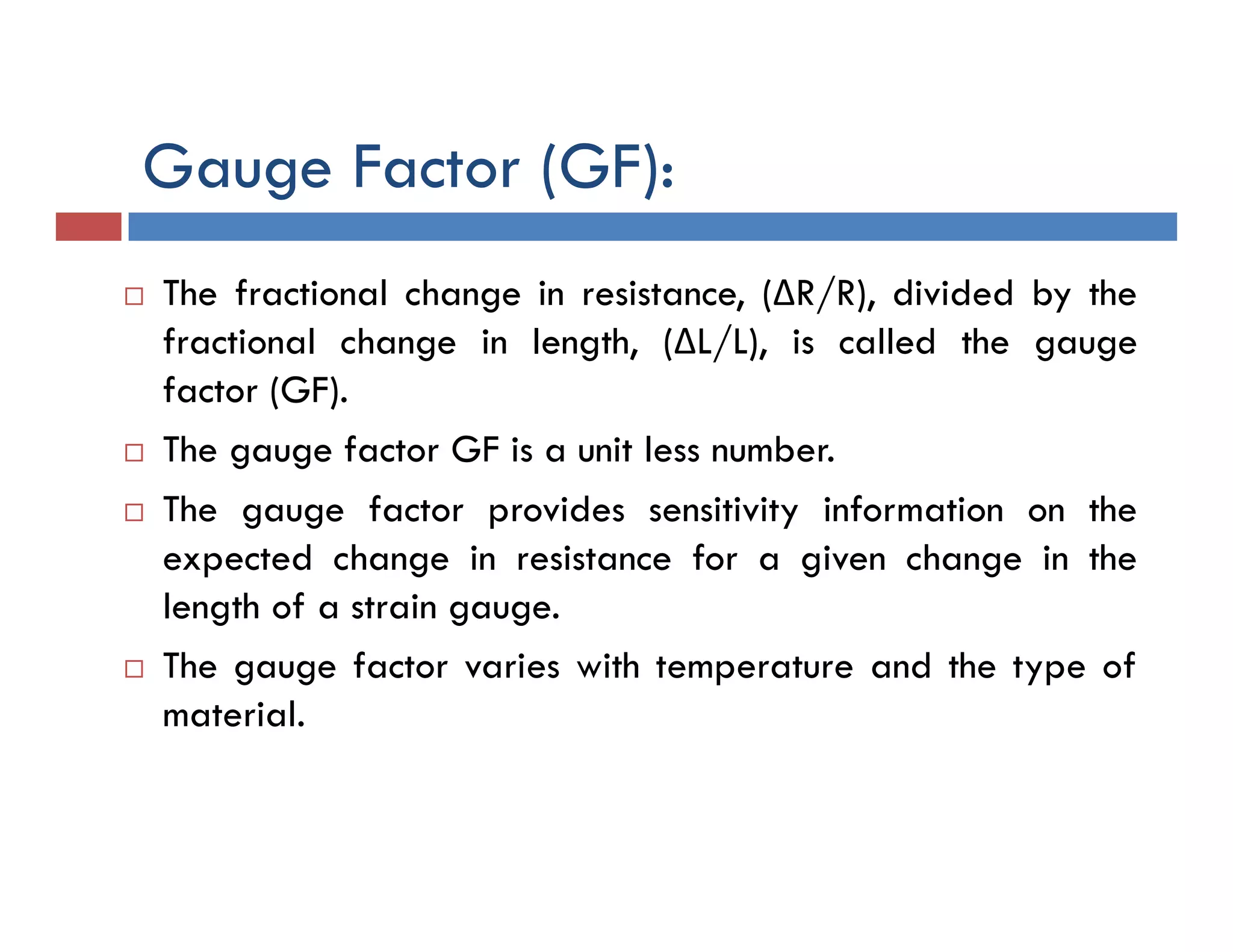
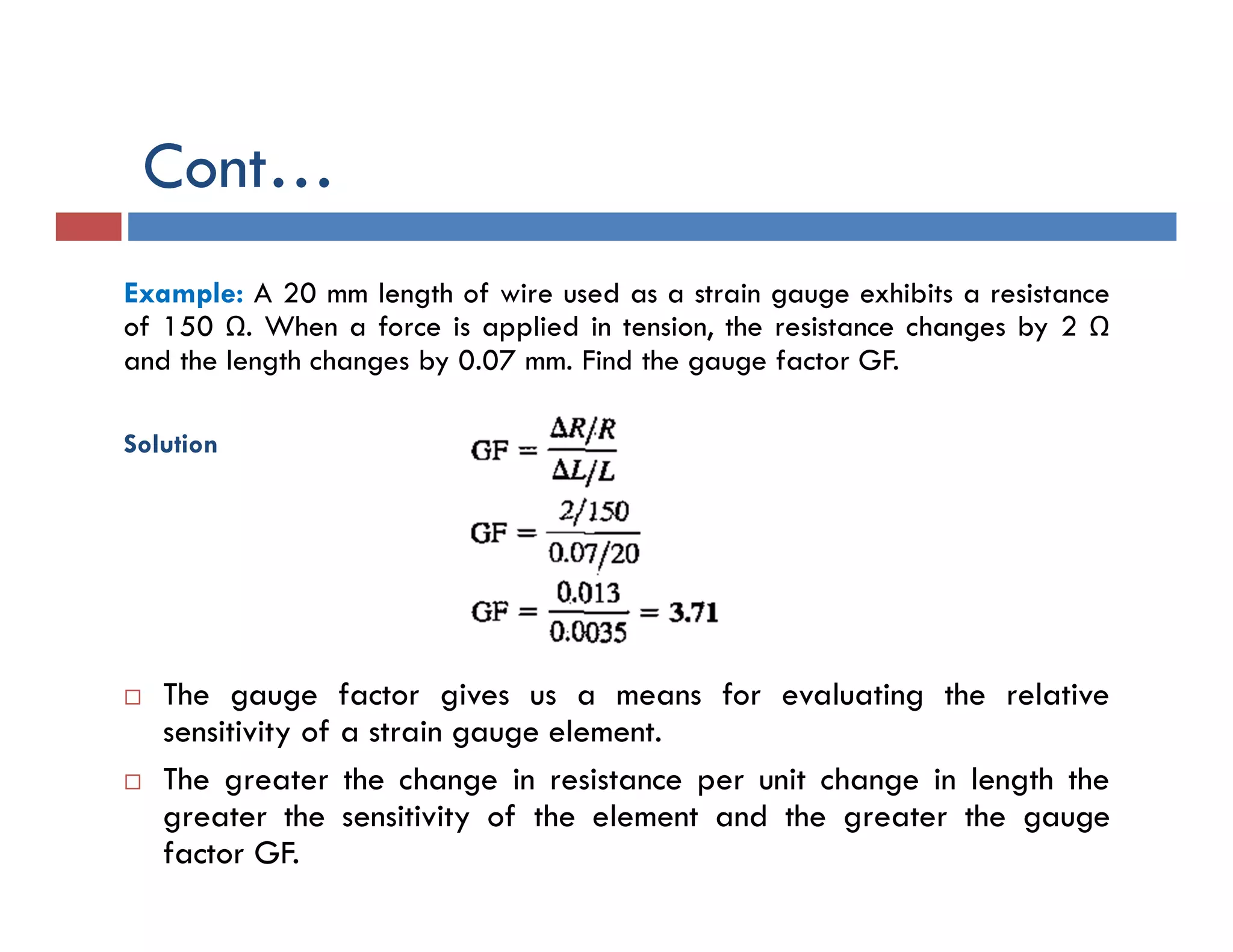
 The fractional change in resistance, (ΔR/R), divided by the
fractional change in length, (ΔL/L), is called the gauge
factor (GF).
 The gauge factor GF is a unit less number.
 The gauge factor provides sensitivity information on the
expected change in resistance for a given change in the
length of a strain gauge.
 The gauge factor varies with temperature and the type of
material.
Gauge Factor (GF):
Cont…
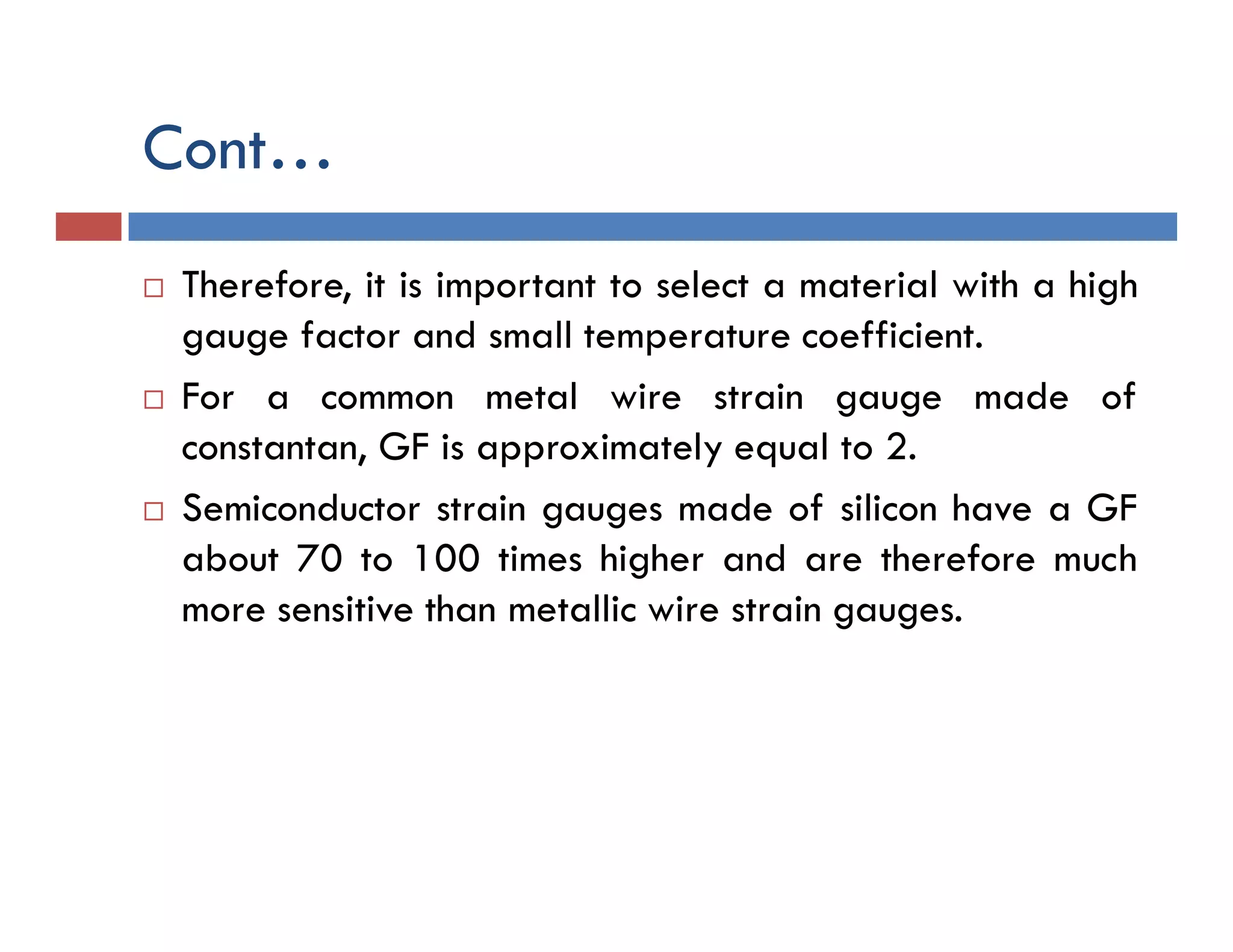
 Therefore, it is important to select a material with a high
gauge factor and small temperature coefficient.
 For a common metal wire strain gauge made of
constantan, GF is approximately equal to 2.
 Semiconductor strain gauges made of silicon have a GF
about 70 to 100 times higher and are therefore much
more sensitive than metallic wire strain gauges.
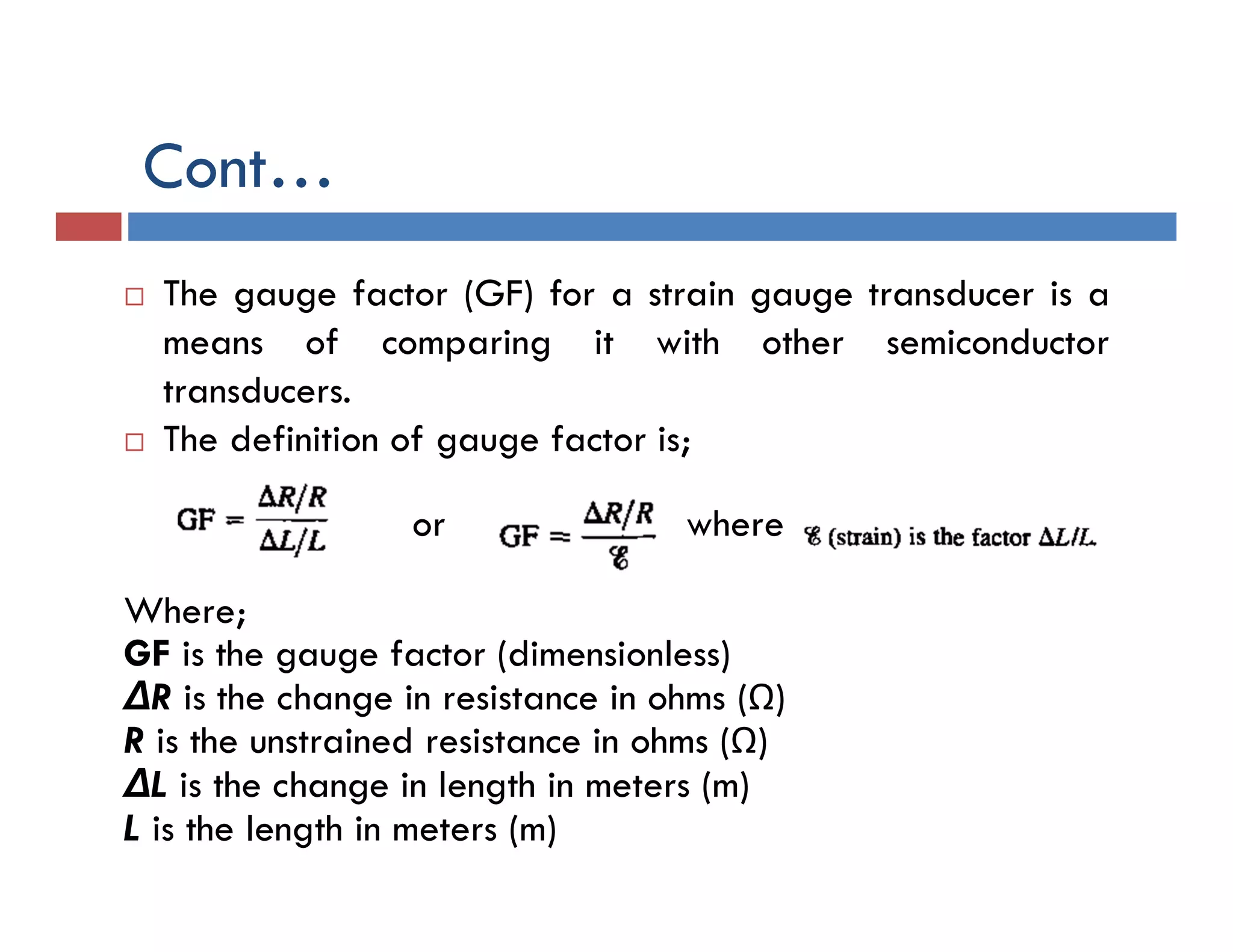
 The gauge factor (GF) for a strain gauge transducer is a
means of comparing it with other semiconductor
transducers.
 The definition of gauge factor is;
or where
Where;
GF is the gauge factor (dimensionless)
ΔR is the change in resistance in ohms (Ω)
R is the unstrained resistance in ohms (Ω)
ΔL is the change in length in meters (m)
L is the length in meters (m)
Cont…
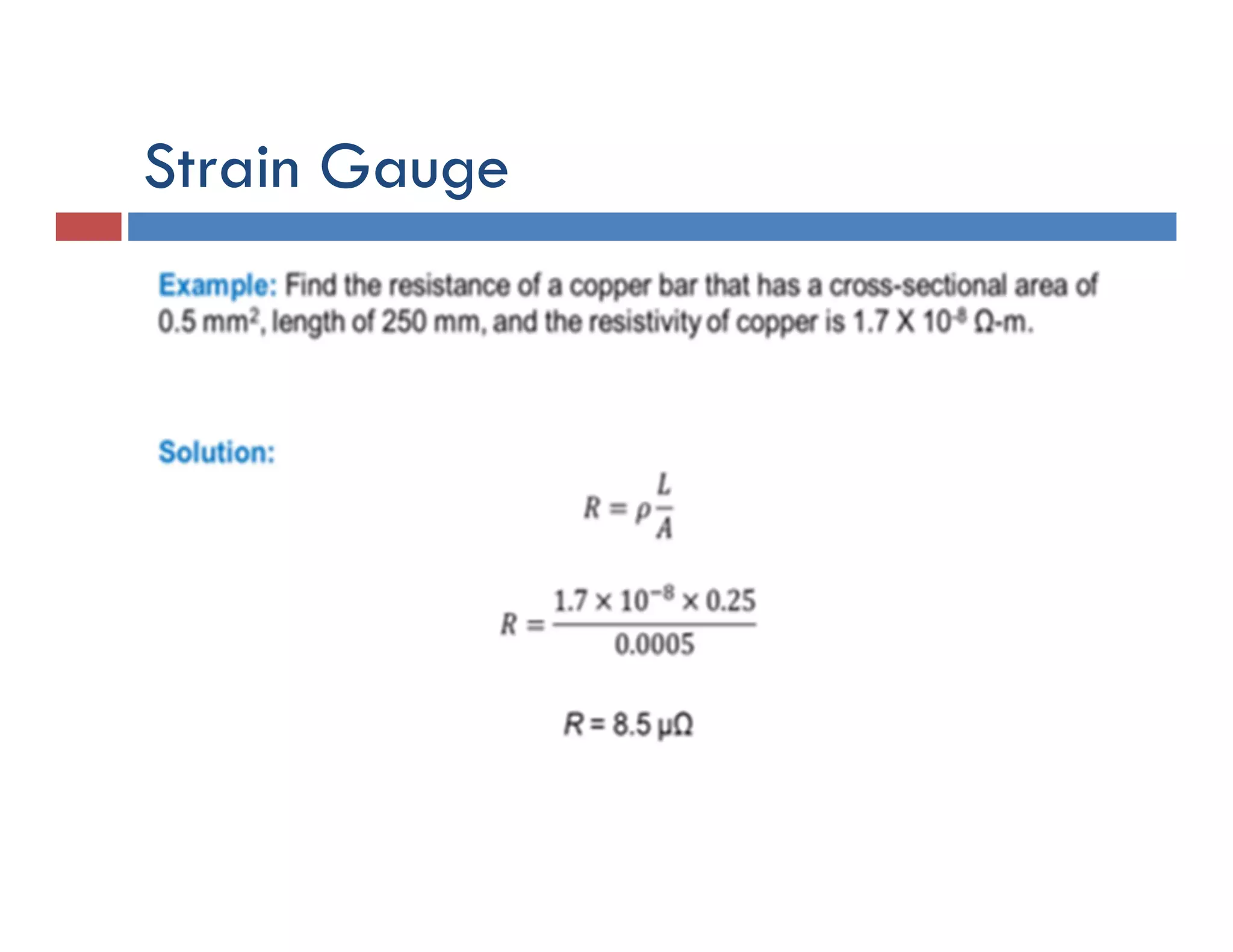
Example: A 20 mm length of wire used as a strain gauge exhibits a resistance
of 150 Ω. When a force is applied in tension, the resistance changes by 2 Ω
and the length changes by 0.07 mm. Find the gauge factor GF.
Solution
 The gauge factor gives us a means for evaluating the relative
sensitivity of a strain gauge element.
 The greater the change in resistance per unit change in length the
greater the sensitivity of the element and the greater the gauge
factor GF.
Cont…
Types of Strain Gauges
Strain gauges typically fall into two categories:
1. Unbonded Strain Gauge
2. Bonded Strain Gauge
Unbonded Strain Gauge
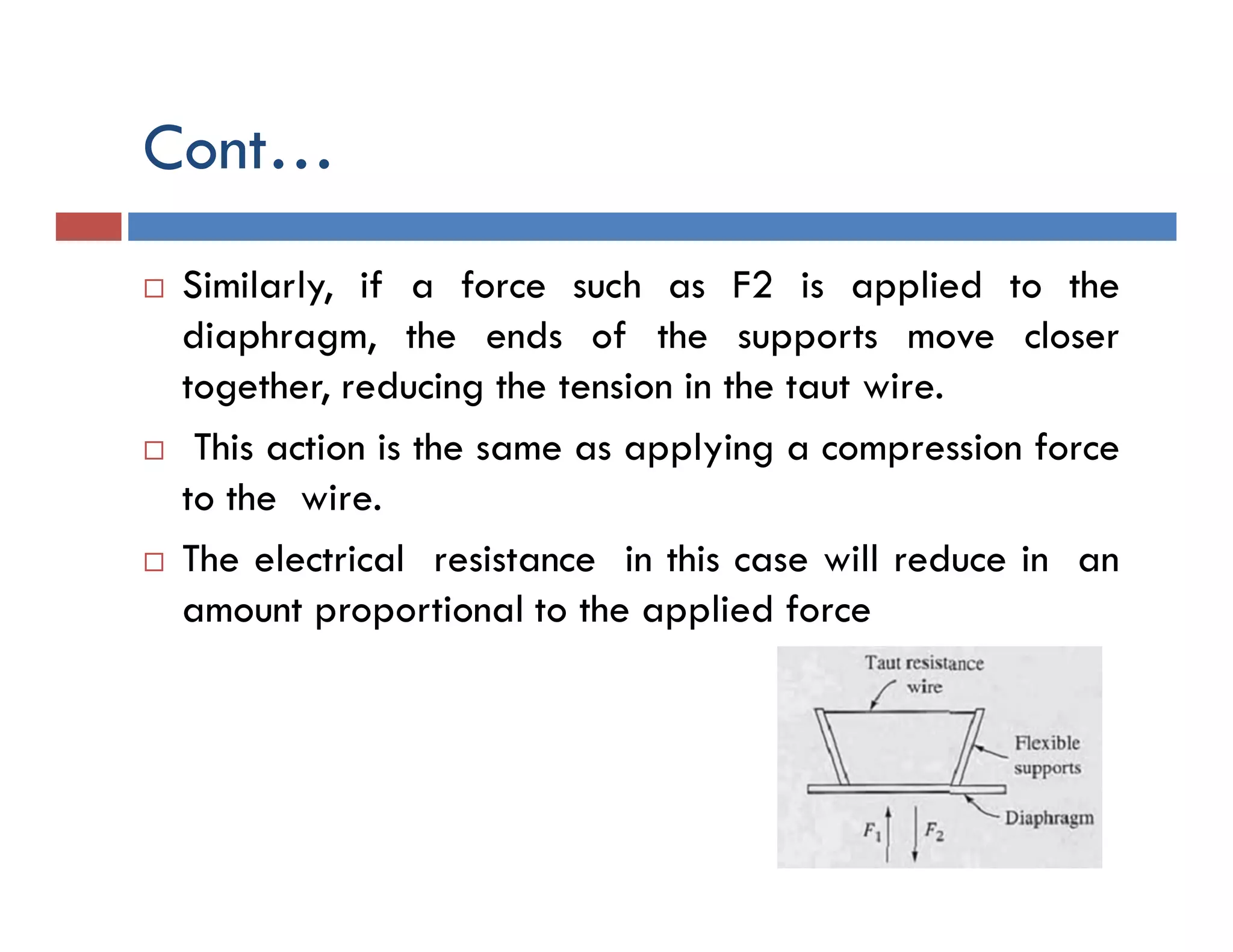
 The resistance element is a thin wire of a special alloy
that is stretched taut between two flexible supports,
which are in turn mounted on a thin metal diaphragm.
 When a force such as F1 is applied, the diaphragm will
flex in a manner that spreads the supports further
apart, causing an increased tension in the resistance
wire.
 This tension tends to increase the resistance of the wire
in an amount proportional to the applied force.
Cont…
 Similarly, if a force such as F2 is applied to the
diaphragm, the ends of the supports move closer
together, reducing the tension in the taut wire.
 This action is the same as applying a compression force
to the wire.
 The electrical resistance in this case will reduce in an
amount proportional to the applied force
Bonded Strain Gauge
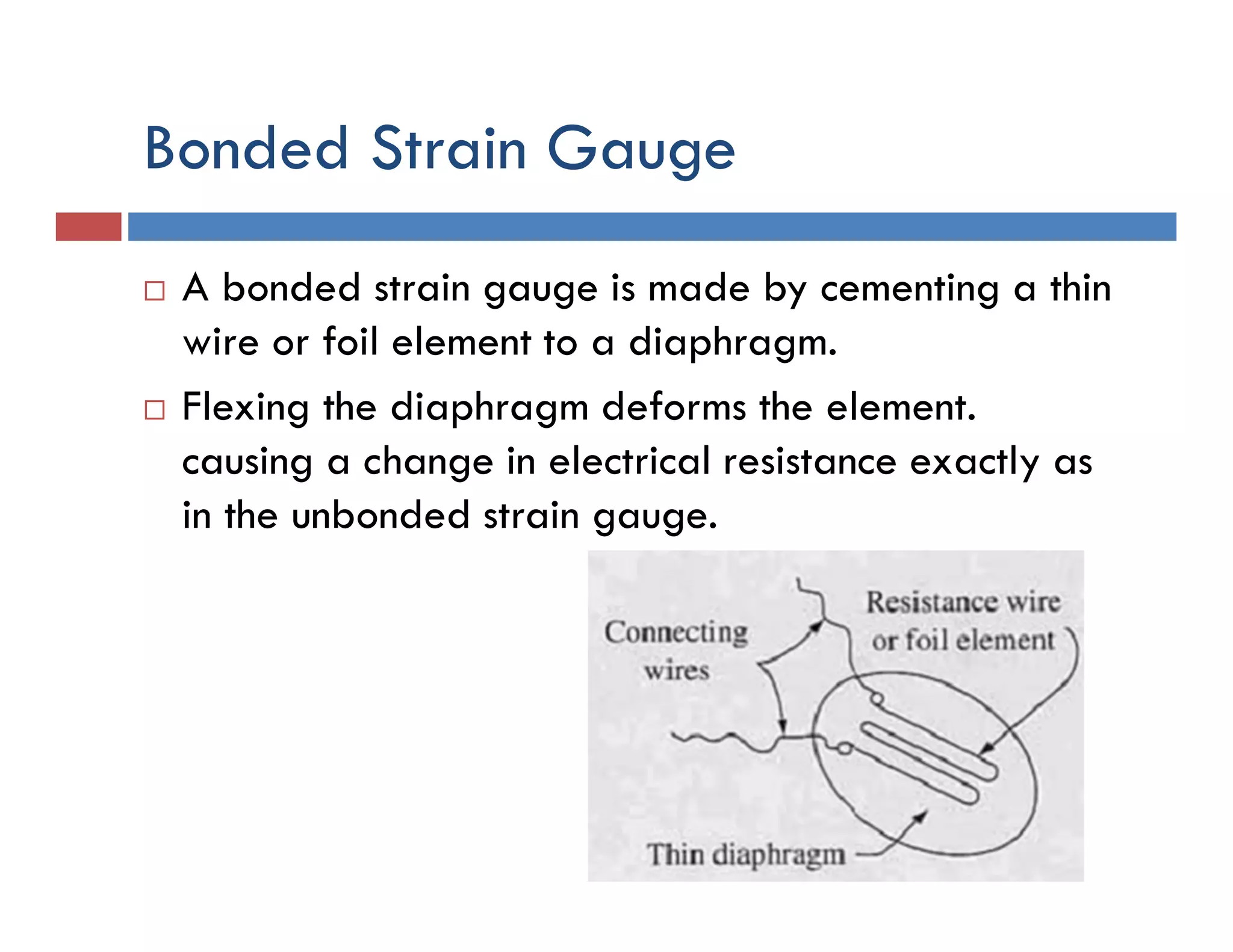
 A bonded strain gauge is made by cementing a thin
wire or foil element to a diaphragm.
 Flexing the diaphragm deforms the element.
causing a change in electrical resistance exactly as
in the unbonded strain gauge.
Strain Gauge
 Many biomedical strain gauge transducers are of bonded construction
because the linear range is adequate and the extra ruggedness is a
desirable feature in medical environments.
 The Statham P-23 series are of the unbonded type strain gauge
transducer but are made in a very rugged housing. These are among
the most common cardiovascular pressure transducers used in medicine.
 In addition, changes in temperature can also cause thermal expansion
of the wire and thus lead to large changes in the resistance of a strain
gauge.
 Therefore, very sensitive electronic amplifiers with special temperature
compensation circuits are typically used in applications involving strain
gauge transducers.
Strain Gauge
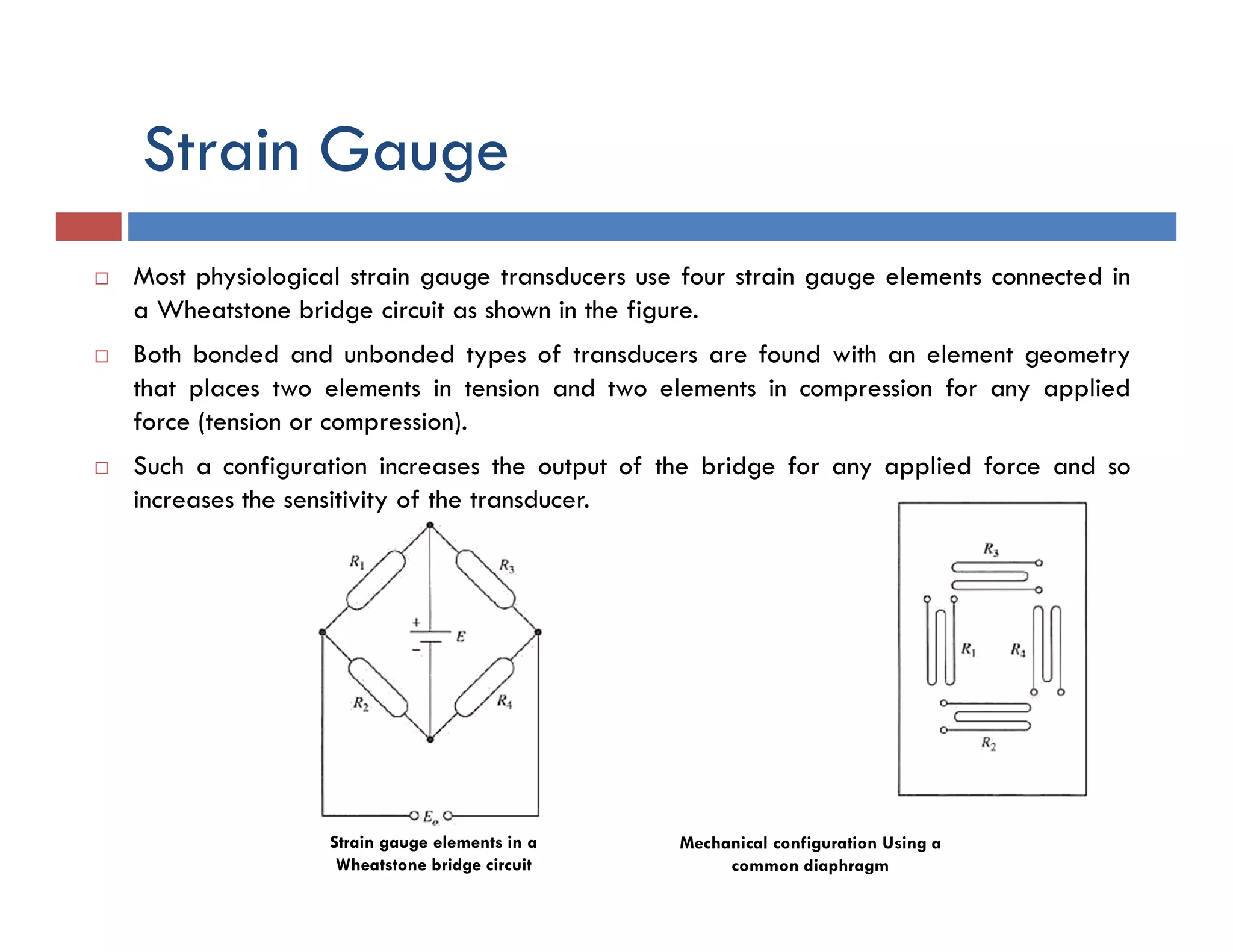
 Most physiological strain gauge transducers use four strain gauge elements connected in
a Wheatstone bridge circuit as shown in the figure.
 Both bonded and unbonded types of transducers are found with an element geometry
that places two elements in tension and two elements in compression for any applied
force (tension or compression).
 Such a configuration increases the output of the bridge for any applied force and so
increases the sensitivity of the transducer.
Strain gauge elements in a
Wheatstone bridge circuit
Mechanical configuration Using a
common diaphragm
Cont…
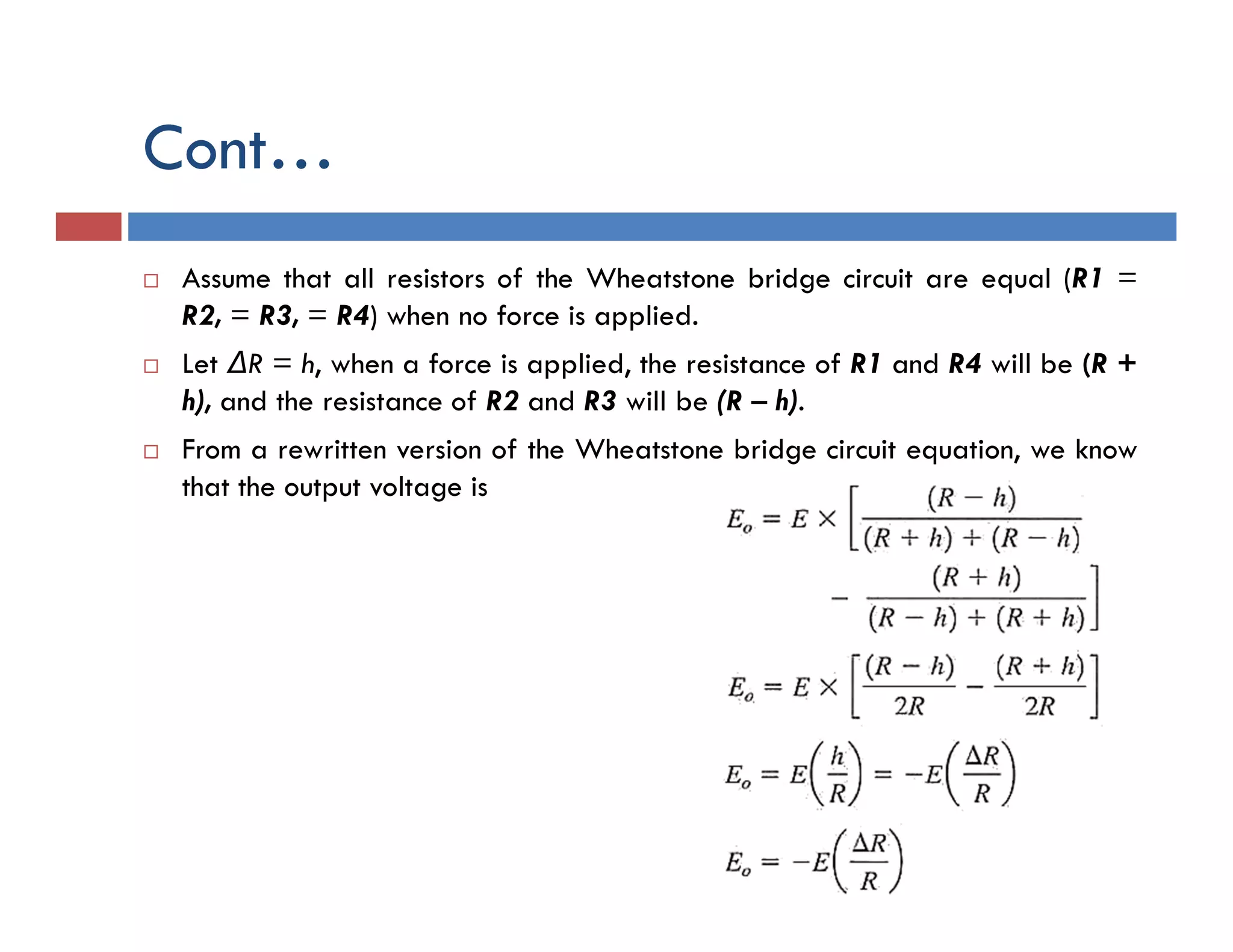
 Assume that all resistors of the Wheatstone bridge circuit are equal (R1 =
R2, = R3, = R4) when no force is applied.
 Let ΔR = h, when a force is applied, the resistance of R1 and R4 will be (R +
h), and the resistance of R2 and R3 will be (R – h).
 From a rewritten version of the Wheatstone bridge circuit equation, we know
that the output voltage is
Cont…
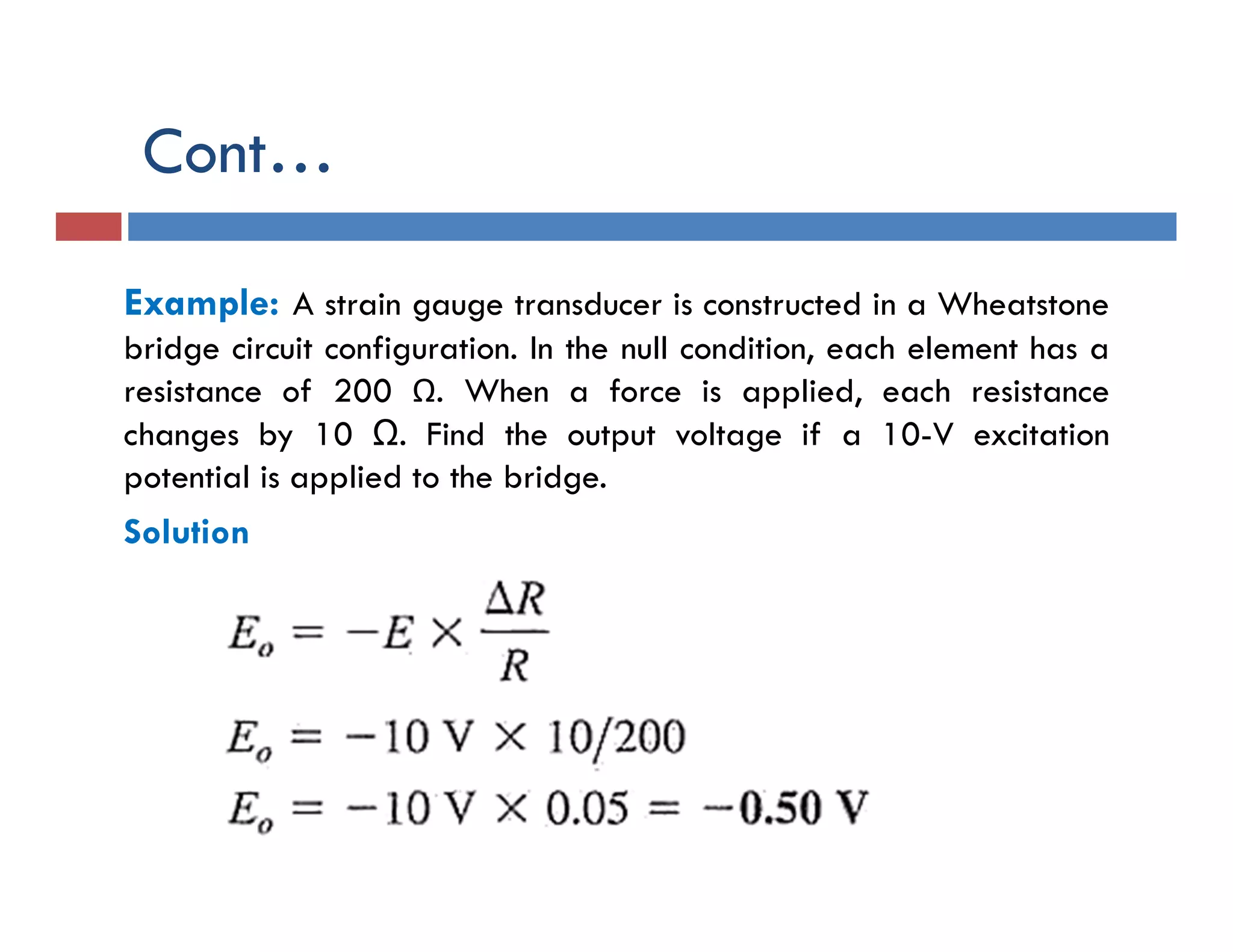
Example: A strain gauge transducer is constructed in a Wheatstone
bridge circuit configuration. In the null condition, each element has a
resistance of 200 Ω. When a force is applied, each resistance
changes by 10 Ω. Find the output voltage if a 10-V excitation
potential is applied to the bridge.
Solution
Transducer Sensitivity
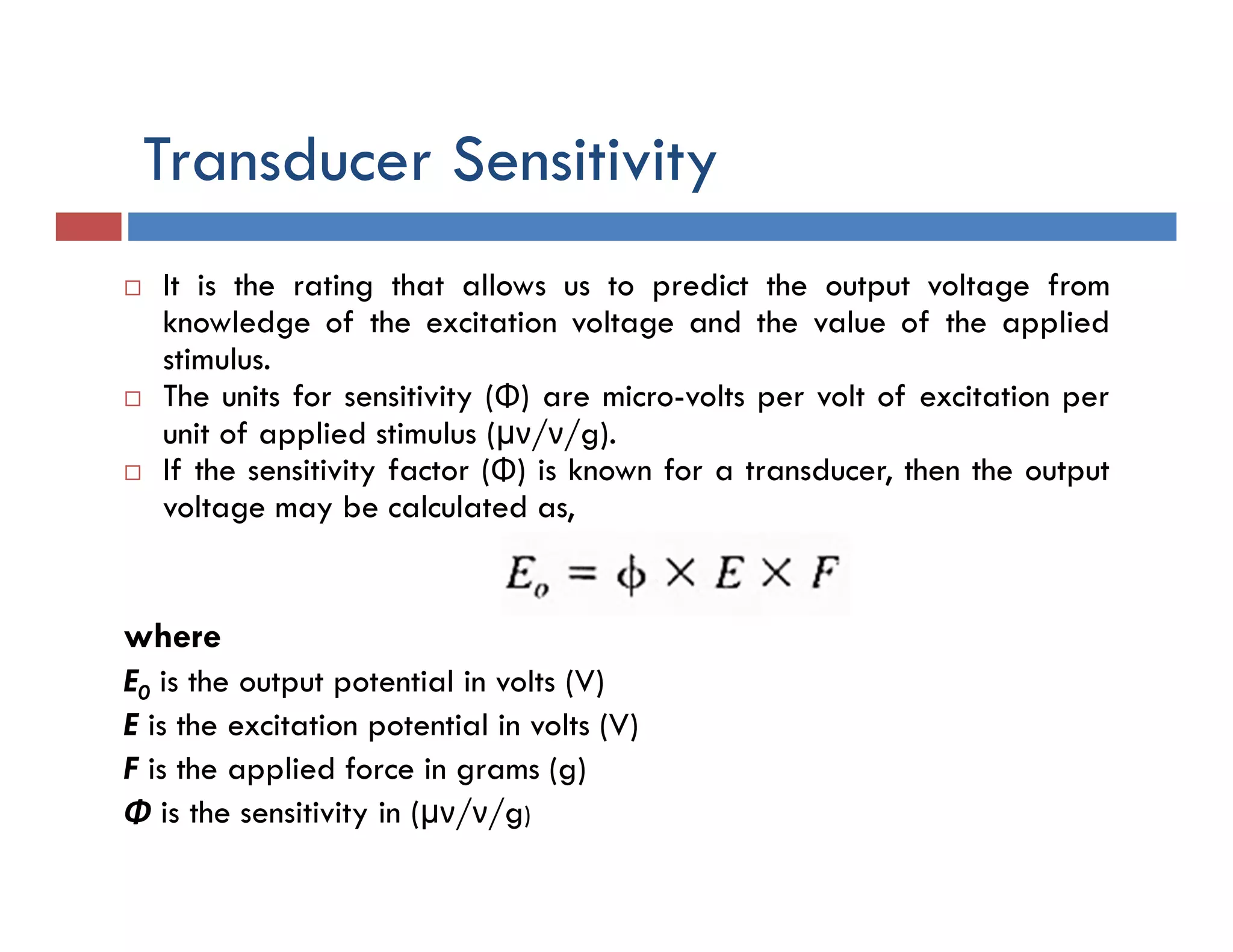
 It is the rating that allows us to predict the output voltage from
knowledge of the excitation voltage and the value of the applied
stimulus.
 The units for sensitivity (Φ) are micro-volts per volt of excitation per
unit of applied stimulus (µν/ν/g).
 If the sensitivity factor (Φ) is known for a transducer, then the output
voltage may be calculated as,
where
E0 is the output potential in volts (V)
E is the excitation potential in volts (V)
F is the applied force in grams (g)
Φ is the sensitivity in (µν/ν/g)
Cont…
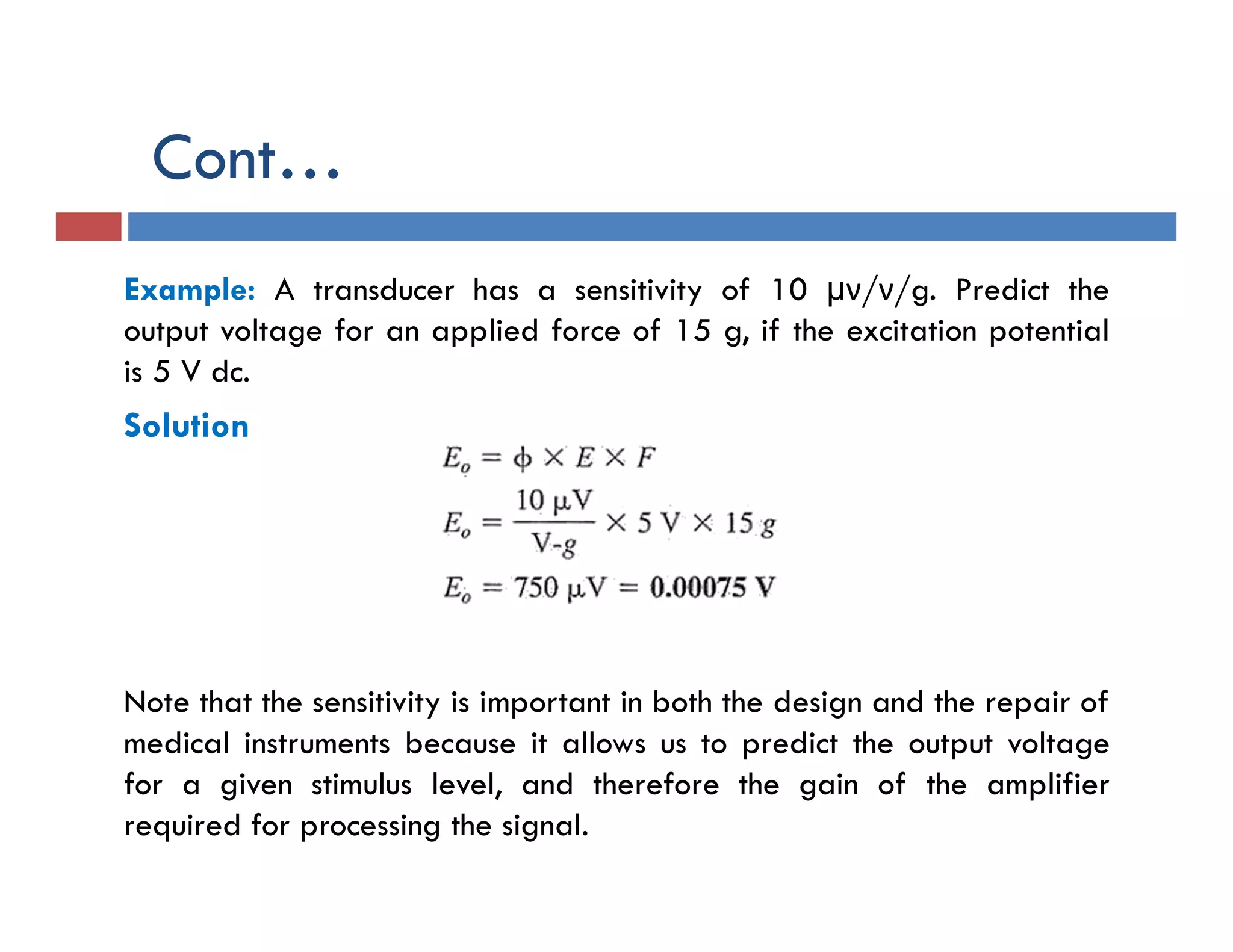
Example: A transducer has a sensitivity of 10 µν/ν/g. Predict the
output voltage for an applied force of 15 g, if the excitation potential
is 5 V dc.
Solution
Note that the sensitivity is important in both the design and the repair of
medical instruments because it allows us to predict the output voltage
for a given stimulus level, and therefore the gain of the amplifier
required for processing the signal.
Potentiometer Transducers
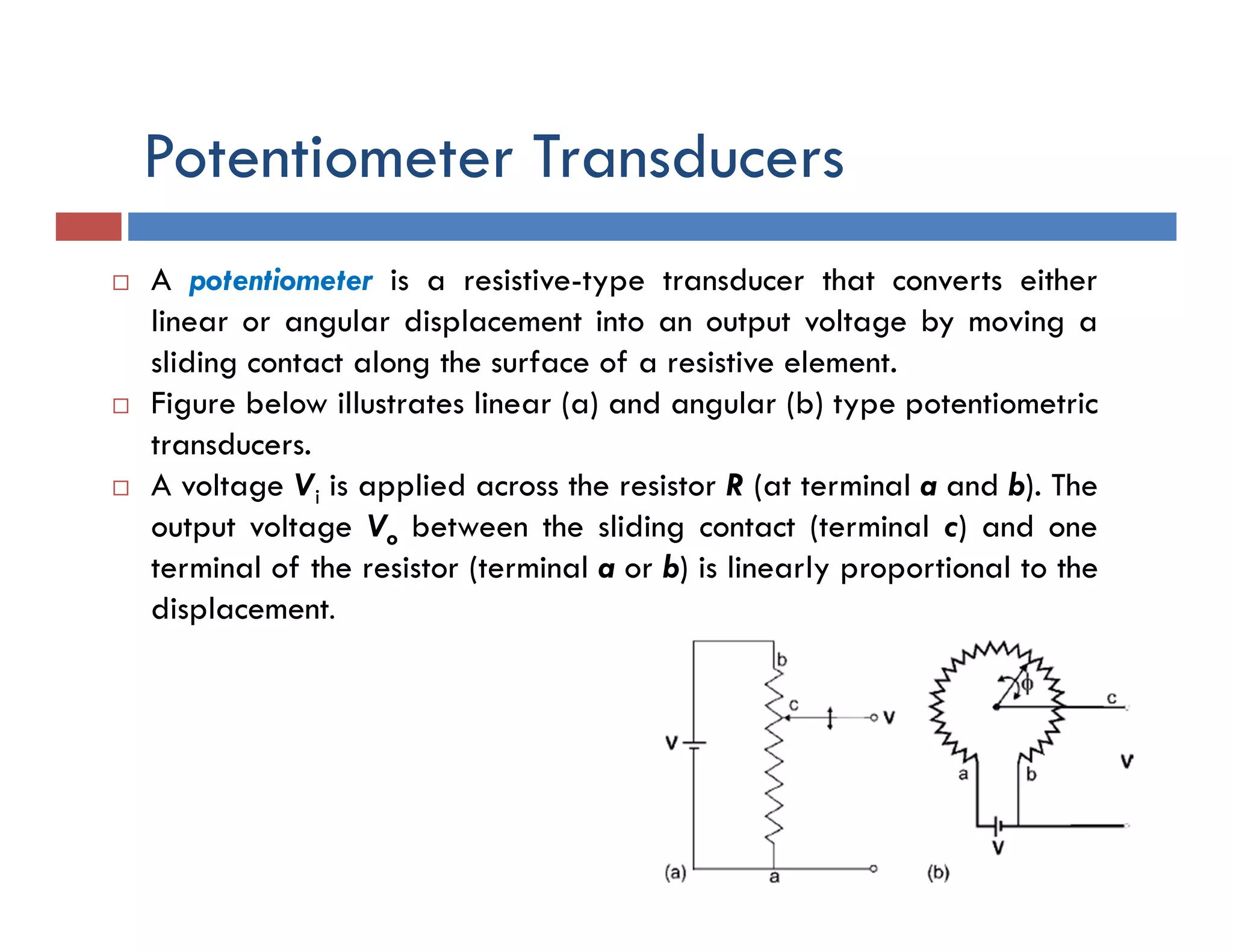
 A potentiometer is a resistive-type transducer that converts either
linear or angular displacement into an output voltage by moving a
sliding contact along the surface of a resistive element.
 Figure below illustrates linear (a) and angular (b) type potentiometric
transducers.
 A voltage Vi is applied across the resistor R (at terminal a and b). The
output voltage Vo between the sliding contact (terminal c) and one
terminal of the resistor (terminal a or b) is linearly proportional to the
displacement.
Elastic Resistive Transducers
 In certain clinical situations, it is desirable to measure changes in the
peripheral volume of a leg when the venous outflow of blood from the
leg is temporarily occluded by a blood pressure cuff.
 This volume-measuring method is called plethysmography.
 The measurement can be performed by wrapping an elastic resistive
transducer around the leg and measuring the rate of change in
resistance of the transducer as a function of time.
 This change corresponds to relative changes in the blood volume of the
leg.
 If a clot is present, it will take more time for the blood stored in the leg
to flow out through the veins after the temporary occlusion is removed.
 A similar transducer can be used to follow a patient’s breathing
pattern by wrapping the elastic band around the chest.
Cont…
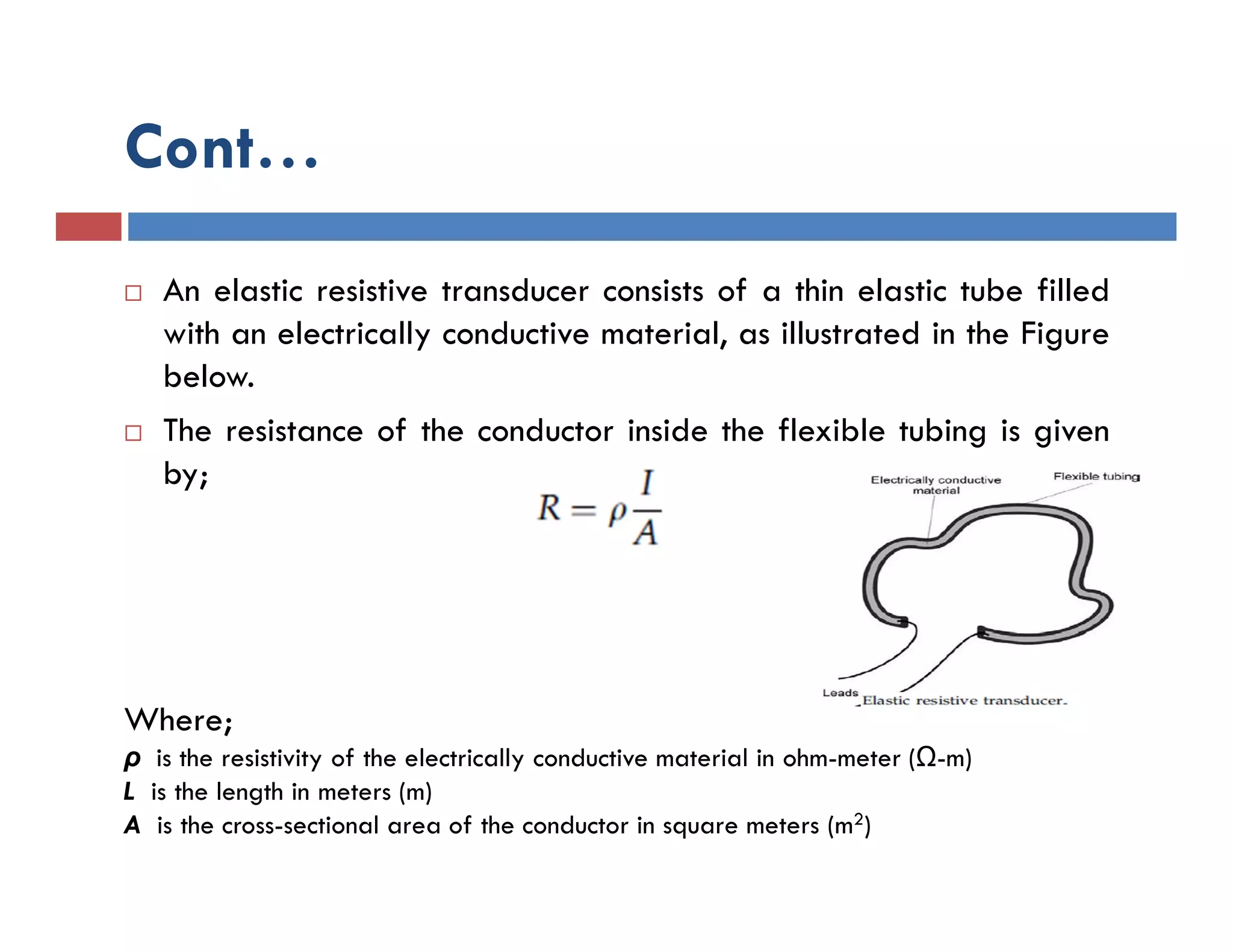
 An elastic resistive transducer consists of a thin elastic tube filled
with an electrically conductive material, as illustrated in the Figure
below.
 The resistance of the conductor inside the flexible tubing is given
by;
Where;
ρ is the resistivity of the electrically conductive material in ohm-meter (Ω-m)
L is the length in meters (m)
A is the cross-sectional area of the conductor in square meters (m2)
Cont…
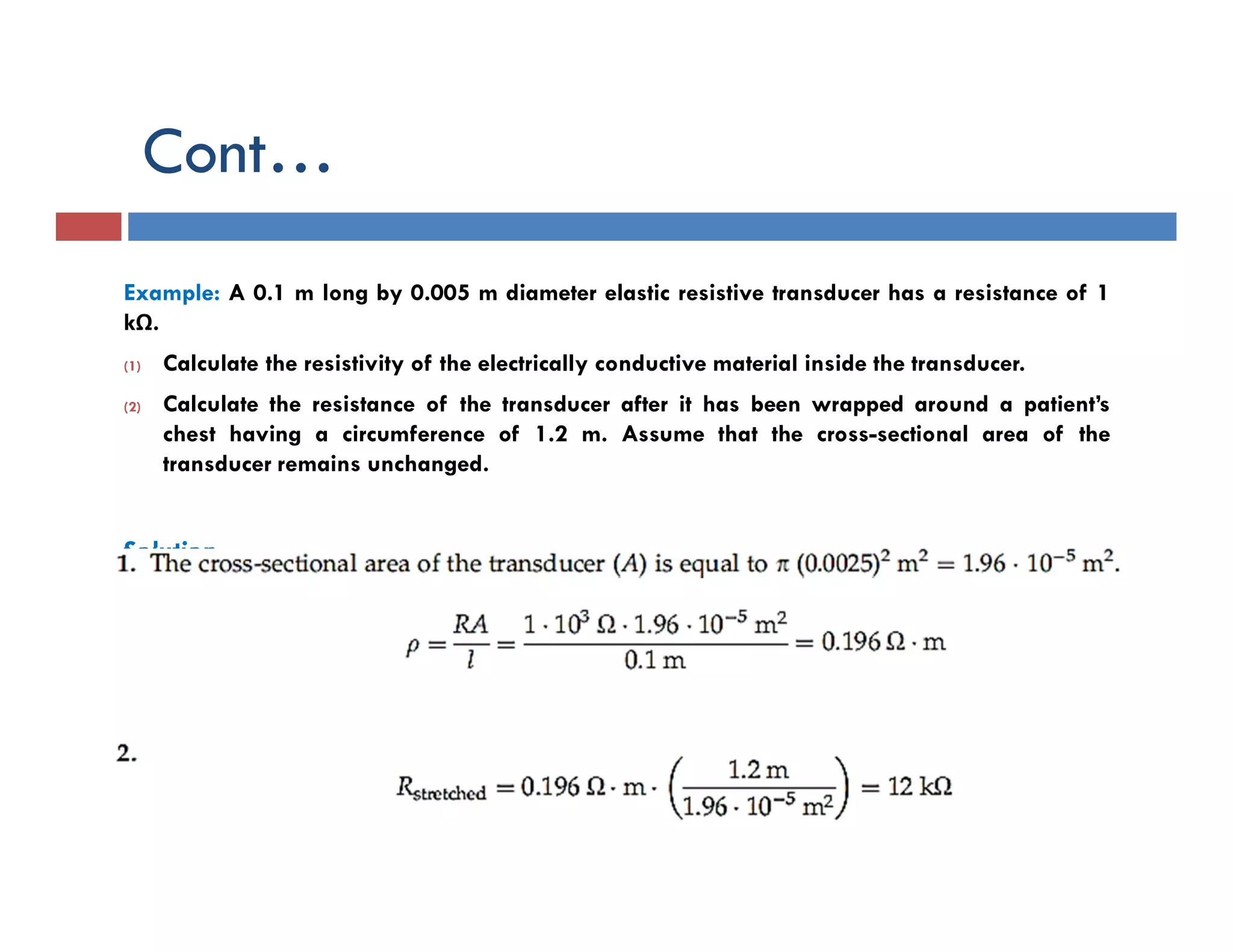
Example: A 0.1 m long by 0.005 m diameter elastic resistive transducer has a resistance of 1
kΩ.
(1) Calculate the resistivity of the electrically conductive material inside the transducer.
(2) Calculate the resistance of the transducer after it has been wrapped around a patient’s
chest having a circumference of 1.2 m. Assume that the cross-sectional area of the
transducer remains unchanged.
Solution
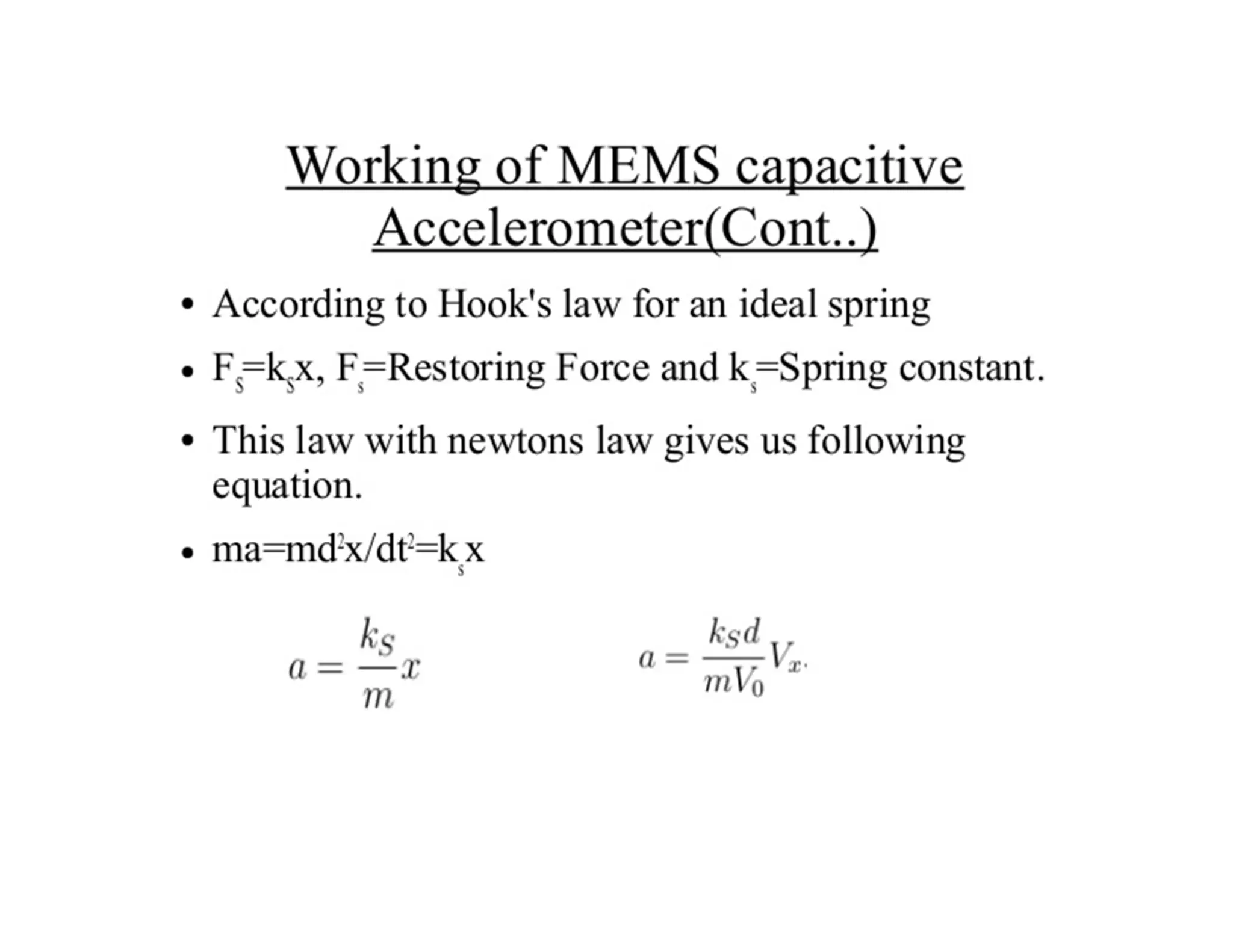
Capacitive Transducers
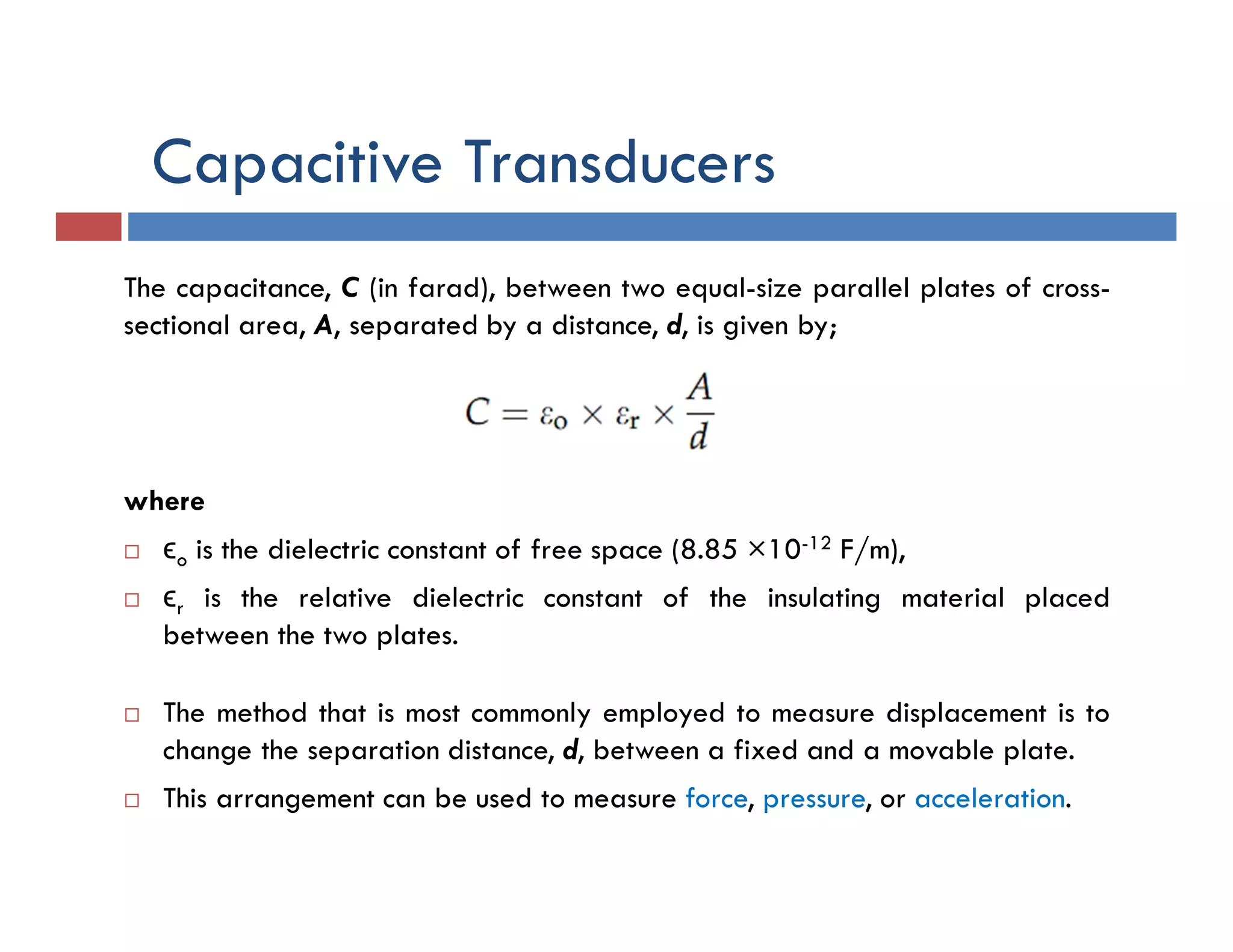
The capacitance, C (in farad), between two equal-size parallel plates of cross-
sectional area, A, separated by a distance, d, is given by;
where
 ϵo is the dielectric constant of free space (8.85 ×10⁻¹² F/m),
 ϵr is the relative dielectric constant of the insulating material placed
between the two plates.
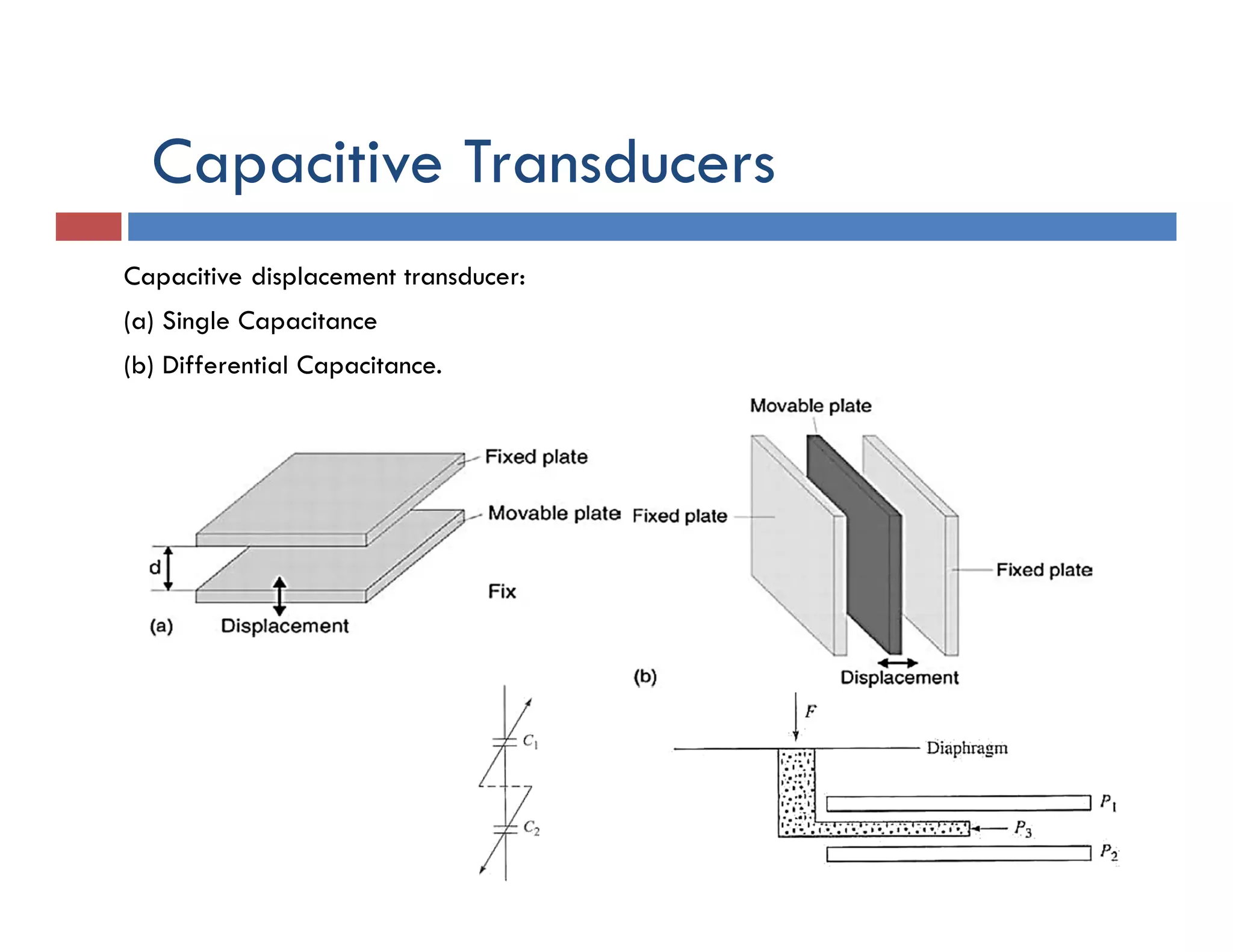
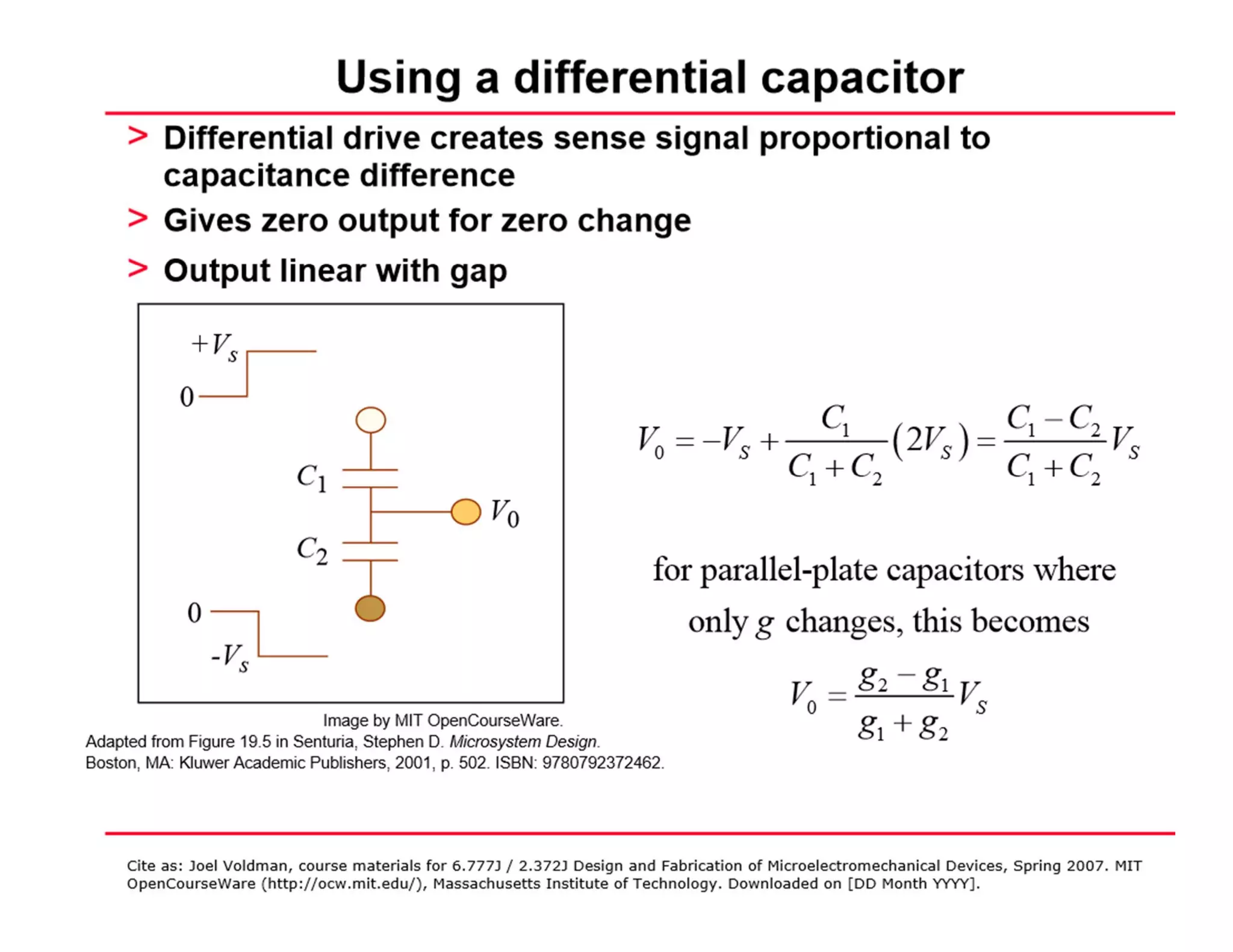
 The method that is most commonly employed to measure displacement is to
change the separation distance, d, between a fixed and a movable plate.
 This arrangement can be used to measure force, pressure, or acceleration.
Capacitive Transducers
Capacitive displacement transducer:
(a) Single Capacitance
(b) Differential Capacitance.
Cont…
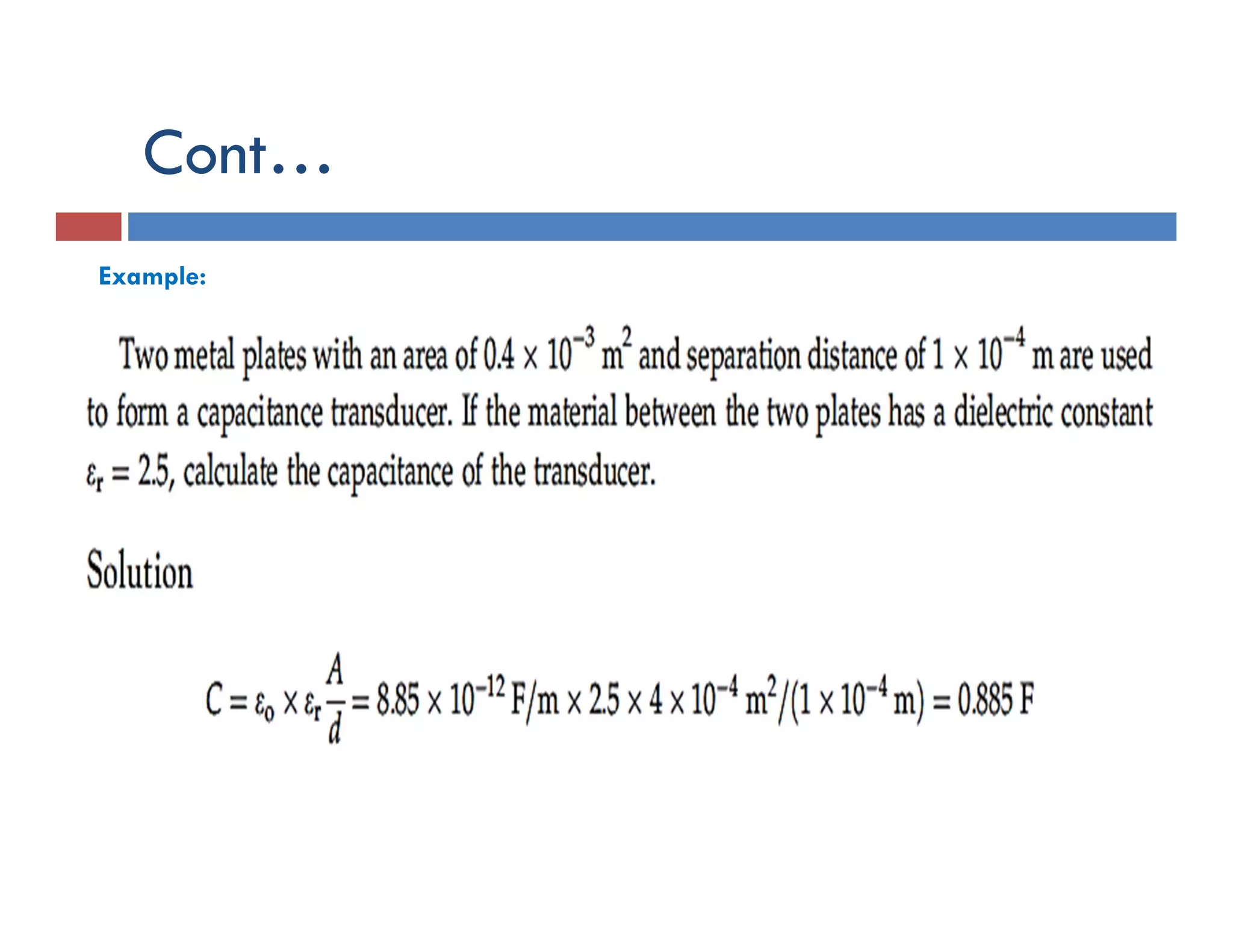
Example:
gunjanpatel.wordpress.com
Thank you

Sensors for Biomedical Devices and systems

  • 1.
    Sensors for Biomedical Devicesand systems Gunjan Patel (MS, BME) MCIS, Manipal UNiversity
  • 2.
    Outline  Differentiate betweenthe terms “Sensor”, “Transducer” & “Actuator”  Active and Passive Transducers/Sensors  Sensors used in Biomedical Instruments  Sensor Error Sources  Sensor Terminology  The Wheatstone Bridge  Displacement Transducers (Resistive, Inductive, or Capacitive type)  Piezoelectric Transducers
  • 3.
    Definitions Transducer: A transducer isa device which converts energy from one form to another. Sensor: A sensor is a device which converts a physical parameter to an electrical output Actuator An actuator is a device which converts an electrical energy to a mechanical or physical output.
  • 4.
    Active sensors  Activesensors generate electrical output directly in response to an applied stimulation or measurand.  An active sensor doesn’t require an external voltage source to produce electrical output.  Example: Solar Cell, Piezoelectric Material, Thermocouple, etc.
  • 5.
    PASSIVE SENSORS  Passivesensors produce a change in some passive electrical quantity, such as capacitance, resistance, or inductance, in response to an applied stimulus or measurand.  Therefore, a passive sensor does require an external ac or dc voltage source in order to convert passive electrical quantity such as capacitance, resistance, or inductance in to electrical output  Example: Photo Diode, Thermistor, Strain Gauge, etc.
  • 6.
    Examples of Sensorsused in Biomedical Instruments  Sensors are now available to measure many parameters of clinical and laboratory interest.  Some types of sensors are summarized in the Table below.
  • 7.
    Sensors in MedicalInstruments  Example of sensors used in typical medical instruments.
  • 8.
    Sensor Error Sources Sensors, like all other devices, sustain certain errors.  The error is defined as the difference between the measured value and the true value.  Sensor errors an be break into five basic categories: 1. Insertion Error 2. Application Error 3. Characteristic Error 4. Dynamic Error 5. Environmental Error
  • 9.
    Sensor Error Sources 1.Insertion Errors The insertion errors occur during the act of inserting the sensor into the system being measured. 2. Application Errors Application errors are caused by the operator
  • 10.
    Cont… 3. Characteristic Errors Thecharacteristic errors are inherent in the device itself. i.e., the difference between the ideal characteristic transfer function of the device and the actual characteristic. This form of error may include a dc off-set value (a false pressure head), an incorrect slope, or a slope that is not perfectly linear.
  • 11.
    4. Dynamic Errors Many sensors are characterized and calibrated in a static condition. i.e., with an input parameter that is either static or quasi- static.  Many sensors are heavily damped so that they will not respond to rapid changes in the input parameter.  Dynamic errors include response time, amplitude distortion, and phase distortion.
  • 12.
    5. Environmental Errors These errors are derived from the environment in which the sensor is used.  They most often include temperature but may also include vibration. shock, altitude, chemical exposure, or other factors.  These factor most often affect the characteristic errors of the sensor, so are often combined with that category in practical application.
  • 13.
    Sensor Terminology 1. Sensitivity 2.Sensitivity Error 3. Range 4. Dynamic Range 5. Precision 6. Resolution 7. Accuracy 8. Offset 9. Linearity 10. Hysteresis 11. Response time 12. Dynamic linearity 13. Transfer function 14. Noise 15. Bandwidth
  • 14.
    Sensor Terminology 1. Sensitivity The sensitivity of the sensor is defined as the slope of the output characteristic curve (ΔY/ΔX).  More generally, the minimum input of physical parameter that will create a detectable output change.  In some sensor, the sensitivity is defined as the input parameter change required to produce a standardized output change.  In others, it is defined as an output voltage change for a given change in input parameter.
  • 15.
  • 16.
    Sensor Terminology 4. DynamicRange • The dynamic range is the total range of the sensor from minimum to maximum. 5. Precision • The precision refers to the degree of reproducibility of a measurement. 6. Resolution • The resolution is define as the smallest detectable incremental change of input parameter that can be detected in the output signal.
  • 17.
    7. Accuracy  Theaccuracy of the sensor is the maximum difference that will exist between the actual value (which must be measured by a primary or good secondary standard) and the indicated value at the output of the sensor.
  • 18.
    Sensor Terminology 8. Offset The offset error of a transducer is defined as the output that will exist when it should be zero.  Alternatively, the difference between the actual output value and the specified output value under some particular set of conditions. 9. Linearity  The linearity of the transducer is an expression of the extent to which the actual measured curve of a sensor departs from the ideal curve.
  • 19.
    Sensor Terminology Ideal versusmeasured curve showing linearity error
  • 20.
    Sensor Terminology 10. Hysteresis •A transducer should be capable of following the changes of the input parameter regardless in which direction the change is made, hysteresis is the measure of this property.
  • 21.
    Sensor Terminology 11. ResponseTime  Sensors do not change output state immediately when an input parameter change occur. Rather, it will change to the new state over a period of time, called the response time.  The response time can be defined as the time required for a sensor output to change from its previous state to a final settled value within a tolerance band of the correct new value.
  • 22.
    Sensor Terminology 12. DynamicLinearity  The dynamic linearity of the sensor is a measure of its ability to follow rapid changes in the input parameter.  Amplitude distortion characteristics. phase distortion characteristics, and response time are important in determining dynamic linearity.
  • 23.
    Sensor Terminology 13. TransferFunction  The functional relationship between physical input signal and electrical output signal. 14. Noise • Almost all type of sensors produce some output noise in addition to the output signal. • The noise of the sensor limits the performance of the system. • Most common types of noise are 50 Hz supply noise, and white noise which is generally distributed across the frequency spectrum.
  • 24.
    Sensor Terminology 15. Bandwidth All sensors have finite response times to an instantaneous change in physical signal.  In addition, many sensors have decay times, which would represent the time after a step change in physical signal for the sensor output to decay to its original value.  The reciprocal of these times correspond to the upper and lower cutoff frequencies, respectively.  The bandwidth of a sensor is the frequency range between these two frequencies.
  • 25.
    The Wheatstone Bridge Many biomedical passive transducers/sensors are used in a circuit configuration called a Wheatstone bridge.  The Wheatstone bridge circuit is ideal for measuring small changes in resistance.  The Wheatstone bridge can be viewed as two resistor voltage dividers connected in parallel with the voltage source E. Wheatstone Bridge Circuit Wheatstone Bridge Circuit Redrawn for Simplify Analysis
  • 26.
    The Wheatstone Bridge Theoutput voltage E0 is the difference between the two ground referenced potentials EC and ED produced by the two voltage divider networks; Where EC and ED can be calculated as; So, the output can be calculated as;
  • 27.
    Cont… Example: A Wheatstonebridge is excited by a 12 v dc source and contains the following resistances; R1 = 1.2 kΩ, R2 = 3 kΩ, R3 = 2.2 kΩ, and R4 = 5 kΩ. Find the output voltage E0. Solution
  • 28.
    Null Condition  Thenull condition in a Wheatstone bridge circuit exists when the output voltage E0 is zero.  The equation of Wheatstone bridge is,  The null condition exists when either the excitation source voltage E must be zero or the expression inside bracket s must be equal to zero.  So the null condition occurs when; , and .  Therefore, the ratio of two equals are,  Replacing voltages with the equivalent current and resistance,  So, the null condition in a Wheatstone bridge circuit occurs when
  • 29.
    Cont… Example: Show thatthe null condition exists in a Wheatstone bridge consisting of the following resistances, R1 = 2 kΩ, R2 = 1 kΩ, R3 = 10 kΩ, and R4 = 5 kΩ. Solution  Note that it is not necessary for the resistances to be equal for the null condition, only that the ratios of the two half-bridge voltage dividers must be equal.  Since both sides of the equation evaluate to the same quantity, we may conclude that the bridge is in the null condition.  A bridge in the null condition is said to be balanced.
  • 30.
    Strain Gauge  Straingauges are displacement-type transducers that measure changes in the length of an object as a result of an applied force.  A strain gauge is a resistive element that produces a change in its resistance proportional to an applied mechanical strain.  A strain is a force applied in either compression (a push along the axis to-word the center) or tension (a pull along the axis away from the center).  The piezoresistive effect describes change in the electrical resistivity of a semiconductor when mechanical stress (force) is applied.
  • 31.
    Mechanism for Piezoresistivity Figure(a): shows a small metallic bar with no force applied.  It will have a length L and a cross-sectional area A.  Changes in length are given by ΔL and changes in area are given by ΔA. Figure (b): shows the result of applying a compression force to the ends of the bar.  The length reduces to L – ΔL, and the cross- sectional area increases to A + ΔA. Figure (c): shows the result of applying a tension force of the same magnitude to the bar.  The length increases to L + ΔL, and the cross-sectional area reduces to A – ΔA.
  • 32.
    Strain Gauge Resistance The resistance of a metallic bar is given in terms of the length and cross-sectional area in the expression as; Where; ρ is the resistivity constant of the material in ohm-meter (Ω-m) L is the length in meters (m) A is the cross-sectional area in square meters (m2)  The above equation shows that the resistance is directly proportional to the length and inversely proportional to the square of the cross-sectional area.
  • 33.
  • 34.
    Strain Gauge Piezoresistivity:  Thechange of resistance with changes in size and shape is some called piezoresistivity.  The resistance of the bar will become R + h in tension.  The resistance of the bar will become R - h in compression.  Where the h is change in resistance.  Examine the equation of strain gauge, it is found that changes in both length and cross-sectional area tend to increase the resistance in tension and decrease the resistance in compression.  The resistances after force is applied are in tension:  The resistances after force is applied are in compression:
  • 35.
    Example: A thinconstantan wire stretched taut has a length of 30 mm and a cross-sectional area of 0.01 mm2. The resistance is 1.5 Ω. The force applied to the wire is increased so that the length further increases by 10 mm and the cross-sectional area decreases by 0.0027 mm2. Find the change in resistance h, where the resistivity of constantan is approximately 5 x 10⁻⁷ Ω-m. Solution: Strain Gauge
  • 36.
     The fractionalchange in resistance, (ΔR/R), divided by the fractional change in length, (ΔL/L), is called the gauge factor (GF).  The gauge factor GF is a unit less number.  The gauge factor provides sensitivity information on the expected change in resistance for a given change in the length of a strain gauge.  The gauge factor varies with temperature and the type of material. Gauge Factor (GF):
  • 37.
    Cont…  Therefore, itis important to select a material with a high gauge factor and small temperature coefficient.  For a common metal wire strain gauge made of constantan, GF is approximately equal to 2.  Semiconductor strain gauges made of silicon have a GF about 70 to 100 times higher and are therefore much more sensitive than metallic wire strain gauges.
  • 38.
     The gaugefactor (GF) for a strain gauge transducer is a means of comparing it with other semiconductor transducers.  The definition of gauge factor is; or where Where; GF is the gauge factor (dimensionless) ΔR is the change in resistance in ohms (Ω) R is the unstrained resistance in ohms (Ω) ΔL is the change in length in meters (m) L is the length in meters (m) Cont…
  • 39.
    Example: A 20mm length of wire used as a strain gauge exhibits a resistance of 150 Ω. When a force is applied in tension, the resistance changes by 2 Ω and the length changes by 0.07 mm. Find the gauge factor GF. Solution  The gauge factor gives us a means for evaluating the relative sensitivity of a strain gauge element.  The greater the change in resistance per unit change in length the greater the sensitivity of the element and the greater the gauge factor GF. Cont…
  • 40.
    Types of StrainGauges Strain gauges typically fall into two categories: 1. Unbonded Strain Gauge 2. Bonded Strain Gauge
  • 41.
    Unbonded Strain Gauge The resistance element is a thin wire of a special alloy that is stretched taut between two flexible supports, which are in turn mounted on a thin metal diaphragm.  When a force such as F1 is applied, the diaphragm will flex in a manner that spreads the supports further apart, causing an increased tension in the resistance wire.  This tension tends to increase the resistance of the wire in an amount proportional to the applied force.
  • 42.
    Cont…  Similarly, ifa force such as F2 is applied to the diaphragm, the ends of the supports move closer together, reducing the tension in the taut wire.  This action is the same as applying a compression force to the wire.  The electrical resistance in this case will reduce in an amount proportional to the applied force
  • 43.
    Bonded Strain Gauge A bonded strain gauge is made by cementing a thin wire or foil element to a diaphragm.  Flexing the diaphragm deforms the element. causing a change in electrical resistance exactly as in the unbonded strain gauge.
  • 44.
    Strain Gauge  Manybiomedical strain gauge transducers are of bonded construction because the linear range is adequate and the extra ruggedness is a desirable feature in medical environments.  The Statham P-23 series are of the unbonded type strain gauge transducer but are made in a very rugged housing. These are among the most common cardiovascular pressure transducers used in medicine.  In addition, changes in temperature can also cause thermal expansion of the wire and thus lead to large changes in the resistance of a strain gauge.  Therefore, very sensitive electronic amplifiers with special temperature compensation circuits are typically used in applications involving strain gauge transducers.
  • 45.
    Strain Gauge  Mostphysiological strain gauge transducers use four strain gauge elements connected in a Wheatstone bridge circuit as shown in the figure.  Both bonded and unbonded types of transducers are found with an element geometry that places two elements in tension and two elements in compression for any applied force (tension or compression).  Such a configuration increases the output of the bridge for any applied force and so increases the sensitivity of the transducer. Strain gauge elements in a Wheatstone bridge circuit Mechanical configuration Using a common diaphragm
  • 46.
    Cont…  Assume thatall resistors of the Wheatstone bridge circuit are equal (R1 = R2, = R3, = R4) when no force is applied.  Let ΔR = h, when a force is applied, the resistance of R1 and R4 will be (R + h), and the resistance of R2 and R3 will be (R – h).  From a rewritten version of the Wheatstone bridge circuit equation, we know that the output voltage is
  • 47.
    Cont… Example: A straingauge transducer is constructed in a Wheatstone bridge circuit configuration. In the null condition, each element has a resistance of 200 Ω. When a force is applied, each resistance changes by 10 Ω. Find the output voltage if a 10-V excitation potential is applied to the bridge. Solution
  • 48.
    Transducer Sensitivity  Itis the rating that allows us to predict the output voltage from knowledge of the excitation voltage and the value of the applied stimulus.  The units for sensitivity (Φ) are micro-volts per volt of excitation per unit of applied stimulus (µν/ν/g).  If the sensitivity factor (Φ) is known for a transducer, then the output voltage may be calculated as, where E0 is the output potential in volts (V) E is the excitation potential in volts (V) F is the applied force in grams (g) Φ is the sensitivity in (µν/ν/g)
  • 49.
    Cont… Example: A transducerhas a sensitivity of 10 µν/ν/g. Predict the output voltage for an applied force of 15 g, if the excitation potential is 5 V dc. Solution Note that the sensitivity is important in both the design and the repair of medical instruments because it allows us to predict the output voltage for a given stimulus level, and therefore the gain of the amplifier required for processing the signal.
  • 50.
    Potentiometer Transducers  Apotentiometer is a resistive-type transducer that converts either linear or angular displacement into an output voltage by moving a sliding contact along the surface of a resistive element.  Figure below illustrates linear (a) and angular (b) type potentiometric transducers.  A voltage Vi is applied across the resistor R (at terminal a and b). The output voltage Vo between the sliding contact (terminal c) and one terminal of the resistor (terminal a or b) is linearly proportional to the displacement.
  • 51.
    Elastic Resistive Transducers In certain clinical situations, it is desirable to measure changes in the peripheral volume of a leg when the venous outflow of blood from the leg is temporarily occluded by a blood pressure cuff.  This volume-measuring method is called plethysmography.  The measurement can be performed by wrapping an elastic resistive transducer around the leg and measuring the rate of change in resistance of the transducer as a function of time.  This change corresponds to relative changes in the blood volume of the leg.  If a clot is present, it will take more time for the blood stored in the leg to flow out through the veins after the temporary occlusion is removed.  A similar transducer can be used to follow a patient’s breathing pattern by wrapping the elastic band around the chest.
  • 52.
    Cont…  An elasticresistive transducer consists of a thin elastic tube filled with an electrically conductive material, as illustrated in the Figure below.  The resistance of the conductor inside the flexible tubing is given by; Where; ρ is the resistivity of the electrically conductive material in ohm-meter (Ω-m) L is the length in meters (m) A is the cross-sectional area of the conductor in square meters (m2)
  • 53.
    Cont… Example: A 0.1m long by 0.005 m diameter elastic resistive transducer has a resistance of 1 kΩ. (1) Calculate the resistivity of the electrically conductive material inside the transducer. (2) Calculate the resistance of the transducer after it has been wrapped around a patient’s chest having a circumference of 1.2 m. Assume that the cross-sectional area of the transducer remains unchanged. Solution
  • 54.
    Capacitive Transducers The capacitance,C (in farad), between two equal-size parallel plates of cross- sectional area, A, separated by a distance, d, is given by; where  ϵo is the dielectric constant of free space (8.85 ×10⁻¹² F/m),  ϵr is the relative dielectric constant of the insulating material placed between the two plates.  The method that is most commonly employed to measure displacement is to change the separation distance, d, between a fixed and a movable plate.  This arrangement can be used to measure force, pressure, or acceleration.
  • 55.
    Capacitive Transducers Capacitive displacementtransducer: (a) Single Capacitance (b) Differential Capacitance.
  • 56.
  • 61.