Scapulohumeral Rhythm
Scapulohumeral rhythm
The coordinated motion of the scapula and humerus experienced
during shoulder movement and motion that has been traditionally
viewed as occurring at a ratio of 2:1 (2 degrees of humeral
flexion/abduction to 1 degree of scapular upward rotation).
The full range of shoulder motion normally is combination between
the motion in glenohumeral and scapulothoracic joint.
2
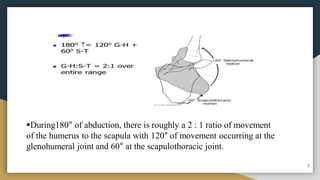
During180° of abduction, there is roughly a 2 : 1 ratio of movement
of the humerus to the scapula with 120° of movement occurring at the
glenohumeral joint and 60° at the scapulothoracic joint.
3
4
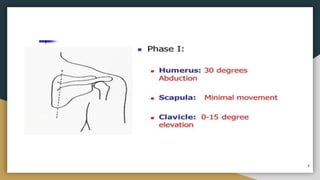
 In the first phase of 30° of elevation through abduction, the scapula
is said to be “setting.” This setting phase means that the scapula
may rotate slightly in, rotate slightly out, or not move at all. Thus,
there is no 2 : 1 ratio of movement during this phase.
 The angle between the scapular spine and the clavicle may also
increase up to 5° by elevating at the sternoclavicular and
acromioclavicular joints, but this depends on whether the scapula
moves during this phase.
 The clavicle rotates minimally during this stage.
5
6
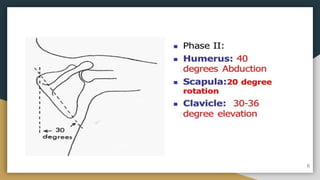
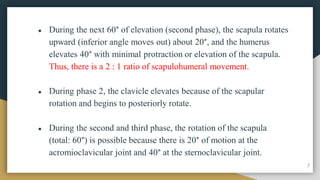
● During the next 60° of elevation (second phase), the scapula rotates
upward (inferior angle moves out) about 20°, and the humerus
elevates 40° with minimal protraction or elevation of the scapula.
Thus, there is a 2 : 1 ratio of scapulohumeral movement.
● During phase 2, the clavicle elevates because of the scapular
rotation and begins to posteriorly rotate.
● During the second and third phase, the rotation of the scapula
(total: 60°) is possible because there is 20° of motion at the
acromioclavicular joint and 40° at the sternoclavicular joint.
7
8
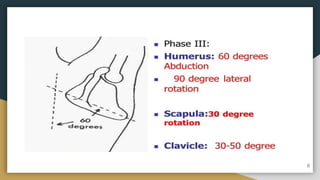
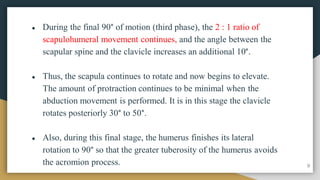
● During the final 90° of motion (third phase), the 2 : 1 ratio of
scapulohumeral movement continues, and the angle between the
scapular spine and the clavicle increases an additional 10°.
● Thus, the scapula continues to rotate and now begins to elevate.
The amount of protraction continues to be minimal when the
abduction movement is performed. It is in this stage the clavicle
rotates posteriorly 30° to 50°.
● Also, during this final stage, the humerus finishes its lateral
rotation to 90° so that the greater tuberosity of the humerus avoids
the acromion process. 9
Purpose of Scapulohumeral Rhythm
● It allows the glenoid fossa to maintain a good position for the
various movements of the head of the humerus.
● It preserves the length-tension relationships of the glenohumeral
muscles; the muscles do not shorten as much as they would
without the scapula's upward rotation, and so can sustain their
force production through a larger portion of the range of motion
● Prevents impingement between the humerus and the acromion by
moving glenoid. 10
Key components of Scapulohumeral
rhythm:
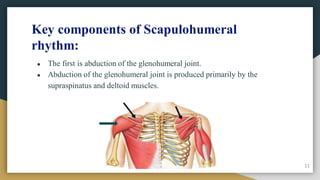
● The first is abduction of the glenohumeral joint.
● Abduction of the glenohumeral joint is produced primarily by the
supraspinatus and deltoid muscles.
11
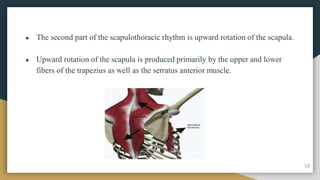
● The second part of the scapulothoracic rhythm is upward rotation of the scapula.
● Upward rotation of the scapula is produced primarily by the upper and lower
fibers of the trapezius as well as the serratus anterior muscle.
12
● An injury to the long thoracic nerve that innervates the serratus anterior
muscle, such as from heavy backpack straps, may impair function in the
serratus anterior muscle.
● If the serratus anterior is not functioning properly, the scapula will not
upward rotate enough. If it doesn’t upwardly rotate enough, the humerus
may compress the underside of the acromion process during attempted
abduction and cause shoulder impingement or rotator cuff disorders.
13
Causes of abnormal Scapulohumeral rhythm
● Fracture of clavicle,
● Spinal accessory nerve palsy,
● Serratus anterior muscle weakness,
● Decrease the strength of rotator cuff muscles,
● Acromioclavicular joint arthritis,
● Glenohumeral joint degeneration.
14
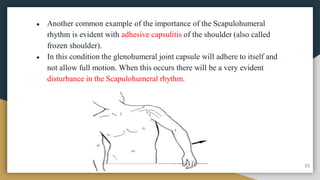
● Another common example of the importance of the Scapulohumeral
rhythm is evident with adhesive capsulitis of the shoulder (also called
frozen shoulder).
● In this condition the glenohumeral joint capsule will adhere to itself and
not allow full motion. When this occurs there will be a very evident
disturbance in the Scapulohumeral rhythm.
15
Outcome measures :
● Simple shoulder test (SST)
● Disabilities of the Arm, Shoulder and Hand (DASH) Questionnaire,
● Shoulder Pain and Disability Index (SPADI)
16
Examination :
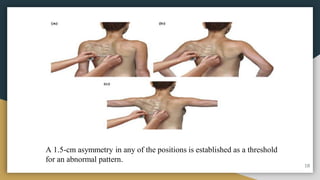
● Lateral scapular slide test (LSST):
 Inferior- medial angle of scapula is palpated and marked on both sides.
 The reference point on the spine is the nearest spinous process, which is
marked.
 Difference is measured on the both sides in three different points:
(a) the subject's arm is relaxed at the side (0° of humeral elevation)
(b) the subject places his or her hand on the lateral iliac crest
(c) corresponds to an internally rotated and abducted arm to 90°
17
A 1.5-cm asymmetry in any of the positions is established as a threshold
for an abnormal pattern.
18
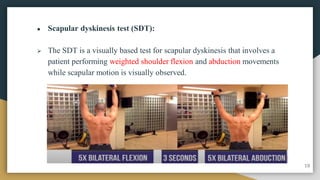
● Scapular dyskinesis test (SDT):
 The SDT is a visually based test for scapular dyskinesis that involves a
patient performing weighted shoulder flexion and abduction movements
while scapular motion is visually observed.
19
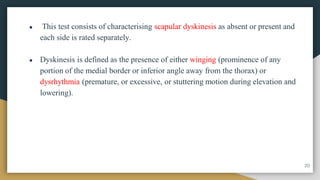
● This test consists of characterising scapular dyskinesis as absent or present and
each side is rated separately.
● Dyskinesis is defined as the presence of either winging (prominence of any
portion of the medial border or inferior angle away from the thorax) or
dysrhythmia (premature, or excessive, or stuttering motion during elevation and
lowering).
20
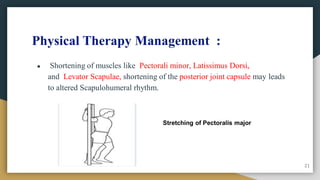
Physical Therapy Management :
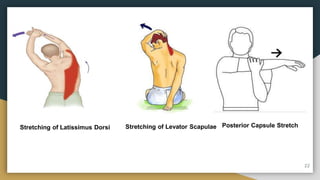
● Shortening of muscles like Pectorali minor, Latissimus Dorsi,
and Levator Scapulae, shortening of the posterior joint capsule may leads
to altered Scapulohumeral rhythm.
Stretching of Pectoralis major
21
Stretching of Latissimus Dorsi Stretching of Levator Scapulae Posterior Capsule Stretch
22
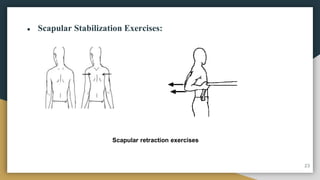
● Scapular Stabilization Exercises:
Scapular retraction exercises
23
External Rotation Shoulder Diagonal
Shoulder Extension
24
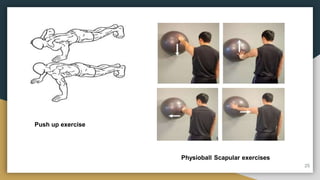
Push up exercise
Physioball Scapular exercises
25
References:
● Magee DJ. Orthopedic physical assessment. Elsevier Health Sciences; 2013 Dec 4.
● Levangie PK, Norkin CC. Joint Structure and Function; A Comprehensive
Analysis. 3rd. Philadelphia: FA. Davis Company. 2000.
● Scapulohumeral Rhythm. (2020, January 31). Physiopedia, . Retrieved 07:40, July
17, 2020 from https://www.physio-
pedia.com/index.php?title=Scapulohumeral_Rhythm&oldid=229383.
● The Scapulohumeral Rhythm- Academy of Clinical Massage.
26
27

Scapulohumeral rhythm and exercises

  • 1.
  • 2.
    Scapulohumeral rhythm The coordinatedmotion of the scapula and humerus experienced during shoulder movement and motion that has been traditionally viewed as occurring at a ratio of 2:1 (2 degrees of humeral flexion/abduction to 1 degree of scapular upward rotation). The full range of shoulder motion normally is combination between the motion in glenohumeral and scapulothoracic joint. 2
  • 3.
    During180° of abduction,there is roughly a 2 : 1 ratio of movement of the humerus to the scapula with 120° of movement occurring at the glenohumeral joint and 60° at the scapulothoracic joint. 3
  • 4.
  • 5.
     In thefirst phase of 30° of elevation through abduction, the scapula is said to be “setting.” This setting phase means that the scapula may rotate slightly in, rotate slightly out, or not move at all. Thus, there is no 2 : 1 ratio of movement during this phase.  The angle between the scapular spine and the clavicle may also increase up to 5° by elevating at the sternoclavicular and acromioclavicular joints, but this depends on whether the scapula moves during this phase.  The clavicle rotates minimally during this stage. 5
  • 6.
  • 7.
    ● During thenext 60° of elevation (second phase), the scapula rotates upward (inferior angle moves out) about 20°, and the humerus elevates 40° with minimal protraction or elevation of the scapula. Thus, there is a 2 : 1 ratio of scapulohumeral movement. ● During phase 2, the clavicle elevates because of the scapular rotation and begins to posteriorly rotate. ● During the second and third phase, the rotation of the scapula (total: 60°) is possible because there is 20° of motion at the acromioclavicular joint and 40° at the sternoclavicular joint. 7
  • 8.
  • 9.
    ● During thefinal 90° of motion (third phase), the 2 : 1 ratio of scapulohumeral movement continues, and the angle between the scapular spine and the clavicle increases an additional 10°. ● Thus, the scapula continues to rotate and now begins to elevate. The amount of protraction continues to be minimal when the abduction movement is performed. It is in this stage the clavicle rotates posteriorly 30° to 50°. ● Also, during this final stage, the humerus finishes its lateral rotation to 90° so that the greater tuberosity of the humerus avoids the acromion process. 9
  • 10.
    Purpose of ScapulohumeralRhythm ● It allows the glenoid fossa to maintain a good position for the various movements of the head of the humerus. ● It preserves the length-tension relationships of the glenohumeral muscles; the muscles do not shorten as much as they would without the scapula's upward rotation, and so can sustain their force production through a larger portion of the range of motion ● Prevents impingement between the humerus and the acromion by moving glenoid. 10
  • 11.
    Key components ofScapulohumeral rhythm: ● The first is abduction of the glenohumeral joint. ● Abduction of the glenohumeral joint is produced primarily by the supraspinatus and deltoid muscles. 11
  • 12.
    ● The secondpart of the scapulothoracic rhythm is upward rotation of the scapula. ● Upward rotation of the scapula is produced primarily by the upper and lower fibers of the trapezius as well as the serratus anterior muscle. 12
  • 13.
    ● An injuryto the long thoracic nerve that innervates the serratus anterior muscle, such as from heavy backpack straps, may impair function in the serratus anterior muscle. ● If the serratus anterior is not functioning properly, the scapula will not upward rotate enough. If it doesn’t upwardly rotate enough, the humerus may compress the underside of the acromion process during attempted abduction and cause shoulder impingement or rotator cuff disorders. 13
  • 14.
    Causes of abnormalScapulohumeral rhythm ● Fracture of clavicle, ● Spinal accessory nerve palsy, ● Serratus anterior muscle weakness, ● Decrease the strength of rotator cuff muscles, ● Acromioclavicular joint arthritis, ● Glenohumeral joint degeneration. 14
  • 15.
    ● Another commonexample of the importance of the Scapulohumeral rhythm is evident with adhesive capsulitis of the shoulder (also called frozen shoulder). ● In this condition the glenohumeral joint capsule will adhere to itself and not allow full motion. When this occurs there will be a very evident disturbance in the Scapulohumeral rhythm. 15
  • 16.
    Outcome measures : ●Simple shoulder test (SST) ● Disabilities of the Arm, Shoulder and Hand (DASH) Questionnaire, ● Shoulder Pain and Disability Index (SPADI) 16
  • 17.
    Examination : ● Lateralscapular slide test (LSST):  Inferior- medial angle of scapula is palpated and marked on both sides.  The reference point on the spine is the nearest spinous process, which is marked.  Difference is measured on the both sides in three different points: (a) the subject's arm is relaxed at the side (0° of humeral elevation) (b) the subject places his or her hand on the lateral iliac crest (c) corresponds to an internally rotated and abducted arm to 90° 17
  • 18.
    A 1.5-cm asymmetryin any of the positions is established as a threshold for an abnormal pattern. 18
  • 19.
    ● Scapular dyskinesistest (SDT):  The SDT is a visually based test for scapular dyskinesis that involves a patient performing weighted shoulder flexion and abduction movements while scapular motion is visually observed. 19
  • 20.
    ● This testconsists of characterising scapular dyskinesis as absent or present and each side is rated separately. ● Dyskinesis is defined as the presence of either winging (prominence of any portion of the medial border or inferior angle away from the thorax) or dysrhythmia (premature, or excessive, or stuttering motion during elevation and lowering). 20
  • 21.
    Physical Therapy Management: ● Shortening of muscles like Pectorali minor, Latissimus Dorsi, and Levator Scapulae, shortening of the posterior joint capsule may leads to altered Scapulohumeral rhythm. Stretching of Pectoralis major 21
  • 22.
    Stretching of LatissimusDorsi Stretching of Levator Scapulae Posterior Capsule Stretch 22
  • 23.
    ● Scapular StabilizationExercises: Scapular retraction exercises 23
  • 24.
    External Rotation ShoulderDiagonal Shoulder Extension 24
  • 25.
    Push up exercise PhysioballScapular exercises 25
  • 26.
    References: ● Magee DJ.Orthopedic physical assessment. Elsevier Health Sciences; 2013 Dec 4. ● Levangie PK, Norkin CC. Joint Structure and Function; A Comprehensive Analysis. 3rd. Philadelphia: FA. Davis Company. 2000. ● Scapulohumeral Rhythm. (2020, January 31). Physiopedia, . Retrieved 07:40, July 17, 2020 from https://www.physio- pedia.com/index.php?title=Scapulohumeral_Rhythm&oldid=229383. ● The Scapulohumeral Rhythm- Academy of Clinical Massage. 26
  • 27.