Cell Cycle
- Acell cycle is a series of events that takes place in a cell as it
grows and divides.
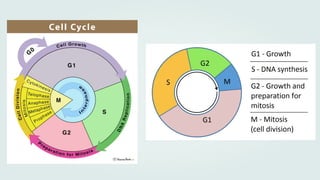
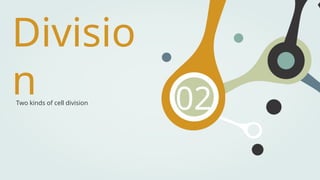
- Two major phases of cell cycle: Interphase and Mitosis
- The cell cycle is a four-stage process in which the cell
increases in size (gap 1, or G1, stage), copies its DNA
(synthesis, or S, stage), prepares to divide (gap 2, or G2,
stage), and divides (mitosis, or M, stage).
- Cell divisionis the process by which a parent cell divides into
two daughter cells.
- The production of new cells to bring about growth
replacement of damaged cells and the production of new
generations of individuals.
Cell
Division
Two kinds of cell
division
- Mitosis
- Meiosis
8.
- Two distinctkinds of cell division take place in our body; they are mitosis and meiosis.
- Mitosis the process of making new body cells, it takes place in our body cells called
somatic cells. Mitosis, is responsible in the increase in weight and height of the baby girl
as she grew and developed into a teenager.
- It is also responsible for the healing of the wound when a part of the body is
accidentally cut or scratched. On the other hand, meiosis is the type of cell division that
creates egg and sperm cells. Meiosis takes place In the ovaries and testes of animals,
including humans. It is responsible for the formation of gametes of sex cells-sperm cell
and egg cell.
- New cells are formed through cell division. This is one important breakthrough that was
discovered by Rudolf Virchow, a German pathologist in 1858. In this process, one cell
divides and becomes two. The two daughter cells formed in the process grow in size and
later divide again to form four new cells. The process of cell division is repeated over
and over in a process called cell cycle.
Two kinds of
cell division
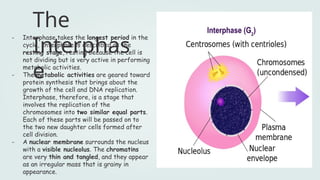
- Interphase takesthe longest period in the
cycle, Interphase is described as the
resting stage, resting because the cell is
not dividing but is very active in performing
metabolic activities.
- The metabolic activities are geared toward
protein synthesis that brings about the
growth of the cell and DNA replication.
Interphase, therefore, is a stage that
involves the replication of the
chromosomes into two similar equal parts.
Each of these parts will be passed on to
the two new daughter cells formed after
cell division.
- A nuclear membrane surrounds the nucleus
with a visible nucleolus. The chromatins
are very thin and tangled, and they appear
as an irregular mass that is grainy in
appearance.
The
Interphas
e
11.
Stages of
Mitosis
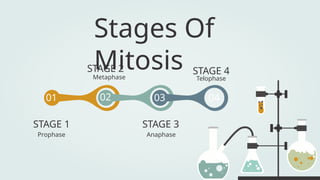
● Mitosisor M phase is
divided into different
stages. We will use
the acronym PMAT to
remember the
different stages.
Stage 1 -
Prophase
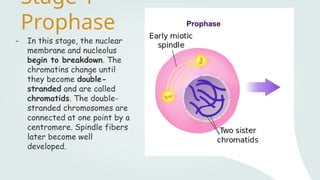
-In this stage, the nuclear
membrane and nucleolus
begin to breakdown. The
chromatins change until
they become double-
stranded and are called
chromatids. The double-
stranded chromosomes are
connected at one point by a
centromere. Spindle fibers
later become well
developed.
14.
Stage 2 -
Metaphase
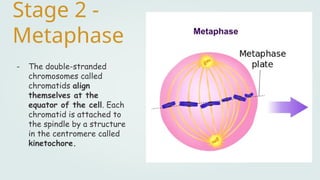
-The double-stranded
chromosomes called
chromatids align
themselves at the
equator of the cell. Each
chromatid is attached to
the spindle by a structure
in the centromere called
kinetochore.
15.
Stage 3 -
Anaphase
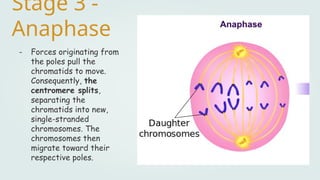
-Forces originating from
the poles pull the
chromatids to move.
Consequently, the
centromere splits,
separating the
chromatids into new,
single-stranded
chromosomes. The
chromosomes then
migrate toward their
respective poles.
16.
Stage 4 -Telophase
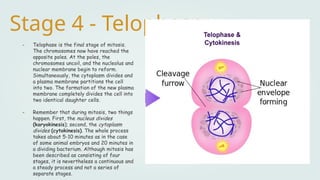
- Telophase is the final stage of mitosis.
The chromosomes now have reached the
opposite poles. At the poles, the
chromosomes uncoil, and the nucleolus and
nuclear membrane begin to reform.
Simultaneously, the cytoplasm divides and
a plasma membrane partitions the cell
into two. The formation of the new plasma
membrane completely divides the cell into
two identical daughter cells.
- Remember that during mitosis, two things
happen. First, the nucleus divides
(karyokinesis); second, the cytoplasm
divides (cytokinesis). The whole process
takes about 5-10 minutes as in the case
of some animal embryos and 20 minutes in
a dividing bacterium. Although mitosis has
been described as consisting of four
stages, it is nevertheless a continuous and
a steady process and not a series of
separate stages.
DIPLOID
● Diploid meanstwo sets of
homologous chromosomes. The
human body, as well as those of the
other multicellular organisms, is
made up of diploid cells. Half of these
chromosomes came from the mother,
and the other half came from the
father. The diploid number of
chromosomes of any species is
maintained from one generation to
the next.
20.
When these cellsdivide by mitosis the daughter cells formed,
which in reality are gametes or sex cells, will also be diploid
cells. If the sex cell (egg and sperm) have the same chromosome
number as the parent, then the number of chromosomes will
double and keep on increasing in successive generations.
In order to maintain the chromosome number of a particular
species from one generation to the next, another type of cell
division evolved among sexually reproducing species; this
remarkable process is called Meiosis.
21.
Stages of
Meiosis
Meiotic divisionis divided into two main
stages and these are Meiosis I and
Meiosis II and each stage is divided
into four substages. Meiosis I has
Prophase I, Metaphase I, Anaphase I,
and Telophase I and for Meiosis II it
has Prophase II, Metaphase II,
Anaphase II, and Telophase II.
22.
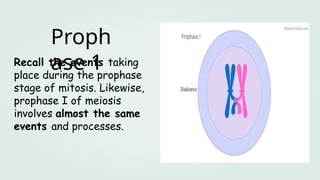
Recall the eventstaking
place during the prophase
stage of mitosis. Likewise,
prophase I of meiosis
involves almost the same
events and processes.
Proph
ase 1
23.
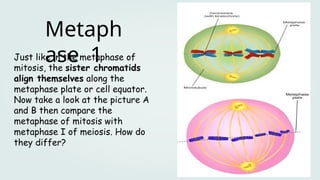
Just like inthe metaphase of
mitosis, the sister chromatids
align themselves along the
metaphase plate or cell equator.
Now take a look at the picture A
and B then compare the
metaphase of mitosis with
metaphase I of meiosis. How do
they differ?
Metaph
ase 1
24.
The difference is,in metaphase I of meiosis, there is a pairing of the homologous
chromosomes also called synapsis, forming a tetrad. A tetrad is composed of four
chromatids, the Maternal Chromatid and Paternal Chromatid. So that instead of the 46
chromosomes aligning at the cell equator, 23 of the homologous chromosomes pair with the
other 23. The chromosomes in the cells formed in meiosis I are still double-stranded but
contain a haploid amount of DNA. So that the two haploid daughter cells undergo another
brief interphase, but no chromosome duplication takes place. After the brief interphase,
both haploid daughter cells divide for the second time (meiosis II) passing through all the
stages, the Prophase II, Metaphase II, Anaphase II, and Telophase II.
The difference between meiosis II with mitosis is found in the beginning parent cells. In
mitosis, the beginning parent cell is diploid:; in meiosis II, the beginning parent cell is
haploid.
The
Differen
ce
25.
To summarize, theprocess of meiosis that takes place in the
gonads is a special type of cell division that occurs among
sexually reproducing individuals. Meiosis reduces the number
of chromosomes by half from diploid to haploid (2N to N).
The daughter cells formed by this process are the gametes
or sex cells (sperm and egg) that unite during fertilization.
As the sperm unites with the egg, the resulting fertilized
egg (called zygote) contains the full set (diploid number) of
chromosomes that characterizes the species.
Summari
zation
26.
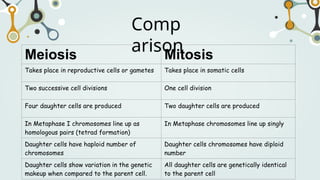
Meiosis Mitosis
Takes placein reproductive cells or gametes Takes place in somatic cells
Two successive cell divisions One cell division
Four daughter cells are produced Two daughter cells are produced
In Metaphase I chromosomes line up as
homologous pairs (tetrad formation)
In Metaphase chromosomes line up singly
Daughter cells have haploid number of
chromosomes
Daughter cells chromosomes have diploid
number
Daughter cells show variation in the genetic
makeup when compared to the parent cell.
All daughter cells are genetically identical
to the parent cell
Comp
arison