CELL DIVISION
(meiosis I &II)
DEPARTMENT OF BIOLOGICAL SCIENCES
FEDERAL UNIVERSITY DUTSIN-MA
BIO 231(Cell biology & Histology)
BY RUQAYYA ADAM
CELL DIVISION
• Cell division is a means of reproduction; whereby parent cells
divide in to two or more daughter cells thereby transmitting
traits from parents to offsprings (progeny).
• Chromosomes play an important role in determining the
characteristics of a cell and its progeny
• It is important that the chromosomes are correctly distributed to
the daughter cells.
• Cells normally have a fixed number of chromosomes which occur
in pairs called Diploid condition
• There are two types of cell division based on the behavior of
chromosomes
• Mitotic cell division
• Meiotic cell division
Diploid vs. Haploid
• Diploid – a cell that contains homologous chromosomes
(one from each parent)
represented by the symbol 2n
– Found in somatic or body cells (ex. Skin, digestive
tract)
• Example : Humans  2n = 46
• Haploid – a cell that contains only a single set of
chromosomes (one from either parent, not both);
represented by the symbol n
– Found in gametes or sex cells – sperm & egg
• Example: Humans  n = 23
MITOTIC CELL DIVISION
• Takes place during growth of an organism, occurs in somatic
cells, and daughter cells ends up exactly with the same number
of chromosomes as the parents.
• It is primarily concerned with equal distribution of chromosomes
into daughter cells
• Note; not all somatic cells undergo mitosis e.g Mammalian RBC
(which has no nucleus) does not divide neither does a neuron (a
specialized cell
• Most cells that divide mitotically are found in the regions of
growth; plant root tips, skin cells, cells of developing embryo
e.t.c.
MEIOTIC CELL DIVISION
• Is otherwise known as reduction division
• is a special type of cell division of germ cells in sexually-
reproducing organisms used to produce the gametes
• In more complex plants, it occurs in the formation of spores
• Daughter cells ends up with half the total number of
chromosomes present in parent cells
• The daughter cells are said to be in the haploid condition with
(n) number of chromosomes
• Meiosis consists of two successive division
• The 1st Meiotic division
• The 2nd Meiotic division
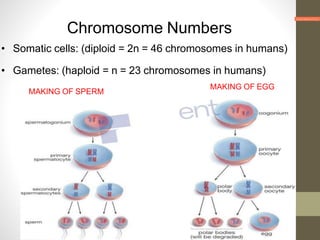
Chromosome Numbers
• Somatic cells: (diploid = 2n = 46 chromosomes in humans)
• Gametes: (haploid = n = 23 chromosomes in humans)
MAKING OF SPERM
MAKING OF EGG
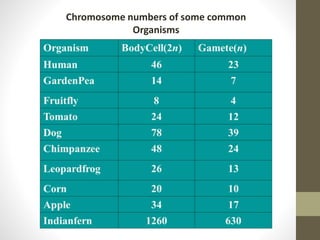
Chromosome numbers of some common
Organisms
MEIOTIC CELL DIVISON
• The 1st meiotic division is regarded as reduction division in
which the parent cells split into two
• And the homologous chromosomes get separated from each
other going into different cells.
• The 2nd meiotic division is where the product of 1st meiotic
division divides again to give a total of four(4) daughter cells.
• It is concerned with separating the chromatids.
• The process of meiosis is divided into series of stages (P,M,A,T)
just like in mitosis but each stage is designed with I or II to
indicate it either belongs to first or second division of meiosis
MEIOSIS I
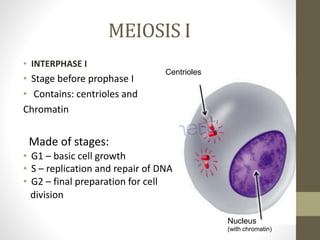
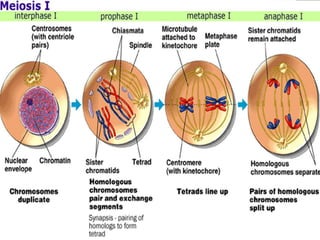
• INTERPHASE I
• Stage before prophase I
• Contains: centrioles and
Chromatin
Made of stages:
• G1 – basic cell growth
• S – replication and repair of DNA
• G2 – final preparation for cell
division
Centrioles
Nucleus
(with chromatin)
MEIOSIS I
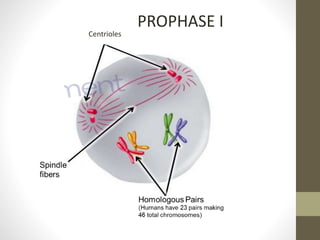
• PROPHASE I
• Nucleolus disappears, centrioles become arranged at
opposite ends of the nucleus
• Chromosomes condense
• The difference between this prophase I and prophase of
mitosis is that the homologous chromosomes come to lie side
by side a process known as synapsis
• The chromosomes become coiled round each other, and when
they move apart slightly, the chromatids of the two
homologous chromosomes make contact at a point known as
chiasmata
• The chiasmata may be followed by chromosomes breakage
with subsequent exchange of the broken segment between
maternal and paternal chromatids, a process known as
crossing over
Centrioles
PROPHASE I
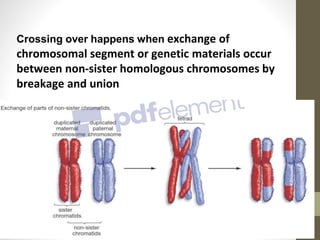
Crossing over happens when exchange of
chromosomal segment or genetic materials occur
between non-sister homologous chromosomes by
breakage and union
MEIOSIS I
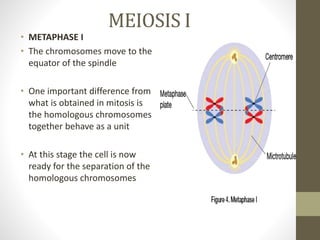
• METAPHASE I
• The chromosomes move to the
equator of the spindle
• One important difference from
what is obtained in mitosis is
the homologous chromosomes
together behave as a unit
• At this stage the cell is now
ready for the separation of the
homologous chromosomes
MEIOSIS I
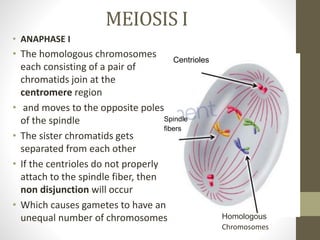
• ANAPHASE I
• The homologous chromosomes
each consisting of a pair of
chromatids join at the
centromere region
• and moves to the opposite poles
of the spindle
• The sister chromatids gets
separated from each other
• If the centrioles do not properly
attach to the spindle fiber, then
non disjunction will occur
• Which causes gametes to have an
unequal number of chromosomes
Centrioles
Spindle
fibers
Homologous
Chromosomes
MEIOSIS I
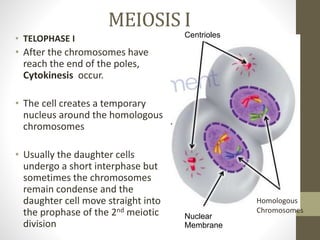
• TELOPHASE I
• After the chromosomes have
reach the end of the poles,
Cytokinesis occur.
• The cell creates a temporary
nucleus around the homologous
chromosomes
• Usually the daughter cells
undergo a short interphase but
sometimes the chromosomes
remain condense and the
daughter cell move straight into
the prophase of the 2nd meiotic
division
Centrioles
Homologous
Chromosomes
Nuclear
Membrane
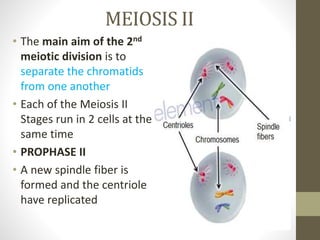
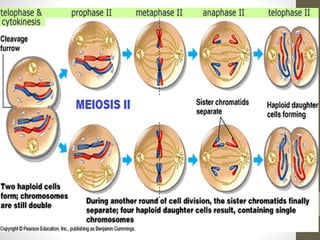
MEIOSIS II
• The main aim of the 2nd
meiotic division is to
separate the chromatids
from one another
• Each of the Meiosis II
Stages run in 2 cells at the
same time
• PROPHASE II
• A new spindle fiber is
formed and the centriole
have replicated
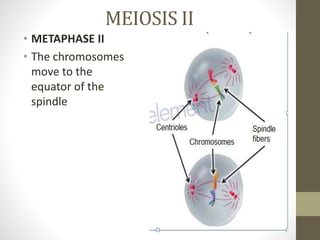
MEIOSIS II
• METAPHASE II
• The chromosomes
move to the
equator of the
spindle
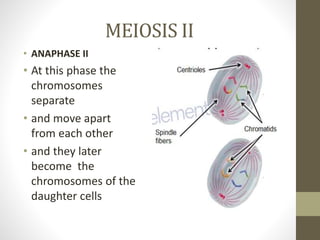
MEIOSIS II
• ANAPHASE II
• At this phase the
chromosomes
separate
• and move apart
from each other
• and they later
become the
chromosomes of the
daughter cells
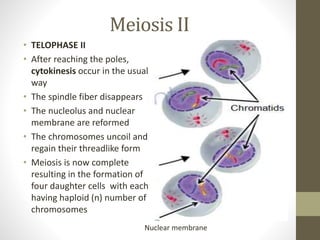
Meiosis II
• TELOPHASE II
• After reaching the poles,
cytokinesis occur in the usual
way
• The spindle fiber disappears
• The nucleolus and nuclear
membrane are reformed
• The chromosomes uncoil and
regain their threadlike form
• Meiosis is now complete
resulting in the formation of
four daughter cells with each
having haploid (n) number of
chromosomes
Nuclear membrane
SIGNIFICANCE OF MEIOSIS
• It is responsible for the formation of sex cells gametes e.g
sperm, ovum/egg, spores
• Production of variation: causes variation in descendants so
that individuals differ in resemblance with their parents
• Provides constancy of chromosome number from generation
to generation by reducing the number from diploid to haploid,
thereby producing haploid gametes

Cell division

  • 1.
    CELL DIVISION (meiosis I&II) DEPARTMENT OF BIOLOGICAL SCIENCES FEDERAL UNIVERSITY DUTSIN-MA BIO 231(Cell biology & Histology) BY RUQAYYA ADAM
  • 2.
    CELL DIVISION • Celldivision is a means of reproduction; whereby parent cells divide in to two or more daughter cells thereby transmitting traits from parents to offsprings (progeny). • Chromosomes play an important role in determining the characteristics of a cell and its progeny • It is important that the chromosomes are correctly distributed to the daughter cells. • Cells normally have a fixed number of chromosomes which occur in pairs called Diploid condition • There are two types of cell division based on the behavior of chromosomes • Mitotic cell division • Meiotic cell division
  • 3.
    Diploid vs. Haploid •Diploid – a cell that contains homologous chromosomes (one from each parent) represented by the symbol 2n – Found in somatic or body cells (ex. Skin, digestive tract) • Example : Humans  2n = 46 • Haploid – a cell that contains only a single set of chromosomes (one from either parent, not both); represented by the symbol n – Found in gametes or sex cells – sperm & egg • Example: Humans  n = 23
  • 4.
    MITOTIC CELL DIVISION •Takes place during growth of an organism, occurs in somatic cells, and daughter cells ends up exactly with the same number of chromosomes as the parents. • It is primarily concerned with equal distribution of chromosomes into daughter cells • Note; not all somatic cells undergo mitosis e.g Mammalian RBC (which has no nucleus) does not divide neither does a neuron (a specialized cell • Most cells that divide mitotically are found in the regions of growth; plant root tips, skin cells, cells of developing embryo e.t.c.
  • 5.
    MEIOTIC CELL DIVISION •Is otherwise known as reduction division • is a special type of cell division of germ cells in sexually- reproducing organisms used to produce the gametes • In more complex plants, it occurs in the formation of spores • Daughter cells ends up with half the total number of chromosomes present in parent cells • The daughter cells are said to be in the haploid condition with (n) number of chromosomes • Meiosis consists of two successive division • The 1st Meiotic division • The 2nd Meiotic division
  • 6.
    Chromosome Numbers • Somaticcells: (diploid = 2n = 46 chromosomes in humans) • Gametes: (haploid = n = 23 chromosomes in humans) MAKING OF SPERM MAKING OF EGG
  • 7.
    Chromosome numbers ofsome common Organisms
  • 8.
    MEIOTIC CELL DIVISON •The 1st meiotic division is regarded as reduction division in which the parent cells split into two • And the homologous chromosomes get separated from each other going into different cells. • The 2nd meiotic division is where the product of 1st meiotic division divides again to give a total of four(4) daughter cells. • It is concerned with separating the chromatids. • The process of meiosis is divided into series of stages (P,M,A,T) just like in mitosis but each stage is designed with I or II to indicate it either belongs to first or second division of meiosis
  • 9.
    MEIOSIS I • INTERPHASEI • Stage before prophase I • Contains: centrioles and Chromatin Made of stages: • G1 – basic cell growth • S – replication and repair of DNA • G2 – final preparation for cell division Centrioles Nucleus (with chromatin)
  • 10.
    MEIOSIS I • PROPHASEI • Nucleolus disappears, centrioles become arranged at opposite ends of the nucleus • Chromosomes condense • The difference between this prophase I and prophase of mitosis is that the homologous chromosomes come to lie side by side a process known as synapsis • The chromosomes become coiled round each other, and when they move apart slightly, the chromatids of the two homologous chromosomes make contact at a point known as chiasmata • The chiasmata may be followed by chromosomes breakage with subsequent exchange of the broken segment between maternal and paternal chromatids, a process known as crossing over
  • 11.
  • 12.
    Crossing over happenswhen exchange of chromosomal segment or genetic materials occur between non-sister homologous chromosomes by breakage and union
  • 13.
    MEIOSIS I • METAPHASEI • The chromosomes move to the equator of the spindle • One important difference from what is obtained in mitosis is the homologous chromosomes together behave as a unit • At this stage the cell is now ready for the separation of the homologous chromosomes
  • 14.
    MEIOSIS I • ANAPHASEI • The homologous chromosomes each consisting of a pair of chromatids join at the centromere region • and moves to the opposite poles of the spindle • The sister chromatids gets separated from each other • If the centrioles do not properly attach to the spindle fiber, then non disjunction will occur • Which causes gametes to have an unequal number of chromosomes Centrioles Spindle fibers Homologous Chromosomes
  • 15.
    MEIOSIS I • TELOPHASEI • After the chromosomes have reach the end of the poles, Cytokinesis occur. • The cell creates a temporary nucleus around the homologous chromosomes • Usually the daughter cells undergo a short interphase but sometimes the chromosomes remain condense and the daughter cell move straight into the prophase of the 2nd meiotic division Centrioles Homologous Chromosomes Nuclear Membrane
  • 17.
    MEIOSIS II • Themain aim of the 2nd meiotic division is to separate the chromatids from one another • Each of the Meiosis II Stages run in 2 cells at the same time • PROPHASE II • A new spindle fiber is formed and the centriole have replicated
  • 18.
    MEIOSIS II • METAPHASEII • The chromosomes move to the equator of the spindle
  • 19.
    MEIOSIS II • ANAPHASEII • At this phase the chromosomes separate • and move apart from each other • and they later become the chromosomes of the daughter cells
  • 20.
    Meiosis II • TELOPHASEII • After reaching the poles, cytokinesis occur in the usual way • The spindle fiber disappears • The nucleolus and nuclear membrane are reformed • The chromosomes uncoil and regain their threadlike form • Meiosis is now complete resulting in the formation of four daughter cells with each having haploid (n) number of chromosomes Nuclear membrane
  • 22.
    SIGNIFICANCE OF MEIOSIS •It is responsible for the formation of sex cells gametes e.g sperm, ovum/egg, spores • Production of variation: causes variation in descendants so that individuals differ in resemblance with their parents • Provides constancy of chromosome number from generation to generation by reducing the number from diploid to haploid, thereby producing haploid gametes