Wastewater:
Types And Characteristics
Water Pollution
Alterations of water quality due to discharge of
wastes from point or diffuse sources.
Sources of wastewater
Non-point source pollution
• Pollution does not originate from a single
source. Pollution is often the cumulative effect
of small amounts of contaminants gathered
from a large area.
Point source water pollution
• Pollution enter a waterway (river, lake) from a
single, identifiable source (pipe, ditch).
Types of wastewater
• Domestic: wastewater by residential, shop houses,
offices, schools etc. and normally generated from
toilets, sinks and bathrooms.
• Industrial: wastewater generated by industries.
Quantity and quality depends on the type of industry
• Storm water: rainwater, may contain pollutants
Why treat wastewater?
• Untreated wastewater harmful to health
• Breeding sites for insects, pests and micro
organisms
• Can cause environmental pollution and affect
ecosystem
Wastewater Characteristics
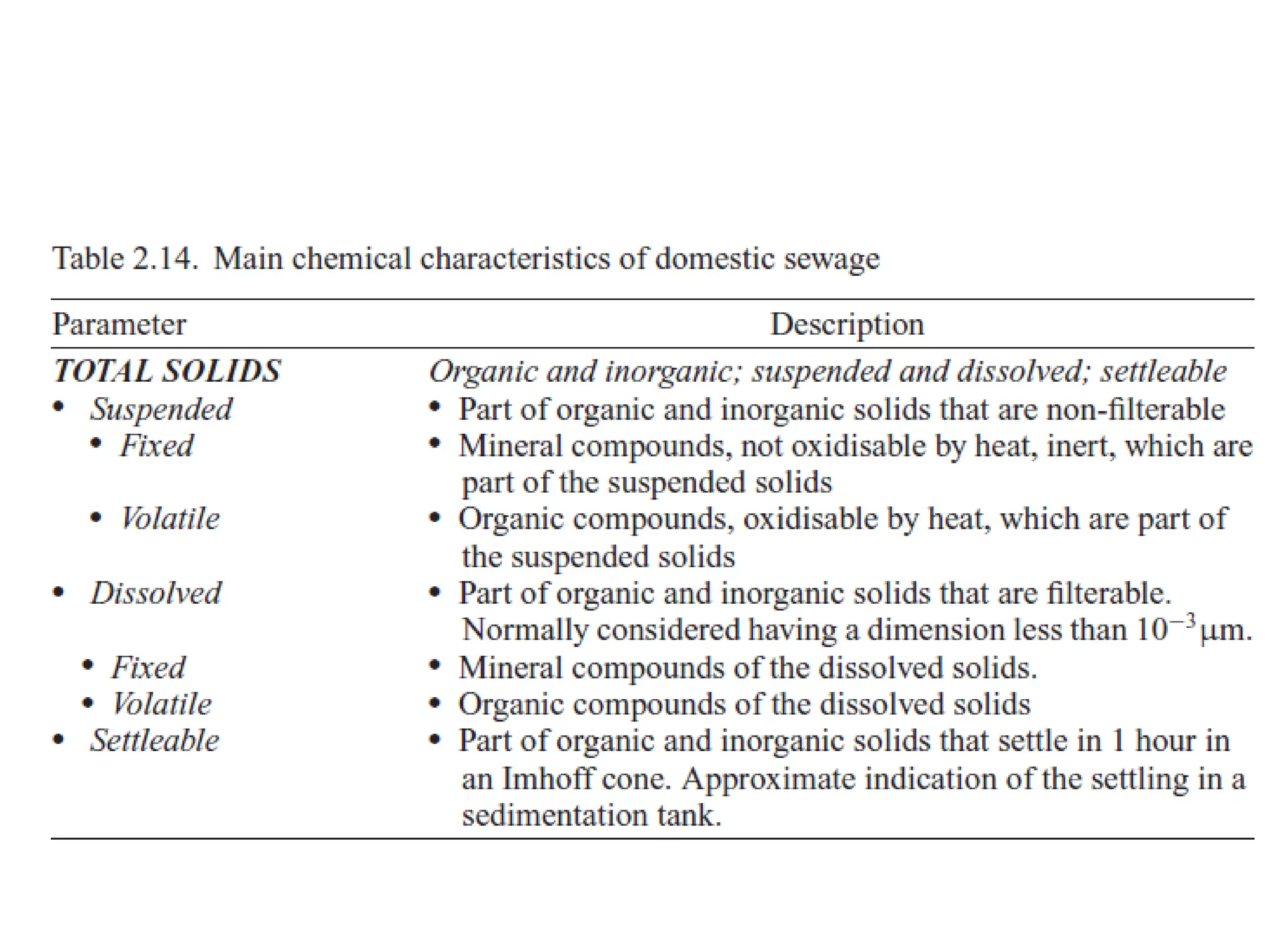
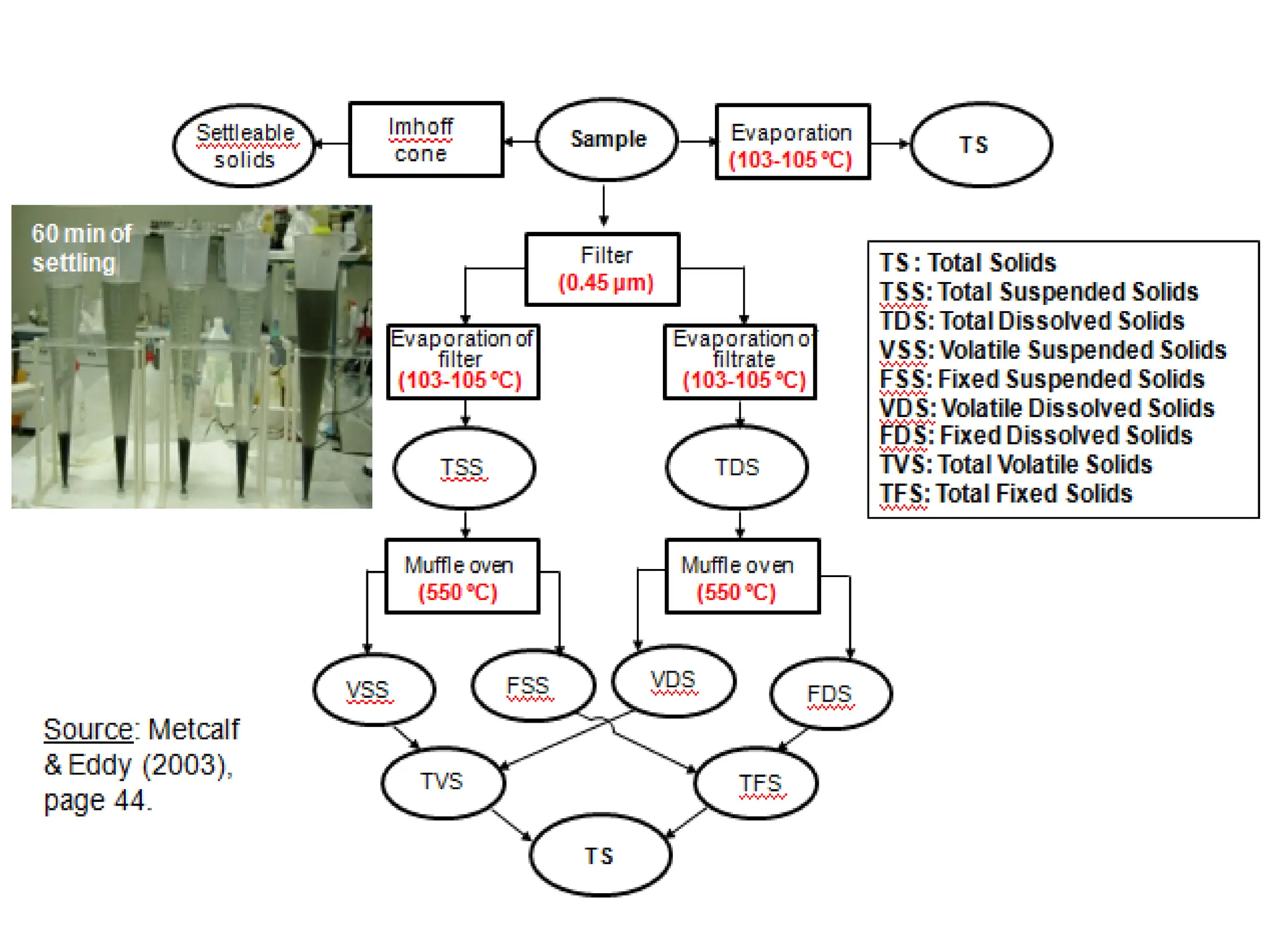
• Physical: solids, temperature, color, turbidity,
salinity, odor
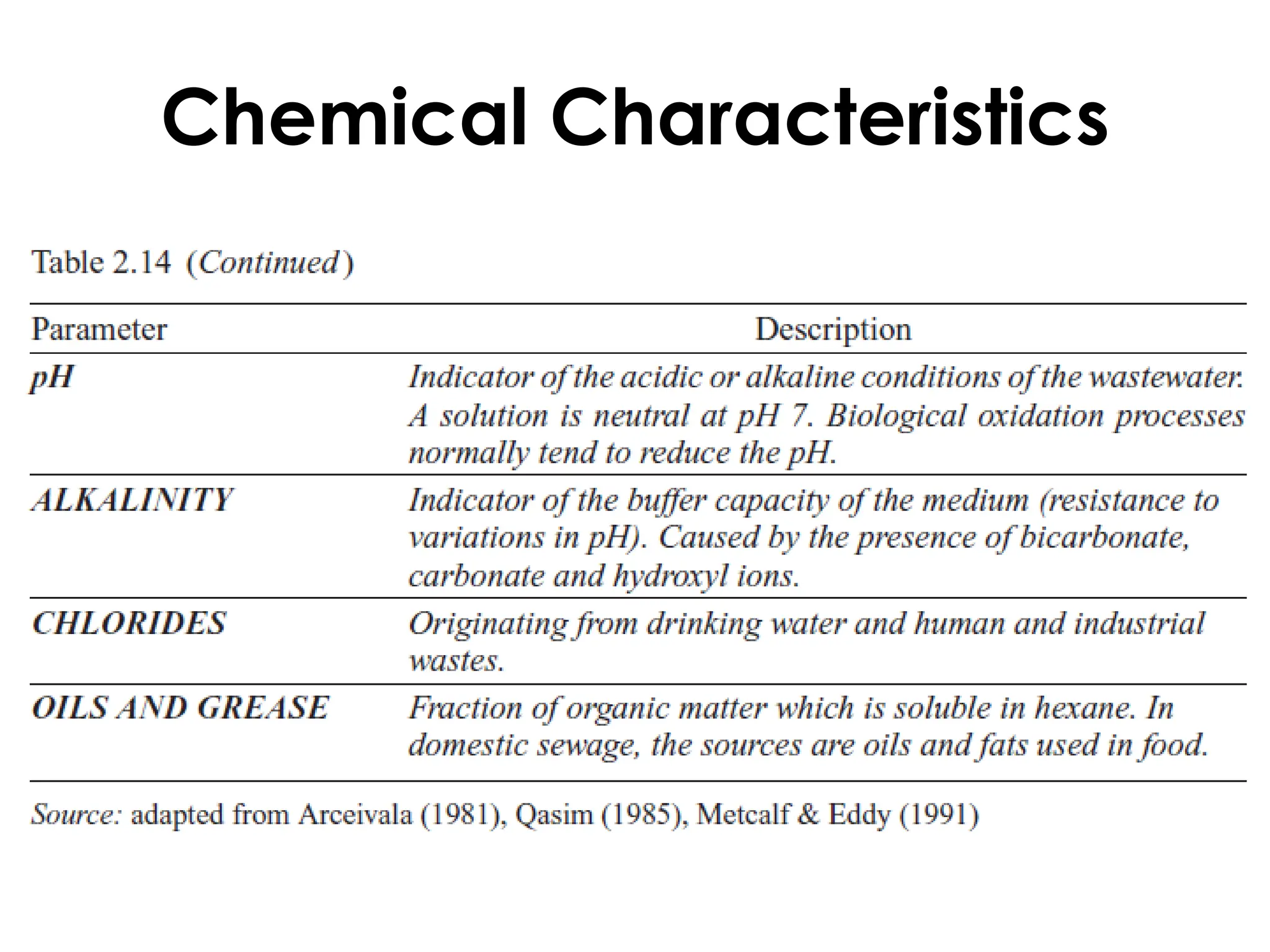
• Chemical:
– Organic : carbohydrates, fats, proteins, toxins…
– Inorganic: alkalinity, N, P, S, pH, metals, salts…
– Gaseous : H2S, CH4, O2 …
• Biological: plants (algae, grass, etc.),
microorganisms (bacteria, viruses)
Physical Characteristics
Chemical Characteristics
What is Biochemical Oxygen Demand
(BOD)?
Definition
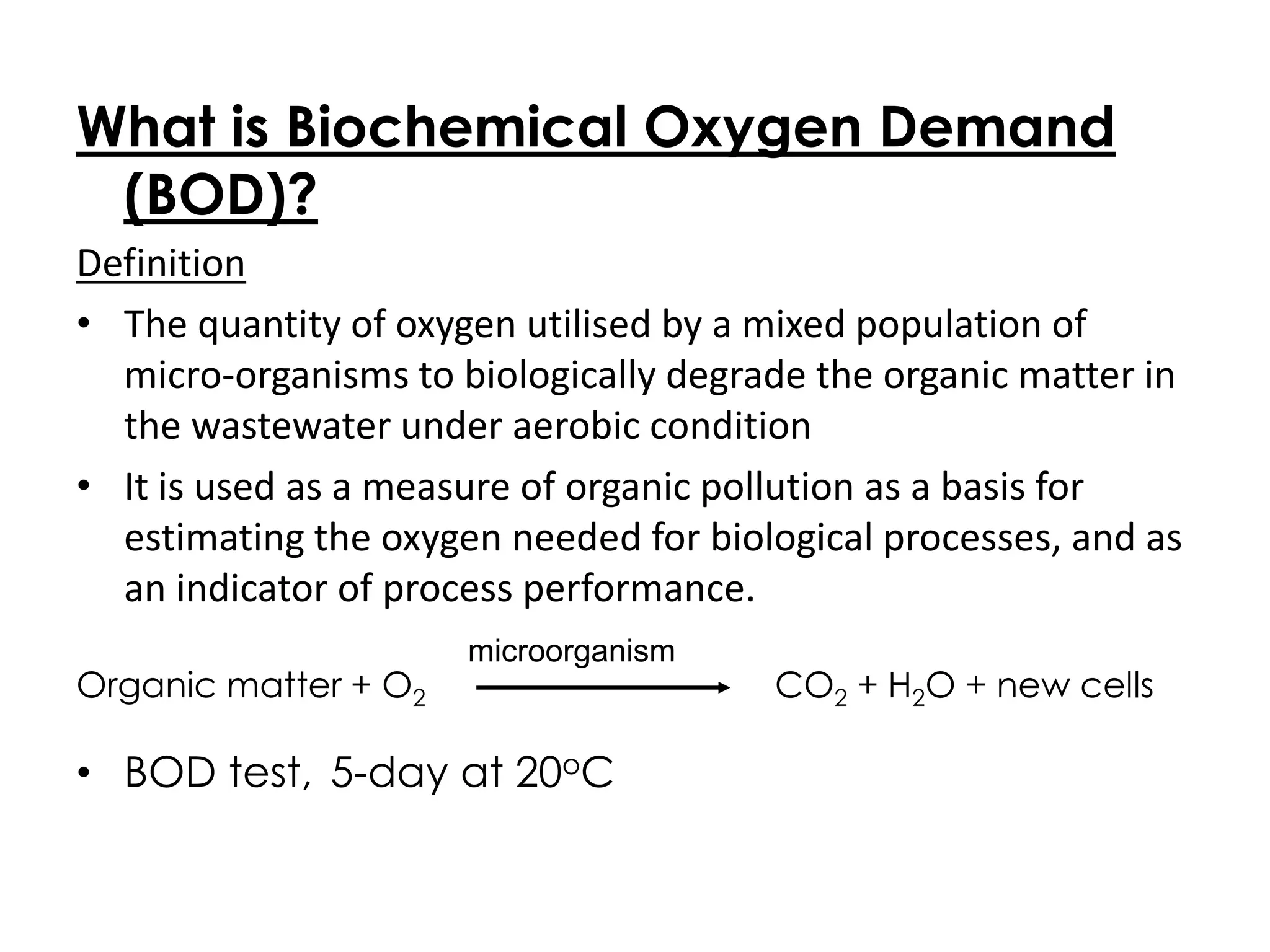
• The quantity of oxygen utilised by a mixed population of
micro-organisms to biologically degrade the organic matter in
the wastewater under aerobic condition
• It is used as a measure of organic pollution as a basis for
estimating the oxygen needed for biological processes, and as
an indicator of process performance.
Organic matter + O2 CO2 + H2O + new cells
• BOD test, 5-day at 20oC
microorganism
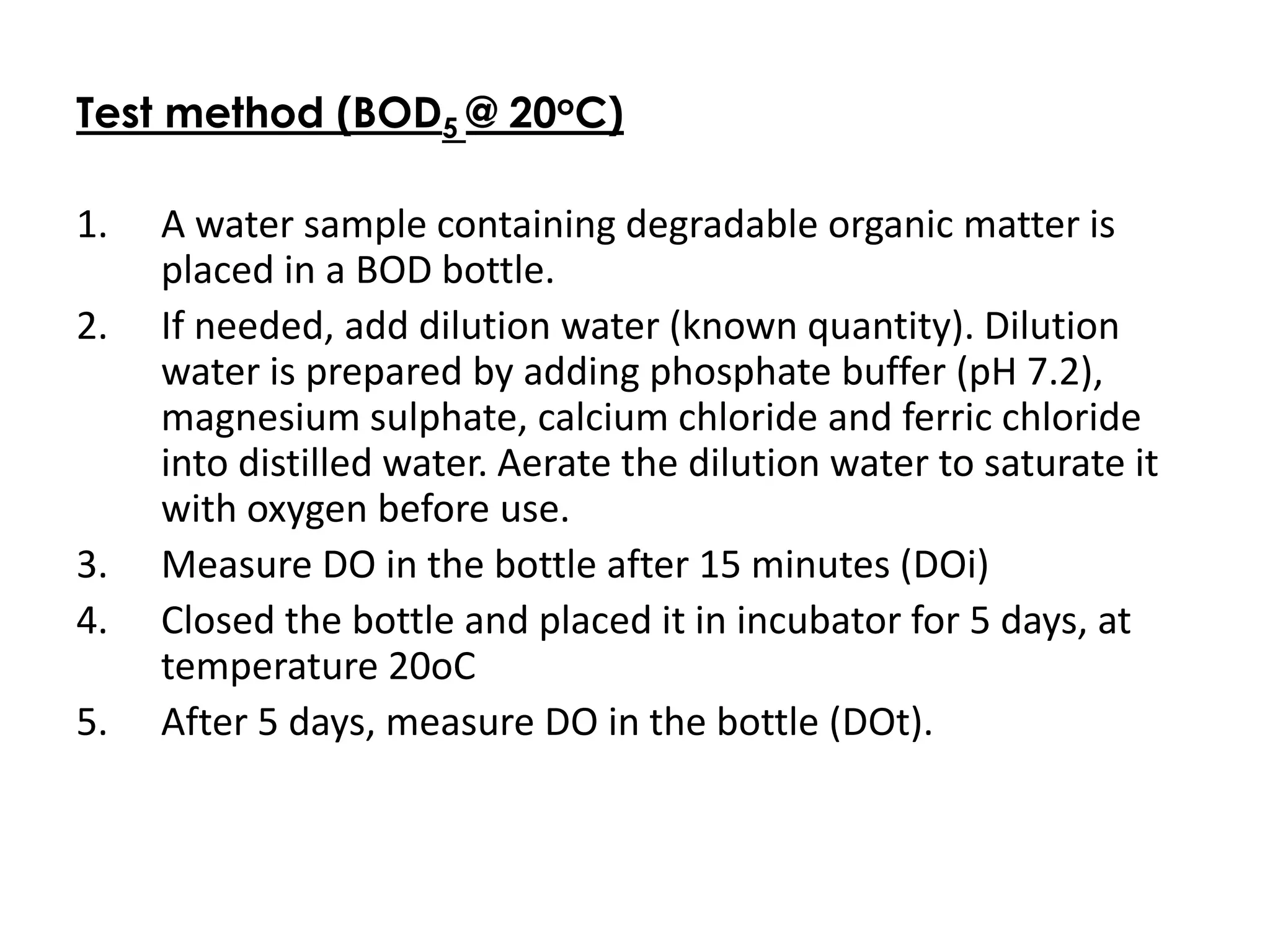
Test method (BOD5 @ 20oC)
1. A water sample containing degradable organic matter is
placed in a BOD bottle.
2. If needed, add dilution water (known quantity). Dilution
water is prepared by adding phosphate buffer (pH 7.2),
magnesium sulphate, calcium chloride and ferric chloride
into distilled water. Aerate the dilution water to saturate it
with oxygen before use.
3. Measure DO in the bottle after 15 minutes (DOi)
4. Closed the bottle and placed it in incubator for 5 days, at
temperature 20oC
5. After 5 days, measure DO in the bottle (DOt).
Calculation of BOD,
Where
BODt = biochemical oxygen demand,
mg/L
DOi = initial DO of the diluted wastewater
sample about 15 min. after preparation, mg/L
DOt = final DO of the diluted wastewater sample
after incubation for five days, mg/L
P = dilution factor
P
DO
DO
BOD t
i
t
−
=
Why dilution is needed?
• For a valid BOD test, the final DO should not be less
than 1 mg/L. BOD test is invalid if DOt value near
zero.
• Dilution can decrease organic strength of the sample.
By using dilution factor, the actual value can be
obtained.
• Dilution of wastes:
- By direct pipetting into 300 mL BOD bottle
In aerobic processes (O2 is present), heterotrophic bacteria
oxidise about 1/3 of the colloidal and dissolved organic matter
to stable end products (CO2 + H2O) and convert the remaining
2/3 into new microbial cells that can be removed from the
wastewater by settling.
The overall biological conversion proceeds sequentially, with
oxidation of carbonaceous material as the first step (known as
carbonaceous oxygen demand):
Organic matter + O2 CO2 + H2O + new cells
2 kinds: cBOD and NBOD
BOD Analysis
Under continuing aerobic conditions, autotrophic
bacteria then convert the nitrogen in organic
compounds to nitrates (known as nitrification oxygen
demand)
And
Organic-Nitrogen Ammonia-Nitrogen
(decomposition)
NH3 - N + O2 Nitrate-Nitrogen
(nitrification)
NBOD
Nitrogeneous BOD (NBOD)
NH O NO H O H
Nitrosomonas
3 2 2 2
15
+ ⎯ →
⎯⎯⎯
⎯ + +
− +
.
NO O NO
Nitrobacter
2 2 3
1
2
− −
+ ⎯ →
⎯⎯
⎯
2 moles oxygen/1 mole of ammonia
4.57 grams oxygen/gram ammonia-nitrogen
NBOD can be modeled as a simple 1st order decay:
dL
dt
k L
N
N
N
= −
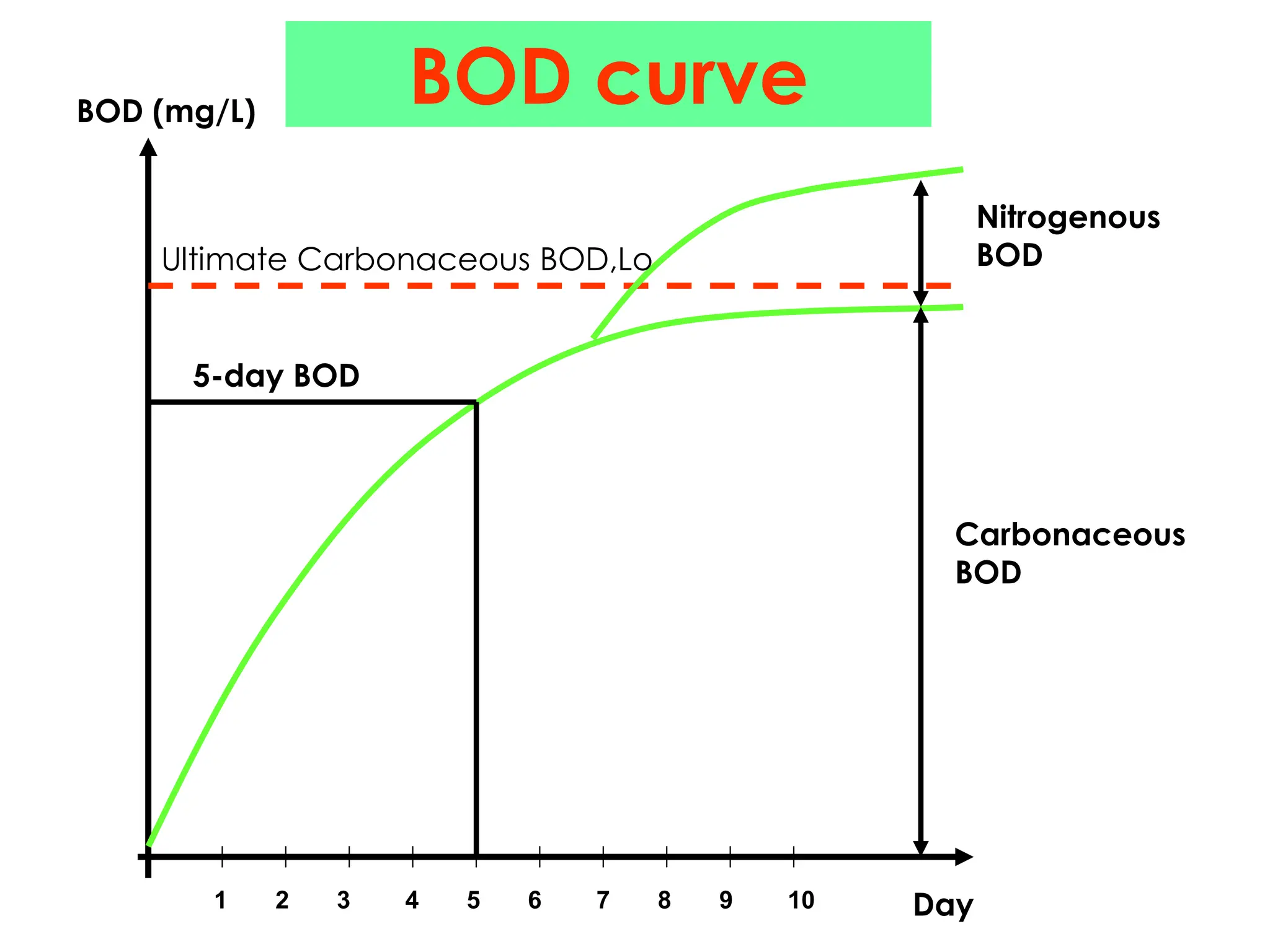
BOD curve
1 2 3 4 5 6 7 8 9 10
Ultimate Carbonaceous BOD,Lo
BOD (mg/L)
Day
5-day BOD
Carbonaceous
BOD
Nitrogenous
BOD
• The carbonaceous oxygen demand curve can be
expressed mathematically as
BODt = Lo (1-e-Kt)
Where
BODt = biochemical oxygen demand at
time t, mg/L
Lo = ultimate BOD, mg/L
t = time, days
K = reaction rate constant, day-1
Effects of Temperature on Reaction Rates and
Ultimate BOD
Reaction Rate Constant, K
- most biological processes speed up as the
temperature increases and slow down as the
temperature drops. The rate of utilization is
affected by temperature
• the relationship for the change in the
reaction rate constant (K) with temperature
is expressed as
Where
KT = reaction rate constant at temperature T, per
day
K20 = reaction rate constant at 20oC, per day
 = temperature coefficient = 1.047
T = temperature of biological reaction, oC
)
20
(
20
−


= T
T K
K
Example:
A BOD test was conducted on a domestic
wastewater at 30oC. The wastewater portion
added to a BOD bottle was 20 mL and the
dissolved oxygen values listed below were
measured.
Time (days) DO (mg/L)
0 7.4
1 5.5
2 4.5
3 3.7
4 2.5
5 2.1
- Calculate values of BOD3
– Determine the BOD rate constant, K30
– Calculate values of BOD5 at 20oC
What is Chemical Oxygen Demand (COD)?
Definition
• The quantity of oxygen needed to chemically oxidize
the organic compound in sample, converted to
carbon dioxide and water.
• Commonly used to define the strength of industrial
wastewaters
TOC and DOC
• Total organic carbon (TOC) is a non-specific
test, which means TOC will not determine
which particular compounds are present
(most samples are complex mixtures which
contain thousands of different organic carbon
compounds). Instead, TOC will inform the
user of the sum of all organic carbon within
those compounds.
• Dissolved organic carbon
Nitrogen
Nitrogen
Phosphorous
Orthophosphate and
polyphosphates
Toxics
● Pesticides
➢ Herbicides
➢ Fungicides
➢ Insecticides
● Metals (naturally occurring in soil, automotive emissions/ tires)
➢ Lead
➢ Zinc
➢ Mercury
● Petroleum Hydrocarbons (automotive exhaust and
fuel/oil)
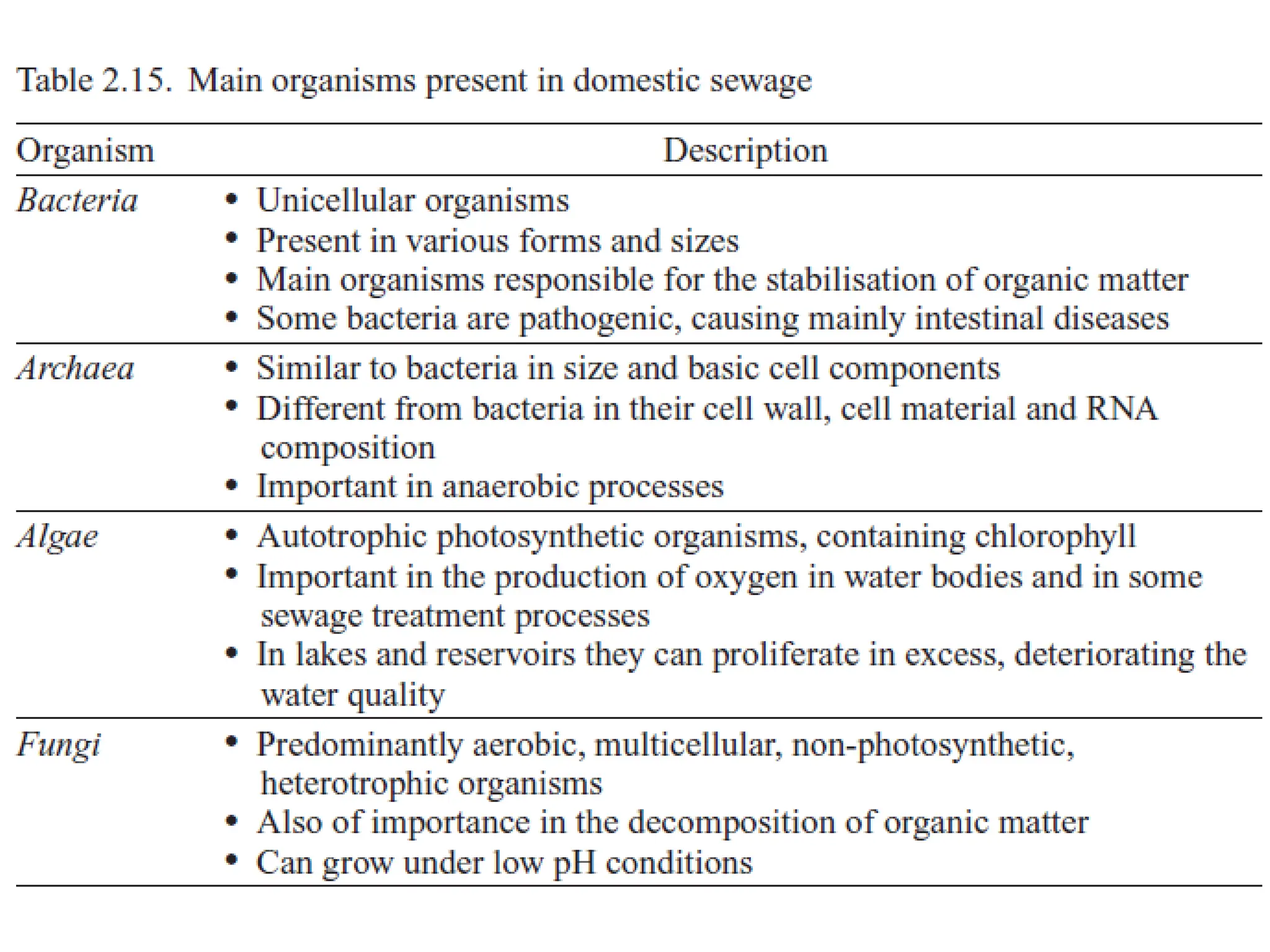
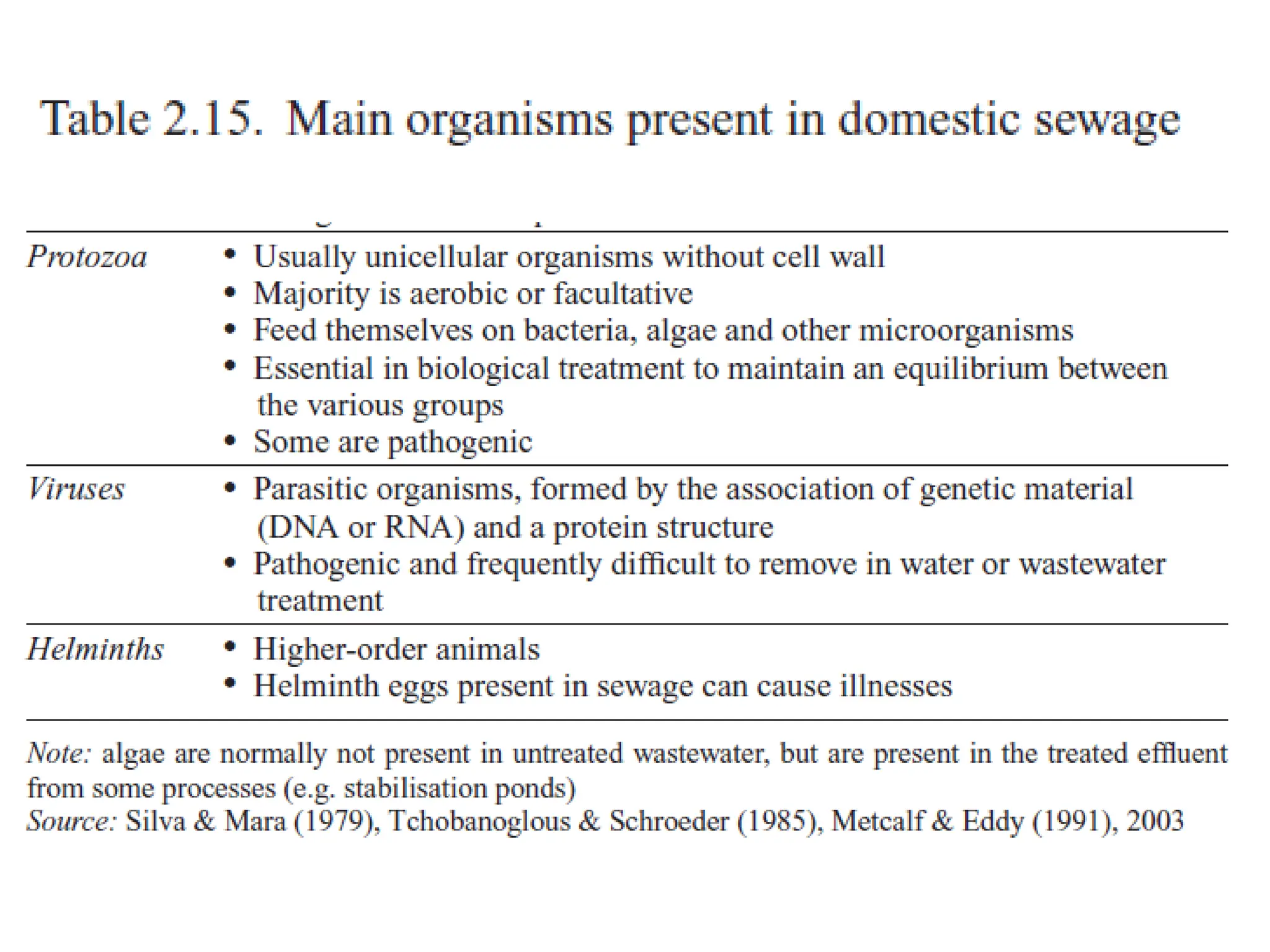
3. Biological Characteristics
The principal groups of microorganisms found
in wastewater are bacteria, fungi, protozoa,
microscopic plants and animals, and viruses.
Most microorganisms (bacteria, protozoa) are
responsible and are beneficial for biological
treatment processes of wastewater.
• Pathogenic organisms are usually excreted by
humans from the gastrointestinal tract and discharge
to wastewater. Water-borne disease include cholera,
typhoid, paratyphoid fever, and diarrhoea. The
number of pathogenic organisms in wastewaters is
generally low in density and they are difficult to
isolate and identify.
• Therefore, indicator bacteria such as total coliform
(TC) and fecal coliform (FC) are used as indicator
organisms.
Lec_2_Wastewater-typescharacteristics.pdf

Lec_2_Wastewater-typescharacteristics.pdf

  • 1.
  • 2.
    Water Pollution Alterations ofwater quality due to discharge of wastes from point or diffuse sources.
  • 3.
    Sources of wastewater Non-pointsource pollution • Pollution does not originate from a single source. Pollution is often the cumulative effect of small amounts of contaminants gathered from a large area. Point source water pollution • Pollution enter a waterway (river, lake) from a single, identifiable source (pipe, ditch).
  • 4.
    Types of wastewater •Domestic: wastewater by residential, shop houses, offices, schools etc. and normally generated from toilets, sinks and bathrooms. • Industrial: wastewater generated by industries. Quantity and quality depends on the type of industry • Storm water: rainwater, may contain pollutants
  • 5.
    Why treat wastewater? •Untreated wastewater harmful to health • Breeding sites for insects, pests and micro organisms • Can cause environmental pollution and affect ecosystem
  • 6.
    Wastewater Characteristics • Physical:solids, temperature, color, turbidity, salinity, odor • Chemical: – Organic : carbohydrates, fats, proteins, toxins… – Inorganic: alkalinity, N, P, S, pH, metals, salts… – Gaseous : H2S, CH4, O2 … • Biological: plants (algae, grass, etc.), microorganisms (bacteria, viruses)
  • 7.
  • 10.
  • 11.
  • 12.
  • 13.
    What is BiochemicalOxygen Demand (BOD)? Definition • The quantity of oxygen utilised by a mixed population of micro-organisms to biologically degrade the organic matter in the wastewater under aerobic condition • It is used as a measure of organic pollution as a basis for estimating the oxygen needed for biological processes, and as an indicator of process performance. Organic matter + O2 CO2 + H2O + new cells • BOD test, 5-day at 20oC microorganism
  • 14.
    Test method (BOD5@ 20oC) 1. A water sample containing degradable organic matter is placed in a BOD bottle. 2. If needed, add dilution water (known quantity). Dilution water is prepared by adding phosphate buffer (pH 7.2), magnesium sulphate, calcium chloride and ferric chloride into distilled water. Aerate the dilution water to saturate it with oxygen before use. 3. Measure DO in the bottle after 15 minutes (DOi) 4. Closed the bottle and placed it in incubator for 5 days, at temperature 20oC 5. After 5 days, measure DO in the bottle (DOt).
  • 15.
    Calculation of BOD, Where BODt= biochemical oxygen demand, mg/L DOi = initial DO of the diluted wastewater sample about 15 min. after preparation, mg/L DOt = final DO of the diluted wastewater sample after incubation for five days, mg/L P = dilution factor P DO DO BOD t i t − =
  • 16.
    Why dilution isneeded? • For a valid BOD test, the final DO should not be less than 1 mg/L. BOD test is invalid if DOt value near zero. • Dilution can decrease organic strength of the sample. By using dilution factor, the actual value can be obtained. • Dilution of wastes: - By direct pipetting into 300 mL BOD bottle
  • 17.
    In aerobic processes(O2 is present), heterotrophic bacteria oxidise about 1/3 of the colloidal and dissolved organic matter to stable end products (CO2 + H2O) and convert the remaining 2/3 into new microbial cells that can be removed from the wastewater by settling. The overall biological conversion proceeds sequentially, with oxidation of carbonaceous material as the first step (known as carbonaceous oxygen demand): Organic matter + O2 CO2 + H2O + new cells 2 kinds: cBOD and NBOD BOD Analysis
  • 18.
    Under continuing aerobicconditions, autotrophic bacteria then convert the nitrogen in organic compounds to nitrates (known as nitrification oxygen demand) And Organic-Nitrogen Ammonia-Nitrogen (decomposition) NH3 - N + O2 Nitrate-Nitrogen (nitrification)
  • 19.
    NBOD Nitrogeneous BOD (NBOD) NHO NO H O H Nitrosomonas 3 2 2 2 15 + ⎯ → ⎯⎯⎯ ⎯ + + − + . NO O NO Nitrobacter 2 2 3 1 2 − − + ⎯ → ⎯⎯ ⎯ 2 moles oxygen/1 mole of ammonia 4.57 grams oxygen/gram ammonia-nitrogen NBOD can be modeled as a simple 1st order decay: dL dt k L N N N = −
  • 20.
    BOD curve 1 23 4 5 6 7 8 9 10 Ultimate Carbonaceous BOD,Lo BOD (mg/L) Day 5-day BOD Carbonaceous BOD Nitrogenous BOD
  • 22.
    • The carbonaceousoxygen demand curve can be expressed mathematically as BODt = Lo (1-e-Kt) Where BODt = biochemical oxygen demand at time t, mg/L Lo = ultimate BOD, mg/L t = time, days K = reaction rate constant, day-1
  • 23.
    Effects of Temperatureon Reaction Rates and Ultimate BOD Reaction Rate Constant, K - most biological processes speed up as the temperature increases and slow down as the temperature drops. The rate of utilization is affected by temperature
  • 24.
    • the relationshipfor the change in the reaction rate constant (K) with temperature is expressed as Where KT = reaction rate constant at temperature T, per day K20 = reaction rate constant at 20oC, per day  = temperature coefficient = 1.047 T = temperature of biological reaction, oC ) 20 ( 20 −   = T T K K
  • 25.
    Example: A BOD testwas conducted on a domestic wastewater at 30oC. The wastewater portion added to a BOD bottle was 20 mL and the dissolved oxygen values listed below were measured.
  • 26.
    Time (days) DO(mg/L) 0 7.4 1 5.5 2 4.5 3 3.7 4 2.5 5 2.1 - Calculate values of BOD3 – Determine the BOD rate constant, K30 – Calculate values of BOD5 at 20oC
  • 27.
    What is ChemicalOxygen Demand (COD)? Definition • The quantity of oxygen needed to chemically oxidize the organic compound in sample, converted to carbon dioxide and water. • Commonly used to define the strength of industrial wastewaters
  • 28.
    TOC and DOC •Total organic carbon (TOC) is a non-specific test, which means TOC will not determine which particular compounds are present (most samples are complex mixtures which contain thousands of different organic carbon compounds). Instead, TOC will inform the user of the sum of all organic carbon within those compounds. • Dissolved organic carbon
  • 29.
  • 30.
  • 31.
  • 32.
    Toxics ● Pesticides ➢ Herbicides ➢Fungicides ➢ Insecticides ● Metals (naturally occurring in soil, automotive emissions/ tires) ➢ Lead ➢ Zinc ➢ Mercury ● Petroleum Hydrocarbons (automotive exhaust and fuel/oil)
  • 33.
    3. Biological Characteristics Theprincipal groups of microorganisms found in wastewater are bacteria, fungi, protozoa, microscopic plants and animals, and viruses. Most microorganisms (bacteria, protozoa) are responsible and are beneficial for biological treatment processes of wastewater.
  • 34.
    • Pathogenic organismsare usually excreted by humans from the gastrointestinal tract and discharge to wastewater. Water-borne disease include cholera, typhoid, paratyphoid fever, and diarrhoea. The number of pathogenic organisms in wastewaters is generally low in density and they are difficult to isolate and identify. • Therefore, indicator bacteria such as total coliform (TC) and fecal coliform (FC) are used as indicator organisms.