Regional initiatives to promote
biosciences innovation:
The Bio-Innovate Program overview
Seyoum Leta
Bio-innovate Regional Experts Workshop on Industrial
Effluents Management in East Africa
Addis Ababa, Ethiopia, 19-20 May 2014
The Bio-Innovate Program
A Regional Initiative to Promote biosciences
innovations in Eastern Africa
 Established in 2010 to catalyze and support multidisciplinary biosciences
and product oriented innovation activities in the eastern Africa
To strengthen biosciences innovations for stimulating adaptability of
small scale farming systems to climate change
Enhance crop, feed and biofuel productivity and provide farmers with
more agribusiness opportunities
Address environmental pollution and climate change threats by
creating and up-scaling innovative technologies with a view of creating
more productive and sustainable agro-process industries
Polling expertise through regional innovation network, enabling policy
analysis on cross cutting issues
WHY
• Need for innovation systems approach engaging new and existing
actors in and outside the region through a new innovation and
policy platform for boosting eastern Africa development
• Need for integrated approach in addressing development challenges
that require collective regional action to maximize synergies and impact;
• Agricultural productivity constraints, market opportunities,
environmental problems such as climate change are regional in nature
and require regional convergence and joint efforts;
• sharing of scarce R&D infrastructure and key competences to avoid
duplication and harness available resources
• Creating mechanism for bringing new knowledge and technologies to a
broad set of institutions and can thus serve as a dynamic and effective
means for developing regional public goods and new products
Vision
Vision
 To develop into a Program of excellence for
“BIORESOURCES INNOVATION FUND” and think-
tank for Science, Technology and Innovation that
contributes to sustainable and integrated
utilization of bio-resources for economic
development of Eastern Africa
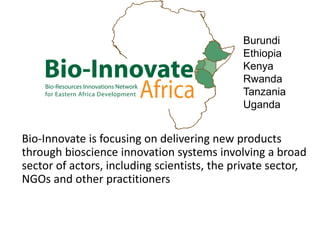
Bio-Innovate is focusing on delivering new products
through bioscience innovation systems involving a broad
sector of actors, including scientists, the private sector,
NGOs and other practitioners
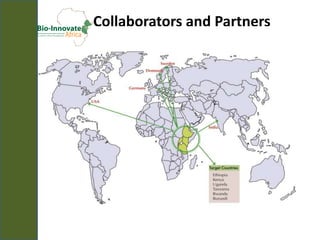
Burundi
Ethiopia
Kenya
Rwanda
Tanzania
Uganda
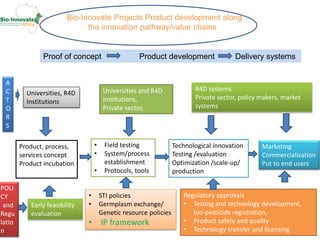
Proof of concept Product development Delivery systems
Universities, R4D
Institutions
Universities and R4D
institutions,
Private sector,
R4D systems
Private sector, policy makers, market
systems
Product, process,
services concept
Product incubation
• Field testing
• System/process
establishment
• Protocols, tools
Technological innovation
Testing /evaluation
Optimization /scale-up/
production
Marketing
Commercialization
Put to end users
Early feasibility
evaluation
• STI policies
• Germplasm exchange/
Genetic resource policies
• IP framework
Regulatory approvals
• Testing and technology development,
bio-pesticide registration,
• Product safety and quality
• Technology transfer and licensing
A
C
T
O
R
S
POLI
CY
and
Regu
latio
n
Bio-Innovate Projects Product development along
the innovation pathway/value chains
Currently, the program comprises of 9 innovation
and policy consortia projects and 57 partnering
and collaborating institutions
Program is supported by the Swedish International
Development Cooperation Agency, 2010 – 2014
Complimentary funds from private sector
Collaborators and Partners
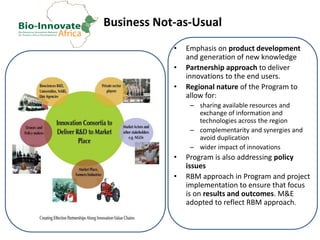
Business Not-as-Usual
• Emphasis on product development
and generation of new knowledge
• Partnership approach to deliver
innovations to the end users.
• Regional nature of the Program to
allow for:
– sharing available resources and
exchange of information and
technologies across the region
– complementarity and synergies and
avoid duplication
– wider impact of innovations
• Program is also addressing policy
issues
• RBM approach in Program and project
implementation to ensure that focus
is on results and outcomes. M&E
adopted to reflect RBM approach.
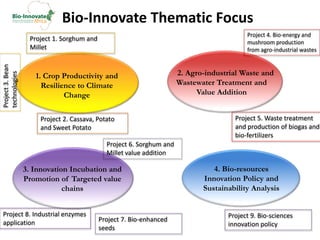
Project3.Bean
technologies
Project 2. Cassava, Potato
and Sweet Potato
Project 1. Sorghum and
Millet
Project 4. Bio-energy and
mushroom production
from agro-industrial wastes
Project 5. Waste treatment
and production of biogas and
bio-fertilizers
Project 6. Sorghum and
Millet value addition
Project 7. Bio-enhanced
seeds
Project 8. Industrial enzymes
application
Project 9. Bio-sciences
innovation policy
1. Crop Productivity and
Resilience to Climate
Change
2. Agro-industrial Waste and
Wastewater Treatment and
Value Addition
3. Innovation Incubation and
Promotion of Targeted value
chains
4. Bio-resources
Innovation Policy and
Sustainability Analysis
Bio-Innovate Thematic Focus
Agro-industrial Waste and wastewater Management and Value
Addition
• Management of wastewaters are becoming a serious challenge in the Eastern
Africa with a growing trend in industrial investment and increasing number of
agro-process industries
Only 10% of industry in the region treat generated waste to any degree
wastewater treatment and management in the region is greatly limited by lack
of efficient treatment technologies, critical trained human resources, and lack
of investment in wastewater management research
As industrial wastewaters are heavily loaded with polluting substances,
conventional wastewater treatment technologies do not remove substantial
amounts of pollutants contained in industrial wastewaters.
In addition to being expensive, these traditional methods often do not meet
national wastewater discharge standards to protect the human population at
risk, and prevent environmental degradation.
• Need for adaptable technologies to manage and add value to agro-industrial
waste and wastewater
Innovative wastewater treatment solutions
• The research team supported by the Bio-Innovate Program
has now come up with the innovative system for treating
wastewater through integration of technologies for producing
biogas and biofertlizers using anaerobic-aerobic bio-reactors,
and clean final effluent using constructed wetlands
• The development is the outcome of more than ten years of
research and innovation activities by a consortium of
researchers drawn from the University of Dar es Salam
(Tanzania), Makere University (Uganda) and Addis Ababa
University (Ethiopia)
• These activities were supported by SIDA through the Bio-EARN
Program in the research and product development phase (2006-
2009) followed by the Bio-Innovate Program in the innovation pilot
testing and demonstration stages ((2010-2014), in collaboration
with the private sector partners in the Eastern Africa
• The solution has been piloted in pilot scale at private industry
premises in the three Eastern African Countries (Ethiopia, Uganda,
and Tanzania) and is proven to work
• detailed techno-economic feasibility analysis and business
development conducted on these technologies have also shown
that these innovative solutions are technically feasible for large
scale roll-out in the region
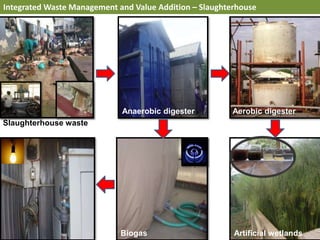
Integrated Waste Management and Value Addition – Slaughterhouse
Slaughterhouse waste
Anaerobic digester Aerobic digester
Biogas Artificial wetlands
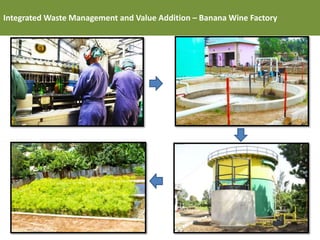
Integrated Waste Management and Value Addition – Banana Wine Factory
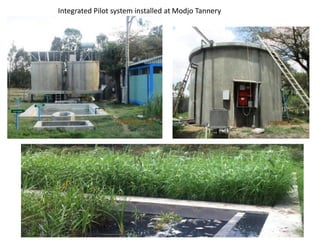
Integrated Pilot system installed at Modjo Tannery
Future direction of Bio-Innovate
• Up-scaling and commercialization of promising
innovations from the current thematic area consortia
projects
• Widen the scope of the Bio-Innovate focus areas
with focus on delivery of innovations to end users
involving private sector partners
• Integrate technology delivery systems with studies
on cross cutting issues
Concluding remark
Innovation is Key for Knowledge-based economic
growth, improve livelihood and sustainable
development
Africa has a competitive advantage in Harnessing
Innovation for boosting the growth of Knowledge-
based Bio-Economy
“If all actors in the NIS can play their role meaningfully,
Africa will soon become part of the emerging economies”
Contact details: Bio-Innovate Program
www.bioinnovate-africa.org
Email: S.Leta@cgiar.org

Regional initiatives to promote biosciences innovation: The BioInnovate Program overview

  • 1.
    Regional initiatives topromote biosciences innovation: The Bio-Innovate Program overview Seyoum Leta Bio-innovate Regional Experts Workshop on Industrial Effluents Management in East Africa Addis Ababa, Ethiopia, 19-20 May 2014
  • 2.
    The Bio-Innovate Program ARegional Initiative to Promote biosciences innovations in Eastern Africa
  • 3.
     Established in2010 to catalyze and support multidisciplinary biosciences and product oriented innovation activities in the eastern Africa To strengthen biosciences innovations for stimulating adaptability of small scale farming systems to climate change Enhance crop, feed and biofuel productivity and provide farmers with more agribusiness opportunities Address environmental pollution and climate change threats by creating and up-scaling innovative technologies with a view of creating more productive and sustainable agro-process industries Polling expertise through regional innovation network, enabling policy analysis on cross cutting issues
  • 4.
    WHY • Need forinnovation systems approach engaging new and existing actors in and outside the region through a new innovation and policy platform for boosting eastern Africa development • Need for integrated approach in addressing development challenges that require collective regional action to maximize synergies and impact; • Agricultural productivity constraints, market opportunities, environmental problems such as climate change are regional in nature and require regional convergence and joint efforts; • sharing of scarce R&D infrastructure and key competences to avoid duplication and harness available resources • Creating mechanism for bringing new knowledge and technologies to a broad set of institutions and can thus serve as a dynamic and effective means for developing regional public goods and new products
  • 5.
    Vision Vision  To developinto a Program of excellence for “BIORESOURCES INNOVATION FUND” and think- tank for Science, Technology and Innovation that contributes to sustainable and integrated utilization of bio-resources for economic development of Eastern Africa
  • 6.
    Bio-Innovate is focusingon delivering new products through bioscience innovation systems involving a broad sector of actors, including scientists, the private sector, NGOs and other practitioners Burundi Ethiopia Kenya Rwanda Tanzania Uganda
  • 7.
    Proof of conceptProduct development Delivery systems Universities, R4D Institutions Universities and R4D institutions, Private sector, R4D systems Private sector, policy makers, market systems Product, process, services concept Product incubation • Field testing • System/process establishment • Protocols, tools Technological innovation Testing /evaluation Optimization /scale-up/ production Marketing Commercialization Put to end users Early feasibility evaluation • STI policies • Germplasm exchange/ Genetic resource policies • IP framework Regulatory approvals • Testing and technology development, bio-pesticide registration, • Product safety and quality • Technology transfer and licensing A C T O R S POLI CY and Regu latio n Bio-Innovate Projects Product development along the innovation pathway/value chains
  • 8.
    Currently, the programcomprises of 9 innovation and policy consortia projects and 57 partnering and collaborating institutions Program is supported by the Swedish International Development Cooperation Agency, 2010 – 2014 Complimentary funds from private sector
  • 9.
  • 10.
    Business Not-as-Usual • Emphasison product development and generation of new knowledge • Partnership approach to deliver innovations to the end users. • Regional nature of the Program to allow for: – sharing available resources and exchange of information and technologies across the region – complementarity and synergies and avoid duplication – wider impact of innovations • Program is also addressing policy issues • RBM approach in Program and project implementation to ensure that focus is on results and outcomes. M&E adopted to reflect RBM approach.
  • 11.
    Project3.Bean technologies Project 2. Cassava,Potato and Sweet Potato Project 1. Sorghum and Millet Project 4. Bio-energy and mushroom production from agro-industrial wastes Project 5. Waste treatment and production of biogas and bio-fertilizers Project 6. Sorghum and Millet value addition Project 7. Bio-enhanced seeds Project 8. Industrial enzymes application Project 9. Bio-sciences innovation policy 1. Crop Productivity and Resilience to Climate Change 2. Agro-industrial Waste and Wastewater Treatment and Value Addition 3. Innovation Incubation and Promotion of Targeted value chains 4. Bio-resources Innovation Policy and Sustainability Analysis Bio-Innovate Thematic Focus
  • 12.
    Agro-industrial Waste andwastewater Management and Value Addition • Management of wastewaters are becoming a serious challenge in the Eastern Africa with a growing trend in industrial investment and increasing number of agro-process industries Only 10% of industry in the region treat generated waste to any degree wastewater treatment and management in the region is greatly limited by lack of efficient treatment technologies, critical trained human resources, and lack of investment in wastewater management research As industrial wastewaters are heavily loaded with polluting substances, conventional wastewater treatment technologies do not remove substantial amounts of pollutants contained in industrial wastewaters. In addition to being expensive, these traditional methods often do not meet national wastewater discharge standards to protect the human population at risk, and prevent environmental degradation. • Need for adaptable technologies to manage and add value to agro-industrial waste and wastewater
  • 13.
    Innovative wastewater treatmentsolutions • The research team supported by the Bio-Innovate Program has now come up with the innovative system for treating wastewater through integration of technologies for producing biogas and biofertlizers using anaerobic-aerobic bio-reactors, and clean final effluent using constructed wetlands • The development is the outcome of more than ten years of research and innovation activities by a consortium of researchers drawn from the University of Dar es Salam (Tanzania), Makere University (Uganda) and Addis Ababa University (Ethiopia)
  • 14.
    • These activitieswere supported by SIDA through the Bio-EARN Program in the research and product development phase (2006- 2009) followed by the Bio-Innovate Program in the innovation pilot testing and demonstration stages ((2010-2014), in collaboration with the private sector partners in the Eastern Africa • The solution has been piloted in pilot scale at private industry premises in the three Eastern African Countries (Ethiopia, Uganda, and Tanzania) and is proven to work • detailed techno-economic feasibility analysis and business development conducted on these technologies have also shown that these innovative solutions are technically feasible for large scale roll-out in the region
  • 15.
    Integrated Waste Managementand Value Addition – Slaughterhouse Slaughterhouse waste Anaerobic digester Aerobic digester Biogas Artificial wetlands
  • 16.
    Integrated Waste Managementand Value Addition – Banana Wine Factory
  • 17.
    Integrated Pilot systeminstalled at Modjo Tannery
  • 18.
    Future direction ofBio-Innovate • Up-scaling and commercialization of promising innovations from the current thematic area consortia projects • Widen the scope of the Bio-Innovate focus areas with focus on delivery of innovations to end users involving private sector partners • Integrate technology delivery systems with studies on cross cutting issues
  • 19.
    Concluding remark Innovation isKey for Knowledge-based economic growth, improve livelihood and sustainable development Africa has a competitive advantage in Harnessing Innovation for boosting the growth of Knowledge- based Bio-Economy “If all actors in the NIS can play their role meaningfully, Africa will soon become part of the emerging economies”
  • 20.
    Contact details: Bio-InnovateProgram www.bioinnovate-africa.org Email: S.Leta@cgiar.org