Global Burden of Animal Disease Ethiopia
case study inception workshop
ILRI Campus, Addis Ababa, and Virtual
March 18, 2021
https://animalhealthmetrics.org
Global Burden of Animal Diseases: Ethiopia case study
Wudu Temesgen1, Theo Knight-Jones1, Wondwosen Awoke2, Ben Huntington3 and Jonathan Rushton3
1International Livestock Research Institute; 2Independent consultant; 3University of Liverpool
https://animalhealthmetrics.org
Outline of the presentation
1. What is GBADs and what it does
2. Genesis of GBADs
3. Ethiopia as GBADs case study country
4. GBADs activities in Ethiopia
5. How GBADs can benefit Ethiopia
6. Set up at ILRI for Ethiopia case study
7. Summary
https://animalhealthmetrics.org
1. What is Global Burden of Animal Diseases and
what it does?
• The Global Burden of Animal Diseases (GBADs) is a
research program measuring and understanding
the Global Burden of Animal Diseases
• The program is inspired by and will build up on the
successful human Global Burden of Disease (GBD)
studies
• GBADs program has a mission “measure to
improve” animal health at a local, national and
global level
• It will create information on the economic burden
of livestock diseases to support animal health
decision making
https://animalhealthmetrics.org
What is GBADs and what it does? Cont’d….
• It will provide information to assess the importance of different
livestock diseases and health problems for different groups, countries
and production systems
• GBADs has been initiated by the University of Liverpool, with support
from the OIE, FAO, ILRI and a group of international collaborating
institutions and organizations
https://animalhealthmetrics.org
GBADs outcomes
• GBADs will:
• provide information for evidence-based
investment plans for veterinary services
• allow allocation of resources to key social,
economic and environmental problems
• support high quality evaluation of existing animal
health investments to insure they are delivering
societal outcomes
https://animalhealthmetrics.org
GBADs outputs
To achieve those outcomes GBADs will produce:
1. Country, sector and animal disease specific case studies
2. Best practice guides on population estimates, production system
classification and livestock production parameters: a basis for an FAO and
FAOSTAT Guide
3. Estimates of animal disease burden at a global, regional and national
level: with an online platform to guide animal health decision-makers
4. Draft of a best practice standard for the economic assessment of animal
health: the basis for a chapter in the OIE Terrestrial Animal Health Code
5. An education & communication package: the importance of animals in
society
https://animalhealthmetrics.org
2. Genesis of GBADs
• The 2016 OIE GS concluded that:
• Estimates of the impact of animal
diseases were of insufficient quality,
• A more systematic process to assess
the burden of animal diseases was
needed: the birth of GBADs
• Subsequently, two workshops were held
that led to the development of GBADs
https://animalhealthmetrics.org
Genesis of GBADs cont’d….
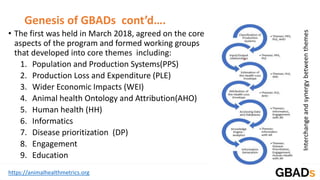
• The first was held in March 2018, agreed on the core
aspects of the program and formed working groups
that developed into core themes including:
1. Population and Production Systems(PPS)
2. Production Loss and Expenditure (PLE)
3. Wider Economic Impacts (WEI)
4. Animal health Ontology and Attribution(AHO)
5. Human health (HH)
6. Informatics
7. Disease prioritization (DP)
8. Engagement
9. Education
https://animalhealthmetrics.org
Genesis of GBADs cont’d….
• At the second workshop the GBADs concept note
was presented at the 2019 OIE General Session
• Support was received from cooperating
international organizations: FAO, ILRI, WHO, WTO,
OECD and the World Bank
• For the current 2 years phase (January 2021-
December 2022) GBADs has been funded by BMGF
and FCDO of the UK Government with plans for
continuing subsequent phases until 2030
https://animalhealthmetrics.org
Genesis of GBADs cont’d….
• In these two years, GBADs program will validate the approach in
specific countries and at global level.
• Ethiopia has been selected as one of the first case study countries
• The work in Ethiopia consists of specific
• case-studies exploring animal disease burden in the country and
• disease burden prioritisation methodologies with wider global relevance
https://animalhealthmetrics.org
3. Ethiopia as GBADs case study country
• During the development phase of GBADs, desirable criteria for case
study country choice were established which include:
• Demonstrate leadership in their region, and a willingness to share
information and collaborate.
• Have livestock systems that are representative of the region.
• Possess modern IT resources providing access to data of good quality.
• Have institutions and key actors that have an analytical way of working,
• Exploit the GBADs consortium’s existing in-country links and other specific in-
country capacities, such as complementary ongoing programs.
https://animalhealthmetrics.org
Ethiopia as GBADs case study country cont’d….
Ethiopia fulfils these criteria:
• It has the largest human and livestock
population in East African region and the largest
livestock population in the African continent
• Livestock, kept in various types of production
systems and sectors, play a prominent role in
the Ethiopian economy
• National strategic efforts such as past GTPs and
associated livestock master plans, and the
current 10-year agriculture perspective plan
have created a strong political and institutional
framework to which the work of the GBADs can
be anchored and aligned.
https://animalhealthmetrics.org
4. GBADs activities in Ethiopia
• GBADs major activities in Ethiopia from January 2021-December 2022
will be:
• Meet with key stakeholders; present the GBADs program and the Ethiopian
case study; carry out participatory knowledge exchange.
• Seek out and collate available data from Ethiopian production systems for
input into GBADs platform.
• Select priority production systems; carry out population estimates.
• Estimate livestock biomass, production and economic value for each system.
• Present data on gender aspects in terms of provision of labour and realisation
of benefits.
https://animalhealthmetrics.org
GBADs activities in Ethiopia cont’d….
• Develop analytical framework and conduct
analysis to estimate the animal health loss
envelope (AHLE)
• Produce an estimate of the AHLE and
attribute to causes
• Design and implement capacity
development workshops on animal health
economics aimed for different
stakeholders
• Widen engagement activities to the region
and use ILRI’s status as a regional research
hub to promote GBADs work
https://animalhealthmetrics.org
5. How GBADs can benefit Ethiopia cont’d….
• In Ethiopia livestock play significant role in the
livelihoods of about 65% of the population and
contributes up to 19% GDP to the national
economy
• The country is endemic for a number of livestock
diseases which continue to hinder livestock
productivity and agricultural development
• The annual loss due to mortality ranges from 8–
10% for cattle, 12–14% for sheep, 11–13% for
goats and 56.9% for poultry and 30-50%
morbidity
• The livestock diseases have a significant public
health, food security and economic impact,
affecting the livelihoods and the national
economy
https://animalhealthmetrics.org
How GBADs can benefit Ethiopia cont’d….
• Currently data on disease burden are limited to losses associated
with individual diseases which do not allow to understand the
actual burden of animal diseases and health losses holistically
• Policy making for disease control is reliant on incomplete data and
without full understanding of livestock disease burdens and
priorities
• GBADs will generate comprehensive quantitative evidence on the
burden of animal diseases and health losses
• As a case study Ethiopia will benefit more as information and
evidence will be generated on Ethiopia’s situation that can inform
important decisions as the national, sector, industry and producer
level
https://animalhealthmetrics.org
How GBADs can benefit Ethiopia cont’d….
• More specifically GBADs in Ethiopia will
• Estimate the burden of livestock diseases
nationally, by production system and by
sectors
• Useful to identify high burden sectors for
interventions
• Estimate the burden to different diseases
• useful input for disease control
prioritization
• Refine methods and collect data on livestock
population, biomass and productivity
• Useful for planning in the livestock sector
https://animalhealthmetrics.org
How GBADs can benefit Ethiopia cont’d….
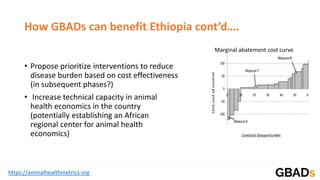
• Propose prioritize interventions to reduce
disease burden based on cost effectiveness
(in subsequent phases?)
• Increase technical capacity in animal
health economics in the country
(potentially establishing an African
regional center for animal health
economics)
Marginal abatement cost curve
https://animalhealthmetrics.org
6. Set –up at ILRI for Ethiopia case study
• Work in Ethiopia will be led by ILRI and implemented with local partners
• ILRI has a strong presence in animal health research in Ethiopia and the
Region
• ILRI hosts the Ethiopia GBADs team
• Dr. Theo Knight-Jones: lead Ethiopia case study
• Prof. Delia Randolph: lead GBADs disease prioritization theme
• Prof. Wudu Temesgen: support country study, animal health economics
• Dr. Wondwosen Asfaw: stakeholder engagement
• Dr. Kebede Amenu: support disease prioritization theme in GBADs
• Dr. Girma Birhan (a PhD student): supported by The Brooke-GBADs in working
equids
https://animalhealthmetrics.org
Summary
In summary in the coming two years GBADs Ethiopia case study will
• Collect and collate data on livestock population and production, and livestock
disease epidemiology, production loss and control expenditure
• Estimate the livestock population, biomass and economic values of selected
production systems (cattle + small ruminant?? + chicken??)
• Estimate the animal health burden on selected production systems/sectors
• Attribute the estimated burden to different diseases and health losses
• Make the information readily available for use by stakeholders
• Increase the capacity of policy makers and farmers on the use of economics
in animal health decision making
https://animalhealthmetrics.org
Thank you for your attention!
Comments and Questions?
THANK YOU

Global Burden of Animal Diseases: Ethiopia case study

  • 1.
    Global Burden ofAnimal Disease Ethiopia case study inception workshop ILRI Campus, Addis Ababa, and Virtual March 18, 2021 https://animalhealthmetrics.org Global Burden of Animal Diseases: Ethiopia case study Wudu Temesgen1, Theo Knight-Jones1, Wondwosen Awoke2, Ben Huntington3 and Jonathan Rushton3 1International Livestock Research Institute; 2Independent consultant; 3University of Liverpool
  • 2.
    https://animalhealthmetrics.org Outline of thepresentation 1. What is GBADs and what it does 2. Genesis of GBADs 3. Ethiopia as GBADs case study country 4. GBADs activities in Ethiopia 5. How GBADs can benefit Ethiopia 6. Set up at ILRI for Ethiopia case study 7. Summary
  • 3.
    https://animalhealthmetrics.org 1. What isGlobal Burden of Animal Diseases and what it does? • The Global Burden of Animal Diseases (GBADs) is a research program measuring and understanding the Global Burden of Animal Diseases • The program is inspired by and will build up on the successful human Global Burden of Disease (GBD) studies • GBADs program has a mission “measure to improve” animal health at a local, national and global level • It will create information on the economic burden of livestock diseases to support animal health decision making
  • 4.
    https://animalhealthmetrics.org What is GBADsand what it does? Cont’d…. • It will provide information to assess the importance of different livestock diseases and health problems for different groups, countries and production systems • GBADs has been initiated by the University of Liverpool, with support from the OIE, FAO, ILRI and a group of international collaborating institutions and organizations
  • 5.
    https://animalhealthmetrics.org GBADs outcomes • GBADswill: • provide information for evidence-based investment plans for veterinary services • allow allocation of resources to key social, economic and environmental problems • support high quality evaluation of existing animal health investments to insure they are delivering societal outcomes
  • 6.
    https://animalhealthmetrics.org GBADs outputs To achievethose outcomes GBADs will produce: 1. Country, sector and animal disease specific case studies 2. Best practice guides on population estimates, production system classification and livestock production parameters: a basis for an FAO and FAOSTAT Guide 3. Estimates of animal disease burden at a global, regional and national level: with an online platform to guide animal health decision-makers 4. Draft of a best practice standard for the economic assessment of animal health: the basis for a chapter in the OIE Terrestrial Animal Health Code 5. An education & communication package: the importance of animals in society
  • 7.
    https://animalhealthmetrics.org 2. Genesis ofGBADs • The 2016 OIE GS concluded that: • Estimates of the impact of animal diseases were of insufficient quality, • A more systematic process to assess the burden of animal diseases was needed: the birth of GBADs • Subsequently, two workshops were held that led to the development of GBADs
  • 8.
    https://animalhealthmetrics.org Genesis of GBADscont’d…. • The first was held in March 2018, agreed on the core aspects of the program and formed working groups that developed into core themes including: 1. Population and Production Systems(PPS) 2. Production Loss and Expenditure (PLE) 3. Wider Economic Impacts (WEI) 4. Animal health Ontology and Attribution(AHO) 5. Human health (HH) 6. Informatics 7. Disease prioritization (DP) 8. Engagement 9. Education
  • 9.
    https://animalhealthmetrics.org Genesis of GBADscont’d…. • At the second workshop the GBADs concept note was presented at the 2019 OIE General Session • Support was received from cooperating international organizations: FAO, ILRI, WHO, WTO, OECD and the World Bank • For the current 2 years phase (January 2021- December 2022) GBADs has been funded by BMGF and FCDO of the UK Government with plans for continuing subsequent phases until 2030
  • 10.
    https://animalhealthmetrics.org Genesis of GBADscont’d…. • In these two years, GBADs program will validate the approach in specific countries and at global level. • Ethiopia has been selected as one of the first case study countries • The work in Ethiopia consists of specific • case-studies exploring animal disease burden in the country and • disease burden prioritisation methodologies with wider global relevance
  • 11.
    https://animalhealthmetrics.org 3. Ethiopia asGBADs case study country • During the development phase of GBADs, desirable criteria for case study country choice were established which include: • Demonstrate leadership in their region, and a willingness to share information and collaborate. • Have livestock systems that are representative of the region. • Possess modern IT resources providing access to data of good quality. • Have institutions and key actors that have an analytical way of working, • Exploit the GBADs consortium’s existing in-country links and other specific in- country capacities, such as complementary ongoing programs.
  • 12.
    https://animalhealthmetrics.org Ethiopia as GBADscase study country cont’d…. Ethiopia fulfils these criteria: • It has the largest human and livestock population in East African region and the largest livestock population in the African continent • Livestock, kept in various types of production systems and sectors, play a prominent role in the Ethiopian economy • National strategic efforts such as past GTPs and associated livestock master plans, and the current 10-year agriculture perspective plan have created a strong political and institutional framework to which the work of the GBADs can be anchored and aligned.
  • 13.
    https://animalhealthmetrics.org 4. GBADs activitiesin Ethiopia • GBADs major activities in Ethiopia from January 2021-December 2022 will be: • Meet with key stakeholders; present the GBADs program and the Ethiopian case study; carry out participatory knowledge exchange. • Seek out and collate available data from Ethiopian production systems for input into GBADs platform. • Select priority production systems; carry out population estimates. • Estimate livestock biomass, production and economic value for each system. • Present data on gender aspects in terms of provision of labour and realisation of benefits.
  • 14.
    https://animalhealthmetrics.org GBADs activities inEthiopia cont’d…. • Develop analytical framework and conduct analysis to estimate the animal health loss envelope (AHLE) • Produce an estimate of the AHLE and attribute to causes • Design and implement capacity development workshops on animal health economics aimed for different stakeholders • Widen engagement activities to the region and use ILRI’s status as a regional research hub to promote GBADs work
  • 15.
    https://animalhealthmetrics.org 5. How GBADscan benefit Ethiopia cont’d…. • In Ethiopia livestock play significant role in the livelihoods of about 65% of the population and contributes up to 19% GDP to the national economy • The country is endemic for a number of livestock diseases which continue to hinder livestock productivity and agricultural development • The annual loss due to mortality ranges from 8– 10% for cattle, 12–14% for sheep, 11–13% for goats and 56.9% for poultry and 30-50% morbidity • The livestock diseases have a significant public health, food security and economic impact, affecting the livelihoods and the national economy
  • 16.
    https://animalhealthmetrics.org How GBADs canbenefit Ethiopia cont’d…. • Currently data on disease burden are limited to losses associated with individual diseases which do not allow to understand the actual burden of animal diseases and health losses holistically • Policy making for disease control is reliant on incomplete data and without full understanding of livestock disease burdens and priorities • GBADs will generate comprehensive quantitative evidence on the burden of animal diseases and health losses • As a case study Ethiopia will benefit more as information and evidence will be generated on Ethiopia’s situation that can inform important decisions as the national, sector, industry and producer level
  • 17.
    https://animalhealthmetrics.org How GBADs canbenefit Ethiopia cont’d…. • More specifically GBADs in Ethiopia will • Estimate the burden of livestock diseases nationally, by production system and by sectors • Useful to identify high burden sectors for interventions • Estimate the burden to different diseases • useful input for disease control prioritization • Refine methods and collect data on livestock population, biomass and productivity • Useful for planning in the livestock sector
  • 18.
    https://animalhealthmetrics.org How GBADs canbenefit Ethiopia cont’d…. • Propose prioritize interventions to reduce disease burden based on cost effectiveness (in subsequent phases?) • Increase technical capacity in animal health economics in the country (potentially establishing an African regional center for animal health economics) Marginal abatement cost curve
  • 19.
    https://animalhealthmetrics.org 6. Set –upat ILRI for Ethiopia case study • Work in Ethiopia will be led by ILRI and implemented with local partners • ILRI has a strong presence in animal health research in Ethiopia and the Region • ILRI hosts the Ethiopia GBADs team • Dr. Theo Knight-Jones: lead Ethiopia case study • Prof. Delia Randolph: lead GBADs disease prioritization theme • Prof. Wudu Temesgen: support country study, animal health economics • Dr. Wondwosen Asfaw: stakeholder engagement • Dr. Kebede Amenu: support disease prioritization theme in GBADs • Dr. Girma Birhan (a PhD student): supported by The Brooke-GBADs in working equids
  • 20.
    https://animalhealthmetrics.org Summary In summary inthe coming two years GBADs Ethiopia case study will • Collect and collate data on livestock population and production, and livestock disease epidemiology, production loss and control expenditure • Estimate the livestock population, biomass and economic values of selected production systems (cattle + small ruminant?? + chicken??) • Estimate the animal health burden on selected production systems/sectors • Attribute the estimated burden to different diseases and health losses • Make the information readily available for use by stakeholders • Increase the capacity of policy makers and farmers on the use of economics in animal health decision making
  • 21.
    https://animalhealthmetrics.org Thank you foryour attention! Comments and Questions?
  • 22.