Modeling and manipulation of
plant-aphid interactions: A new
avenue for sustainable disease
management of beans in Africa
J.M. Mutuku1, F. Wamonje2, A. Djikeng1, J. Carr2 and J. Harvey1
The development challenge: Common Bean (Phaseolus vulgaris L.) is an important food crop in Eastern and Central Africa.
Predominantly grown by women, it provides food and nutritional security, and income, to over 200 million people in sub-Saharan Africa.
Significant challenges to production include aphid-transmitted disease caused by Bean Common Mosaic Virus (BCMV) and Bean
Common Mosaic Necrosis Virus (BCMNV). While breeders are working to develop resistant varieties, sustainably tackling challenges
unique to this pathosystem requires multiple resistance and management strategies.
Potential impact: Novel strategies of controlling bean virus diseases will be disseminated through the partnership, including the Pan-
African Bean Research Alliance (PABRA) network across 29 African countries. Given the widespread distribution of these viruses, yield
losses could be prevented for many millions of farmers across a wide geographic area. Further, the principles of manipulating insect
vectors of plant viruses may be extrapolated to a broad range of important food and nutritional security crops.
Josiah Musembi Mutuku, J.Mutuku@cgiar.org
Jagger Harvey, J.Harvey@cgiar.org
Biosciences Eastern and Central Africa (BecA) Hub-International Livestock
Research Institute. P.O. Box 30709, Nairobi 00100, KENYA.
www.hub.africabiosciences.org
Partner institutions: Cambridge University, Rothamsted Research, CIAT
Funding: Financial support is provided through Sustainable Crop
Production Research for International Development, (SCPRID), which is
funded by the Biotechnology and Biological Sciences Research Council
(BBSRC), the Department for International Development (DFID) and
(through a grant awarded to BBSRC) the Bill & Melinda Gates
Foundation.
This	document	is	licensed	for	use	under	a	Crea3ve	Commons	A6ribu3on	–Non	commercial-Share	Alike	3.0	Unported	License																									February	2016	
1.  BecA-ILRI Hub
2.  University of Cambridge
(Broader project partners listed below)
Partnerships
1)  A multidisciplinary, international scientific
team coalesced around a difficult
challenge constraining food and
nutritional security in sub-Saharan Africa.
2)  Genes differentially regulated in bean
plants infected with BCMNV, BCMV and
Cucumber mosaic virus (CMV) identified.
3)  BCMNV was found to induce the greatest
response in bean plants in terms of
changes in gene expression compared to
BCMV and CMV.
4)  Genes involved in secondary metabolic
pathways showed the greatest differential
expression.
5)  Validation of candidate genes for future
manipulation and deployment (in
progress)
6)  Sequenced BCMV, BCMNV and CMV
from Kenya
7)  Institutional and human capacity building,
including training of African PhD at
Cambridge University, and appointment
of Minister of Agriculture and Livestock
Resources (Rwanda) from the project
team.
Outputs
1)  African national bean breeders
developing resistant varieties using
markers resulting from high-level
genomic and epidemiological analysis of
the pathosystem.
2)  Farmers using bioscience-based
interventions (improved varieties,
semiochemical-based traps, push-pull
systems) for increased yield and
nutritional security.
3)  Phytosanitary, regulatory, breeder and
research actors using epidemiological
models to curtail viral and aphid
problems in a broader geographic
context and wider set of crops.
4)  NARS systems and stakeholders better
equipped to tackle challenging crop
improvement issues, incorporating high-
end, appropriate biosciences.
5)  Phytosanitary strategies for trade of
beans can be adapted based on
pathogen characterization, in order to
safeguard regions from introduction of
new, virulent strains; this includes
safeguarding African smallholder
farmers .
Expected outcomes
Potential to scale-up
1.  Identification of the genetic basis of host resistance against viruses may be
applied in the development of resistant cultivars to help reduce economic
losses estimated to be at least US$ 400 million annually due to these viruses.
2.  Information on molecular markers useful for selecting resistant cultivars or
resistance genes will be disseminated through the BecA NARS network
including the PABRA network across 29 African countries.
3.  The principles of manipulating insect vectors of plant viruses may be
extrapolated to a broad range of important food and nutritional security crops.
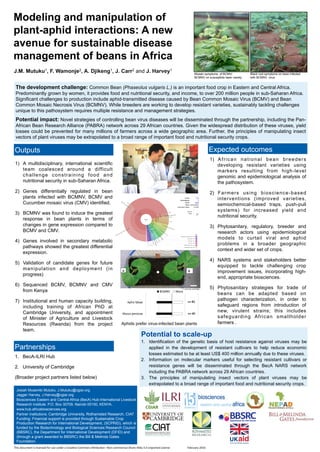
Aphids prefer virus-infected bean plants
Modeling and manipulation of
plant-aphid interactions: A new
avenue for sustainable disease
management of beans in Africa
J.M. Mutuku1, F. Wamonje2, A. Djikeng1, J. Carr2 and J. Harvey1
The development challenge: Common Bean (Phaseolus vulgaris L.) is an important food crop in Eastern and Central Africa.
Predominantly grown by women, it provides food and nutritional security, and income, to over 200 million people in sub-Saharan Africa.
Significant challenges to production include aphid-transmitted disease caused by Bean Common Mosaic Virus (BCMV) and Bean
Common Mosaic Necrosis Virus (BCMNV). While breeders are working to develop resistant varieties, sustainably tackling challenges
unique to this pathosystem requires multiple resistance and management strategies.
Potential impact: The novel strategies of controlling bean virus diseases will be disseminated through the partnership, including the
PABRA network across 29 African countries. Further, the principles of manipulating insect vectors of plant viruses may be extrapolated
to a broad range of important food and nutritional security crops. Given the widespread distribution of these viruses, yield losses could
be prevented for many millions of farmers across a wide geographic area.
Josiah Musembi Mutuku, J.Mutuku@cgiar.org
Jagger Harvey, J.Harvey@cgiar.org
Biosciences Eastern and Central Africa (BecA) Hub-International Livestock
Research Institute. P.O. Box 30709, Nairobi 00100, KENYA.
www.hub.africabiosciences.org
Partner institutions: Cambridge University, Rothamsted Research, CIAT
Funding: Financial support is provided through Sustainable Crop
Production Research for International Development, (SCPRID), which is
funded by the Biotechnology and Biological Sciences Research Council
(BBSRC), the Department for International Development (DFID) and
(through a grant awarded to BBSRC) the Bill & Melinda Gates
Foundation.
1.  BecA-ILRI Hub
2.  University of Cambridge
(Broader project partners listed below)
Partnerships
1)  A multidisciplinary, international scientific
team coalesced around a difficult
challenge constraining food and
nutritional security in sub-Saharan Africa.
2)  Genes differentially regulated in bean
plants infected with Bean common
mosaic necrosis virus (BCMNV), Bean
common mosaic virus (BCMV) and
Cucumber mosaic virus (CMV) identified.
3)  BCMNV was found to induce the greatest
response in bean plants in terms of
changes in gene expression compared to
BCMV and CMV.
4)  Genes involved in secondary metabolic
pathways showed the greatest differential
expression.
5)  Validation of candidate genes for future
manipulation and deployment (in
progress)
6)  Sequenced BCMV, BCMNV and CMV
from Kenya
7)  Institutional and human capacity building,
including training of African PhD at
Cambridge University, and appointment
of Minister of Agriculture and Livestock
Resources (Rwanda) from the project
team.
Outputs
1)  African national bean breeders
developing resistant varieties using
markers resulting from high level
genomic and epidemiological analysis of
the pathosystem.
2)  Farmers using bioscience-based
interventions (improved varieties,
semiochemical-based traps, push-pull
systems) for increased yield and
nutritional security.
3)  Phytosanitary, regulatory, breeder and
research actors using epidemiological
models to curtail viral and aphid
problems in a broader geographic
context and wider set of crops.
4)  NARS systems and stakeholders better
equipped to tackle challenging crop
improvement issues, incorporating high-
end, appropriate biosciences.
5)  Phytosanitary strategies for trade of
beans can be adapted based on
pathogen characterization, in order to
safeguard regions from introduction of
new, virulent strains; this includes
safeguarding African smallholder
farmers .
Expected outcomes
Potential to scale-up
1.  Identification of the genetic basis of host resistance against viruses may be
applied in the development of resistant cultivars to help reduce economic
losses estimated to be at least US$ 400 million annually due to these
viruses.
2.  Information on molecular markers useful for selecting resistant cultivars or
resistance genes will be disseminated through the BecA NARS network
including the PABRA network across 29 African countries
3.  The principles of manipulating insect vectors of plant viruses may be
extrapolated to a broad range of important food and nutritional security crops
Aphid-infested bean plants Viral symptoms in infected bean
F.	Wamonje,	Cambridge	
Aphids prefer virus-infected bean plants
Mosaic symptoms of BCMV/
BCMNV on susceptible bean variety
Black root symptoms on bean infected
with BCMNV virus

Modeling and manipulation of plant-aphid interactions: A new avenue for sustainable disease management of beans in Africa

  • 1.
    Modeling and manipulationof plant-aphid interactions: A new avenue for sustainable disease management of beans in Africa J.M. Mutuku1, F. Wamonje2, A. Djikeng1, J. Carr2 and J. Harvey1 The development challenge: Common Bean (Phaseolus vulgaris L.) is an important food crop in Eastern and Central Africa. Predominantly grown by women, it provides food and nutritional security, and income, to over 200 million people in sub-Saharan Africa. Significant challenges to production include aphid-transmitted disease caused by Bean Common Mosaic Virus (BCMV) and Bean Common Mosaic Necrosis Virus (BCMNV). While breeders are working to develop resistant varieties, sustainably tackling challenges unique to this pathosystem requires multiple resistance and management strategies. Potential impact: Novel strategies of controlling bean virus diseases will be disseminated through the partnership, including the Pan- African Bean Research Alliance (PABRA) network across 29 African countries. Given the widespread distribution of these viruses, yield losses could be prevented for many millions of farmers across a wide geographic area. Further, the principles of manipulating insect vectors of plant viruses may be extrapolated to a broad range of important food and nutritional security crops. Josiah Musembi Mutuku, J.Mutuku@cgiar.org Jagger Harvey, J.Harvey@cgiar.org Biosciences Eastern and Central Africa (BecA) Hub-International Livestock Research Institute. P.O. Box 30709, Nairobi 00100, KENYA. www.hub.africabiosciences.org Partner institutions: Cambridge University, Rothamsted Research, CIAT Funding: Financial support is provided through Sustainable Crop Production Research for International Development, (SCPRID), which is funded by the Biotechnology and Biological Sciences Research Council (BBSRC), the Department for International Development (DFID) and (through a grant awarded to BBSRC) the Bill & Melinda Gates Foundation. This document is licensed for use under a Crea3ve Commons A6ribu3on –Non commercial-Share Alike 3.0 Unported License February 2016 1.  BecA-ILRI Hub 2.  University of Cambridge (Broader project partners listed below) Partnerships 1)  A multidisciplinary, international scientific team coalesced around a difficult challenge constraining food and nutritional security in sub-Saharan Africa. 2)  Genes differentially regulated in bean plants infected with BCMNV, BCMV and Cucumber mosaic virus (CMV) identified. 3)  BCMNV was found to induce the greatest response in bean plants in terms of changes in gene expression compared to BCMV and CMV. 4)  Genes involved in secondary metabolic pathways showed the greatest differential expression. 5)  Validation of candidate genes for future manipulation and deployment (in progress) 6)  Sequenced BCMV, BCMNV and CMV from Kenya 7)  Institutional and human capacity building, including training of African PhD at Cambridge University, and appointment of Minister of Agriculture and Livestock Resources (Rwanda) from the project team. Outputs 1)  African national bean breeders developing resistant varieties using markers resulting from high-level genomic and epidemiological analysis of the pathosystem. 2)  Farmers using bioscience-based interventions (improved varieties, semiochemical-based traps, push-pull systems) for increased yield and nutritional security. 3)  Phytosanitary, regulatory, breeder and research actors using epidemiological models to curtail viral and aphid problems in a broader geographic context and wider set of crops. 4)  NARS systems and stakeholders better equipped to tackle challenging crop improvement issues, incorporating high- end, appropriate biosciences. 5)  Phytosanitary strategies for trade of beans can be adapted based on pathogen characterization, in order to safeguard regions from introduction of new, virulent strains; this includes safeguarding African smallholder farmers . Expected outcomes Potential to scale-up 1.  Identification of the genetic basis of host resistance against viruses may be applied in the development of resistant cultivars to help reduce economic losses estimated to be at least US$ 400 million annually due to these viruses. 2.  Information on molecular markers useful for selecting resistant cultivars or resistance genes will be disseminated through the BecA NARS network including the PABRA network across 29 African countries. 3.  The principles of manipulating insect vectors of plant viruses may be extrapolated to a broad range of important food and nutritional security crops. Aphids prefer virus-infected bean plants Modeling and manipulation of plant-aphid interactions: A new avenue for sustainable disease management of beans in Africa J.M. Mutuku1, F. Wamonje2, A. Djikeng1, J. Carr2 and J. Harvey1 The development challenge: Common Bean (Phaseolus vulgaris L.) is an important food crop in Eastern and Central Africa. Predominantly grown by women, it provides food and nutritional security, and income, to over 200 million people in sub-Saharan Africa. Significant challenges to production include aphid-transmitted disease caused by Bean Common Mosaic Virus (BCMV) and Bean Common Mosaic Necrosis Virus (BCMNV). While breeders are working to develop resistant varieties, sustainably tackling challenges unique to this pathosystem requires multiple resistance and management strategies. Potential impact: The novel strategies of controlling bean virus diseases will be disseminated through the partnership, including the PABRA network across 29 African countries. Further, the principles of manipulating insect vectors of plant viruses may be extrapolated to a broad range of important food and nutritional security crops. Given the widespread distribution of these viruses, yield losses could be prevented for many millions of farmers across a wide geographic area. Josiah Musembi Mutuku, J.Mutuku@cgiar.org Jagger Harvey, J.Harvey@cgiar.org Biosciences Eastern and Central Africa (BecA) Hub-International Livestock Research Institute. P.O. Box 30709, Nairobi 00100, KENYA. www.hub.africabiosciences.org Partner institutions: Cambridge University, Rothamsted Research, CIAT Funding: Financial support is provided through Sustainable Crop Production Research for International Development, (SCPRID), which is funded by the Biotechnology and Biological Sciences Research Council (BBSRC), the Department for International Development (DFID) and (through a grant awarded to BBSRC) the Bill & Melinda Gates Foundation. 1.  BecA-ILRI Hub 2.  University of Cambridge (Broader project partners listed below) Partnerships 1)  A multidisciplinary, international scientific team coalesced around a difficult challenge constraining food and nutritional security in sub-Saharan Africa. 2)  Genes differentially regulated in bean plants infected with Bean common mosaic necrosis virus (BCMNV), Bean common mosaic virus (BCMV) and Cucumber mosaic virus (CMV) identified. 3)  BCMNV was found to induce the greatest response in bean plants in terms of changes in gene expression compared to BCMV and CMV. 4)  Genes involved in secondary metabolic pathways showed the greatest differential expression. 5)  Validation of candidate genes for future manipulation and deployment (in progress) 6)  Sequenced BCMV, BCMNV and CMV from Kenya 7)  Institutional and human capacity building, including training of African PhD at Cambridge University, and appointment of Minister of Agriculture and Livestock Resources (Rwanda) from the project team. Outputs 1)  African national bean breeders developing resistant varieties using markers resulting from high level genomic and epidemiological analysis of the pathosystem. 2)  Farmers using bioscience-based interventions (improved varieties, semiochemical-based traps, push-pull systems) for increased yield and nutritional security. 3)  Phytosanitary, regulatory, breeder and research actors using epidemiological models to curtail viral and aphid problems in a broader geographic context and wider set of crops. 4)  NARS systems and stakeholders better equipped to tackle challenging crop improvement issues, incorporating high- end, appropriate biosciences. 5)  Phytosanitary strategies for trade of beans can be adapted based on pathogen characterization, in order to safeguard regions from introduction of new, virulent strains; this includes safeguarding African smallholder farmers . Expected outcomes Potential to scale-up 1.  Identification of the genetic basis of host resistance against viruses may be applied in the development of resistant cultivars to help reduce economic losses estimated to be at least US$ 400 million annually due to these viruses. 2.  Information on molecular markers useful for selecting resistant cultivars or resistance genes will be disseminated through the BecA NARS network including the PABRA network across 29 African countries 3.  The principles of manipulating insect vectors of plant viruses may be extrapolated to a broad range of important food and nutritional security crops Aphid-infested bean plants Viral symptoms in infected bean F. Wamonje, Cambridge Aphids prefer virus-infected bean plants Mosaic symptoms of BCMV/ BCMNV on susceptible bean variety Black root symptoms on bean infected with BCMNV virus