Moving Bio-innovations
   from the Laboratory to the Market
A Comparative Study of Four Bio-Innovate
         Technological Clusters

          First Bio-Innovate Regional Scientific
        Conference, Addis Ababa, Ethiopia, 25-27
                      February 2013
                         BIPCEA
 Ecuru J., Virgin, I., Omari J., Chuwa P., Teklehaimanot
   H., Alemu A.,Komen J., Nyange N., Ozor N., Opati
       L., Karembu M., Nguthi F., Gasingirwa C.
Outline
• Introduction

• Conceptual & methodological considerations

• Results

• Discussions and recommendations
Introduction
• Governments, stressing increased agricultural
  production, value addition and agro-processing.

• There is evidence of bio-innovations in
  universities & public R&D orgs, but they are
  unable to move to the market.

• Moving bio-innovations to market need well
  functioning innovation system;
The Study
Studies on four Bio-Innovate technological clusters with the aim
  to:

• Understand, from a technological innovation systems
  perspective, enabling conditions and barriers to moving
  bio-innovations from the laboratory to the market in
  eastern Africa

• Compare the different innovation systems and highlight
  similarities and dissimilarities between the four systems.

• Suggest actions and policy measures to improve the
  conditions for bioscience innovation in the region.
The Technological clusters include:

1. Crop improvement technologies (especially for
   cassava, sweet potato and potato)
2. Bio-energy and mushroom production from
   agro-industrial waste
3. Value added products from sorghum and millet
4. Industrial Enzymes for Sustainable Bio-
   Economy
The Conceptual framework
• Technological Innovation Systems (TIS) framework.

      • “[…] a network or networks of agents interacting in a
        specific technology area under a particular institutional
        infrastructure [e.g. norms and regulation] to
        generate, diffuse, and utilise technology or product.”


• TIS approach enables analysis of how different parts
  of the innovation system functions.
Conceptual framework…
Using seven processes to broadly map the strengths and
  weaknesses of the innovation system :
   1. Knowledge development and diffusion .
   2. Entrepreneurial activity
   3. Guidance visions, policies and strategies
   4. Market creation
   5. Getting legitimacy
   6. Resource mobilisation
   7. Positive externalities
An important part of the TIS analysis is also the
characterisation of the structural components (actors in the
system, infrastructure)
Conceptual framework…
  In order to describe the strength the functions and the
  structural components of the innovation system, we
  have used a quantitative scale of 1-4,

1- Very poor. The function is fulfilled in an inadequate
   manner, or there are serious weaknesses.
2 - Poor. While the function is partly fulfilled, there are
   major weaknesses.
3 - Fair. While the function is broadly fulfilled, there are
   still serious weaknesses.
4 - Good. The function adequately fulfill
Study Method
Mixed methods in gathering qualitative data, based
on:
1. Review of national and regional policy
   documents and institutional reports,
2. Observations
3. One focus group discussion and least five
   interviews with key actors in each technological
   cluster (including industry) in
   Ethiopia, Kenya, Tanzania and Uganda, Rwanda
   and Burundi
Results
Structural components of the
      innovation system: The Actors

• From the results, it appears the actors and organizations
  needed to move bio-innovations to the market largely exist
  in the region.

• However, the actors are not interlinked to function
  properly.

• But, as has been seen in other related innovation
  systems, the number of involved actors and especially new
  entrants can change the dynamics of the innovation system
  fast.
Knowledge development

• Knowledge development in all the studied innovations
  systems is at a relatively high level.
• The knowledge base is no longer a major limiting
  factor in any of the four innovation systems studied.
But……
• In all the systems, marketing skills and the ability to
  make assessment of economic potential of
  commercialization of technologies and products is still
  weak.
• Skills in developing cost effective production and
  distribution regimes are also weak
Entrepreneurial activity
• The entrepreneurship skills at public R&D institutions
  still limited

• Few private sector actors are investing in R&D. Close
  collaboration between academia and the private sector is
  not common.

• Actors in innovation consortia seldom properly
  interlinked and supported to play complimentary roles.

• New entrants are making impact(especially in the case of
  crop improvement/tissue culture)
Guidance/ Policies and an enabling
                    environment
• Science, technology and innovation(STI) policy frameworks in
  place; but specific policies/regulations largely lacking.

• High taxation on imported equipment is a negative factor.

• Strategies, priority setting regimes and specific government
  programmes supporting innovation still too few.

• Limited institutional structures & policies for innovation (e.g.
  inst.IP policies/ management capacities to develop effective
  contractual agreements, and abilities to link with market actors)

•   Slow procurement procedures delaying implementation of projects
Market Creation
• Markets for all the four innovation systems are weak and affect the
  four innovation systems negatively.

• Marketing techniques, marketing skills and also resources for
  marketing technologies and products are to a large extent lacking

• No active market creation. Absence of focused national
  goals, targets, incentives.

• As an example, in the case of biogas production unfavorable feed-
  in tariffs to sell electricity generated from biogas to national
  electricity grids is a negative factor.
Getting legitimacy

• For all of the innovation systems, a strong legitimacy for the
  positive impacts these new technologies and products could
  have on improving food security, climate change resilience and
  converting agrowaste into something beneficial.

• At the same time other factors are acting to reduce this
  legitimacy, likely based on perceptions, such as;
  - some of the potential products associated with poverty,
  -Running biogas digesters perceived as dirty and unattractive
.
Resources
• Human resources appear to be adequate to drive the
  innovation process forward.

• Financial resources for moving the innovation
  process forward towards commercialization and large
  scale application is a limiting factor.

• What is promising is that in countries such as
  Tanzania, Ethiopia and Kenya, new funding
  mechanisms for innovation are under development.
Externalities
• Advocacy groups lacking with an exception of
  tissue culture buisness network.
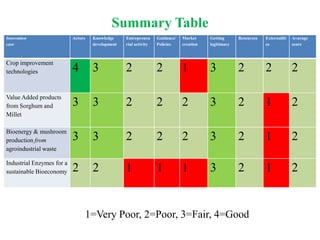
Summary Table
Innovation                 Actors    Knowledge     Entrepreneu     Guidance/   Market     Getting      Resources   Externaliti   Avarage
case                                 development   rial activity   Policies    creation   legitimacy               es            score


Crop improvement
technologies               4         3             2               2           1          3            2           2             2

Value Added products
from Sorghum and           3         3             2               2           2          3            2           1             2
Millet

Bioenergy & mushroom
production from            3         3             2               2           2          3            2           1             2
agroindustrial waste

Industrial Enzymes for a
sustainable Bioeconomy     2         2             1               1           1          3            2           1             2


                                    1=Very Poor, 2=Poor, 3=Fair, 4=Good
Discussion and
Recommendations
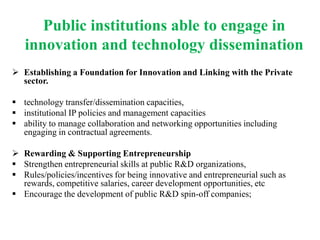
Public institutions able to engage in
   innovation and technology dissemination
 Establishing a Foundation for Innovation and Linking with the Private
  sector.

 technology transfer/dissemination capacities,
 institutional IP policies and management capacities
 ability to manage collaboration and networking opportunities including
  engaging in contractual agreements.

 Rewarding & Supporting Entrepreneurship
 Strengthen entrepreneurial skills at public R&D organizations,
 Rules/policies/incentives for being innovative and entrepreneurial such as
  rewards, competitive salaries, career development opportunities, etc
 Encourage the development of public R&D spin-off companies;
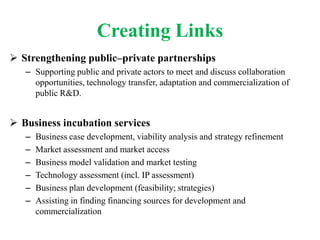
Creating Links
 Strengthening public–private partnerships
   – Supporting public and private actors to meet and discuss collaboration
     opportunities, technology transfer, adaptation and commercialization of
     public R&D.


 Business incubation services
   –   Business case development, viability analysis and strategy refinement
   –   Market assessment and market access
   –   Business model validation and market testing
   –   Technology assessment (incl. IP assessment)
   –   Business plan development (feasibility; strategies)
   –   Assisting in finding financing sources for development and
       commercialization
Policies, strategies, communication

Policies, regulations at national and regional
 level should be supportive

Clear goals, sufficient incentives, and
 strategies necessary

Communicating effectively
Funding R&D and Innovation
• Government innovation funds. The donor
  community can complement and strengthen
  government innovation funds.

• Venture capital.

• Attracting more philanthropic investments.

• Providing incentives for local private sector
  investment in research.
Conclusion
• The actors and all functions in the four sub-innovations
  systems and how they perform are weak. An exception to this
  is the case on micropropagation of disease free cassava, sweet
  potato and potato which is a more mature field of innovation
  and where many of its functions are stronger.
• A visible pattern, although not very distinctive, is that the
  number of actors involved in the systems and knowledge
  formation is improving in all the cases, with the exception of
  industrial enzymes.
• The Bio-Innovate programme has most probably been an
  important factor behind this improvement.
• Thus, need to make these innovation systems more effective, a
  more pronounced focus and investment on improving market
  potentials, policies and resources for these systems would be
  more effective than strengthening R&D efforts.
Acknowledgement
• Bio-Innovate/Sida
• Bio-Innovate Project Teams
Thank you

Moving bio-innovations from the laboratory to the market: A comparative study of four bio-innovate technological clusters

  • 1.
    Moving Bio-innovations from the Laboratory to the Market A Comparative Study of Four Bio-Innovate Technological Clusters First Bio-Innovate Regional Scientific Conference, Addis Ababa, Ethiopia, 25-27 February 2013 BIPCEA Ecuru J., Virgin, I., Omari J., Chuwa P., Teklehaimanot H., Alemu A.,Komen J., Nyange N., Ozor N., Opati L., Karembu M., Nguthi F., Gasingirwa C.
  • 2.
    Outline • Introduction • Conceptual& methodological considerations • Results • Discussions and recommendations
  • 3.
    Introduction • Governments, stressingincreased agricultural production, value addition and agro-processing. • There is evidence of bio-innovations in universities & public R&D orgs, but they are unable to move to the market. • Moving bio-innovations to market need well functioning innovation system;
  • 4.
    The Study Studies onfour Bio-Innovate technological clusters with the aim to: • Understand, from a technological innovation systems perspective, enabling conditions and barriers to moving bio-innovations from the laboratory to the market in eastern Africa • Compare the different innovation systems and highlight similarities and dissimilarities between the four systems. • Suggest actions and policy measures to improve the conditions for bioscience innovation in the region.
  • 5.
    The Technological clustersinclude: 1. Crop improvement technologies (especially for cassava, sweet potato and potato) 2. Bio-energy and mushroom production from agro-industrial waste 3. Value added products from sorghum and millet 4. Industrial Enzymes for Sustainable Bio- Economy
  • 6.
    The Conceptual framework •Technological Innovation Systems (TIS) framework. • “[…] a network or networks of agents interacting in a specific technology area under a particular institutional infrastructure [e.g. norms and regulation] to generate, diffuse, and utilise technology or product.” • TIS approach enables analysis of how different parts of the innovation system functions.
  • 7.
    Conceptual framework… Using sevenprocesses to broadly map the strengths and weaknesses of the innovation system : 1. Knowledge development and diffusion . 2. Entrepreneurial activity 3. Guidance visions, policies and strategies 4. Market creation 5. Getting legitimacy 6. Resource mobilisation 7. Positive externalities An important part of the TIS analysis is also the characterisation of the structural components (actors in the system, infrastructure)
  • 8.
    Conceptual framework… In order to describe the strength the functions and the structural components of the innovation system, we have used a quantitative scale of 1-4, 1- Very poor. The function is fulfilled in an inadequate manner, or there are serious weaknesses. 2 - Poor. While the function is partly fulfilled, there are major weaknesses. 3 - Fair. While the function is broadly fulfilled, there are still serious weaknesses. 4 - Good. The function adequately fulfill
  • 9.
    Study Method Mixed methodsin gathering qualitative data, based on: 1. Review of national and regional policy documents and institutional reports, 2. Observations 3. One focus group discussion and least five interviews with key actors in each technological cluster (including industry) in Ethiopia, Kenya, Tanzania and Uganda, Rwanda and Burundi
  • 10.
  • 11.
    Structural components ofthe innovation system: The Actors • From the results, it appears the actors and organizations needed to move bio-innovations to the market largely exist in the region. • However, the actors are not interlinked to function properly. • But, as has been seen in other related innovation systems, the number of involved actors and especially new entrants can change the dynamics of the innovation system fast.
  • 12.
    Knowledge development • Knowledgedevelopment in all the studied innovations systems is at a relatively high level. • The knowledge base is no longer a major limiting factor in any of the four innovation systems studied. But…… • In all the systems, marketing skills and the ability to make assessment of economic potential of commercialization of technologies and products is still weak. • Skills in developing cost effective production and distribution regimes are also weak
  • 13.
    Entrepreneurial activity • Theentrepreneurship skills at public R&D institutions still limited • Few private sector actors are investing in R&D. Close collaboration between academia and the private sector is not common. • Actors in innovation consortia seldom properly interlinked and supported to play complimentary roles. • New entrants are making impact(especially in the case of crop improvement/tissue culture)
  • 14.
    Guidance/ Policies andan enabling environment • Science, technology and innovation(STI) policy frameworks in place; but specific policies/regulations largely lacking. • High taxation on imported equipment is a negative factor. • Strategies, priority setting regimes and specific government programmes supporting innovation still too few. • Limited institutional structures & policies for innovation (e.g. inst.IP policies/ management capacities to develop effective contractual agreements, and abilities to link with market actors) • Slow procurement procedures delaying implementation of projects
  • 15.
    Market Creation • Marketsfor all the four innovation systems are weak and affect the four innovation systems negatively. • Marketing techniques, marketing skills and also resources for marketing technologies and products are to a large extent lacking • No active market creation. Absence of focused national goals, targets, incentives. • As an example, in the case of biogas production unfavorable feed- in tariffs to sell electricity generated from biogas to national electricity grids is a negative factor.
  • 16.
    Getting legitimacy • Forall of the innovation systems, a strong legitimacy for the positive impacts these new technologies and products could have on improving food security, climate change resilience and converting agrowaste into something beneficial. • At the same time other factors are acting to reduce this legitimacy, likely based on perceptions, such as; - some of the potential products associated with poverty, -Running biogas digesters perceived as dirty and unattractive .
  • 17.
    Resources • Human resourcesappear to be adequate to drive the innovation process forward. • Financial resources for moving the innovation process forward towards commercialization and large scale application is a limiting factor. • What is promising is that in countries such as Tanzania, Ethiopia and Kenya, new funding mechanisms for innovation are under development.
  • 18.
    Externalities • Advocacy groupslacking with an exception of tissue culture buisness network.
  • 19.
    Summary Table Innovation Actors Knowledge Entrepreneu Guidance/ Market Getting Resources Externaliti Avarage case development rial activity Policies creation legitimacy es score Crop improvement technologies 4 3 2 2 1 3 2 2 2 Value Added products from Sorghum and 3 3 2 2 2 3 2 1 2 Millet Bioenergy & mushroom production from 3 3 2 2 2 3 2 1 2 agroindustrial waste Industrial Enzymes for a sustainable Bioeconomy 2 2 1 1 1 3 2 1 2 1=Very Poor, 2=Poor, 3=Fair, 4=Good
  • 20.
  • 21.
    Public institutions ableto engage in innovation and technology dissemination  Establishing a Foundation for Innovation and Linking with the Private sector.  technology transfer/dissemination capacities,  institutional IP policies and management capacities  ability to manage collaboration and networking opportunities including engaging in contractual agreements.  Rewarding & Supporting Entrepreneurship  Strengthen entrepreneurial skills at public R&D organizations,  Rules/policies/incentives for being innovative and entrepreneurial such as rewards, competitive salaries, career development opportunities, etc  Encourage the development of public R&D spin-off companies;
  • 22.
    Creating Links  Strengtheningpublic–private partnerships – Supporting public and private actors to meet and discuss collaboration opportunities, technology transfer, adaptation and commercialization of public R&D.  Business incubation services – Business case development, viability analysis and strategy refinement – Market assessment and market access – Business model validation and market testing – Technology assessment (incl. IP assessment) – Business plan development (feasibility; strategies) – Assisting in finding financing sources for development and commercialization
  • 23.
    Policies, strategies, communication Policies,regulations at national and regional level should be supportive Clear goals, sufficient incentives, and strategies necessary Communicating effectively
  • 24.
    Funding R&D andInnovation • Government innovation funds. The donor community can complement and strengthen government innovation funds. • Venture capital. • Attracting more philanthropic investments. • Providing incentives for local private sector investment in research.
  • 25.
    Conclusion • The actorsand all functions in the four sub-innovations systems and how they perform are weak. An exception to this is the case on micropropagation of disease free cassava, sweet potato and potato which is a more mature field of innovation and where many of its functions are stronger. • A visible pattern, although not very distinctive, is that the number of actors involved in the systems and knowledge formation is improving in all the cases, with the exception of industrial enzymes. • The Bio-Innovate programme has most probably been an important factor behind this improvement. • Thus, need to make these innovation systems more effective, a more pronounced focus and investment on improving market potentials, policies and resources for these systems would be more effective than strengthening R&D efforts.
  • 26.
  • 27.