
Better lives through livestock
Tadele Dessie, PI AsCGG
LiveGene Program, ILRI – Addis Ababa
AsCGG Project Virtual Launch ,
May 24 and 25 2021
Asian Chicken Genetic Gains (AsCGG):
A platform for exploring, testing and delivering improved chickens for
enhanced livelihood outcomes in South East Asia (SEA)
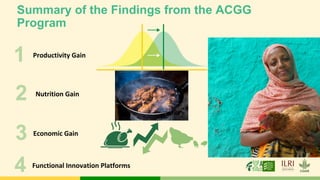
Summary of the Findings from the ACGG
Program
1
3
2
Productivity Gain
Nutrition Gain
Economic Gain
4 Functional Innovation Platforms
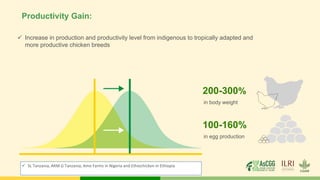
Productivity Gain:
✓ Increase in production and productivity level from indigenous to tropically adapted and
more productive chicken breeds
200-300%
in body weight
100-160%
in egg production
✓ SL Tanzania, AKM G Tanzania, Amo Farms in Nigeria and Ethiochicken in Ethiopia
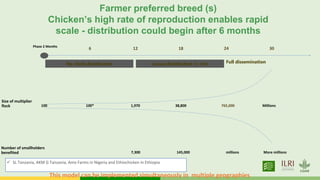
Farmer preferred breed (s)
Chicken’s high rate of reproduction enables rapid
scale - distribution could begin after 6 months
6 12
Phase 2 Months
18 24 30
Size of multiplier
flock 100* 1,970 38,800 765,000 Millions
100
Number of smallholders
benefited 7,300 145,000 millions More millions
No chick distribution Limited distribution (5-10%) Full dissemination
This model can be implemented simultaneously in multiple geographies.
✓ SL Tanzania, AKM G Tanzania, Amo Farms in Nigeria and Ethiochicken in Ethiopia
How and Why AsCGG?
✓ Interest of researchers and development partners in South East Asia
- expressed interest in learning from the experiences of ACGG.
✓ ACGG team from ILRI organized a scoping visit (in April 2019)
- Met with researchers, development practitioners, private sector operators, met with
smallholder farmers
- Tried to understand the policy and strategy environment in the countries
- Tried to understand the aspirations of the farmers, private sector operators
- Developed and submit a compressive report of the scoping visit to ACIAR and ILRI
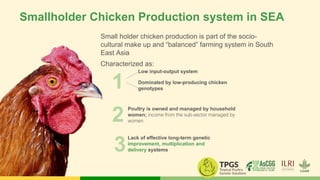
Smallholder Chicken Production system in SEA
Small holder chicken production is part of the socio-
cultural make up and “balanced” farming system in South
East Asia
Characterized as:
Low input-output system
Dominated by low-producing chicken
genotypes
1
Poultry is owned and managed by household
women; income from the sub-sector managed by
women
2
Lack of effective long-term genetic
improvement, multiplication and
delivery systems
3
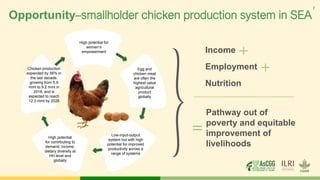
High potential for
women’s
empowerment
Chicken production
expanded by 56% in
the last decade,
growing from 5.9
mmt to 9.2 mmt in
2018, and is
expected to reach
12.3 mmt by 2028
Egg and
chicken meat
are often the
highest value
agricultural
product
globally
High potential
for contributing to
demand, income,
dietary diversity at
HH level and
globally
Low-input-output
system but with high
potential for improved
productivity across a
range of systems
Pathway out of
poverty and equitable
improvement of
livelihoods
Income
Employment
Nutrition
7
Opportunity–smallholder chicken production system in SEA
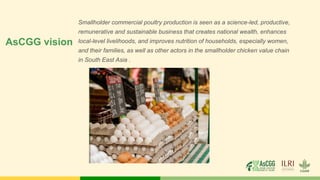
Smallholder commercial poultry production is seen as a science-led, productive,
remunerative and sustainable business that creates national wealth, enhances
local-level livelihoods, and improves nutrition of households, especially women,
and their families, as well as other actors in the smallholder chicken value chain
in South East Asia .
AsCGG vision
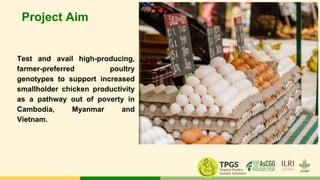
Project Aim
Test and avail high-producing,
farmer-preferred poultry
genotypes to support increased
smallholder chicken productivity
as a pathway out of poverty in
Cambodia, Myanmar and
Vietnam.
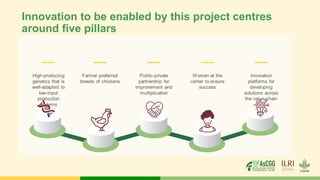
Innovation to be enabled by this project centres
around five pillars
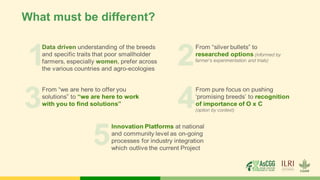
What must be different?
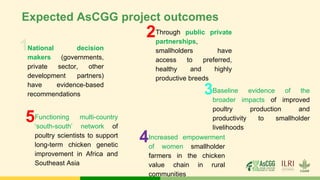
Expected AsCGG project outcomes
National decision
makers (governments,
private sector, other
development partners)
have evidence-based
recommendations
1
Through public private
partnerships,
smallholders have
access to preferred,
healthy and highly
productive breeds
2
Baseline evidence of the
broader impacts of improved
poultry production and
productivity to smallholder
livelihoods
Increased empowerment
of women smallholder
farmers in the chicken
value chain in rural
communities
4
Functioning multi-country
‘south-south’ network of
poultry scientists to support
long-term chicken genetic
improvement in Africa and
Southeast Asia
5
3
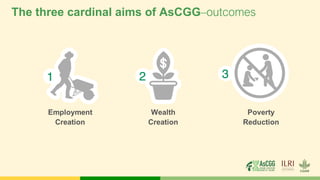
The three cardinal aims of AsCGG–outcomes
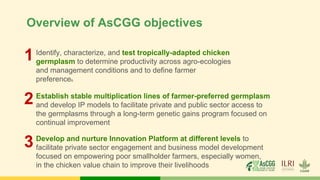
Overview of AsCGG objectives
Identify, characterize, and test tropically-adapted chicken
germplasm to determine productivity across agro-ecologies
and management conditions and to define farmer
preferences.
Establish stable multiplication lines of farmer-preferred germplasm
and develop IP models to facilitate private and public sector access to
the germplasms through a long-term genetic gains program focused on
continual improvement
Develop and nurture Innovation Platform at different levels to
facilitate private sector engagement and business model development
focused on empowering poor smallholder farmers, especially women,
in the chicken value chain to improve their livelihoods
1
2
3
Research Questions
1. What are the existing smallholder poultry production and marketing systems in Cambodia,
Myanmar and Vietnam?
2. What are the phenotypic and genetic characteristics of tropically adapted indigenous and
exotic poultry breeds most suited to village poultry production in Cambodia, Vietnam and
Myanmar?
3. What are farmer and consumer preferences for poultry traits and are there differences
between men and women?
4. How can key public and private inputs and services be organised/strengthened to facilitate
effective functioning of the smallholder poultry value chains?
5. What is the impact of foreign genetic importation on the diversity of indigenous chicken
populations, and how can the indigenous germplasm be conserved?
6. How can increased empowerment of women smallholder farmers in the chicken value chain
in rural communities be supported and encouraged?
Research activities
1. Understanding the knowledge base and the system, the animals
✓ Literature review on existing village poultry production and marketing systems in Cambodia, Myanmar
and Vietnam
✓ Baseline survey to define and characterize current smallholder chicken production systems, including
consumer demand for chicken in Cambodia, Myanmar and Vietnam
✓ Confirm and characterise promising indigenous breeds in Vietnam, Cambodia and Myanmar
2. Identifying, testing and setup long term genetic improvemet programs
✓ Design and implement indigenous breed improvement program (IBIP) in Cambodia
✓ Negotiate and access foreign Germplasm candidates - Myanmar and Vietnam
✓ On-farm comparative testing (Vietnam): Performance test preferred local poultry breeds
alongside the same number of imported indigenous breeds and examine the
profitability/acceptability to different value chain actors
✓ On-station comparative testing (Myanmar and Vietnam): Performance test preferred local poultry breeds
alongside same number of imported indigenous breeds under controlled conditions
✓ Evaluate the impact of foreign genetics on the diversity of indigenous chicken populations in Vietnam
Research activities (Cont…)
3. Capacity building
✓ Demonstrate and build the capacity of national partners to cryopreserve Primordial Germ
Cells (PCGs) of promising and endangered chicken ecotypes from Vietnam, Cambodia and
Myanmar
✓ Enhance the capacity of national agricultural research and development system on
smallholder poultry value chain development - Vietnam, Cambodia and Myanmar
4. Institutional building
✓ National innovation platform established in Cambodia (1) and Vietnam (1)Enhance the capacity of
national agricultural research and development system on smallholder poultry value chain development
Vietnam, Cambodia and Myanmar
✓ Community level Innovation Platforms established - Cambodia (2) and Vietnam (6)
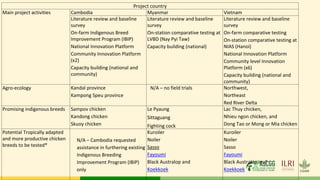
Project country
Main project activities Cambodia Myanmar Vietnam
Literature review and baseline
survey
On-farm Indigenous Breed
Improvement Program (IBIP)
National Innovation Platform
Community Innovation Platform
(x2)
Capacity building (national and
community)
Literature review and baseline
survey
On-station comparative testing at
LVBD (Nay Pyi Taw)
Capacity building (national)
Literature review and baseline
survey
On-farm comparative testing
On-station comparative testing at
NIAS (Hanoi)
National Innovation Platform
Community level Innovation
Platform (x6)
Capacity building (national and
community)
Agro-ecology Kandal province
Kampong Speu province
N/A – no field trials Northwest,
Northeast
Red River Delta
Promising indigenous breeds Sampov chicken
Kandong chicken
Skuoy chicken
Le Pyaung
Sittaguang
Fighting cock
Lac Thuy chicken,
Nhieu ngon chicken, and
Dong Tao or Mong or Mia chicken
Potential Tropically adapted
and more productive chicken
breeds to be tested*
N/A – Cambodia requested
assistance in furthering existing
Indigenous Breeding
Improvement Program (IBIP)
only
Kuroiler
Noiler
Sasso
Fayoumi
Black Australop and
Koekkoek
Kuroiler
Noiler
Sasso
Fayoumi
Black Australop and
Koekkoek
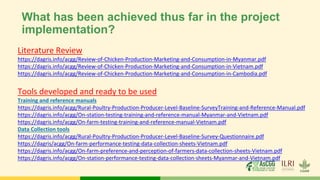
What has been achieved thus far in the project
implementation?
Literature Review
https://dagris.info/acgg/Review-of-Chicken-Production-Marketing-and-Consumption-in-Myanmar.pdf
https://dagris.info/acgg/Review-of-Chicken-Production-Marketing-and-Consumption-in-Vietnam.pdf
https://dagris.info/acgg/Review-of-Chicken-Production-Marketing-and-Consumption-in-Cambodia.pdf
Tools developed and ready to be used
Training and reference manuals
https://dagris.info/acgg/Rural-Poultry-Production-Producer-Level-Baseline-SurveyTraining-and-Reference-Manual.pdf
https://dagris.info/acgg/On-station-testing-training-and-reference-manual-Myanmar-and-Vietnam.pdf
https://dagris.info/acgg/On-farm-testing-training-and-reference-manual-Vietnam.pdf
Data Collection tools
https://dagris.info/acgg/Rural-Poultry-Production-Producer-Level-Baseline-Survey-Questionnaire.pdf
https://dagris/acgg/On-farm-performance-testing-data-collection-sheets-Vietnam.pdf
https://dagris.info/acgg/On-farm-preference-and-perception-of-farmers-data-collection-sheets-Vietnam.pdf
https://dagris.info/acgg/On-station-performance-testing-data-collection-sheets-Myanmar-and-Vietnam.pdf
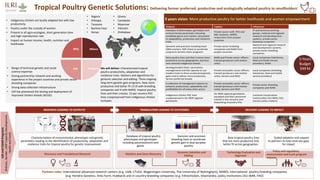
Tropical Poultry Genetic Solutions: Delivering farmer preferred, productive and ecologically adapted poultry to smallholders’
Products
Why Where
ILRI
ILRI
and
CGIAR
Programs
(Policies,
Gender,
LiMP
Capacity
Development,
Health
and
Feed)
• Indigenous chicken are locally adapted but with low
productivity
• Poultry under the custody of women
• Present in all agro-ecologies, short generation time
and high reproduction rate
• Impact on human income, health, nutrition and
livelihoods
• Range of technical genetic and social
science expertise
• Strong partnership network and working
experience in the project countries and private sector
breeding companies
• Strong data collection infrastructure
• ILRI has pioneered the testing and deployment of
improved chicken breeds (ACGG)
We will deliver: Characterized tropical
poultry productivity, adaptation and
resilience traits. Markers and algorithms for
genomic selection and editing. Three ongoing
long-term genetic gain programs. New more
productive and better fit 13 (9 with breeding
companies and 4 with NARS) tropical poultry
lines and their crosses. 15 per country PGC
lines cryopreserved from indigenous chicken
ecotypes
5 years vision: More productive poultry for better livelihoods and women empowerment
• Nigeria
• Ethiopia
• Tanzania
• Burkina Faso
• Kenya
• Ghana
• Cambodia
• Myanmar
• Vietnam
• Zimbabwe
RESEARCH LEADING TO OUTPUTS DELIVERY LEADING TO IMPACT
TRANSLATION LEADING TO OUTCOMES
Characterization of environmental, phenotypic and genetic
parameters leading to the identification of productivity, adaptation and
resilience traits for tropical poultry for genetic improvement
Discovery and Translational Research
Database of tropical poultry
phenotypes and genotypes
including polymorphisms and
genes
Genomic and precision
breeding tools to accelerate
genetic gain in dual purpose
poultry
Markers and Gene Discovery
Genomic Selection and
Editing
New tropical poultry lines
that are more productive and
better fit across geographies
Scaled adoption and support
to partners to help close key gaps
for impact
Technology Evaluation and
Approval
Policy and regulatory
environment and track program
impacts
Partners roles: International advanced research centers (e.g. UoN, CTLGH, Wageningen University, The University of Nottingham), NARES; international poultry breeding companies
(e.g. Hendrix Genetics. Amo Farm, Hubbard) and in-country breeding companies (e.g. Ethiochicken, Silverlands), policy institutions (AU-IBAR, FAO)
5-Years
Budget
$49 M
Outputs CapDev Influences
Database of phenotypes, genotypes and
environmental parameters including
candidate genes and markers associated
to adaptability, production and resilience
traits
Private sector staff, PhD and
MSc students, NARES
researchers from project
countries
IP and technical working
groups, national and regional
research and development
systems, private sector
breeding companies
Genomic and precision breeding tools
(DNA markers, SNP chips) to accelerate
Long term Genetic Gains programs
Private sector breeding
companies and NARS from
project countries
National and regional research
and development systems,
private sector breeding
companies
Nine poultry lines and their crosses more
productive across geographies, and four
new selected indigenous breeds
NARS and Private sector officers
trained (producers and mother
units)
Local companies (hatcheries,
feed and health service
providers), NARS
Strategy/toolkit (feed, vaccination,
management) and the capacity to use
modern tools to drive accelerated genetic
gains and to deliver more productive,
farmer-preferred breeds
Private and public sector officers
trained (producers and mother
units), farmers and NGO
Local companies (breeding,
hatcheries, feed and health
service providers)
A collection of management options to
enhance productivity, adaptability and
profitability for all value chain actors
Private and public sector officers
trained (producers and mother
units), farmers and NGO
Private sector breeding
companies and NARS
Indigenous chicken PGC lines
cryopreserved in AU-IBAR regional
genebanks
AU-IBAR regional genebanks
equipped and their personnel
trained in the recovery and
biobanking of poultry PGC
Livestock Conservation
Communities (AU-IBAR, FAO,
country policy-makers)
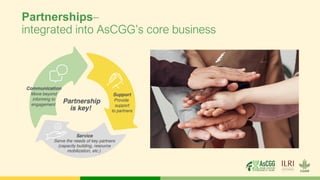
Partnerships–
integrated into AsCGG’s core business
Partnering in project implementation
Thank you
Kyay Zu
Saum arkoun
Cảm ơn

Asian Chicken Genetic Gains (AsCGG): A platform for exploring, testing and delivering improved chickens for enhanced livelihood outcomes in South EastAsia

  • 1.
    Better lives throughlivestock Tadele Dessie, PI AsCGG LiveGene Program, ILRI – Addis Ababa AsCGG Project Virtual Launch , May 24 and 25 2021 Asian Chicken Genetic Gains (AsCGG): A platform for exploring, testing and delivering improved chickens for enhanced livelihood outcomes in South East Asia (SEA)
  • 2.
    Summary of theFindings from the ACGG Program 1 3 2 Productivity Gain Nutrition Gain Economic Gain 4 Functional Innovation Platforms
  • 3.
    Productivity Gain: ✓ Increasein production and productivity level from indigenous to tropically adapted and more productive chicken breeds 200-300% in body weight 100-160% in egg production ✓ SL Tanzania, AKM G Tanzania, Amo Farms in Nigeria and Ethiochicken in Ethiopia
  • 4.
    Farmer preferred breed(s) Chicken’s high rate of reproduction enables rapid scale - distribution could begin after 6 months 6 12 Phase 2 Months 18 24 30 Size of multiplier flock 100* 1,970 38,800 765,000 Millions 100 Number of smallholders benefited 7,300 145,000 millions More millions No chick distribution Limited distribution (5-10%) Full dissemination This model can be implemented simultaneously in multiple geographies. ✓ SL Tanzania, AKM G Tanzania, Amo Farms in Nigeria and Ethiochicken in Ethiopia
  • 5.
    How and WhyAsCGG? ✓ Interest of researchers and development partners in South East Asia - expressed interest in learning from the experiences of ACGG. ✓ ACGG team from ILRI organized a scoping visit (in April 2019) - Met with researchers, development practitioners, private sector operators, met with smallholder farmers - Tried to understand the policy and strategy environment in the countries - Tried to understand the aspirations of the farmers, private sector operators - Developed and submit a compressive report of the scoping visit to ACIAR and ILRI
  • 6.
    Smallholder Chicken Productionsystem in SEA Small holder chicken production is part of the socio- cultural make up and “balanced” farming system in South East Asia Characterized as: Low input-output system Dominated by low-producing chicken genotypes 1 Poultry is owned and managed by household women; income from the sub-sector managed by women 2 Lack of effective long-term genetic improvement, multiplication and delivery systems 3
  • 7.
    High potential for women’s empowerment Chickenproduction expanded by 56% in the last decade, growing from 5.9 mmt to 9.2 mmt in 2018, and is expected to reach 12.3 mmt by 2028 Egg and chicken meat are often the highest value agricultural product globally High potential for contributing to demand, income, dietary diversity at HH level and globally Low-input-output system but with high potential for improved productivity across a range of systems Pathway out of poverty and equitable improvement of livelihoods Income Employment Nutrition 7 Opportunity–smallholder chicken production system in SEA
  • 8.
    Smallholder commercial poultryproduction is seen as a science-led, productive, remunerative and sustainable business that creates national wealth, enhances local-level livelihoods, and improves nutrition of households, especially women, and their families, as well as other actors in the smallholder chicken value chain in South East Asia . AsCGG vision
  • 9.
    Project Aim Test andavail high-producing, farmer-preferred poultry genotypes to support increased smallholder chicken productivity as a pathway out of poverty in Cambodia, Myanmar and Vietnam.
  • 10.
    Innovation to beenabled by this project centres around five pillars
  • 11.
    What must bedifferent?
  • 12.
    Expected AsCGG projectoutcomes National decision makers (governments, private sector, other development partners) have evidence-based recommendations 1 Through public private partnerships, smallholders have access to preferred, healthy and highly productive breeds 2 Baseline evidence of the broader impacts of improved poultry production and productivity to smallholder livelihoods Increased empowerment of women smallholder farmers in the chicken value chain in rural communities 4 Functioning multi-country ‘south-south’ network of poultry scientists to support long-term chicken genetic improvement in Africa and Southeast Asia 5 3
  • 13.
    The three cardinalaims of AsCGG–outcomes
  • 14.
    Overview of AsCGGobjectives Identify, characterize, and test tropically-adapted chicken germplasm to determine productivity across agro-ecologies and management conditions and to define farmer preferences. Establish stable multiplication lines of farmer-preferred germplasm and develop IP models to facilitate private and public sector access to the germplasms through a long-term genetic gains program focused on continual improvement Develop and nurture Innovation Platform at different levels to facilitate private sector engagement and business model development focused on empowering poor smallholder farmers, especially women, in the chicken value chain to improve their livelihoods 1 2 3
  • 15.
    Research Questions 1. Whatare the existing smallholder poultry production and marketing systems in Cambodia, Myanmar and Vietnam? 2. What are the phenotypic and genetic characteristics of tropically adapted indigenous and exotic poultry breeds most suited to village poultry production in Cambodia, Vietnam and Myanmar? 3. What are farmer and consumer preferences for poultry traits and are there differences between men and women? 4. How can key public and private inputs and services be organised/strengthened to facilitate effective functioning of the smallholder poultry value chains? 5. What is the impact of foreign genetic importation on the diversity of indigenous chicken populations, and how can the indigenous germplasm be conserved? 6. How can increased empowerment of women smallholder farmers in the chicken value chain in rural communities be supported and encouraged?
  • 16.
    Research activities 1. Understandingthe knowledge base and the system, the animals ✓ Literature review on existing village poultry production and marketing systems in Cambodia, Myanmar and Vietnam ✓ Baseline survey to define and characterize current smallholder chicken production systems, including consumer demand for chicken in Cambodia, Myanmar and Vietnam ✓ Confirm and characterise promising indigenous breeds in Vietnam, Cambodia and Myanmar 2. Identifying, testing and setup long term genetic improvemet programs ✓ Design and implement indigenous breed improvement program (IBIP) in Cambodia ✓ Negotiate and access foreign Germplasm candidates - Myanmar and Vietnam ✓ On-farm comparative testing (Vietnam): Performance test preferred local poultry breeds alongside the same number of imported indigenous breeds and examine the profitability/acceptability to different value chain actors ✓ On-station comparative testing (Myanmar and Vietnam): Performance test preferred local poultry breeds alongside same number of imported indigenous breeds under controlled conditions ✓ Evaluate the impact of foreign genetics on the diversity of indigenous chicken populations in Vietnam
  • 17.
    Research activities (Cont…) 3.Capacity building ✓ Demonstrate and build the capacity of national partners to cryopreserve Primordial Germ Cells (PCGs) of promising and endangered chicken ecotypes from Vietnam, Cambodia and Myanmar ✓ Enhance the capacity of national agricultural research and development system on smallholder poultry value chain development - Vietnam, Cambodia and Myanmar 4. Institutional building ✓ National innovation platform established in Cambodia (1) and Vietnam (1)Enhance the capacity of national agricultural research and development system on smallholder poultry value chain development Vietnam, Cambodia and Myanmar ✓ Community level Innovation Platforms established - Cambodia (2) and Vietnam (6)
  • 18.
    Project country Main projectactivities Cambodia Myanmar Vietnam Literature review and baseline survey On-farm Indigenous Breed Improvement Program (IBIP) National Innovation Platform Community Innovation Platform (x2) Capacity building (national and community) Literature review and baseline survey On-station comparative testing at LVBD (Nay Pyi Taw) Capacity building (national) Literature review and baseline survey On-farm comparative testing On-station comparative testing at NIAS (Hanoi) National Innovation Platform Community level Innovation Platform (x6) Capacity building (national and community) Agro-ecology Kandal province Kampong Speu province N/A – no field trials Northwest, Northeast Red River Delta Promising indigenous breeds Sampov chicken Kandong chicken Skuoy chicken Le Pyaung Sittaguang Fighting cock Lac Thuy chicken, Nhieu ngon chicken, and Dong Tao or Mong or Mia chicken Potential Tropically adapted and more productive chicken breeds to be tested* N/A – Cambodia requested assistance in furthering existing Indigenous Breeding Improvement Program (IBIP) only Kuroiler Noiler Sasso Fayoumi Black Australop and Koekkoek Kuroiler Noiler Sasso Fayoumi Black Australop and Koekkoek
  • 19.
    What has beenachieved thus far in the project implementation? Literature Review https://dagris.info/acgg/Review-of-Chicken-Production-Marketing-and-Consumption-in-Myanmar.pdf https://dagris.info/acgg/Review-of-Chicken-Production-Marketing-and-Consumption-in-Vietnam.pdf https://dagris.info/acgg/Review-of-Chicken-Production-Marketing-and-Consumption-in-Cambodia.pdf Tools developed and ready to be used Training and reference manuals https://dagris.info/acgg/Rural-Poultry-Production-Producer-Level-Baseline-SurveyTraining-and-Reference-Manual.pdf https://dagris.info/acgg/On-station-testing-training-and-reference-manual-Myanmar-and-Vietnam.pdf https://dagris.info/acgg/On-farm-testing-training-and-reference-manual-Vietnam.pdf Data Collection tools https://dagris.info/acgg/Rural-Poultry-Production-Producer-Level-Baseline-Survey-Questionnaire.pdf https://dagris/acgg/On-farm-performance-testing-data-collection-sheets-Vietnam.pdf https://dagris.info/acgg/On-farm-preference-and-perception-of-farmers-data-collection-sheets-Vietnam.pdf https://dagris.info/acgg/On-station-performance-testing-data-collection-sheets-Myanmar-and-Vietnam.pdf
  • 21.
    Tropical Poultry GeneticSolutions: Delivering farmer preferred, productive and ecologically adapted poultry to smallholders’ Products Why Where ILRI ILRI and CGIAR Programs (Policies, Gender, LiMP Capacity Development, Health and Feed) • Indigenous chicken are locally adapted but with low productivity • Poultry under the custody of women • Present in all agro-ecologies, short generation time and high reproduction rate • Impact on human income, health, nutrition and livelihoods • Range of technical genetic and social science expertise • Strong partnership network and working experience in the project countries and private sector breeding companies • Strong data collection infrastructure • ILRI has pioneered the testing and deployment of improved chicken breeds (ACGG) We will deliver: Characterized tropical poultry productivity, adaptation and resilience traits. Markers and algorithms for genomic selection and editing. Three ongoing long-term genetic gain programs. New more productive and better fit 13 (9 with breeding companies and 4 with NARS) tropical poultry lines and their crosses. 15 per country PGC lines cryopreserved from indigenous chicken ecotypes 5 years vision: More productive poultry for better livelihoods and women empowerment • Nigeria • Ethiopia • Tanzania • Burkina Faso • Kenya • Ghana • Cambodia • Myanmar • Vietnam • Zimbabwe RESEARCH LEADING TO OUTPUTS DELIVERY LEADING TO IMPACT TRANSLATION LEADING TO OUTCOMES Characterization of environmental, phenotypic and genetic parameters leading to the identification of productivity, adaptation and resilience traits for tropical poultry for genetic improvement Discovery and Translational Research Database of tropical poultry phenotypes and genotypes including polymorphisms and genes Genomic and precision breeding tools to accelerate genetic gain in dual purpose poultry Markers and Gene Discovery Genomic Selection and Editing New tropical poultry lines that are more productive and better fit across geographies Scaled adoption and support to partners to help close key gaps for impact Technology Evaluation and Approval Policy and regulatory environment and track program impacts Partners roles: International advanced research centers (e.g. UoN, CTLGH, Wageningen University, The University of Nottingham), NARES; international poultry breeding companies (e.g. Hendrix Genetics. Amo Farm, Hubbard) and in-country breeding companies (e.g. Ethiochicken, Silverlands), policy institutions (AU-IBAR, FAO) 5-Years Budget $49 M Outputs CapDev Influences Database of phenotypes, genotypes and environmental parameters including candidate genes and markers associated to adaptability, production and resilience traits Private sector staff, PhD and MSc students, NARES researchers from project countries IP and technical working groups, national and regional research and development systems, private sector breeding companies Genomic and precision breeding tools (DNA markers, SNP chips) to accelerate Long term Genetic Gains programs Private sector breeding companies and NARS from project countries National and regional research and development systems, private sector breeding companies Nine poultry lines and their crosses more productive across geographies, and four new selected indigenous breeds NARS and Private sector officers trained (producers and mother units) Local companies (hatcheries, feed and health service providers), NARS Strategy/toolkit (feed, vaccination, management) and the capacity to use modern tools to drive accelerated genetic gains and to deliver more productive, farmer-preferred breeds Private and public sector officers trained (producers and mother units), farmers and NGO Local companies (breeding, hatcheries, feed and health service providers) A collection of management options to enhance productivity, adaptability and profitability for all value chain actors Private and public sector officers trained (producers and mother units), farmers and NGO Private sector breeding companies and NARS Indigenous chicken PGC lines cryopreserved in AU-IBAR regional genebanks AU-IBAR regional genebanks equipped and their personnel trained in the recovery and biobanking of poultry PGC Livestock Conservation Communities (AU-IBAR, FAO, country policy-makers)
  • 22.
  • 23.
    Partnering in projectimplementation
  • 24.
    Thank you Kyay Zu Saumarkoun Cảm ơn