



Multiple Alignment
Outline
1. Introduction to Multiple Alignment
2. Progressive Alignment
3. Scoring Multiple Alignments
4. Partial Order Alignment
5. A-Bruijn Approach to Multiple Alignment
Section 1:
Introduction to Multiple
Alignment
Multiple Sequence Alignment (MSA)
• Up until now we have only
tried to align two sequences.
Multiple Sequence Alignment (MSA)
• Up until now we have only
tried to align two sequences.
• What about aligning more
than two sequences?
Multiple Sequence Alignment (MSA)
• Up until now we have only
tried to align two sequences.
• What about aligning more
than two sequences?
• A faint similarity between
two sequences becomes
significant if it is present in
many other sequences.
Multiple Sequence Alignment (MSA)
• Up until now we have only
tried to align two sequences.
• What about aligning more
than two sequences?
• A faint similarity between
two sequences becomes
significant if it is present in
many other sequences.
• Therefore multiple
alignments can reveal subtle
similarities that pairwise
alignments do not reveal.
Generalizing Pairwise to Multiple Alignment
• Alignment of 2 sequences is represented as a 2-row matrix.
• In a similar way, we represent alignment of 3 sequences as a
3-row matrix
• Example:
A T - G C G -
A - C G T - A
A T C A C - A
• Our scoring function should score alignments with conserved
columns higher.
A A T -- C
A -- T G C
-- A T G C
Alignments = Paths in 3-Space
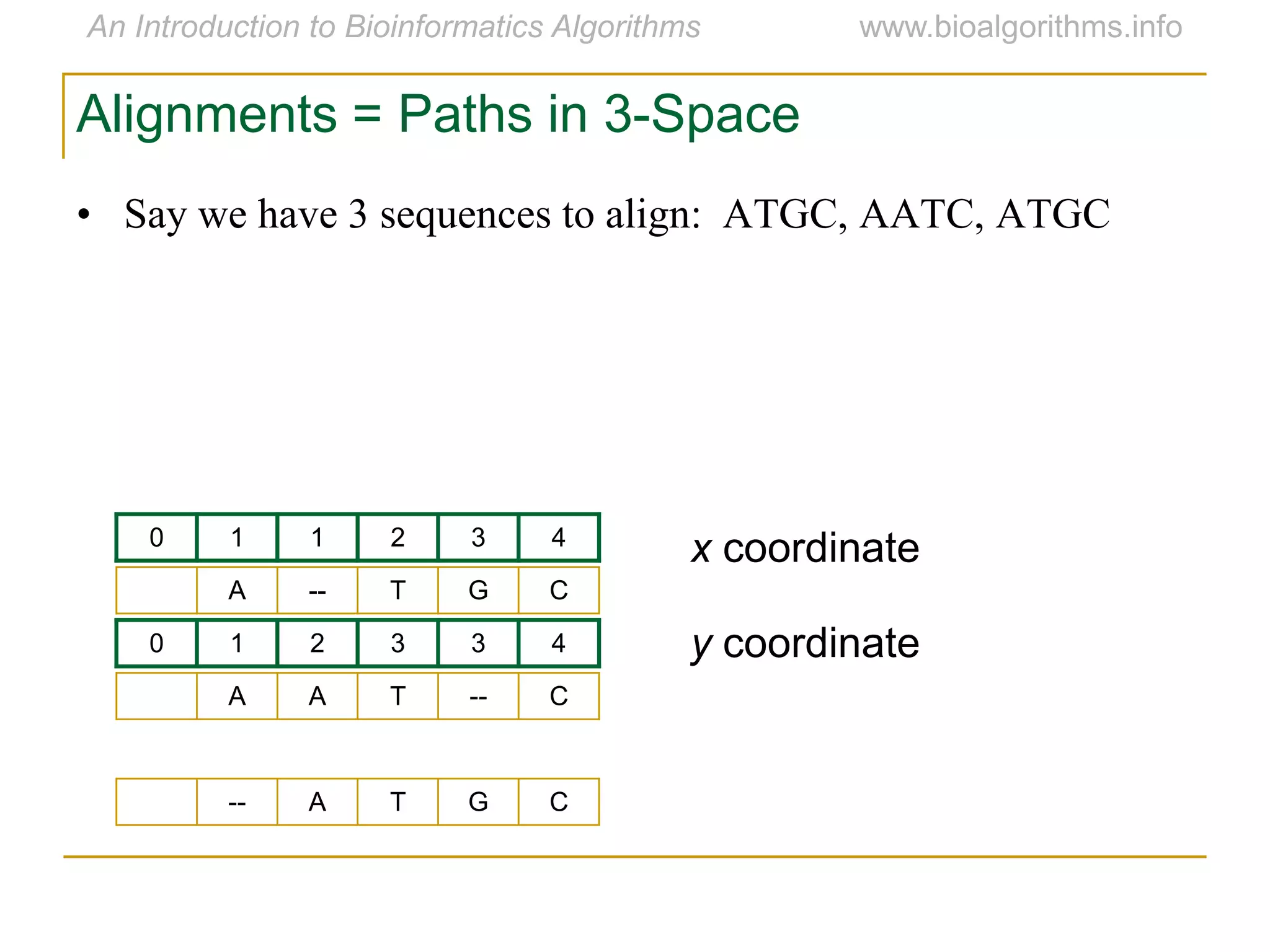
• Say we have 3 sequences to align: ATGC, AATC, ATGC
0 1 1 2 3 4
A A T -- C
A -- T G C
-- A T G C
x coordinate
Alignments = Paths in 3-Space
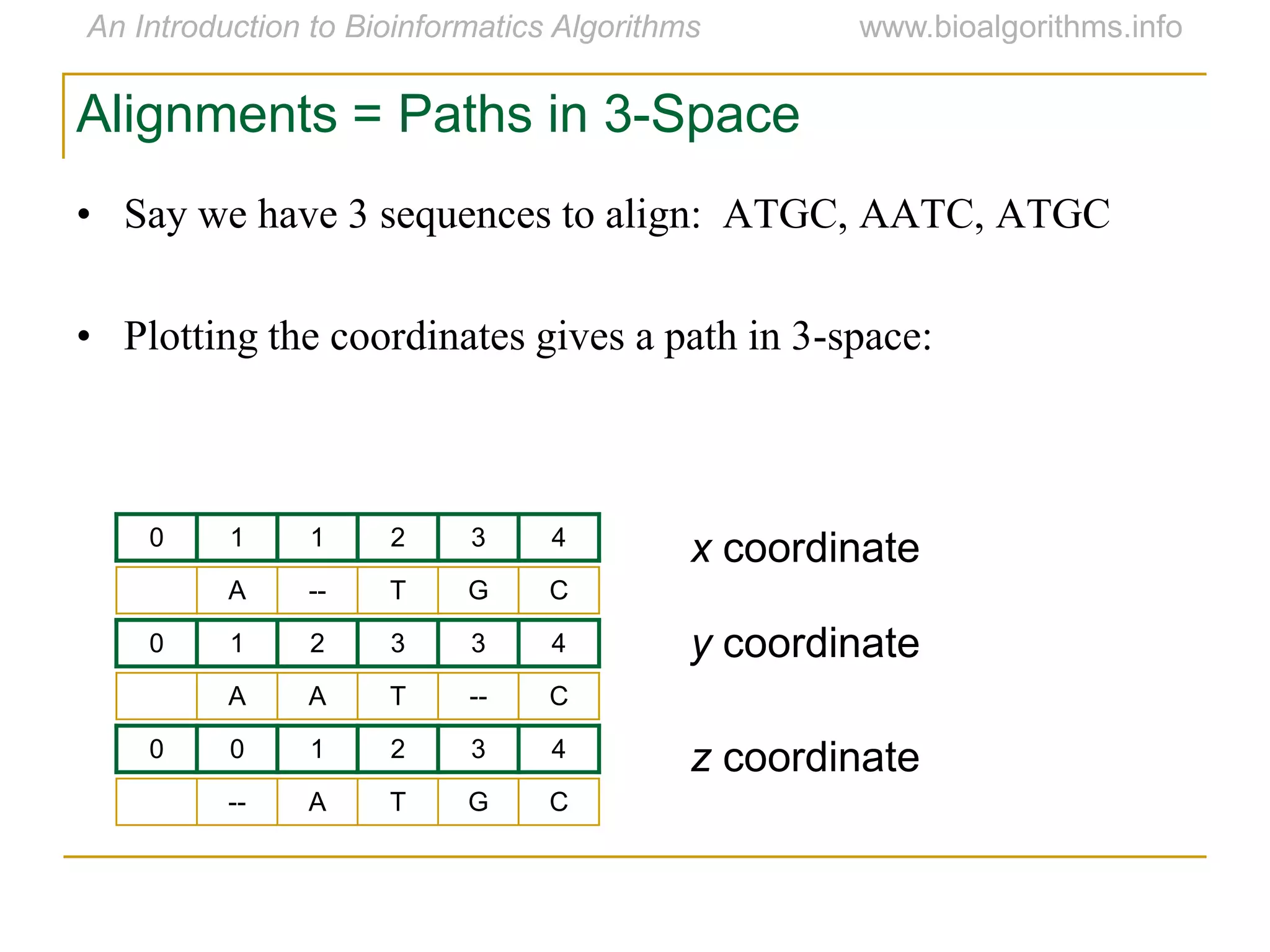
• Say we have 3 sequences to align: ATGC, AATC, ATGC
0 1 1 2 3 4
0 1 2 3 3 4
A A T -- C
A -- T G C
-- A T G C
y coordinate
Alignments = Paths in 3-Space
• Say we have 3 sequences to align: ATGC, AATC, ATGC
x coordinate
0 1 1 2 3 4
0 1 2 3 3 4
A A T -- C
A -- T G C
0 0 1 2 3 4
-- A T G C
x coordinate
y coordinate
z coordinate
Alignments = Paths in 3-Space
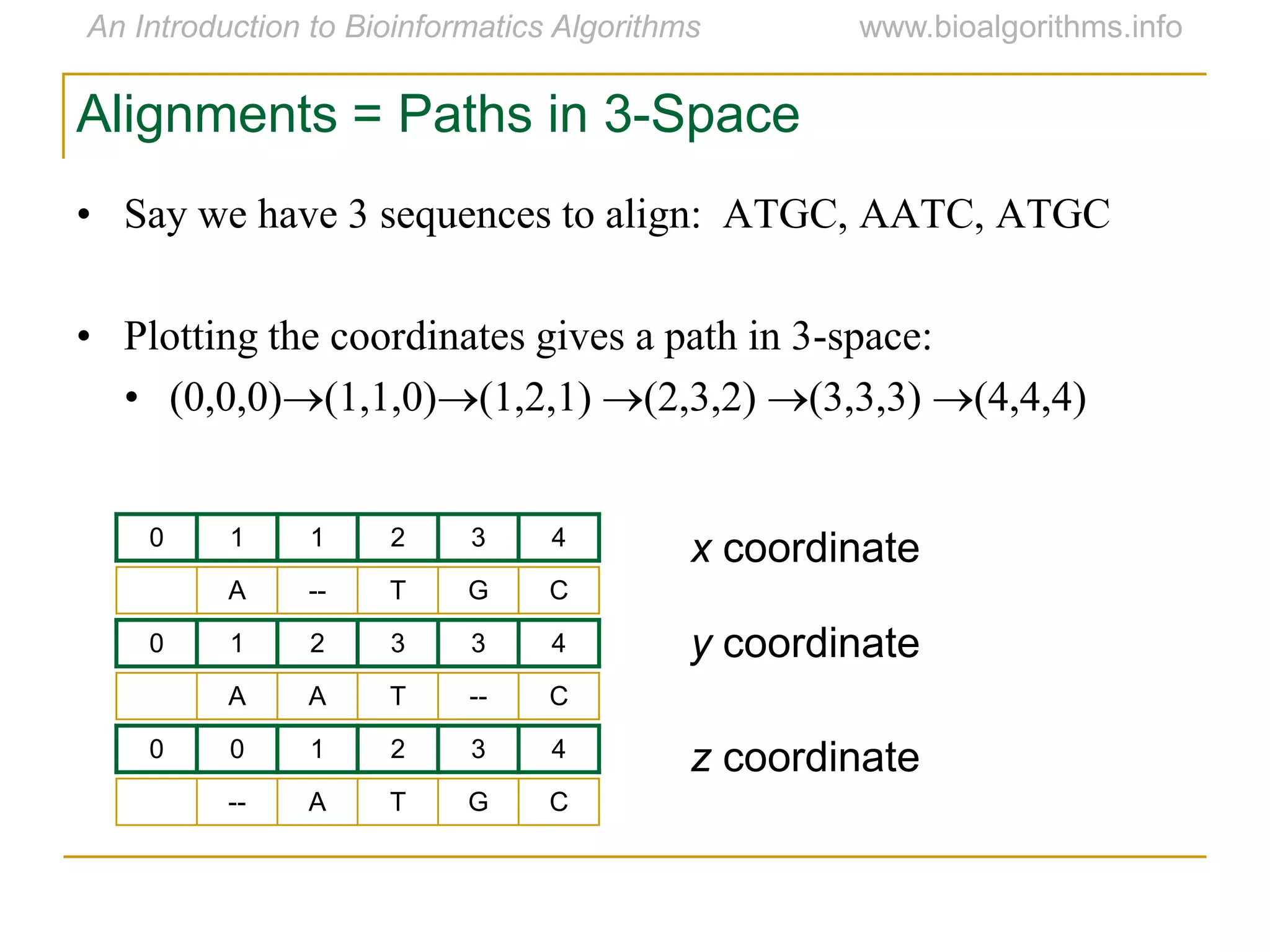
• Say we have 3 sequences to align: ATGC, AATC, ATGC
• Plotting the coordinates gives a path in 3-space:
0 1 1 2 3 4
0 1 2 3 3 4
A A T -- C
A -- T G C
0 0 1 2 3 4
-- A T G C
x coordinate
y coordinate
z coordinate
Alignments = Paths in 3-Space
• Say we have 3 sequences to align: ATGC, AATC, ATGC
• Plotting the coordinates gives a path in 3-space:
• (0,0,0)(1,1,0)(1,2,1) (2,3,2) (3,3,3) (4,4,4)
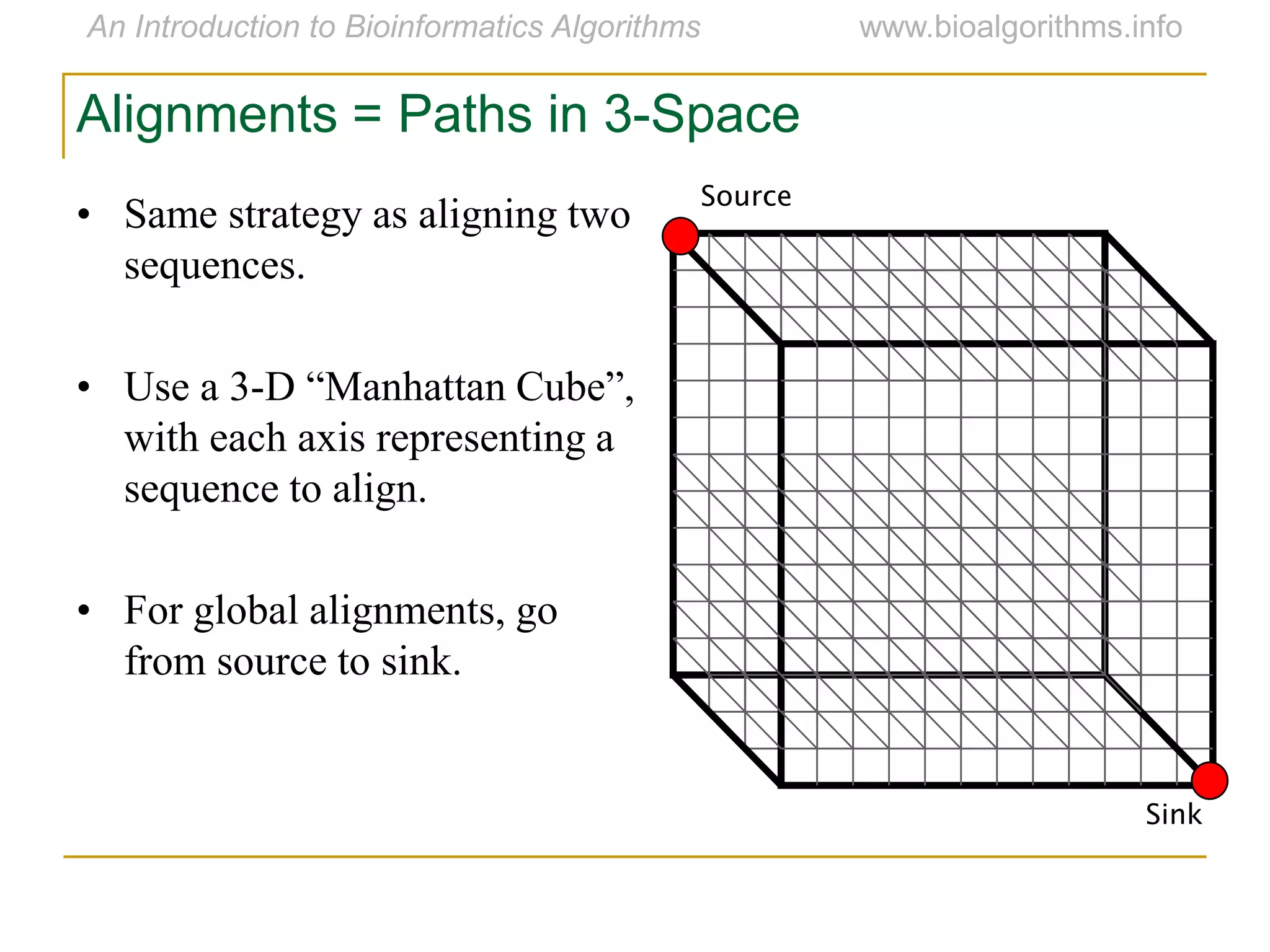
Source
Sink
Alignments = Paths in 3-Space
• Same strategy as aligning two
sequences.
• Use a 3-D “Manhattan Cube”,
with each axis representing a
sequence to align.
• For global alignments, go
from source to sink.
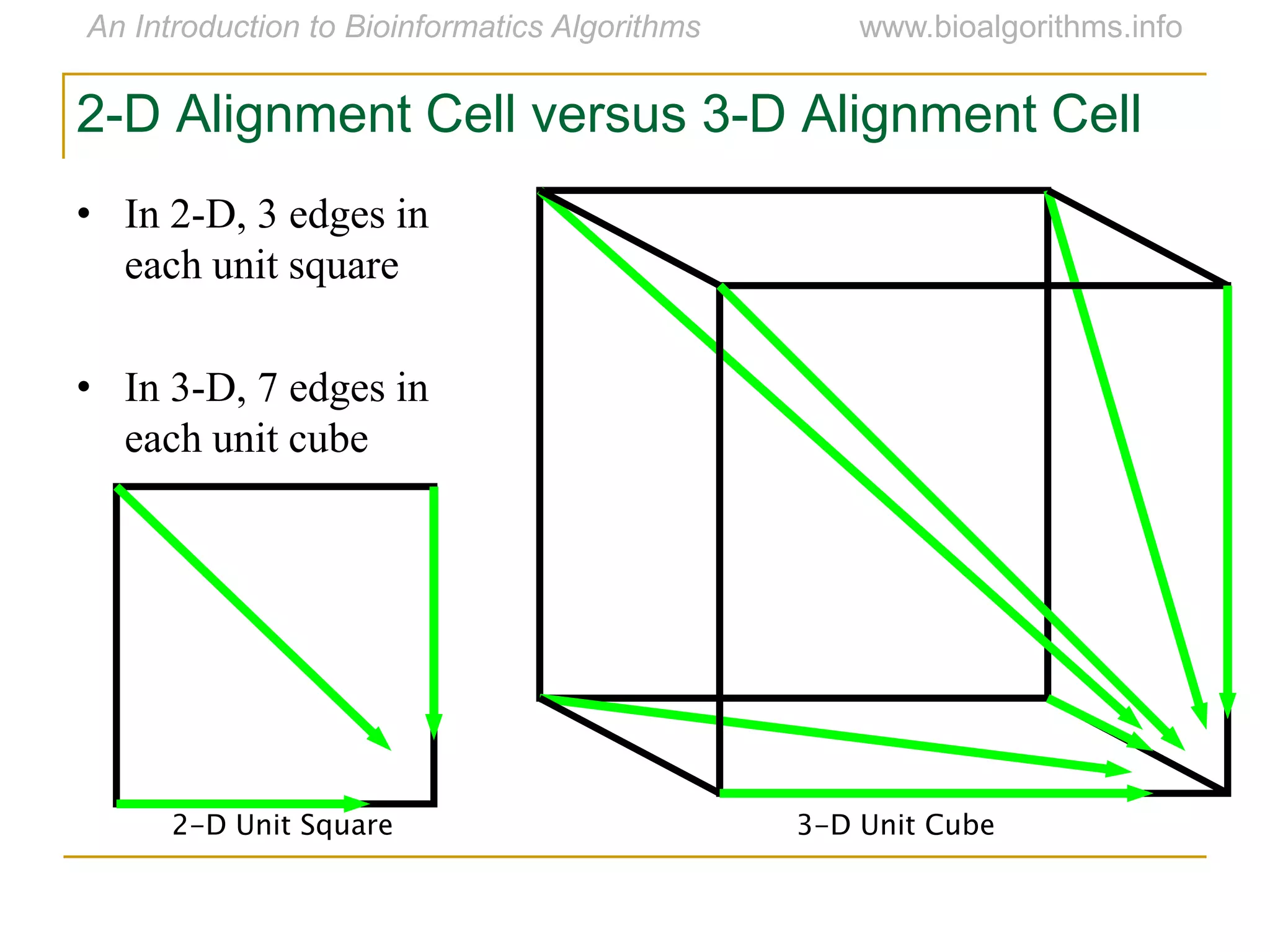
2-D Alignment Cell versus 3-D Alignment Cell
• In 2-D, 3 edges in
each unit square
• In 3-D, 7 edges in
each unit cube
3-D Unit Cube2-D Unit Square
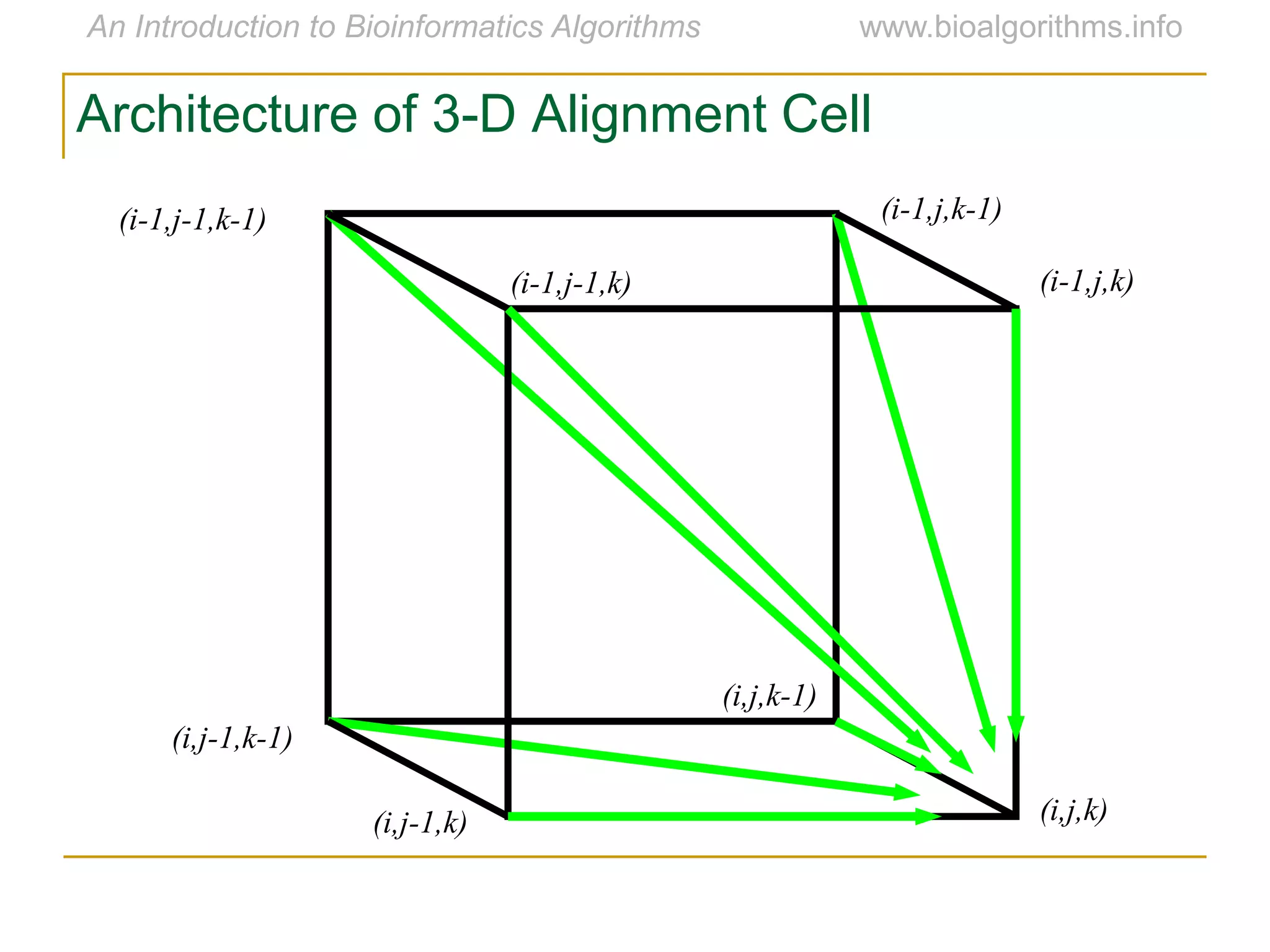
(i-1,j-1,k-1)
(i,j-1,k-1)
(i,j-1,k)
(i-1,j-1,k) (i-1,j,k)
(i,j,k)
(i-1,j,k-1)
(i,j,k-1)
Architecture of 3-D Alignment Cell
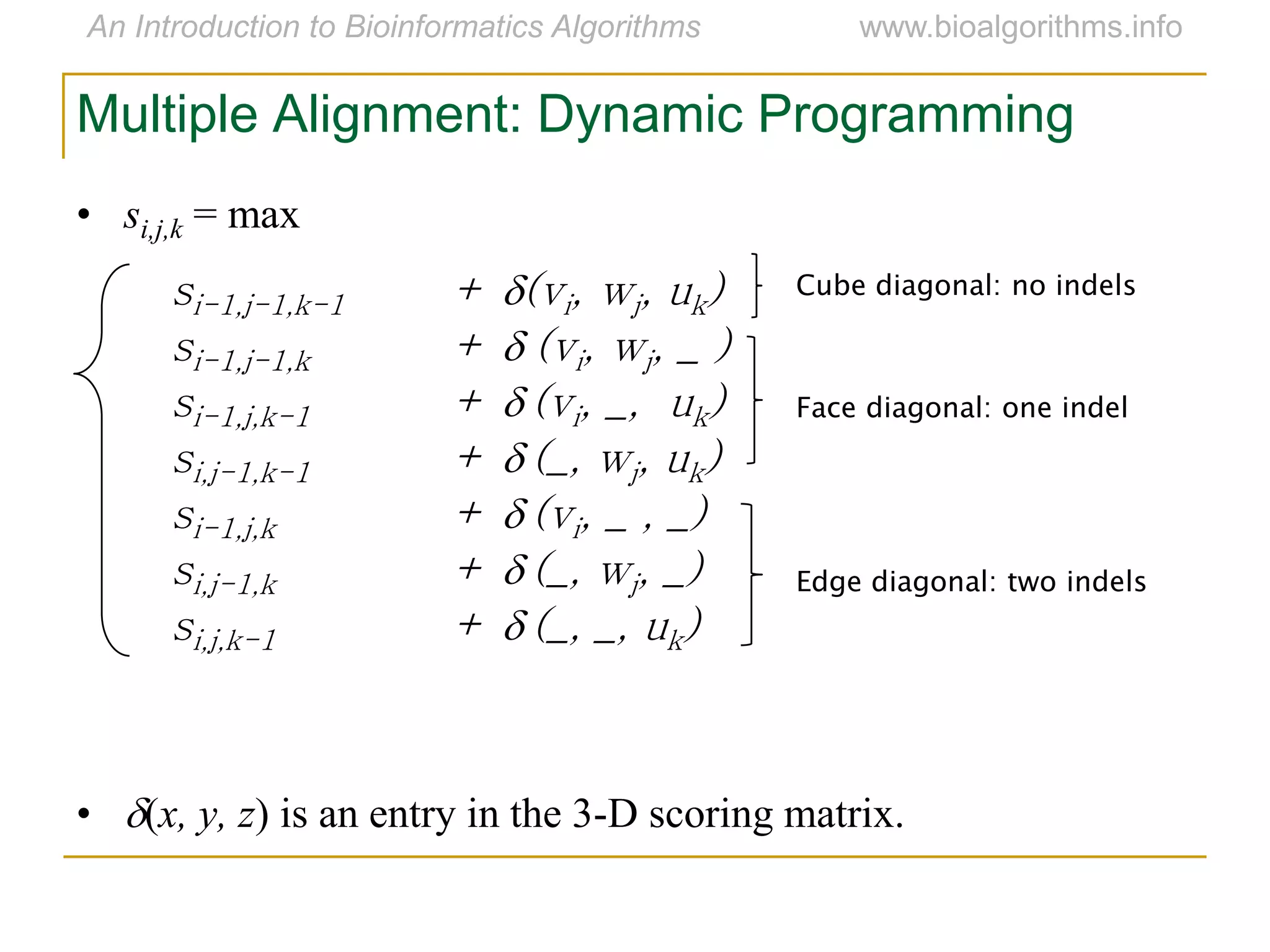
• si,j,k = max
• (x, y, z) is an entry in the 3-D scoring matrix.
Cube diagonal: no indels
Face diagonal: one indel
Edge diagonal: two indels
Multiple Alignment: Dynamic Programming
si-1,j-1,k-1 + (vi, wj, uk)
si-1,j-1,k +  (vi, wj, _ )
si-1,j,k-1 +  (vi, _, uk)
si,j-1,k-1 +  (_, wj, uk)
si-1,j,k +  (vi, _ , _)
si,j-1,k +  (_, wj, _)
si,j,k-1 +  (_, _, uk)
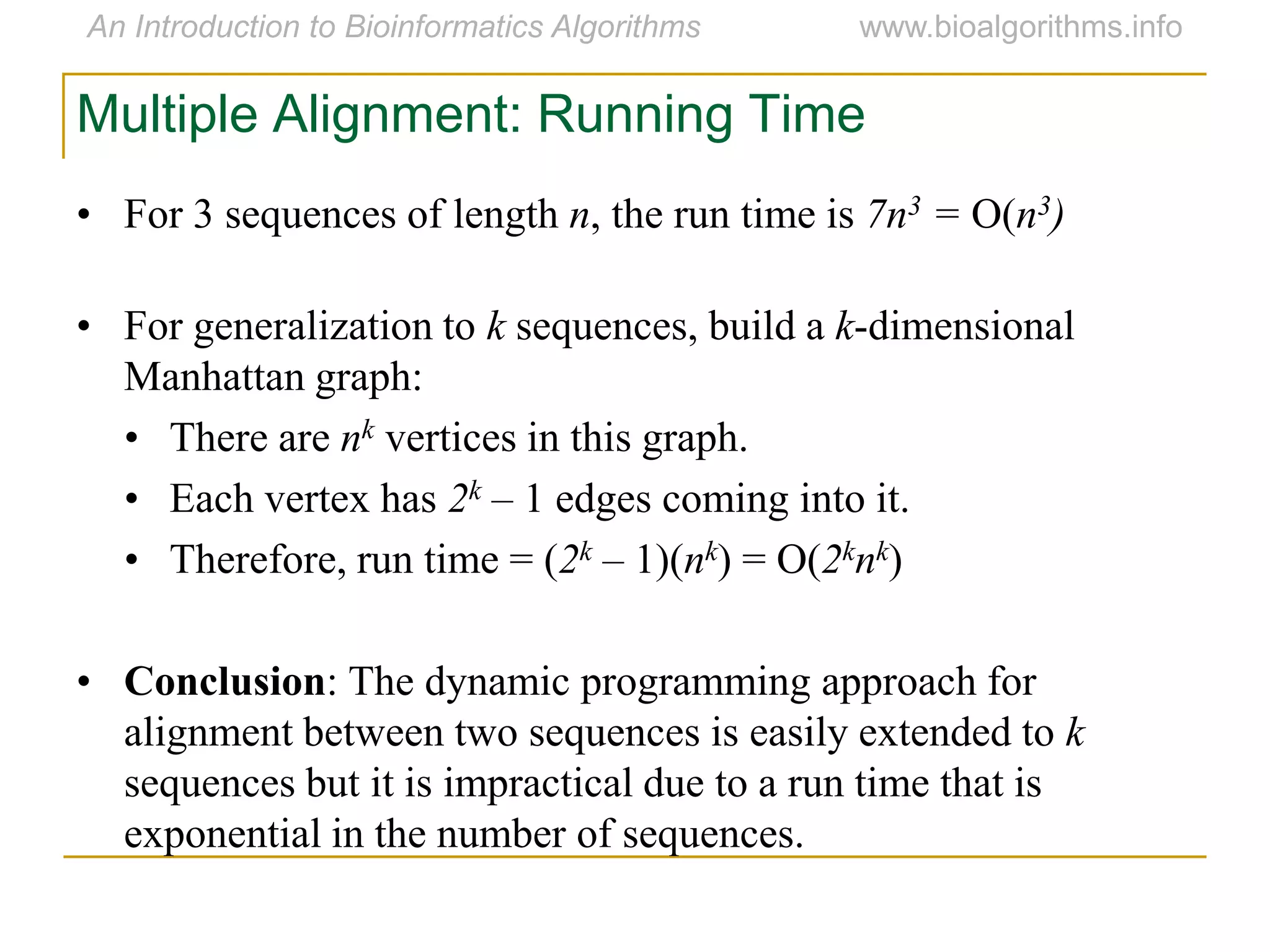
Multiple Alignment: Running Time
• For 3 sequences of length n, the run time is 7n3 = O(n3)
• For generalization to k sequences, build a k-dimensional
Manhattan graph:
• There are nk vertices in this graph.
• Each vertex has 2k – 1 edges coming into it.
• Therefore, run time = (2k – 1)(nk) = O(2knk)
• Conclusion: The dynamic programming approach for
alignment between two sequences is easily extended to k
sequences but it is impractical due to a run time that is
exponential in the number of sequences.
Multiple Alignment Induces Pairwise
Alignments
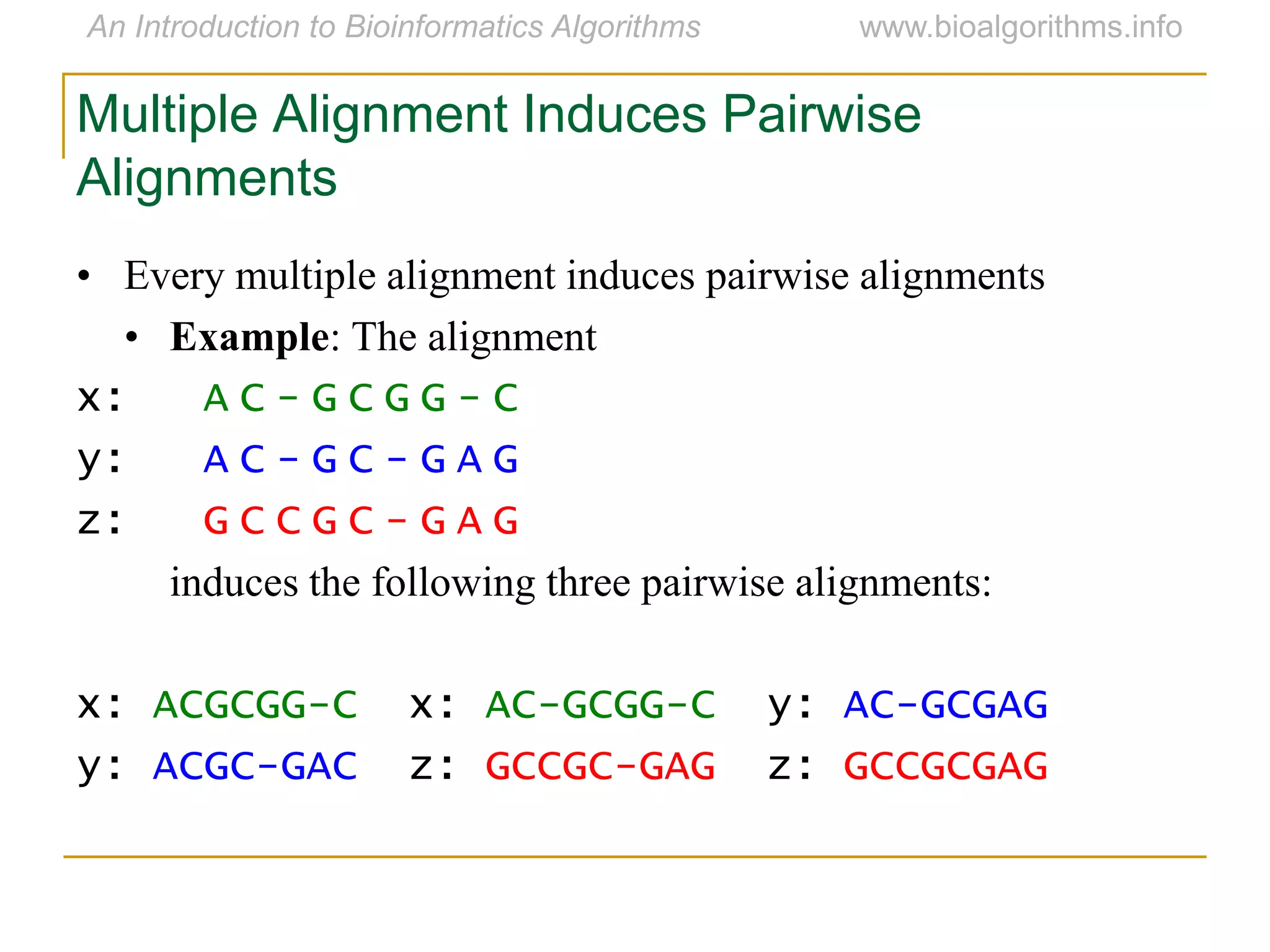
• Every multiple alignment induces pairwise alignments
• Example: The alignment
x: A C - G C G G - C
y: A C - G C - G A G
z: G C C G C - G A G
induces the following three pairwise alignments:
x: ACGCGG-C x: AC-GCGG-C y: AC-GCGAG
y: ACGC-GAC z: GCCGC-GAG z: GCCGCGAG
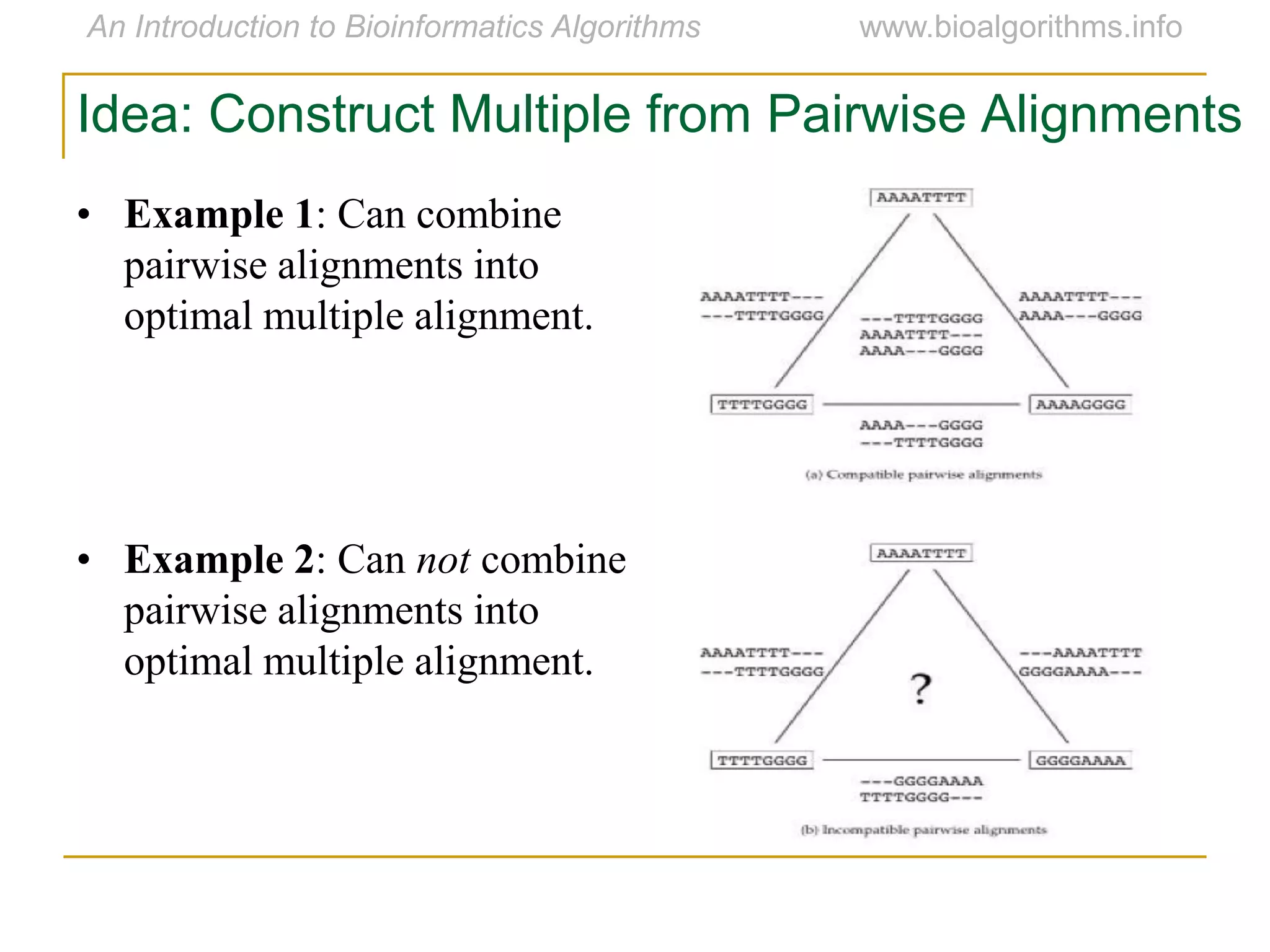
Idea: Construct Multiple from Pairwise Alignments
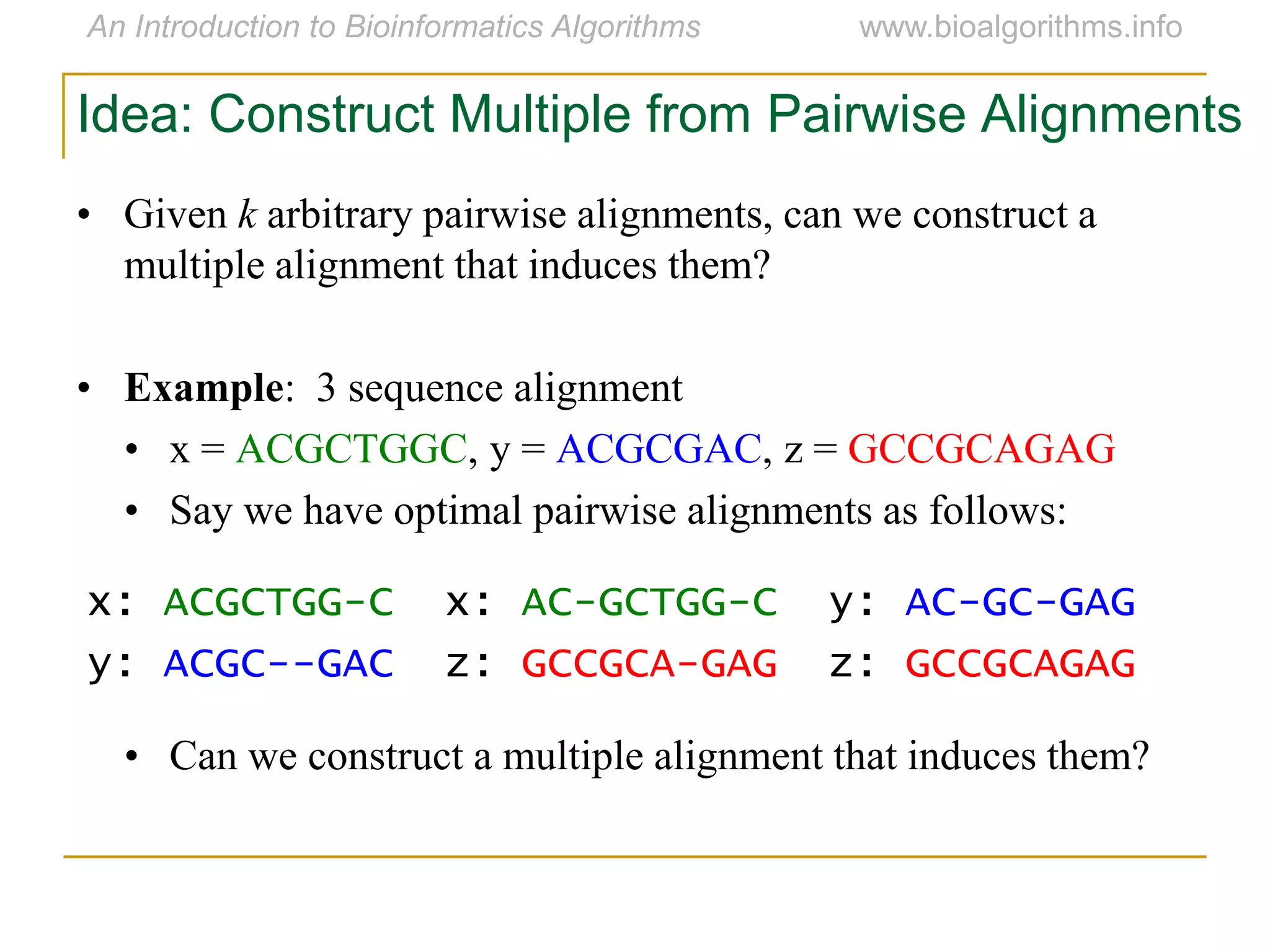
• Given k arbitrary pairwise alignments, can we construct a
multiple alignment that induces them?
• Example: 3 sequence alignment
• x = ACGCTGGC, y = ACGCGAC, z = GCCGCAGAG
• Say we have optimal pairwise alignments as follows:
• Can we construct a multiple alignment that induces them?
x: ACGCTGG-C x: AC-GCTGG-C y: AC-GC-GAG
y: ACGC--GAC z: GCCGCA-GAG z: GCCGCAGAG
Idea: Construct Multiple from Pairwise Alignments
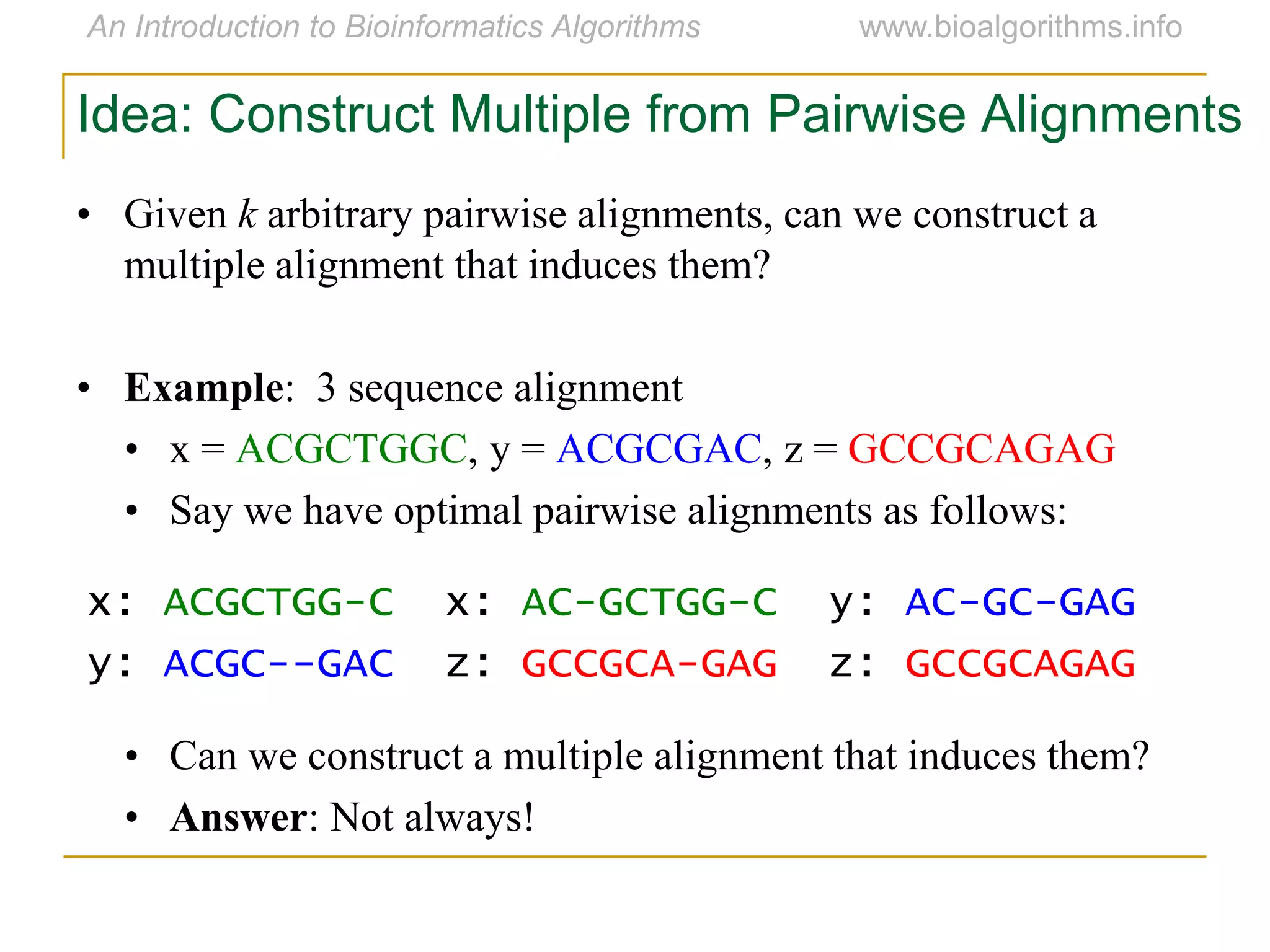
• Given k arbitrary pairwise alignments, can we construct a
multiple alignment that induces them?
• Example: 3 sequence alignment
• x = ACGCTGGC, y = ACGCGAC, z = GCCGCAGAG
• Say we have optimal pairwise alignments as follows:
• Can we construct a multiple alignment that induces them?
• Answer: Not always!
x: ACGCTGG-C x: AC-GCTGG-C y: AC-GC-GAG
y: ACGC--GAC z: GCCGCA-GAG z: GCCGCAGAG
Idea: Construct Multiple from Pairwise Alignments
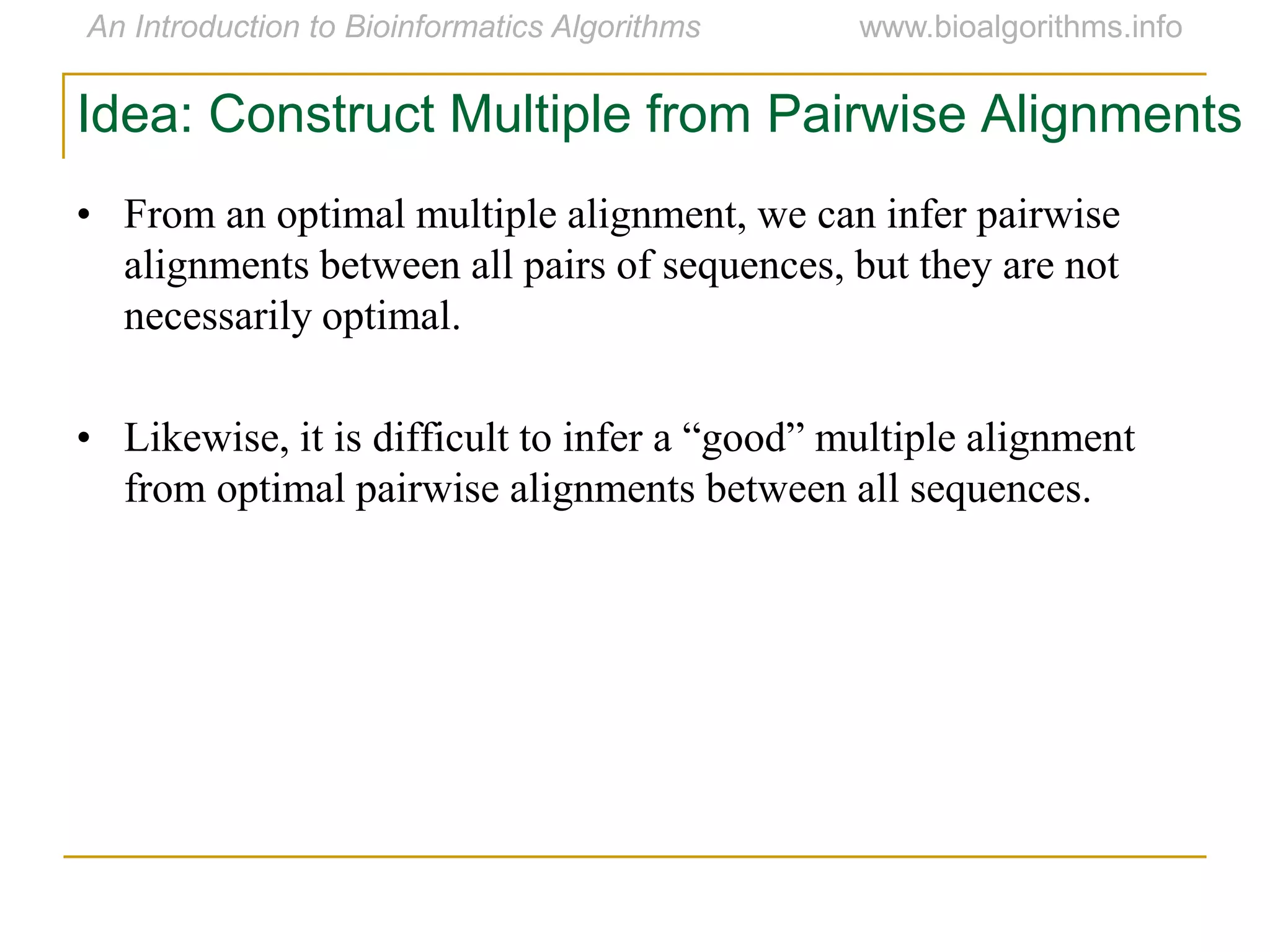
• From an optimal multiple alignment, we can infer pairwise
alignments between all pairs of sequences, but they are not
necessarily optimal.
• Likewise, it is difficult to infer a “good” multiple alignment
from optimal pairwise alignments between all sequences.
Idea: Construct Multiple from Pairwise Alignments
• Example 1: Can combine
pairwise alignments into
optimal multiple alignment.
• Example 2: Can not combine
pairwise alignments into
optimal multiple alignment.
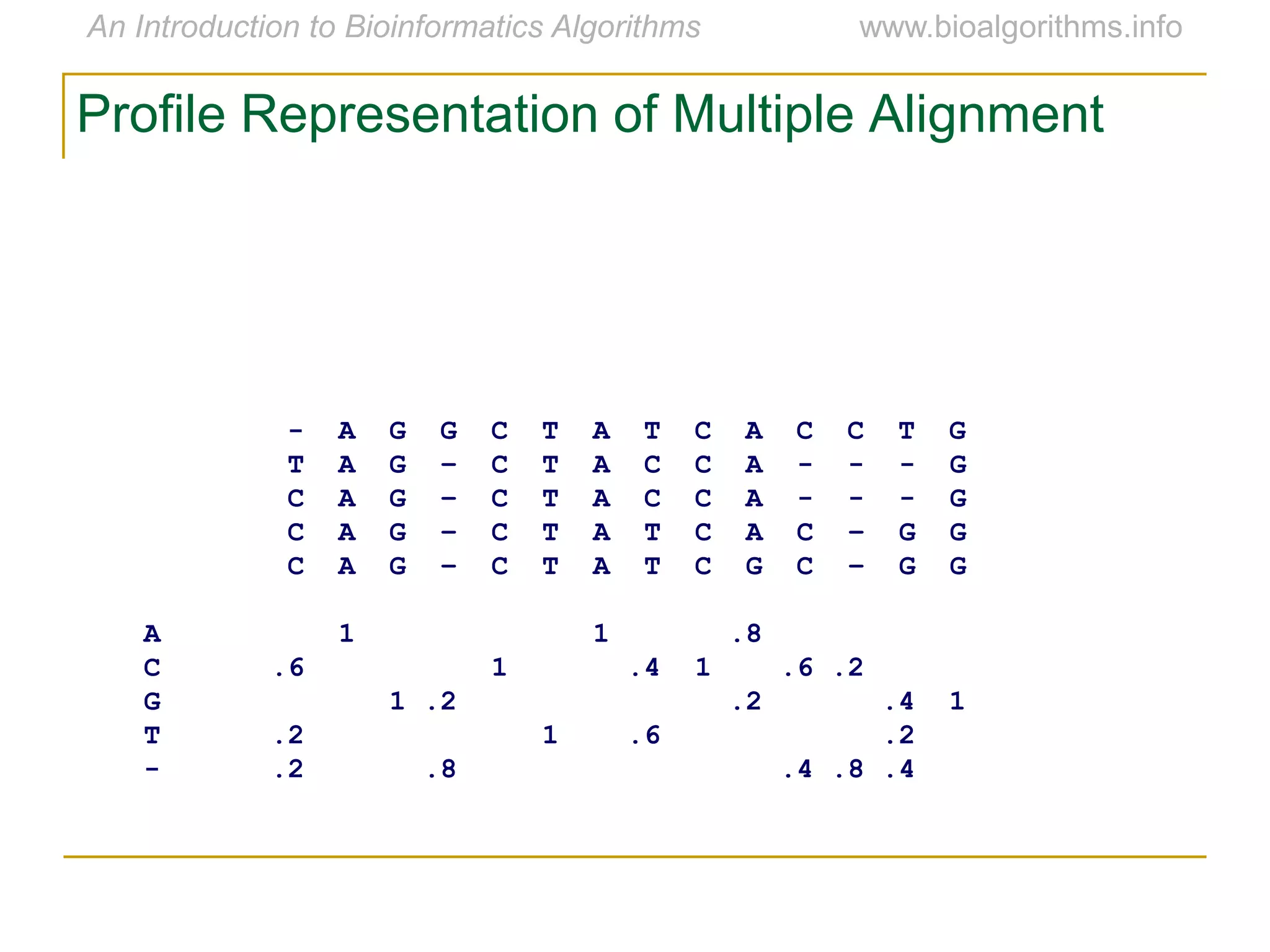
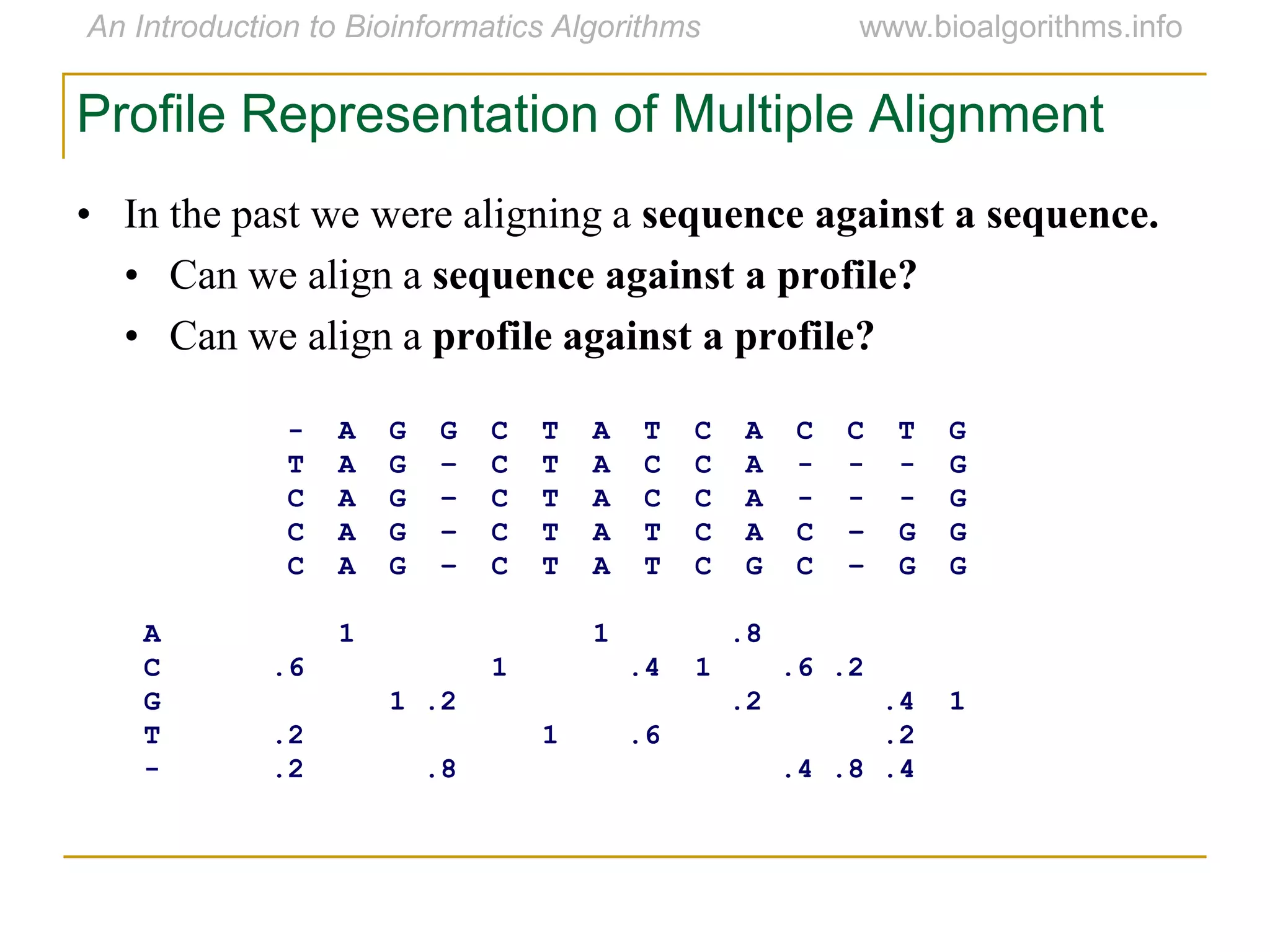
- A G G C T A T C A C C T G
T A G – C T A C C A - - - G
C A G – C T A C C A - - - G
C A G – C T A T C A C – G G
C A G – C T A T C G C – G G
A 1 1 .8
C .6 1 .4 1 .6 .2
G 1 .2 .2 .4 1
T .2 1 .6 .2
- .2 .8 .4 .8 .4
Profile Representation of Multiple Alignment
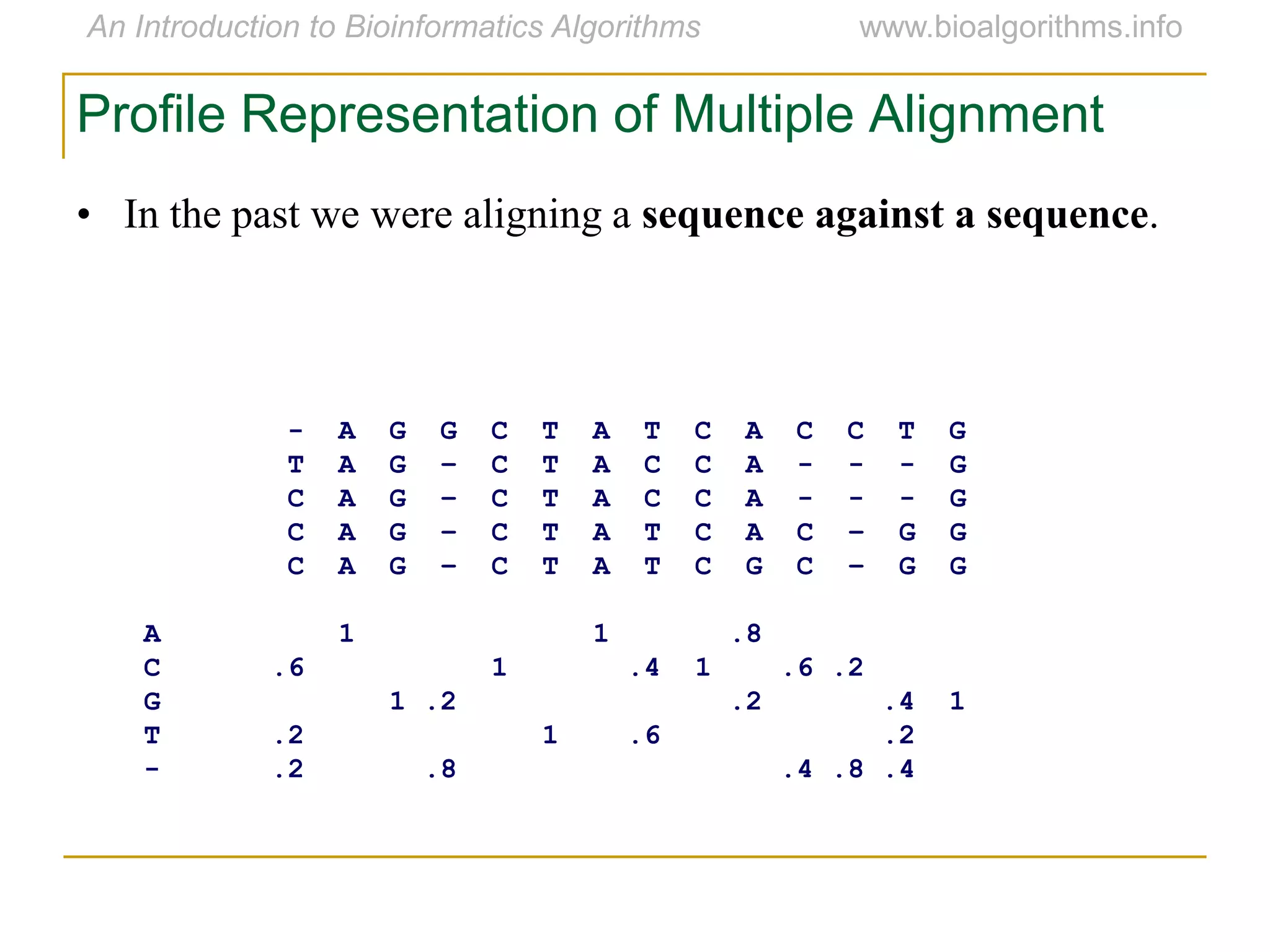
• In the past we were aligning a sequence against a sequence.
- A G G C T A T C A C C T G
T A G – C T A C C A - - - G
C A G – C T A C C A - - - G
C A G – C T A T C A C – G G
C A G – C T A T C G C – G G
A 1 1 .8
C .6 1 .4 1 .6 .2
G 1 .2 .2 .4 1
T .2 1 .6 .2
- .2 .8 .4 .8 .4
Profile Representation of Multiple Alignment
• In the past we were aligning a sequence against a sequence.
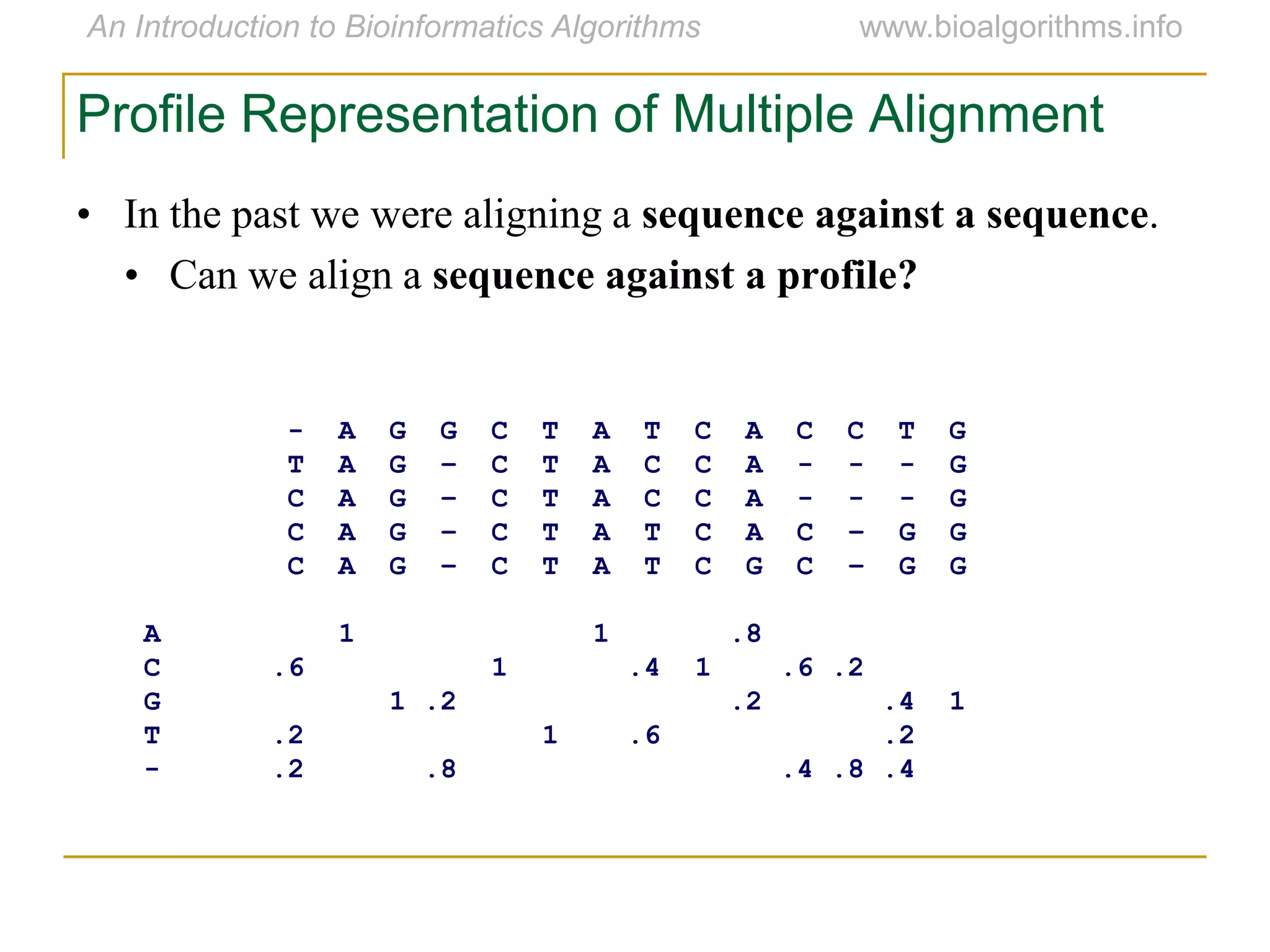
• Can we align a sequence against a profile?
- A G G C T A T C A C C T G
T A G – C T A C C A - - - G
C A G – C T A C C A - - - G
C A G – C T A T C A C – G G
C A G – C T A T C G C – G G
A 1 1 .8
C .6 1 .4 1 .6 .2
G 1 .2 .2 .4 1
T .2 1 .6 .2
- .2 .8 .4 .8 .4
Profile Representation of Multiple Alignment
• In the past we were aligning a sequence against a sequence.
• Can we align a sequence against a profile?
• Can we align a profile against a profile?
- A G G C T A T C A C C T G
T A G – C T A C C A - - - G
C A G – C T A C C A - - - G
C A G – C T A T C A C – G G
C A G – C T A T C G C – G G
A 1 1 .8
C .6 1 .4 1 .6 .2
G 1 .2 .2 .4 1
T .2 1 .6 .2
- .2 .8 .4 .8 .4
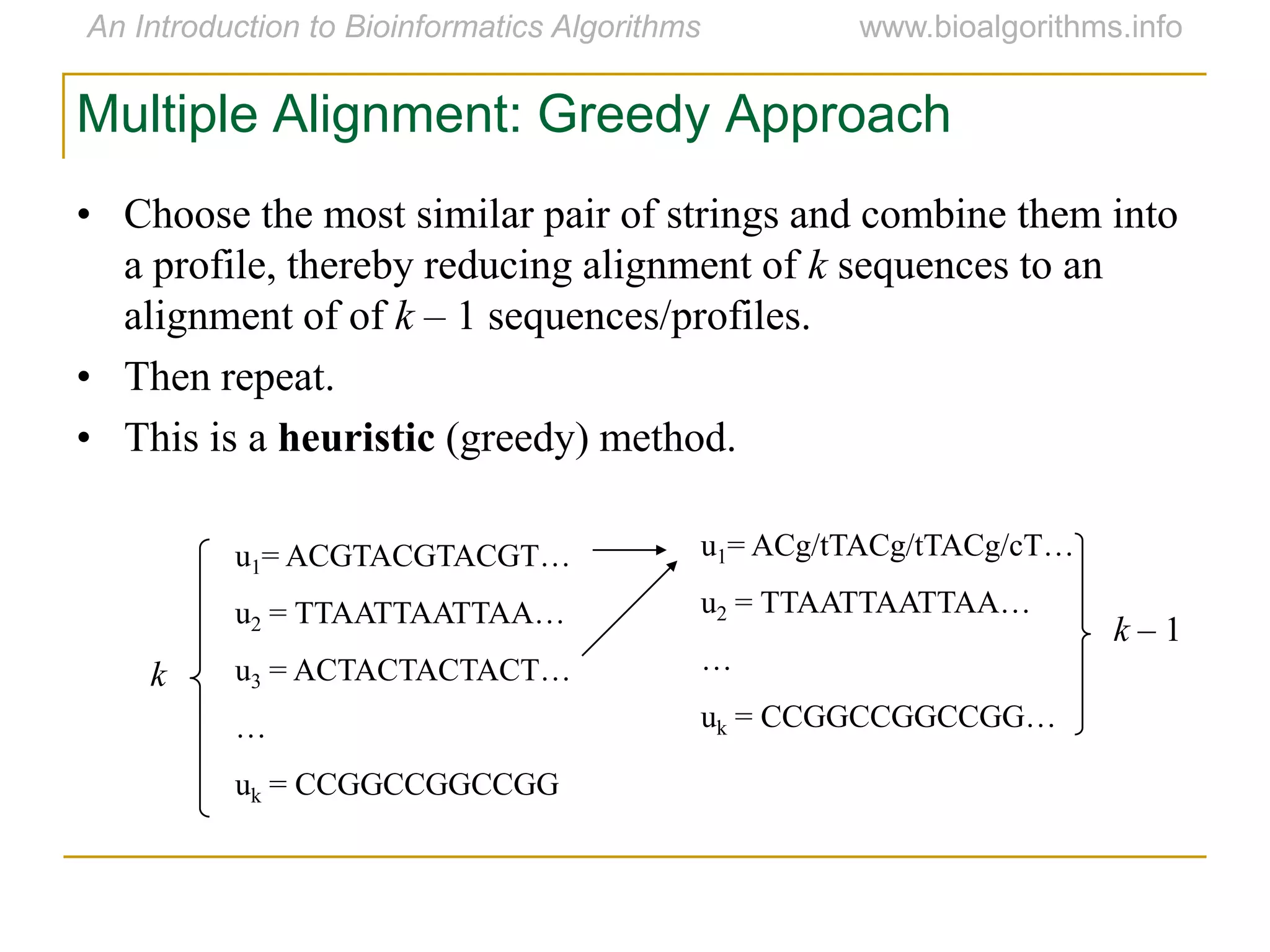
• Choose the most similar pair of strings and combine them into
a profile, thereby reducing alignment of k sequences to an
alignment of of k – 1 sequences/profiles.
• Then repeat.
• This is a heuristic (greedy) method.
u1= ACGTACGTACGT…
u2 = TTAATTAATTAA…
u3 = ACTACTACTACT…
…
uk = CCGGCCGGCCGG
u1= ACg/tTACg/tTACg/cT…
u2 = TTAATTAATTAA…
…
uk = CCGGCCGGCCGG…
k
k – 1
Multiple Alignment: Greedy Approach
Greedy Approach: Example
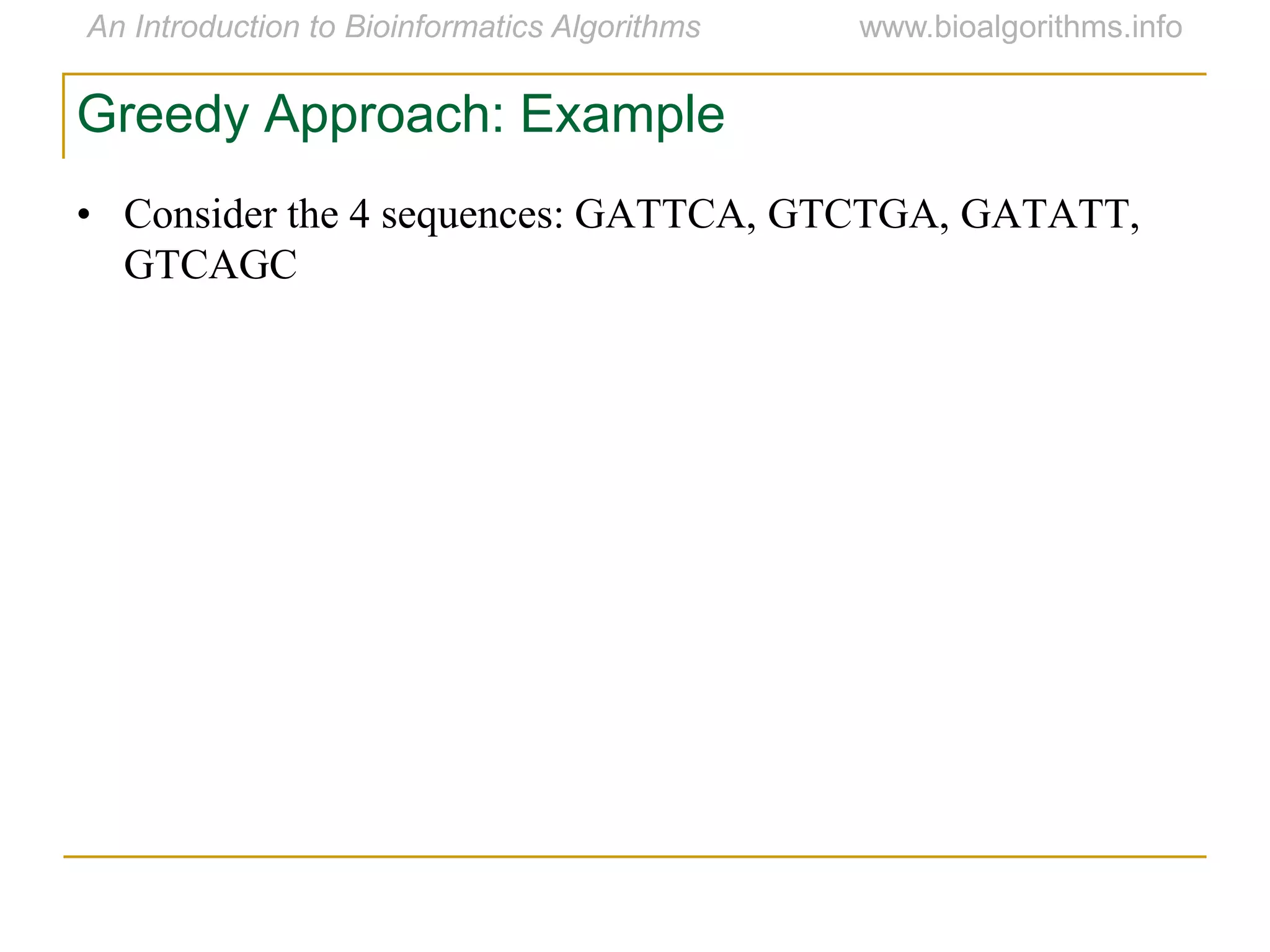
• Consider the 4 sequences: GATTCA, GTCTGA, GATATT,
GTCAGC
• Consider the 4 sequences: GATTCA, GTCTGA, GATATT,
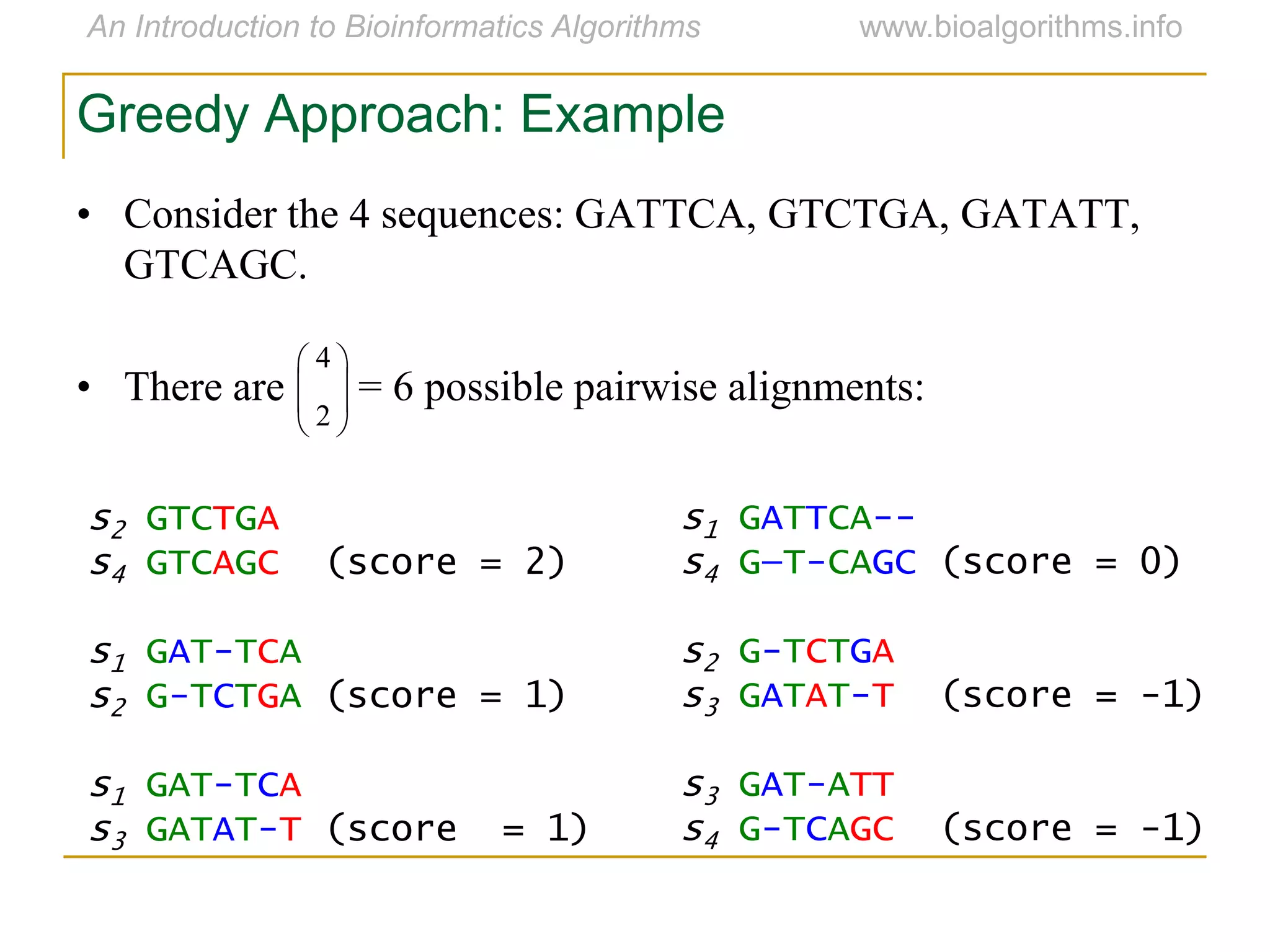
GTCAGC.
• There are = 6 possible pairwise alignments:





2
4
s2 GTCTGA
s4 GTCAGC (score = 2)
s1 GAT-TCA
s2 G-TCTGA (score = 1)
s1 GAT-TCA
s3 GATAT-T (score = 1)
s1 GATTCA--
s4 G—T-CAGC (score = 0)
s2 G-TCTGA
s3 GATAT-T (score = -1)
s3 GAT-ATT
s4 G-TCAGC (score = -1)
Greedy Approach: Example
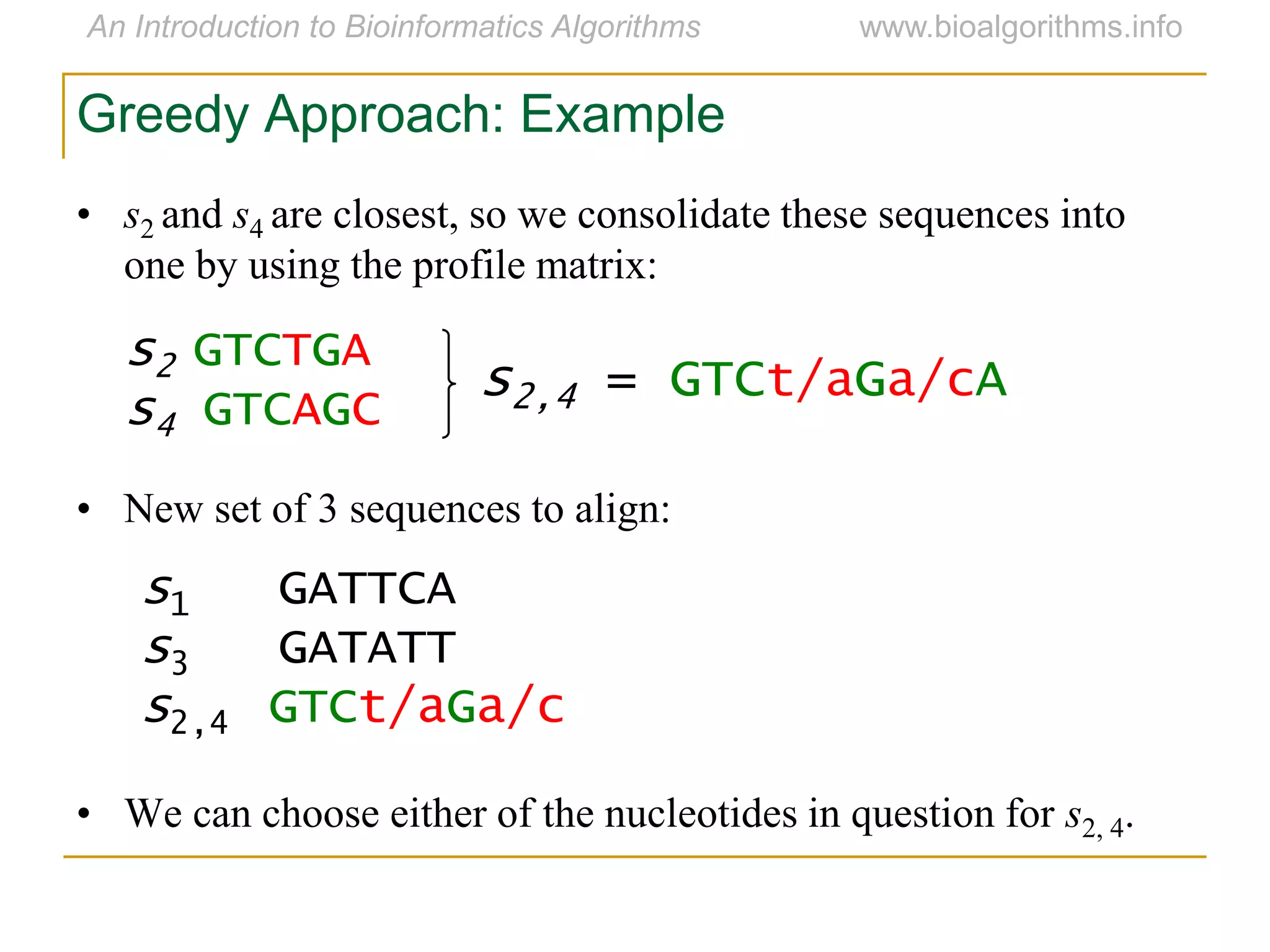
• s2 and s4 are closest, so we consolidate these sequences into
one by using the profile matrix:
• New set of 3 sequences to align:
• We can choose either of the nucleotides in question for s2, 4.
s2 GTCTGA
s4 GTCAGC
s2,4 = GTCt/aGa/cA
s1 GATTCA
s3 GATATT
s2,4 GTCt/aGa/c
Greedy Approach: Example
Section 2:
Progressive Alignment
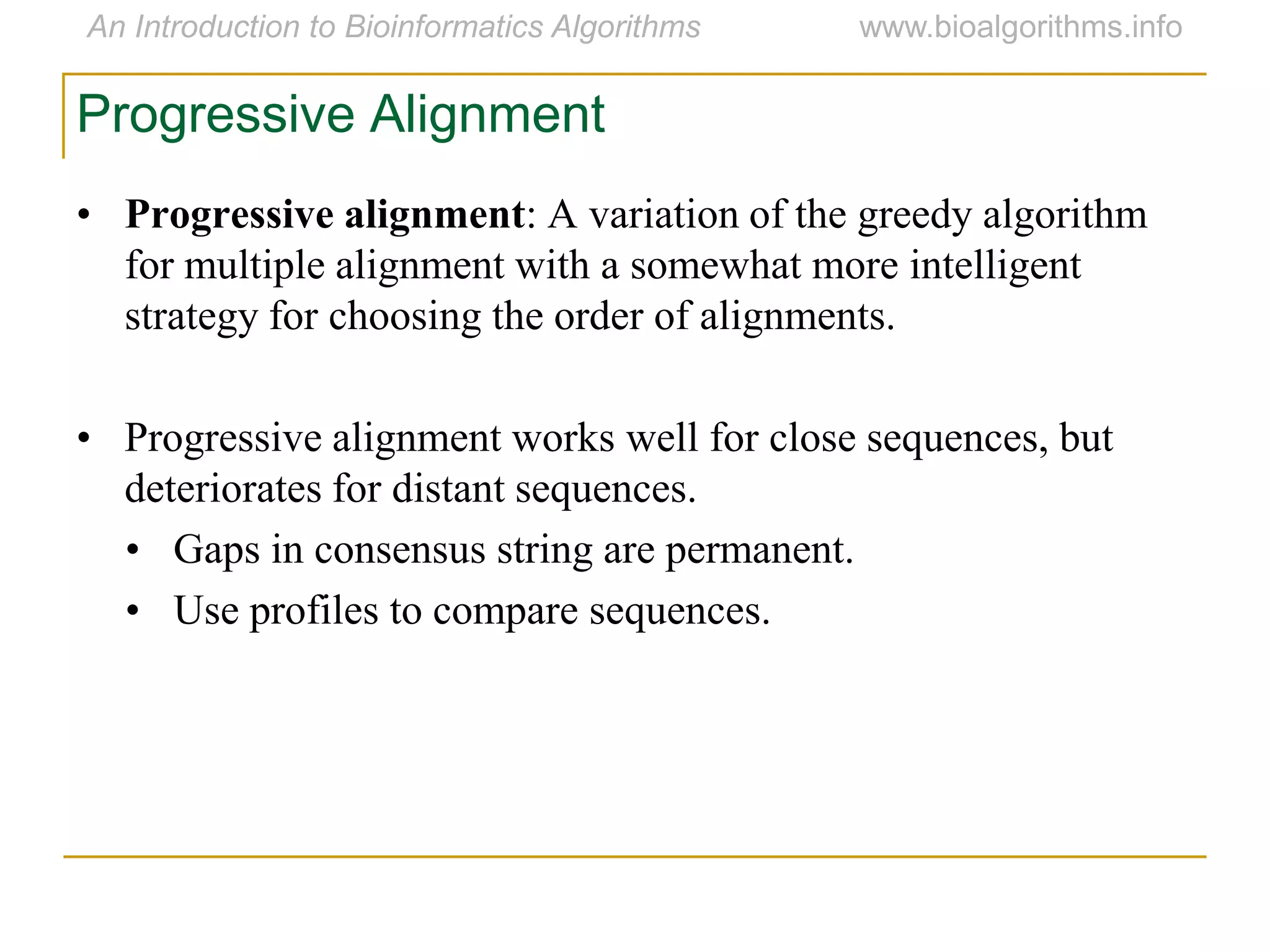
• Progressive alignment: A variation of the greedy algorithm
for multiple alignment with a somewhat more intelligent
strategy for choosing the order of alignments.
• Progressive alignment works well for close sequences, but
deteriorates for distant sequences.
• Gaps in consensus string are permanent.
• Use profiles to compare sequences.
ClustalW
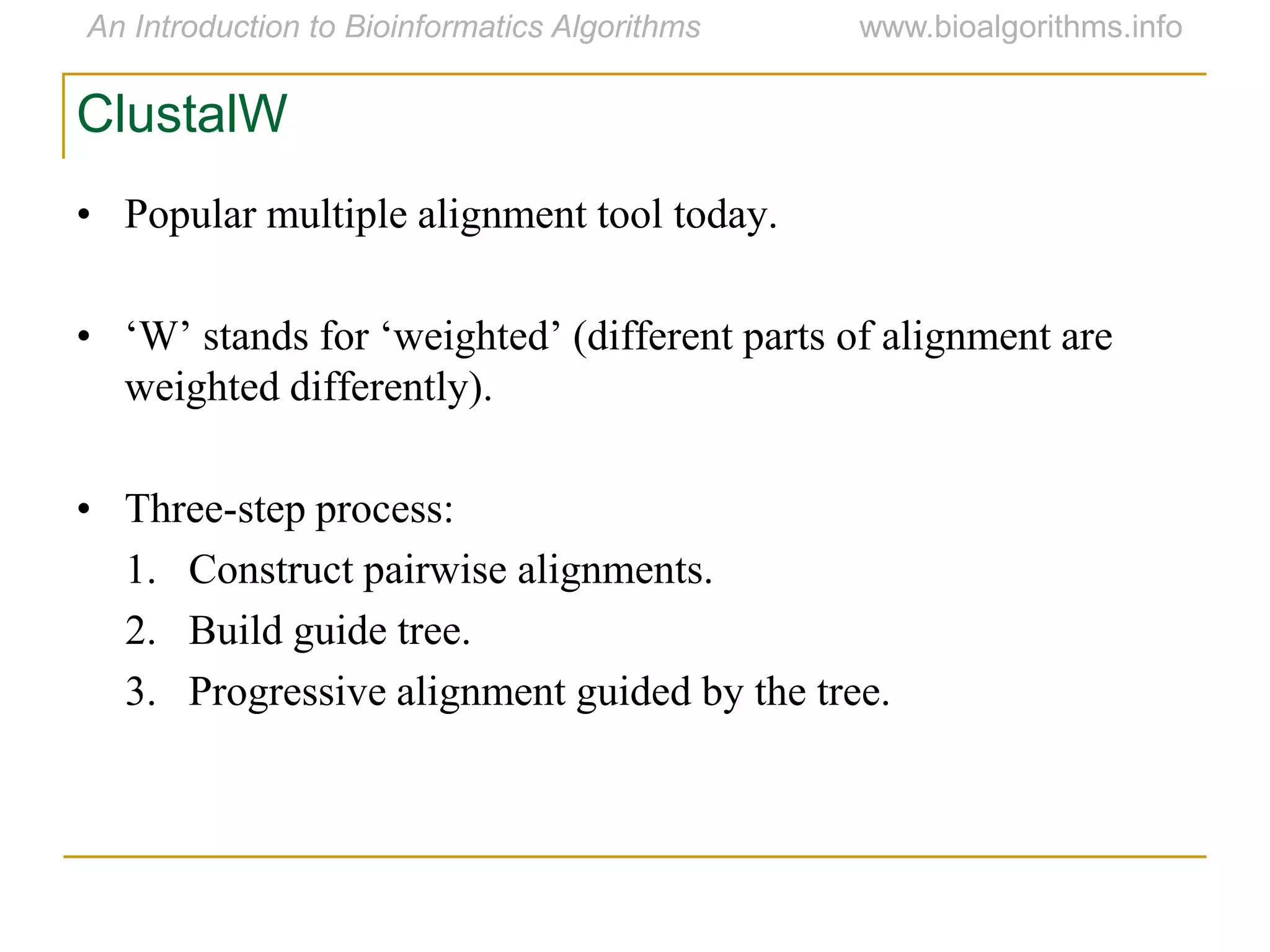
• Popular multiple alignment tool today.
• „W‟ stands for „weighted‟ (different parts of alignment are
weighted differently).
• Three-step process:
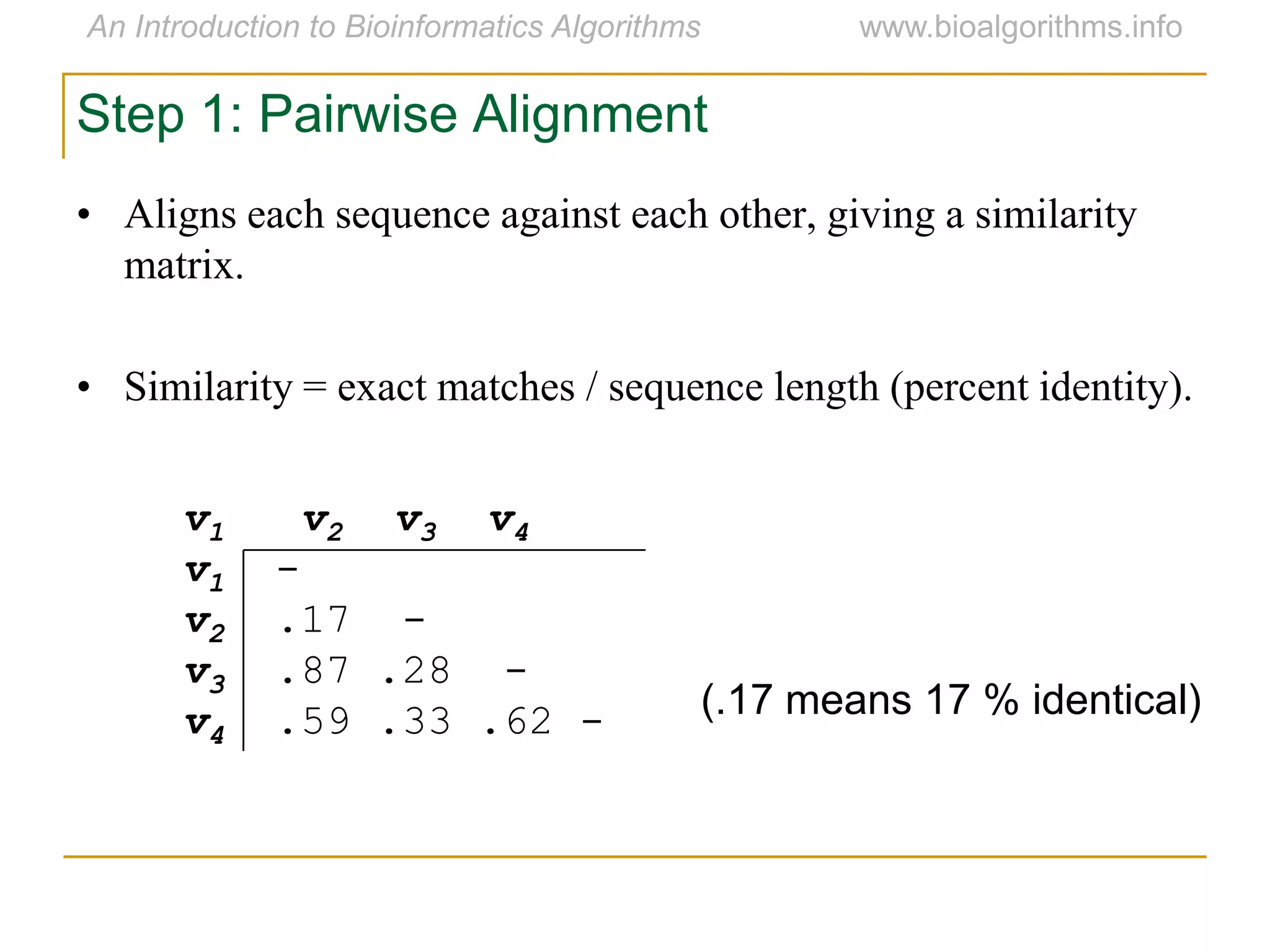
1. Construct pairwise alignments.
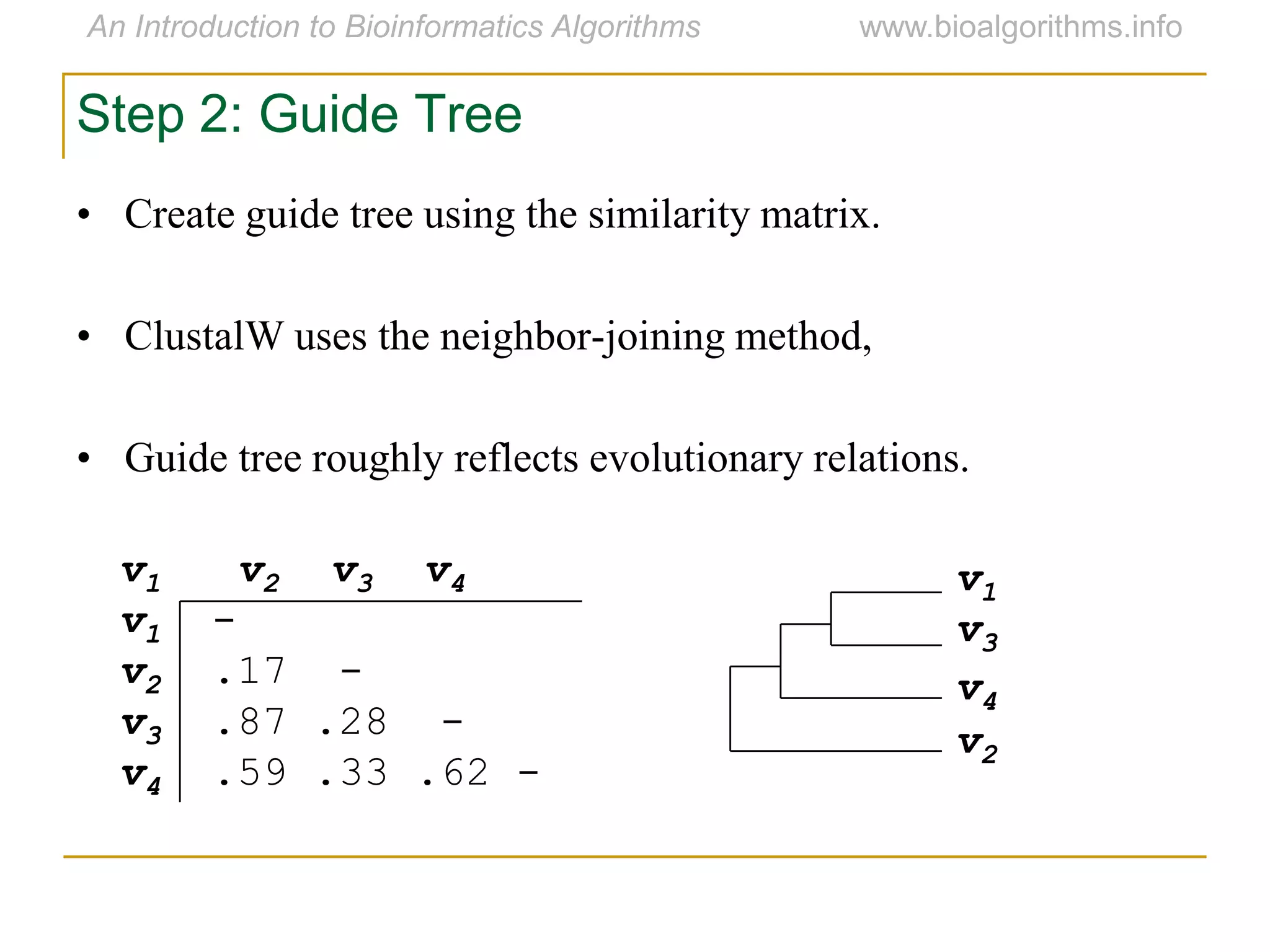
2. Build guide tree.
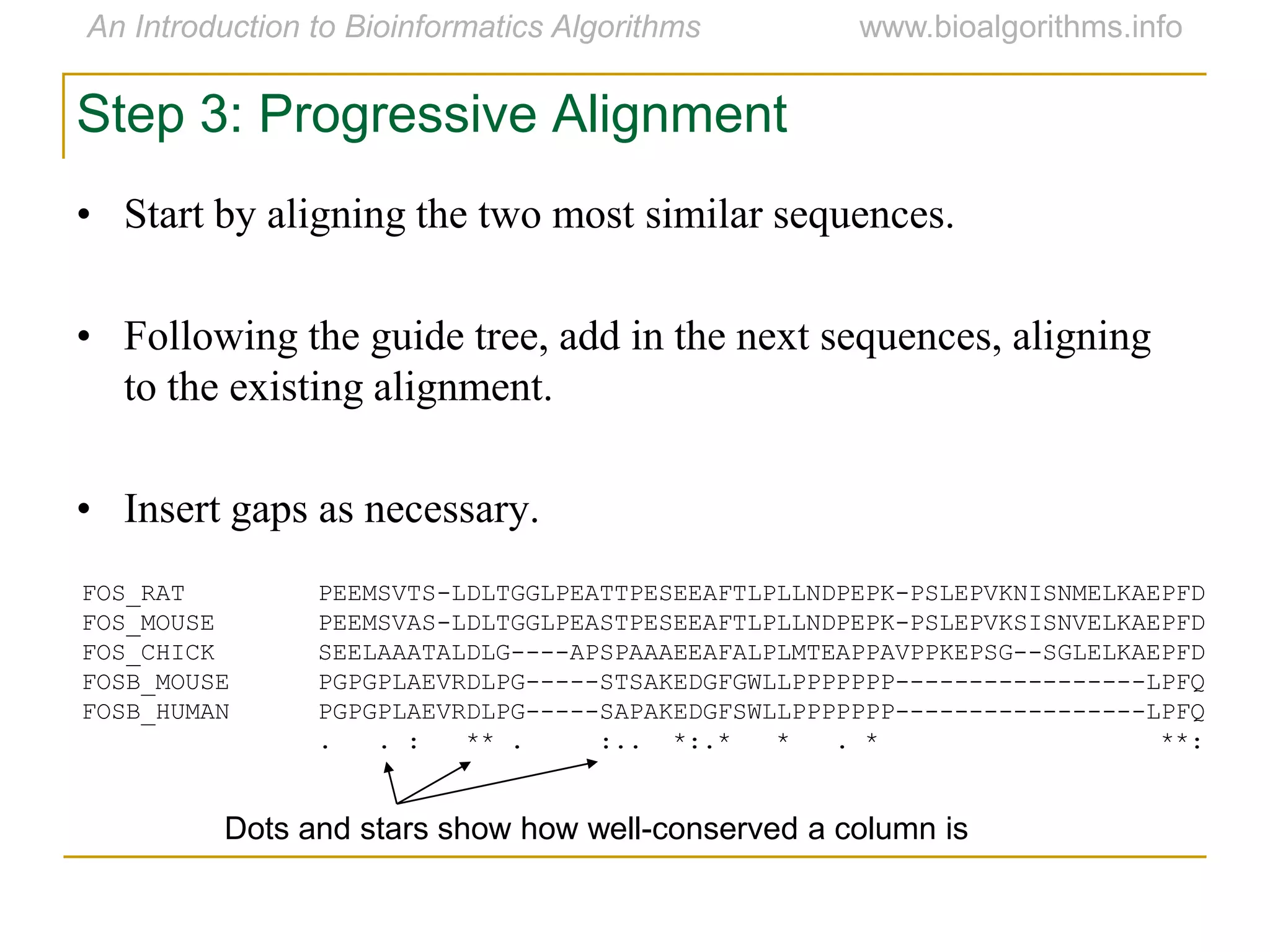
3. Progressive alignment guided by the tree.
v1 v2 v3 v4
v1 -
v2 .17 -
v3 .87 .28 -
v4 .59 .33 .62 - (.17 means 17 % identical)
Step 1: Pairwise Alignment
• Aligns each sequence against each other, giving a similarity
matrix.
• Similarity = exact matches / sequence length (percent identity).
Step 2: Guide Tree
• Create guide tree using the similarity matrix.
• ClustalW uses the neighbor-joining method,
• Guide tree roughly reflects evolutionary relations.
v1 v2 v3 v4
v1 -
v2 .17 -
v3 .87 .28 -
v4 .59 .33 .62 -
v1
v3
v4
v2
FOS_RAT PEEMSVTS-LDLTGGLPEATTPESEEAFTLPLLNDPEPK-PSLEPVKNISNMELKAEPFD
FOS_MOUSE PEEMSVAS-LDLTGGLPEASTPESEEAFTLPLLNDPEPK-PSLEPVKSISNVELKAEPFD
FOS_CHICK SEELAAATALDLG----APSPAAAEEAFALPLMTEAPPAVPPKEPSG--SGLELKAEPFD
FOSB_MOUSE PGPGPLAEVRDLPG-----STSAKEDGFGWLLPPPPPPP-----------------LPFQ
FOSB_HUMAN PGPGPLAEVRDLPG-----SAPAKEDGFSWLLPPPPPPP-----------------LPFQ
. . : ** . :.. *:.* * . * **:
Dots and stars show how well-conserved a column is
Step 3: Progressive Alignment
• Start by aligning the two most similar sequences.
• Following the guide tree, add in the next sequences, aligning
to the existing alignment.
• Insert gaps as necessary.
Section 3:
Scoring Multiple
Alignments
Multiple Alignments: Scoring
• We will discuss three possible scoring systems:
1. Number of matches (multiple longest common
subsequence score)
2. Entropy score
3. Sum of pairs (SP-Score)
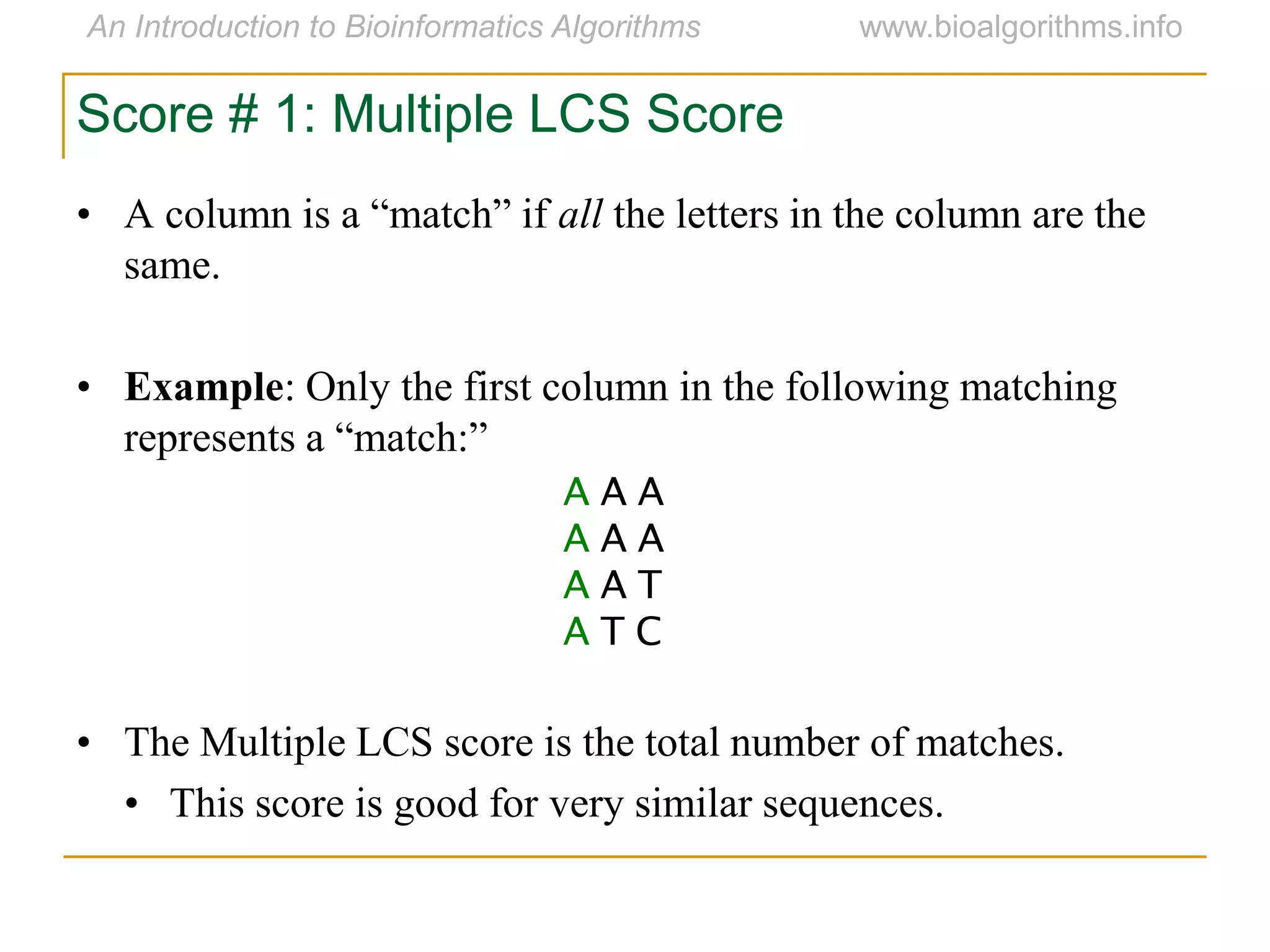
• A column is a “match” if all the letters in the column are the
same.
• Example: Only the first column in the following matching
represents a “match:”
• The Multiple LCS score is the total number of matches.
• This score is good for very similar sequences.
A A A
A A A
A A T
A T C
Score # 1: Multiple LCS Score
Score # 2: Entropy Score
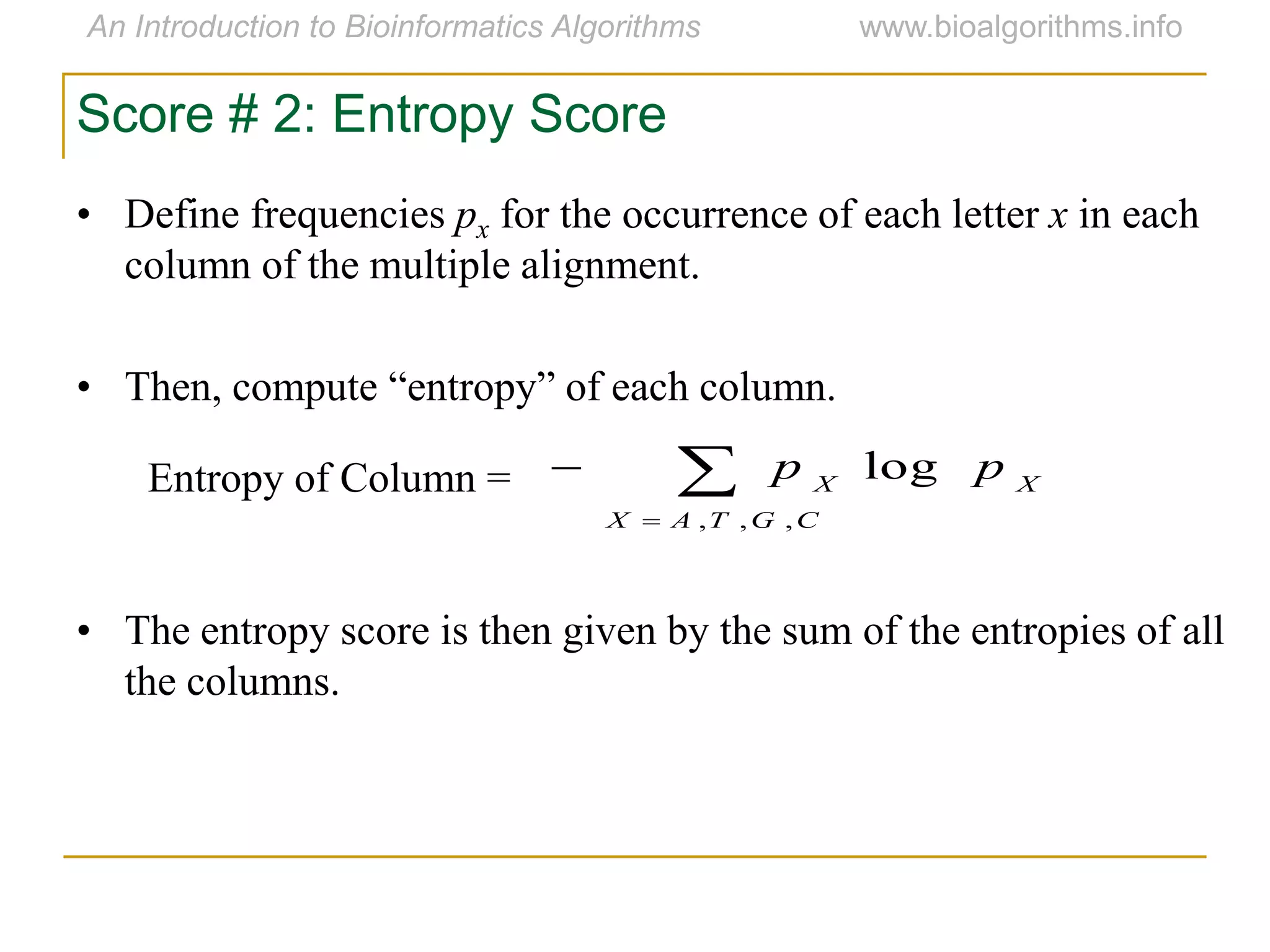
• Define frequencies px for the occurrence of each letter x in each
column of the multiple alignment.
• Then, compute “entropy” of each column.
• The entropy score is then given by the sum of the entropies of all
the columns.
Entropy of Column = 


CGTAX
XX
pp
,,,
log
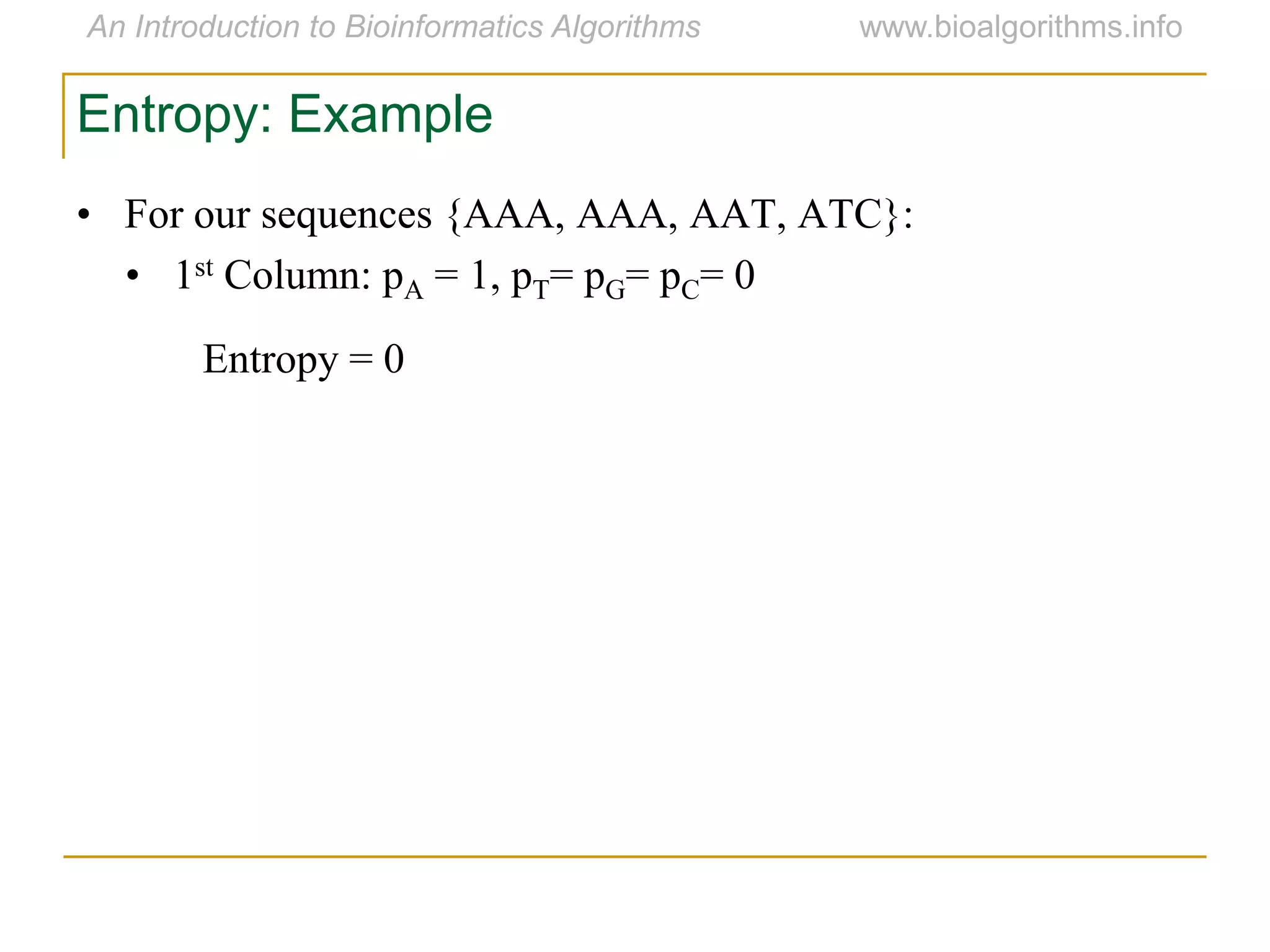
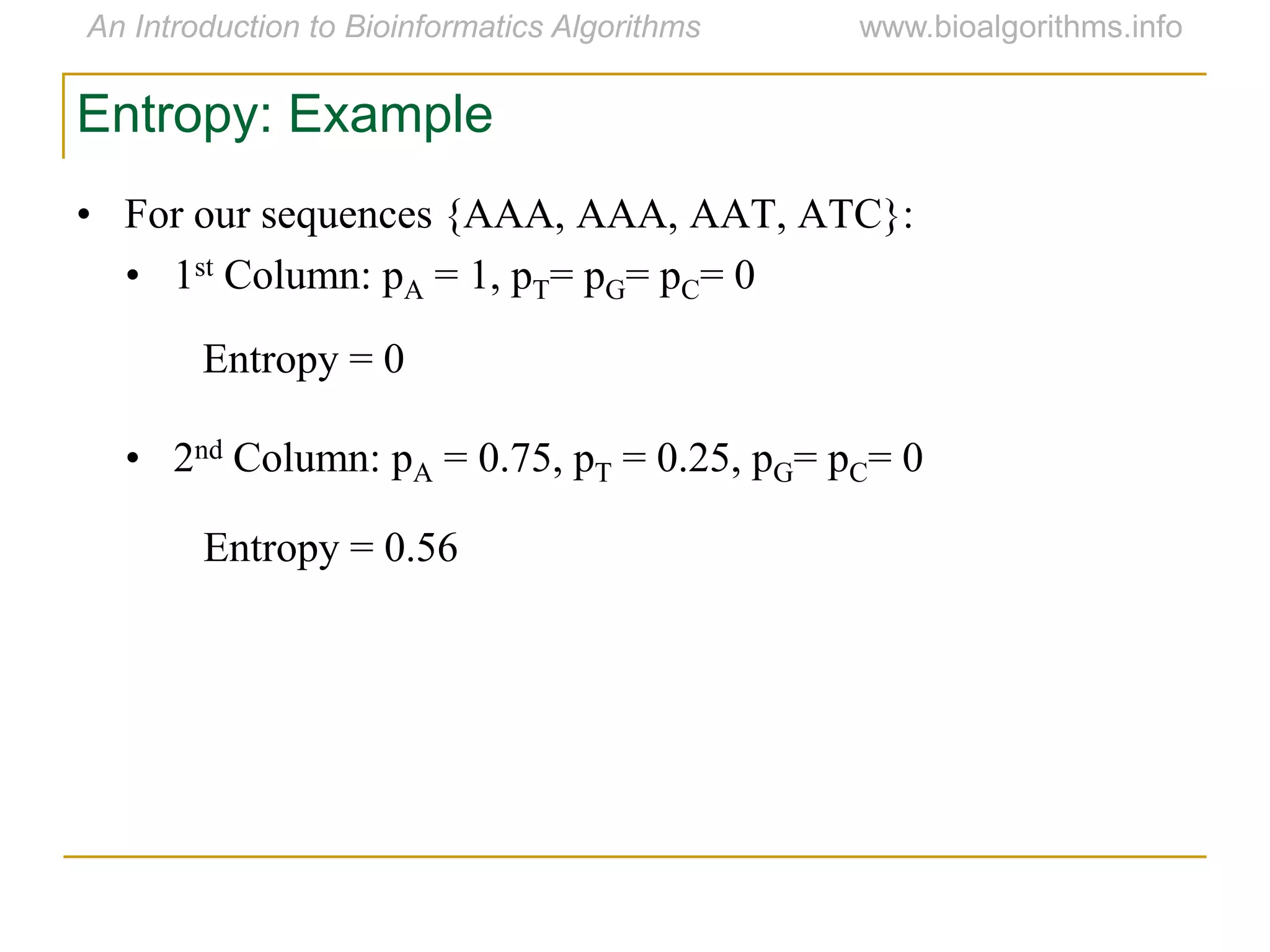
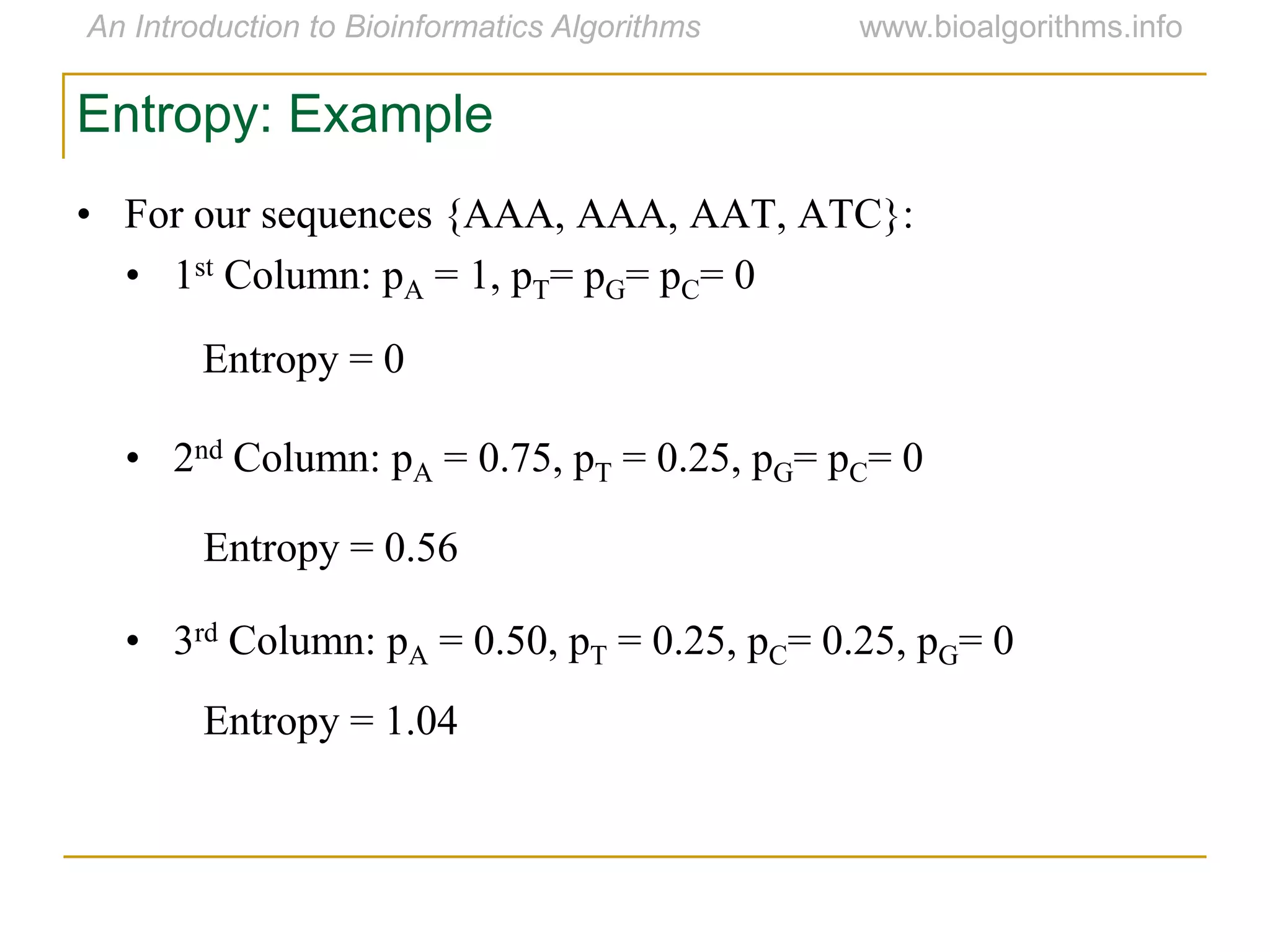
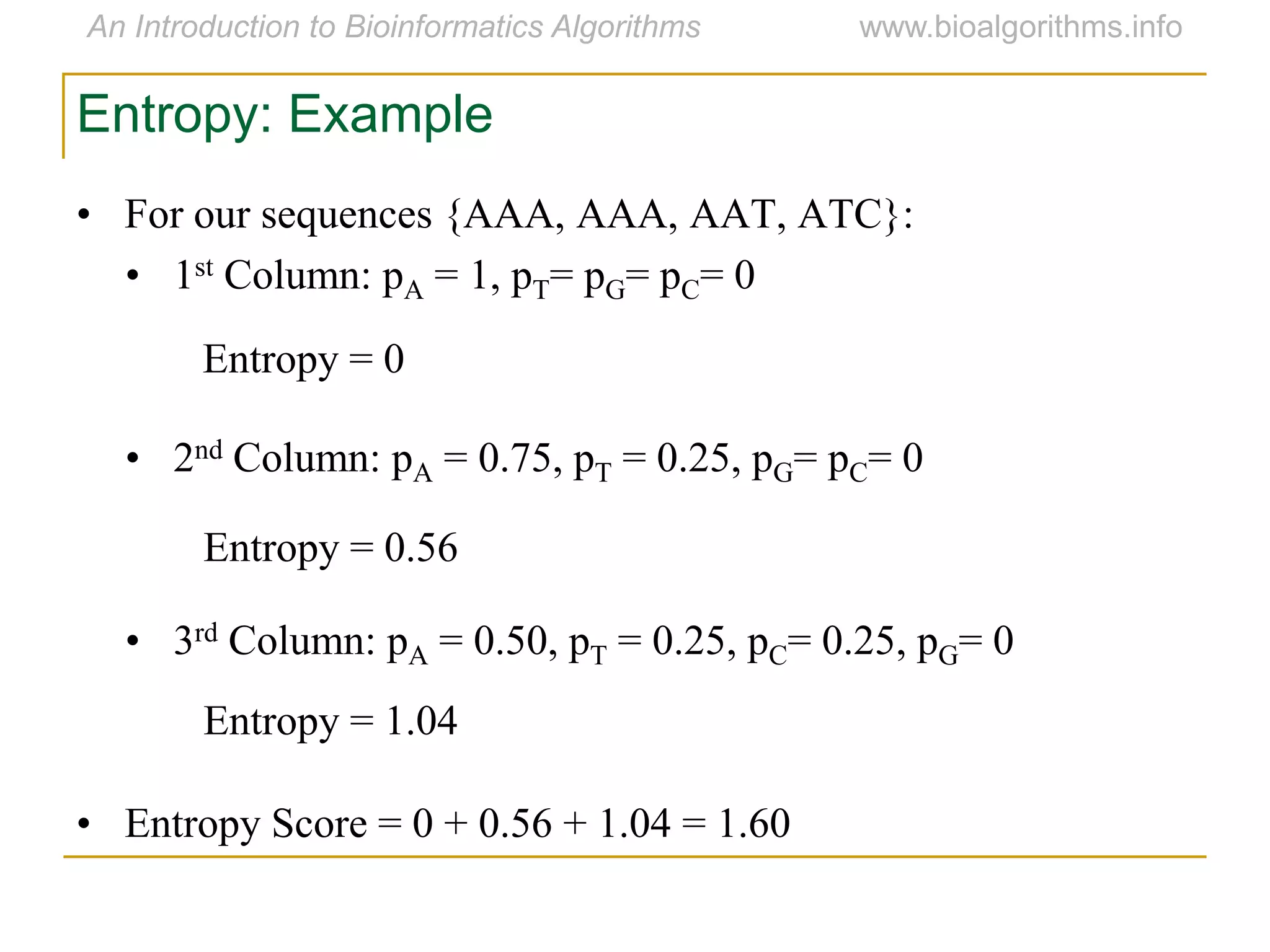
Entropy: Example
• For our sequences {AAA, AAA, AAT, ATC}:
Entropy: Example
• For our sequences {AAA, AAA, AAT, ATC}:
• 1st Column: pA = 1, pT= pG= pC= 0
Entropy = 0
Entropy: Example
• For our sequences {AAA, AAA, AAT, ATC}:
• 1st Column: pA = 1, pT= pG= pC= 0
• 2nd Column: pA = 0.75, pT = 0.25, pG= pC= 0
Entropy = 0
Entropy = 0.56
Entropy: Example
• For our sequences {AAA, AAA, AAT, ATC}:
• 1st Column: pA = 1, pT= pG= pC= 0
• 2nd Column: pA = 0.75, pT = 0.25, pG= pC= 0
• 3rd Column: pA = 0.50, pT = 0.25, pC= 0.25, pG= 0
Entropy = 0
Entropy = 0.56
Entropy = 1.04
Entropy: Example
• For our sequences {AAA, AAA, AAT, ATC}:
• 1st Column: pA = 1, pT= pG= pC= 0
• 2nd Column: pA = 0.75, pT = 0.25, pG= pC= 0
• 3rd Column: pA = 0.50, pT = 0.25, pC= 0.25, pG= 0
• Entropy Score = 0 + 0.56 + 1.04 = 1.60
Entropy = 0
Entropy = 0.56
Entropy = 1.04
0














A
A
A
A
entropy
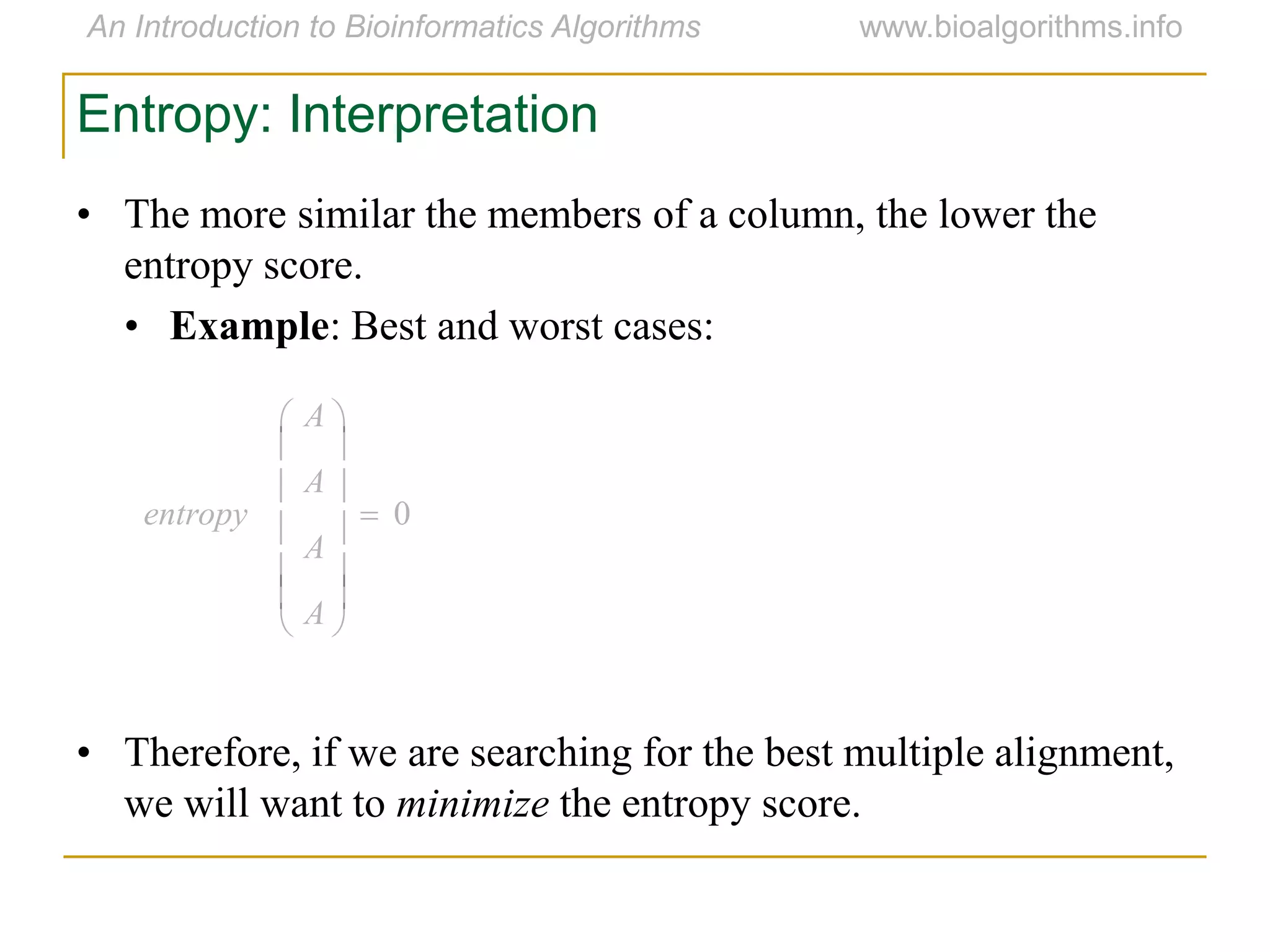
Entropy: Interpretation
• The more similar the members of a column, the lower the
entropy score.
• Example: Best and worst cases:
• Therefore, if we are searching for the best multiple alignment,
we will want to minimize the entropy score.
Inferring Pairwise from Multiple Alignments
• Recall: Every multiple alignment induces pairwise alignments.
• From a multiple alignment, we can infer pairwise alignments
between all sequences, but they are not necessarily optimal.
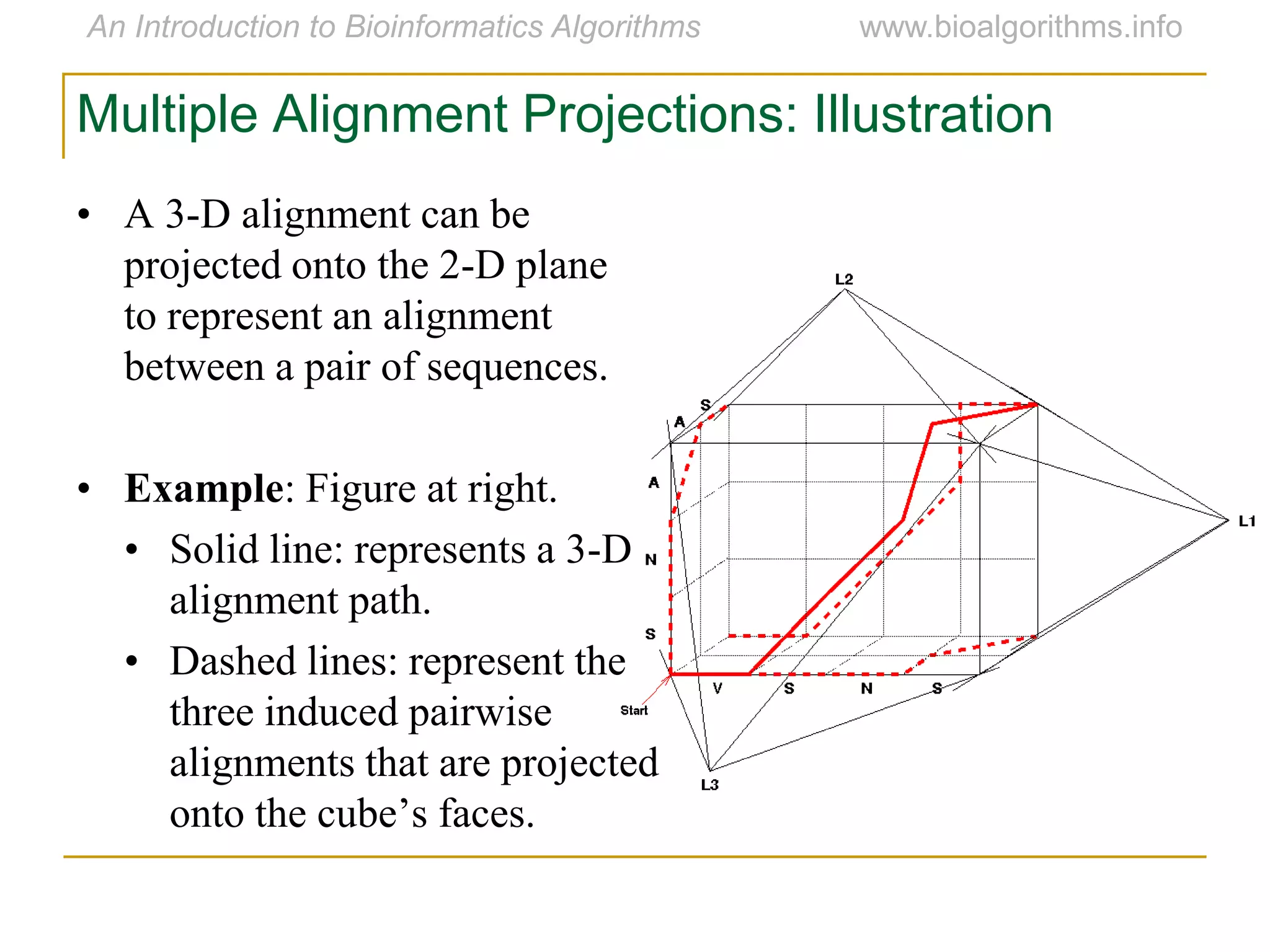
• We can view reducing multiple alignments to pairwise
alignments as projecting a 3-D multiple alignment path onto a
2-D face of the cube
• Our third scoring function for MSA will be based off the
projections.
Multiple Alignment Projections: Illustration
• A 3-D alignment can be
projected onto the 2-D plane
to represent an alignment
between a pair of sequences.
• Example: Figure at right.
• Solid line: represents a 3-D
alignment path.
• Dashed lines: represent the
three induced pairwise
alignments that are projected
onto the cube‟s faces.
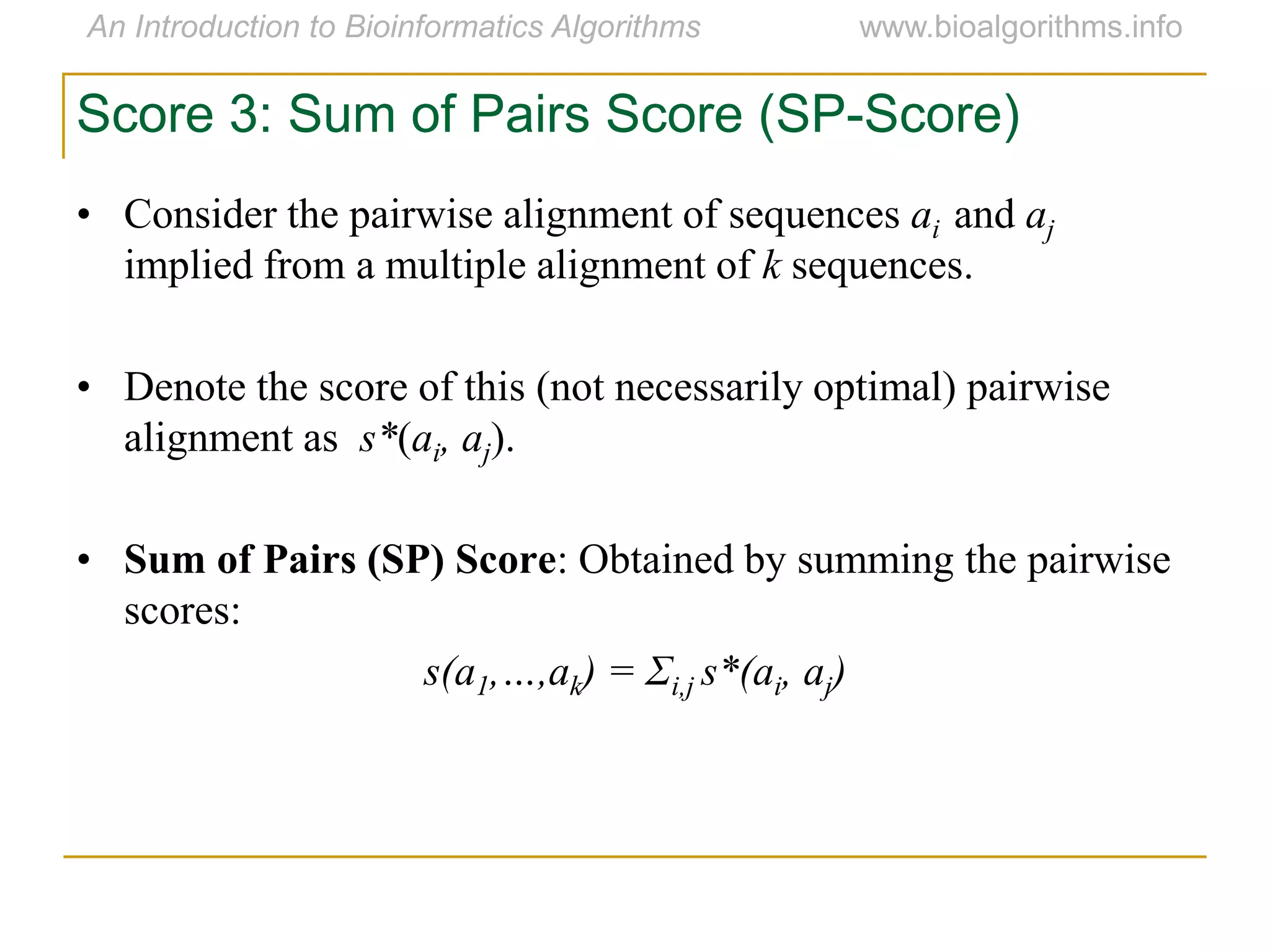
• Consider the pairwise alignment of sequences ai and aj
implied from a multiple alignment of k sequences.
• Denote the score of this (not necessarily optimal) pairwise
alignment as s*(ai, aj).
• Sum of Pairs (SP) Score: Obtained by summing the pairwise
scores:
s(a1,…,ak) = Σi,j s*(ai, aj)
Score 3: Sum of Pairs Score (SP-Score)
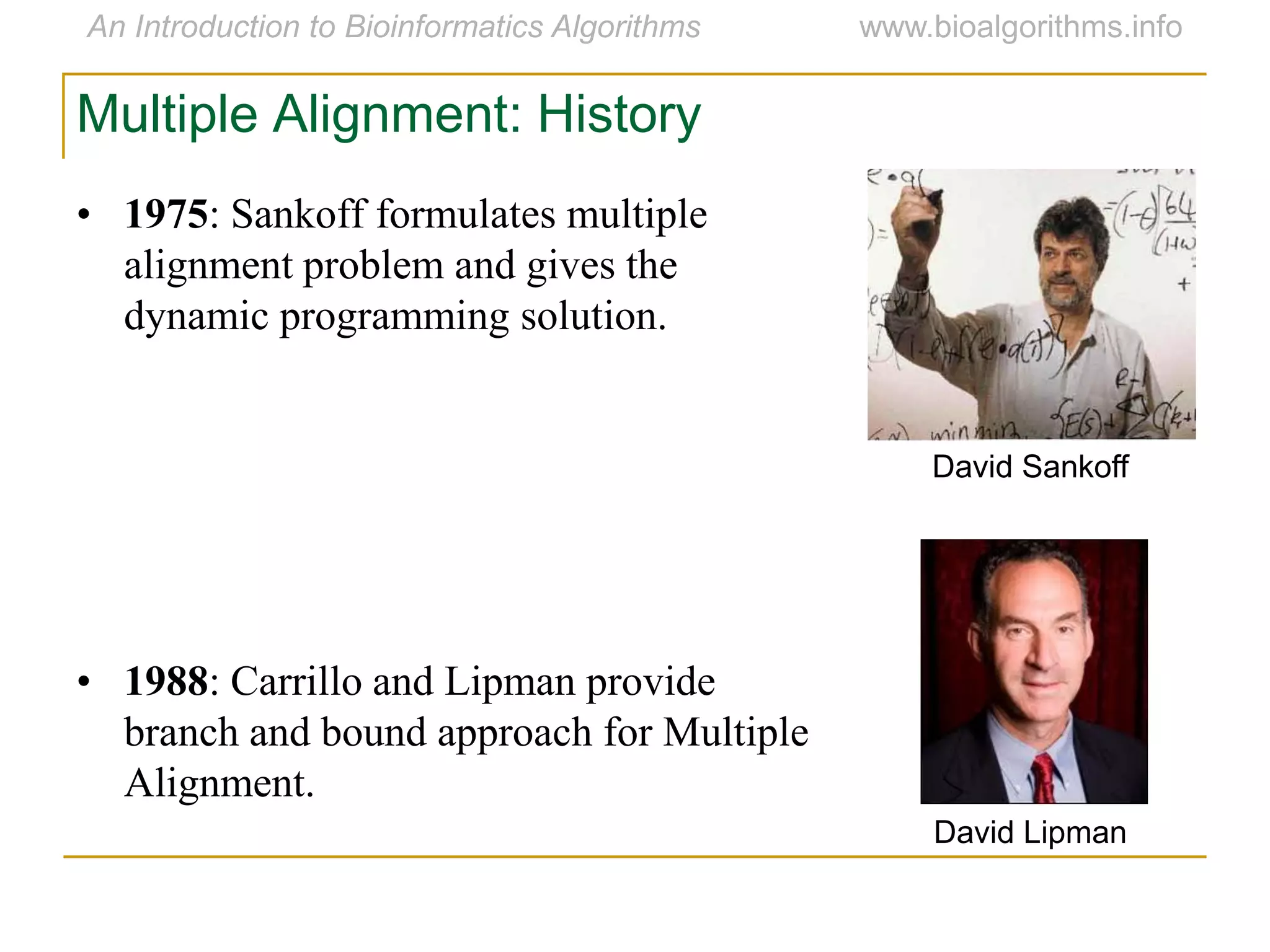
Multiple Alignment: History
• 1975: Sankoff formulates multiple
alignment problem and gives the
dynamic programming solution.
• 1988: Carrillo and Lipman provide
branch and bound approach for Multiple
Alignment.
David Sankoff
David Lipman
Multiple Alignment: History
• 1990: Feng and Doolittle develop
progressive alignment.
• 1994: Thompson,
Higgins, and Gibson
create ClustalW, which
is the most popular
multiple alignment
program in the world. Des HigginsJulie Thompson Toby Gibson
Russell Doolittle
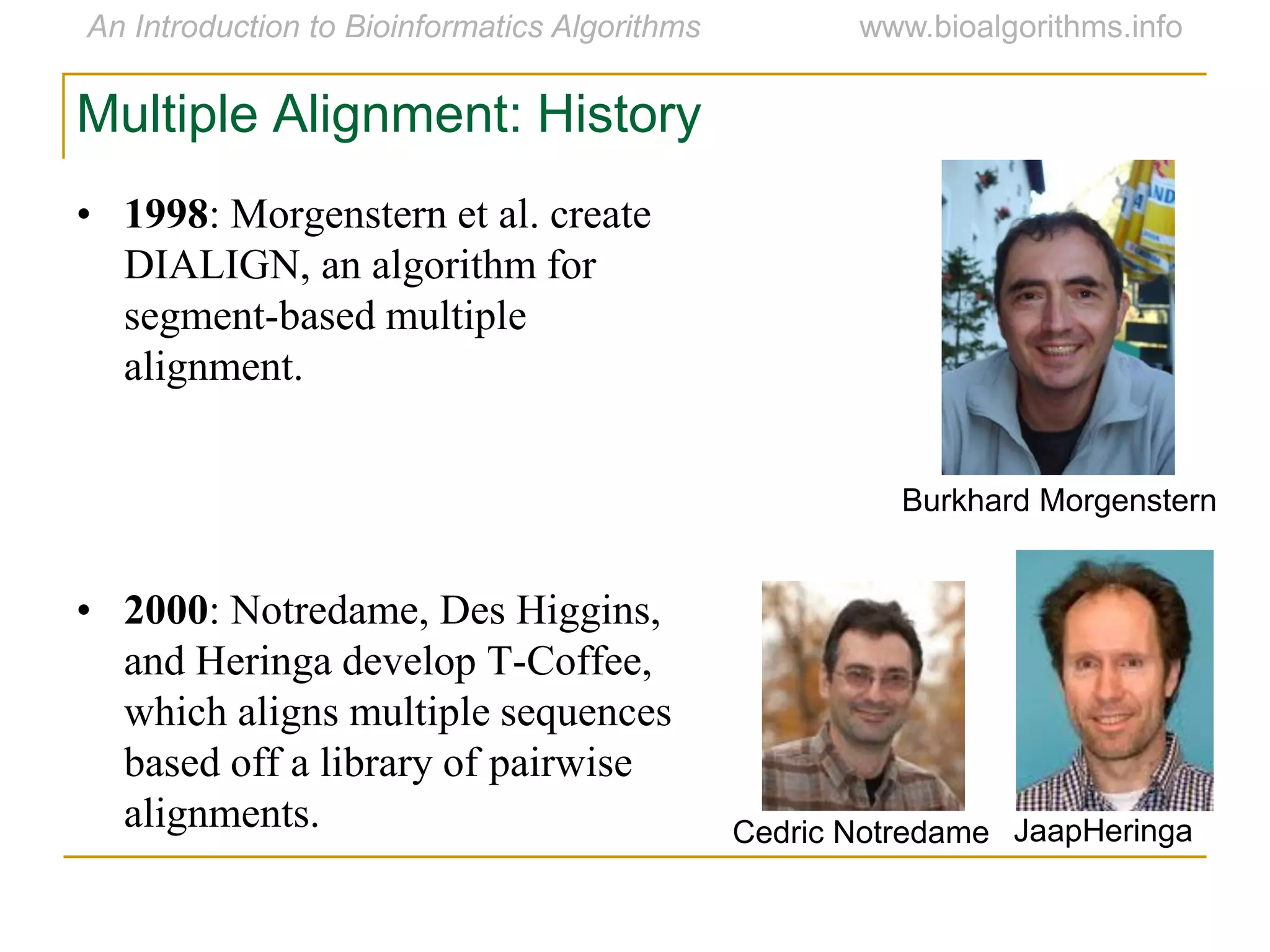
Multiple Alignment: History
• 1998: Morgenstern et al. create
DIALIGN, an algorithm for
segment-based multiple
alignment.
• 2000: Notredame, Des Higgins,
and Heringa develop T-Coffee,
which aligns multiple sequences
based off a library of pairwise
alignments.
Burkhard Morgenstern
Cedric Notredame JaapHeringa
Multiple Alignment: History
• 2004: Robert Edgar formulates
MUSCLE, a faster and more efficient
algorithm than ClustalW.
• 201X: What is next?
Problems with Multiple Alignment
• Multidomain proteins evolve not only through point mutations
but also through domain duplications and domain
recombinations.
• Although Multiple Alignment is a 30 year old problem, there
were no approaches for aligning rearranged sequences (i.e.,
multi-domain proteins with shuffled domains) prior to 2002.
• It is often impossible to align all protein sequences throughout
their entire length.
Section 4:
Partial Order Alignment
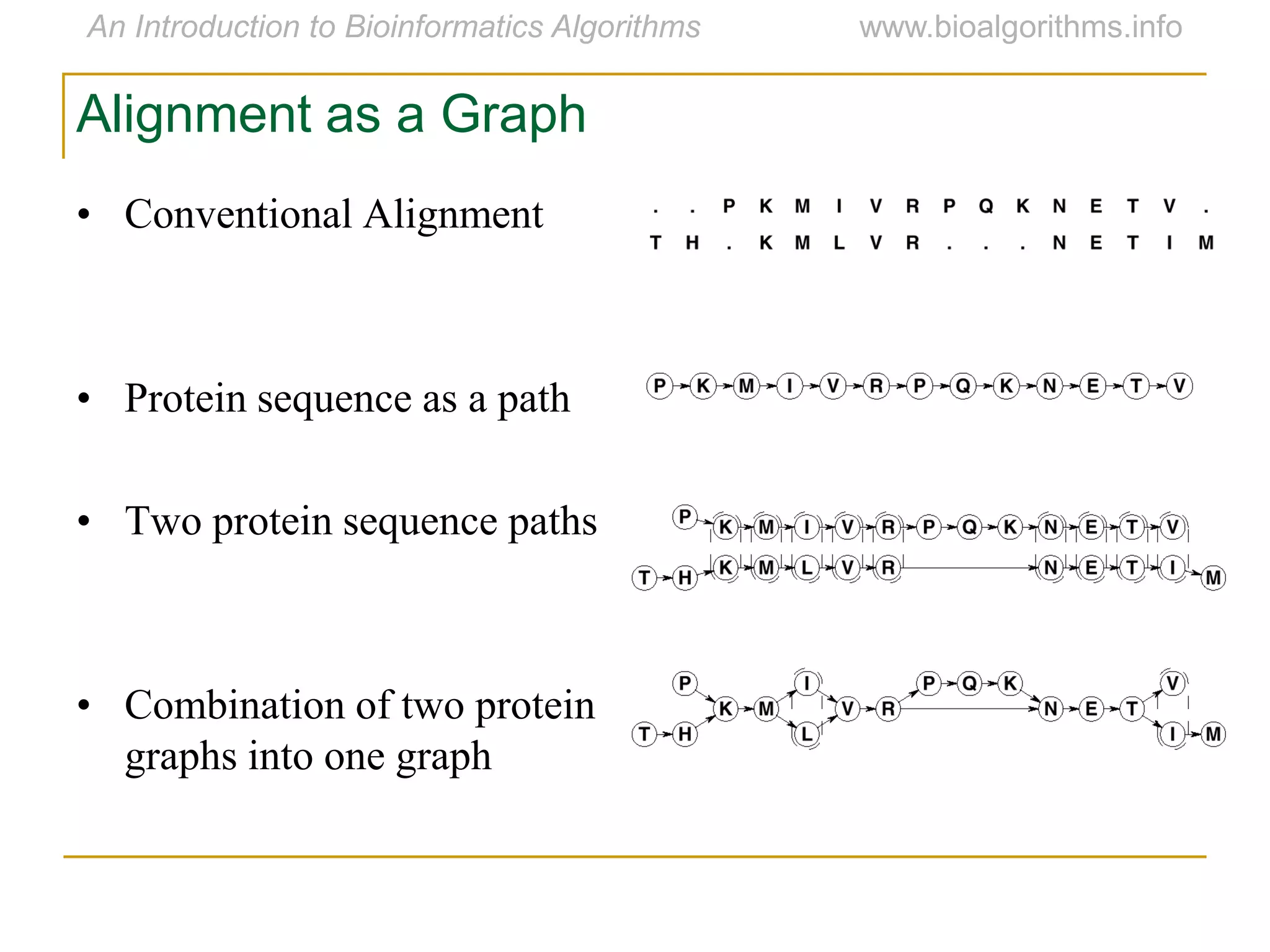
Alignment as a Graph
• Conventional Alignment
• Protein sequence as a path
• Two protein sequence paths
• Combination of two protein
graphs into one graph
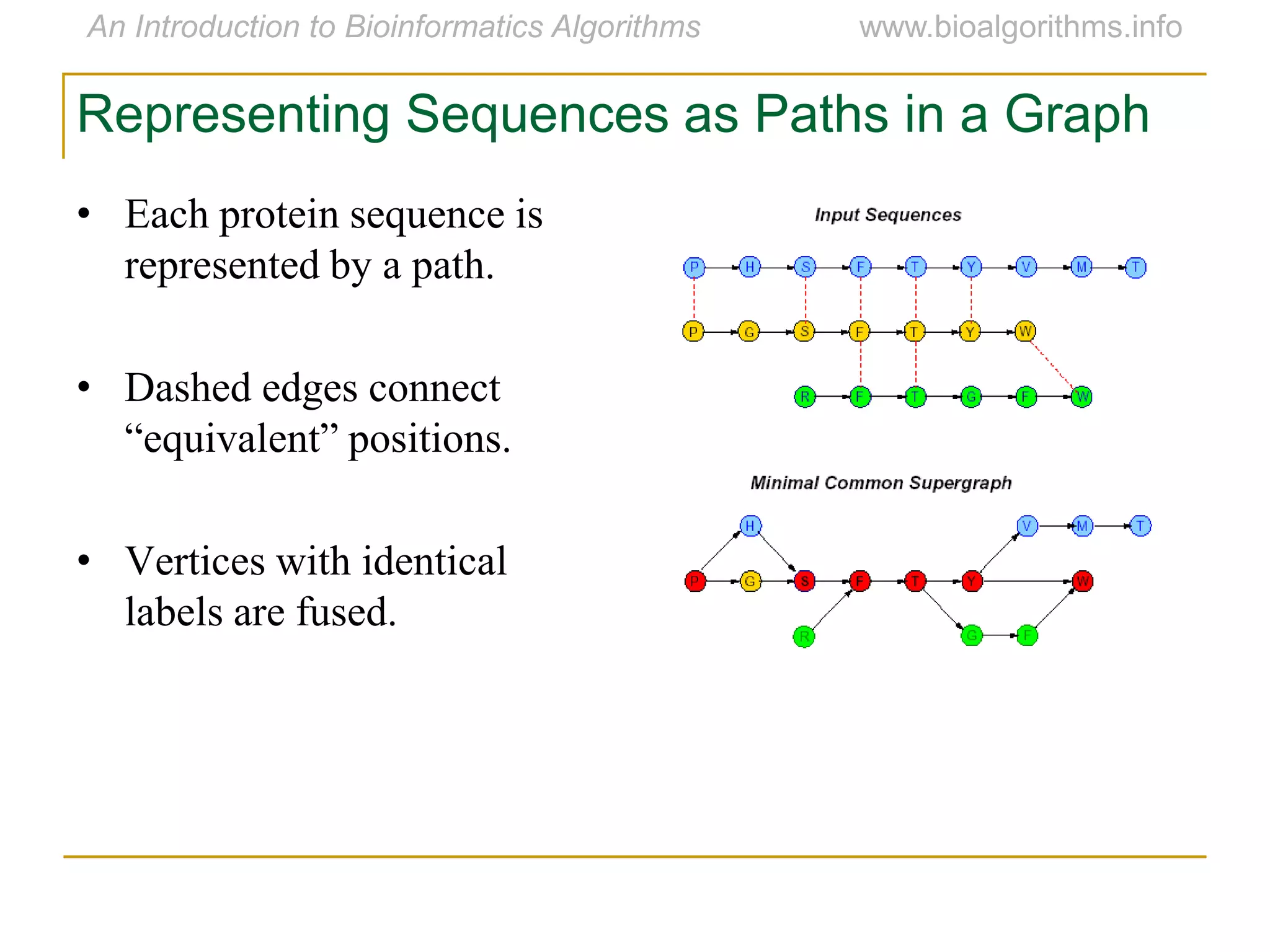
Representing Sequences as Paths in a Graph
• Each protein sequence is
represented by a path.
• Dashed edges connect
“equivalent” positions.
• Vertices with identical
labels are fused.
• Two objectives:
1. Find a graph that represents domain structure
2. Find mapping of each sequence to this graph
• Partial Order Alignment (POA): A graph such that every
sequence in the given set is a path in G.
Partial Order Multiple Alignment
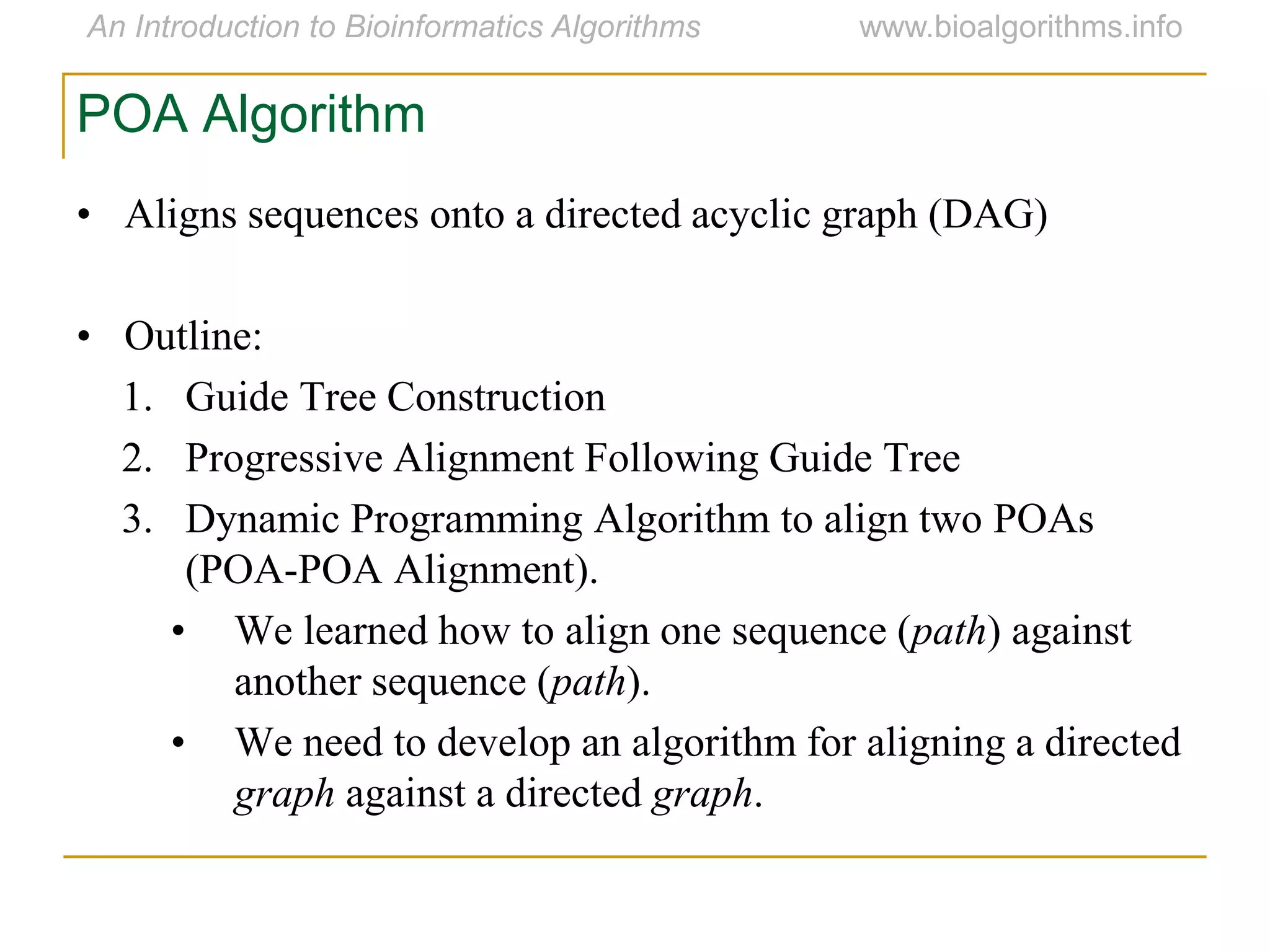
• Aligns sequences onto a directed acyclic graph (DAG)
• Outline:
1. Guide Tree Construction
2. Progressive Alignment Following Guide Tree
3. Dynamic Programming Algorithm to align two POAs
(POA-POA Alignment).
• We learned how to align one sequence (path) against
another sequence (path).
• We need to develop an algorithm for aligning a directed
graph against a directed graph.
POA Algorithm
Dynamic Programming for Aligning Two
Graphs
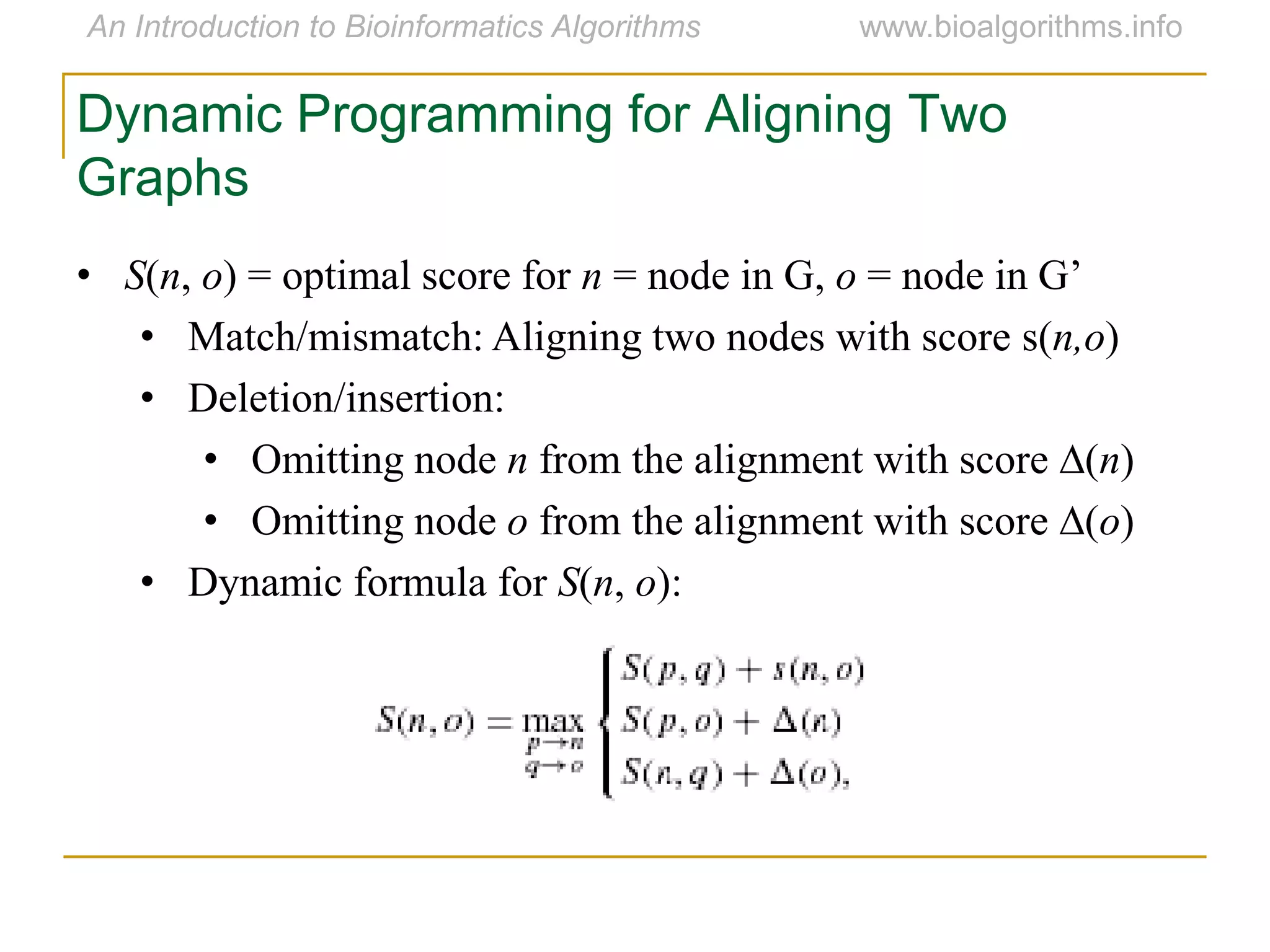
• S(n, o) = optimal score for n = node in G, o = node in G‟
• Match/mismatch: Aligning two nodes with score s(n,o)
• Deletion/insertion:
• Omitting node n from the alignment with score ∆(n)
• Omitting node o from the alignment with score ∆(o)
• Dynamic formula for S(n, o):
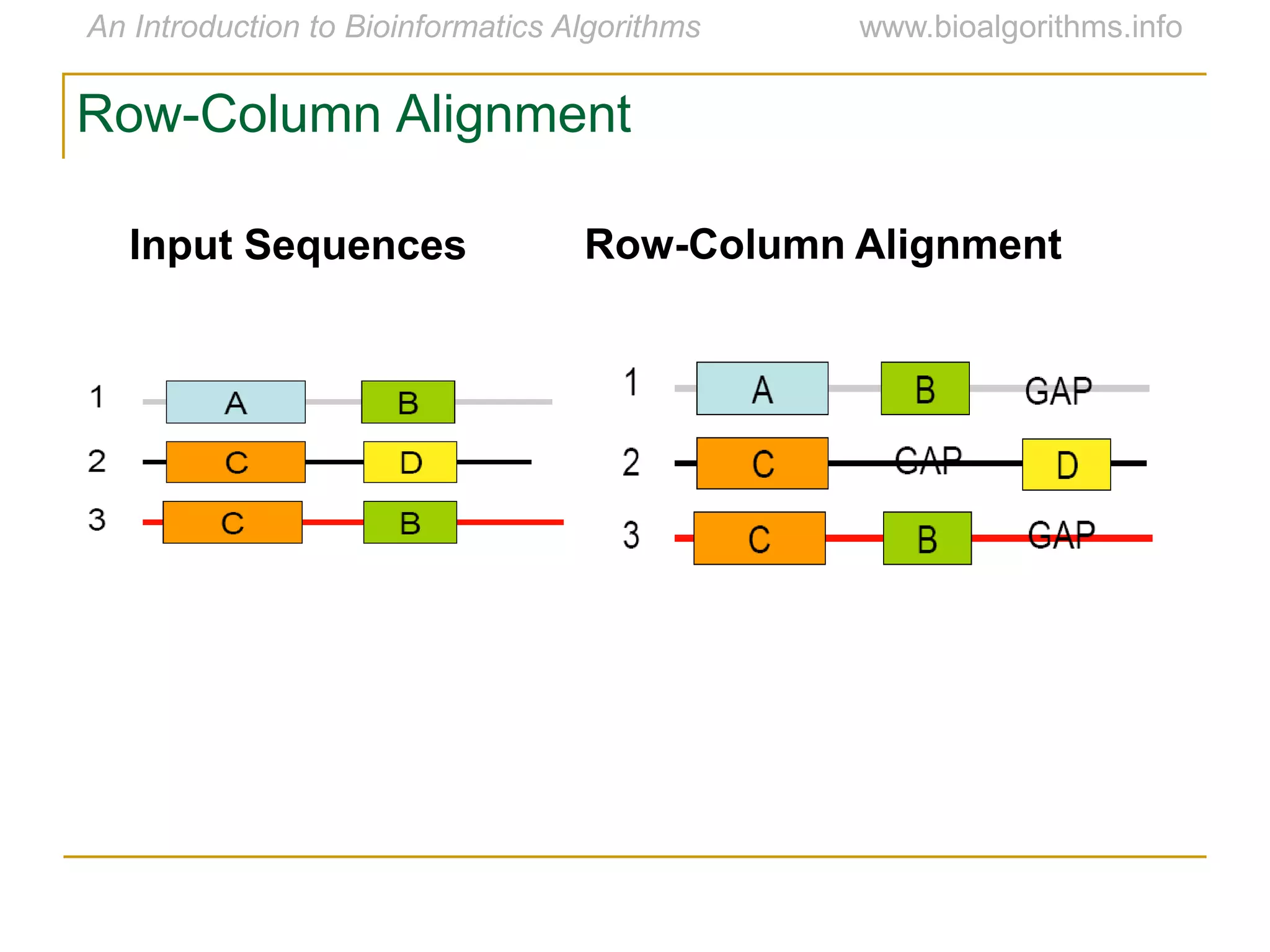
Row-Column AlignmentInput Sequences
Row-Column Alignment
• POA is more flexible: standard methods force sequences to
align linearly.
• POA representation handles gaps more naturally and retains
(and uses) all information in the MSA (unlike linear profiles).
POA Advantages
Section 5:
A-Bruijn Approach to
Multiple Alignment
A-Bruijn Alignment
• A-Bruijn Alignment (ABA): Represents alignment as
directed graph that may contains cycles.
• This is in contrast to POA, which represents alignment as an
acyclic directed graph.
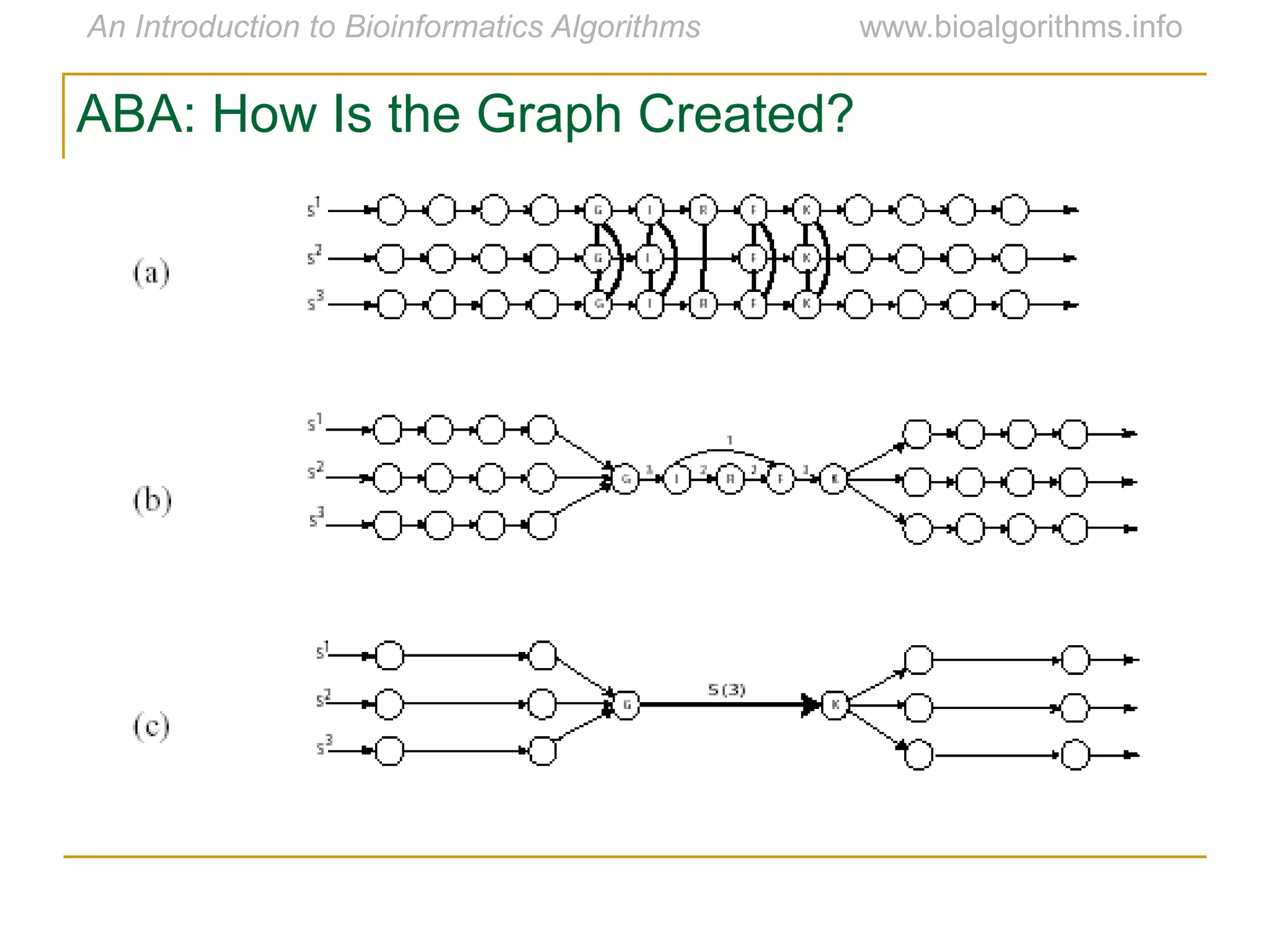
ABA: How Is the Graph Created?
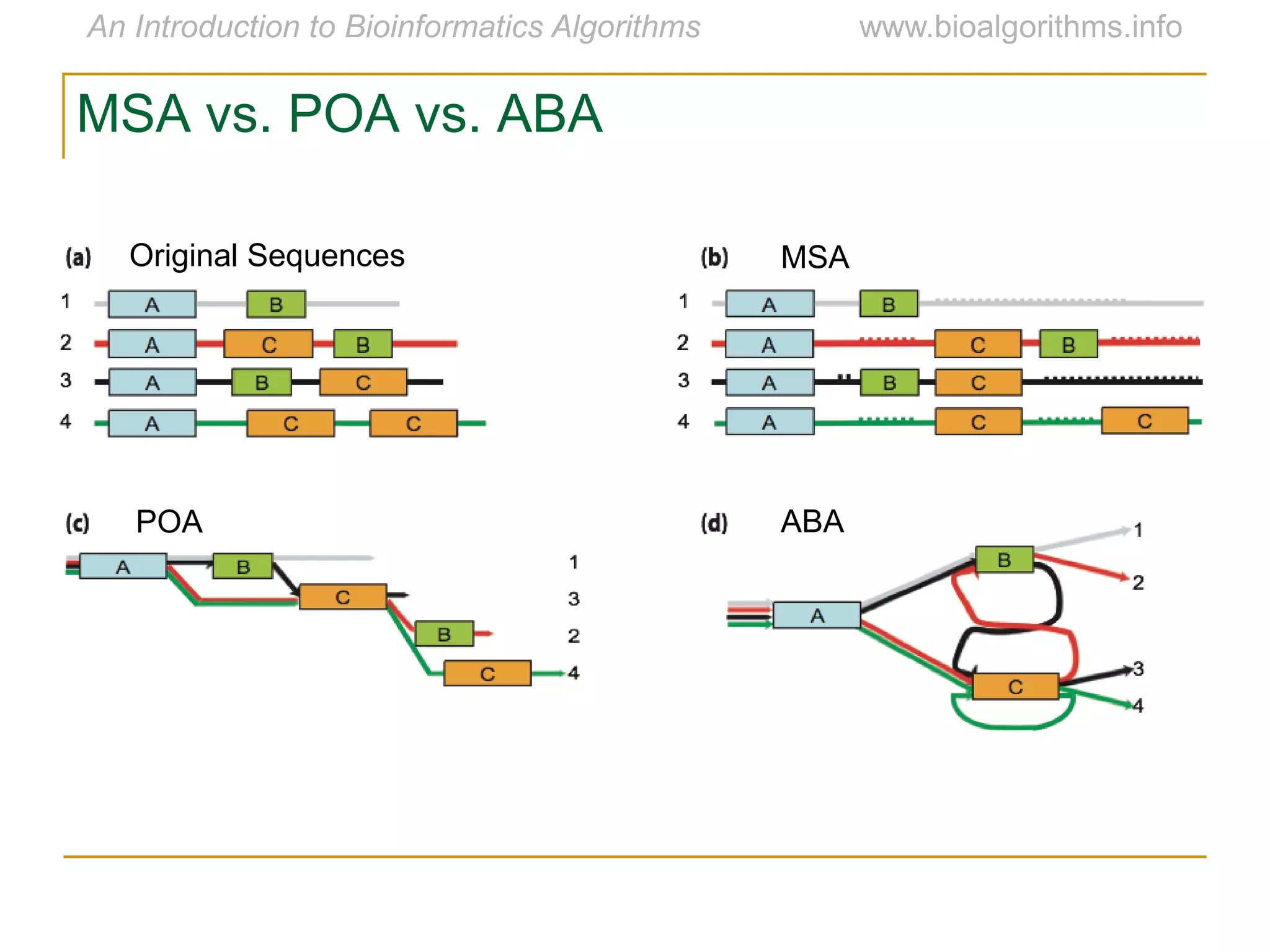
MSA vs. POA vs. ABA
MSAOriginal Sequences
ABAPOA
Advantages of ABA
1. More flexible than POA: allows larger class of evolutionary
relationships between aligned sequences
2. Can align proteins with shuffled and/or repeated domain
structure
3. Can align proteins with domains present in multiple copies in
some proteins
4. Handles:
• Domains not present in all proteins.
• Domains present in different orders in different proteins.
• Chris Lee, POA, UCLA
http://www.bioinformatics.ucla.edu/poa/Poa_Tutorial.html
Credits

Ch06 multalign

  • 1.
  • 2.
    Outline 1. Introduction toMultiple Alignment 2. Progressive Alignment 3. Scoring Multiple Alignments 4. Partial Order Alignment 5. A-Bruijn Approach to Multiple Alignment
  • 3.
    Section 1: Introduction toMultiple Alignment
  • 4.
    Multiple Sequence Alignment(MSA) • Up until now we have only tried to align two sequences.
  • 5.
    Multiple Sequence Alignment(MSA) • Up until now we have only tried to align two sequences. • What about aligning more than two sequences?
  • 6.
    Multiple Sequence Alignment(MSA) • Up until now we have only tried to align two sequences. • What about aligning more than two sequences? • A faint similarity between two sequences becomes significant if it is present in many other sequences.
  • 7.
    Multiple Sequence Alignment(MSA) • Up until now we have only tried to align two sequences. • What about aligning more than two sequences? • A faint similarity between two sequences becomes significant if it is present in many other sequences. • Therefore multiple alignments can reveal subtle similarities that pairwise alignments do not reveal.
  • 8.
    Generalizing Pairwise toMultiple Alignment • Alignment of 2 sequences is represented as a 2-row matrix. • In a similar way, we represent alignment of 3 sequences as a 3-row matrix • Example: A T - G C G - A - C G T - A A T C A C - A • Our scoring function should score alignments with conserved columns higher.
  • 9.
    A A T-- C A -- T G C -- A T G C Alignments = Paths in 3-Space • Say we have 3 sequences to align: ATGC, AATC, ATGC
  • 10.
    0 1 12 3 4 A A T -- C A -- T G C -- A T G C x coordinate Alignments = Paths in 3-Space • Say we have 3 sequences to align: ATGC, AATC, ATGC
  • 11.
    0 1 12 3 4 0 1 2 3 3 4 A A T -- C A -- T G C -- A T G C y coordinate Alignments = Paths in 3-Space • Say we have 3 sequences to align: ATGC, AATC, ATGC x coordinate
  • 12.
    0 1 12 3 4 0 1 2 3 3 4 A A T -- C A -- T G C 0 0 1 2 3 4 -- A T G C x coordinate y coordinate z coordinate Alignments = Paths in 3-Space • Say we have 3 sequences to align: ATGC, AATC, ATGC • Plotting the coordinates gives a path in 3-space:
  • 13.
    0 1 12 3 4 0 1 2 3 3 4 A A T -- C A -- T G C 0 0 1 2 3 4 -- A T G C x coordinate y coordinate z coordinate Alignments = Paths in 3-Space • Say we have 3 sequences to align: ATGC, AATC, ATGC • Plotting the coordinates gives a path in 3-space: • (0,0,0)(1,1,0)(1,2,1) (2,3,2) (3,3,3) (4,4,4)
  • 14.
    Source Sink Alignments = Pathsin 3-Space • Same strategy as aligning two sequences. • Use a 3-D “Manhattan Cube”, with each axis representing a sequence to align. • For global alignments, go from source to sink.
  • 15.
    2-D Alignment Cellversus 3-D Alignment Cell • In 2-D, 3 edges in each unit square • In 3-D, 7 edges in each unit cube 3-D Unit Cube2-D Unit Square
  • 16.
  • 17.
    • si,j,k =max • (x, y, z) is an entry in the 3-D scoring matrix. Cube diagonal: no indels Face diagonal: one indel Edge diagonal: two indels Multiple Alignment: Dynamic Programming si-1,j-1,k-1 + (vi, wj, uk) si-1,j-1,k +  (vi, wj, _ ) si-1,j,k-1 +  (vi, _, uk) si,j-1,k-1 +  (_, wj, uk) si-1,j,k +  (vi, _ , _) si,j-1,k +  (_, wj, _) si,j,k-1 +  (_, _, uk)
  • 18.
    Multiple Alignment: RunningTime • For 3 sequences of length n, the run time is 7n3 = O(n3) • For generalization to k sequences, build a k-dimensional Manhattan graph: • There are nk vertices in this graph. • Each vertex has 2k – 1 edges coming into it. • Therefore, run time = (2k – 1)(nk) = O(2knk) • Conclusion: The dynamic programming approach for alignment between two sequences is easily extended to k sequences but it is impractical due to a run time that is exponential in the number of sequences.
  • 19.
    Multiple Alignment InducesPairwise Alignments • Every multiple alignment induces pairwise alignments • Example: The alignment x: A C - G C G G - C y: A C - G C - G A G z: G C C G C - G A G induces the following three pairwise alignments: x: ACGCGG-C x: AC-GCGG-C y: AC-GCGAG y: ACGC-GAC z: GCCGC-GAG z: GCCGCGAG
  • 20.
    Idea: Construct Multiplefrom Pairwise Alignments • Given k arbitrary pairwise alignments, can we construct a multiple alignment that induces them? • Example: 3 sequence alignment • x = ACGCTGGC, y = ACGCGAC, z = GCCGCAGAG • Say we have optimal pairwise alignments as follows: • Can we construct a multiple alignment that induces them? x: ACGCTGG-C x: AC-GCTGG-C y: AC-GC-GAG y: ACGC--GAC z: GCCGCA-GAG z: GCCGCAGAG
  • 21.
    Idea: Construct Multiplefrom Pairwise Alignments • Given k arbitrary pairwise alignments, can we construct a multiple alignment that induces them? • Example: 3 sequence alignment • x = ACGCTGGC, y = ACGCGAC, z = GCCGCAGAG • Say we have optimal pairwise alignments as follows: • Can we construct a multiple alignment that induces them? • Answer: Not always! x: ACGCTGG-C x: AC-GCTGG-C y: AC-GC-GAG y: ACGC--GAC z: GCCGCA-GAG z: GCCGCAGAG
  • 22.
    Idea: Construct Multiplefrom Pairwise Alignments • From an optimal multiple alignment, we can infer pairwise alignments between all pairs of sequences, but they are not necessarily optimal. • Likewise, it is difficult to infer a “good” multiple alignment from optimal pairwise alignments between all sequences.
  • 23.
    Idea: Construct Multiplefrom Pairwise Alignments • Example 1: Can combine pairwise alignments into optimal multiple alignment. • Example 2: Can not combine pairwise alignments into optimal multiple alignment.
  • 24.
    - A GG C T A T C A C C T G T A G – C T A C C A - - - G C A G – C T A C C A - - - G C A G – C T A T C A C – G G C A G – C T A T C G C – G G A 1 1 .8 C .6 1 .4 1 .6 .2 G 1 .2 .2 .4 1 T .2 1 .6 .2 - .2 .8 .4 .8 .4 Profile Representation of Multiple Alignment
  • 25.
    Profile Representation ofMultiple Alignment • In the past we were aligning a sequence against a sequence. - A G G C T A T C A C C T G T A G – C T A C C A - - - G C A G – C T A C C A - - - G C A G – C T A T C A C – G G C A G – C T A T C G C – G G A 1 1 .8 C .6 1 .4 1 .6 .2 G 1 .2 .2 .4 1 T .2 1 .6 .2 - .2 .8 .4 .8 .4
  • 26.
    Profile Representation ofMultiple Alignment • In the past we were aligning a sequence against a sequence. • Can we align a sequence against a profile? - A G G C T A T C A C C T G T A G – C T A C C A - - - G C A G – C T A C C A - - - G C A G – C T A T C A C – G G C A G – C T A T C G C – G G A 1 1 .8 C .6 1 .4 1 .6 .2 G 1 .2 .2 .4 1 T .2 1 .6 .2 - .2 .8 .4 .8 .4
  • 27.
    Profile Representation ofMultiple Alignment • In the past we were aligning a sequence against a sequence. • Can we align a sequence against a profile? • Can we align a profile against a profile? - A G G C T A T C A C C T G T A G – C T A C C A - - - G C A G – C T A C C A - - - G C A G – C T A T C A C – G G C A G – C T A T C G C – G G A 1 1 .8 C .6 1 .4 1 .6 .2 G 1 .2 .2 .4 1 T .2 1 .6 .2 - .2 .8 .4 .8 .4
  • 28.
    • Choose themost similar pair of strings and combine them into a profile, thereby reducing alignment of k sequences to an alignment of of k – 1 sequences/profiles. • Then repeat. • This is a heuristic (greedy) method. u1= ACGTACGTACGT… u2 = TTAATTAATTAA… u3 = ACTACTACTACT… … uk = CCGGCCGGCCGG u1= ACg/tTACg/tTACg/cT… u2 = TTAATTAATTAA… … uk = CCGGCCGGCCGG… k k – 1 Multiple Alignment: Greedy Approach
  • 29.
    Greedy Approach: Example •Consider the 4 sequences: GATTCA, GTCTGA, GATATT, GTCAGC
  • 30.
    • Consider the4 sequences: GATTCA, GTCTGA, GATATT, GTCAGC. • There are = 6 possible pairwise alignments:      2 4 s2 GTCTGA s4 GTCAGC (score = 2) s1 GAT-TCA s2 G-TCTGA (score = 1) s1 GAT-TCA s3 GATAT-T (score = 1) s1 GATTCA-- s4 G—T-CAGC (score = 0) s2 G-TCTGA s3 GATAT-T (score = -1) s3 GAT-ATT s4 G-TCAGC (score = -1) Greedy Approach: Example
  • 31.
    • s2 ands4 are closest, so we consolidate these sequences into one by using the profile matrix: • New set of 3 sequences to align: • We can choose either of the nucleotides in question for s2, 4. s2 GTCTGA s4 GTCAGC s2,4 = GTCt/aGa/cA s1 GATTCA s3 GATATT s2,4 GTCt/aGa/c Greedy Approach: Example
  • 32.
  • 33.
    Progressive Alignment • Progressivealignment: A variation of the greedy algorithm for multiple alignment with a somewhat more intelligent strategy for choosing the order of alignments. • Progressive alignment works well for close sequences, but deteriorates for distant sequences. • Gaps in consensus string are permanent. • Use profiles to compare sequences.
  • 34.
    ClustalW • Popular multiplealignment tool today. • „W‟ stands for „weighted‟ (different parts of alignment are weighted differently). • Three-step process: 1. Construct pairwise alignments. 2. Build guide tree. 3. Progressive alignment guided by the tree.
  • 35.
    v1 v2 v3v4 v1 - v2 .17 - v3 .87 .28 - v4 .59 .33 .62 - (.17 means 17 % identical) Step 1: Pairwise Alignment • Aligns each sequence against each other, giving a similarity matrix. • Similarity = exact matches / sequence length (percent identity).
  • 36.
    Step 2: GuideTree • Create guide tree using the similarity matrix. • ClustalW uses the neighbor-joining method, • Guide tree roughly reflects evolutionary relations. v1 v2 v3 v4 v1 - v2 .17 - v3 .87 .28 - v4 .59 .33 .62 - v1 v3 v4 v2
  • 37.
    FOS_RAT PEEMSVTS-LDLTGGLPEATTPESEEAFTLPLLNDPEPK-PSLEPVKNISNMELKAEPFD FOS_MOUSE PEEMSVAS-LDLTGGLPEASTPESEEAFTLPLLNDPEPK-PSLEPVKSISNVELKAEPFD FOS_CHICKSEELAAATALDLG----APSPAAAEEAFALPLMTEAPPAVPPKEPSG--SGLELKAEPFD FOSB_MOUSE PGPGPLAEVRDLPG-----STSAKEDGFGWLLPPPPPPP-----------------LPFQ FOSB_HUMAN PGPGPLAEVRDLPG-----SAPAKEDGFSWLLPPPPPPP-----------------LPFQ . . : ** . :.. *:.* * . * **: Dots and stars show how well-conserved a column is Step 3: Progressive Alignment • Start by aligning the two most similar sequences. • Following the guide tree, add in the next sequences, aligning to the existing alignment. • Insert gaps as necessary.
  • 38.
  • 39.
    Multiple Alignments: Scoring •We will discuss three possible scoring systems: 1. Number of matches (multiple longest common subsequence score) 2. Entropy score 3. Sum of pairs (SP-Score)
  • 40.
    • A columnis a “match” if all the letters in the column are the same. • Example: Only the first column in the following matching represents a “match:” • The Multiple LCS score is the total number of matches. • This score is good for very similar sequences. A A A A A A A A T A T C Score # 1: Multiple LCS Score
  • 41.
    Score # 2:Entropy Score • Define frequencies px for the occurrence of each letter x in each column of the multiple alignment. • Then, compute “entropy” of each column. • The entropy score is then given by the sum of the entropies of all the columns. Entropy of Column =    CGTAX XX pp ,,, log
  • 42.
    Entropy: Example • Forour sequences {AAA, AAA, AAT, ATC}:
  • 43.
    Entropy: Example • Forour sequences {AAA, AAA, AAT, ATC}: • 1st Column: pA = 1, pT= pG= pC= 0 Entropy = 0
  • 44.
    Entropy: Example • Forour sequences {AAA, AAA, AAT, ATC}: • 1st Column: pA = 1, pT= pG= pC= 0 • 2nd Column: pA = 0.75, pT = 0.25, pG= pC= 0 Entropy = 0 Entropy = 0.56
  • 45.
    Entropy: Example • Forour sequences {AAA, AAA, AAT, ATC}: • 1st Column: pA = 1, pT= pG= pC= 0 • 2nd Column: pA = 0.75, pT = 0.25, pG= pC= 0 • 3rd Column: pA = 0.50, pT = 0.25, pC= 0.25, pG= 0 Entropy = 0 Entropy = 0.56 Entropy = 1.04
  • 46.
    Entropy: Example • Forour sequences {AAA, AAA, AAT, ATC}: • 1st Column: pA = 1, pT= pG= pC= 0 • 2nd Column: pA = 0.75, pT = 0.25, pG= pC= 0 • 3rd Column: pA = 0.50, pT = 0.25, pC= 0.25, pG= 0 • Entropy Score = 0 + 0.56 + 1.04 = 1.60 Entropy = 0 Entropy = 0.56 Entropy = 1.04
  • 47.
    0               A A A A entropy Entropy: Interpretation • Themore similar the members of a column, the lower the entropy score. • Example: Best and worst cases: • Therefore, if we are searching for the best multiple alignment, we will want to minimize the entropy score.
  • 48.
    Inferring Pairwise fromMultiple Alignments • Recall: Every multiple alignment induces pairwise alignments. • From a multiple alignment, we can infer pairwise alignments between all sequences, but they are not necessarily optimal. • We can view reducing multiple alignments to pairwise alignments as projecting a 3-D multiple alignment path onto a 2-D face of the cube • Our third scoring function for MSA will be based off the projections.
  • 49.
    Multiple Alignment Projections:Illustration • A 3-D alignment can be projected onto the 2-D plane to represent an alignment between a pair of sequences. • Example: Figure at right. • Solid line: represents a 3-D alignment path. • Dashed lines: represent the three induced pairwise alignments that are projected onto the cube‟s faces.
  • 50.
    • Consider thepairwise alignment of sequences ai and aj implied from a multiple alignment of k sequences. • Denote the score of this (not necessarily optimal) pairwise alignment as s*(ai, aj). • Sum of Pairs (SP) Score: Obtained by summing the pairwise scores: s(a1,…,ak) = Σi,j s*(ai, aj) Score 3: Sum of Pairs Score (SP-Score)
  • 51.
    Multiple Alignment: History •1975: Sankoff formulates multiple alignment problem and gives the dynamic programming solution. • 1988: Carrillo and Lipman provide branch and bound approach for Multiple Alignment. David Sankoff David Lipman
  • 52.
    Multiple Alignment: History •1990: Feng and Doolittle develop progressive alignment. • 1994: Thompson, Higgins, and Gibson create ClustalW, which is the most popular multiple alignment program in the world. Des HigginsJulie Thompson Toby Gibson Russell Doolittle
  • 53.
    Multiple Alignment: History •1998: Morgenstern et al. create DIALIGN, an algorithm for segment-based multiple alignment. • 2000: Notredame, Des Higgins, and Heringa develop T-Coffee, which aligns multiple sequences based off a library of pairwise alignments. Burkhard Morgenstern Cedric Notredame JaapHeringa
  • 54.
    Multiple Alignment: History •2004: Robert Edgar formulates MUSCLE, a faster and more efficient algorithm than ClustalW. • 201X: What is next?
  • 55.
    Problems with MultipleAlignment • Multidomain proteins evolve not only through point mutations but also through domain duplications and domain recombinations. • Although Multiple Alignment is a 30 year old problem, there were no approaches for aligning rearranged sequences (i.e., multi-domain proteins with shuffled domains) prior to 2002. • It is often impossible to align all protein sequences throughout their entire length.
  • 56.
  • 57.
    Alignment as aGraph • Conventional Alignment • Protein sequence as a path • Two protein sequence paths • Combination of two protein graphs into one graph
  • 58.
    Representing Sequences asPaths in a Graph • Each protein sequence is represented by a path. • Dashed edges connect “equivalent” positions. • Vertices with identical labels are fused.
  • 59.
    • Two objectives: 1.Find a graph that represents domain structure 2. Find mapping of each sequence to this graph • Partial Order Alignment (POA): A graph such that every sequence in the given set is a path in G. Partial Order Multiple Alignment
  • 60.
    • Aligns sequencesonto a directed acyclic graph (DAG) • Outline: 1. Guide Tree Construction 2. Progressive Alignment Following Guide Tree 3. Dynamic Programming Algorithm to align two POAs (POA-POA Alignment). • We learned how to align one sequence (path) against another sequence (path). • We need to develop an algorithm for aligning a directed graph against a directed graph. POA Algorithm
  • 61.
    Dynamic Programming forAligning Two Graphs • S(n, o) = optimal score for n = node in G, o = node in G‟ • Match/mismatch: Aligning two nodes with score s(n,o) • Deletion/insertion: • Omitting node n from the alignment with score ∆(n) • Omitting node o from the alignment with score ∆(o) • Dynamic formula for S(n, o):
  • 62.
  • 63.
    • POA ismore flexible: standard methods force sequences to align linearly. • POA representation handles gaps more naturally and retains (and uses) all information in the MSA (unlike linear profiles). POA Advantages
  • 64.
    Section 5: A-Bruijn Approachto Multiple Alignment
  • 65.
    A-Bruijn Alignment • A-BruijnAlignment (ABA): Represents alignment as directed graph that may contains cycles. • This is in contrast to POA, which represents alignment as an acyclic directed graph.
  • 66.
    ABA: How Isthe Graph Created?
  • 67.
    MSA vs. POAvs. ABA MSAOriginal Sequences ABAPOA
  • 68.
    Advantages of ABA 1.More flexible than POA: allows larger class of evolutionary relationships between aligned sequences 2. Can align proteins with shuffled and/or repeated domain structure 3. Can align proteins with domains present in multiple copies in some proteins 4. Handles: • Domains not present in all proteins. • Domains present in different orders in different proteins.
  • 69.
    • Chris Lee,POA, UCLA http://www.bioinformatics.ucla.edu/poa/Poa_Tutorial.html Credits