Protein Data Bank
Mr. Kamble Sainath Hanmant
Assistant Professor in Microbiology
D.B.F.Dayanand College of Arts And Science, Solapur
 The PDB was established in 1971 at Brookhaven National
Laboratory and originally contained 7 structures.
 In 1998, the Research Collaboratory for Structural
Bioinformatics (RCSB) became responsible for the
management of the PDB.
 In 2003, the wwPDB was formed to maintain a single PDB
archive of macromolecular structural data that is freely and
publicly available to the global community.
 It consists of organizations that act as deposition, data
processing and distribution centers for PDB data.
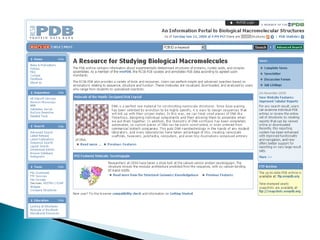
 The Protein Data Bank (PDB) is a repository for the 3-D
structural data of large biological molecules, such
as proteins and nucleic acids.
 The Protein Data Bank (PDB) is the single worldwide archive of 3D
structural Data of biological Macromolecules, including proteins
and nucleic acids.
 These are the molecules of life that are found in all organisms
including bacteria, yeast, plants, flies, other animals, and humans.
 Understanding the shape of a molecule helps to understand how it
works. This knowledge can be used to help deduce a structure's role
in human health and disease, and in drug development.
 The data, is typically obtained by X-ray
crystallography or NMR spectroscopy and submitted by
biologists and biochemists from around the world, are freely
accessible on the Internet via the websites of its member
organisations (PDBe, PDBj, and RCSB).
 These data show that most structures are determined by X-ray
diffraction(85%) , but about 15% of structures are now
determined by protein NMR.
 When using X-ray diffraction, approximations of the coordinates
of the atoms of the protein are obtained, whereas estimations of
the distances between pairs of atoms of the protein are found
through NMR experiments.
 Therefore, the final conformation of the protein is obtained.
 In the latter case, by solving a distance geometry problem.
 A few proteins are determined by cryo-electron microscopy.
 Currently it holds 40,000 released structures
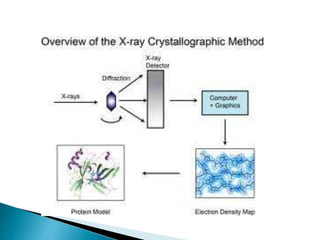
 X-ray crystallography is a method used for determining
the atomic and molecular structure of a crystal, in which
the crystalline atoms cause a beam of X-
rays to diffract into many specific directions.
 By measuring the angles and intensities of these diffracted
beams, a crystallographer can produce a three-dimensional
picture of the density of electrons within the crystal.
 The PDB is overseen by an organization called the Worldwide
Protein Data Bank, wwPDB.
 The Worldwide Protein Data Bank (wwPDB) consists of
organizations that act as deposition, data processing and
distribution centers for PDB data.
 Founding Members are: RCSB (Research Collaboratory for
Structural Bioinformatics)PDB (USA), PDBe (Europe)
and PDBj (Japan), and BMRB (Biological Magnetic
Resonance Data Bank, USA)
The wwPDB's mission is to maintain a single PDB archive of macromolecular structural
data that is freely and publicly available to the global community.
THE WORLDWIDE PROTEIN DATA BANK (wwPDB)
Joined with
RESEARCH COLLABORATORY FOR STRUCTURAL BIOINFORMATICS
PROTEIN DATA BANK (RCSB PDB), Piscataway New Jersey, , and La Jolla California
and
PROTEIN DATA BANK IN EUROPE (PDBe), Hinxton United Kingdom
and
PROTEIN DATA BANK JAPAN, Osaka Japan
and
BIOLOGICAL MAGNETIC RESONANCE BANK (BMRB), Madison Wisconsin
United States
 The PDB is a key resource in areas of structural biology, such
as structural genomics.
 Most major scientific journals, and some funding agencies, such
as the NIH in the USA, now require scientists to submit their
structure data to the PDB.
 If the contents of the PDB are thought of as primary data, then
there are hundreds of derived (i.e., secondary) databases that
categorize the data differently.
 The PDB database is updated weekly (UTC+0 Wednesday).
Likewise, the PDB holdings list is also updated weekly.
 Users are a very diverse group of researchers in biology,
chemistry and computer scientists, educators, and students at
all levels.
 The tremendous influx of data soon to be fueled by the
structural genomics initiative, and the increased recognition of
the value of the data toward understanding biological function,
demand new ways to collect, organize and distribute the data.
 A model defines the 3D positions of atoms
in one or more molecules.
 There are models of proteins, protein
complexes, proteins and DNA, protein
segments, etc …
 The models also include the positions of
ligand molecules, solvent molecules, metal
ions, etc.
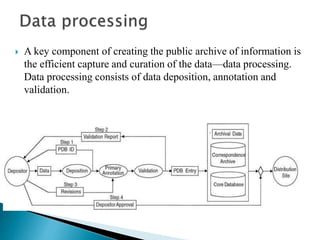
 A key component of creating the public archive of information is
the efficient capture and curation of the data—data processing.
Data processing consists of data deposition, annotation and
validation.

Bioinformatics

  • 1.
    Protein Data Bank Mr.Kamble Sainath Hanmant Assistant Professor in Microbiology D.B.F.Dayanand College of Arts And Science, Solapur
  • 2.
     The PDBwas established in 1971 at Brookhaven National Laboratory and originally contained 7 structures.  In 1998, the Research Collaboratory for Structural Bioinformatics (RCSB) became responsible for the management of the PDB.  In 2003, the wwPDB was formed to maintain a single PDB archive of macromolecular structural data that is freely and publicly available to the global community.  It consists of organizations that act as deposition, data processing and distribution centers for PDB data.
  • 3.
     The ProteinData Bank (PDB) is a repository for the 3-D structural data of large biological molecules, such as proteins and nucleic acids.  The Protein Data Bank (PDB) is the single worldwide archive of 3D structural Data of biological Macromolecules, including proteins and nucleic acids.  These are the molecules of life that are found in all organisms including bacteria, yeast, plants, flies, other animals, and humans.  Understanding the shape of a molecule helps to understand how it works. This knowledge can be used to help deduce a structure's role in human health and disease, and in drug development.
  • 4.
     The data,is typically obtained by X-ray crystallography or NMR spectroscopy and submitted by biologists and biochemists from around the world, are freely accessible on the Internet via the websites of its member organisations (PDBe, PDBj, and RCSB).  These data show that most structures are determined by X-ray diffraction(85%) , but about 15% of structures are now determined by protein NMR.  When using X-ray diffraction, approximations of the coordinates of the atoms of the protein are obtained, whereas estimations of the distances between pairs of atoms of the protein are found through NMR experiments.  Therefore, the final conformation of the protein is obtained.
  • 5.
     In thelatter case, by solving a distance geometry problem.  A few proteins are determined by cryo-electron microscopy.  Currently it holds 40,000 released structures  X-ray crystallography is a method used for determining the atomic and molecular structure of a crystal, in which the crystalline atoms cause a beam of X- rays to diffract into many specific directions.  By measuring the angles and intensities of these diffracted beams, a crystallographer can produce a three-dimensional picture of the density of electrons within the crystal.
  • 7.
     The PDBis overseen by an organization called the Worldwide Protein Data Bank, wwPDB.  The Worldwide Protein Data Bank (wwPDB) consists of organizations that act as deposition, data processing and distribution centers for PDB data.  Founding Members are: RCSB (Research Collaboratory for Structural Bioinformatics)PDB (USA), PDBe (Europe) and PDBj (Japan), and BMRB (Biological Magnetic Resonance Data Bank, USA)
  • 8.
    The wwPDB's missionis to maintain a single PDB archive of macromolecular structural data that is freely and publicly available to the global community. THE WORLDWIDE PROTEIN DATA BANK (wwPDB) Joined with RESEARCH COLLABORATORY FOR STRUCTURAL BIOINFORMATICS PROTEIN DATA BANK (RCSB PDB), Piscataway New Jersey, , and La Jolla California and PROTEIN DATA BANK IN EUROPE (PDBe), Hinxton United Kingdom and PROTEIN DATA BANK JAPAN, Osaka Japan and BIOLOGICAL MAGNETIC RESONANCE BANK (BMRB), Madison Wisconsin United States
  • 9.
     The PDBis a key resource in areas of structural biology, such as structural genomics.  Most major scientific journals, and some funding agencies, such as the NIH in the USA, now require scientists to submit their structure data to the PDB.  If the contents of the PDB are thought of as primary data, then there are hundreds of derived (i.e., secondary) databases that categorize the data differently.  The PDB database is updated weekly (UTC+0 Wednesday). Likewise, the PDB holdings list is also updated weekly.
  • 10.
     Users area very diverse group of researchers in biology, chemistry and computer scientists, educators, and students at all levels.  The tremendous influx of data soon to be fueled by the structural genomics initiative, and the increased recognition of the value of the data toward understanding biological function, demand new ways to collect, organize and distribute the data.
  • 12.
     A modeldefines the 3D positions of atoms in one or more molecules.  There are models of proteins, protein complexes, proteins and DNA, protein segments, etc …  The models also include the positions of ligand molecules, solvent molecules, metal ions, etc.
  • 13.
     A keycomponent of creating the public archive of information is the efficient capture and curation of the data—data processing. Data processing consists of data deposition, annotation and validation.