Prepared By : Renu Juneja
Date: 28/02/2017
PRESENTATION ON COMMERCIAL PRODUCTION
OF ANTIBIOTICS & PENICILLIN-G
1. Introduction of Antibiotics.
2. Commercial Production of Antibiotics.
3. Process Description
4. Introduction of Penicillin G (Benzyl-Penicillin)
5. Biosynthesis of Benzyl-Penicillin
6. Production of Penicillin G (Benzyl-Penicillin)
7. Process Description
8. PFD
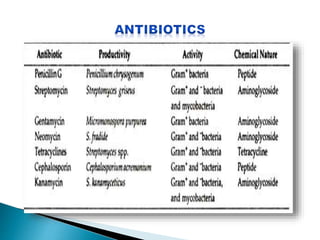
 Antibiotics are chemical substances that can inhibit the
growth of, and even destroy, harmful microorganisms.
They are derived from special microorganisms or other
living systems, and are produced on an industrial scale
using a fermentation process.
 The first antibiotic was discovered in 1896 by Ernest-
Duchesne and "rediscovered" by Alexander-
Flemming in 1928 from the filamentous fungus
Penicilium-notatum.
Antibiotics are used in many forms:
 For bacterial infections on the skin surface, eye, or ear,
an antibiotic may be applied as an ointment or cream.
 If the infection is internal, the antibiotic can be swallowed
or injected directly into the body. The antibiotic is
delivered throughout the body by absorption into the
bloodstream.
Inoculum:
 A small amount of material containing bacteria,
viruses, or other microorganisms that is used to
start a culture.
 A high yielding strain (Bacteria) is a prerequisite for
antibiotic production.
 The Inoculum is prepared usually in the form of a spore
suspension, which is transferred into the fermenter.
Fermenter / Bioreactor:
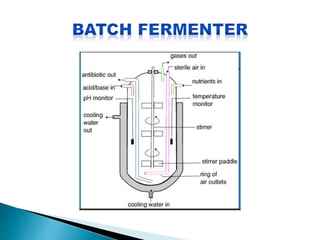
 Antibiotic are generally produced in stainless steel fermenters
used in the batch or fed mode, see in figure below.
 Water cooling is often used to maintain the temperature
between 24-26° C.
 Generally, the fermenter is maintained at above atmospheric
pressure which reduces contamination risk and enhances
O2 supply.
 The final stage fermenter is preferably used for antibiotic
production for the longest period.
 Initial stages of fermentation are designed for
considerable microbial growth; these are carried out in
seed stage fermenters of smaller size.
 One or more seed stages may be used, depending on the
process and the strain, to produce the maximum amount
of biomass.
Flow Diagram
Production Medium:
 Antibiotic production employs a variety of media, a
different one for each stage of operation.
 In some cases, a suitable precursor for the antibiotic is
also provided.
List of Media for different stages
Process Description:
 The production fermenter is run in a fed batch
mode in which a nutrient e.g., glucose is added
continuously throughout the fermentation to
enhance the duration of antibiotic production.
 This is accompanied by withdrawal of small
volumes of broth to check increase in volume of
the broth in the fermenter.
 Antifoaming agents are added at the appropriate
stage of fermentation.
 Selected microbiological, physical and chemical features
are monitored during the fermentation in order to
achieve proper control.
 At the end of final production stage incubation, the broth
contains only a low concentration (3-35% If the total
solutes in the broth) of the antibiotic.
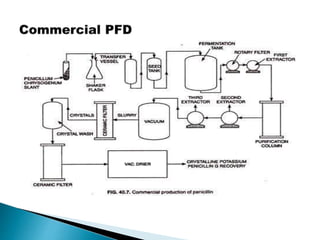
 Antibiotic recovery is done by separation of cells from
the broth by filtration or centrifugation which is followed
by purification.
 What Is Penicillin?:
A class of antibiotics that comes from mold (fungi).
Discovered by accident in 1928 by Alexander Fleming, is
the first antibiotic called Penicillin.
 Benzyl-penicillin, also known as penicillin G, is
an antibiotic used to treat a number
of bacterial infections.
 Penicillin (PCN or pen) is a group of antibiotics which
include penicillin G (intravenous use), penicillin V (use
by mouth), procaine penicillin, and benzathine
penicillin (intramuscular use).
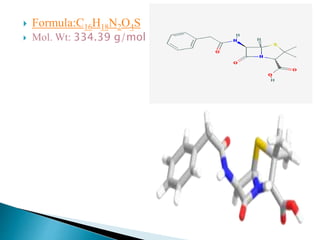
 Formula:C16H18N2O4S
 Mol. Wt: 334.39 g/mol
 The sulfur and nitrogen of the five-
membered thiazolidine ring are shown in yellow and
blue respectively.
 The image shows that the thiazolidine ring and fused
four-membered β-lactam are not in the same plane.
 The key structural feature of the penicillins is the
four-membered β-lactam ring; this structural moiety is
essential for penicillin's antibacterial activity.
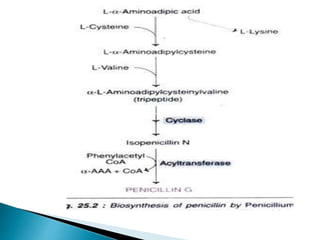
 Three main and important steps to the biosynthesis
of Penicillin G (benzyl-penicillin).
 The first step is the condensation of three amino acids L-
α-aminoadipic acid,L-cysteine L-valine into a tripeptide.
 Before condensing into the tripeptide, the amino acid L-
valine must undergo epimerization to become D-valine.
 The condensed tripeptide is named δ-(L-α-aminoadipyl)-
L-cysteine-D-valine (ACV).
 The second step in the biosynthesis of penicillin G is
the oxidative conversion of linear ACV into the bicyclic
intermediate isopenicillin N.
 Isopenicillin N is a very weak intermediate, because it
does not show strong antibiotic activity.
 The final step is a transamidation by isopenicillin N N-
acyltransferase, in which the α-aminoadipyl side-chain of
isopenicillin N is removed and exchanged for a
phenylacetyl side-chain.
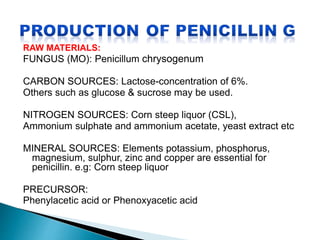
RAW MATERIALS:
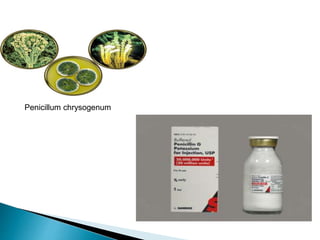
FUNGUS (MO): Penicillum chrysogenum
CARBON SOURCES: Lactose-concentration of 6%.
Others such as glucose & sucrose may be used.
NITROGEN SOURCES: Corn steep liquor (CSL),
Ammonium sulphate and ammonium acetate, yeast extract etc
MINERAL SOURCES: Elements potassium, phosphorus,
magnesium, sulphur, zinc and copper are essential for
penicillin. e.g: Corn steep liquor
PRECURSOR:
Phenylacetic acid or Phenoxyacetic acid
 Like all antibiotics, penicillin is a secondary metabolite.
 Primary metabolites are produced during active cell
growth, and secondary metabolites are produced near
the onset of stationary phase.
 The industrial production of penicillin was broadly
classified in to two processes namely, Upstream
processing Downstream processing
 UPSTREAM PROCESSING :
It encompasses any technology that leads to the
synthesis of a product. Upstream includes the
exploration, development and production.
 The medium is designed to provide the organism with all
the nutrients that it requires. Inoculation method-
submerged technique Spores -major source of inoculum.
 DOWNSTREAM PROCESSING:
 The extraction and purification of a biotechnological
product from fermentation is referred to as downstream
processing.
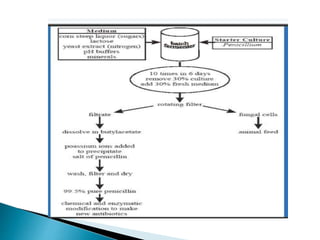
 The medium is inoculated with a suspension of conidia
of Penicillium chrysogenum. The medium is constantly
aerated and agitated, and the mould grows throughout
as pellets.
 After about seven days, growth is complete, the pH rises
to 8.0 or above, and penicillin production ceases.
 Downstream processing is relatively easy since penicillin
is secreted into the medium.
 Removal of cells:
The first step in product recovery is the separation of
whole cells and other insoluble ingredients from the
culture broth by technique such as filtration and
centrifugation.
 The product needs to be very pure, since it being used
as a therapeutic medical drug, so it is dissolved and then
precipitated as a potassium salt to separate it from other
substances in the medium.
ISOLATION OF BENZYL PENICILLIN:
 The PH is adjusted to 2-2.5 with the help of phosphoric
or sulphuric acids.
 In aqueous solution at low PH values there is a partition
coefficient in favor of certain organic solvents such as
butyl acetate.
 This step has to be carried out quickly for penicillin is
very unstable at low PH values.
 Antibiotic is then extracted back into an aqueous buffer
at a PH of 7.5, the partition coefficient now being
strongly in favor of the aqueous phase.
 The resulting aqueous solution is again acidified & re-
extracted with an organic solvent.
 These shifts between the water and solvent help in the
purification of penicillin.
Penicillum chrysogenum
THANK YOU

Penicillin g production

  • 1.
    Prepared By :Renu Juneja Date: 28/02/2017 PRESENTATION ON COMMERCIAL PRODUCTION OF ANTIBIOTICS & PENICILLIN-G
  • 2.
    1. Introduction ofAntibiotics. 2. Commercial Production of Antibiotics. 3. Process Description 4. Introduction of Penicillin G (Benzyl-Penicillin) 5. Biosynthesis of Benzyl-Penicillin 6. Production of Penicillin G (Benzyl-Penicillin) 7. Process Description 8. PFD
  • 3.
     Antibiotics arechemical substances that can inhibit the growth of, and even destroy, harmful microorganisms. They are derived from special microorganisms or other living systems, and are produced on an industrial scale using a fermentation process.  The first antibiotic was discovered in 1896 by Ernest- Duchesne and "rediscovered" by Alexander- Flemming in 1928 from the filamentous fungus Penicilium-notatum.
  • 4.
    Antibiotics are usedin many forms:  For bacterial infections on the skin surface, eye, or ear, an antibiotic may be applied as an ointment or cream.  If the infection is internal, the antibiotic can be swallowed or injected directly into the body. The antibiotic is delivered throughout the body by absorption into the bloodstream.
  • 6.
    Inoculum:  A smallamount of material containing bacteria, viruses, or other microorganisms that is used to start a culture.  A high yielding strain (Bacteria) is a prerequisite for antibiotic production.  The Inoculum is prepared usually in the form of a spore suspension, which is transferred into the fermenter.
  • 7.
    Fermenter / Bioreactor: Antibiotic are generally produced in stainless steel fermenters used in the batch or fed mode, see in figure below.  Water cooling is often used to maintain the temperature between 24-26° C.  Generally, the fermenter is maintained at above atmospheric pressure which reduces contamination risk and enhances O2 supply.  The final stage fermenter is preferably used for antibiotic production for the longest period.
  • 9.
     Initial stagesof fermentation are designed for considerable microbial growth; these are carried out in seed stage fermenters of smaller size.  One or more seed stages may be used, depending on the process and the strain, to produce the maximum amount of biomass. Flow Diagram
  • 10.
    Production Medium:  Antibioticproduction employs a variety of media, a different one for each stage of operation.  In some cases, a suitable precursor for the antibiotic is also provided. List of Media for different stages
  • 11.
    Process Description:  Theproduction fermenter is run in a fed batch mode in which a nutrient e.g., glucose is added continuously throughout the fermentation to enhance the duration of antibiotic production.  This is accompanied by withdrawal of small volumes of broth to check increase in volume of the broth in the fermenter.  Antifoaming agents are added at the appropriate stage of fermentation.
  • 12.
     Selected microbiological,physical and chemical features are monitored during the fermentation in order to achieve proper control.  At the end of final production stage incubation, the broth contains only a low concentration (3-35% If the total solutes in the broth) of the antibiotic.  Antibiotic recovery is done by separation of cells from the broth by filtration or centrifugation which is followed by purification.
  • 13.
     What IsPenicillin?: A class of antibiotics that comes from mold (fungi). Discovered by accident in 1928 by Alexander Fleming, is the first antibiotic called Penicillin.  Benzyl-penicillin, also known as penicillin G, is an antibiotic used to treat a number of bacterial infections.  Penicillin (PCN or pen) is a group of antibiotics which include penicillin G (intravenous use), penicillin V (use by mouth), procaine penicillin, and benzathine penicillin (intramuscular use).
  • 14.
  • 15.
     The sulfurand nitrogen of the five- membered thiazolidine ring are shown in yellow and blue respectively.  The image shows that the thiazolidine ring and fused four-membered β-lactam are not in the same plane.  The key structural feature of the penicillins is the four-membered β-lactam ring; this structural moiety is essential for penicillin's antibacterial activity.
  • 16.
     Three mainand important steps to the biosynthesis of Penicillin G (benzyl-penicillin).  The first step is the condensation of three amino acids L- α-aminoadipic acid,L-cysteine L-valine into a tripeptide.  Before condensing into the tripeptide, the amino acid L- valine must undergo epimerization to become D-valine.  The condensed tripeptide is named δ-(L-α-aminoadipyl)- L-cysteine-D-valine (ACV).
  • 17.
     The secondstep in the biosynthesis of penicillin G is the oxidative conversion of linear ACV into the bicyclic intermediate isopenicillin N.  Isopenicillin N is a very weak intermediate, because it does not show strong antibiotic activity.  The final step is a transamidation by isopenicillin N N- acyltransferase, in which the α-aminoadipyl side-chain of isopenicillin N is removed and exchanged for a phenylacetyl side-chain.
  • 19.
    RAW MATERIALS: FUNGUS (MO):Penicillum chrysogenum CARBON SOURCES: Lactose-concentration of 6%. Others such as glucose & sucrose may be used. NITROGEN SOURCES: Corn steep liquor (CSL), Ammonium sulphate and ammonium acetate, yeast extract etc MINERAL SOURCES: Elements potassium, phosphorus, magnesium, sulphur, zinc and copper are essential for penicillin. e.g: Corn steep liquor PRECURSOR: Phenylacetic acid or Phenoxyacetic acid
  • 20.
     Like allantibiotics, penicillin is a secondary metabolite.  Primary metabolites are produced during active cell growth, and secondary metabolites are produced near the onset of stationary phase.  The industrial production of penicillin was broadly classified in to two processes namely, Upstream processing Downstream processing
  • 21.
     UPSTREAM PROCESSING: It encompasses any technology that leads to the synthesis of a product. Upstream includes the exploration, development and production.  The medium is designed to provide the organism with all the nutrients that it requires. Inoculation method- submerged technique Spores -major source of inoculum.  DOWNSTREAM PROCESSING:  The extraction and purification of a biotechnological product from fermentation is referred to as downstream processing.
  • 22.
     The mediumis inoculated with a suspension of conidia of Penicillium chrysogenum. The medium is constantly aerated and agitated, and the mould grows throughout as pellets.  After about seven days, growth is complete, the pH rises to 8.0 or above, and penicillin production ceases.  Downstream processing is relatively easy since penicillin is secreted into the medium.
  • 24.
     Removal ofcells: The first step in product recovery is the separation of whole cells and other insoluble ingredients from the culture broth by technique such as filtration and centrifugation.  The product needs to be very pure, since it being used as a therapeutic medical drug, so it is dissolved and then precipitated as a potassium salt to separate it from other substances in the medium.
  • 26.
    ISOLATION OF BENZYLPENICILLIN:  The PH is adjusted to 2-2.5 with the help of phosphoric or sulphuric acids.  In aqueous solution at low PH values there is a partition coefficient in favor of certain organic solvents such as butyl acetate.  This step has to be carried out quickly for penicillin is very unstable at low PH values.  Antibiotic is then extracted back into an aqueous buffer at a PH of 7.5, the partition coefficient now being strongly in favor of the aqueous phase.  The resulting aqueous solution is again acidified & re- extracted with an organic solvent.  These shifts between the water and solvent help in the purification of penicillin.
  • 27.
  • 28.