Veterinary Public Health
Indian Veterinary Research Institute
Izatnagar, Bareilly
WELCOMEWELCOME
ByBy
Irshad. AIrshad. A
MVSc ScholarMVSc Scholar
Livestock Product TechnologyLivestock Product Technology
Email:- irshad2k6@gmail.comEmail:- irshad2k6@gmail.com
Meat Hygiene
..
EFFLUENTEFFLUENT
Effluent is an out flowing of water or gas from a
natural body of water, or from a human-made
structure.
The meat industry uses large quantities of water.
Water used in abattoir for cleaning purpose
Efficient disposal of effluent is important because of
the possible pollution of water
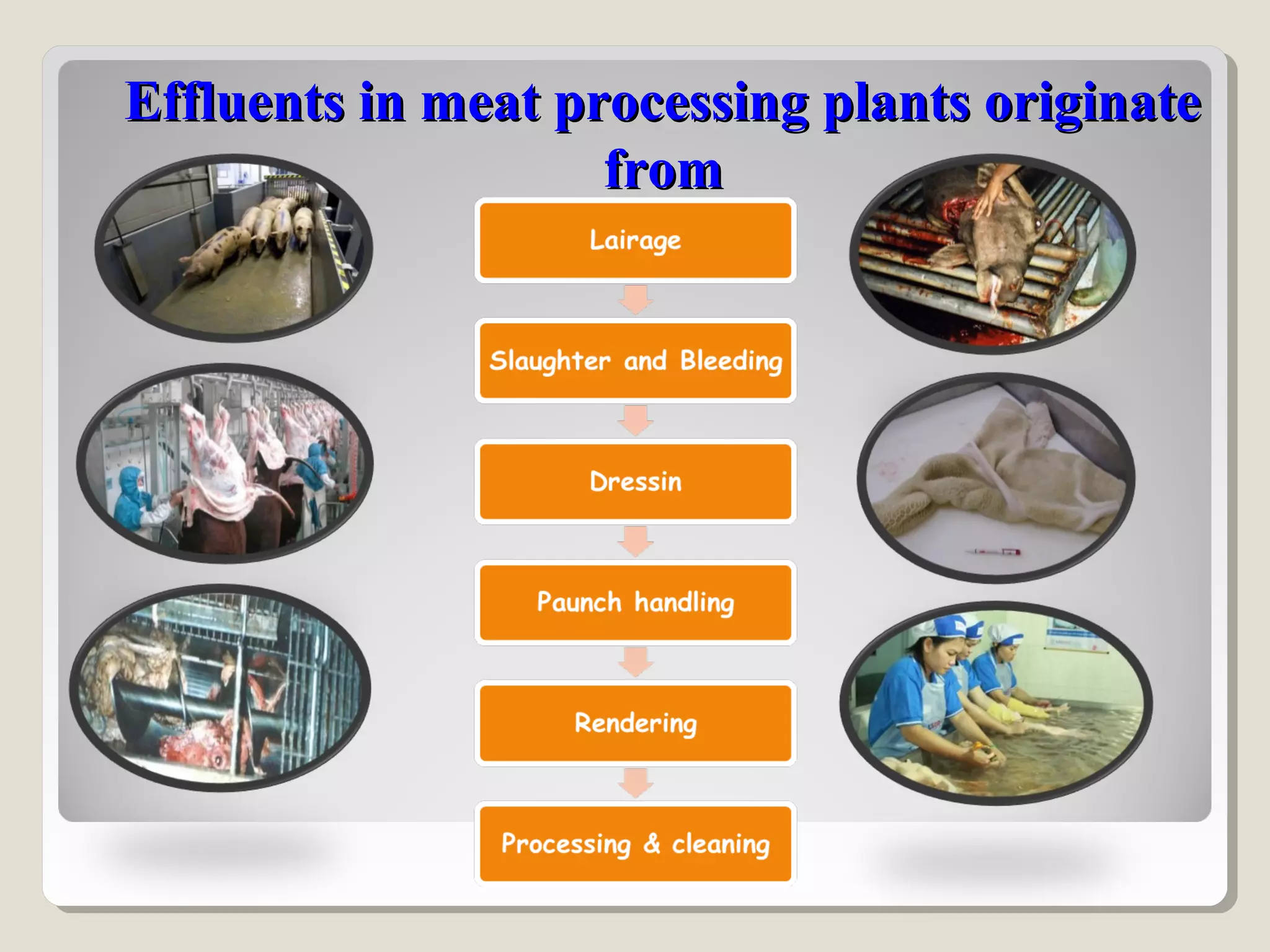
Effluents in meat processing plants originateEffluents in meat processing plants originate
fromfrom
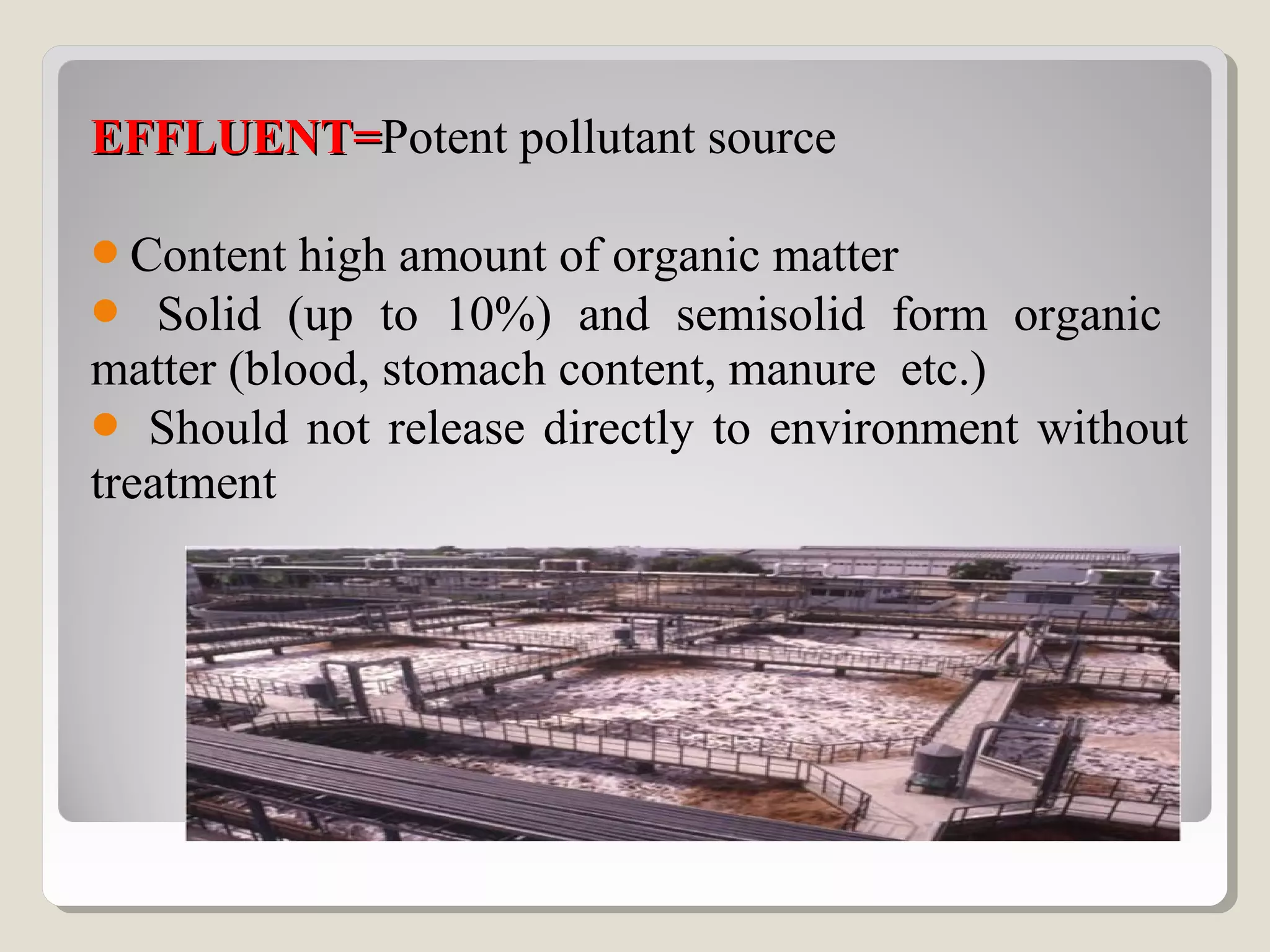
EFFLUENT=EFFLUENT=Potent pollutant source
Content high amount of organic matter
 Solid (up to 10%) and semisolid form organic
matter (blood, stomach content, manure etc.)
 Should not release directly to environment without
treatment
Effluents can be divided into four categories:
o
Non-toxic and not directly pollutant but liable to disturb
the physical nature of the receiving water.
o
Non-toxic and pollutant due to organic matter content of
high oxygen demand.
o
Toxic - containing highly poisonous materials.
o
Toxic and pollutant due to organic matter of high
oxygen demand and toxic in addition.
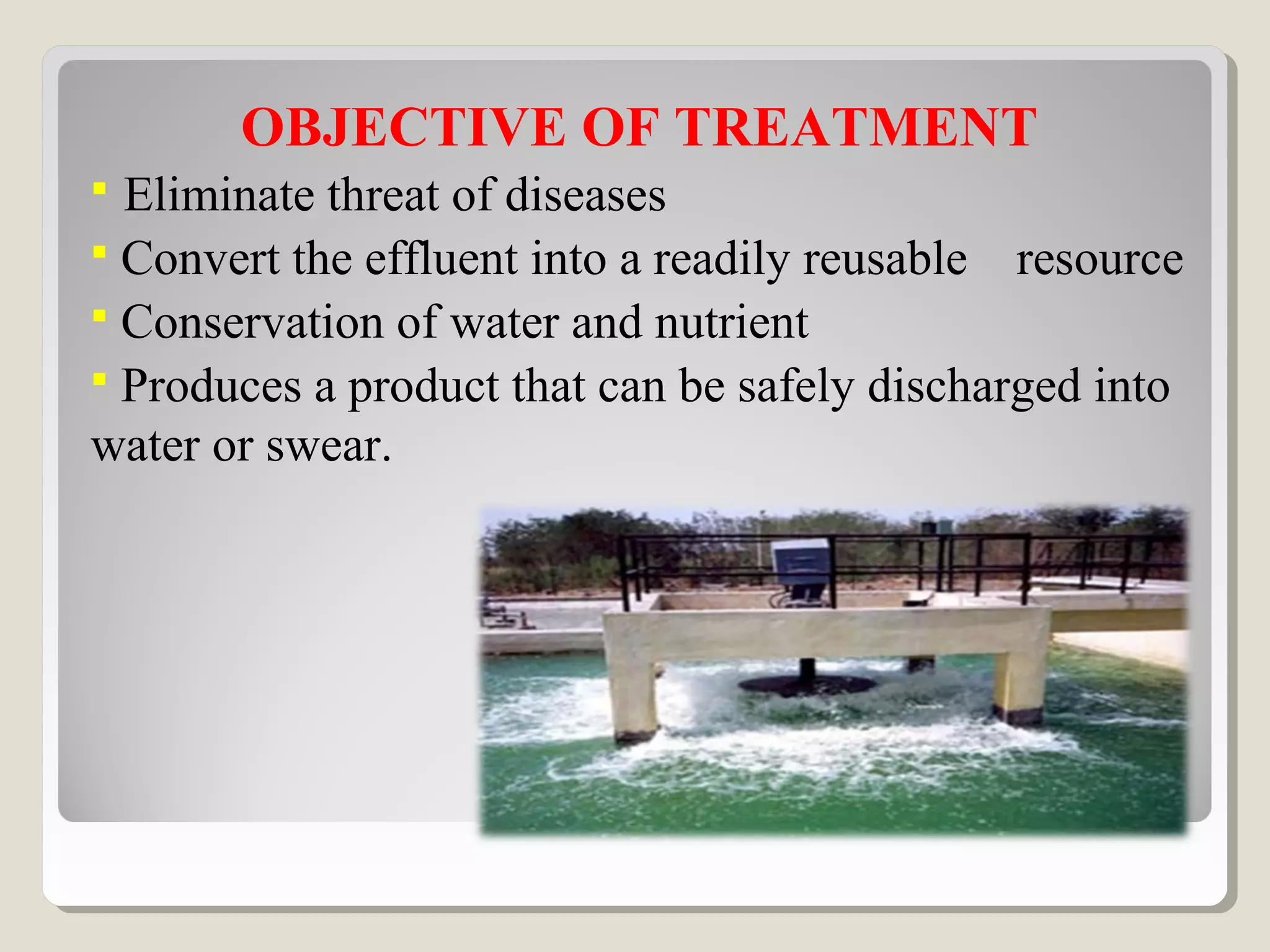
OBJECTIVE OF TREATMENT
 Eliminate threat of diseases
 Convert the effluent into a readily reusable resource
 Conservation of water and nutrient
 Produces a product that can be safely discharged into
water or swear.
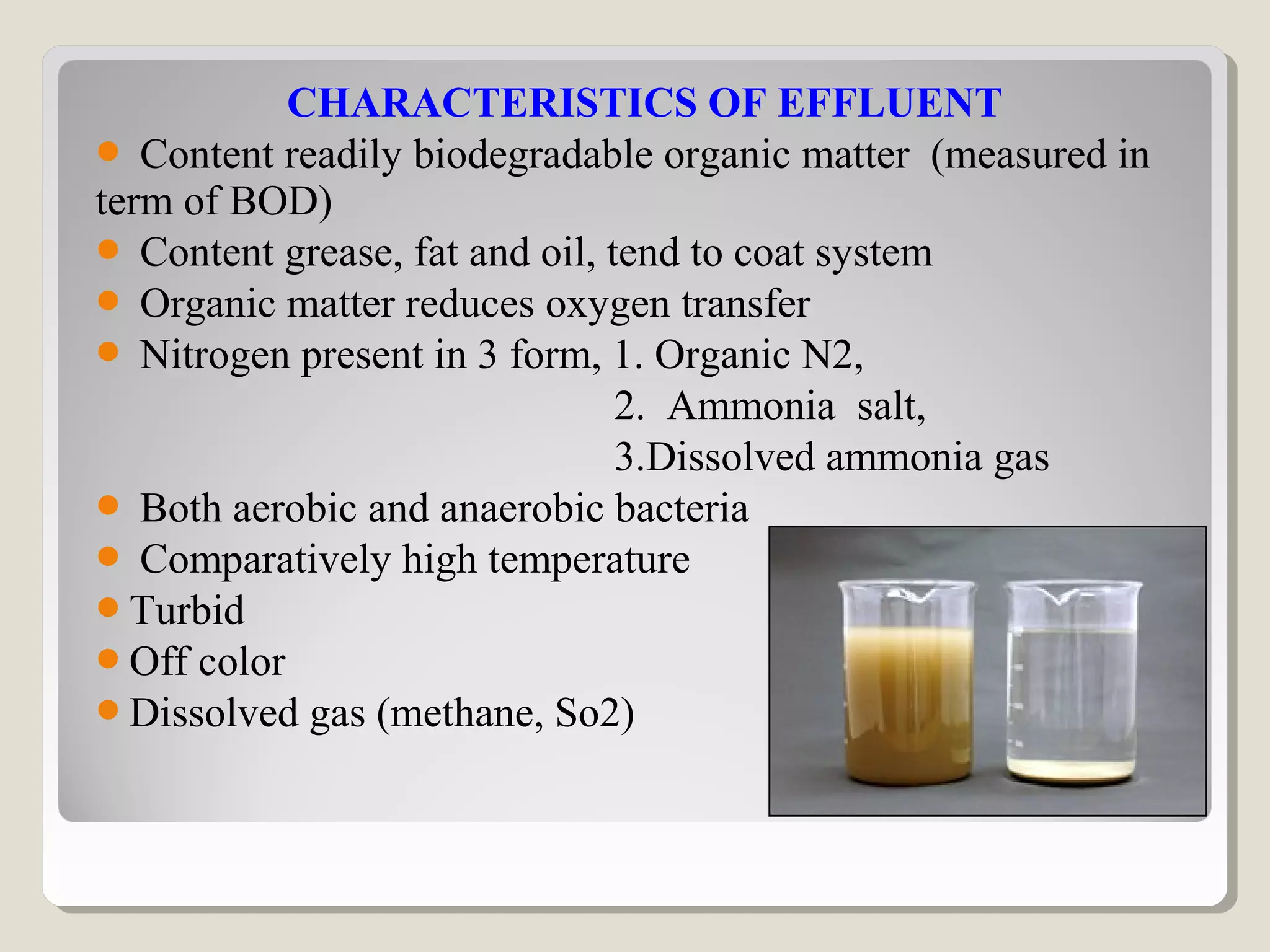
CHARACTERISTICS OF EFFLUENT
 Content readily biodegradable organic matter (measured in
term of BOD)
 Content grease, fat and oil, tend to coat system
 Organic matter reduces oxygen transfer
 Nitrogen present in 3 form, 1. Organic N2,
2. Ammonia salt,
3.Dissolved ammonia gas
 Both aerobic and anaerobic bacteria
 Comparatively high temperature
Turbid
Off color
Dissolved gas (methane, So2)
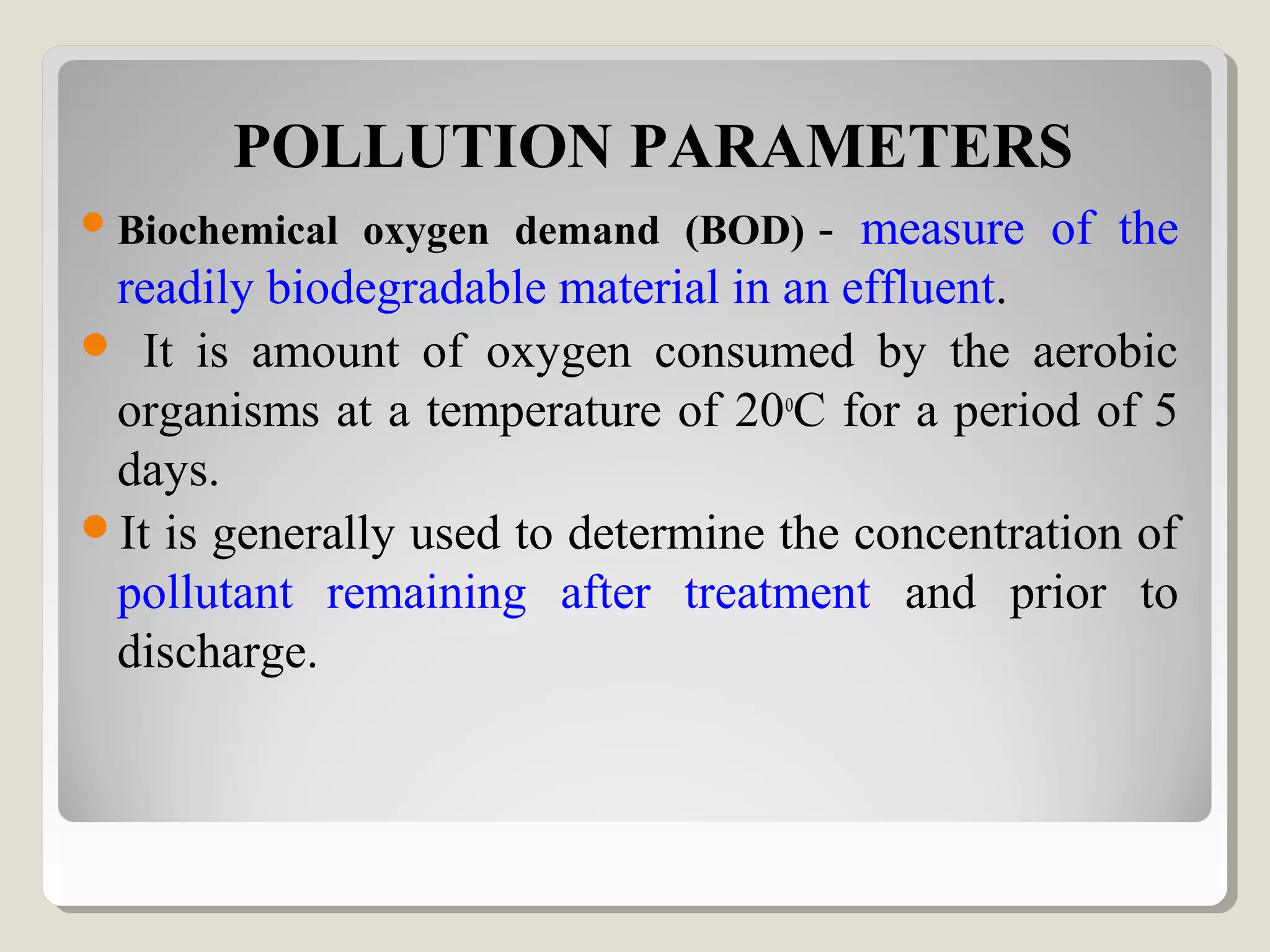
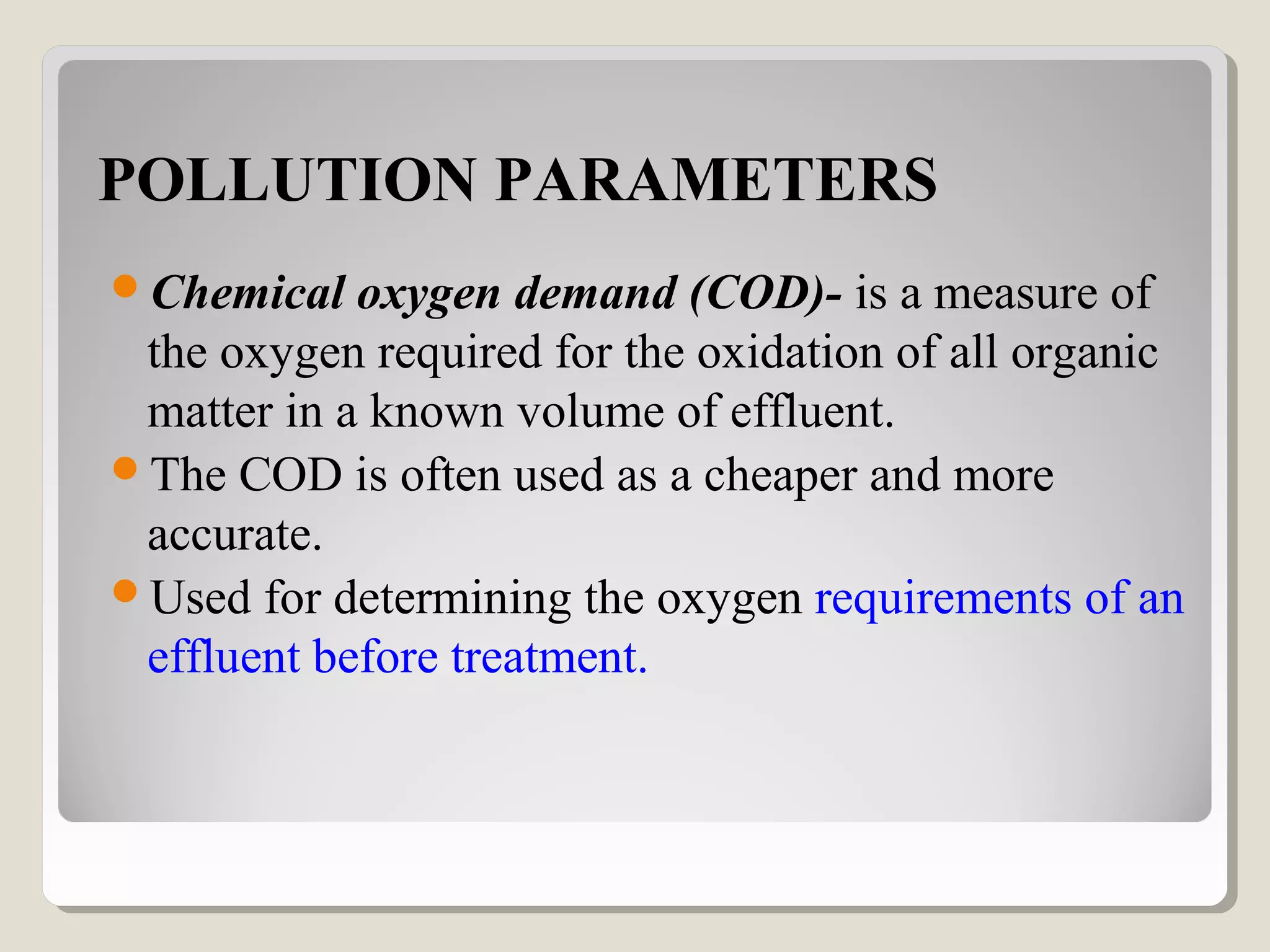
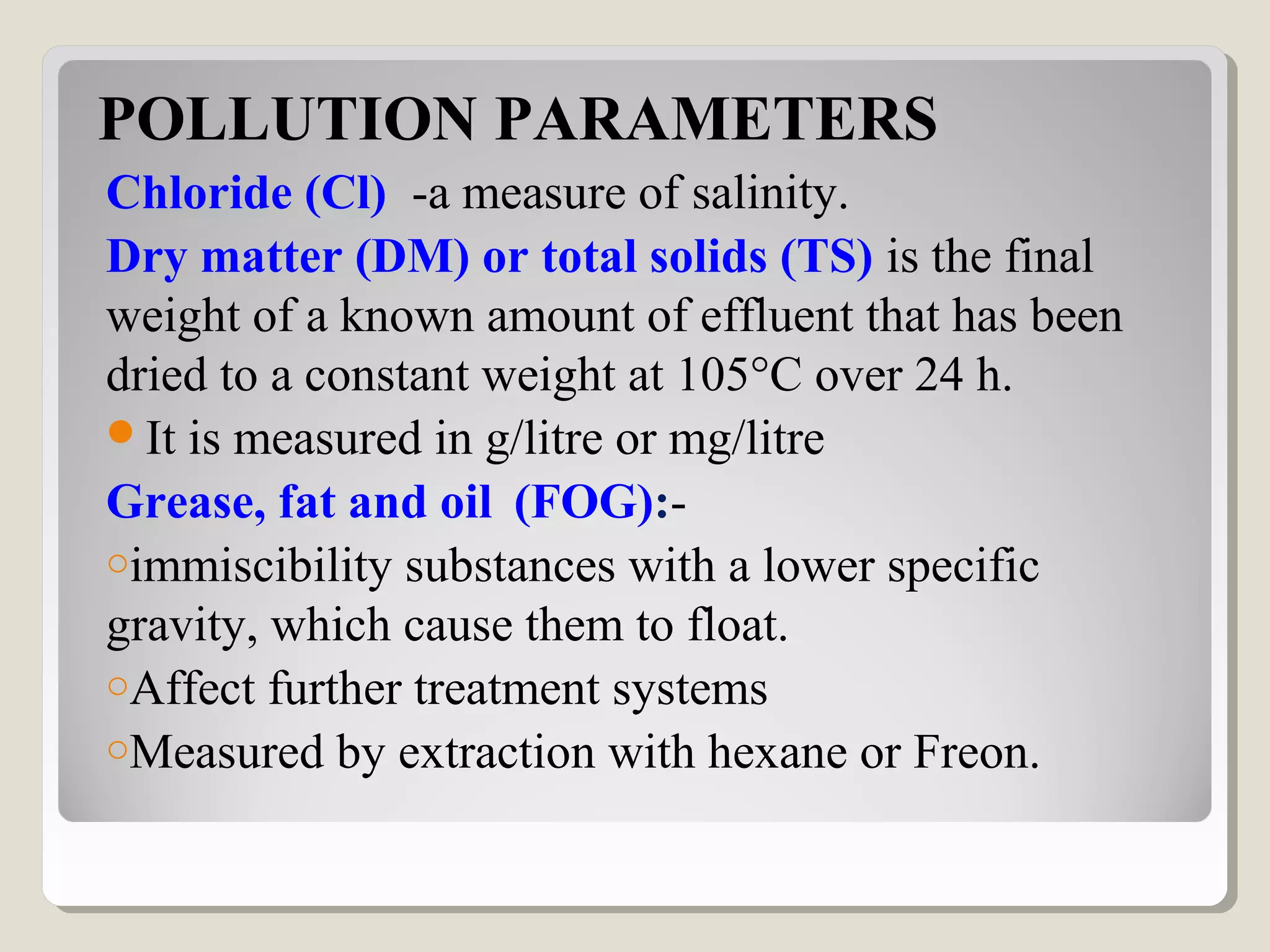
POLLUTION PARAMETERS
Biochemical oxygen demand (BOD) - measure of the
readily biodegradable material in an effluent.
 It is amount of oxygen consumed by the aerobic
organisms at a temperature of 20o
C for a period of 5
days.
It is generally used to determine the concentration of
pollutant remaining after treatment and prior to
discharge.
POLLUTION PARAMETERS
Chemical oxygen demand (COD)- is a measure of
the oxygen required for the oxidation of all organic
matter in a known volume of effluent.
The COD is often used as a cheaper and more
accurate.
Used for determining the oxygen requirements of an
effluent before treatment.
POLLUTION PARAMETERS
Chloride (Cl) -a measure of salinity.
Dry matter (DM) or total solids (TS) is the final
weight of a known amount of effluent that has been
dried to a constant weight at 105°C over 24 h.
It is measured in g/litre or mg/litre
Grease, fat and oil (FOG):-
oimmiscibility substances with a lower specific
gravity, which cause them to float.
oAffect further treatment systems
oMeasured by extraction with hexane or Freon.
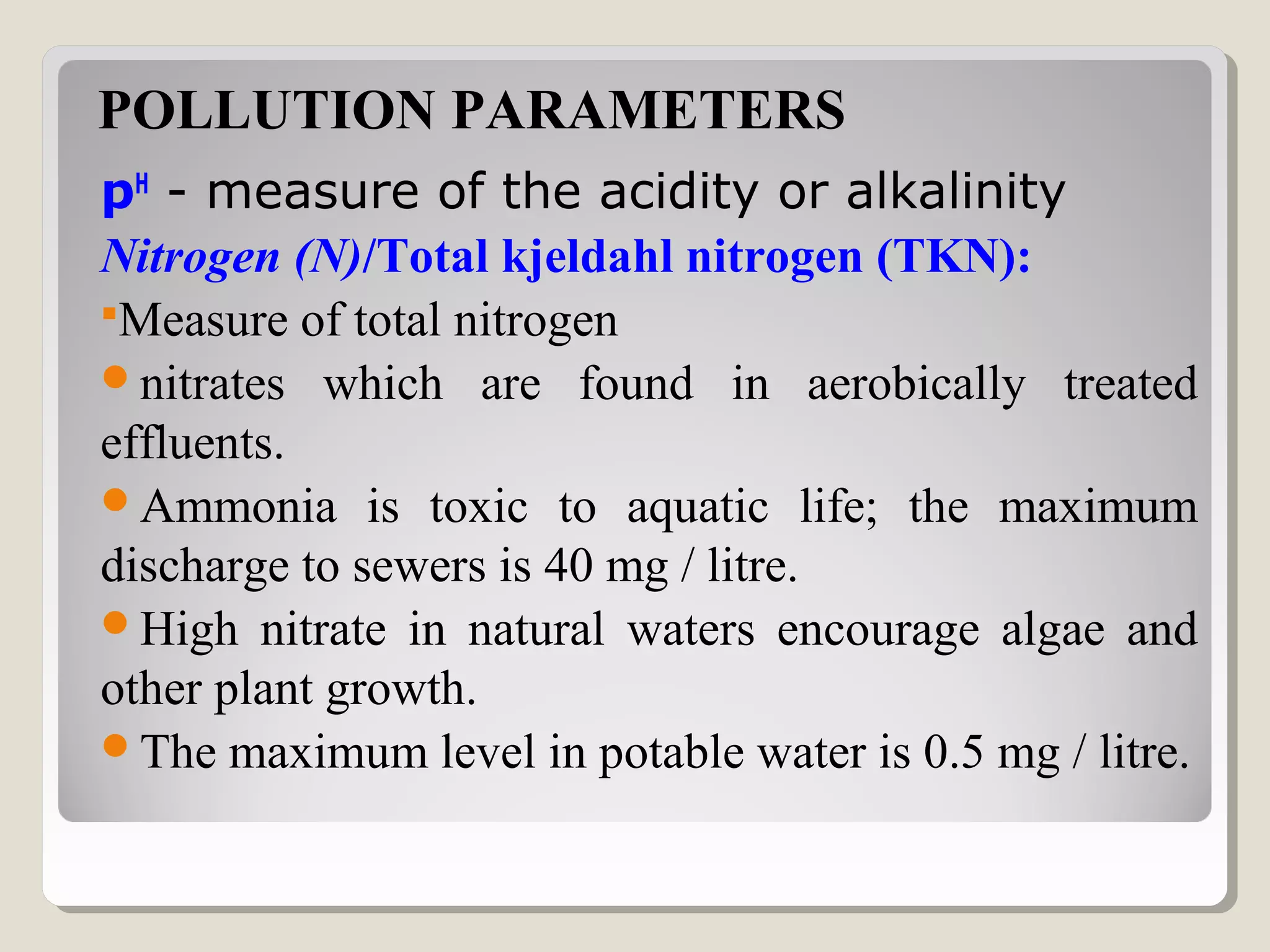
POLLUTION PARAMETERS
pH
 - measure of the acidity or alkalinity 
Nitrogen (N)/Total kjeldahl nitrogen (TKN):
Measure of total nitrogen
nitrates which are found in aerobically treated
effluents.
Ammonia is toxic to aquatic life; the maximum
discharge to sewers is 40 mg / litre.
High nitrate in natural waters encourage algae and
other plant growth.
The maximum level in potable water is 0.5 mg / litre.
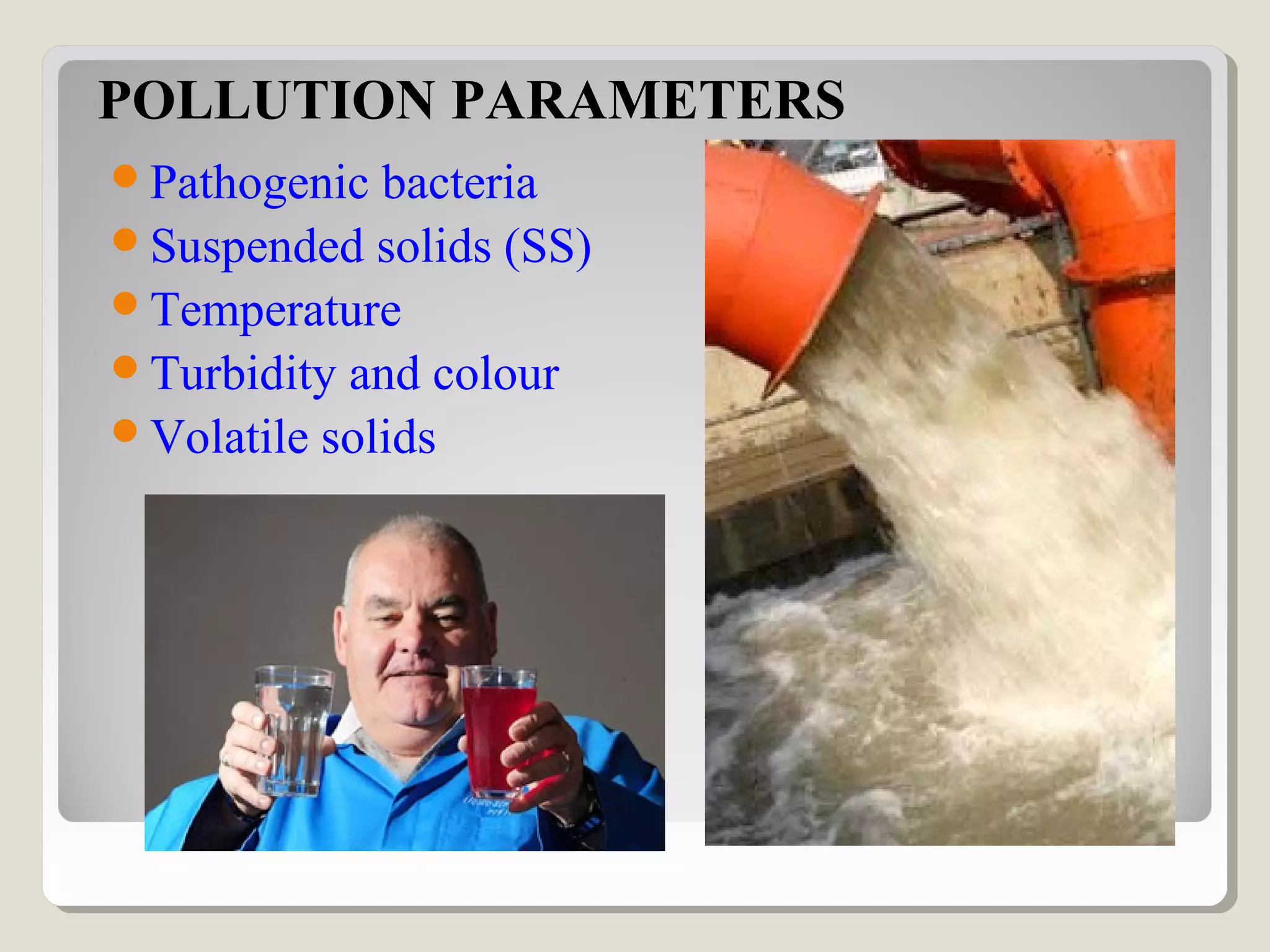
Pathogenic bacteria
Suspended solids (SS)
Temperature
Turbidity and colour
Volatile solids
POLLUTION PARAMETERS
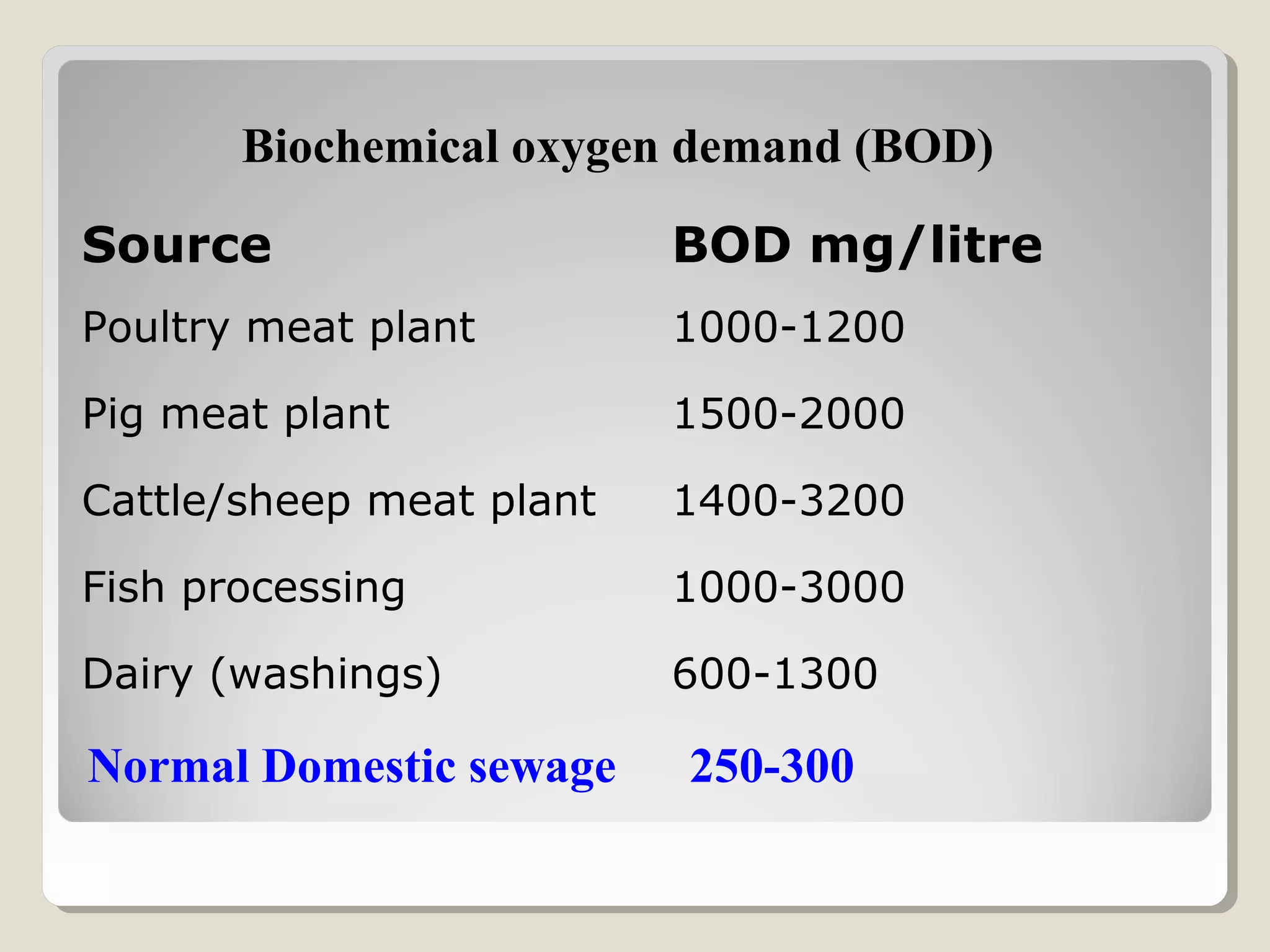
Source BOD mg/litre
Poultry meat plant 1000-1200
Pig meat plant 1500-2000
Cattle/sheep meat plant 1400-3200
Fish processing 1000-3000
Dairy (washings) 600-1300
Biochemical oxygen demand (BOD)
Normal Domestic sewage 250-300
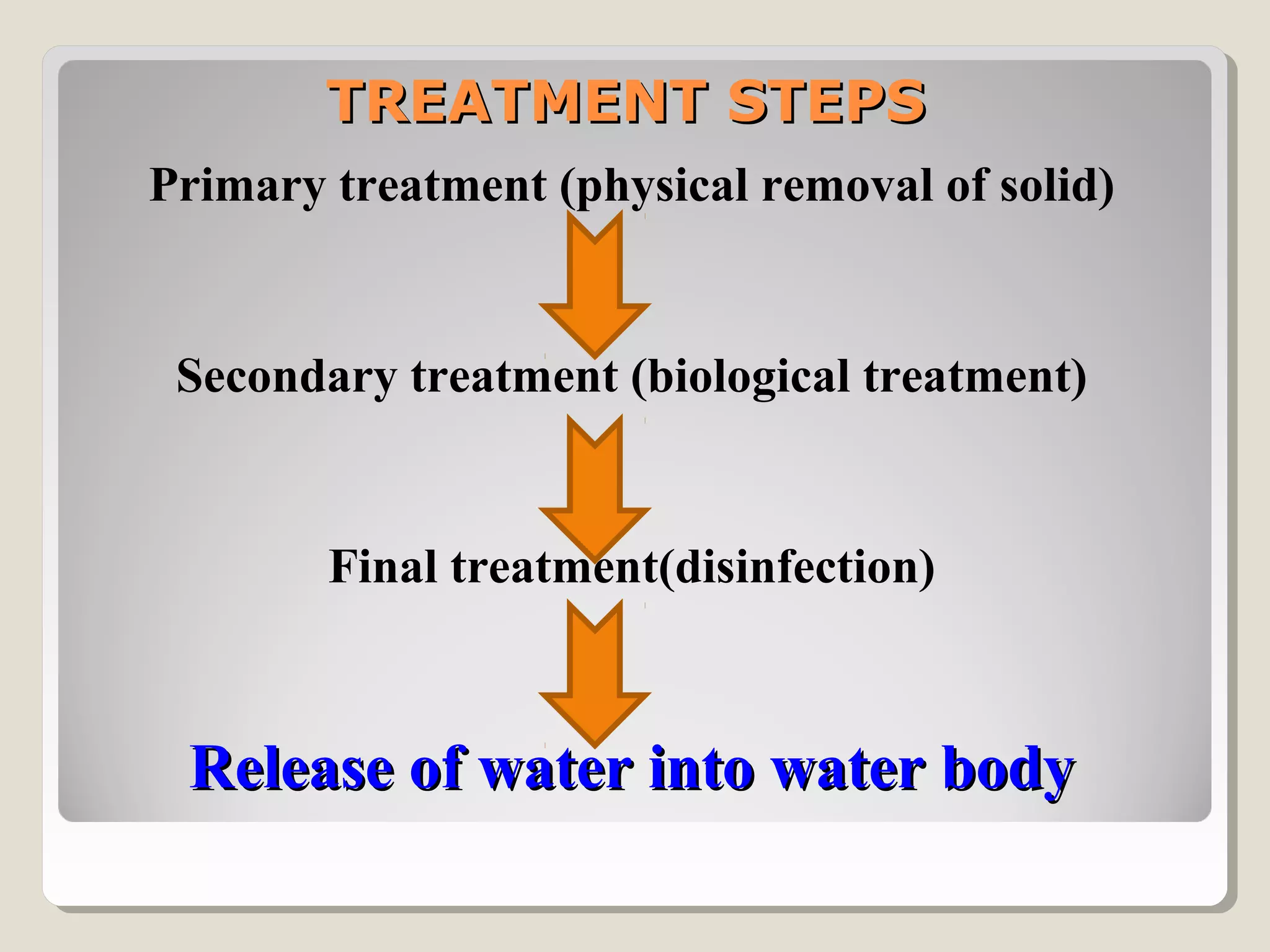
TREATMENT STEPSTREATMENT STEPS
Primary treatment (physical removal of solid)
Secondary treatment (biological treatment)
Final treatment(disinfection)
Release of water into water bodyRelease of water into water body
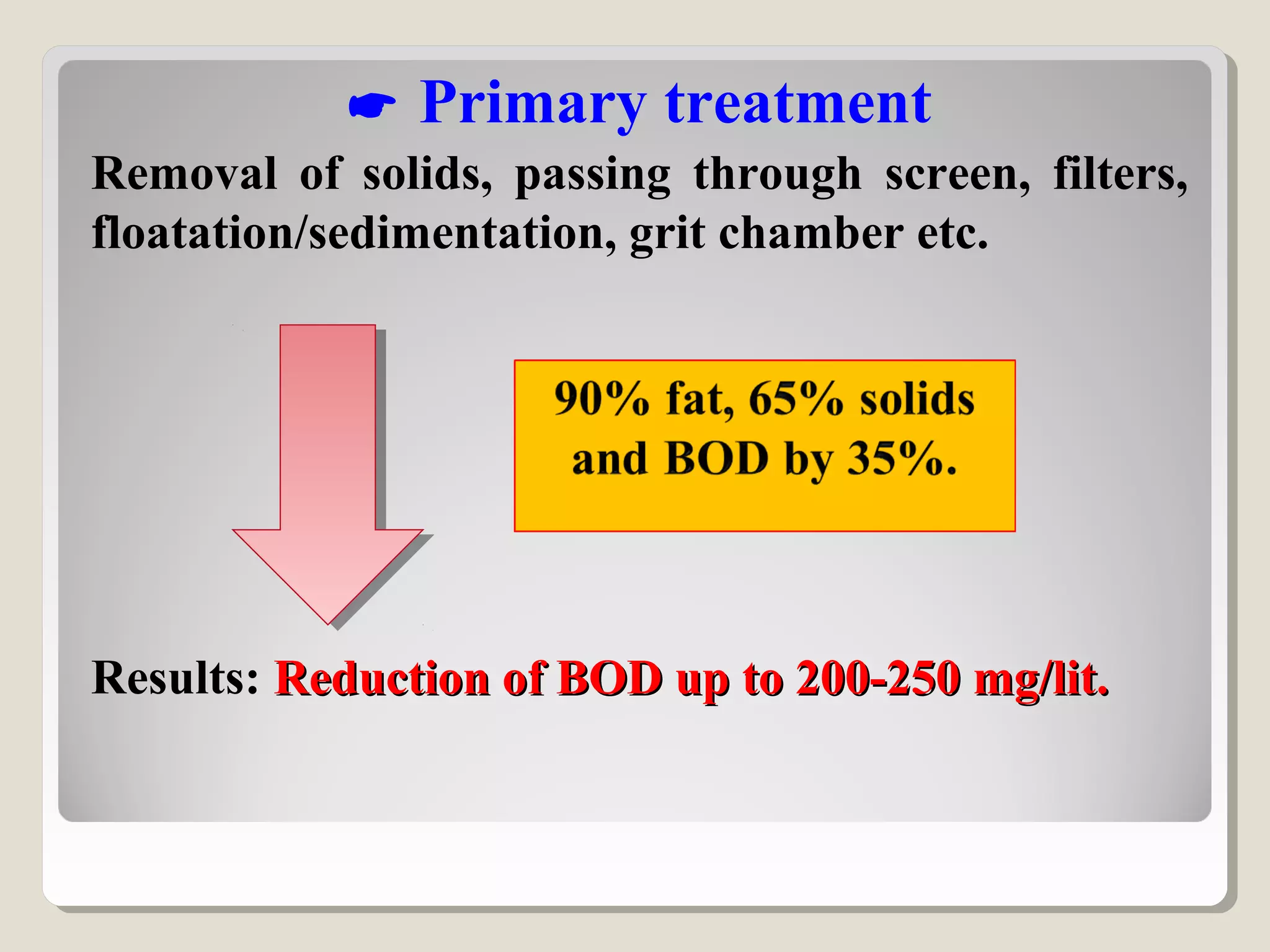
 Primary treatment
Removal of solids, passing through screen, filters,
floatation/sedimentation, grit chamber etc.
Results: Reduction of BOD up to 200-250 mg/lit.Reduction of BOD up to 200-250 mg/lit.
Consequent steps:Consequent steps:
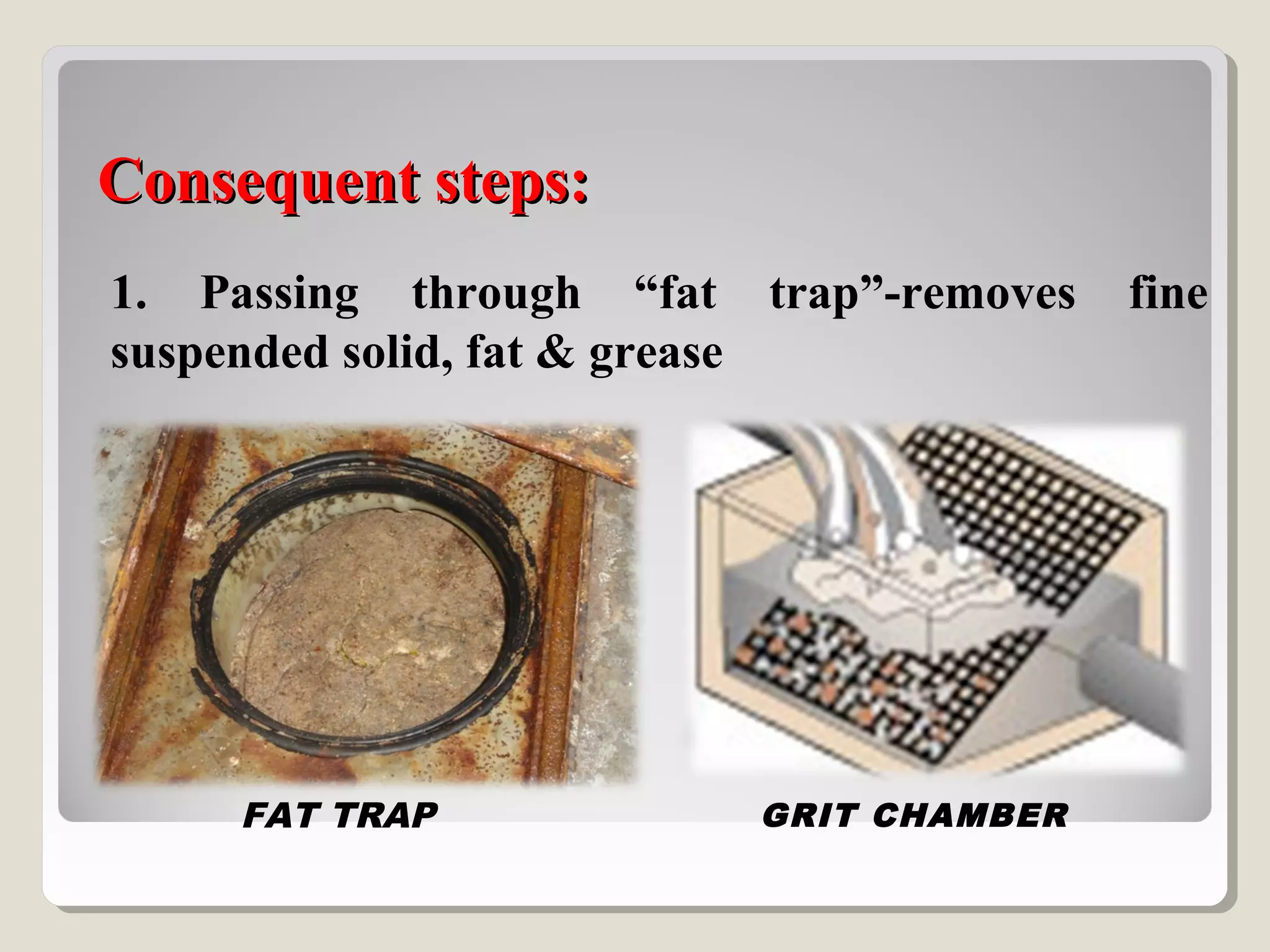
1. Passing through “fat trap”-removes fine
suspended solid, fat & grease
FAT TRAP GRIT CHAMBER
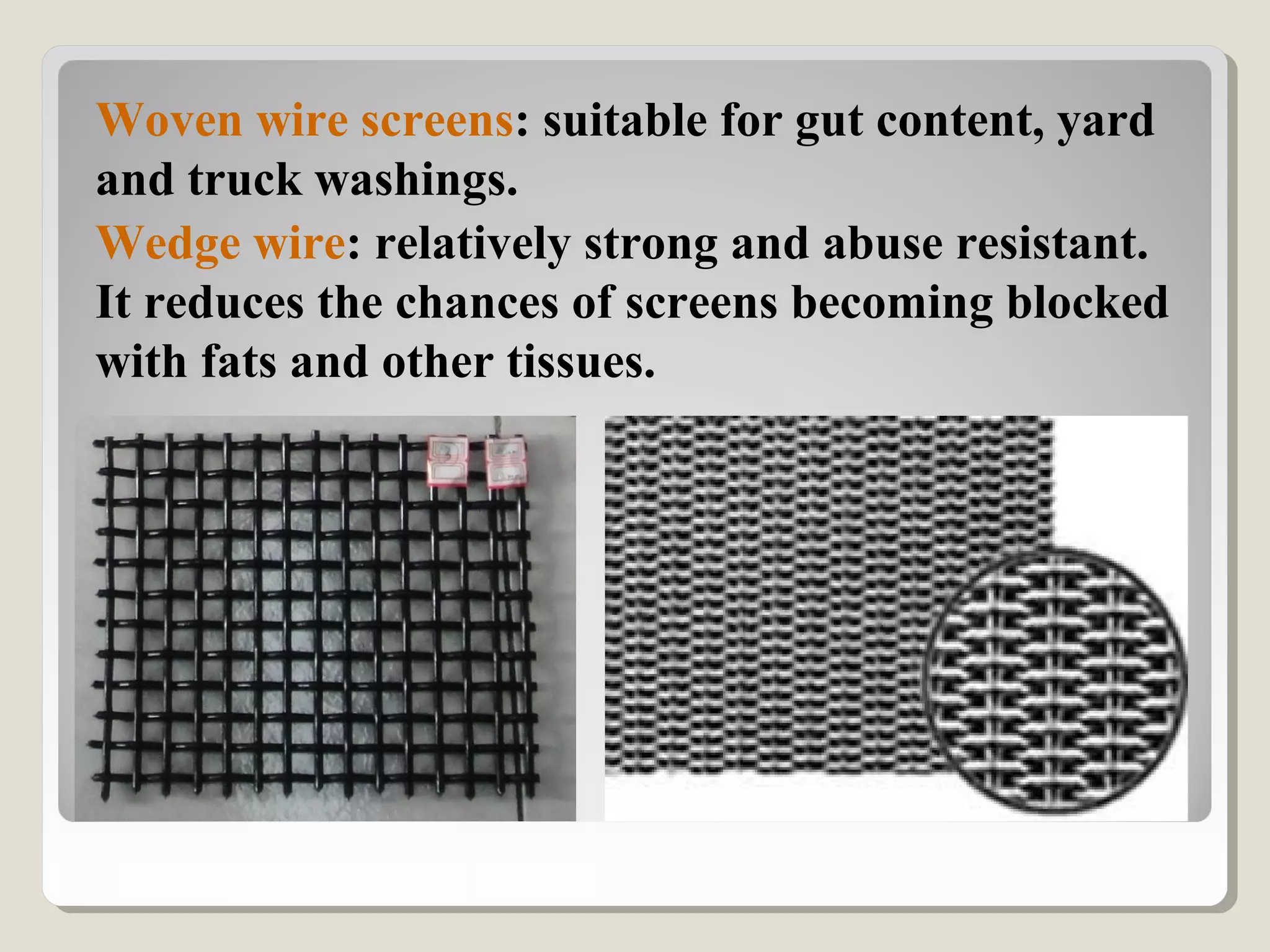
Woven wire screens: suitable for gut content, yard
and truck washings.
Wedge wire: relatively strong and abuse resistant.
It reduces the chances of screens becoming blocked
with fats and other tissues.
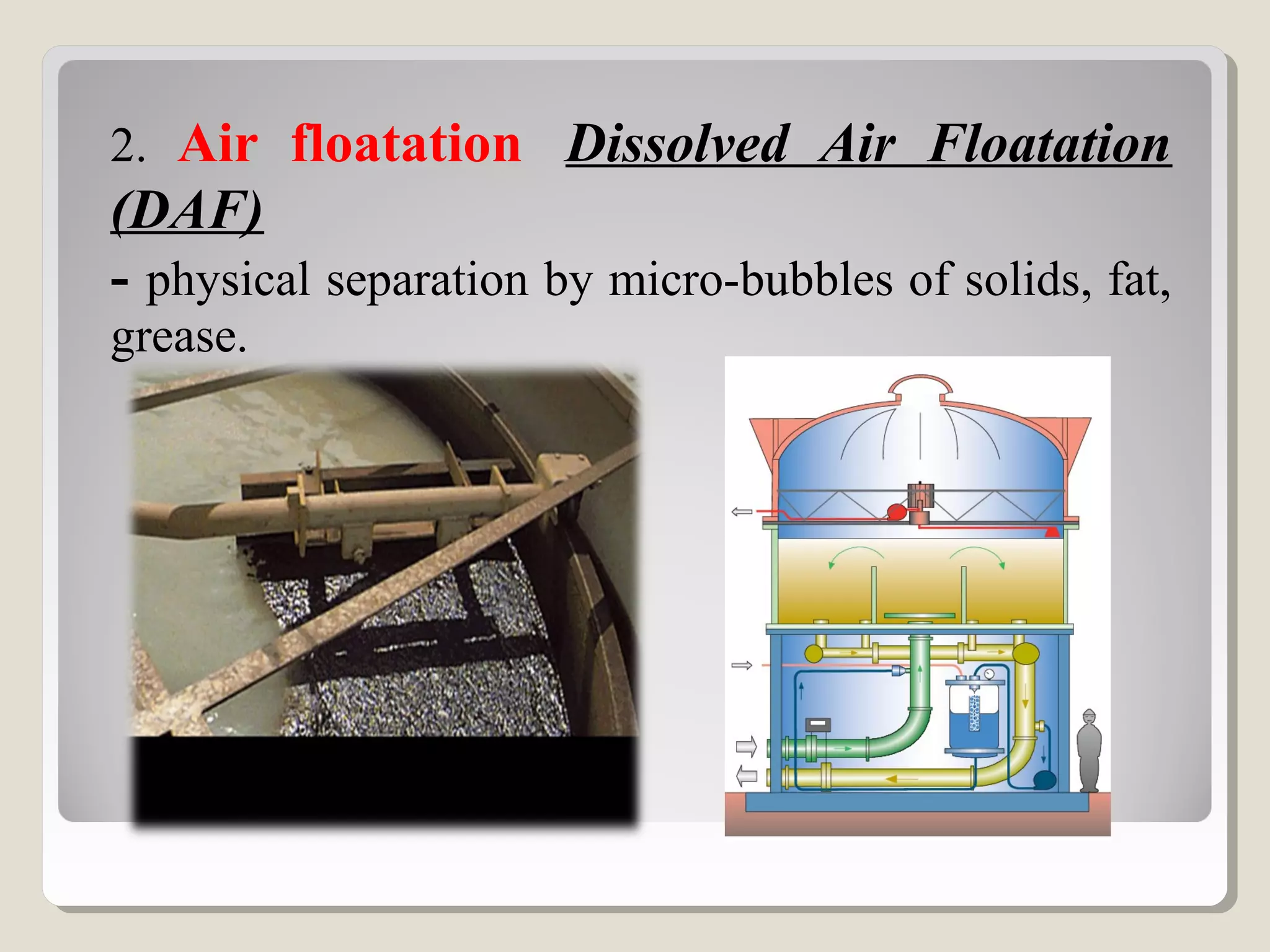
2. Air floatation Dissolved Air Floatation
(DAF)
- physical separation by micro-bubbles of solids, fat,
grease.
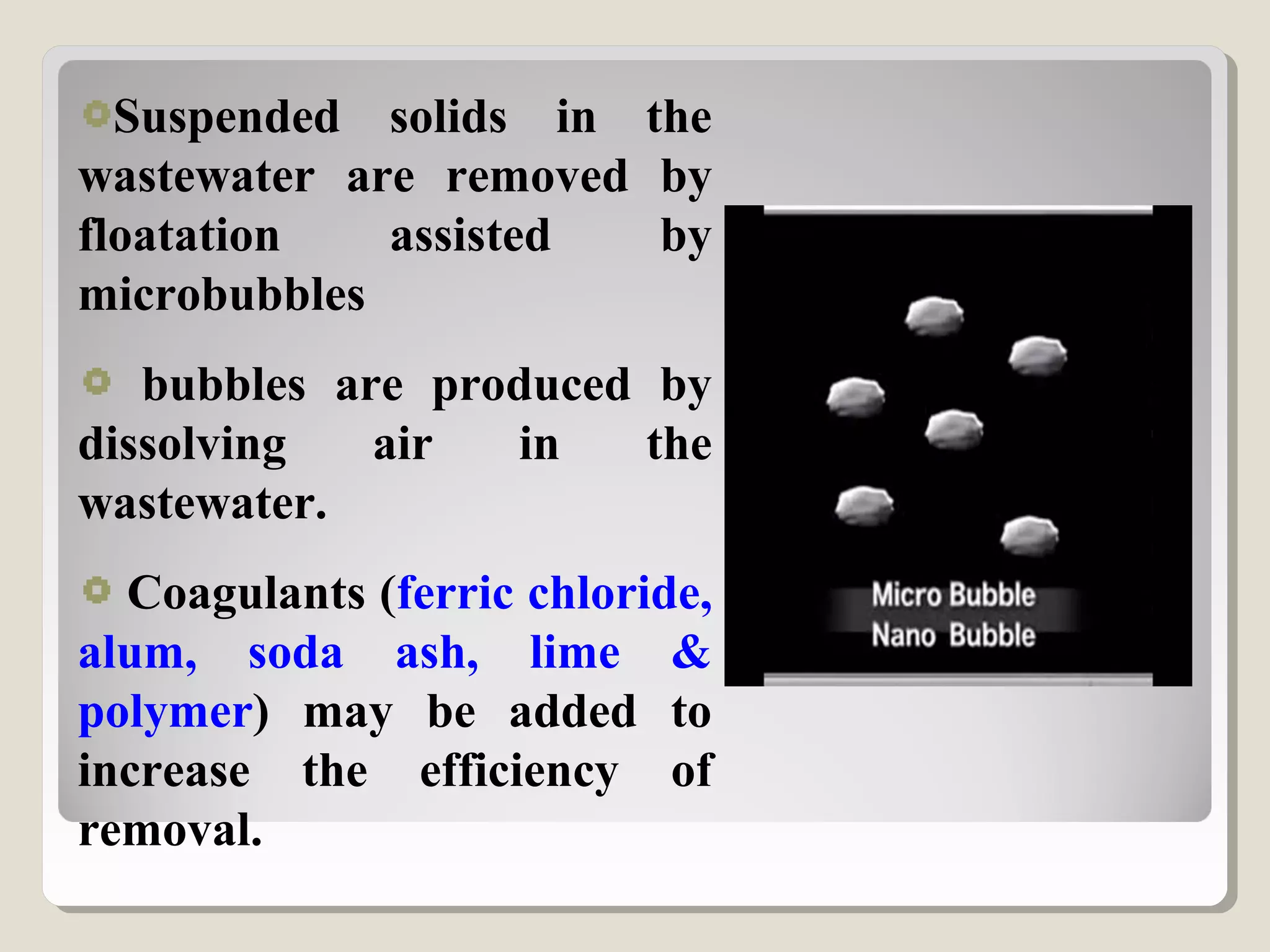
Suspended solids in the
wastewater are removed by
floatation assisted by
microbubbles
bubbles are produced by
dissolving air in the
wastewater.
Coagulants (ferric chloride,
alum, soda ash, lime &
polymer) may be added to
increase the efficiency of
removal.
ADVANTAGESADVANTAGES
works faster and produces a drier sludge.
 Low capital cost
 Less ground area requirements
 Less operator time
 Flexibility of operations in respect of
recovery of oil and proteins.
62-90% of oil and grease removal
&
30-80% of BOD reduction.
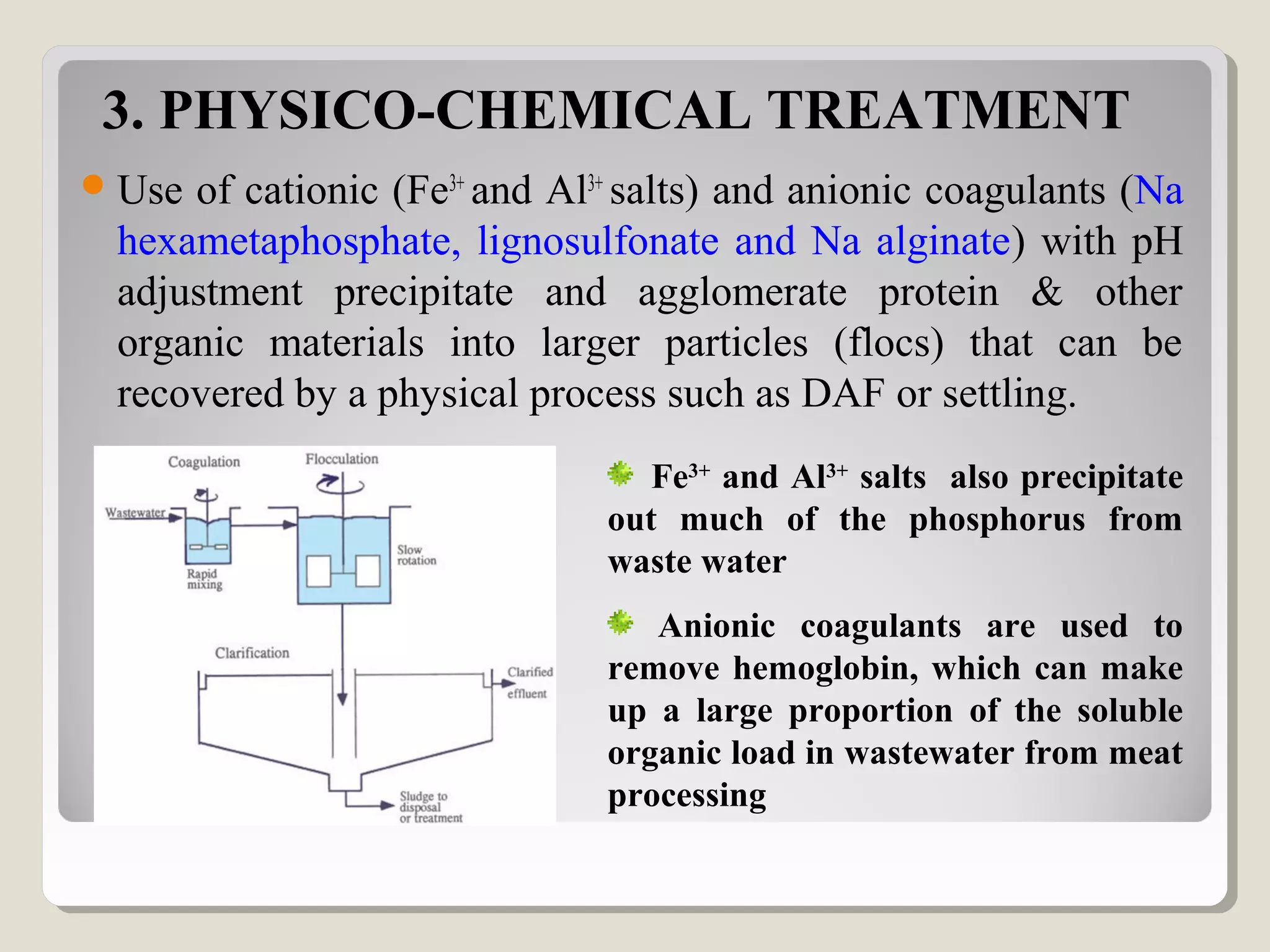
3. PHYSICO-CHEMICAL TREATMENT
Use of cationic (Fe3+
and Al3+
salts) and anionic coagulants (Na
hexametaphosphate, lignosulfonate and Na alginate) with pH
adjustment precipitate and agglomerate protein & other
organic materials into larger particles (flocs) that can be
recovered by a physical process such as DAF or settling.
Fe3+
and Al3+
salts also precipitate
out much of the phosphorus from
waste water
Anionic coagulants are used to
remove hemoglobin, which can make
up a large proportion of the soluble
organic load in wastewater from meat
processing
Secondary treatmentSecondary treatment
One biological treatment system under controlled
condition
 Culture of microbes is mixed
 Microbes utilizes available organic matter &
synthesis new cell
 More than 90% organic matter removed
Secondary treatment can be done aerobically or
anaerobically followed by disinfection using
chlorides or by other methods and digestion of
solids.
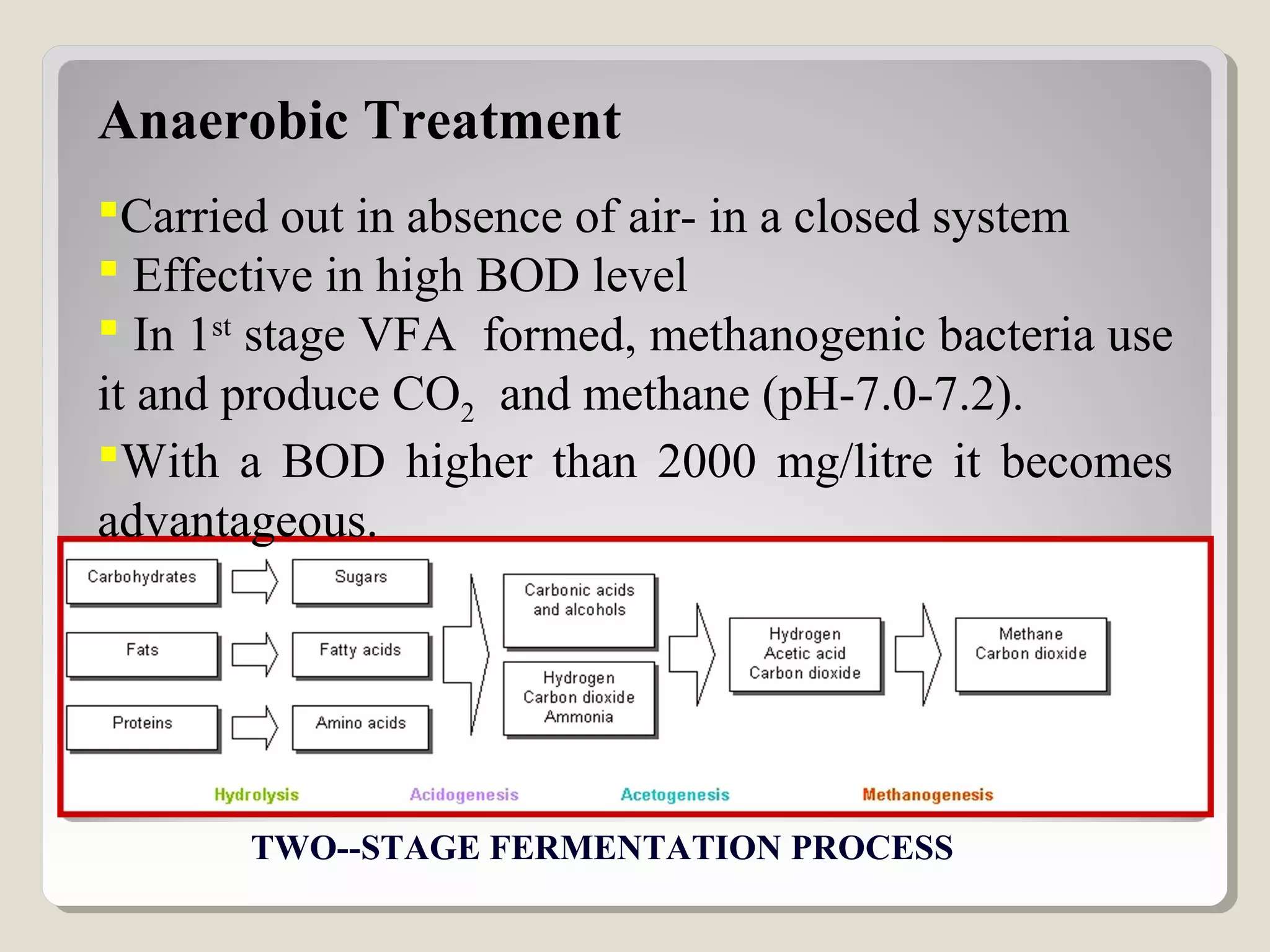
Anaerobic Treatment
Carried out in absence of air- in a closed system
 Effective in high BOD level
 In 1st
stage VFA formed, methanogenic bacteria use
it and produce CO2 and methane (pH-7.0-7.2).
With a BOD higher than 2000 mg/litre it becomes
advantageous.
TWO--STAGE FERMENTATION PROCESS
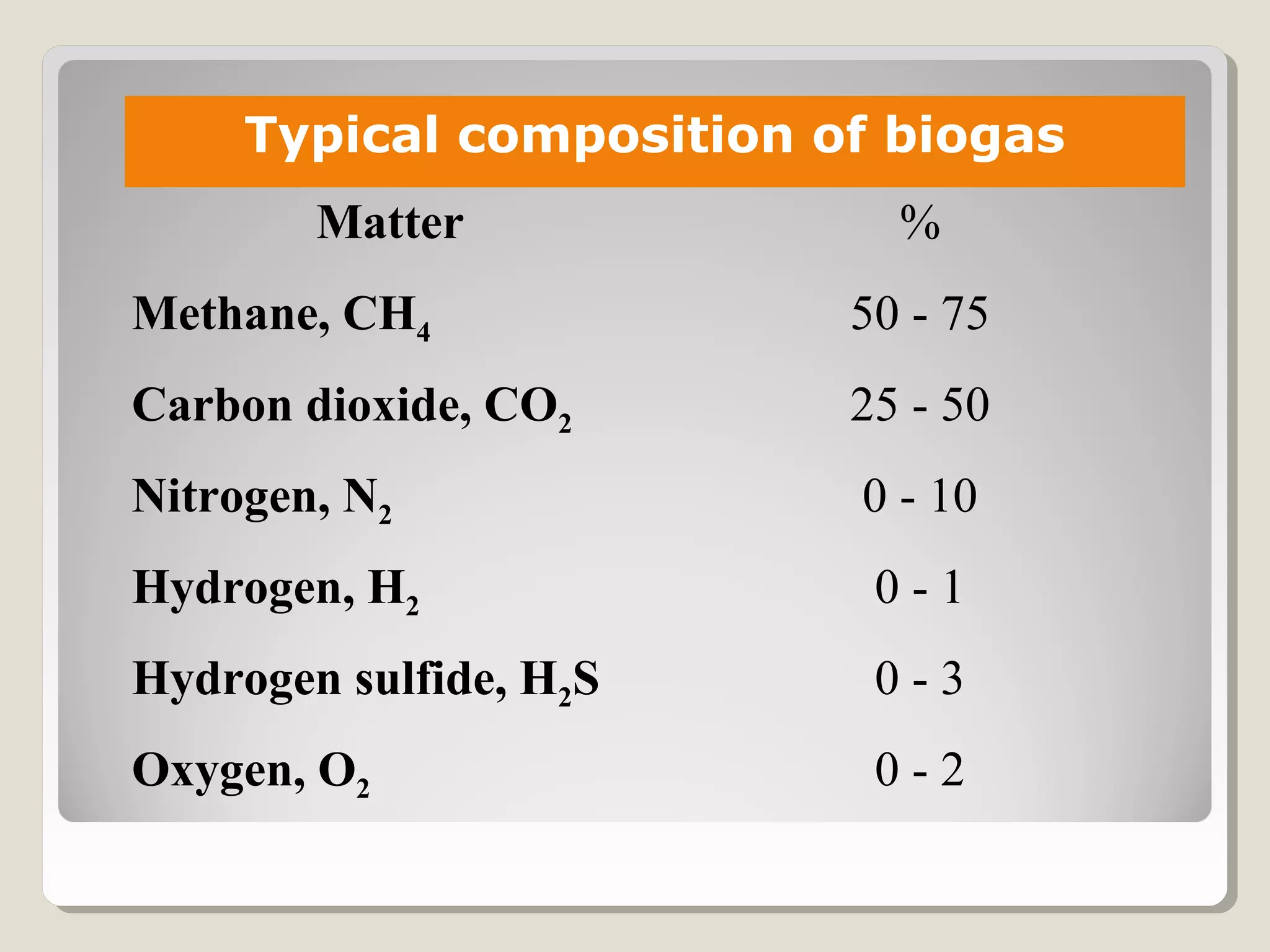
Typical composition of biogas
Matter %
Methane, CH4 50 - 75
Carbon dioxide, CO2 25 - 50
Nitrogen, N2 0 - 10
Hydrogen, H2 0 - 1
Hydrogen sulfide, H2S 0 - 3
Oxygen, O2 0 - 2
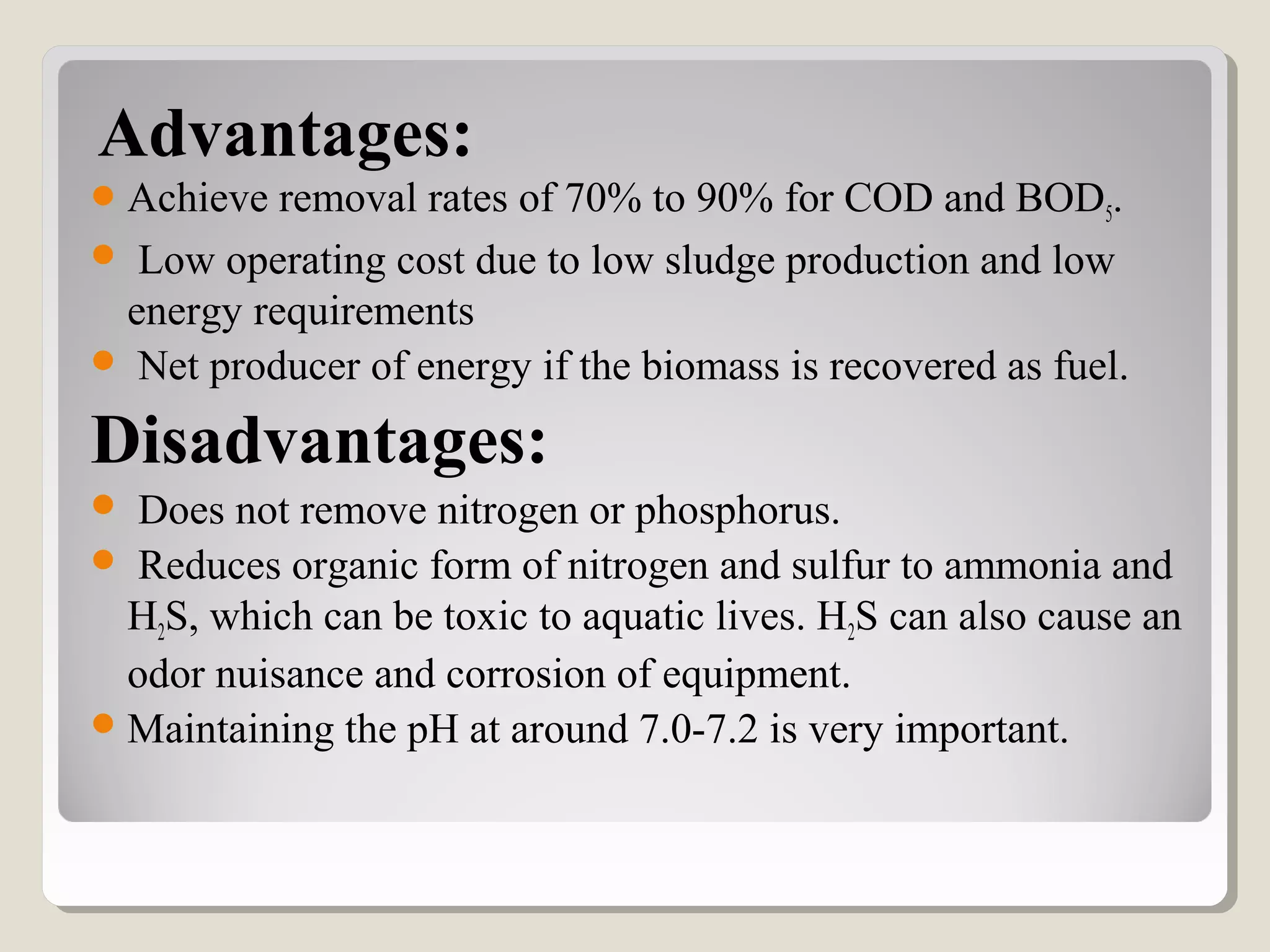
Advantages:
Achieve removal rates of 70% to 90% for COD and BOD5.
 Low operating cost due to low sludge production and low
energy requirements
 Net producer of energy if the biomass is recovered as fuel.
Disadvantages:
 Does not remove nitrogen or phosphorus.
 Reduces organic form of nitrogen and sulfur to ammonia and
H2S, which can be toxic to aquatic lives. H2S can also cause an
odor nuisance and corrosion of equipment.
Maintaining the pH at around 7.0-7.2 is very important.
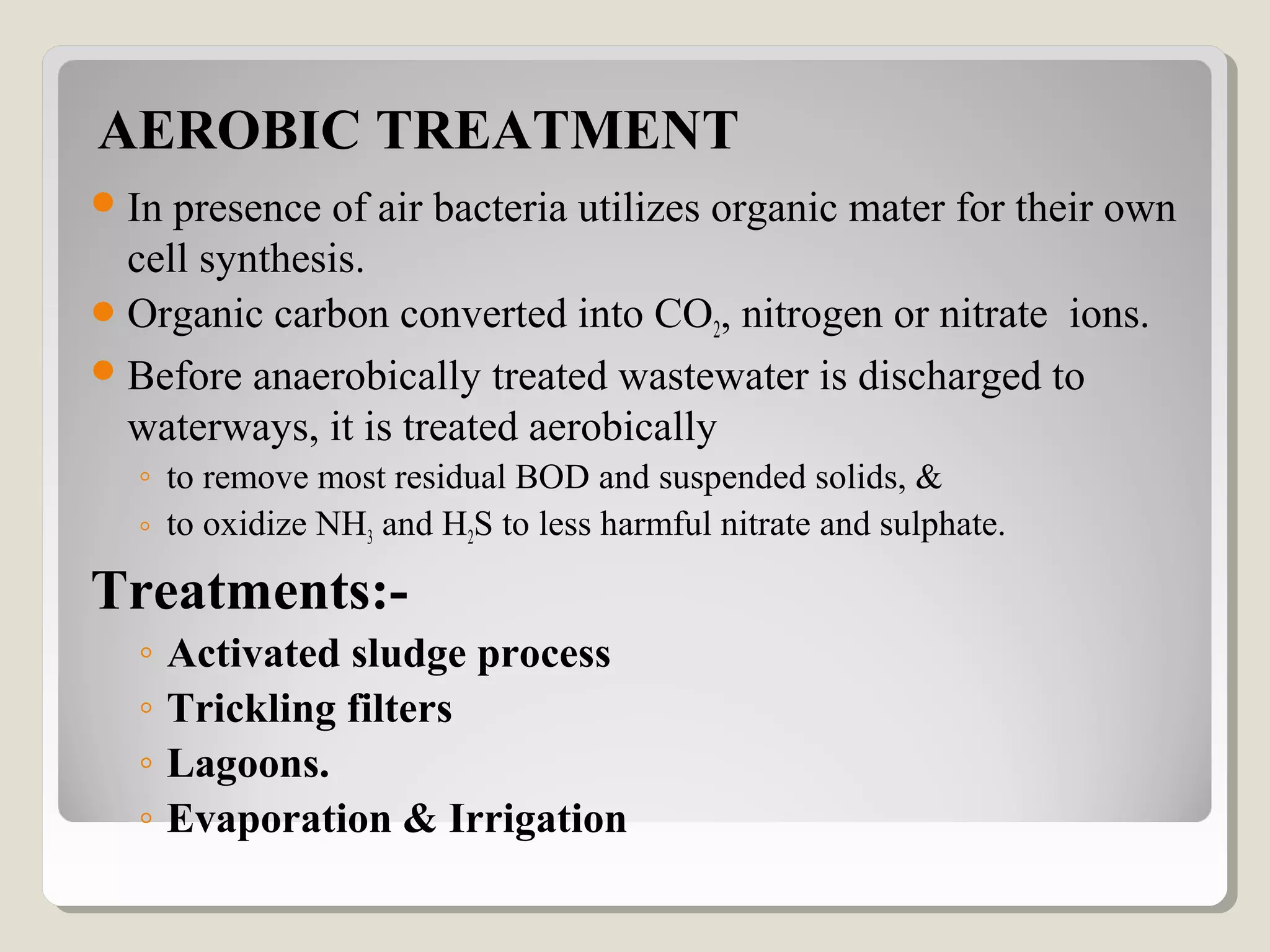
AEROBIC TREATMENT
In presence of air bacteria utilizes organic mater for their own
cell synthesis.
Organic carbon converted into CO2, nitrogen or nitrate ions.
Before anaerobically treated wastewater is discharged to
waterways, it is treated aerobically
◦ to remove most residual BOD and suspended solids, &
◦ to oxidize NH3 and H2S to less harmful nitrate and sulphate.
Treatments:-
◦ Activated sludge process
◦ Trickling filters
◦ Lagoons.
◦ Evaporation & Irrigation
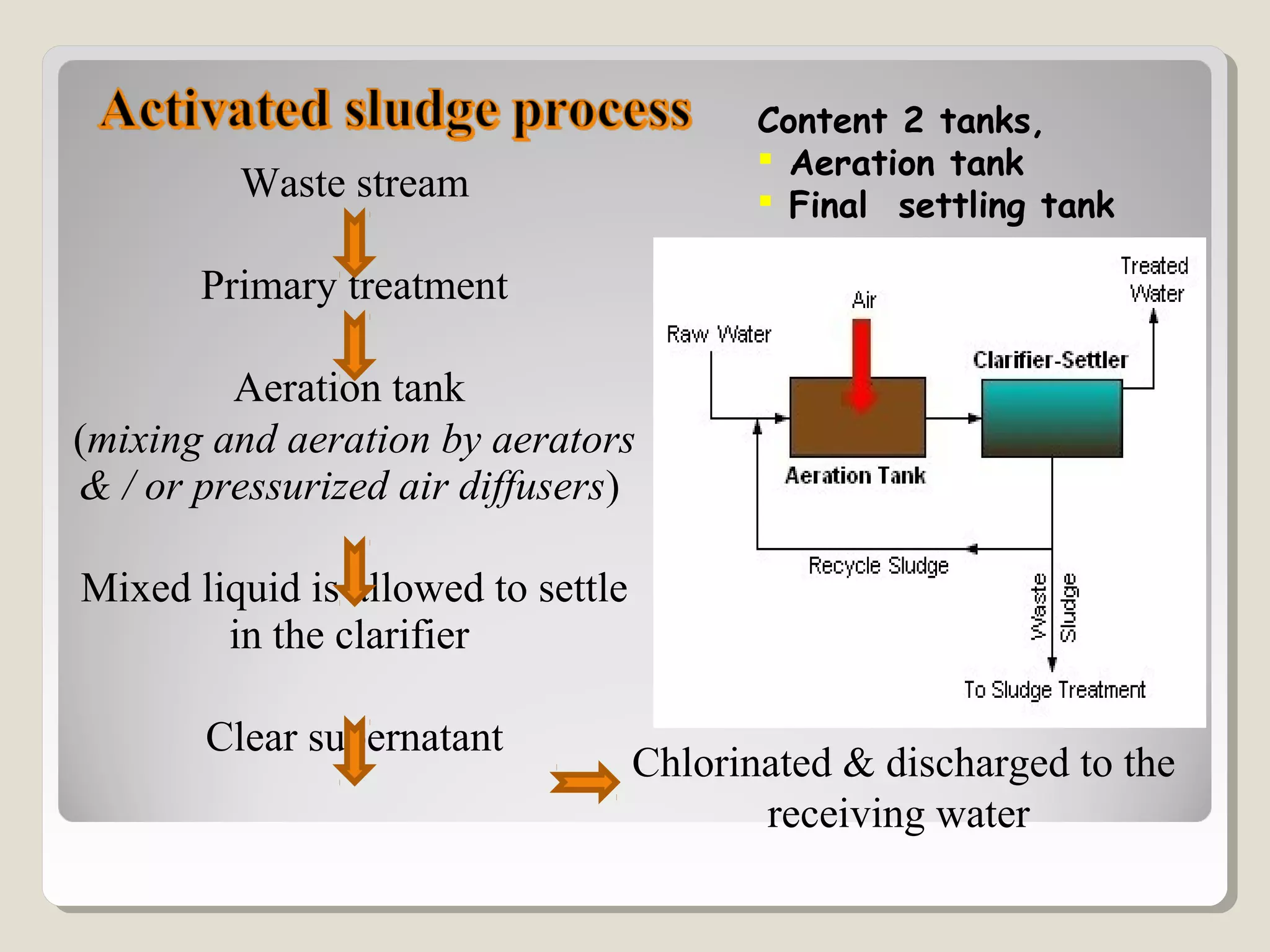
Waste stream
Primary treatment
Aeration tank
(mixing and aeration by aerators
& / or pressurized air diffusers)
Mixed liquid is allowed to settle
in the clarifier
Clear supernatant
Chlorinated & discharged to the
receiving water
Content 2 tanks,
 Aeration tank
 Final settling tank
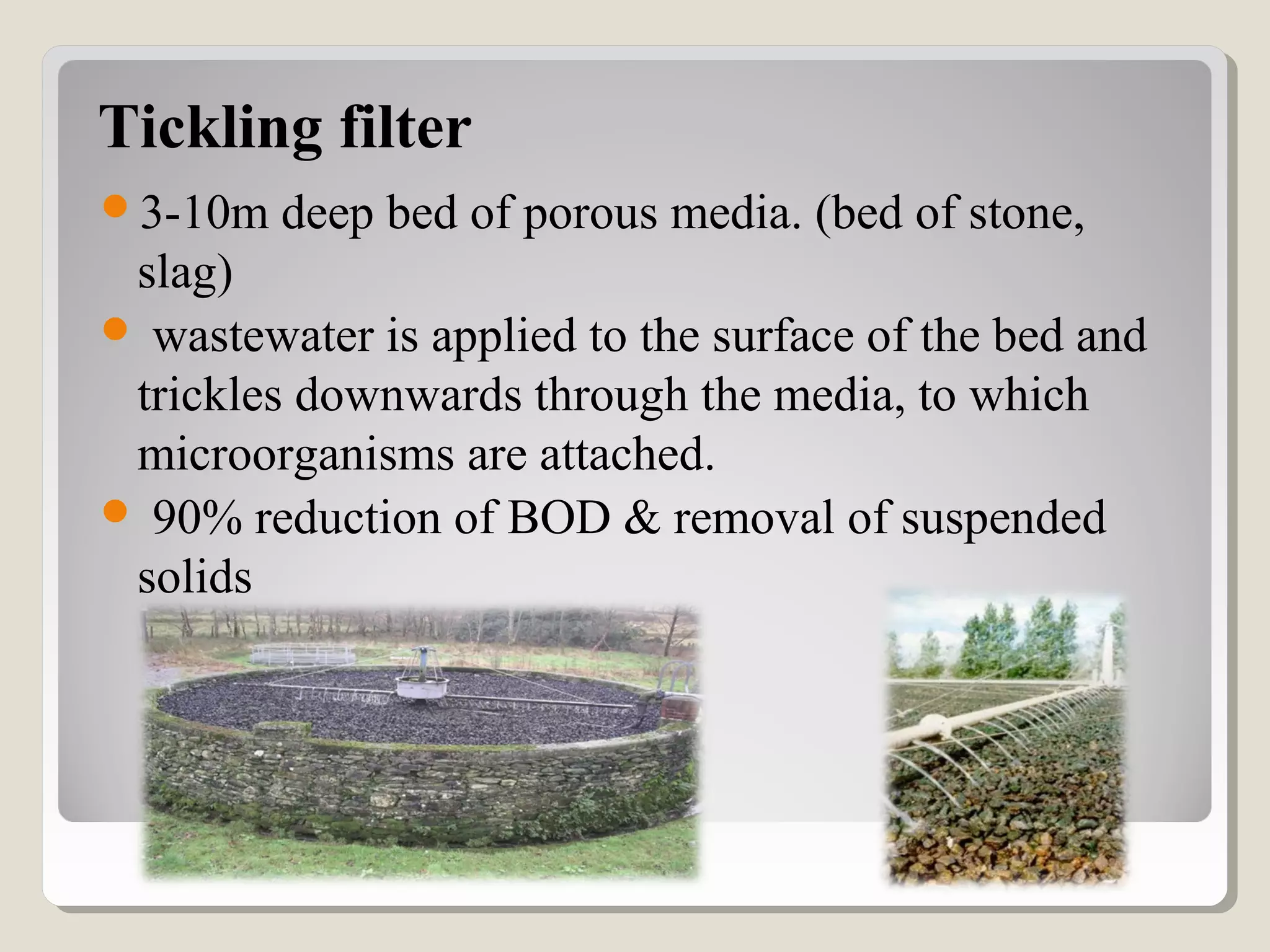
Tickling filter
3-10m deep bed of porous media. (bed of stone,
slag)
 wastewater is applied to the surface of the bed and
trickles downwards through the media, to which
microorganisms are attached.
 90% reduction of BOD & removal of suspended
solids
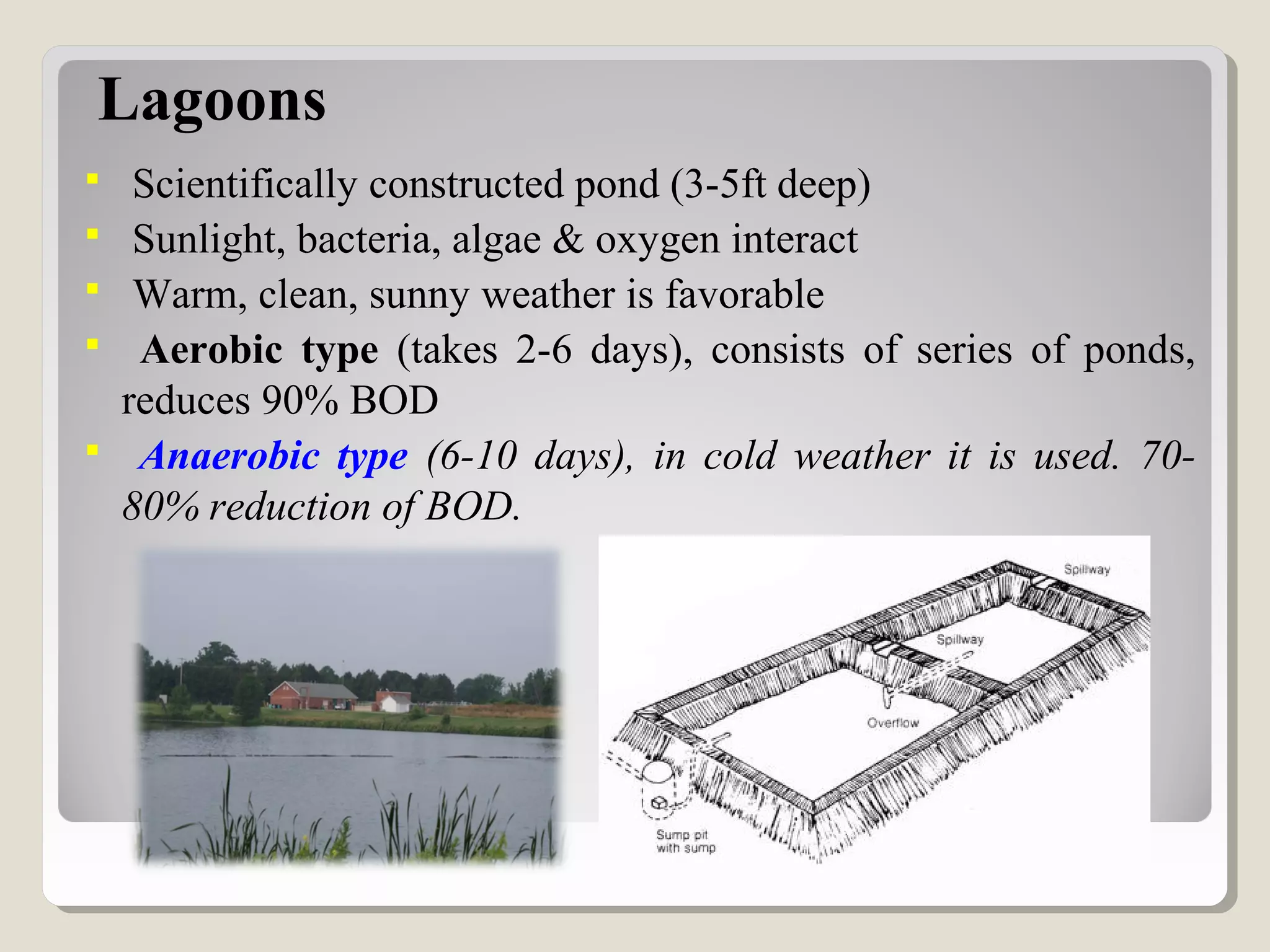
Lagoons
 Scientifically constructed pond (3-5ft deep)
 Sunlight, bacteria, algae & oxygen interact
 Warm, clean, sunny weather is favorable
 Aerobic type (takes 2-6 days), consists of series of ponds,
reduces 90% BOD
 Anaerobic type (6-10 days), in cold weather it is used. 70-
80% reduction of BOD.
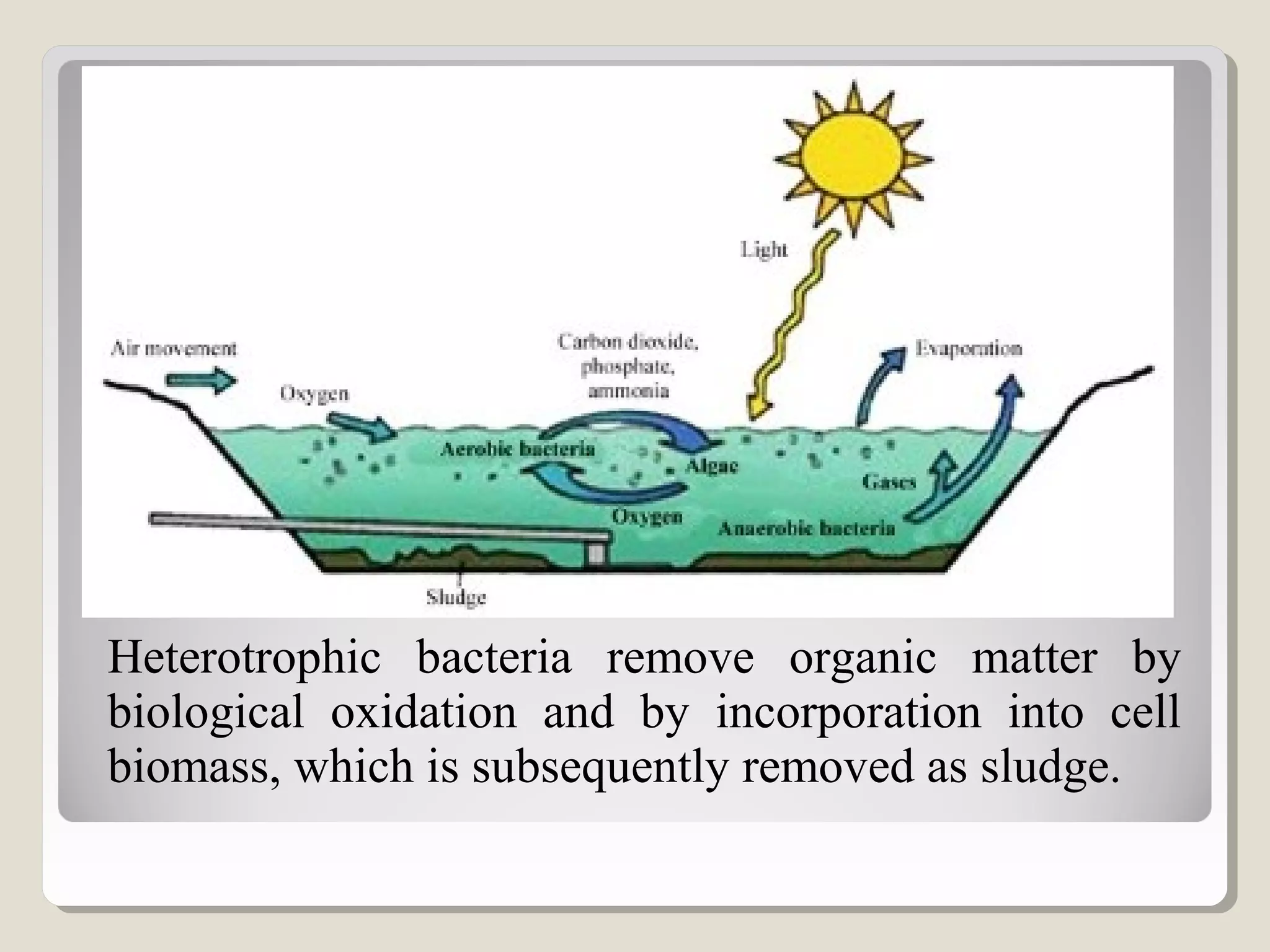
Heterotrophic bacteria remove organic matter by
biological oxidation and by incorporation into cell
biomass, which is subsequently removed as sludge.
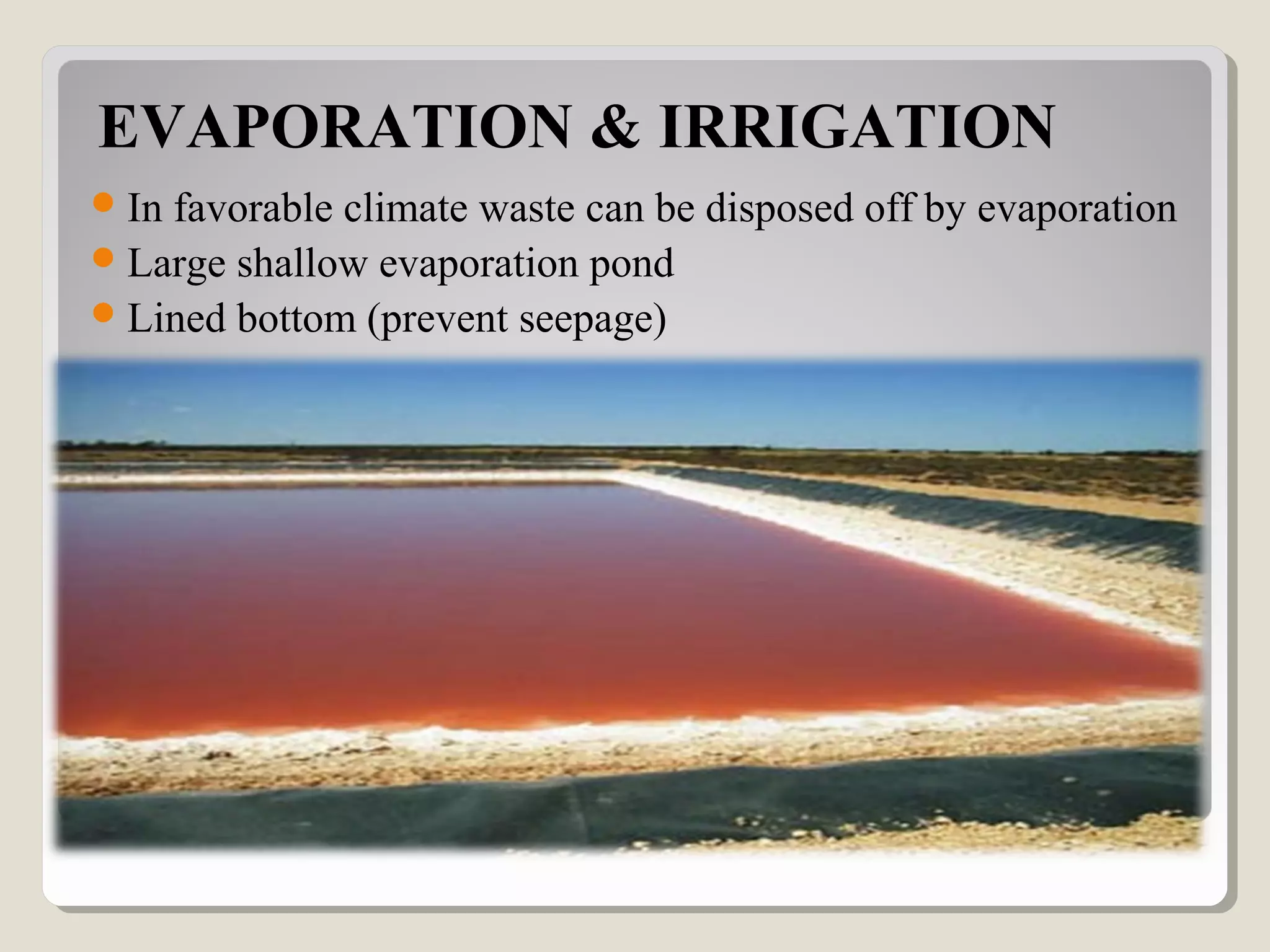
EVAPORATION & IRRIGATION
In favorable climate waste can be disposed off by evaporation
Large shallow evaporation pond
Lined bottom (prevent seepage)
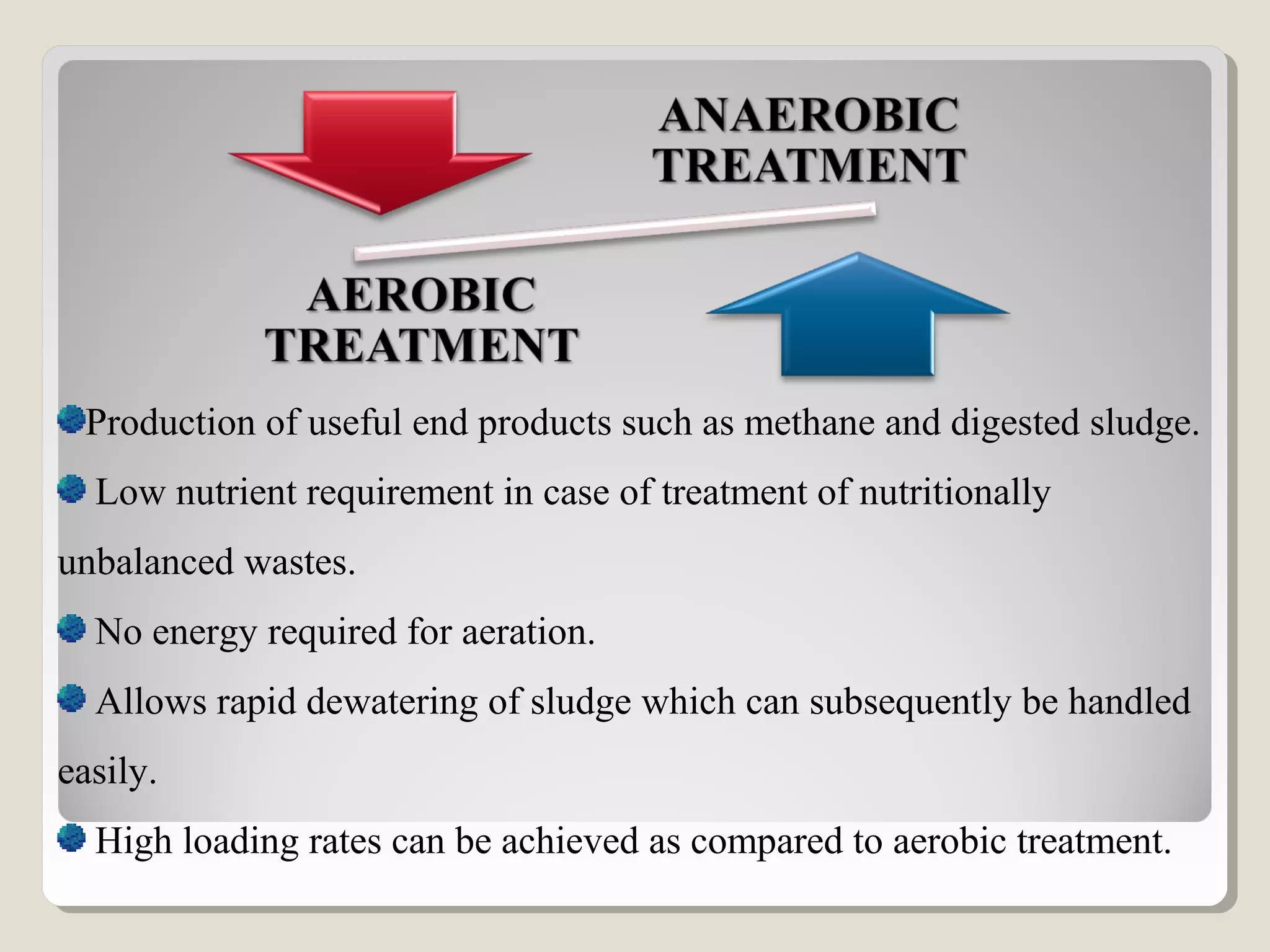
Production of useful end products such as methane and digested sludge.
Low nutrient requirement in case of treatment of nutritionally
unbalanced wastes.
No energy required for aeration.
Allows rapid dewatering of sludge which can subsequently be handled
easily.
High loading rates can be achieved as compared to aerobic treatment.
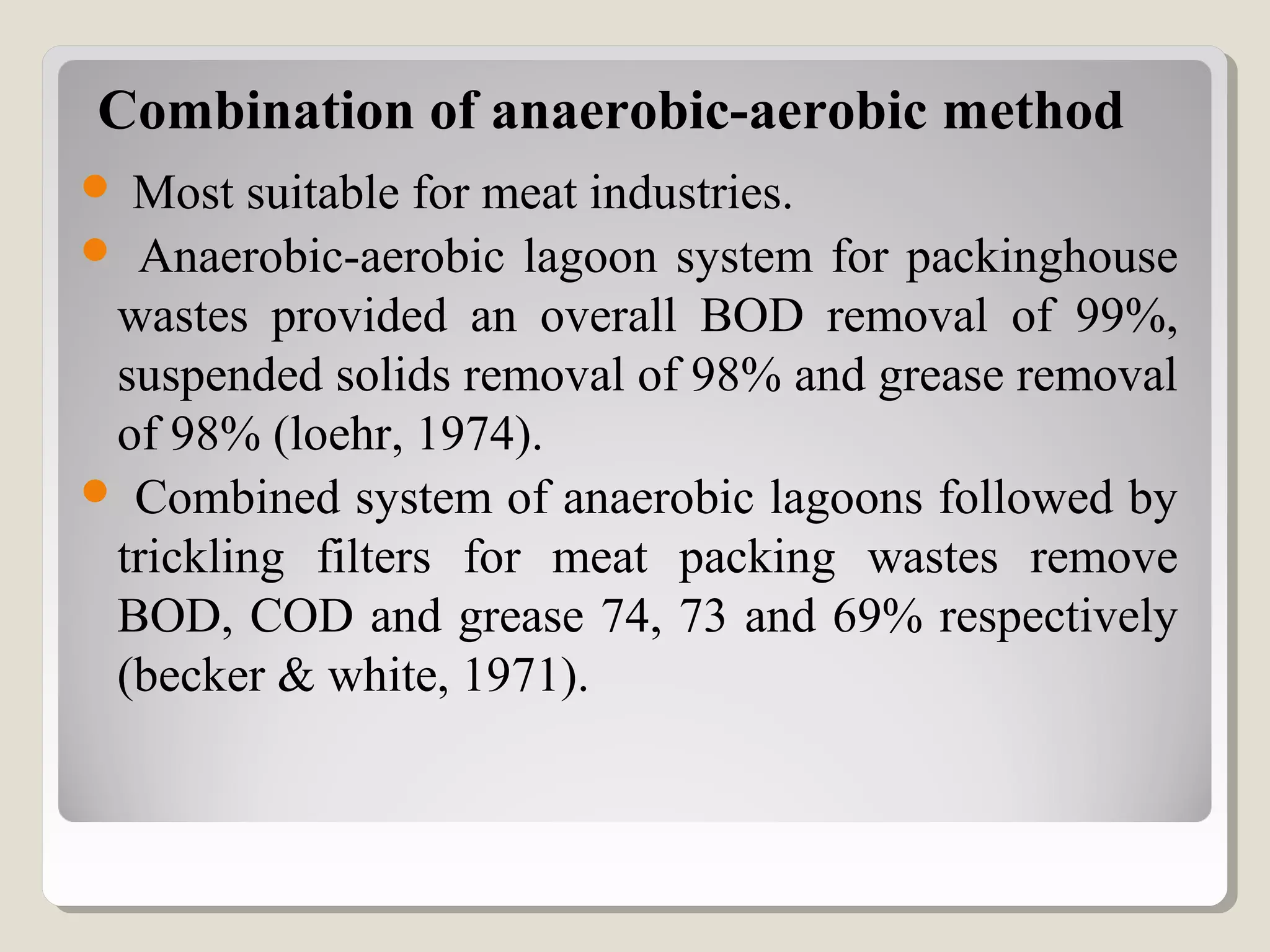
Combination of anaerobic-aerobic method
 Most suitable for meat industries.
 Anaerobic-aerobic lagoon system for packinghouse
wastes provided an overall BOD removal of 99%,
suspended solids removal of 98% and grease removal
of 98% (loehr, 1974).
 Combined system of anaerobic lagoons followed by
trickling filters for meat packing wastes remove
BOD, COD and grease 74, 73 and 69% respectively
(becker & white, 1971).
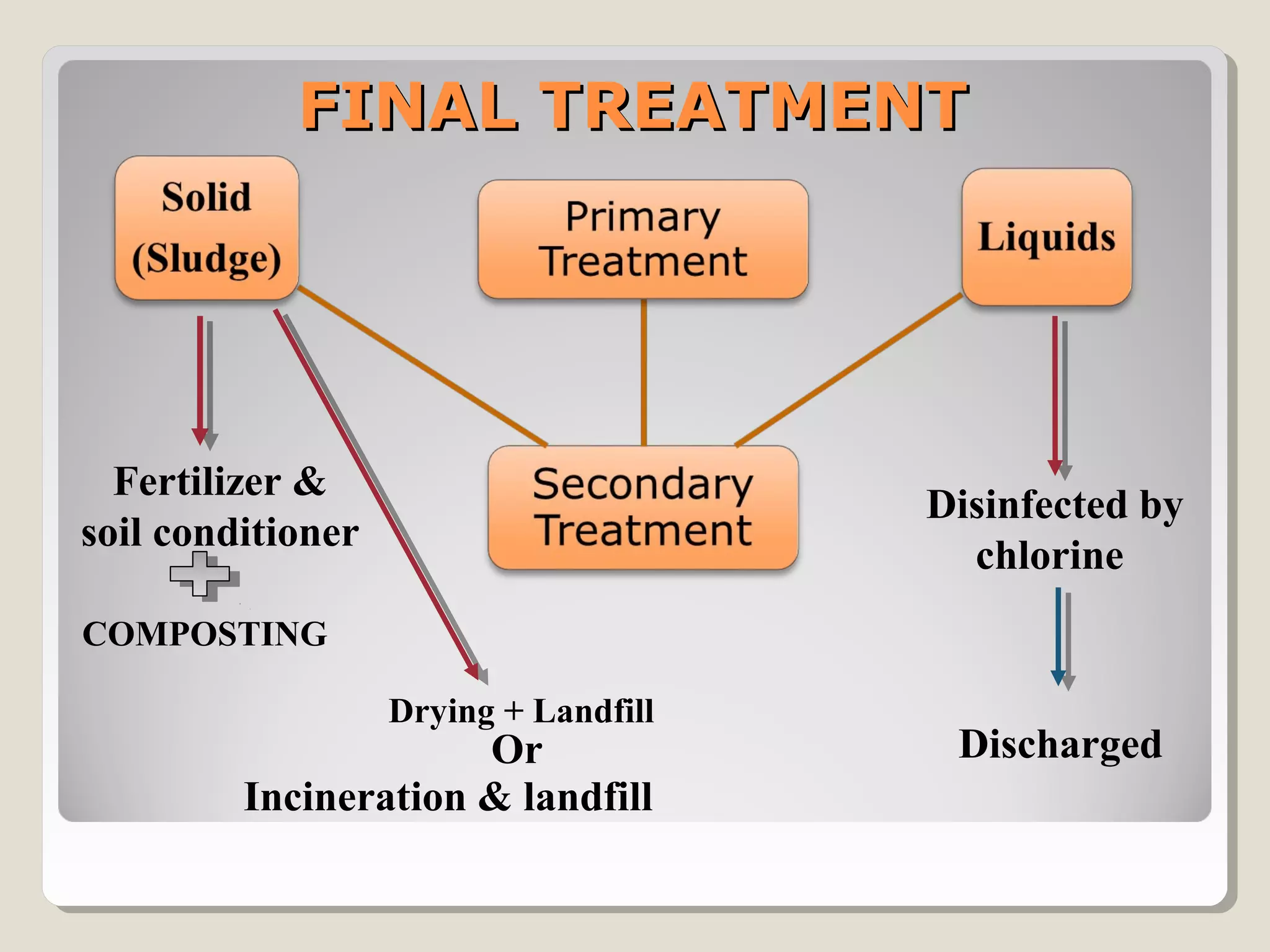
FINAL TREATMENTFINAL TREATMENT
Fertilizer &
soil conditioner
COMPOSTING
Incineration & landfill
Drying + Landfill
Or
Disinfected by
chlorine
Discharged
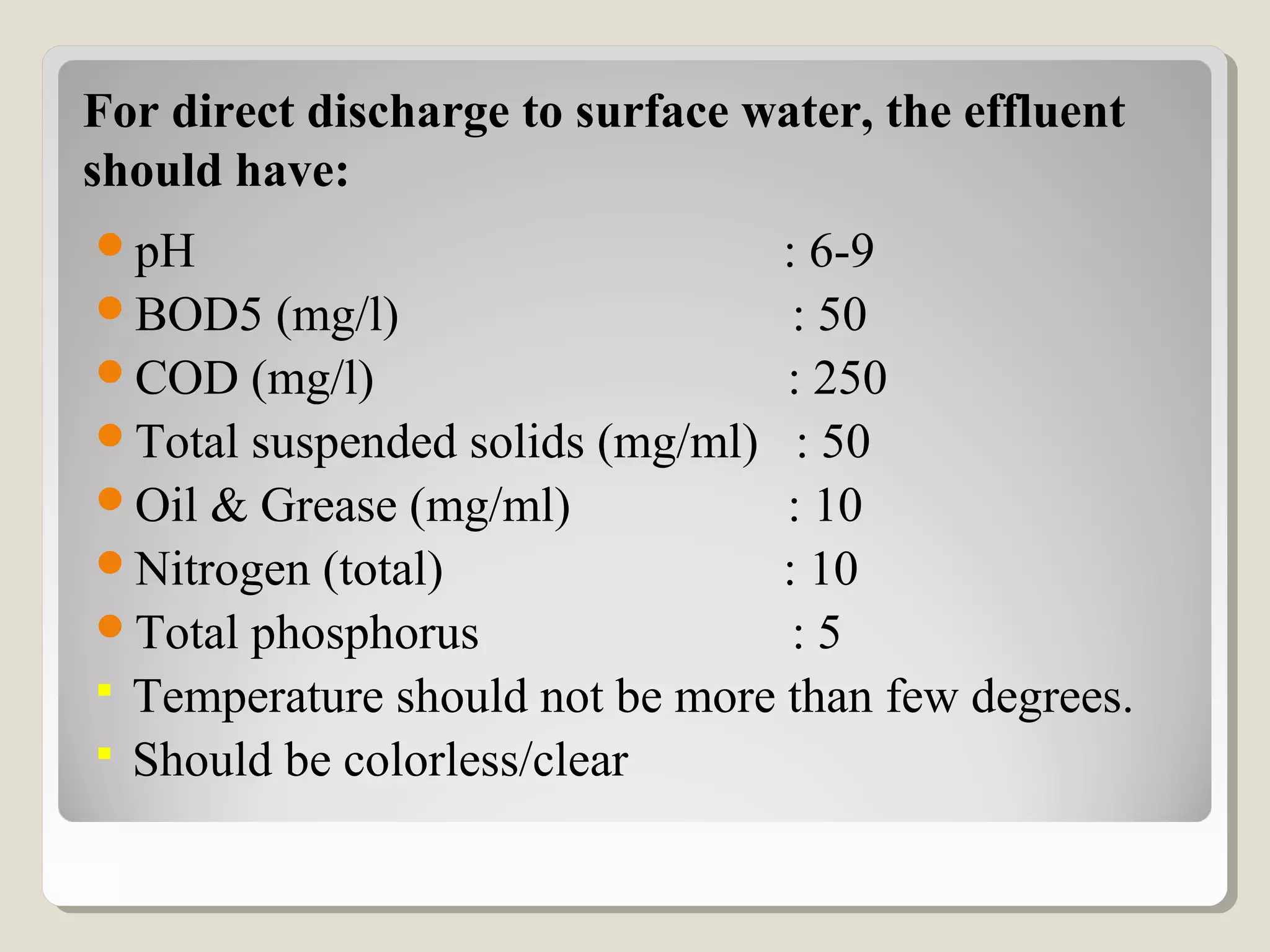
For direct discharge to surface water, the effluent
should have:
pH : 6-9
BOD5 (mg/l) : 50
COD (mg/l) : 250
Total suspended solids (mg/ml) : 50
Oil & Grease (mg/ml) : 10
Nitrogen (total) : 10
Total phosphorus : 5
 Temperature should not be more than few degrees.
 Should be colorless/clear
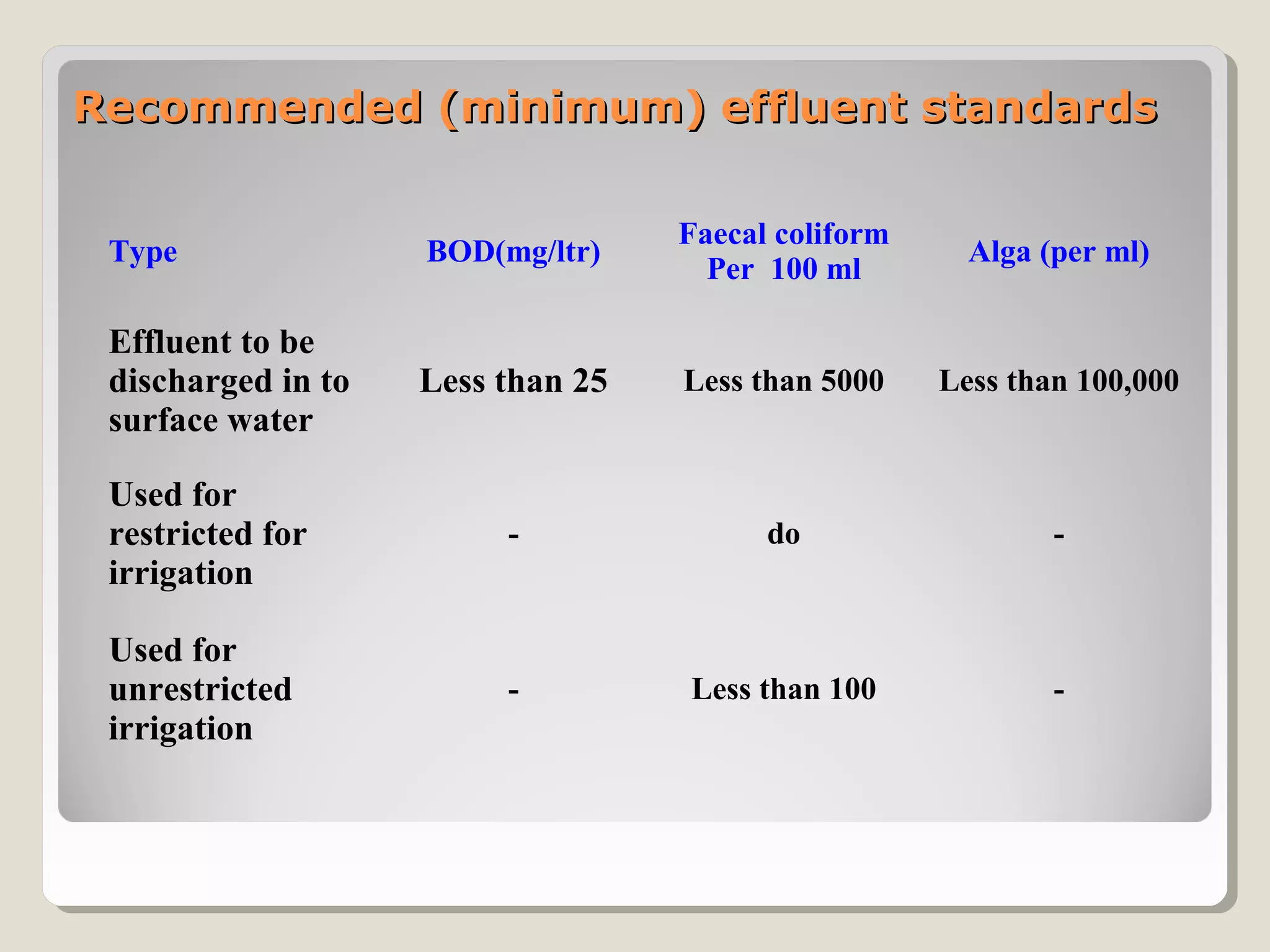
Recommended (minimum) effluent standardsRecommended (minimum) effluent standards
Type BOD(mg/ltr)
Faecal coliform
Per 100 ml
Alga (per ml)
Effluent to be
discharged in to
surface water
Less than 25 Less than 5000 Less than 100,000
Used for
restricted for
irrigation
- do -
Used for
unrestricted
irrigation
- Less than 100 -
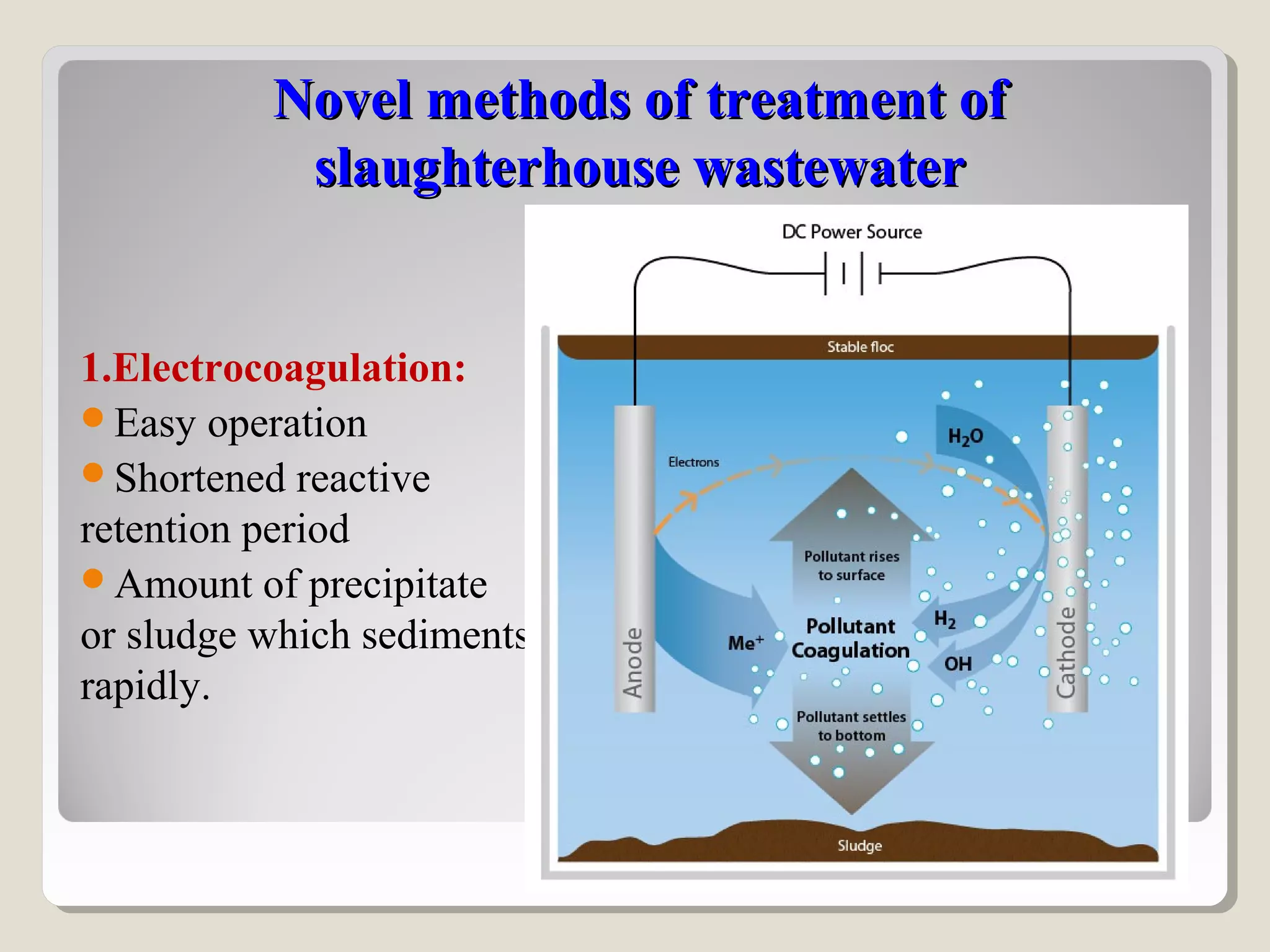
Novel methods of treatment ofNovel methods of treatment of
slaughterhouse wastewaterslaughterhouse wastewater
1.Electrocoagulation:
Easy operation
Shortened reactive
retention period
Amount of precipitate
or sludge which sediments
rapidly.
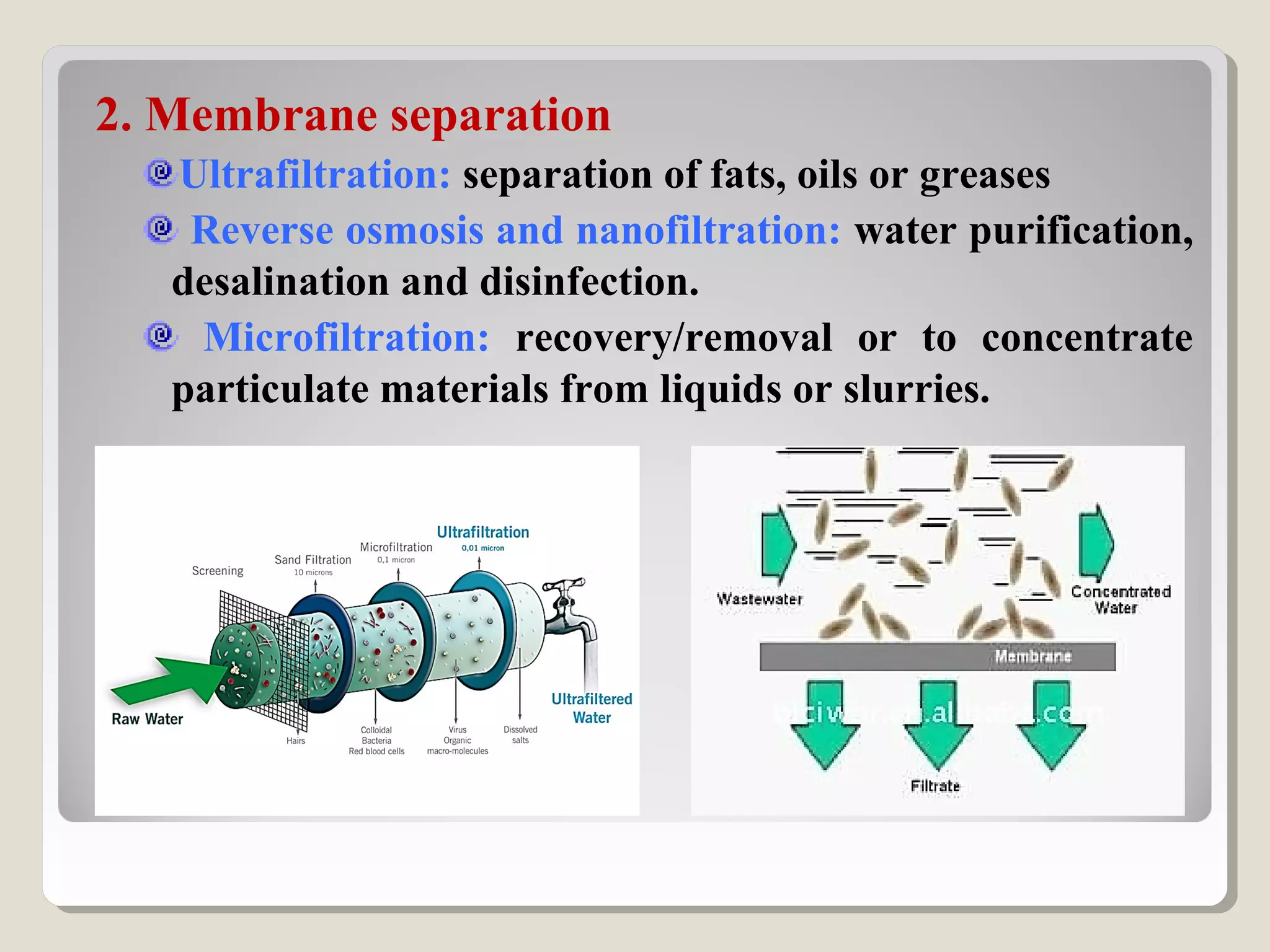
2. Membrane separation
Ultrafiltration: separation of fats, oils or greases
Reverse osmosis and nanofiltration: water purification,
desalination and disinfection.
Microfiltration: recovery/removal or to concentrate
particulate materials from liquids or slurries.
ReferenceReference
Gracey, Collins and Huey. 1999. Meat Hygiene. 10th Edition. W. B.
Saunders Company.
Hui, Nip, Rogers and Young. 2001 Meat Science and Applications. Marcel
Dekker Inc.
Ranken. 2000. Handbook of Meat Products Technology. Blackwell
www.fao.org
Masse, D.I., and Masse, L. 2000. Treatment of slaughterhouse wastewater
in anaerobic sequencing batch reactors. Agriculture and Agri-Food
Canada, P.O. Box 90, Route 108 East, Lennoxville, QC, Canada J1M
1Z3. Agriculture and Agri-Food Canada contribution No. 659
Sindhu, R., and Meera, V. Treatment Of Slaughterhouse Effluent Using
Upflow Anaerobic Packed Bed Reactor. 2012 International Congress
on Informatics, Environment, Energy and Applications-IEEA 2012
IPCSIT vol.38, Singapore.
``

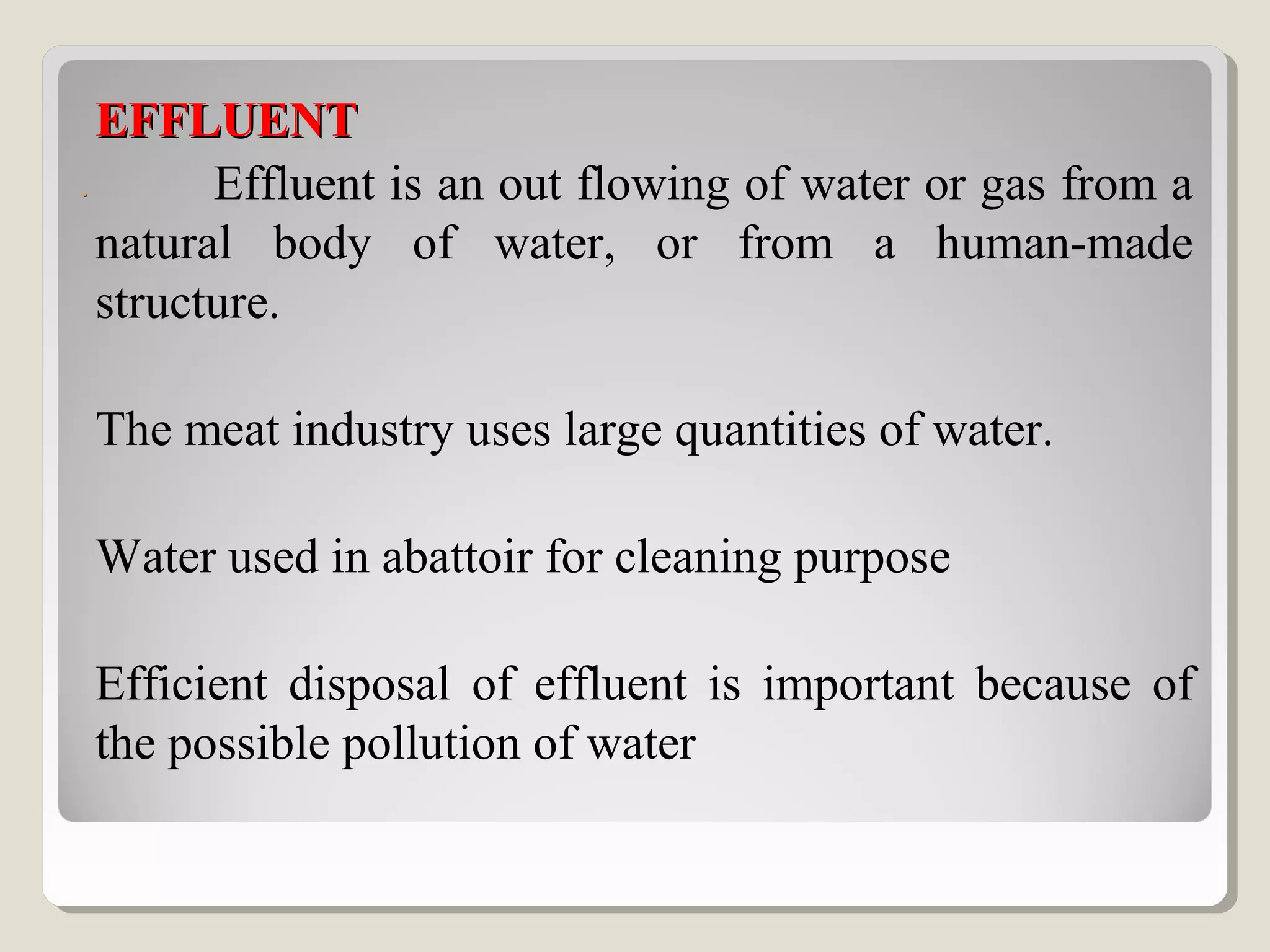
TREATMENT OF ABATTOIR EFFLUENT

  • 1.
    Veterinary Public Health IndianVeterinary Research Institute Izatnagar, Bareilly WELCOMEWELCOME ByBy Irshad. AIrshad. A MVSc ScholarMVSc Scholar Livestock Product TechnologyLivestock Product Technology Email:- irshad2k6@gmail.comEmail:- irshad2k6@gmail.com Meat Hygiene
  • 3.
    .. EFFLUENTEFFLUENT Effluent is anout flowing of water or gas from a natural body of water, or from a human-made structure. The meat industry uses large quantities of water. Water used in abattoir for cleaning purpose Efficient disposal of effluent is important because of the possible pollution of water
  • 4.
    Effluents in meatprocessing plants originateEffluents in meat processing plants originate fromfrom
  • 5.
    EFFLUENT=EFFLUENT=Potent pollutant source Contenthigh amount of organic matter  Solid (up to 10%) and semisolid form organic matter (blood, stomach content, manure etc.)  Should not release directly to environment without treatment
  • 6.
    Effluents can bedivided into four categories: o Non-toxic and not directly pollutant but liable to disturb the physical nature of the receiving water. o Non-toxic and pollutant due to organic matter content of high oxygen demand. o Toxic - containing highly poisonous materials. o Toxic and pollutant due to organic matter of high oxygen demand and toxic in addition.
  • 7.
    OBJECTIVE OF TREATMENT Eliminate threat of diseases  Convert the effluent into a readily reusable resource  Conservation of water and nutrient  Produces a product that can be safely discharged into water or swear.
  • 8.
    CHARACTERISTICS OF EFFLUENT Content readily biodegradable organic matter (measured in term of BOD)  Content grease, fat and oil, tend to coat system  Organic matter reduces oxygen transfer  Nitrogen present in 3 form, 1. Organic N2, 2. Ammonia salt, 3.Dissolved ammonia gas  Both aerobic and anaerobic bacteria  Comparatively high temperature Turbid Off color Dissolved gas (methane, So2)
  • 9.
    POLLUTION PARAMETERS Biochemical oxygendemand (BOD) - measure of the readily biodegradable material in an effluent.  It is amount of oxygen consumed by the aerobic organisms at a temperature of 20o C for a period of 5 days. It is generally used to determine the concentration of pollutant remaining after treatment and prior to discharge.
  • 10.
    POLLUTION PARAMETERS Chemical oxygendemand (COD)- is a measure of the oxygen required for the oxidation of all organic matter in a known volume of effluent. The COD is often used as a cheaper and more accurate. Used for determining the oxygen requirements of an effluent before treatment.
  • 11.
    POLLUTION PARAMETERS Chloride (Cl)-a measure of salinity. Dry matter (DM) or total solids (TS) is the final weight of a known amount of effluent that has been dried to a constant weight at 105°C over 24 h. It is measured in g/litre or mg/litre Grease, fat and oil (FOG):- oimmiscibility substances with a lower specific gravity, which cause them to float. oAffect further treatment systems oMeasured by extraction with hexane or Freon.
  • 12.
    POLLUTION PARAMETERS pH  - measure of the acidity or alkalinity  Nitrogen (N)/Totalkjeldahl nitrogen (TKN): Measure of total nitrogen nitrates which are found in aerobically treated effluents. Ammonia is toxic to aquatic life; the maximum discharge to sewers is 40 mg / litre. High nitrate in natural waters encourage algae and other plant growth. The maximum level in potable water is 0.5 mg / litre.
  • 13.
    Pathogenic bacteria Suspended solids(SS) Temperature Turbidity and colour Volatile solids POLLUTION PARAMETERS
  • 14.
    Source BOD mg/litre Poultry meat plant1000-1200 Pig meat plant 1500-2000 Cattle/sheep meat plant 1400-3200 Fish processing 1000-3000 Dairy (washings) 600-1300 Biochemical oxygen demand (BOD) Normal Domestic sewage 250-300
  • 15.
    TREATMENT STEPSTREATMENT STEPS Primarytreatment (physical removal of solid) Secondary treatment (biological treatment) Final treatment(disinfection) Release of water into water bodyRelease of water into water body
  • 16.
     Primary treatment Removalof solids, passing through screen, filters, floatation/sedimentation, grit chamber etc. Results: Reduction of BOD up to 200-250 mg/lit.Reduction of BOD up to 200-250 mg/lit.
  • 17.
    Consequent steps:Consequent steps: 1.Passing through “fat trap”-removes fine suspended solid, fat & grease FAT TRAP GRIT CHAMBER
  • 18.
    Woven wire screens:suitable for gut content, yard and truck washings. Wedge wire: relatively strong and abuse resistant. It reduces the chances of screens becoming blocked with fats and other tissues.
  • 19.
    2. Air floatationDissolved Air Floatation (DAF) - physical separation by micro-bubbles of solids, fat, grease.
  • 20.
    Suspended solids inthe wastewater are removed by floatation assisted by microbubbles bubbles are produced by dissolving air in the wastewater. Coagulants (ferric chloride, alum, soda ash, lime & polymer) may be added to increase the efficiency of removal.
  • 21.
    ADVANTAGESADVANTAGES works faster andproduces a drier sludge.  Low capital cost  Less ground area requirements  Less operator time  Flexibility of operations in respect of recovery of oil and proteins. 62-90% of oil and grease removal & 30-80% of BOD reduction.
  • 22.
    3. PHYSICO-CHEMICAL TREATMENT Useof cationic (Fe3+ and Al3+ salts) and anionic coagulants (Na hexametaphosphate, lignosulfonate and Na alginate) with pH adjustment precipitate and agglomerate protein & other organic materials into larger particles (flocs) that can be recovered by a physical process such as DAF or settling. Fe3+ and Al3+ salts also precipitate out much of the phosphorus from waste water Anionic coagulants are used to remove hemoglobin, which can make up a large proportion of the soluble organic load in wastewater from meat processing
  • 23.
    Secondary treatmentSecondary treatment Onebiological treatment system under controlled condition  Culture of microbes is mixed  Microbes utilizes available organic matter & synthesis new cell  More than 90% organic matter removed Secondary treatment can be done aerobically or anaerobically followed by disinfection using chlorides or by other methods and digestion of solids.
  • 24.
    Anaerobic Treatment Carried outin absence of air- in a closed system  Effective in high BOD level  In 1st stage VFA formed, methanogenic bacteria use it and produce CO2 and methane (pH-7.0-7.2). With a BOD higher than 2000 mg/litre it becomes advantageous. TWO--STAGE FERMENTATION PROCESS
  • 25.
    Typical composition ofbiogas Matter % Methane, CH4 50 - 75 Carbon dioxide, CO2 25 - 50 Nitrogen, N2 0 - 10 Hydrogen, H2 0 - 1 Hydrogen sulfide, H2S 0 - 3 Oxygen, O2 0 - 2
  • 26.
    Advantages: Achieve removal ratesof 70% to 90% for COD and BOD5.  Low operating cost due to low sludge production and low energy requirements  Net producer of energy if the biomass is recovered as fuel. Disadvantages:  Does not remove nitrogen or phosphorus.  Reduces organic form of nitrogen and sulfur to ammonia and H2S, which can be toxic to aquatic lives. H2S can also cause an odor nuisance and corrosion of equipment. Maintaining the pH at around 7.0-7.2 is very important.
  • 27.
    AEROBIC TREATMENT In presenceof air bacteria utilizes organic mater for their own cell synthesis. Organic carbon converted into CO2, nitrogen or nitrate ions. Before anaerobically treated wastewater is discharged to waterways, it is treated aerobically ◦ to remove most residual BOD and suspended solids, & ◦ to oxidize NH3 and H2S to less harmful nitrate and sulphate. Treatments:- ◦ Activated sludge process ◦ Trickling filters ◦ Lagoons. ◦ Evaporation & Irrigation
  • 28.
    Waste stream Primary treatment Aerationtank (mixing and aeration by aerators & / or pressurized air diffusers) Mixed liquid is allowed to settle in the clarifier Clear supernatant Chlorinated & discharged to the receiving water Content 2 tanks,  Aeration tank  Final settling tank
  • 29.
    Tickling filter 3-10m deepbed of porous media. (bed of stone, slag)  wastewater is applied to the surface of the bed and trickles downwards through the media, to which microorganisms are attached.  90% reduction of BOD & removal of suspended solids
  • 30.
    Lagoons  Scientifically constructedpond (3-5ft deep)  Sunlight, bacteria, algae & oxygen interact  Warm, clean, sunny weather is favorable  Aerobic type (takes 2-6 days), consists of series of ponds, reduces 90% BOD  Anaerobic type (6-10 days), in cold weather it is used. 70- 80% reduction of BOD.
  • 31.
    Heterotrophic bacteria removeorganic matter by biological oxidation and by incorporation into cell biomass, which is subsequently removed as sludge.
  • 32.
    EVAPORATION & IRRIGATION Infavorable climate waste can be disposed off by evaporation Large shallow evaporation pond Lined bottom (prevent seepage)
  • 33.
    Production of usefulend products such as methane and digested sludge. Low nutrient requirement in case of treatment of nutritionally unbalanced wastes. No energy required for aeration. Allows rapid dewatering of sludge which can subsequently be handled easily. High loading rates can be achieved as compared to aerobic treatment.
  • 34.
    Combination of anaerobic-aerobicmethod  Most suitable for meat industries.  Anaerobic-aerobic lagoon system for packinghouse wastes provided an overall BOD removal of 99%, suspended solids removal of 98% and grease removal of 98% (loehr, 1974).  Combined system of anaerobic lagoons followed by trickling filters for meat packing wastes remove BOD, COD and grease 74, 73 and 69% respectively (becker & white, 1971).
  • 35.
    FINAL TREATMENTFINAL TREATMENT Fertilizer& soil conditioner COMPOSTING Incineration & landfill Drying + Landfill Or Disinfected by chlorine Discharged
  • 36.
    For direct dischargeto surface water, the effluent should have: pH : 6-9 BOD5 (mg/l) : 50 COD (mg/l) : 250 Total suspended solids (mg/ml) : 50 Oil & Grease (mg/ml) : 10 Nitrogen (total) : 10 Total phosphorus : 5  Temperature should not be more than few degrees.  Should be colorless/clear
  • 37.
    Recommended (minimum) effluentstandardsRecommended (minimum) effluent standards Type BOD(mg/ltr) Faecal coliform Per 100 ml Alga (per ml) Effluent to be discharged in to surface water Less than 25 Less than 5000 Less than 100,000 Used for restricted for irrigation - do - Used for unrestricted irrigation - Less than 100 -
  • 38.
    Novel methods oftreatment ofNovel methods of treatment of slaughterhouse wastewaterslaughterhouse wastewater 1.Electrocoagulation: Easy operation Shortened reactive retention period Amount of precipitate or sludge which sediments rapidly.
  • 39.
    2. Membrane separation Ultrafiltration:separation of fats, oils or greases Reverse osmosis and nanofiltration: water purification, desalination and disinfection. Microfiltration: recovery/removal or to concentrate particulate materials from liquids or slurries.
  • 41.
    ReferenceReference Gracey, Collins andHuey. 1999. Meat Hygiene. 10th Edition. W. B. Saunders Company. Hui, Nip, Rogers and Young. 2001 Meat Science and Applications. Marcel Dekker Inc. Ranken. 2000. Handbook of Meat Products Technology. Blackwell www.fao.org Masse, D.I., and Masse, L. 2000. Treatment of slaughterhouse wastewater in anaerobic sequencing batch reactors. Agriculture and Agri-Food Canada, P.O. Box 90, Route 108 East, Lennoxville, QC, Canada J1M 1Z3. Agriculture and Agri-Food Canada contribution No. 659 Sindhu, R., and Meera, V. Treatment Of Slaughterhouse Effluent Using Upflow Anaerobic Packed Bed Reactor. 2012 International Congress on Informatics, Environment, Energy and Applications-IEEA 2012 IPCSIT vol.38, Singapore.
  • 42.