By: Julius Martonia Manolong
INTRODUCTION
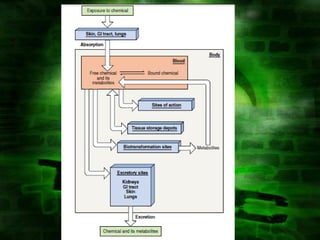
₰ Toxicant (Poison)
  – any agent capable of producing a deleterious
    response in a biological system

  – ”Foreign” Chemicals or Xenobiotics

  – Air we breathe, water we drink and food we eat.
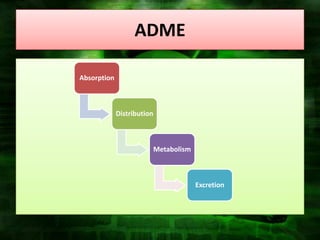
ADME

Absorption


             Distribution


                            Metabolism


                                         Excretion
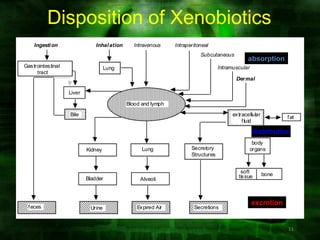
Disposition of Xenobiotics
    Ingesti on                 Inhal ation     Intravenous     Intraperitoneal
                                                                          Subcutaneous
                                                                                                absorption
Gastrointestinal                    Lung                                           Intramuscular
     tract
                                                                                          Der mal

                   Liver

                                             Blood and lymph

                   Bile                                                                  extracellular          f at
                                                                                             f luid

                                                                                                   distribution
                                                                                                 body
                           Kidney                  Lung               Secretory                 organs
                                                                      Structures


                                                                                            soft
                                                                                           tissue        bone
                           Bladder                Alveoli


                                                                                                   excretion
 f eces                     Urine                Expired Air           Secretions


                                                                                                                11
ADME: ABSORPTION
₰ ability of a chemical to enter the blood
  (blood is in equilibrium with tissues)

₰ Rate the following processes in order of fastest
  to slowest:
      ORAL
      INTRAVENOUS
      INHALATION
      DERMAL EXPOSURE.
INGESTION/ORAL

• Most xenobiotics move through the lining of the
  gastrointestinal tract
   – Diffusion or carrier-mediated transport
Factors Affecting GI

• Disintegration of dosage form and dissolution of
  particles
• Chemical stability of chemical in gastric and
  intestinal juices and enzymes
• Rate of gastric emptying
• Motility and mixing in GI tract
• Presence and type of food
INHALATION:

• For gases, vapors and volatile liquids, aerosols
  and particles
• In general: large surface area, thin barrier, high
  blood flow           rapid absorption
• Blood:air partition coefficient –
  influence of respiratory rate and blood flow
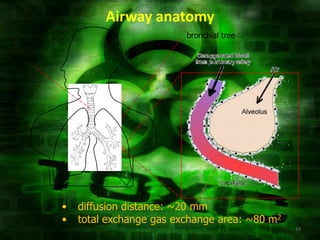
Airway anatomy
                                   bronchial tree

trachea


          •   diffusion distance: ~20 mm
          •   total exchange gas exchange area: ~80 m2
                                                         16
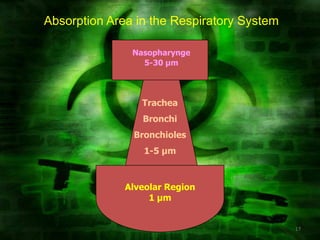
Absorption Area in the Respiratory System

               Nasopharynge
                 5-30 µm


                 Trachea
                 Bronchi
               Bronchioles
                  1-5 µm


              Alveolar Region
                   1 µm


                                            17
DERMAL
• Must cross several cell layers (stratum
  corneum, epidermis, dermis) to reach
  blood vessels.

• Factors important here are:
     lipid solubility
     hydration of skin
     site (e.g. sole of feet vs. scrotum)
INTRAVENOUS

• Intraperitoneal
      -large surface area, vascularized, first pass
  effect.

• Intramuscular, subcutaneous, intradermal:
     -absorption through endothelial pores into
  the circulation; blood flow is most important +
  other factors
ADME: DISTRIBUTION
  ₰ the process in which a chemical agent
   translocates throughout the body.

• Blood carries the agent to and from its site of
  action,    storage     depots,     organs    of
  transformation, and organs of elimination
• Rate of distribution (rapid) dependent upon
   – blood flow
   – characteristics of toxicant (affinity for the tissue,
     and the partition coefficient)
• Distribution may change over time
Storage and Binding Sites:
• Storage in Adipose tissue-very lipophylic compounds
  (DDT) will store in fat. Rapid mobilization of the fat
  (starvation) can rapidly increase blood concentration

• Storage in Bone--Chemicals analogous to Calcium--
  Fluoride, Lead, Strontium

• Binding to Plasma proteins--can displace endogenous
  compounds. Only free is available for adverse effects
  or excretion
ADME: METABOLISM
• Also called as Biotransformation

• The process by which the administered chemical
  (parent compounds) are modified by the
  organism by enzymatic reactions.

• Bioactivation--Biotransformation can result in the
  formation of reactive metabolites
• 1o objective--make chemical agents more water
  soluble and easier to excrete
   – decrease lipid solubility                      -->
     decrease amount at target
   – increase ionization                           -->
     increase excretion rate --> decrease toxicity
₰ Occurs in liver and to some extent to;
  *Kidney
  *skin
  *placenta and
  *other organs

  ₰ Can have several consequences

  Microsomal enzyme system (MES)- a hepatic
  enzyme that is inducible and performs a role in
  biotransformation. Ex…
Hepatic biotransformation mechanisms can be
maladaptive.
   -”toxify” rather than “detoxify”
   Ex: Cigarette smoke--Carcinogen


MEs evolved not to defend against the foreign
 chemicals but rather to metabolize endogenous
 substances.
     -Inhibitors
ADME: EXCRETION
• Toxicants are eliminated from the body by
  several routes
  – Filtered thru renal corspuscle
  – secreted across the tubular epithelium in order to
    appear in urine
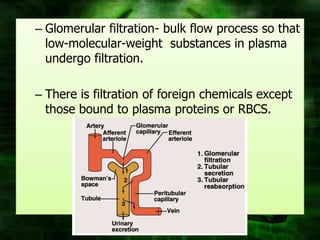
– Glomerular filtration- bulk flow process so that
  low-molecular-weight substances in plasma
  undergo filtration.

– There is filtration of foreign chemicals except
  those bound to plasma proteins or RBCS.
• Urinary excretion
  – water soluble products are filtered out of the
    blood by the kidney and excreted into the urine
• Exhalation
  – Volatile compounds are exhaled by breathing
• Biliary Excretion via Fecal Excretion
  – Compounds can be extracted by the liver and
    excreted into the bile. The bile drains into the
    small intestine and is eliminated in the feces.
• Milk       Sweat       Saliva
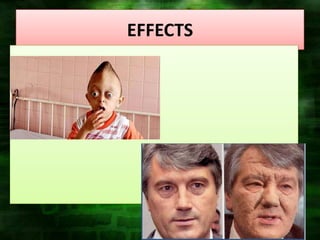
EFFECTS
Toxicity (mechanism)

Toxicity (mechanism)

  • 6.
  • 7.
    INTRODUCTION ₰ Toxicant (Poison) – any agent capable of producing a deleterious response in a biological system – ”Foreign” Chemicals or Xenobiotics – Air we breathe, water we drink and food we eat.
  • 9.
    ADME Absorption Distribution Metabolism Excretion
  • 11.
    Disposition of Xenobiotics Ingesti on Inhal ation Intravenous Intraperitoneal Subcutaneous absorption Gastrointestinal Lung Intramuscular tract Der mal Liver Blood and lymph Bile extracellular f at f luid distribution body Kidney Lung Secretory organs Structures soft tissue bone Bladder Alveoli excretion f eces Urine Expired Air Secretions 11
  • 12.
    ADME: ABSORPTION ₰ abilityof a chemical to enter the blood (blood is in equilibrium with tissues) ₰ Rate the following processes in order of fastest to slowest: ORAL INTRAVENOUS INHALATION DERMAL EXPOSURE.
  • 13.
    INGESTION/ORAL • Most xenobioticsmove through the lining of the gastrointestinal tract – Diffusion or carrier-mediated transport
  • 14.
    Factors Affecting GI •Disintegration of dosage form and dissolution of particles • Chemical stability of chemical in gastric and intestinal juices and enzymes • Rate of gastric emptying • Motility and mixing in GI tract • Presence and type of food
  • 15.
    INHALATION: • For gases,vapors and volatile liquids, aerosols and particles • In general: large surface area, thin barrier, high blood flow rapid absorption • Blood:air partition coefficient – influence of respiratory rate and blood flow
  • 16.
    Airway anatomy bronchial tree trachea • diffusion distance: ~20 mm • total exchange gas exchange area: ~80 m2 16
  • 17.
    Absorption Area inthe Respiratory System Nasopharynge 5-30 µm Trachea Bronchi Bronchioles 1-5 µm Alveolar Region 1 µm 17
  • 18.
    DERMAL • Must crossseveral cell layers (stratum corneum, epidermis, dermis) to reach blood vessels. • Factors important here are: lipid solubility hydration of skin site (e.g. sole of feet vs. scrotum)
  • 19.
    INTRAVENOUS • Intraperitoneal -large surface area, vascularized, first pass effect. • Intramuscular, subcutaneous, intradermal: -absorption through endothelial pores into the circulation; blood flow is most important + other factors
  • 20.
    ADME: DISTRIBUTION ₰ the process in which a chemical agent translocates throughout the body. • Blood carries the agent to and from its site of action, storage depots, organs of transformation, and organs of elimination
  • 21.
    • Rate ofdistribution (rapid) dependent upon – blood flow – characteristics of toxicant (affinity for the tissue, and the partition coefficient) • Distribution may change over time
  • 22.
    Storage and BindingSites: • Storage in Adipose tissue-very lipophylic compounds (DDT) will store in fat. Rapid mobilization of the fat (starvation) can rapidly increase blood concentration • Storage in Bone--Chemicals analogous to Calcium-- Fluoride, Lead, Strontium • Binding to Plasma proteins--can displace endogenous compounds. Only free is available for adverse effects or excretion
  • 23.
    ADME: METABOLISM • Alsocalled as Biotransformation • The process by which the administered chemical (parent compounds) are modified by the organism by enzymatic reactions. • Bioactivation--Biotransformation can result in the formation of reactive metabolites
  • 24.
    • 1o objective--makechemical agents more water soluble and easier to excrete – decrease lipid solubility --> decrease amount at target – increase ionization --> increase excretion rate --> decrease toxicity
  • 25.
    ₰ Occurs inliver and to some extent to; *Kidney *skin *placenta and *other organs ₰ Can have several consequences Microsomal enzyme system (MES)- a hepatic enzyme that is inducible and performs a role in biotransformation. Ex…
  • 26.
    Hepatic biotransformation mechanismscan be maladaptive. -”toxify” rather than “detoxify” Ex: Cigarette smoke--Carcinogen MEs evolved not to defend against the foreign chemicals but rather to metabolize endogenous substances. -Inhibitors
  • 27.
    ADME: EXCRETION • Toxicantsare eliminated from the body by several routes – Filtered thru renal corspuscle – secreted across the tubular epithelium in order to appear in urine
  • 28.
    – Glomerular filtration-bulk flow process so that low-molecular-weight substances in plasma undergo filtration. – There is filtration of foreign chemicals except those bound to plasma proteins or RBCS.
  • 29.
    • Urinary excretion – water soluble products are filtered out of the blood by the kidney and excreted into the urine • Exhalation – Volatile compounds are exhaled by breathing • Biliary Excretion via Fecal Excretion – Compounds can be extracted by the liver and excreted into the bile. The bile drains into the small intestine and is eliminated in the feces. • Milk Sweat Saliva
  • 30.