VIVEKANANDHA
ARTS AND SCIENCE COLLEGE FOR WOMEN
VEERACHIPALAYAM, SANKAGIRI, SALEM, TAMILNADU
Department of Microbiology
Topic :Biodegradable of Plastics and
Super Bug
SUBJECT INCHARGE:
Dr. R.DINESHKUMAR, ASSISTANT PROFESSOR,
DEPARTMENT OF MICROBIOLOGY, VIVEKANANDHA ARTS
AND SCIENCE COLLEGE FOR WOMEN,
SANKAGIRI, SALEM, TAMILNADU.
Submitted By:
P.Suvetha, I-M.SC
MICROBIOLOGY,
VIVEKANANDHA ARTS AND SCIENCE
COLLEGE FOR WOMEN,
SANKAGIRI, SALEM, TAMILNADU.
Subject: Bioremediation
Overview
• Introduction
• Biodegradable Plastics
• Types of Biodegradable Plastics
• Factors Affecting Biodegradation
• Biodegradation Process
• Benefits of Biodegradable Plastics
• Limitations of Biodegradable Plastics
• Real-World Applications of Biodegradable Plastics
• Superbugs
• Types of Superbugs
• Role of Superbugs in Plastic Degradation
• Factors Influencing Superbug Efficiency
• Advantages of Using Superbugs
• Challenges with Superbugs
• Research on Superbugs
• Environmental Impact
• Future Innovations
• Conclusion
Introduction
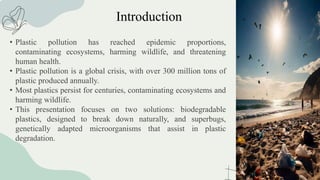
• Plastic pollution has reached epidemic proportions,
contaminating ecosystems, harming wildlife, and threatening
human health.
• Plastic pollution is a global crisis, with over 300 million tons of
plastic produced annually.
• Most plastics persist for centuries, contaminating ecosystems and
harming wildlife.
• This presentation focuses on two solutions: biodegradable
plastics, designed to break down naturally, and superbugs,
genetically adapted microorganisms that assist in plastic
degradation.
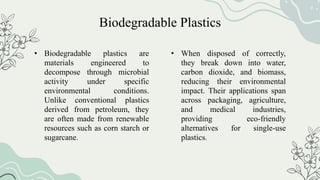
• Biodegradable plastics are
materials engineered to
decompose through microbial
activity under specific
environmental conditions.
Unlike conventional plastics
derived from petroleum, they
are often made from renewable
resources such as corn starch or
sugarcane.
• When disposed of correctly,
they break down into water,
carbon dioxide, and biomass,
reducing their environmental
impact. Their applications span
across packaging, agriculture,
and medical industries,
providing eco-friendly
alternatives for single-use
plastics.
Biodegradable Plastics
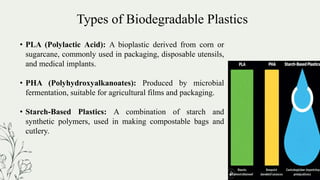
Types of Biodegradable Plastics
• PLA (Polylactic Acid): A bioplastic derived from corn or
sugarcane, commonly used in packaging, disposable utensils,
and medical implants.
• PHA (Polyhydroxyalkanoates): Produced by microbial
fermentation, suitable for agricultural films and packaging.
• Starch-Based Plastics: A combination of starch and
synthetic polymers, used in making compostable bags and
cutlery.
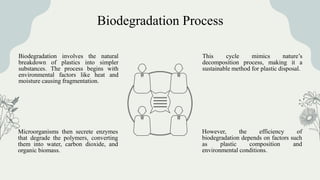
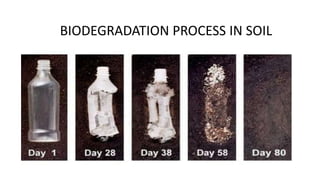
Biodegradation Process
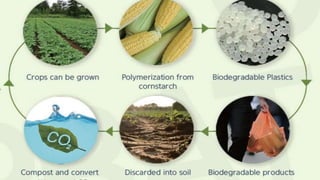
This cycle mimics nature’s
decomposition process, making it a
sustainable method for plastic disposal.
However, the efficiency of
biodegradation depends on factors such
as plastic composition and
environmental conditions.
Biodegradation involves the natural
breakdown of plastics into simpler
substances. The process begins with
environmental factors like heat and
moisture causing fragmentation.
Microorganisms then secrete enzymes
that degrade the polymers, converting
them into water, carbon dioxide, and
organic biomass.
Factors Affecting Biodegradation
• Environmental Conditions: Temperature, moisture, and pH levels play a
crucial role.
• Plastic Composition: Plastics with simpler chemical structures degrade
faster.
• Microbial Availability: The presence of effective microbes enhances the
process. Ensuring optimal conditions for biodegradation is essential for
achieving effective results.
BIODEGRADATION PROCESS IN SOIL
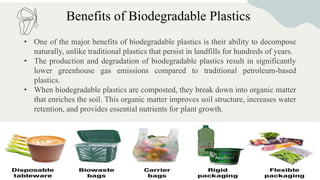
Benefits of Biodegradable Plastics
• One of the major benefits of biodegradable plastics is their ability to decompose
naturally, unlike traditional plastics that persist in landfills for hundreds of years.
• The production and degradation of biodegradable plastics result in significantly
lower greenhouse gas emissions compared to traditional petroleum-based
plastics.
• When biodegradable plastics are composted, they break down into organic matter
that enriches the soil. This organic matter improves soil structure, increases water
retention, and provides essential nutrients for plant growth.
Limitations of Biodegradable Plastics
• High production costs limit their widespread adoption: One of the major
barriers to the large-scale adoption of biodegradable plastics is their high
production cost compared to traditional petroleum-based plastics.
• Require specific environmental conditions for effective degradation:
Biodegradable plastics do not always decompose under natural conditions
• Risk of contamination with non-biodegradable plastics: Another
challenge is the risk of contamination when biodegradable plastics are mixed
with non-biodegradable plastics in waste streams.
Advantages of Using Superbugs
• Accelerate the Breakdown of Non-Biodegradable Plastics: Non-
biodegradable plastics like PET (polyethylene terephthalate) and
polyurethane are highly resistant to natural degradation, persisting in the
environment for centuries.
• Reduce Microplastic Accumulation in the Environment: Microplastics tiny
fragments of plastic that result from the breakdown of larger items pose a
significant threat to ecosystems and human health.
• Offer a Scalable Solution for Cleaning Marine and Terrestrial Ecosystems:
One of the most compelling advantages of superbugs is their potential for
scalability in environmental applications.
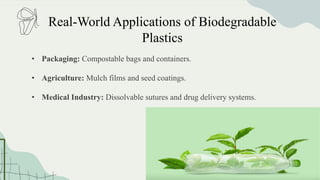
Real-World Applications of Biodegradable
Plastics
• Packaging: Compostable bags and containers.
• Agriculture: Mulch films and seed coatings.
• Medical Industry: Dissolvable sutures and drug delivery systems.
Superbugs
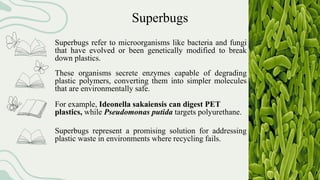
Superbugs refer to microorganisms like bacteria and fungi
that have evolved or been genetically modified to break
down plastics.
These organisms secrete enzymes capable of degrading
plastic polymers, converting them into simpler molecules
that are environmentally safe.
For example, Ideonella sakaiensis can digest PET
plastics, while Pseudomonas putida targets polyurethane.
Superbugs represent a promising solution for addressing
plastic waste in environments where recycling fails.
Types of Superbugs
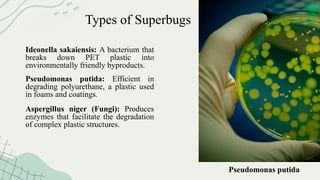
Ideonella sakaiensis: A bacterium that
breaks down PET plastic into
environmentally friendly byproducts.
Pseudomonas putida: Efficient in
degrading polyurethane, a plastic used
in foams and coatings.
Aspergillus niger (Fungi): Produces
enzymes that facilitate the degradation
of complex plastic structures.
Pseudomonas putida
Role of Superbugs in Plastic Degradation
Superbugs play a pivotal role in accelerating plastic degradation. By
producing enzymes, they can break chemical bonds in plastics,
converting them into simpler molecules like carbon dioxide and
water.
For instance, Ideonella sakaiensis digests PET plastic into harmless
monomers, while Pseudomonas putida breaks down polyurethane
into organic compounds.
These microorganisms hold the potential to revolutionize plastic
waste management by tackling non-recyclable plastics.
Factors Influencing Superbug Efficiency
• Environmental Settings: Oxygen levels, temperature,
and humidity affect their activity.
• Type of Plastic: Some plastics are easier to degrade
than others.
• Genetic Modifications: Scientists are enhancing
superbugs to improve their adaptability and efficiency.
Advantages of Using Superbugs
• Accelerate the Breakdown of Non-Biodegradable Plastics: Non-
biodegradable plastics like PET (polyethylene terephthalate) and
polyurethane are highly resistant to natural degradation, persisting in the
environment for centuries.
• Reduce Microplastic Accumulation in the Environment: Microplastics
tiny fragments of plastic that result from the breakdown of larger items pose
a significant threat to ecosystems and human health.
• Offer a Scalable Solution for Cleaning Marine and Terrestrial
Ecosystems: One of the most compelling advantages of superbugs is their
potential for scalability in environmental applications.
Challenges with Superbugs
• Controlled environments are necessary for their optimal functioning.
• Potential ecological risks if superbugs escape into natural habitats.
• Limited ability to degrade all types of plastics.
Further research and regulation are required to address these concerns
effectively.
Research on Superbugs
• Ideonella sakaiensis is being studied for industrial-scale PET degradation.
• Genetic modifications are enhancing the efficiency of microorganisms like
Pseudomonas putida.
• Superbugs have been tested for marine plastic cleanup, showing potential for
large-scale applications.
Environmental Impact
• The combined use of biodegradable plastics and superbugs has a profound
environmental impact.
• They help reduce plastic waste in landfills and oceans, mitigate greenhouse
gas emissions, and minimize microplastic pollution.
• Together, they represent a sustainable approach to addressing the global
plastic crisis.
Future Innovations
• Developing Hybrid Plastics That Degrade Faster: Hybrid plastics combine
the properties of conventional plastics with biodegradable or environmentally
friendly materials, aiming to achieve faster decomposition without
compromising functionality.
• Advancing Genetic Engineering to Enhance Superbug Efficiency:
Genetic engineering plays a crucial role in enhancing the capabilities of
superbugs, making them more efficient at breaking down plastics.
• Integrating Microorganisms into Waste Recycling Processes: The
integration of microorganisms, including superbugs, into existing recycling
systems offers a sustainable and efficient approach to managing plastic
waste.
CONCLUSION
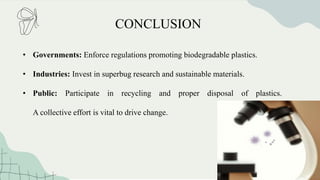
• Governments: Enforce regulations promoting biodegradable plastics.
• Industries: Invest in superbug research and sustainable materials.
• Public: Participate in recycling and proper disposal of plastics.
A collective effort is vital to drive change.
BIODEGRADABLE  OF  PLASTIC AND SUPER BUG

BIODEGRADABLE OF PLASTIC AND SUPER BUG

  • 1.
    VIVEKANANDHA ARTS AND SCIENCECOLLEGE FOR WOMEN VEERACHIPALAYAM, SANKAGIRI, SALEM, TAMILNADU Department of Microbiology Topic :Biodegradable of Plastics and Super Bug SUBJECT INCHARGE: Dr. R.DINESHKUMAR, ASSISTANT PROFESSOR, DEPARTMENT OF MICROBIOLOGY, VIVEKANANDHA ARTS AND SCIENCE COLLEGE FOR WOMEN, SANKAGIRI, SALEM, TAMILNADU. Submitted By: P.Suvetha, I-M.SC MICROBIOLOGY, VIVEKANANDHA ARTS AND SCIENCE COLLEGE FOR WOMEN, SANKAGIRI, SALEM, TAMILNADU. Subject: Bioremediation
  • 2.
    Overview • Introduction • BiodegradablePlastics • Types of Biodegradable Plastics • Factors Affecting Biodegradation • Biodegradation Process • Benefits of Biodegradable Plastics • Limitations of Biodegradable Plastics • Real-World Applications of Biodegradable Plastics • Superbugs • Types of Superbugs • Role of Superbugs in Plastic Degradation • Factors Influencing Superbug Efficiency • Advantages of Using Superbugs • Challenges with Superbugs • Research on Superbugs • Environmental Impact • Future Innovations • Conclusion
  • 3.
    Introduction • Plastic pollutionhas reached epidemic proportions, contaminating ecosystems, harming wildlife, and threatening human health. • Plastic pollution is a global crisis, with over 300 million tons of plastic produced annually. • Most plastics persist for centuries, contaminating ecosystems and harming wildlife. • This presentation focuses on two solutions: biodegradable plastics, designed to break down naturally, and superbugs, genetically adapted microorganisms that assist in plastic degradation.
  • 4.
    • Biodegradable plasticsare materials engineered to decompose through microbial activity under specific environmental conditions. Unlike conventional plastics derived from petroleum, they are often made from renewable resources such as corn starch or sugarcane. • When disposed of correctly, they break down into water, carbon dioxide, and biomass, reducing their environmental impact. Their applications span across packaging, agriculture, and medical industries, providing eco-friendly alternatives for single-use plastics. Biodegradable Plastics
  • 5.
    Types of BiodegradablePlastics • PLA (Polylactic Acid): A bioplastic derived from corn or sugarcane, commonly used in packaging, disposable utensils, and medical implants. • PHA (Polyhydroxyalkanoates): Produced by microbial fermentation, suitable for agricultural films and packaging. • Starch-Based Plastics: A combination of starch and synthetic polymers, used in making compostable bags and cutlery.
  • 6.
    Biodegradation Process This cyclemimics nature’s decomposition process, making it a sustainable method for plastic disposal. However, the efficiency of biodegradation depends on factors such as plastic composition and environmental conditions. Biodegradation involves the natural breakdown of plastics into simpler substances. The process begins with environmental factors like heat and moisture causing fragmentation. Microorganisms then secrete enzymes that degrade the polymers, converting them into water, carbon dioxide, and organic biomass.
  • 8.
    Factors Affecting Biodegradation •Environmental Conditions: Temperature, moisture, and pH levels play a crucial role. • Plastic Composition: Plastics with simpler chemical structures degrade faster. • Microbial Availability: The presence of effective microbes enhances the process. Ensuring optimal conditions for biodegradation is essential for achieving effective results.
  • 9.
  • 10.
    Benefits of BiodegradablePlastics • One of the major benefits of biodegradable plastics is their ability to decompose naturally, unlike traditional plastics that persist in landfills for hundreds of years. • The production and degradation of biodegradable plastics result in significantly lower greenhouse gas emissions compared to traditional petroleum-based plastics. • When biodegradable plastics are composted, they break down into organic matter that enriches the soil. This organic matter improves soil structure, increases water retention, and provides essential nutrients for plant growth.
  • 11.
    Limitations of BiodegradablePlastics • High production costs limit their widespread adoption: One of the major barriers to the large-scale adoption of biodegradable plastics is their high production cost compared to traditional petroleum-based plastics. • Require specific environmental conditions for effective degradation: Biodegradable plastics do not always decompose under natural conditions • Risk of contamination with non-biodegradable plastics: Another challenge is the risk of contamination when biodegradable plastics are mixed with non-biodegradable plastics in waste streams.
  • 12.
    Advantages of UsingSuperbugs • Accelerate the Breakdown of Non-Biodegradable Plastics: Non- biodegradable plastics like PET (polyethylene terephthalate) and polyurethane are highly resistant to natural degradation, persisting in the environment for centuries. • Reduce Microplastic Accumulation in the Environment: Microplastics tiny fragments of plastic that result from the breakdown of larger items pose a significant threat to ecosystems and human health. • Offer a Scalable Solution for Cleaning Marine and Terrestrial Ecosystems: One of the most compelling advantages of superbugs is their potential for scalability in environmental applications. Real-World Applications of Biodegradable Plastics • Packaging: Compostable bags and containers. • Agriculture: Mulch films and seed coatings. • Medical Industry: Dissolvable sutures and drug delivery systems.
  • 13.
    Superbugs Superbugs refer tomicroorganisms like bacteria and fungi that have evolved or been genetically modified to break down plastics. These organisms secrete enzymes capable of degrading plastic polymers, converting them into simpler molecules that are environmentally safe. For example, Ideonella sakaiensis can digest PET plastics, while Pseudomonas putida targets polyurethane. Superbugs represent a promising solution for addressing plastic waste in environments where recycling fails.
  • 14.
    Types of Superbugs Ideonellasakaiensis: A bacterium that breaks down PET plastic into environmentally friendly byproducts. Pseudomonas putida: Efficient in degrading polyurethane, a plastic used in foams and coatings. Aspergillus niger (Fungi): Produces enzymes that facilitate the degradation of complex plastic structures. Pseudomonas putida
  • 15.
    Role of Superbugsin Plastic Degradation Superbugs play a pivotal role in accelerating plastic degradation. By producing enzymes, they can break chemical bonds in plastics, converting them into simpler molecules like carbon dioxide and water. For instance, Ideonella sakaiensis digests PET plastic into harmless monomers, while Pseudomonas putida breaks down polyurethane into organic compounds. These microorganisms hold the potential to revolutionize plastic waste management by tackling non-recyclable plastics.
  • 16.
    Factors Influencing SuperbugEfficiency • Environmental Settings: Oxygen levels, temperature, and humidity affect their activity. • Type of Plastic: Some plastics are easier to degrade than others. • Genetic Modifications: Scientists are enhancing superbugs to improve their adaptability and efficiency.
  • 17.
    Advantages of UsingSuperbugs • Accelerate the Breakdown of Non-Biodegradable Plastics: Non- biodegradable plastics like PET (polyethylene terephthalate) and polyurethane are highly resistant to natural degradation, persisting in the environment for centuries. • Reduce Microplastic Accumulation in the Environment: Microplastics tiny fragments of plastic that result from the breakdown of larger items pose a significant threat to ecosystems and human health. • Offer a Scalable Solution for Cleaning Marine and Terrestrial Ecosystems: One of the most compelling advantages of superbugs is their potential for scalability in environmental applications.
  • 18.
    Challenges with Superbugs •Controlled environments are necessary for their optimal functioning. • Potential ecological risks if superbugs escape into natural habitats. • Limited ability to degrade all types of plastics. Further research and regulation are required to address these concerns effectively.
  • 19.
    Research on Superbugs •Ideonella sakaiensis is being studied for industrial-scale PET degradation. • Genetic modifications are enhancing the efficiency of microorganisms like Pseudomonas putida. • Superbugs have been tested for marine plastic cleanup, showing potential for large-scale applications.
  • 20.
    Environmental Impact • Thecombined use of biodegradable plastics and superbugs has a profound environmental impact. • They help reduce plastic waste in landfills and oceans, mitigate greenhouse gas emissions, and minimize microplastic pollution. • Together, they represent a sustainable approach to addressing the global plastic crisis.
  • 21.
    Future Innovations • DevelopingHybrid Plastics That Degrade Faster: Hybrid plastics combine the properties of conventional plastics with biodegradable or environmentally friendly materials, aiming to achieve faster decomposition without compromising functionality. • Advancing Genetic Engineering to Enhance Superbug Efficiency: Genetic engineering plays a crucial role in enhancing the capabilities of superbugs, making them more efficient at breaking down plastics. • Integrating Microorganisms into Waste Recycling Processes: The integration of microorganisms, including superbugs, into existing recycling systems offers a sustainable and efficient approach to managing plastic waste.
  • 22.
    CONCLUSION • Governments: Enforceregulations promoting biodegradable plastics. • Industries: Invest in superbug research and sustainable materials. • Public: Participate in recycling and proper disposal of plastics. A collective effort is vital to drive change.