University institute of technology
(rajiv Gandhi proudyogiki vishwavidyalaya)
session 2015-16
environment science presentation
first year
second semester
cse “b”
Guided by: submitted by:
rishabh soni
nidhi kushwaha
megha sahu
content
 INTRODUCTION
 WHY WE NEED ECO FRIENDLY FUELS
 EXAMPLES OF ECO FRIENDLY FUELS
 COMPRESSED NATURAL GAS (CNG)
 BIO-DIESEL
 SOLAR ENERGY
 ELECTRICITY
 Policy on eco-friendly transport fuels
 Types of biofuel
 Availability of Biofuels
 Biodiesel in India
 Advantages AND Disadvantages
 The future for bio-fuels in India
 conclusion
INTRODUCTION
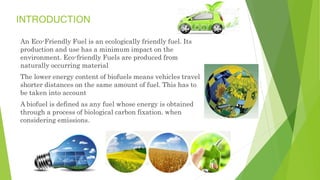
An Eco-Friendly Fuel is an ecologically friendly fuel. Its
production and use has a minimum impact on the
environment. Eco-friendly Fuels are produced from
naturally occurring material
The lower energy content of biofuels means vehicles travel
shorter distances on the same amount of fuel. This has to
be taken into account
A biofuel is defined as any fuel whose energy is obtained
through a process of biological carbon fixation. when
considering emissions.
WHY WE NEED ECO FRIENDLY FUELS
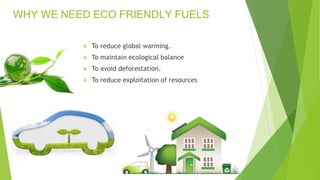
 To reduce global warming.
 To maintain ecological balance
 To avoid deforestation.
 To reduce exploitation of resources
Examples of eco friendly fuels
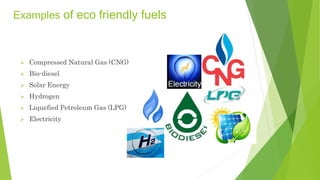
 Compressed Natural Gas (CNG)
 Bio-diesel
 Solar Energy
 Hydrogen
 Liquefied Petroleum Gas (LPG)
 Electricity
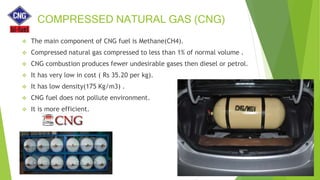
COMPRESSED NATURAL GAS (CNG)
 The main component of CNG fuel is Methane(CH4).
 Compressed natural gas compressed to less than 1% of normal volume .
 CNG combustion produces fewer undesirable gases then diesel or petrol.
 It has very low in cost ( Rs 35.20 per kg).
 It has low density(175 Kg/m3) .
 CNG fuel does not pollute environment.
 It is more efficient.
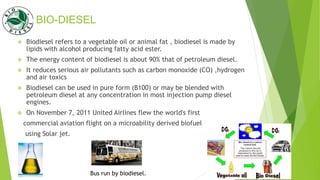
BIO-DIESEL
 Biodiesel refers to a vegetable oil or animal fat , biodiesel is made by
lipids with alcohol producing fatty acid ester.
 The energy content of biodiesel is about 90% that of petroleum diesel.
 It reduces serious air pollutants such as carbon monoxide (CO) ,hydrogen
and air toxics
 Biodiesel can be used in pure form (B100) or may be blended with
petroleum diesel at any concentration in most injection pump diesel
engines.
 On November 7, 2011 United Airlines flew the world's first
commercial aviation flight on a microability derived biofuel
using Solar jet.
Bus run by biodiesel.
SOLAR ENERGY
 Solar energy is radiant light and heat from the Sun harnessed
using a range of ever-evolving technologist is renewable energy
 As of 2007, the total installed capacity of solar hot water
systems is approximately 154 thermal gigawatt (GWth)
 China is the world leader in their deployment with 70 GWth
installed as of 2006 and a long-term goal of 210 GWth by 2020
 The simplest solar cooker is the box cooker first built by Horace
de Saussure in 1767
 Solar power is the conversion of sunlight into electricity, either
directly using photovoltaics (PV), or indirectly using
concentrated solar distillation can be used to make saline or
brackish water potable.
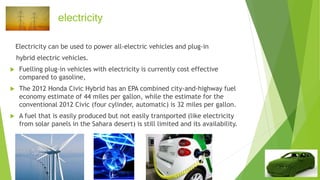
electricity
Electricity can be used to power all-electric vehicles and plug-in
hybrid electric vehicles.
 Fuelling plug-in vehicles with electricity is currently cost effective
compared to gasoline,
 The 2012 Honda Civic Hybrid has an EPA combined city-and-highway fuel
economy estimate of 44 miles per gallon, while the estimate for the
conventional 2012 Civic (four cylinder, automatic) is 32 miles per gallon.
 A fuel that is easily produced but not easily transported (like electricity
from solar panels in the Sahara desert) is still limited and its availability.
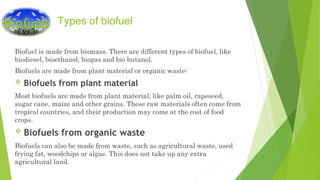
Types of biofuel
Biofuel is made from biomass. There are different types of biofuel, like
biodiesel, bioethanol, biogas and bio butanol.
Biofuels are made from plant material or organic waste:
 Biofuels from plant material
Most biofuels are made from plant material, like palm oil, rapeseed,
sugar cane, maize and other grains. These raw materials often come from
tropical countries, and their production may come at the cost of food
crops.
 Biofuels from organic waste
Biofuels can also be made from waste, such as agricultural waste, used
frying fat, woodchips or algae. This does not take up any extra
agricultural land.
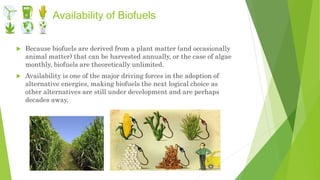
Availability of Biofuels
 Because biofuels are derived from a plant matter (and occasionally
animal matter) that can be harvested annually, or the case of algae
monthly, biofuels are theoretically unlimited.
 Availability is one of the major driving forces in the adoption of
alternative energies, making biofuels the next logical choice as
other alternatives are still under development and are perhaps
decades away.
Biodiesel in India
 Indian Biofuel Policy was announced on 23rd Dec 2009. It gives a rough guideline,
which was actually proposed many years back. Main stumbling blocks are still not
resolved. There are no Figures or Financial commitments. Some of the points are
 The Minimum Purchase Price (MPP) for bio-diesel by the Oil Marketing
Companies (OMCs) will be linked to the prevailing retail diesel price.
 Financial incentives, including subsidies and grants, may be considered upon
merit for new and second generation feed stocks, advanced technologies and
conversion processes, and production units based on new and second generation
feed stocks.
New Diesel Cars are
Hitting the Road
Everyday.
India's biodiesel processing capacity is estimated at 600,000
tons per year. The government owned Oil Marketing
companies have now floated a tender again to buy 840
million liter of Biodiesel. However there are few interested
suppliers. They prefer to export, rather than selling in
India.
Government's Policies
Government of India started Biofuel mission in 2003, but it announced Biofuel
Policy on 2009. The Union Cabinet in its meeting gave its approval for the National
Policy on Biofuel prepared by the Ministry of New and Renewable Energy, and also
approved for setting up of an empowered National Biofuel Coordination Committee,
headed by then Prime Minister of India and a Biofuel Steering Committee headed by
Cabinet Secretary.
 An indicative target of 20% by 2017 for the blending of biofuels (bioethanol and
bio-diesel) was proposed. (Even 1% is not possible)
 Bio-diesel production will be taken up from non-edible oil seeds grown in waste /
degraded / marginal lands. (This has Failed)
 Oil companies had declared their own Biodiesel Purchase Policy. These companies
offered a price of Rupees 34.00 per liter of Biodiesel, which was less than the
manufacturing cost of Biodiesel.
Biofuel research in india
1. International Centre for Genetic Engineering and Biotechnology
(ICGEB), New Delhi Synthetic biology and biofuel group
Focus area: Discovery and design of novel enzymes and enzyme systems
for biofuels Engineering bacteria to produce biofuel.
2. DBT-ICT-Centre of Energy Biosciences, Mumbai, Maharashtra
Focus area Development of biotechnologies for deriving energy from
renewable resources
3. DBT-IOC Centre for Advanced Bioenergy Research, Faridabad,
Haryana
Focus Area Lignocellulosic based bio-fuels Development of new and
economical pre-treatment process
.
 4. Centre for Alternate Energy Research, University of Petroleum &
Energy Studies, Dehradun, Uttarakhand
 Focus Area Includes bio-fuels, bio-energy, solar, wind energy, hydrogen
& fuel cell and new technology.
 5. DBT-IOC Centre for Advanced Bioenergy Research, Faridabad,
Haryana
 Focus Area Lignocellulosic based bio-fuels Development of new and
economical pre-treatment process Feedstock selection/development
and characterization Process optimization for saccharification /
Fermentation and scale up Bio-assisted / Chemical lignin de-
polymerization and Lignin value addition
advantages
 Cost: Biofuels have the potential to be significantly less expensive than gasoline
and other fossil fuels.
 Source material: biofuels can be manufactured from a wide range of materials
including crop waste, manure, and other byproduct .
 Security: Biofuels can be produced locally, which decreases the nation's
dependence upon foreign energy
 Lower carbon emissions: When biofuels are burned, they produce
significantly less carbon output and fewer toxins, making them a safer alternative
to preserve atmospheric quality and lower air pollution. biofuels help to reduce
carbon emissions by 50-60%.
 Renewability: biofuels are much more easily renewable as new crops are grown
and waste material is collected.
 Reduce Greenhouse Gases: biofuels reduces greenhouse gases up to 65
percent.
Disadvantages
 Energy output: Biofuels have a lower energy output than traditional fuels
 Food prices: As demand for food crops such as corn grows for biofuel
production, it could also raise prices for necessary staple food crops.
 Water use: Massive quantities of water are required for proper irrigation of
biofuel crops as well as to manufacture the fuel, which could strain local and
regional water resources.
 High Cost of Production: To refine biofuels to more efficient energy
outputs, and to build the necessary manufacturing plants to increase biofuel
quantities, a high initial investment is often required.
 Fuel Use : Producing enough biodiesel or ethanol to replace one gallon of
petroleum fuel, they argue, requires the energy equivalent to several gallons'
worth of petroleum fuel
The future for bio-fuels in India
 Biofuel has huge potential to stimulate rural development
and to generate employment. Benefits to the
environment as well as energy security are key factors
working in favour of biofuels.
 An indicative target proposed to be implemented by 2017
is to have of 20 percent blending of biofuels, both for bio-
diesel and bio-ethanol.
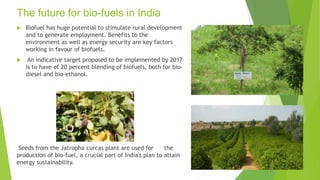
Seeds from the Jatropha curcas plant are used for the
production of bio-fuel, a crucial part of India's plan to attain
energy sustainability.
conclusion
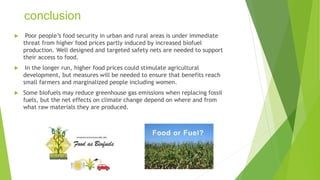
 Poor people’s food security in urban and rural areas is under immediate
threat from higher food prices partly induced by increased biofuel
production. Well designed and targeted safety nets are needed to support
their access to food.
 In the longer run, higher food prices could stimulate agricultural
development, but measures will be needed to ensure that benefits reach
small farmers and marginalized people including women.
 Some biofuels may reduce greenhouse gas emissions when replacing fossil
fuels, but the net effects on climate change depend on where and from
what raw materials they are produced.
refference
 http://biofuel.org.uk/
 http://www.slideshare.net/
 http://www.svlele.com/biodiesel_in_india.htm
Environmental Science

Environmental Science

  • 1.
    University institute oftechnology (rajiv Gandhi proudyogiki vishwavidyalaya) session 2015-16 environment science presentation first year second semester cse “b” Guided by: submitted by: rishabh soni nidhi kushwaha megha sahu
  • 2.
    content  INTRODUCTION  WHYWE NEED ECO FRIENDLY FUELS  EXAMPLES OF ECO FRIENDLY FUELS  COMPRESSED NATURAL GAS (CNG)  BIO-DIESEL  SOLAR ENERGY  ELECTRICITY  Policy on eco-friendly transport fuels  Types of biofuel  Availability of Biofuels  Biodiesel in India  Advantages AND Disadvantages  The future for bio-fuels in India  conclusion
  • 3.
    INTRODUCTION An Eco-Friendly Fuelis an ecologically friendly fuel. Its production and use has a minimum impact on the environment. Eco-friendly Fuels are produced from naturally occurring material The lower energy content of biofuels means vehicles travel shorter distances on the same amount of fuel. This has to be taken into account A biofuel is defined as any fuel whose energy is obtained through a process of biological carbon fixation. when considering emissions.
  • 4.
    WHY WE NEEDECO FRIENDLY FUELS  To reduce global warming.  To maintain ecological balance  To avoid deforestation.  To reduce exploitation of resources
  • 5.
    Examples of ecofriendly fuels  Compressed Natural Gas (CNG)  Bio-diesel  Solar Energy  Hydrogen  Liquefied Petroleum Gas (LPG)  Electricity
  • 6.
    COMPRESSED NATURAL GAS(CNG)  The main component of CNG fuel is Methane(CH4).  Compressed natural gas compressed to less than 1% of normal volume .  CNG combustion produces fewer undesirable gases then diesel or petrol.  It has very low in cost ( Rs 35.20 per kg).  It has low density(175 Kg/m3) .  CNG fuel does not pollute environment.  It is more efficient.
  • 7.
    BIO-DIESEL  Biodiesel refersto a vegetable oil or animal fat , biodiesel is made by lipids with alcohol producing fatty acid ester.  The energy content of biodiesel is about 90% that of petroleum diesel.  It reduces serious air pollutants such as carbon monoxide (CO) ,hydrogen and air toxics  Biodiesel can be used in pure form (B100) or may be blended with petroleum diesel at any concentration in most injection pump diesel engines.  On November 7, 2011 United Airlines flew the world's first commercial aviation flight on a microability derived biofuel using Solar jet. Bus run by biodiesel.
  • 8.
    SOLAR ENERGY  Solarenergy is radiant light and heat from the Sun harnessed using a range of ever-evolving technologist is renewable energy  As of 2007, the total installed capacity of solar hot water systems is approximately 154 thermal gigawatt (GWth)  China is the world leader in their deployment with 70 GWth installed as of 2006 and a long-term goal of 210 GWth by 2020  The simplest solar cooker is the box cooker first built by Horace de Saussure in 1767  Solar power is the conversion of sunlight into electricity, either directly using photovoltaics (PV), or indirectly using concentrated solar distillation can be used to make saline or brackish water potable.
  • 9.
    electricity Electricity can beused to power all-electric vehicles and plug-in hybrid electric vehicles.  Fuelling plug-in vehicles with electricity is currently cost effective compared to gasoline,  The 2012 Honda Civic Hybrid has an EPA combined city-and-highway fuel economy estimate of 44 miles per gallon, while the estimate for the conventional 2012 Civic (four cylinder, automatic) is 32 miles per gallon.  A fuel that is easily produced but not easily transported (like electricity from solar panels in the Sahara desert) is still limited and its availability.
  • 10.
    Types of biofuel Biofuelis made from biomass. There are different types of biofuel, like biodiesel, bioethanol, biogas and bio butanol. Biofuels are made from plant material or organic waste:  Biofuels from plant material Most biofuels are made from plant material, like palm oil, rapeseed, sugar cane, maize and other grains. These raw materials often come from tropical countries, and their production may come at the cost of food crops.  Biofuels from organic waste Biofuels can also be made from waste, such as agricultural waste, used frying fat, woodchips or algae. This does not take up any extra agricultural land.
  • 11.
    Availability of Biofuels Because biofuels are derived from a plant matter (and occasionally animal matter) that can be harvested annually, or the case of algae monthly, biofuels are theoretically unlimited.  Availability is one of the major driving forces in the adoption of alternative energies, making biofuels the next logical choice as other alternatives are still under development and are perhaps decades away.
  • 12.
    Biodiesel in India Indian Biofuel Policy was announced on 23rd Dec 2009. It gives a rough guideline, which was actually proposed many years back. Main stumbling blocks are still not resolved. There are no Figures or Financial commitments. Some of the points are  The Minimum Purchase Price (MPP) for bio-diesel by the Oil Marketing Companies (OMCs) will be linked to the prevailing retail diesel price.  Financial incentives, including subsidies and grants, may be considered upon merit for new and second generation feed stocks, advanced technologies and conversion processes, and production units based on new and second generation feed stocks. New Diesel Cars are Hitting the Road Everyday. India's biodiesel processing capacity is estimated at 600,000 tons per year. The government owned Oil Marketing companies have now floated a tender again to buy 840 million liter of Biodiesel. However there are few interested suppliers. They prefer to export, rather than selling in India.
  • 13.
    Government's Policies Government ofIndia started Biofuel mission in 2003, but it announced Biofuel Policy on 2009. The Union Cabinet in its meeting gave its approval for the National Policy on Biofuel prepared by the Ministry of New and Renewable Energy, and also approved for setting up of an empowered National Biofuel Coordination Committee, headed by then Prime Minister of India and a Biofuel Steering Committee headed by Cabinet Secretary.  An indicative target of 20% by 2017 for the blending of biofuels (bioethanol and bio-diesel) was proposed. (Even 1% is not possible)  Bio-diesel production will be taken up from non-edible oil seeds grown in waste / degraded / marginal lands. (This has Failed)  Oil companies had declared their own Biodiesel Purchase Policy. These companies offered a price of Rupees 34.00 per liter of Biodiesel, which was less than the manufacturing cost of Biodiesel.
  • 14.
    Biofuel research inindia 1. International Centre for Genetic Engineering and Biotechnology (ICGEB), New Delhi Synthetic biology and biofuel group Focus area: Discovery and design of novel enzymes and enzyme systems for biofuels Engineering bacteria to produce biofuel. 2. DBT-ICT-Centre of Energy Biosciences, Mumbai, Maharashtra Focus area Development of biotechnologies for deriving energy from renewable resources 3. DBT-IOC Centre for Advanced Bioenergy Research, Faridabad, Haryana Focus Area Lignocellulosic based bio-fuels Development of new and economical pre-treatment process
  • 15.
    .  4. Centrefor Alternate Energy Research, University of Petroleum & Energy Studies, Dehradun, Uttarakhand  Focus Area Includes bio-fuels, bio-energy, solar, wind energy, hydrogen & fuel cell and new technology.  5. DBT-IOC Centre for Advanced Bioenergy Research, Faridabad, Haryana  Focus Area Lignocellulosic based bio-fuels Development of new and economical pre-treatment process Feedstock selection/development and characterization Process optimization for saccharification / Fermentation and scale up Bio-assisted / Chemical lignin de- polymerization and Lignin value addition
  • 16.
    advantages  Cost: Biofuelshave the potential to be significantly less expensive than gasoline and other fossil fuels.  Source material: biofuels can be manufactured from a wide range of materials including crop waste, manure, and other byproduct .  Security: Biofuels can be produced locally, which decreases the nation's dependence upon foreign energy  Lower carbon emissions: When biofuels are burned, they produce significantly less carbon output and fewer toxins, making them a safer alternative to preserve atmospheric quality and lower air pollution. biofuels help to reduce carbon emissions by 50-60%.  Renewability: biofuels are much more easily renewable as new crops are grown and waste material is collected.  Reduce Greenhouse Gases: biofuels reduces greenhouse gases up to 65 percent.
  • 17.
    Disadvantages  Energy output:Biofuels have a lower energy output than traditional fuels  Food prices: As demand for food crops such as corn grows for biofuel production, it could also raise prices for necessary staple food crops.  Water use: Massive quantities of water are required for proper irrigation of biofuel crops as well as to manufacture the fuel, which could strain local and regional water resources.  High Cost of Production: To refine biofuels to more efficient energy outputs, and to build the necessary manufacturing plants to increase biofuel quantities, a high initial investment is often required.  Fuel Use : Producing enough biodiesel or ethanol to replace one gallon of petroleum fuel, they argue, requires the energy equivalent to several gallons' worth of petroleum fuel
  • 18.
    The future forbio-fuels in India  Biofuel has huge potential to stimulate rural development and to generate employment. Benefits to the environment as well as energy security are key factors working in favour of biofuels.  An indicative target proposed to be implemented by 2017 is to have of 20 percent blending of biofuels, both for bio- diesel and bio-ethanol. Seeds from the Jatropha curcas plant are used for the production of bio-fuel, a crucial part of India's plan to attain energy sustainability.
  • 19.
    conclusion  Poor people’sfood security in urban and rural areas is under immediate threat from higher food prices partly induced by increased biofuel production. Well designed and targeted safety nets are needed to support their access to food.  In the longer run, higher food prices could stimulate agricultural development, but measures will be needed to ensure that benefits reach small farmers and marginalized people including women.  Some biofuels may reduce greenhouse gas emissions when replacing fossil fuels, but the net effects on climate change depend on where and from what raw materials they are produced.
  • 20.