PROJECT PRESENTATION
ON
“HIGH SPEED TRAINS”
SUBMITTED BY
Mr. GARAD AKSHAY BALAJI
ME MECHANICAL ENGINEERING
ROLL NO. 520
ENROLLMENT NO. 1815130126
GUIDED BY
Prof. U. J. CHAVAN
BABASAHEB PHADTARE POLYTECNIQUE ,
KALAMB- WALCHANDNAGAR
PROBLEM RUNNING ON CURRENT
RAILWAY
 The primary problem with existing
railways is that they can have tight curves. The
centrifugal forces on an object going round a bend
are the function of the square of velocity, i.e.,
double the speed, quadruple the centrifugal forces,
triple the speed, centrifugal forces increase by
nine-fold. Therefore even what might appear mild
curves provide problems at speed.
HIGH SPEED LINES
OUTPUT PARAMETERS
Break power in Watt of single cylinder engine by
using different blends of Jatropha and Undi.
Break specific fuel consumption in Kg/kwh of single
cylinder engine by using different blends of Jatropha
and Undi.
Break thermal efficiency of single cylinder engine by
using different blends of Jatropha and Undi By using
MATLAB software.
Emission parameter like CO, NOx, HC etc.
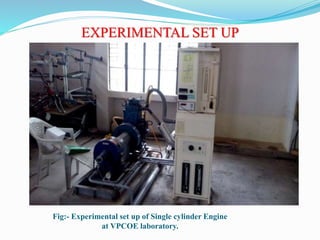
EXPERIMENTAL SET UP
Fig:- Experimental set up of Single cylinder Engine
at VPCOE laboratory.
ADVANTAGES OF VEGETABLE OILS
 Vegetable oil is easily available worldwide.
 It is renewable, environment friendly.
 Lower sulphur content.
 Cetane number of vegetable oil is close to that of diesel
fuel.
 Heat content of vegetable oil is about 10% less than
diesel fuel.
 Long chain saturated, unbranched hydrocarbon chains
in the fatty acids are especially suitable for
conventional diesel engine.
ADVANTAGES OF BIODIESEL
 Biodiesel is non-toxic and ecofriendly, as it produces
substantially less carbon monoxide and 100 per cent
less sulfur dioxide emissions with no unburn
hydrocarbons, making it thus an ideal fuel for heavily
polluted cities (Hofmanetal. 2006).
 Biodiesel reduces particulate matter content in the
ambient air and hence reduces air toxicity (Coltrain
2002). It provides a 90 per cent reduction in cancer
risks and neonatal defects due to its less polluting
combustion.
 Biodiesel is biodegradable and renewable in nature.
 Biodiesel extends the life of diesel engines.
 Compared with a spill of petroleum diesel, however,
the damage would be less, both because the toxicity of
biodiesel to living organisms is less and because it
degrades twice as quickly in the environment (Zhang
et al. 1998).
 Biodiesel can be used alone or mixed in any ratio with
conventional diesel. The preferred ratio of mixture
ranges from 5 to 20 per cent (Hofmanetal. 2006).
 Biodiesel could be cheaper than conventional diesel
and hence has good potential for rural employment
generation (Kurki et al. 2006).
DISADVANTAGES OF VEGETABLE OIL
 Diesel fuel has a chain of 11-13 carbons, and fresh
vegetable oil has a chain of about 18. To burn in an
engine, the chain needs to be broken down to be
similar in length to diesel.
 The kinematic viscosity is however several times
higher than that of diesel oil. The high viscosity,
35–45 cSt as against about 4.0 cSt for diesel oil at
40°C, leads to problems in pumping and
atomization in the injection system of a diesel
engine.
 Vegetable oils have poor volatility characteristics,
prohibiting their use in SI engines.
 The combination of high viscosity and low
volatility of vegetable oils causes misfire, ignition
delay and poor cold engine start-up.
 Since neat vegetable oils are not suitable as a fuel
in diesel engine, they have to be modified to bring
their combustion-related properties closer to those
of diesel fuel. This fuel modification is mainly
aimed at reducing the viscosity to get rid of flow
related problems. The method employed includes
the heating of vegetable oil, dilution with diesel,
thermal cracking of highly complex molecule of
vegetable oil into lighter molecules, micro-
emulsion, and Transesterification.
HOW TO OVERCOME PROBLEM OF VISCOSITY:
For reduce viscosity of vegetable oil of the four
processes via Pyrolysis, Micro emulsification,
Dilution or Transesterification process.
In case of dilution a reduction of viscosity of
55.56% and 62.13% was obtained with 70:30 and
60:40 blends, respectively.
The viscosity and density of blend comprising
30:70 and 20:80 are close to those of diesel oil
Viscosity of 9.848 and 6.931 cSt and Density of
0.862 and 0.853 g/cc was observed
TRANSESTERIFICATION:
Biodiesel is produced in a chemical process
using base catalyzed transesterification as it is the
most economical process, requiring only low
temperatures and pressures while producing a 98%
conversion yield. The transesterification process is
the reaction of a triglyceride (fat/oil) with an
alcohol to form esters and glycerol. A triglyceride
has a glycerine molecule as its base with three long
chain fatty acids attached. The characteristics of
the fat are determined by the nature of the fatty
acids attached to the glycerine.
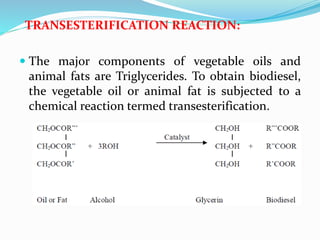
TRANSESTERIFICATION REACTION:
 The major components of vegetable oils and
animal fats are Triglycerides. To obtain biodiesel,
the vegetable oil or animal fat is subjected to a
chemical reaction termed transesterification.
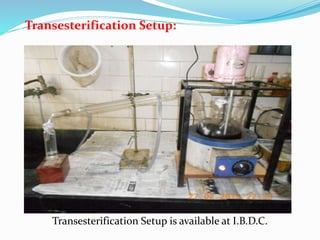
Transesterification Setup:
Transesterification Setup is available at I.B.D.C.
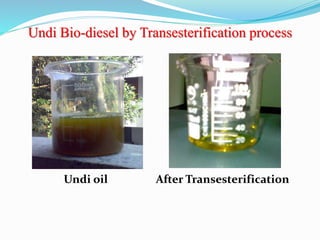
Undi Bio-diesel by Transesterification process
Undi oil After Transesterification
To study tentative graphical analysis of
Jatropha biodiesel
Variation Of Brake Power With Specific Fuel
Consumption.
Variation Of Brake Power With Break thermal efficiency.[7.J.Narayana Reddy]
Variation Of Brake Power With Specific Fuel Consumption [7.J.Narayana Reddy]
Variation Of Brake Power With CO2 [7.J.Narayana Reddy]
VALIDATION METHOD
 Validation with comparing result of pure diesel and
given oil is analyzed in the graphical form.
 Validation is with the previous research papers.
 Validation with comparing result of Jatropha oil which
is maximum research carried out and given seeds oil.
 Validation by finding different proerties of biodiesel.
AVAILABILITY OF THE RESOURCES
 Equipment's available for testing
 Single cylinder diesel engine test rig is available in vpcoe
laboratory.
 5X gas analyzer is available in vpcoe laboratory/ taking
from outside.
 Bio-diesel making Transesterification setup is available at
Indian Biodiesel Corporation, Baramati.
 Flash point, fire point, moisture, acid value, viscosity etc.
setup is available at Indian Biodiesel Corporation, Baramati.
 Calorific value, cetane number and density checking work is
outsourcing.
CURRENT STATUS OF PROJECT
 Bio-diesel from Jatropha and Undi (Calophyllum
Inophyllum Linn) oil making process by
trasesterification process is complete with the help of
Indian Bio-diesel corporation Baramati.
 Blend sample are ready for both i.e. Jatropha and
Undi is B25, B50, B75, B100 and ready for test on
single cylinder engine.
 Properties checking like Fire point, flash point,
moisture, viscosity, density, acid value, calorific value
and cetane number is completed.
REFERENCES
 1. A. Jehad, A.Yamin, Nina Sakhnin, Ahmed Sakhrieh, “Performance of C.I. engines using biodiesel as
fuel”, Amman-Jorden, GCREEDER, (2009).
 2. Indraj Singh and Vikas Rastogi, “Performance analysis of a modified four-stroke engine using
biodiesel fuel for irrigation purpose”, International Journal of applied environmental sciences , ISSN
0973-6077, Volume 4, No. 2, (2009).
 3. GVNSR Ratnakar Rao, V.Ramachandra Raju and M. Murlidhar Rao, “Optimising the compression
ratio for a diesel fuelled C.I. Engine”, ARPN journal of engineering and applied sciences, volume 3,
No. 2, (2008).
 4. B.K.Venkanna et.al., “Influence of injector opening pressures on the performance, emission and
combustion characteristics of DI diesel engine running on calophyllum inophyllum linn oil (honne
oil)”, Int. Jou. of Ren. Ene., 6( 1), 2011
 5. Widayat et.al. (2012), “ Optimization Process of Biodiesel Production From Nyamplung Seed
(Calophyllum inophyllum L) Using In Situ Process and Ultrasonic Assisted, Pro. of Int. Con. Chem.
and Mat. Eng. 978-602-097-281-7, (2012)
 6. Navindgi M.C., “Comparative analysis of mahua and hone oils as alternative bio-diesel fuelin
agricultural CI engine,” IJERIA, 0974-1518,5( 1) 157-170 (2012)
 7. J.Narayana Reddy, A. Ramesh “Parametric studies for improving the performance of Jatropha oil-
fuelled compression ignition engine”, Journal of Renewable Energy 1994-2016, (2006).
 8. Amit Pal S S kacggwaha S. maji and M K G bahu,”Thumba (Citrullus Colocyntis) seed oil:A
sustainable source of renewable energy for biodiesel production “Journal of scientific and industrial
research” Vol 69,May 2010,pp 384-389
 9. K. Pramanik. “Properties and use of jatropha curcas oil and diesel fuel blends in C.I engines”,
Journal of Renewable Energy 239-248, (2003)
 10. Mekalilie Benjamin Bol, T. K. Bhattacharya and H. I. Mohammed” Studies on compatible fuel
properties of soybean ethyl ester and its blends with diesel for fuel use in compression ignition
engines.”
Thank you

High speed Trains | Mechanical Engineering | Paper Presentation | BPP Kalamb

  • 1.
    PROJECT PRESENTATION ON “HIGH SPEEDTRAINS” SUBMITTED BY Mr. GARAD AKSHAY BALAJI ME MECHANICAL ENGINEERING ROLL NO. 520 ENROLLMENT NO. 1815130126 GUIDED BY Prof. U. J. CHAVAN BABASAHEB PHADTARE POLYTECNIQUE , KALAMB- WALCHANDNAGAR
  • 2.
    PROBLEM RUNNING ONCURRENT RAILWAY  The primary problem with existing railways is that they can have tight curves. The centrifugal forces on an object going round a bend are the function of the square of velocity, i.e., double the speed, quadruple the centrifugal forces, triple the speed, centrifugal forces increase by nine-fold. Therefore even what might appear mild curves provide problems at speed.
  • 3.
  • 4.
    OUTPUT PARAMETERS Break powerin Watt of single cylinder engine by using different blends of Jatropha and Undi. Break specific fuel consumption in Kg/kwh of single cylinder engine by using different blends of Jatropha and Undi. Break thermal efficiency of single cylinder engine by using different blends of Jatropha and Undi By using MATLAB software. Emission parameter like CO, NOx, HC etc.
  • 5.
    EXPERIMENTAL SET UP Fig:-Experimental set up of Single cylinder Engine at VPCOE laboratory.
  • 6.
    ADVANTAGES OF VEGETABLEOILS  Vegetable oil is easily available worldwide.  It is renewable, environment friendly.  Lower sulphur content.  Cetane number of vegetable oil is close to that of diesel fuel.  Heat content of vegetable oil is about 10% less than diesel fuel.  Long chain saturated, unbranched hydrocarbon chains in the fatty acids are especially suitable for conventional diesel engine.
  • 7.
    ADVANTAGES OF BIODIESEL Biodiesel is non-toxic and ecofriendly, as it produces substantially less carbon monoxide and 100 per cent less sulfur dioxide emissions with no unburn hydrocarbons, making it thus an ideal fuel for heavily polluted cities (Hofmanetal. 2006).  Biodiesel reduces particulate matter content in the ambient air and hence reduces air toxicity (Coltrain 2002). It provides a 90 per cent reduction in cancer risks and neonatal defects due to its less polluting combustion.  Biodiesel is biodegradable and renewable in nature.  Biodiesel extends the life of diesel engines.
  • 8.
     Compared witha spill of petroleum diesel, however, the damage would be less, both because the toxicity of biodiesel to living organisms is less and because it degrades twice as quickly in the environment (Zhang et al. 1998).  Biodiesel can be used alone or mixed in any ratio with conventional diesel. The preferred ratio of mixture ranges from 5 to 20 per cent (Hofmanetal. 2006).  Biodiesel could be cheaper than conventional diesel and hence has good potential for rural employment generation (Kurki et al. 2006).
  • 9.
    DISADVANTAGES OF VEGETABLEOIL  Diesel fuel has a chain of 11-13 carbons, and fresh vegetable oil has a chain of about 18. To burn in an engine, the chain needs to be broken down to be similar in length to diesel.  The kinematic viscosity is however several times higher than that of diesel oil. The high viscosity, 35–45 cSt as against about 4.0 cSt for diesel oil at 40°C, leads to problems in pumping and atomization in the injection system of a diesel engine.  Vegetable oils have poor volatility characteristics, prohibiting their use in SI engines.
  • 10.
     The combinationof high viscosity and low volatility of vegetable oils causes misfire, ignition delay and poor cold engine start-up.  Since neat vegetable oils are not suitable as a fuel in diesel engine, they have to be modified to bring their combustion-related properties closer to those of diesel fuel. This fuel modification is mainly aimed at reducing the viscosity to get rid of flow related problems. The method employed includes the heating of vegetable oil, dilution with diesel, thermal cracking of highly complex molecule of vegetable oil into lighter molecules, micro- emulsion, and Transesterification.
  • 11.
    HOW TO OVERCOMEPROBLEM OF VISCOSITY: For reduce viscosity of vegetable oil of the four processes via Pyrolysis, Micro emulsification, Dilution or Transesterification process. In case of dilution a reduction of viscosity of 55.56% and 62.13% was obtained with 70:30 and 60:40 blends, respectively. The viscosity and density of blend comprising 30:70 and 20:80 are close to those of diesel oil Viscosity of 9.848 and 6.931 cSt and Density of 0.862 and 0.853 g/cc was observed
  • 12.
    TRANSESTERIFICATION: Biodiesel is producedin a chemical process using base catalyzed transesterification as it is the most economical process, requiring only low temperatures and pressures while producing a 98% conversion yield. The transesterification process is the reaction of a triglyceride (fat/oil) with an alcohol to form esters and glycerol. A triglyceride has a glycerine molecule as its base with three long chain fatty acids attached. The characteristics of the fat are determined by the nature of the fatty acids attached to the glycerine.
  • 13.
    TRANSESTERIFICATION REACTION:  Themajor components of vegetable oils and animal fats are Triglycerides. To obtain biodiesel, the vegetable oil or animal fat is subjected to a chemical reaction termed transesterification.
  • 14.
  • 15.
    Undi Bio-diesel byTransesterification process Undi oil After Transesterification
  • 16.
    To study tentativegraphical analysis of Jatropha biodiesel Variation Of Brake Power With Specific Fuel Consumption. Variation Of Brake Power With Break thermal efficiency.[7.J.Narayana Reddy]
  • 17.
    Variation Of BrakePower With Specific Fuel Consumption [7.J.Narayana Reddy]
  • 18.
    Variation Of BrakePower With CO2 [7.J.Narayana Reddy]
  • 19.
    VALIDATION METHOD  Validationwith comparing result of pure diesel and given oil is analyzed in the graphical form.  Validation is with the previous research papers.  Validation with comparing result of Jatropha oil which is maximum research carried out and given seeds oil.  Validation by finding different proerties of biodiesel.
  • 20.
    AVAILABILITY OF THERESOURCES  Equipment's available for testing  Single cylinder diesel engine test rig is available in vpcoe laboratory.  5X gas analyzer is available in vpcoe laboratory/ taking from outside.  Bio-diesel making Transesterification setup is available at Indian Biodiesel Corporation, Baramati.  Flash point, fire point, moisture, acid value, viscosity etc. setup is available at Indian Biodiesel Corporation, Baramati.  Calorific value, cetane number and density checking work is outsourcing.
  • 21.
    CURRENT STATUS OFPROJECT  Bio-diesel from Jatropha and Undi (Calophyllum Inophyllum Linn) oil making process by trasesterification process is complete with the help of Indian Bio-diesel corporation Baramati.  Blend sample are ready for both i.e. Jatropha and Undi is B25, B50, B75, B100 and ready for test on single cylinder engine.  Properties checking like Fire point, flash point, moisture, viscosity, density, acid value, calorific value and cetane number is completed.
  • 22.
    REFERENCES  1. A.Jehad, A.Yamin, Nina Sakhnin, Ahmed Sakhrieh, “Performance of C.I. engines using biodiesel as fuel”, Amman-Jorden, GCREEDER, (2009).  2. Indraj Singh and Vikas Rastogi, “Performance analysis of a modified four-stroke engine using biodiesel fuel for irrigation purpose”, International Journal of applied environmental sciences , ISSN 0973-6077, Volume 4, No. 2, (2009).  3. GVNSR Ratnakar Rao, V.Ramachandra Raju and M. Murlidhar Rao, “Optimising the compression ratio for a diesel fuelled C.I. Engine”, ARPN journal of engineering and applied sciences, volume 3, No. 2, (2008).  4. B.K.Venkanna et.al., “Influence of injector opening pressures on the performance, emission and combustion characteristics of DI diesel engine running on calophyllum inophyllum linn oil (honne oil)”, Int. Jou. of Ren. Ene., 6( 1), 2011  5. Widayat et.al. (2012), “ Optimization Process of Biodiesel Production From Nyamplung Seed (Calophyllum inophyllum L) Using In Situ Process and Ultrasonic Assisted, Pro. of Int. Con. Chem. and Mat. Eng. 978-602-097-281-7, (2012)  6. Navindgi M.C., “Comparative analysis of mahua and hone oils as alternative bio-diesel fuelin agricultural CI engine,” IJERIA, 0974-1518,5( 1) 157-170 (2012)  7. J.Narayana Reddy, A. Ramesh “Parametric studies for improving the performance of Jatropha oil- fuelled compression ignition engine”, Journal of Renewable Energy 1994-2016, (2006).  8. Amit Pal S S kacggwaha S. maji and M K G bahu,”Thumba (Citrullus Colocyntis) seed oil:A sustainable source of renewable energy for biodiesel production “Journal of scientific and industrial research” Vol 69,May 2010,pp 384-389  9. K. Pramanik. “Properties and use of jatropha curcas oil and diesel fuel blends in C.I engines”, Journal of Renewable Energy 239-248, (2003)  10. Mekalilie Benjamin Bol, T. K. Bhattacharya and H. I. Mohammed” Studies on compatible fuel properties of soybean ethyl ester and its blends with diesel for fuel use in compression ignition engines.”
  • 23.