


Binom 
ial 
The 
Theorem 
By iTutor.com 
T- 1-855-694-8886 
Email- info@iTutor.com
Binomials 
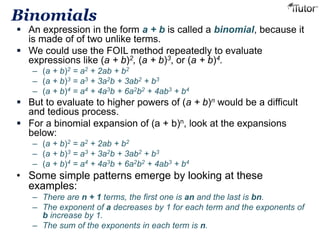
 An expression in the form a + b is called a binomial, because it 
is made of of two unlike terms. 
 We could use the FOIL method repeatedly to evaluate 
expressions like (a + b)2, (a + b)3, or (a + b)4. 
– (a + b)2 = a2 + 2ab + b2 
– (a + b)3 = a3 + 3a2b + 3ab2 + b3 
– (a + b)4 = a4 + 4a3b + 6a2b2 + 4ab3 + b4 
 But to evaluate to higher powers of (a + b)n would be a difficult 
and tedious process. 
 For a binomial expansion of (a + b)n, look at the expansions 
below: 
– (a + b)2 = a2 + 2ab + b2 
– (a + b)3 = a3 + 3a2b + 3ab2 + b3 
– (a + b)4 = a4 + 4a3b + 6a2b2 + 4ab3 + b4 
• Some simple patterns emerge by looking at these 
examples: 
– There are n + 1 terms, the first one is an and the last is bn. 
– The exponent of a decreases by 1 for each term and the exponents of 
b increase by 1. 
– The sum of the exponents in each term is n.
For bigger exponents 
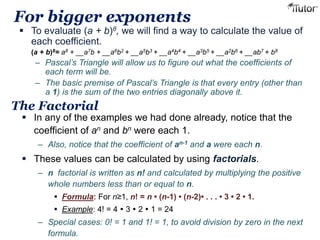
 To evaluate (a + b)8, we will find a way to calculate the value of 
each coefficient. 
(a + b)8= a8 + __a7b + __a6b2 + __a5b3 + __a4b4 + __a3b5 + __a2b6 + __ab7 + b8 
– Pascal’s Triangle will allow us to figure out what the coefficients of 
each term will be. 
– The basic premise of Pascal’s Triangle is that every entry (other than 
a 1) is the sum of the two entries diagonally above it. 
The Factorial 
 In any of the examples we had done already, notice that the 
coefficient of an and bn were each 1. 
– Also, notice that the coefficient of an-1 and a were each n. 
 These values can be calculated by using factorials. 
– n factorial is written as n! and calculated by multiplying the positive 
whole numbers less than or equal to n. 
 Formula: For n≥1, n! = n • (n-1) • (n-2)• . . . • 3 • 2 • 1. 
 Example: 4! = 4  3  2  1 = 24 
– Special cases: 0! = 1 and 1! = 1, to avoid division by zero in the next 
formula.
The Binomial Coefficient 
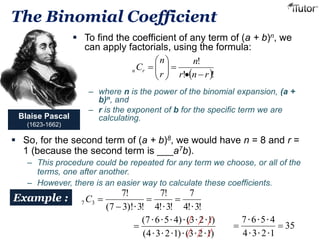
 To find the coefficient of any term of (a + b)n, we 
can apply factorials, using the formula: 
n 
! 
 
   
 
 
 
  
Cn r   
!  ! 
r n r 
n 
r 
 
– where n is the power of the binomial expansion, (a + 
b)n, and 
– r is the exponent of b for the specific term we are 
Blaise Pascal calculating. 
(1623-1662) 
 So, for the second term of (a + b)8, we would have n = 8 and r = 
1 (because the second term is ___a7b). 
– This procedure could be repeated for any term we choose, or all of the 
terms, one after another. 
– However, there is an easier way to calculate these coefficients. 
Example : 
7 
4! 3! 
7! 
7 3   
4! 3! 
7! 
(7 3)! 3! 
• • • 
 
C  
(7 • 6 • 5 • 4) • (3 • 2 • 
1) 
7 • 6 • 5 • 
4 
 35 
(4 • 3 • 2 • 1) • (3 • 2 • 
1) 
  
4 • 3 • 2 • 
1
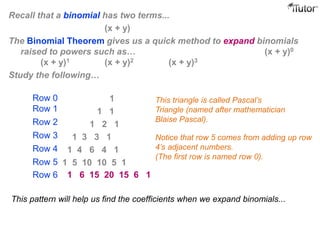
Recall that a binomial has two terms... 
(x + y) 
The Binomial Theorem gives us a quick method to expand binomials 
raised to powers such as… (x + y)0 
(x + y)1 (x + y)2 (x + y)3 
Study the following… 
1 
1 1 
1 2 1 
1 3 3 1 
1 4 6 4 1 
1 5 10 10 5 1 
This triangle is called Pascal’s 
Triangle (named after mathematician 
Blaise Pascal). 
Notice that row 5 comes from adding up row 
4’s adjacent numbers. 
(The first row is named row 0). 
Row 0 
Row 1 
Row 2 
Row 3 
Row 4 
Row 5 
Row 6 1 6 15 20 15 6 1 
This pattern will help us find the coefficients when we expand binomials...
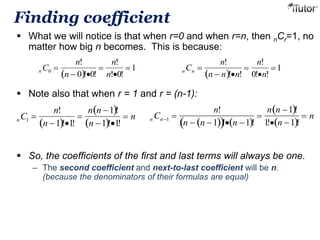
 What we will notice is that when r=0 and when r=n, then nCr=1, no 
matter how big n becomes. This is because: 
 Note also that when r = 1 and r = (n-1): 
 So, the coefficients of the first and last terms will always be one. 
– The second coefficient and next-to-last coefficient will be n. 
(because the denominators of their formulas are equal) 
 
nC0  
n! 
n  0!0! 
 
n! 
n!0! 
 1 
 
nCn  
n! 
n  n!n! 
 
n! 
0!n! 
 1 
Finding coefficient 
nC1  
n! 
n 1!1! 
 
nn 1! 
n 1!1! 
 n 
 
nCn 1  
n! 
n  n 1!n 1! 
 
nn 1! 
1!n 1! 
 n
Constructing Pascal’s Triangle 
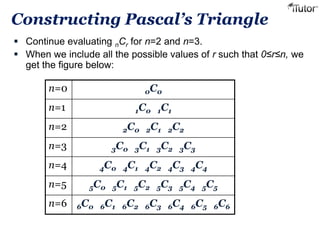
 Continue evaluating nCr for n=2 and n=3. 
 When we include all the possible values of r such that 0≤r≤n, we 
get the figure below: 
n=0 0C0 
n=1 1C0 1C1 
n=2 2C0 2C1 2C2 
n=3 3C0 3C1 3C2 3C3 
n=4 4C0 4C1 4C2 4C3 4C4 
n=5 5C0 5C1 5C2 5C3 5C4 5C5 
n=6 6C0 6C1 6C2 6C3 6C4 6C5 6C6
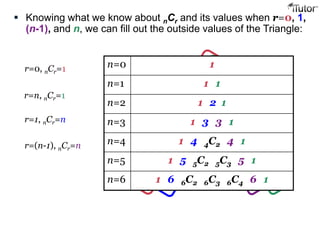
 Knowing what we know about nCr and its values when r=0, 1, 
(n-1), and n, we can fill out the outside values of the Triangle: 
r=0, nCr=1 0C0 
1C0 1C1 
2C0 2C2 
3C0 3C3 
4C0 4C4 
5C0 5C5 
6C0 6C6 
r=n, nCr=1 
n=0 1 
n=1 1 1 C1 
11 
n=2 1 1 CCC1 
221 1 22 
n=3 1 1 CCCCC1 
331 1 332 2 33 
n=4 1 1 CCCCCCC1 
441 1 442 2 443 3 44 
n=5 1 1 CCCCCCCCC1 
551 1 552 2 553 3 554 4 55 
n=6 1 CCCCCC61 62 63 64 65 66 
1 6C1 6C2 6C3 6C4 6C5 1 
r=1, nCr=n 
1 2 1 
1 3 32 1 
1 4 4C2 4C3 1 
1 5 52 53 54 1 
1 6 6C2 6C3 6C4 6C5 1 
r=(n-1), nCr=n 
1 3 3 1 
1 4 4 1 
1 5 5 1 
1 6 6 1
Using Pascal’s Triangle 
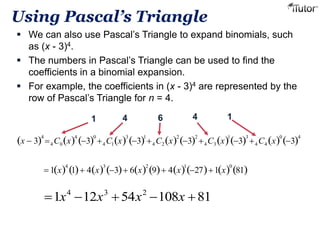
 We can also use Pascal’s Triangle to expand binomials, such 
as (x - 3)4. 
 The numbers in Pascal’s Triangle can be used to find the 
coefficients in a binomial expansion. 
 For example, the coefficients in (x - 3)4 are represented by the 
row of Pascal’s Triangle for n = 4. 
x  34 
4C0 x4 
30 
4C1 x3 
31 
4C2 x2 
32 
4C3 x1 
33 
4C4 x0 
34 
1 4 6 4 1 
1x4 12x3  54x2 108x  81 
 
 1x4 
1 4x3 
3 6x2 
9 4x1 
271x0 
81
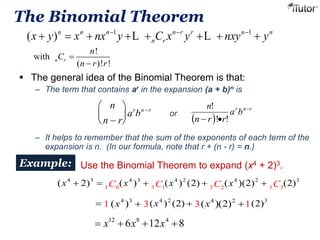
The Binomial Theorem 
1 1 ( )n n n n r r n n 
n r x y x nx y C x y nxy y       L  L   
n 
C 
 The general idea of the Binomial Theorem is that: 
– The term that contains ar in the expansion (a + b)n is 
or 
n ! 
 
 ! ! 
– It helps to remember that the sum of the exponents of each term of the 
expansion is n. (In our formula, note that r + (n - r) = n.) 
 
n 
n  r 
 
 
 
 
 
arbn r 
  
r n r a b 
n r r 
! 
with 
n r 
( n r )! r 
!  
 
Example: Use the Binomial Theorem to expand (x4 + 2)3. 
3 0 C 3 1 C 3 2 C 3 3   C 4 3 (x 2)  4 3 (x ) ( ) (2)  4 2 x  4 2 (x )(2) 3 (2) 
1  4 3 ) (x  3 ) 2 ( ) ( 4 2 x 3  4 2 ) 2 )( (x 1 3 (2) 
6 12 8 12 8 4  x  x  x 
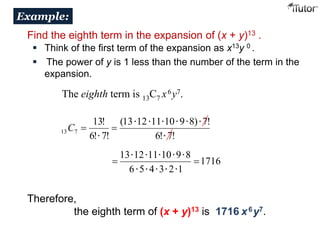
Find the eighth term in the expansion of (x + y)13 . 
The eighth term is 13C7 x6y7. 
13 7 C   
Therefore, 
(13 • 12 • 11 • 10 • 9 • 8) • 
7! 
6! 7! 
13! 
6! 7! 
• 
• 
1716 
13 • 12 • 11 • 10 • 9 • 
8 
  
6 • 5 • 4 • 3 • 2 • 
1 
the eighth term of (x + y)13 is 1716 x6y7. 
Example: 
 Think of the first term of the expansion as x13y 0 . 
 The power of y is 1 less than the number of the term in the 
expansion.
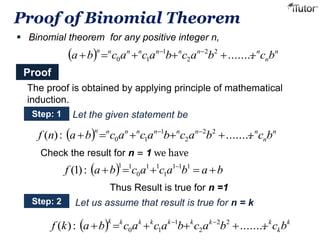
Proof of Binomial Theorem 
 Binomial theorem for any positive integer n, 
n n n n n n n n a b  c a  c a b c a b   c b   ........ 2 2 
  n 
n 
2 
1 
0 1 
Proof 
The proof is obtained by applying principle of mathematical 
induction. 
Step: 1 
Let the given statement be 
  n 
n n n n n n n n f n ab  c a  c a b c a b   c b   ( ) : ........ 2 2 
Check the result for n = 1 we have 
n 
2 
1 
0 1 
f a b  c a  c a b  a b  (1) : 1 1 1 
1 
1 1 
0 
1 1 
Thus Result is true for n =1 
Step: 2 Let us assume that result is true for n = k 
k k k k k k k k f k ab  c a  c a b c a b   c b   ( ) : ........ 2 2 
  k 
k 
2 
1 
0 1
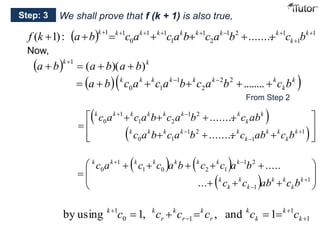
Step: 3 We shall prove that f (k + 1) is also true, 
k k k k k k k k f k a b c a c a b c a b c b 
(  1) :   1   1        ........   k 
 
  1 
1 
1 2 1 
2 
1 
1 
1 1 
0 
 
k 
Now, 
  k k a b (a b)(a b) 1      
   k  
k k k k k k k  a  b c a  c a b c a b   c b   ........ 2 2 
k 
2 
1 
0 1 
From Step 2 
  
 
 
  
c a  c a b  c a b  ........ 
 
c ab 
  
 
 
 
 
 
    
 
 
 
 
........ 
1 
1 
1 2 
0 1 
1 2 
1 2 
1 
0 
k 
k 
k k 
k 
k k k k k 
k 
k 
k k k k k k k 
c a b c a b c ab c b 
    
 
 
1 2 
k k k k k k k k 
c a c c a b c c a b 
     
   
 
 
 
 
 
   
 
 
 
  
1 
1 
1 0 2 1 
1 
0 
. .. 
..... 
k 
k 
k k 
k 
k 
k 
k 
c c ab c b 
k k c c c c c c 
1 by using 1, , and 1  
1 
       
1 
0  
1 
k 
k 
k 
k 
r 
k 
r 
k 
r
k k k k k k k c a c a b c a b c ab c b 
             k 
1 ........  
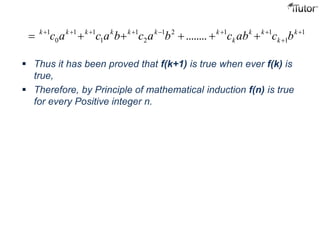
 Thus it has been proved that f(k+1) is true when ever f(k) is 
true, 
 Therefore, by Principle of mathematical induction f(n) is true 
for every Positive integer n. 
1 
1 
1 2 1 1 
2 
1 
1 
1 1 
0 
 
k 
k k 
k
Call us for 
more 
Information: 
1-855-694- 
8886 
www.iTutor.com 
Vis 
it 
The End

Binomial theorem

  • 1.
    Binom ial The Theorem By iTutor.com T- 1-855-694-8886 Email- info@iTutor.com
  • 2.
    Binomials  Anexpression in the form a + b is called a binomial, because it is made of of two unlike terms.  We could use the FOIL method repeatedly to evaluate expressions like (a + b)2, (a + b)3, or (a + b)4. – (a + b)2 = a2 + 2ab + b2 – (a + b)3 = a3 + 3a2b + 3ab2 + b3 – (a + b)4 = a4 + 4a3b + 6a2b2 + 4ab3 + b4  But to evaluate to higher powers of (a + b)n would be a difficult and tedious process.  For a binomial expansion of (a + b)n, look at the expansions below: – (a + b)2 = a2 + 2ab + b2 – (a + b)3 = a3 + 3a2b + 3ab2 + b3 – (a + b)4 = a4 + 4a3b + 6a2b2 + 4ab3 + b4 • Some simple patterns emerge by looking at these examples: – There are n + 1 terms, the first one is an and the last is bn. – The exponent of a decreases by 1 for each term and the exponents of b increase by 1. – The sum of the exponents in each term is n.
  • 3.
    For bigger exponents  To evaluate (a + b)8, we will find a way to calculate the value of each coefficient. (a + b)8= a8 + __a7b + __a6b2 + __a5b3 + __a4b4 + __a3b5 + __a2b6 + __ab7 + b8 – Pascal’s Triangle will allow us to figure out what the coefficients of each term will be. – The basic premise of Pascal’s Triangle is that every entry (other than a 1) is the sum of the two entries diagonally above it. The Factorial  In any of the examples we had done already, notice that the coefficient of an and bn were each 1. – Also, notice that the coefficient of an-1 and a were each n.  These values can be calculated by using factorials. – n factorial is written as n! and calculated by multiplying the positive whole numbers less than or equal to n.  Formula: For n≥1, n! = n • (n-1) • (n-2)• . . . • 3 • 2 • 1.  Example: 4! = 4  3  2  1 = 24 – Special cases: 0! = 1 and 1! = 1, to avoid division by zero in the next formula.
  • 4.
    The Binomial Coefficient  To find the coefficient of any term of (a + b)n, we can apply factorials, using the formula: n !          Cn r   !  ! r n r n r  – where n is the power of the binomial expansion, (a + b)n, and – r is the exponent of b for the specific term we are Blaise Pascal calculating. (1623-1662)  So, for the second term of (a + b)8, we would have n = 8 and r = 1 (because the second term is ___a7b). – This procedure could be repeated for any term we choose, or all of the terms, one after another. – However, there is an easier way to calculate these coefficients. Example : 7 4! 3! 7! 7 3   4! 3! 7! (7 3)! 3! • • •  C  (7 • 6 • 5 • 4) • (3 • 2 • 1) 7 • 6 • 5 • 4  35 (4 • 3 • 2 • 1) • (3 • 2 • 1)   4 • 3 • 2 • 1
  • 5.
    Recall that abinomial has two terms... (x + y) The Binomial Theorem gives us a quick method to expand binomials raised to powers such as… (x + y)0 (x + y)1 (x + y)2 (x + y)3 Study the following… 1 1 1 1 2 1 1 3 3 1 1 4 6 4 1 1 5 10 10 5 1 This triangle is called Pascal’s Triangle (named after mathematician Blaise Pascal). Notice that row 5 comes from adding up row 4’s adjacent numbers. (The first row is named row 0). Row 0 Row 1 Row 2 Row 3 Row 4 Row 5 Row 6 1 6 15 20 15 6 1 This pattern will help us find the coefficients when we expand binomials...
  • 6.
     What wewill notice is that when r=0 and when r=n, then nCr=1, no matter how big n becomes. This is because:  Note also that when r = 1 and r = (n-1):  So, the coefficients of the first and last terms will always be one. – The second coefficient and next-to-last coefficient will be n. (because the denominators of their formulas are equal)  nC0  n! n  0!0!  n! n!0!  1  nCn  n! n  n!n!  n! 0!n!  1 Finding coefficient nC1  n! n 1!1!  nn 1! n 1!1!  n  nCn 1  n! n  n 1!n 1!  nn 1! 1!n 1!  n
  • 7.
    Constructing Pascal’s Triangle  Continue evaluating nCr for n=2 and n=3.  When we include all the possible values of r such that 0≤r≤n, we get the figure below: n=0 0C0 n=1 1C0 1C1 n=2 2C0 2C1 2C2 n=3 3C0 3C1 3C2 3C3 n=4 4C0 4C1 4C2 4C3 4C4 n=5 5C0 5C1 5C2 5C3 5C4 5C5 n=6 6C0 6C1 6C2 6C3 6C4 6C5 6C6
  • 8.
     Knowing whatwe know about nCr and its values when r=0, 1, (n-1), and n, we can fill out the outside values of the Triangle: r=0, nCr=1 0C0 1C0 1C1 2C0 2C2 3C0 3C3 4C0 4C4 5C0 5C5 6C0 6C6 r=n, nCr=1 n=0 1 n=1 1 1 C1 11 n=2 1 1 CCC1 221 1 22 n=3 1 1 CCCCC1 331 1 332 2 33 n=4 1 1 CCCCCCC1 441 1 442 2 443 3 44 n=5 1 1 CCCCCCCCC1 551 1 552 2 553 3 554 4 55 n=6 1 CCCCCC61 62 63 64 65 66 1 6C1 6C2 6C3 6C4 6C5 1 r=1, nCr=n 1 2 1 1 3 32 1 1 4 4C2 4C3 1 1 5 52 53 54 1 1 6 6C2 6C3 6C4 6C5 1 r=(n-1), nCr=n 1 3 3 1 1 4 4 1 1 5 5 1 1 6 6 1
  • 9.
    Using Pascal’s Triangle  We can also use Pascal’s Triangle to expand binomials, such as (x - 3)4.  The numbers in Pascal’s Triangle can be used to find the coefficients in a binomial expansion.  For example, the coefficients in (x - 3)4 are represented by the row of Pascal’s Triangle for n = 4. x  34 4C0 x4 30 4C1 x3 31 4C2 x2 32 4C3 x1 33 4C4 x0 34 1 4 6 4 1 1x4 12x3  54x2 108x  81   1x4 1 4x3 3 6x2 9 4x1 271x0 81
  • 10.
    The Binomial Theorem 1 1 ( )n n n n r r n n n r x y x nx y C x y nxy y       L  L   n C  The general idea of the Binomial Theorem is that: – The term that contains ar in the expansion (a + b)n is or n !   ! ! – It helps to remember that the sum of the exponents of each term of the expansion is n. (In our formula, note that r + (n - r) = n.)  n n  r      arbn r   r n r a b n r r ! with n r ( n r )! r !   Example: Use the Binomial Theorem to expand (x4 + 2)3. 3 0 C 3 1 C 3 2 C 3 3   C 4 3 (x 2)  4 3 (x ) ( ) (2)  4 2 x  4 2 (x )(2) 3 (2) 1  4 3 ) (x  3 ) 2 ( ) ( 4 2 x 3  4 2 ) 2 )( (x 1 3 (2) 6 12 8 12 8 4  x  x  x 
  • 11.
    Find the eighthterm in the expansion of (x + y)13 . The eighth term is 13C7 x6y7. 13 7 C   Therefore, (13 • 12 • 11 • 10 • 9 • 8) • 7! 6! 7! 13! 6! 7! • • 1716 13 • 12 • 11 • 10 • 9 • 8   6 • 5 • 4 • 3 • 2 • 1 the eighth term of (x + y)13 is 1716 x6y7. Example:  Think of the first term of the expansion as x13y 0 .  The power of y is 1 less than the number of the term in the expansion.
  • 12.
    Proof of BinomialTheorem  Binomial theorem for any positive integer n, n n n n n n n n a b  c a  c a b c a b   c b   ........ 2 2   n n 2 1 0 1 Proof The proof is obtained by applying principle of mathematical induction. Step: 1 Let the given statement be   n n n n n n n n n f n ab  c a  c a b c a b   c b   ( ) : ........ 2 2 Check the result for n = 1 we have n 2 1 0 1 f a b  c a  c a b  a b  (1) : 1 1 1 1 1 1 0 1 1 Thus Result is true for n =1 Step: 2 Let us assume that result is true for n = k k k k k k k k k f k ab  c a  c a b c a b   c b   ( ) : ........ 2 2   k k 2 1 0 1
  • 13.
    Step: 3 Weshall prove that f (k + 1) is also true, k k k k k k k k f k a b c a c a b c a b c b (  1) :   1   1        ........   k    1 1 1 2 1 2 1 1 1 1 0  k Now,   k k a b (a b)(a b) 1         k  k k k k k k k  a  b c a  c a b c a b   c b   ........ 2 2 k 2 1 0 1 From Step 2       c a  c a b  c a b  ........  c ab                ........ 1 1 1 2 0 1 1 2 1 2 1 0 k k k k k k k k k k k k k k k k k k k c a b c a b c ab c b       1 2 k k k k k k k k c a c c a b c c a b                      1 1 1 0 2 1 1 0 . .. ..... k k k k k k k k c c ab c b k k c c c c c c 1 by using 1, , and 1  1        1 0  1 k k k k r k r k r
  • 14.
    k k kk k k k c a c a b c a b c ab c b              k 1 ........   Thus it has been proved that f(k+1) is true when ever f(k) is true,  Therefore, by Principle of mathematical induction f(n) is true for every Positive integer n. 1 1 1 2 1 1 2 1 1 1 1 0  k k k k
  • 15.
    Call us for more Information: 1-855-694- 8886 www.iTutor.com Vis it The End