Mohammad Mobasheri
SpR General Surgery
 Types of gallstone
 Cholesterol stones (20%)
 Pigment stones (5%)
 Mixed (75%)
 Epidemiology
 Fat, Fair, Female, Fertile, Fourty inaccurate, but reminder
of the typical patient
 F:M = 2:1
 10% of British women in their 40s have gallstones
 Genetic predisposition – ask about family history
 Composition of bile:
 Bilirubin (by-product of haem degradation)
 Cholesterol (kept soluble by bile salts and lecithin)
 Bile salts/acids (cholic acid/chenodeoxycholic acid):
mostly reabsorbed in terminal ileum(entero-hepatic
circulation).
 Lecithin (increases solubility of cholesterol)
 Inorganic salts (sodium bicarbonate to keep bile alkaline
to neutralise gastric acid in duodenum)
 Water (makes up 97% of bile)
 Cholesterol
 Imbalance between bile salts/lecithin and cholesterol allows
cholesterol to precipitate out of solution and form stones
 Pigment
 Occur due to excess of circulating bile pigment (e.g. Heamolytic
anaemia)
 Mixed
 Same pathophysiology as cholesterol stones
 Other Factors
 Stasis (e.g. Pregnancy)
 Ileal dysfunction (prevents re-absorption of bile salts)
 Obesity and hypercholesterolaemia
 80% Asymptomatic
 20% develop complications and do so on
recurrent basis
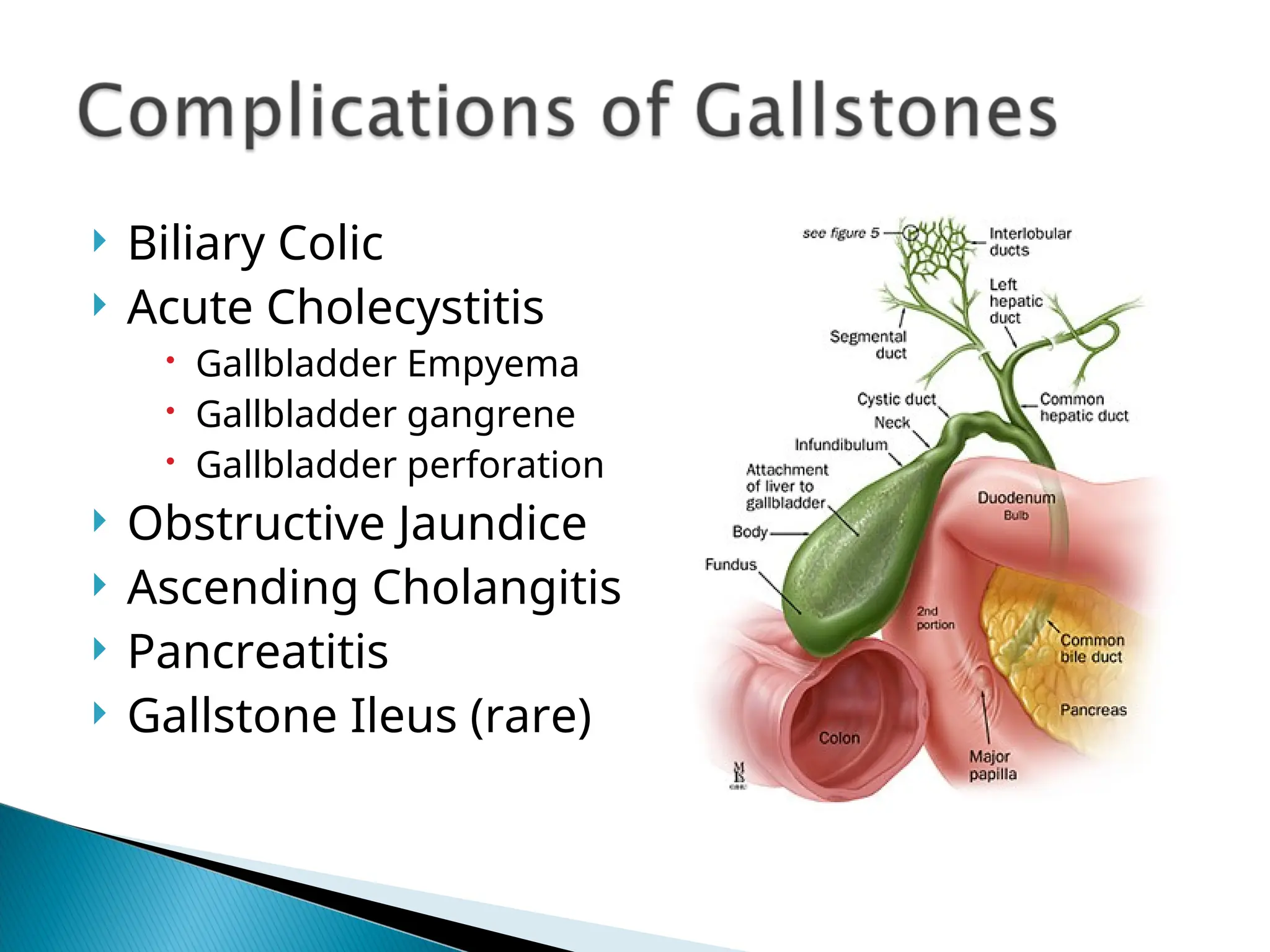
 Biliary Colic
 Acute Cholecystitis
 Gallbladder Empyema
 Gallbladder gangrene
 Gallbladder perforation
 Obstructive Jaundice
 Ascending Cholangitis
 Pancreatitis
 Gallstone Ileus (rare)
 Gallstone disease (and its related complications)
 Gastritis/duodenitis
 Peptic ulcer disease/perforated peptic ulcer
 Acute pancreatitis
 Right lower lobe pneumonia
 MI
 If presenting to A&E with RUQ pain all patients
should get
 Blood tests
 AXR/E-CXR (to exclude perforation/pneumonia)
 ECG
 Can differentiate between gallstone
complications based on:
 History
 Examination
 Blood tests
 FBC
 LFT
 CRP
 Clotting
 Amylase
Complication History Examination Blood tests
Biliary Colic - Intermittent RUQ/epigastric
pain (minutes/hours) into back
or right shoulder
- N&V
-Tender RUQ
-No peritonism
-Murphy’s –
-Apyrexial, HR and BP (N)
-WCC (N) CRP (N)
- LFT (N)
Acute Cholecystitis -Constant RUQ pain into back
or right shoulder
-N&V
-Feverish
-Tender RUQ
-Periotnism RUQ
(guarding/rebound)
-Murphy’s +
-Pyrexia, HR ( )
↑
-WCC and CRP ( )
↑
-LFT (N or mildly ( )
↑
Empyema -Constant RUQ pain into back
or right shoulder
-N&V
-Feverish
-Tender RUQ
-Peritonism RUQ
-Murphy’s +
-Pyrexia, HR ( ), BP ( or )
↑ ↔ ↓
-More septic than acute
cholecystitis
-WCC and CRP ( )
↑
-LFT (N or mildly ( )
↑
Obstructive Jaundice -Yellow discolouration
-Pale stool, dark urine
-painless or assocaited with
mild RUQ pain
-Jaundiced
-Non-tender or minimally tender
RUQ
-No peritonism
-Murphy’s –
-Apyrexial, HR and BP (N)
-WCC and CRP (N)
-LFT: obstructive pattern bili
( ), ALP ( ), GGT ( ),
↑ ↑ ↑
ALT/AST ( )
↔
-INR ( or )
↔ ↑
Ascending Cholangitis Becks triad
-RUQ pain (constant)
-Jaundice
-Rigors
-Jaundiced
-Tender RUQ
-Peritonism RUQ
-Spiking high pyrexia (38-39)
-HR ( ), BP ( or )
↑ ↔ ↓
-Can develop septic shock
-WCC and CRP ( )
↑
-LFT : obstructive pattern bili
( ), ALP ( ), GGT ( ),
↑ ↑ ↑
ALT/AST ( )
↔
-INR ( or )
↔ ↑
Acute Pancreatitis -Severe upper abdominal pain
(constant) into back
-Profuse vomiting
-Tender upper abdomen
-Upper abdominal or generalised
peritonism
-Usually apyrexial, HR ( ), BP (
↑ ↔
or )
↓
-WCC and CRP ( )
↑
-LFT: (N) if passed stone or
obstructive pattern ifstone
still in CBD
-Amylase ( )
↑
-INR/APTT (N) or ( ) if DIC
↑
Gallstone Ileus - 4 cardinal features of SBO -distended tympanic abdomen
-hyperactive/tinkling bowel
sounds
 Bloods (already discussed)
 AXR (10% gallstones are radio-opaque)
 E-CXR (to exclude perforation – MUST!)
 ECG (to exclude MI)
 USS: first line investigation in gallstone disease
 Confirms presence of gallstones
 Gall bladder wall thickness (if thickened suggests cholecystitis)
 Biliary tree calibre (CBD/extrahepatic/intrahepatic) – if dilated suggests stone in CBD (normal CBD <8mm).
 Sometimes CBD stone can be seen.
 MRCP: To visualise biliary tree accurately (much more accurate than USS)
 Diagnostic only but non-invasive
 Look for biliary dilatation and any stones in biliary tree
 ERCP: Diagnostic and therepeutic in biliary obstruction
 Diagnostic and therepeutic but invasive
 Look for biliary tree dilatation and stones in biliary tree
 Stones can be extracted to unobstruct the biliary tree and perform sphincterotomy
 Risk of pancreatitis, duodenal perforation
 PTC
 To unobstruct biliary tree when ERCP has failed
 Invasive – higher complication rate than ERCP
 CT: Not first line investigation. Mainly used if suspicion of gallbladder empyema, gangrene, or
perforation and in acute pancreatitis (USS not good for looking at pancreas)
Pathogenesis
 Stone intermittently obstructing cystic duct
(causing pain) and then dropping back into
gallbladder (pain subsides)
USS confirms presence of gallstones
Treatment
 Analgesia
 Fluid resuscitation if vomiting
 If pain and vomiting subside does not need
admitting
Pathogenesis:
 Due to obstruction of cystic duct by gallstone:
 Cystic duct blockage by gallstone
 Obstruction to secretion of bile from gallbladder
 Bile becomes concentrated
 Chemical inflammation initially
 Secondarily infected by organisms released by liver into bile stream
USS confirms diagnosis (gallstones, thickened gallbladder wall, peri-cholecystic fluid)
Complications of acute cholecystitis
 Empyema of gallbaldder
 Gangrene of gallbladder (rare)
 Perforation ofgallbaldder (rare)
Treatment
 Admit for monitoring
 Analgesia
 Clear fluids initially, then build up oral intake as cholecystitis settles
 IVF
 Antibiotics
 95% settle with above management
 If do not settle then for CT scan
 Empyema  percutaneous drainage
 Gangrene/perforation with generalised peritonitis emergency surgery
Pathogenesis:
 Stone obstructing CBD (bear in mind there are other causes for obstructive jaundice)
– danger is progression to ascending cholangitis.
 USS
 Will confirm gallstones in the gallbladder
 CBD dilatation i.e. >8mm (not always!)
 May visualise stone in CBD (most often does not)
 MRCP
 In cases where suspect stone in CBD but USS indeterminate
 E.g.1 obstructive LFTs but USS shows no biliary dilatation and no stone in CBD
 E.g. 2 normal LFTS but USS shows biliary dilatation
 ERCP
 If confirmed stone in CBD on USS or MRCP proceed to ERCP which will confirm this (diagnostic) and
allow extraction of stones and sphincterotomy (therepeutic)
Treatment
 Must unobstruct biliary tree with ERCP to prevent progression to ascending
cholangitis
 Whilst awaiting ERCP monitor for signs of sepsis suggestive of cholangitis
Pathogenesis:
 Stone obstructing CBD with infection/pus proximal
to the blockage
Treatment
 ABC
 Fluid resuscitation (clear fuids and IVF, catheter)
 Antibiotics (Augmentin)
 HDU/ITU if unwell/septic shock
 Pus must be drained* - this is done by
decompressing the biliary tree
 Urgent ERCP
 Urgent PTC – if ERCP unavailable or unsuccesful
Pathogenesis
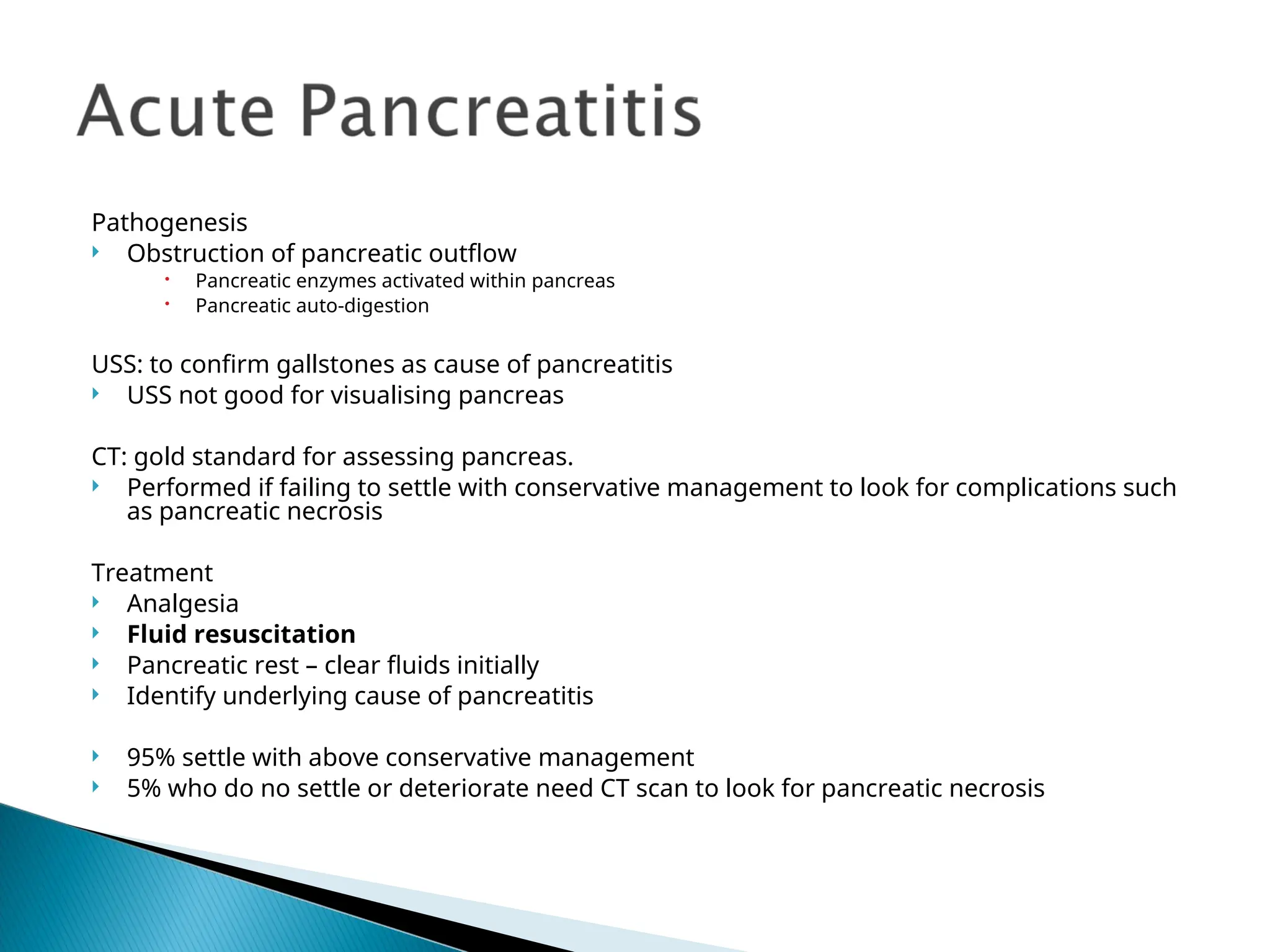
 Obstruction of pancreatic outflow
 Pancreatic enzymes activated within pancreas
 Pancreatic auto-digestion
USS: to confirm gallstones as cause of pancreatitis
 USS not good for visualising pancreas
CT: gold standard for assessing pancreas.
 Performed if failing to settle with conservative management to look for complications such
as pancreatic necrosis
Treatment
 Analgesia
 Fluid resuscitation
 Pancreatic rest – clear fluids initially
 Identify underlying cause of pancreatitis
 95% settle with above conservative management
 5% who do no settle or deteriorate need CT scan to look for pancreatic necrosis
Pathogenesis:
 Gallstone causing small bowel obstruction (usually obstructs in terminal ileum)
 Gallstone enters small bowel via cholecysto-duodenal fistula (not via CBD)
AXR – dilated small bowel loops
 May see stone if radio-opaque
Treatment
 NBM
 Fluid resuscitation + catheter
 NG tube
 Analgesia
 Surgery (will not settle with conservative management) – enterotomy + removal
of stone
Diagnosis of gallstone ileus usually made at the time of surgery.
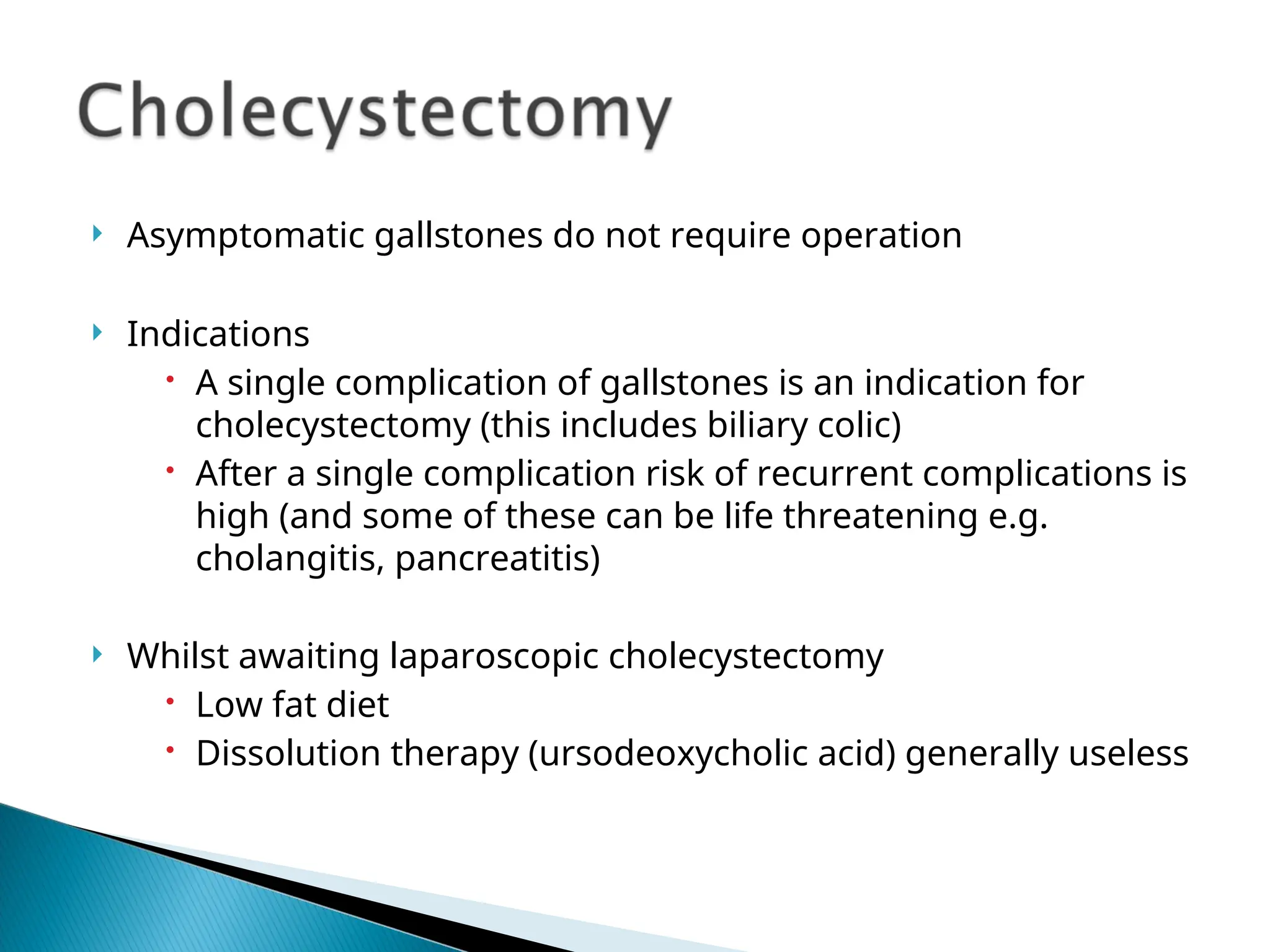
 Asymptomatic gallstones do not require operation
 Indications
 A single complication of gallstones is an indication for
cholecystectomy (this includes biliary colic)
 After a single complication risk of recurrent complications is
high (and some of these can be life threatening e.g.
cholangitis, pancreatitis)
 Whilst awaiting laparoscopic cholecystectomy
 Low fat diet
 Dissolution therapy (ursodeoxycholic acid) generally useless
 All performed laparoscopically
 Advantages:
 Less post-op pain
 Shorter hospital stay
 Quicker return to normal activities
 Disadvantages:
 Learning curve
 Inexperience at performing open cholecystectomies
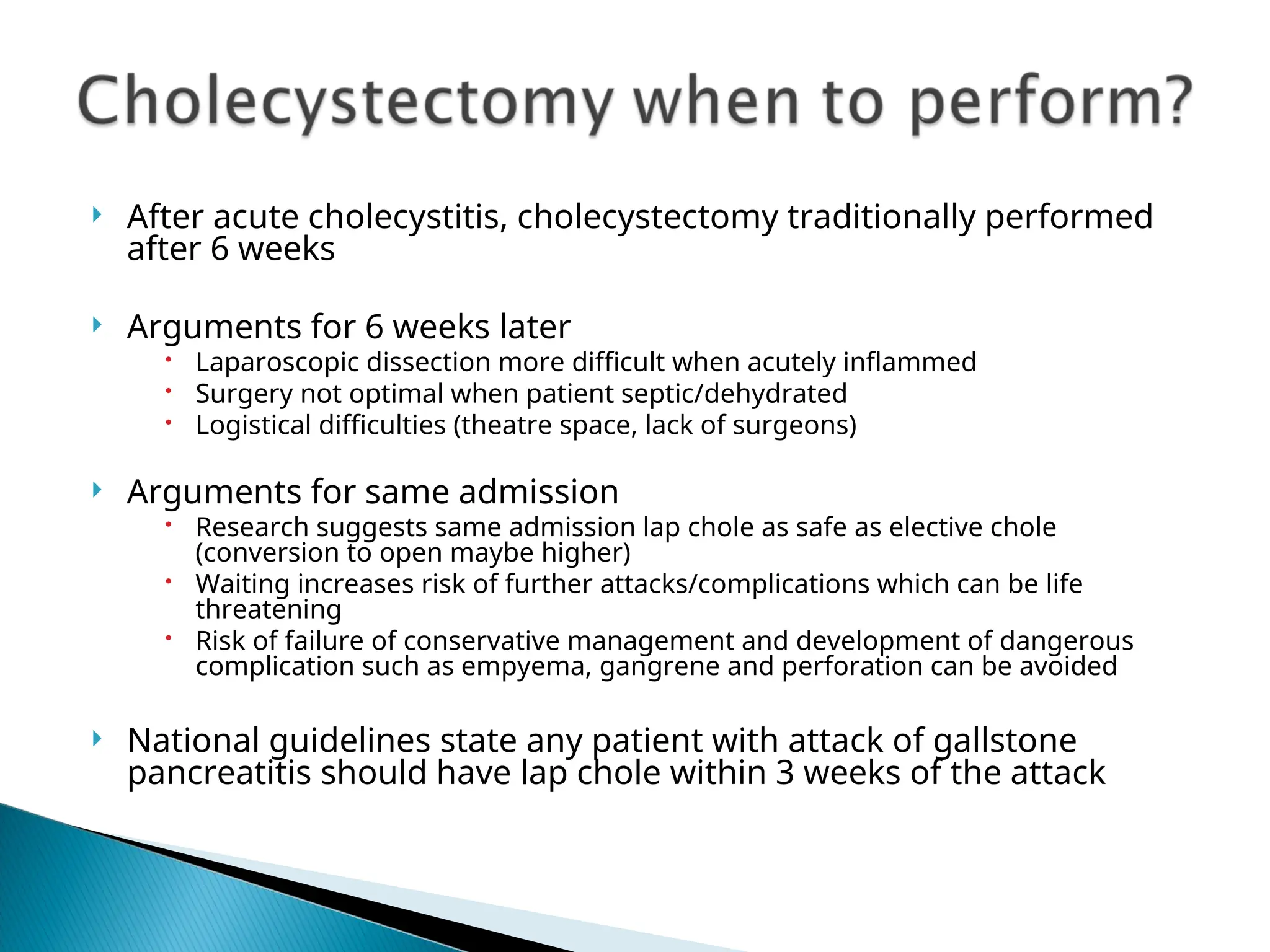
 After acute cholecystitis, cholecystectomy traditionally performed
after 6 weeks
 Arguments for 6 weeks later
 Laparoscopic dissection more difficult when acutely inflammed
 Surgery not optimal when patient septic/dehydrated
 Logistical difficulties (theatre space, lack of surgeons)
 Arguments for same admission
 Research suggests same admission lap chole as safe as elective chole
(conversion to open maybe higher)
 Waiting increases risk of further attacks/complications which can be life
threatening
 Risk of failure of conservative management and development of dangerous
complication such as empyema, gangrene and perforation can be avoided
 National guidelines state any patient with attack of gallstone
pancreatitis should have lap chole within 3 weeks of the attack
Questions?

Gallstone-disease-and-acute-cholecystitis.ppt

  • 1.
  • 2.
     Types ofgallstone  Cholesterol stones (20%)  Pigment stones (5%)  Mixed (75%)  Epidemiology  Fat, Fair, Female, Fertile, Fourty inaccurate, but reminder of the typical patient  F:M = 2:1  10% of British women in their 40s have gallstones  Genetic predisposition – ask about family history
  • 3.
     Composition ofbile:  Bilirubin (by-product of haem degradation)  Cholesterol (kept soluble by bile salts and lecithin)  Bile salts/acids (cholic acid/chenodeoxycholic acid): mostly reabsorbed in terminal ileum(entero-hepatic circulation).  Lecithin (increases solubility of cholesterol)  Inorganic salts (sodium bicarbonate to keep bile alkaline to neutralise gastric acid in duodenum)  Water (makes up 97% of bile)
  • 4.
     Cholesterol  Imbalancebetween bile salts/lecithin and cholesterol allows cholesterol to precipitate out of solution and form stones  Pigment  Occur due to excess of circulating bile pigment (e.g. Heamolytic anaemia)  Mixed  Same pathophysiology as cholesterol stones  Other Factors  Stasis (e.g. Pregnancy)  Ileal dysfunction (prevents re-absorption of bile salts)  Obesity and hypercholesterolaemia
  • 5.
     80% Asymptomatic 20% develop complications and do so on recurrent basis
  • 7.
     Biliary Colic Acute Cholecystitis  Gallbladder Empyema  Gallbladder gangrene  Gallbladder perforation  Obstructive Jaundice  Ascending Cholangitis  Pancreatitis  Gallstone Ileus (rare)
  • 8.
     Gallstone disease(and its related complications)  Gastritis/duodenitis  Peptic ulcer disease/perforated peptic ulcer  Acute pancreatitis  Right lower lobe pneumonia  MI  If presenting to A&E with RUQ pain all patients should get  Blood tests  AXR/E-CXR (to exclude perforation/pneumonia)  ECG
  • 9.
     Can differentiatebetween gallstone complications based on:  History  Examination  Blood tests  FBC  LFT  CRP  Clotting  Amylase
  • 10.
    Complication History ExaminationBlood tests Biliary Colic - Intermittent RUQ/epigastric pain (minutes/hours) into back or right shoulder - N&V -Tender RUQ -No peritonism -Murphy’s – -Apyrexial, HR and BP (N) -WCC (N) CRP (N) - LFT (N) Acute Cholecystitis -Constant RUQ pain into back or right shoulder -N&V -Feverish -Tender RUQ -Periotnism RUQ (guarding/rebound) -Murphy’s + -Pyrexia, HR ( ) ↑ -WCC and CRP ( ) ↑ -LFT (N or mildly ( ) ↑ Empyema -Constant RUQ pain into back or right shoulder -N&V -Feverish -Tender RUQ -Peritonism RUQ -Murphy’s + -Pyrexia, HR ( ), BP ( or ) ↑ ↔ ↓ -More septic than acute cholecystitis -WCC and CRP ( ) ↑ -LFT (N or mildly ( ) ↑ Obstructive Jaundice -Yellow discolouration -Pale stool, dark urine -painless or assocaited with mild RUQ pain -Jaundiced -Non-tender or minimally tender RUQ -No peritonism -Murphy’s – -Apyrexial, HR and BP (N) -WCC and CRP (N) -LFT: obstructive pattern bili ( ), ALP ( ), GGT ( ), ↑ ↑ ↑ ALT/AST ( ) ↔ -INR ( or ) ↔ ↑ Ascending Cholangitis Becks triad -RUQ pain (constant) -Jaundice -Rigors -Jaundiced -Tender RUQ -Peritonism RUQ -Spiking high pyrexia (38-39) -HR ( ), BP ( or ) ↑ ↔ ↓ -Can develop septic shock -WCC and CRP ( ) ↑ -LFT : obstructive pattern bili ( ), ALP ( ), GGT ( ), ↑ ↑ ↑ ALT/AST ( ) ↔ -INR ( or ) ↔ ↑ Acute Pancreatitis -Severe upper abdominal pain (constant) into back -Profuse vomiting -Tender upper abdomen -Upper abdominal or generalised peritonism -Usually apyrexial, HR ( ), BP ( ↑ ↔ or ) ↓ -WCC and CRP ( ) ↑ -LFT: (N) if passed stone or obstructive pattern ifstone still in CBD -Amylase ( ) ↑ -INR/APTT (N) or ( ) if DIC ↑ Gallstone Ileus - 4 cardinal features of SBO -distended tympanic abdomen -hyperactive/tinkling bowel sounds
  • 11.
     Bloods (alreadydiscussed)  AXR (10% gallstones are radio-opaque)  E-CXR (to exclude perforation – MUST!)  ECG (to exclude MI)  USS: first line investigation in gallstone disease  Confirms presence of gallstones  Gall bladder wall thickness (if thickened suggests cholecystitis)  Biliary tree calibre (CBD/extrahepatic/intrahepatic) – if dilated suggests stone in CBD (normal CBD <8mm).  Sometimes CBD stone can be seen.  MRCP: To visualise biliary tree accurately (much more accurate than USS)  Diagnostic only but non-invasive  Look for biliary dilatation and any stones in biliary tree  ERCP: Diagnostic and therepeutic in biliary obstruction  Diagnostic and therepeutic but invasive  Look for biliary tree dilatation and stones in biliary tree  Stones can be extracted to unobstruct the biliary tree and perform sphincterotomy  Risk of pancreatitis, duodenal perforation  PTC  To unobstruct biliary tree when ERCP has failed  Invasive – higher complication rate than ERCP  CT: Not first line investigation. Mainly used if suspicion of gallbladder empyema, gangrene, or perforation and in acute pancreatitis (USS not good for looking at pancreas)
  • 12.
    Pathogenesis  Stone intermittentlyobstructing cystic duct (causing pain) and then dropping back into gallbladder (pain subsides) USS confirms presence of gallstones Treatment  Analgesia  Fluid resuscitation if vomiting  If pain and vomiting subside does not need admitting
  • 13.
    Pathogenesis:  Due toobstruction of cystic duct by gallstone:  Cystic duct blockage by gallstone  Obstruction to secretion of bile from gallbladder  Bile becomes concentrated  Chemical inflammation initially  Secondarily infected by organisms released by liver into bile stream USS confirms diagnosis (gallstones, thickened gallbladder wall, peri-cholecystic fluid) Complications of acute cholecystitis  Empyema of gallbaldder  Gangrene of gallbladder (rare)  Perforation ofgallbaldder (rare) Treatment  Admit for monitoring  Analgesia  Clear fluids initially, then build up oral intake as cholecystitis settles  IVF  Antibiotics  95% settle with above management  If do not settle then for CT scan  Empyema  percutaneous drainage  Gangrene/perforation with generalised peritonitis emergency surgery
  • 14.
    Pathogenesis:  Stone obstructingCBD (bear in mind there are other causes for obstructive jaundice) – danger is progression to ascending cholangitis.  USS  Will confirm gallstones in the gallbladder  CBD dilatation i.e. >8mm (not always!)  May visualise stone in CBD (most often does not)  MRCP  In cases where suspect stone in CBD but USS indeterminate  E.g.1 obstructive LFTs but USS shows no biliary dilatation and no stone in CBD  E.g. 2 normal LFTS but USS shows biliary dilatation  ERCP  If confirmed stone in CBD on USS or MRCP proceed to ERCP which will confirm this (diagnostic) and allow extraction of stones and sphincterotomy (therepeutic) Treatment  Must unobstruct biliary tree with ERCP to prevent progression to ascending cholangitis  Whilst awaiting ERCP monitor for signs of sepsis suggestive of cholangitis
  • 15.
    Pathogenesis:  Stone obstructingCBD with infection/pus proximal to the blockage Treatment  ABC  Fluid resuscitation (clear fuids and IVF, catheter)  Antibiotics (Augmentin)  HDU/ITU if unwell/septic shock  Pus must be drained* - this is done by decompressing the biliary tree  Urgent ERCP  Urgent PTC – if ERCP unavailable or unsuccesful
  • 16.
    Pathogenesis  Obstruction ofpancreatic outflow  Pancreatic enzymes activated within pancreas  Pancreatic auto-digestion USS: to confirm gallstones as cause of pancreatitis  USS not good for visualising pancreas CT: gold standard for assessing pancreas.  Performed if failing to settle with conservative management to look for complications such as pancreatic necrosis Treatment  Analgesia  Fluid resuscitation  Pancreatic rest – clear fluids initially  Identify underlying cause of pancreatitis  95% settle with above conservative management  5% who do no settle or deteriorate need CT scan to look for pancreatic necrosis
  • 17.
    Pathogenesis:  Gallstone causingsmall bowel obstruction (usually obstructs in terminal ileum)  Gallstone enters small bowel via cholecysto-duodenal fistula (not via CBD) AXR – dilated small bowel loops  May see stone if radio-opaque Treatment  NBM  Fluid resuscitation + catheter  NG tube  Analgesia  Surgery (will not settle with conservative management) – enterotomy + removal of stone Diagnosis of gallstone ileus usually made at the time of surgery.
  • 18.
     Asymptomatic gallstonesdo not require operation  Indications  A single complication of gallstones is an indication for cholecystectomy (this includes biliary colic)  After a single complication risk of recurrent complications is high (and some of these can be life threatening e.g. cholangitis, pancreatitis)  Whilst awaiting laparoscopic cholecystectomy  Low fat diet  Dissolution therapy (ursodeoxycholic acid) generally useless
  • 19.
     All performedlaparoscopically  Advantages:  Less post-op pain  Shorter hospital stay  Quicker return to normal activities  Disadvantages:  Learning curve  Inexperience at performing open cholecystectomies
  • 20.
     After acutecholecystitis, cholecystectomy traditionally performed after 6 weeks  Arguments for 6 weeks later  Laparoscopic dissection more difficult when acutely inflammed  Surgery not optimal when patient septic/dehydrated  Logistical difficulties (theatre space, lack of surgeons)  Arguments for same admission  Research suggests same admission lap chole as safe as elective chole (conversion to open maybe higher)  Waiting increases risk of further attacks/complications which can be life threatening  Risk of failure of conservative management and development of dangerous complication such as empyema, gangrene and perforation can be avoided  National guidelines state any patient with attack of gallstone pancreatitis should have lap chole within 3 weeks of the attack
  • 21.