1
INTRODUCTION
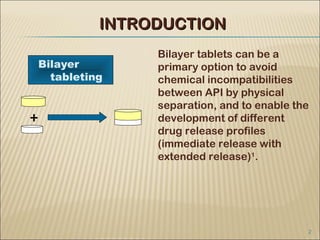
                   Bilayer tablets can be a
    Bilayer        primary option to avoid
      tableting    chemical incompatibilities
                   between API by physical
                   separation, and to enable the
+                  development of different
                   drug release profiles
                   (immediate release with
                   extended release)1.


                                               2
ADVANTAGES
   Release of both drugs starts immediately
   Combination of incompatible drugs2

Physical/chemical incompatibility can be prevented by physical
  separation of two drugs.
   Combination of different release profiles

Immediate release and sustained release profile can be achieved in
  single tablet by forming IR layer and SR layer.
   Reduced Pill Burden

By reducing individual dose of two drug due to their additive effect .
Example: Salbutamol + Theophylline


                                                                         3
Reduce the side effects Reduced by using one drug of the
combination for this purpose2.

Amiloride may prevent hypokalemia caused by
hydrochlorthiazide19, 20
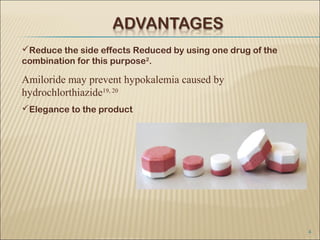
Elegance to the product


                                                            4
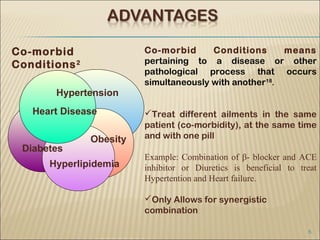
Co-morbid                Co-morbid      Conditions      means
Conditions 2             pertaining to a disease or other
                         pathological process that occurs
                         simultaneously with another18.
       Hypertension
   Heart Disease         Treat different ailments in the same
                         patient (co-morbidity), at the same time
               Obesity   and with one pill
 Diabetes
                         Example: Combination of β- blocker and ACE
      Hyperlipidemia     inhibitor or Diuretics is beneficial to treat
                         Hypertention and Heart failure.

                         Only Allows for synergistic
                         combination

                                                                   5
   Drug produces additive/synergistic effect
Anti- asthmatic: Salbutamol + Theophylline

   Drugs having opposite side effects, may reduce the side effect
Omeprazole + NSAIDS
Hydroclorothiazide + Amiloride

   Incompatible drugs

   Low biological half life (ideal for modified release bilayer)
   Unstable at intenstinal pH ( ideal for bilayer floating)
   High first pass metabolism with low biological half life (ideal for
    buccoadhesive bilayer)


                                                                          6
DIFFERENT TYPES
   Bilayer modified release tablet
Example:
Aceclofenac9 : NSAIDS, COX-2 inhibitor; t/2 = 3-4 hrs

Metoclopramide HCL + Ibuprofen13, 14:
Metoclopramide HCL is anti emetic; Given as immediate release
  dose and Ibuprofen is NSAID; given as SR dose, due to its low t/2
  (2 hrs).
This is widely used combination in treatment of migraine. It improve
  the absorbance of Ibuprofen, whose absorption is less due to
  gastric stasis10 especially in migraine.


                                                                   7
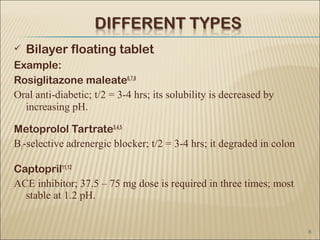
   Bilayer floating tablet
Example:
Rosiglitazone maleate6,7,8
Oral anti-diabetic; t/2 = 3-4 hrs; its solubility is decreased by
  increasing pH.

Metoprolol Tartrate3,4,5
Β1-selective adrenergic blocker; t/2 = 3-4 hrs; it degraded in colon

Captopril11,12
ACE inhibitor; 37.5 – 75 mg dose is required in three times; most
  stable at 1.2 pH.


                                                                       8
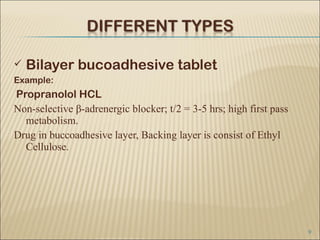
   Bilayer bucoadhesive tablet
Example:
Propranolol HCL
Non-selective β-adrenergic blocker; t/2 = 3-5 hrs; high first pass
  metabolism.
Drug in buccoadhesive layer, Backing layer is consist of Ethyl
  Cellulose.


                                                                     9
PRACTICAL PROBLEMS IN DEVELOPING
        BILAYER TABLETS

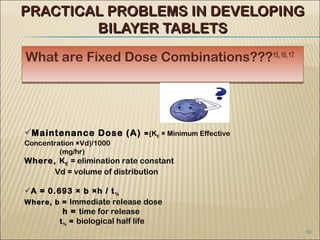
What are Fixed Dose Combinations???15, 16, 17
                                   15, 16, 17


Maintenance Dose (A) =(KE × Minimum Effective
Concentration ×Vd)/1000
         (mg/hr)
Where, KE = elimination rate constant
      Vd = volume of distribution

A = 0.693 × b ×h / t ½
Where, b = Immediate release dose
          h = time for release
        t ½ = biological half life
                                                 10
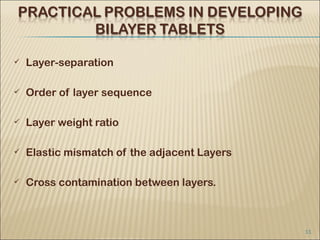
   Layer-separation

   Order of layer sequence

   Layer weight ratio

   Elastic mismatch of the adjacent Layers

   Cross contamination between layers.


                                              11
1.   Patel Mehul, et al; Challenges in the formulation of bilayered
     tablets: a review. IJPRD; Vol. 2; 2010, 30-42.
2.   Pharmaceutical Development with Focus
     on Paediatric formulations. WHO/FIP TRAINING WORKSHOP;28
     April 2008 – 2 May 2008.
3.   Hoffman BB. Catecholamines, sympathomimetics drugs, and
     adrenergic receptor antagonists. In: Hardman JG, Limbird LE,
     eds. Goodman and Gilman’s The Pharmacological Basis of
     Therapeutics. 10th ed. New York, NY: McGraw-Hill;
     2001:255Y256.
4.    Kendall MJ, Maxwell SR, Sandberg A, Westergren G. Controlled
     release metoprolol. Clinical pharmacokinetic and therapeutic
     implications. Clin Pharmacokinet. 1991;21:319Y330.
5.   Hwang SJ, Park H, Park K. Gastric retentive drug-delivery
     systems. Crit Rev Ther Drug Carrier Syst. 1998;15:243Y284.


                                                                  12
6.    J. E. F. Reynolds. Martindale-the extra Pharmacopoeia. Director
      of the Council of Royal Pharmaceutical Society of Great Britain,
      2005, 34: 345.
7.    G. K. McEvoy. AHFS Drug Information. Authority of the board of
      the American Society of the Health-System Pharmacists, 2004,
      3055-3058.
8.    M. C. Chapel Sky, K. Thompson-culkin, A. K. Miller, et al.
      Pharmacokinetics of rosiglitazone in patients with varying
      degrees of renal insuffi ciency. J. Clin. Pharmacol., 2003, 43:
      252-259.
9.    British Pharmacopoeia 2005 v1983ol-1. P.No:40 & http/www
      .medindia .net/doctors/drug-information/aceclofenac htm.
10.   http://en.wikipedia.org/wiki/Gastric_stasis


                                                                     13
11.   C. Dollery, Therapeutics Drugs, Churchill Livingstone, New York
      1999, pp. c38–c43.
12.   N. H. Anaizi and C. Swenson, Instability of captopril solution, Am.
      J. Hosp. Pharm. 50 (1993) 486–488.
13.   B. G. Wells, J. T. DiPiro, T. L. Schwinghammer, and C. W.
      Hamilton. Pharmacotherapy Handbook, McGraw-Hill, New York,
      2006, pp. 535–547.
14.   Bhavesh Shiyani, Surendra Gattani and Sanjay Surana.
      Formulation and Evaluation of Bi-layer Tablet of Metoclopramide
      Hydrochloride and Ibuprofen, AAPS PharmSciTech, Vol. 9, No. 3,
      September 2008, 818-827.
15.   Deelip Derle, Omkar Joshi, Ashish Pawar, Jatin Patel, Amol
      Jagadale; formulation and evaluation of buccoadhesive bi-layer
      tablet of propranolol hydrochloride. International Journal of
      Pharmacy and Pharmaceutical Sciences, Vol. 1, Issue 1, July-
      Sep. 2009; 206-212.


                                                                       14
16.   Gosh R., Modern concept in pharmacology and therapeutics, 24 th
      edition, Hilton and Co., p 761.
17.   Chong H. Choe, Selim S. Bouhaouala, Itzhak Brook, Thomas B.
      Elliott, Gregory B. Knudson. In Vitro development of resistance
      to Ofloxacin and doxycycline in Bacillus anthracis sterne,
      Antimicrobial agents and chemotherapy. June 2000; 44(6): 1766.
18.   Cedillo-Ramírez E, Villafuerte-Robles L, Hernandez-leon A Effect
      of added Pharmatose DCL11 on the sustained-release of
      metronidazole from Methocel K4M and Carbopol 971P NF
      floating matrices, Dev Ind Pharm 2001; 31(4): 200-208.
19.   http://medical-dictionary.thefreedictionary.com/comorbid
20.   http://congestive-heart-failure.emedtv.com/amiloride/side-
      effects-of-amiloride.html
21.   http://blood-pressure.emedtv.com/hydrochlorothiazide/side-
      effects-of-hydrochlorothiazide.html

                                                                     15
THANK
 YOU
        16

Bi layer tablet

  • 1.
  • 2.
    INTRODUCTION Bilayer tablets can be a Bilayer primary option to avoid tableting chemical incompatibilities between API by physical separation, and to enable the + development of different drug release profiles (immediate release with extended release)1. 2
  • 3.
    ADVANTAGES  Release of both drugs starts immediately  Combination of incompatible drugs2 Physical/chemical incompatibility can be prevented by physical separation of two drugs.  Combination of different release profiles Immediate release and sustained release profile can be achieved in single tablet by forming IR layer and SR layer.  Reduced Pill Burden By reducing individual dose of two drug due to their additive effect . Example: Salbutamol + Theophylline 3
  • 4.
    Reduce the sideeffects Reduced by using one drug of the combination for this purpose2. Amiloride may prevent hypokalemia caused by hydrochlorthiazide19, 20 Elegance to the product 4
  • 5.
    Co-morbid Co-morbid Conditions means Conditions 2 pertaining to a disease or other pathological process that occurs simultaneously with another18. Hypertension Heart Disease Treat different ailments in the same patient (co-morbidity), at the same time Obesity and with one pill Diabetes Example: Combination of β- blocker and ACE Hyperlipidemia inhibitor or Diuretics is beneficial to treat Hypertention and Heart failure. Only Allows for synergistic combination 5
  • 6.
    Drug produces additive/synergistic effect Anti- asthmatic: Salbutamol + Theophylline  Drugs having opposite side effects, may reduce the side effect Omeprazole + NSAIDS Hydroclorothiazide + Amiloride  Incompatible drugs  Low biological half life (ideal for modified release bilayer)  Unstable at intenstinal pH ( ideal for bilayer floating)  High first pass metabolism with low biological half life (ideal for buccoadhesive bilayer) 6
  • 7.
    DIFFERENT TYPES  Bilayer modified release tablet Example: Aceclofenac9 : NSAIDS, COX-2 inhibitor; t/2 = 3-4 hrs Metoclopramide HCL + Ibuprofen13, 14: Metoclopramide HCL is anti emetic; Given as immediate release dose and Ibuprofen is NSAID; given as SR dose, due to its low t/2 (2 hrs). This is widely used combination in treatment of migraine. It improve the absorbance of Ibuprofen, whose absorption is less due to gastric stasis10 especially in migraine. 7
  • 8.
    Bilayer floating tablet Example: Rosiglitazone maleate6,7,8 Oral anti-diabetic; t/2 = 3-4 hrs; its solubility is decreased by increasing pH. Metoprolol Tartrate3,4,5 Β1-selective adrenergic blocker; t/2 = 3-4 hrs; it degraded in colon Captopril11,12 ACE inhibitor; 37.5 – 75 mg dose is required in three times; most stable at 1.2 pH. 8
  • 9.
    Bilayer bucoadhesive tablet Example: Propranolol HCL Non-selective β-adrenergic blocker; t/2 = 3-5 hrs; high first pass metabolism. Drug in buccoadhesive layer, Backing layer is consist of Ethyl Cellulose. 9
  • 10.
    PRACTICAL PROBLEMS INDEVELOPING BILAYER TABLETS What are Fixed Dose Combinations???15, 16, 17 15, 16, 17 Maintenance Dose (A) =(KE × Minimum Effective Concentration ×Vd)/1000 (mg/hr) Where, KE = elimination rate constant Vd = volume of distribution A = 0.693 × b ×h / t ½ Where, b = Immediate release dose h = time for release t ½ = biological half life 10
  • 11.
    Layer-separation  Order of layer sequence  Layer weight ratio  Elastic mismatch of the adjacent Layers  Cross contamination between layers. 11
  • 12.
    1. Patel Mehul, et al; Challenges in the formulation of bilayered tablets: a review. IJPRD; Vol. 2; 2010, 30-42. 2. Pharmaceutical Development with Focus on Paediatric formulations. WHO/FIP TRAINING WORKSHOP;28 April 2008 – 2 May 2008. 3. Hoffman BB. Catecholamines, sympathomimetics drugs, and adrenergic receptor antagonists. In: Hardman JG, Limbird LE, eds. Goodman and Gilman’s The Pharmacological Basis of Therapeutics. 10th ed. New York, NY: McGraw-Hill; 2001:255Y256. 4. Kendall MJ, Maxwell SR, Sandberg A, Westergren G. Controlled release metoprolol. Clinical pharmacokinetic and therapeutic implications. Clin Pharmacokinet. 1991;21:319Y330. 5. Hwang SJ, Park H, Park K. Gastric retentive drug-delivery systems. Crit Rev Ther Drug Carrier Syst. 1998;15:243Y284. 12
  • 13.
    6. J. E. F. Reynolds. Martindale-the extra Pharmacopoeia. Director of the Council of Royal Pharmaceutical Society of Great Britain, 2005, 34: 345. 7. G. K. McEvoy. AHFS Drug Information. Authority of the board of the American Society of the Health-System Pharmacists, 2004, 3055-3058. 8. M. C. Chapel Sky, K. Thompson-culkin, A. K. Miller, et al. Pharmacokinetics of rosiglitazone in patients with varying degrees of renal insuffi ciency. J. Clin. Pharmacol., 2003, 43: 252-259. 9. British Pharmacopoeia 2005 v1983ol-1. P.No:40 & http/www .medindia .net/doctors/drug-information/aceclofenac htm. 10. http://en.wikipedia.org/wiki/Gastric_stasis 13
  • 14.
    11. C. Dollery, Therapeutics Drugs, Churchill Livingstone, New York 1999, pp. c38–c43. 12. N. H. Anaizi and C. Swenson, Instability of captopril solution, Am. J. Hosp. Pharm. 50 (1993) 486–488. 13. B. G. Wells, J. T. DiPiro, T. L. Schwinghammer, and C. W. Hamilton. Pharmacotherapy Handbook, McGraw-Hill, New York, 2006, pp. 535–547. 14. Bhavesh Shiyani, Surendra Gattani and Sanjay Surana. Formulation and Evaluation of Bi-layer Tablet of Metoclopramide Hydrochloride and Ibuprofen, AAPS PharmSciTech, Vol. 9, No. 3, September 2008, 818-827. 15. Deelip Derle, Omkar Joshi, Ashish Pawar, Jatin Patel, Amol Jagadale; formulation and evaluation of buccoadhesive bi-layer tablet of propranolol hydrochloride. International Journal of Pharmacy and Pharmaceutical Sciences, Vol. 1, Issue 1, July- Sep. 2009; 206-212. 14
  • 15.
    16. Gosh R., Modern concept in pharmacology and therapeutics, 24 th edition, Hilton and Co., p 761. 17. Chong H. Choe, Selim S. Bouhaouala, Itzhak Brook, Thomas B. Elliott, Gregory B. Knudson. In Vitro development of resistance to Ofloxacin and doxycycline in Bacillus anthracis sterne, Antimicrobial agents and chemotherapy. June 2000; 44(6): 1766. 18. Cedillo-Ramírez E, Villafuerte-Robles L, Hernandez-leon A Effect of added Pharmatose DCL11 on the sustained-release of metronidazole from Methocel K4M and Carbopol 971P NF floating matrices, Dev Ind Pharm 2001; 31(4): 200-208. 19. http://medical-dictionary.thefreedictionary.com/comorbid 20. http://congestive-heart-failure.emedtv.com/amiloride/side- effects-of-amiloride.html 21. http://blood-pressure.emedtv.com/hydrochlorothiazide/side- effects-of-hydrochlorothiazide.html 15
  • 16.