Boiler Mountings
Boiler mountings are the fittings, which are
mounted on the boiler for its proper and safe
functioning.
Some important boiler mountings are as follows:
1. Water Level indicator
2. Pressure gauge
3. Safety valves
4. Stop valve
5. Blow off cock
6. Feed check valve
7. Fusible plug
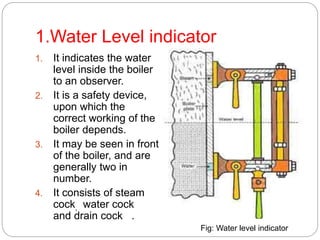
1.Water Level indicator
1. It indicates the water
level inside the boiler
to an observer.
2. It is a safety device,
upon which the
correct working of the
boiler depends.
3. It may be seen in front
of the boiler, and are
generally two in
number.
4. It consists of steam
cock, water cock
and drain cock .
Fig: Water level indicator
2.Pressure gauge
1. It is used to measure
the pressure of the
steam inside the steam
boiler.
2. It is fixed in front of the
steam boiler.
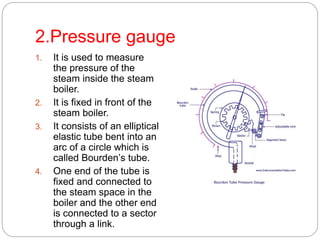
3. It consists of an elliptical
elastic tube bent into an
arc of a circle which is
called Bourden’s tube.
4. One end of the tube is
fixed and connected to
the steam space in the
boiler and the other end
is connected to a sector
through a link.
3. Safety valves
1. It is used to preventing explosions due to
excessive internal pressure of steam.
2. It’s function is to blow off the steam when the
pressure of steam inside the boiler exceeds the
working pressure.
3. There are four types of safety valves:
a. Lever safety valve
b. Dead weight safety valve
c. High steam and low water safety valve
d. Spring loaded safety valve
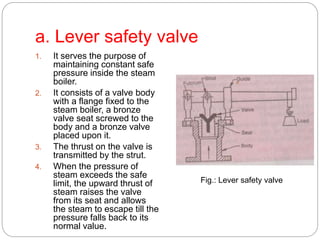
a. Lever safety valve
1. It serves the purpose of
maintaining constant safe
pressure inside the steam
boiler.
2. It consists of a valve body
with a flange fixed to the
steam boiler, a bronze
valve seat screwed to the
body and a bronze valve
placed upon it.
3. The thrust on the valve is
transmitted by the strut.
4. When the pressure of
steam exceeds the safe
limit, the upward thrust of
steam raises the valve
from its seat and allows
the steam to escape till the
pressure falls back to its
normal value.
Fig.: Lever safety valve
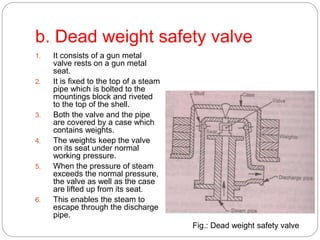
b. Dead weight safety valve
1. It consists of a gun metal
valve rests on a gun metal
seat.
2. It is fixed to the top of a steam
pipe which is bolted to the
mountings block and riveted
to the top of the shell.
3. Both the valve and the pipe
are covered by a case which
contains weights.
4. The weights keep the valve
on its seat under normal
working pressure.
5. When the pressure of steam
exceeds the normal pressure,
the valve as well as the case
are lifted up from its seat.
6. This enables the steam to
escape through the discharge
pipe.
Fig.: Dead weight safety valve
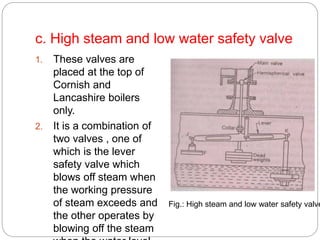
c. High steam and low water safety valve
1. These valves are
placed at the top of
Cornish and
Lancashire boilers
only.
2. It is a combination of
two valves , one of
which is the lever
safety valve which
blows off steam when
the working pressure
of steam exceeds and
the other operates by
blowing off the steam
Fig.: High steam and low water safety valve
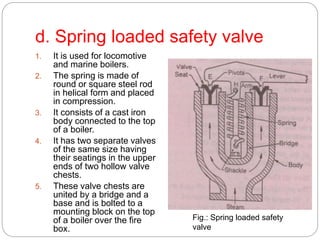
d. Spring loaded safety valve
1. It is used for locomotive
and marine boilers.
2. The spring is made of
round or square steel rod
in helical form and placed
in compression.
3. It consists of a cast iron
body connected to the top
of a boiler.
4. It has two separate valves
of the same size having
their seatings in the upper
ends of two hollow valve
chests.
5. These valve chests are
united by a bridge and a
base and is bolted to a
mounting block on the top
of a boiler over the fire
box.
Fig.: Spring loaded safety
valve
4. Steam Stop Valve
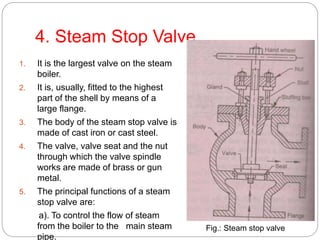
1. It is the largest valve on the steam
boiler.
2. It is, usually, fitted to the highest
part of the shell by means of a
large flange.
3. The body of the steam stop valve is
made of cast iron or cast steel.
4. The valve, valve seat and the nut
through which the valve spindle
works are made of brass or gun
metal.
5. The principal functions of a steam
stop valve are:
a). To control the flow of steam
from the boiler to the main steam
pipe.
Fig.: Steam stop valve
5. Blow off Cock
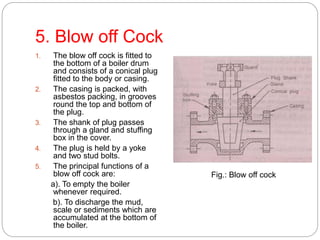
1. The blow off cock is fitted to
the bottom of a boiler drum
and consists of a conical plug
fitted to the body or casing.
2. The casing is packed, with
asbestos packing, in grooves
round the top and bottom of
the plug.
3. The shank of plug passes
through a gland and stuffing
box in the cover.
4. The plug is held by a yoke
and two stud bolts.
5. The principal functions of a
blow off cock are:
a). To empty the boiler
whenever required.
b). To discharge the mud,
scale or sediments which are
accumulated at the bottom of
the boiler.
Fig.: Blow off cock
6. Feed Check Valve
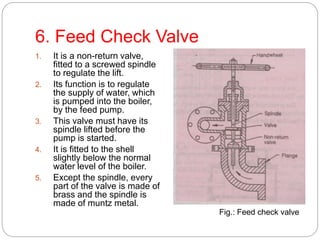
1. It is a non-return valve,
fitted to a screwed spindle
to regulate the lift.
2. Its function is to regulate
the supply of water, which
is pumped into the boiler,
by the feed pump.
3. This valve must have its
spindle lifted before the
pump is started.
4. It is fitted to the shell
slightly below the normal
water level of the boiler.
5. Except the spindle, every
part of the valve is made of
brass and the spindle is
made of muntz metal.
Fig.: Feed check valve
7. Fusible Plug
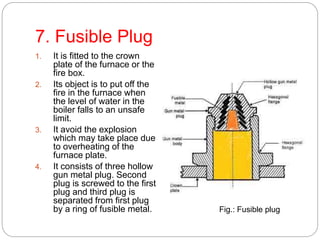
1. It is fitted to the crown
plate of the furnace or the
fire box.
2. Its object is to put off the
fire in the furnace when
the level of water in the
boiler falls to an unsafe
limit.
3. It avoid the explosion
which may take place due
to overheating of the
furnace plate.
4. It consists of three hollow
gun metal plug. Second
plug is screwed to the first
plug and third plug is
separated from first plug
by a ring of fusible metal. Fig.: Fusible plug
Boiler Accessories
These are the devices which are used as integral parts
of a boiler and help in running efficiently. Though
there are many types of accessories, yet the following
are important from the subject point of view:
1. Feed pump
2. Super heater
3. Economiser
4. Air pre heater
1.Feed Pump
1. Water in a boiler is
continuously converted into
steam, so a feed pump is
need to deliver water to the
boiler.
2. The pressure of steam inside
a boiler is high, so the
pressure of feed water has to
be increased proportionately
before it is made to enter the
boiler. Generally, the pressure
of feed water is 20% more
than that in the boiler.
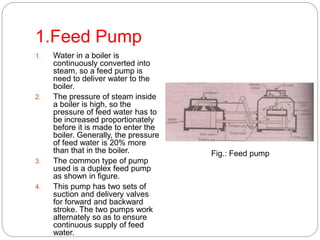
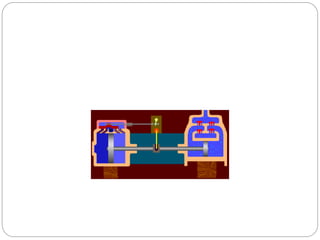
3. The common type of pump
used is a duplex feed pump
as shown in figure.
4. This pump has two sets of
suction and delivery valves
for forward and backward
stroke. The two pumps work
alternately so as to ensure
continuous supply of feed
water.
Fig.: Feed pump
2. Super heater
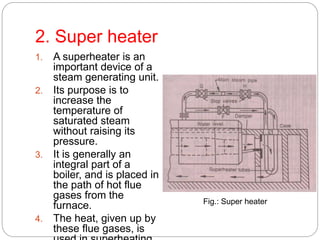
1. A superheater is an
important device of a
steam generating unit.
2. Its purpose is to
increase the
temperature of
saturated steam
without raising its
pressure.
3. It is generally an
integral part of a
boiler, and is placed in
the path of hot flue
gases from the
furnace.
4. The heat, given up by
these flue gases, is
Fig.: Super heater
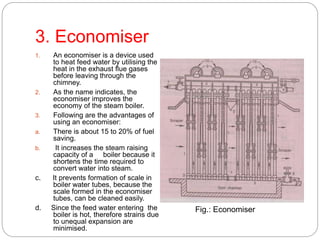
3. Economiser
1. An economiser is a device used
to heat feed water by utilising the
heat in the exhaust flue gases
before leaving through the
chimney.
2. As the name indicates, the
economiser improves the
economy of the steam boiler.
3. Following are the advantages of
using an economiser:
a. There is about 15 to 20% of fuel
saving.
b. It increases the steam raising
capacity of a boiler because it
shortens the time required to
convert water into steam.
c. It prevents formation of scale in
boiler water tubes, because the
scale formed in the economiser
tubes, can be cleaned easily.
d. Since the feed water entering the
boiler is hot, therefore strains due
to unequal expansion are
minimised.
Fig.: Economiser
4. Air Preheater
1. An air preheater is used to recover heat from the exhaust flue
gases.
2. It is installed between the economiser and the chimney.
3. The air required for the purpose of combustion is drawn
through the air preheater where its temperature is raised.
4. It is then passed through ducts to the furnace.
5. The air is passed through the tubes of the heater internally
while the hot flue gases are passed over the outside of the
tubes.
6. Following are the advantages obtained by using an air
preheater:
a. The preheated air gives higher furnace temperature which
results in more heat transfer to the water and thus increases
the evaporative capacity per kg of fuel.
b. There is an increase of about 2% in the boiler efficiency for
each 35-40 C rise in temperature of air.
c. It results in better combustion with less soot, smoke and ash.
d. It enables a low grade fuel to be burnt with less excess air.
boiler mountings & Accessories

boiler mountings & Accessories

  • 1.
    Boiler Mountings Boiler mountingsare the fittings, which are mounted on the boiler for its proper and safe functioning. Some important boiler mountings are as follows: 1. Water Level indicator 2. Pressure gauge 3. Safety valves 4. Stop valve 5. Blow off cock 6. Feed check valve 7. Fusible plug
  • 2.
    1.Water Level indicator 1.It indicates the water level inside the boiler to an observer. 2. It is a safety device, upon which the correct working of the boiler depends. 3. It may be seen in front of the boiler, and are generally two in number. 4. It consists of steam cock, water cock and drain cock . Fig: Water level indicator
  • 3.
    2.Pressure gauge 1. Itis used to measure the pressure of the steam inside the steam boiler. 2. It is fixed in front of the steam boiler. 3. It consists of an elliptical elastic tube bent into an arc of a circle which is called Bourden’s tube. 4. One end of the tube is fixed and connected to the steam space in the boiler and the other end is connected to a sector through a link.
  • 4.
    3. Safety valves 1.It is used to preventing explosions due to excessive internal pressure of steam. 2. It’s function is to blow off the steam when the pressure of steam inside the boiler exceeds the working pressure. 3. There are four types of safety valves: a. Lever safety valve b. Dead weight safety valve c. High steam and low water safety valve d. Spring loaded safety valve
  • 5.
    a. Lever safetyvalve 1. It serves the purpose of maintaining constant safe pressure inside the steam boiler. 2. It consists of a valve body with a flange fixed to the steam boiler, a bronze valve seat screwed to the body and a bronze valve placed upon it. 3. The thrust on the valve is transmitted by the strut. 4. When the pressure of steam exceeds the safe limit, the upward thrust of steam raises the valve from its seat and allows the steam to escape till the pressure falls back to its normal value. Fig.: Lever safety valve
  • 6.
    b. Dead weightsafety valve 1. It consists of a gun metal valve rests on a gun metal seat. 2. It is fixed to the top of a steam pipe which is bolted to the mountings block and riveted to the top of the shell. 3. Both the valve and the pipe are covered by a case which contains weights. 4. The weights keep the valve on its seat under normal working pressure. 5. When the pressure of steam exceeds the normal pressure, the valve as well as the case are lifted up from its seat. 6. This enables the steam to escape through the discharge pipe. Fig.: Dead weight safety valve
  • 7.
    c. High steamand low water safety valve 1. These valves are placed at the top of Cornish and Lancashire boilers only. 2. It is a combination of two valves , one of which is the lever safety valve which blows off steam when the working pressure of steam exceeds and the other operates by blowing off the steam Fig.: High steam and low water safety valve
  • 8.
    d. Spring loadedsafety valve 1. It is used for locomotive and marine boilers. 2. The spring is made of round or square steel rod in helical form and placed in compression. 3. It consists of a cast iron body connected to the top of a boiler. 4. It has two separate valves of the same size having their seatings in the upper ends of two hollow valve chests. 5. These valve chests are united by a bridge and a base and is bolted to a mounting block on the top of a boiler over the fire box. Fig.: Spring loaded safety valve
  • 9.
    4. Steam StopValve 1. It is the largest valve on the steam boiler. 2. It is, usually, fitted to the highest part of the shell by means of a large flange. 3. The body of the steam stop valve is made of cast iron or cast steel. 4. The valve, valve seat and the nut through which the valve spindle works are made of brass or gun metal. 5. The principal functions of a steam stop valve are: a). To control the flow of steam from the boiler to the main steam pipe. Fig.: Steam stop valve
  • 10.
    5. Blow offCock 1. The blow off cock is fitted to the bottom of a boiler drum and consists of a conical plug fitted to the body or casing. 2. The casing is packed, with asbestos packing, in grooves round the top and bottom of the plug. 3. The shank of plug passes through a gland and stuffing box in the cover. 4. The plug is held by a yoke and two stud bolts. 5. The principal functions of a blow off cock are: a). To empty the boiler whenever required. b). To discharge the mud, scale or sediments which are accumulated at the bottom of the boiler. Fig.: Blow off cock
  • 11.
    6. Feed CheckValve 1. It is a non-return valve, fitted to a screwed spindle to regulate the lift. 2. Its function is to regulate the supply of water, which is pumped into the boiler, by the feed pump. 3. This valve must have its spindle lifted before the pump is started. 4. It is fitted to the shell slightly below the normal water level of the boiler. 5. Except the spindle, every part of the valve is made of brass and the spindle is made of muntz metal. Fig.: Feed check valve
  • 12.
    7. Fusible Plug 1.It is fitted to the crown plate of the furnace or the fire box. 2. Its object is to put off the fire in the furnace when the level of water in the boiler falls to an unsafe limit. 3. It avoid the explosion which may take place due to overheating of the furnace plate. 4. It consists of three hollow gun metal plug. Second plug is screwed to the first plug and third plug is separated from first plug by a ring of fusible metal. Fig.: Fusible plug
  • 13.
    Boiler Accessories These arethe devices which are used as integral parts of a boiler and help in running efficiently. Though there are many types of accessories, yet the following are important from the subject point of view: 1. Feed pump 2. Super heater 3. Economiser 4. Air pre heater
  • 14.
    1.Feed Pump 1. Waterin a boiler is continuously converted into steam, so a feed pump is need to deliver water to the boiler. 2. The pressure of steam inside a boiler is high, so the pressure of feed water has to be increased proportionately before it is made to enter the boiler. Generally, the pressure of feed water is 20% more than that in the boiler. 3. The common type of pump used is a duplex feed pump as shown in figure. 4. This pump has two sets of suction and delivery valves for forward and backward stroke. The two pumps work alternately so as to ensure continuous supply of feed water. Fig.: Feed pump
  • 16.
    2. Super heater 1.A superheater is an important device of a steam generating unit. 2. Its purpose is to increase the temperature of saturated steam without raising its pressure. 3. It is generally an integral part of a boiler, and is placed in the path of hot flue gases from the furnace. 4. The heat, given up by these flue gases, is Fig.: Super heater
  • 17.
    3. Economiser 1. Aneconomiser is a device used to heat feed water by utilising the heat in the exhaust flue gases before leaving through the chimney. 2. As the name indicates, the economiser improves the economy of the steam boiler. 3. Following are the advantages of using an economiser: a. There is about 15 to 20% of fuel saving. b. It increases the steam raising capacity of a boiler because it shortens the time required to convert water into steam. c. It prevents formation of scale in boiler water tubes, because the scale formed in the economiser tubes, can be cleaned easily. d. Since the feed water entering the boiler is hot, therefore strains due to unequal expansion are minimised. Fig.: Economiser
  • 18.
    4. Air Preheater 1.An air preheater is used to recover heat from the exhaust flue gases. 2. It is installed between the economiser and the chimney. 3. The air required for the purpose of combustion is drawn through the air preheater where its temperature is raised. 4. It is then passed through ducts to the furnace. 5. The air is passed through the tubes of the heater internally while the hot flue gases are passed over the outside of the tubes. 6. Following are the advantages obtained by using an air preheater: a. The preheated air gives higher furnace temperature which results in more heat transfer to the water and thus increases the evaporative capacity per kg of fuel. b. There is an increase of about 2% in the boiler efficiency for each 35-40 C rise in temperature of air. c. It results in better combustion with less soot, smoke and ash. d. It enables a low grade fuel to be burnt with less excess air.