Beyond 
Competence? 
Ethical Leadership
“Not everything that 
counts can be counted, 
and not everything that 
can be counted counts” 
(Bruce Cameron)
Define Ethics 
Differentiate between 
Principle Based and 
Utilitarian approaches. 
Debate ‘applied ethics’ and 
decision making around 
ethical dilemmas. 
Synthesize ethics with 
other leadership theory.
Before we begin: A point for debate 
1. How useful are ‘standards criterion’ at 
promoting expected practice, or do they 
promote ‘competence’? 
2. Is ‘competence’ good enough’? 
3. Do leaders have to ‘be’ and behave in ways 
that are somehow ‘beyond these standards’? 
4. Can leadership be enhanced by a clear 
understanding of ethical leadership and 
improved self-efficacy?
Darley’s law – ‘Play’ the system? 
Darley states, a person with the best will in the 
world, does what optimizes his or her performance 
measurements, without realizing that this is not 
what the system intended” (1994:18-19). 
A standard-based system can have another, more 
ethically questionable and destructive side effect. 
Individuals faced with an established standard may 
cheat the system by exploiting its weaknesses. 
(Source: Bazerman et al, 1997)
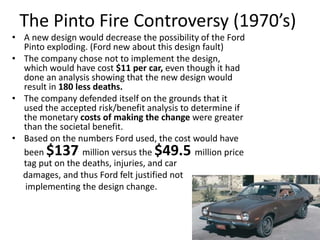
The Pinto Fire Controversy (1970’s) 
• A new design would decrease the possibility of the Ford 
Pinto exploding. (Ford new about this design fault) 
• The company chose not to implement the design, 
which would have cost $11 per car, even though it had 
done an analysis showing that the new design would 
result in 180 less deaths. 
• The company defended itself on the grounds that it 
used the accepted risk/benefit analysis to determine if 
the monetary costs of making the change were greater 
than the societal benefit. 
• Based on the numbers Ford used, the cost would have 
been $137 million versus the $49.5 million price 
tag put on the deaths, injuries, and car 
damages, and thus Ford felt justified not 
implementing the design change.
What are ethics? 
• Is a derivative of the Greek word ethos, 
meaning customs, conduct, or character 
• Is concerned with the kinds of values and 
morals an individual or society ascribes as 
desirable or appropriate 
• Focuses on the virtuousness of individuals and 
their motives
A Dictionary Definition 
• 1. a system of moral principles: the ethics of a culture. 
• 2. the rules of conduct recognized in respect to a 
particular class of human actions or a particular group, 
culture, etc.: medical ethics; Christian ethics. 
• 3. moral principles, as of an individual: His ethics 
forbade betrayal of a confidence. 
• 4. (usually used with a singular verb ) that branch of 
philosophy dealing with values relating to human 
conduct, with respect to the rightness and wrongness 
of certain actions and to the goodness and badness of 
the motives and ends of such actions.
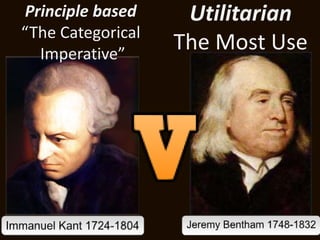
Principle based 
“The Categorical 
Imperative” 
Utilitarian 
The Most Use
Principle based (Kantian) 
3 Minute Philosophy: Deontological 
• Duty-based or Deontological ethics The word 
'deontological' comes from the Greek word deon, which 
means 'duty'. 
• Deontological (duty-based) ethics are concerned with what 
people do, not with the consequences of their actions. 
• Do the right thing: Do it because it's the right thing to do. 
• Don't do wrong things: Avoid them because they are 
wrong. 
• Under this form of ethics you can't justify an action by 
showing that it produced good consequences, which is why 
it's sometimes called 'non-Consequentialist'.
Utilitarian (Teleological) 
3 Minute Philosophy: Utilitarianism 
• Consequentialist theory: the ends justify the 
means. 
• Humans have 2 masters (motivations) 
• 1. Humans seek happiness 
• 2. Humans avoid pain. 
• Therefore, we should maximise happiness and 
minimise pain.
What are applied ethics? 
• Applied ethics is distinguished 
from normative ethics, (see 
earlier slides) which concerns 
what people should believe to be 
right and wrong, and from meta-ethics, 
which concerns the nature 
of moral statements. 
• Require a decision to be made in 
a contentious context. 
• Require contexts to be realistic.
Ethical Dilemmas 
• Trolley Dilemma 
• Prisoner’s Dilemma 
• Two friends out for a drink (my example). 
• Cheating Partner (my example). 
• Worthy Donation (my example).
Leadership Ethics 
• Has to do with what leaders do and who leaders are 
• It is concerned with the nature of the leaders’ 
behaviour and their virtuousness 
• In any decision-making situation, ethical issues are 
either implicitly or explicitly involved 
• What choices leaders make and how they respond 
in a particular circumstance are informed and 
directed by their ethics
Principles of Ethical Leadership 
Honest leaders are authentic but also sensitive 
to the feelings and attitudes of others 
Leaders: 
– Are not deceptive 
– Tell the truth with a 
balance of openness and 
candor while monitoring 
what is appropriate to 
disclose in a particular 
situation 
Leader behaviors 
– Don’t promise what you can’t deliver 
– Don’t suppress obligations 
– Don’t evade accountability 
– Don’t accept “survival of the fittest” 
pressures 
– Acknowledge and reward honest 
behavior in the organization
Application 
• Can be applied to individuals at all levels of organization and 
in all walks of life 
• Because leadership has a moral dimension, being a leader 
demands awareness on our part of the way our ethics defines 
our leadership 
• Managers and leaders can use information on ethics to 
understand themselves and strengthen their own leadership 
• Leaders can use ethical principles as benchmarks for their 
own behavior 
• Leaders can learn that leader-follower relationship is central 
to ethical leadership
Centrality of Ethics to Leadership 
• Influence dimension of leadership requires the 
leader to have an impact on the lives of followers 
• Power and control differences create enormous 
ethical responsibility for leader’s 
• Respect for persons – sensitive to followers’ own 
interests, and needs 
• Leaders help to establish and reinforce 
organizational values – an ethical climate
• Teleological Theories: focus on consequences of 
leaders’ actions, results 
– Ethical egoism (create greatest good for the leader) 
• Closely related to transactional leadership theories 
• Example: leader takes a political stand on an issue for no other 
reason than to get re-elected 
– Utilitarianism (create greatest good for greatest number) 
• Example: leader distributes scarce resources so as to maximize 
benefit to everyone, while hurting the fewest; preventive 
healthcare vs. catastrophic illnesses 
– Altruism (show concern for best interests of others) 
• Authentic transformational leadership is based on altruistic 
principles 
– Example: the work of Mother Theresa, who gave her entire life 
to help the poor
Ethical Theories 
CHARACTER 
• Virtue-based Theories: about leader’s 
character 
– Focus on who people are as people 
• Rather than tell people what to do, tell people what 
to be 
• Help people become more virtuous through training 
and development 
• Virtues present within person’s disposition, and 
practice makes good values habitual 
– Examples: courage, honesty, fairness, justice, integrity, 
humility
Pitfalls in Ethical Decision Making 
1. The false-necessity trap (convincing yourself that no 
other choice exists) 
2. The doctrine-of-relative-filth trap (comparing your 
unethical behaviour with someone else’s even more 
unethical behaviour) 
3. The rationalization trap (justifying unethical actions 
with excuses) 
4. The self-deception trap (persuading yourself, for 
example, that a lie is not really a lie) 
5. The ends-justify-the-means trap (using unethical 
methods to accomplish a desirable goal)
Organizational Ethical Trap: Darley’s 
Law (again) beyond competence? 
• Performance measurement systems can 
incentivise unethical behaviour 
• Cheating/lying – to protect or advance self 
• Cheating/lying – to protect or advance 
organization (“cooking the books”) 
• Sub-optimization - Optimize metrics 
to detriment of overall organization
Framework for Identifying and 
Resolving Ethical Issues (source: Dunn & Bradstreet) 
1. Why is this bothering me? 
– Am I genuinely perplexed? 
– Am I afraid to do what I know is 
right? 
2. Who else matters? 
– Implications for customers, 
peers shareholders? 
– How does the problem appear 
from the other side? 
3. Is it my responsibility? 
– What will happen if I do/ don’t 
act? 
4. What is the ethical concern? 
– Legal obligation? 
– Honesty, fairness, promise-keeping, 
avoiding harm? 
5. Whom can give me advice? 
– Supervisor, peers, HR, legal, ethics 
hot line? 
6. Am I being true to myself? 
– Consistency with my values and 
personal commitments? With 
company values? 
– Can I share my decision with family, 
colleagues, customers? 
– Can I see my decision on the front 
page of the newspaper?
Conclusions Part 1 
• As a leader (and practitioner!) You will often need 
to make decisions without someone, ‘telling you 
what to do’. 
• On what basis do you make these decisions? 
• Most if not all decision making involves 
considering ‘options’. 
• Ultimately, one option is selected and other 
options are rejected, then acted upon. 
• The selection and rejection of options is 
influenced by values.
Conclusions Part 2 
• Hence, all decision making is value based or 
ethical at some level. 
• Ethical dilemmas are able to starkly 
demonstrate these ethical components. 
• Identifying the ethical component within ‘day 
to day’ decision making can be a more tricky 
business – perhaps REFLECTION can help?

Beyond competence ethical leadership

  • 1.
  • 2.
    “Not everything that counts can be counted, and not everything that can be counted counts” (Bruce Cameron)
  • 3.
    Define Ethics Differentiatebetween Principle Based and Utilitarian approaches. Debate ‘applied ethics’ and decision making around ethical dilemmas. Synthesize ethics with other leadership theory.
  • 4.
    Before we begin:A point for debate 1. How useful are ‘standards criterion’ at promoting expected practice, or do they promote ‘competence’? 2. Is ‘competence’ good enough’? 3. Do leaders have to ‘be’ and behave in ways that are somehow ‘beyond these standards’? 4. Can leadership be enhanced by a clear understanding of ethical leadership and improved self-efficacy?
  • 5.
    Darley’s law –‘Play’ the system? Darley states, a person with the best will in the world, does what optimizes his or her performance measurements, without realizing that this is not what the system intended” (1994:18-19). A standard-based system can have another, more ethically questionable and destructive side effect. Individuals faced with an established standard may cheat the system by exploiting its weaknesses. (Source: Bazerman et al, 1997)
  • 6.
    The Pinto FireControversy (1970’s) • A new design would decrease the possibility of the Ford Pinto exploding. (Ford new about this design fault) • The company chose not to implement the design, which would have cost $11 per car, even though it had done an analysis showing that the new design would result in 180 less deaths. • The company defended itself on the grounds that it used the accepted risk/benefit analysis to determine if the monetary costs of making the change were greater than the societal benefit. • Based on the numbers Ford used, the cost would have been $137 million versus the $49.5 million price tag put on the deaths, injuries, and car damages, and thus Ford felt justified not implementing the design change.
  • 7.
    What are ethics? • Is a derivative of the Greek word ethos, meaning customs, conduct, or character • Is concerned with the kinds of values and morals an individual or society ascribes as desirable or appropriate • Focuses on the virtuousness of individuals and their motives
  • 8.
    A Dictionary Definition • 1. a system of moral principles: the ethics of a culture. • 2. the rules of conduct recognized in respect to a particular class of human actions or a particular group, culture, etc.: medical ethics; Christian ethics. • 3. moral principles, as of an individual: His ethics forbade betrayal of a confidence. • 4. (usually used with a singular verb ) that branch of philosophy dealing with values relating to human conduct, with respect to the rightness and wrongness of certain actions and to the goodness and badness of the motives and ends of such actions.
  • 9.
    Principle based “TheCategorical Imperative” Utilitarian The Most Use
  • 10.
    Principle based (Kantian) 3 Minute Philosophy: Deontological • Duty-based or Deontological ethics The word 'deontological' comes from the Greek word deon, which means 'duty'. • Deontological (duty-based) ethics are concerned with what people do, not with the consequences of their actions. • Do the right thing: Do it because it's the right thing to do. • Don't do wrong things: Avoid them because they are wrong. • Under this form of ethics you can't justify an action by showing that it produced good consequences, which is why it's sometimes called 'non-Consequentialist'.
  • 11.
    Utilitarian (Teleological) 3Minute Philosophy: Utilitarianism • Consequentialist theory: the ends justify the means. • Humans have 2 masters (motivations) • 1. Humans seek happiness • 2. Humans avoid pain. • Therefore, we should maximise happiness and minimise pain.
  • 12.
    What are appliedethics? • Applied ethics is distinguished from normative ethics, (see earlier slides) which concerns what people should believe to be right and wrong, and from meta-ethics, which concerns the nature of moral statements. • Require a decision to be made in a contentious context. • Require contexts to be realistic.
  • 13.
    Ethical Dilemmas •Trolley Dilemma • Prisoner’s Dilemma • Two friends out for a drink (my example). • Cheating Partner (my example). • Worthy Donation (my example).
  • 14.
    Leadership Ethics •Has to do with what leaders do and who leaders are • It is concerned with the nature of the leaders’ behaviour and their virtuousness • In any decision-making situation, ethical issues are either implicitly or explicitly involved • What choices leaders make and how they respond in a particular circumstance are informed and directed by their ethics
  • 15.
    Principles of EthicalLeadership Honest leaders are authentic but also sensitive to the feelings and attitudes of others Leaders: – Are not deceptive – Tell the truth with a balance of openness and candor while monitoring what is appropriate to disclose in a particular situation Leader behaviors – Don’t promise what you can’t deliver – Don’t suppress obligations – Don’t evade accountability – Don’t accept “survival of the fittest” pressures – Acknowledge and reward honest behavior in the organization
  • 16.
    Application • Canbe applied to individuals at all levels of organization and in all walks of life • Because leadership has a moral dimension, being a leader demands awareness on our part of the way our ethics defines our leadership • Managers and leaders can use information on ethics to understand themselves and strengthen their own leadership • Leaders can use ethical principles as benchmarks for their own behavior • Leaders can learn that leader-follower relationship is central to ethical leadership
  • 17.
    Centrality of Ethicsto Leadership • Influence dimension of leadership requires the leader to have an impact on the lives of followers • Power and control differences create enormous ethical responsibility for leader’s • Respect for persons – sensitive to followers’ own interests, and needs • Leaders help to establish and reinforce organizational values – an ethical climate
  • 18.
    • Teleological Theories:focus on consequences of leaders’ actions, results – Ethical egoism (create greatest good for the leader) • Closely related to transactional leadership theories • Example: leader takes a political stand on an issue for no other reason than to get re-elected – Utilitarianism (create greatest good for greatest number) • Example: leader distributes scarce resources so as to maximize benefit to everyone, while hurting the fewest; preventive healthcare vs. catastrophic illnesses – Altruism (show concern for best interests of others) • Authentic transformational leadership is based on altruistic principles – Example: the work of Mother Theresa, who gave her entire life to help the poor
  • 19.
    Ethical Theories CHARACTER • Virtue-based Theories: about leader’s character – Focus on who people are as people • Rather than tell people what to do, tell people what to be • Help people become more virtuous through training and development • Virtues present within person’s disposition, and practice makes good values habitual – Examples: courage, honesty, fairness, justice, integrity, humility
  • 20.
    Pitfalls in EthicalDecision Making 1. The false-necessity trap (convincing yourself that no other choice exists) 2. The doctrine-of-relative-filth trap (comparing your unethical behaviour with someone else’s even more unethical behaviour) 3. The rationalization trap (justifying unethical actions with excuses) 4. The self-deception trap (persuading yourself, for example, that a lie is not really a lie) 5. The ends-justify-the-means trap (using unethical methods to accomplish a desirable goal)
  • 21.
    Organizational Ethical Trap:Darley’s Law (again) beyond competence? • Performance measurement systems can incentivise unethical behaviour • Cheating/lying – to protect or advance self • Cheating/lying – to protect or advance organization (“cooking the books”) • Sub-optimization - Optimize metrics to detriment of overall organization
  • 22.
    Framework for Identifyingand Resolving Ethical Issues (source: Dunn & Bradstreet) 1. Why is this bothering me? – Am I genuinely perplexed? – Am I afraid to do what I know is right? 2. Who else matters? – Implications for customers, peers shareholders? – How does the problem appear from the other side? 3. Is it my responsibility? – What will happen if I do/ don’t act? 4. What is the ethical concern? – Legal obligation? – Honesty, fairness, promise-keeping, avoiding harm? 5. Whom can give me advice? – Supervisor, peers, HR, legal, ethics hot line? 6. Am I being true to myself? – Consistency with my values and personal commitments? With company values? – Can I share my decision with family, colleagues, customers? – Can I see my decision on the front page of the newspaper?
  • 23.
    Conclusions Part 1 • As a leader (and practitioner!) You will often need to make decisions without someone, ‘telling you what to do’. • On what basis do you make these decisions? • Most if not all decision making involves considering ‘options’. • Ultimately, one option is selected and other options are rejected, then acted upon. • The selection and rejection of options is influenced by values.
  • 24.
    Conclusions Part 2 • Hence, all decision making is value based or ethical at some level. • Ethical dilemmas are able to starkly demonstrate these ethical components. • Identifying the ethical component within ‘day to day’ decision making can be a more tricky business – perhaps REFLECTION can help?