Theory of Work
Adjustment

                Jenny Dominguez
      University of Saint Thomas
                     EDUC 5359
Development
 The Theory of Work Adjustment (TWA)
  developed in two phases during the
  1960s and 1970s.
 During the 1960s, Lloyd H. Lofquist and
  Rene V. Dawis, University of Minnesota
  psychologists, formulated a trait-and-
  factor matching model and in
  collaboration with David J. Weiss
  developed instruments to measure the
  major constructs introduced by the
  theory (Eggerth & Tinsley, 2008).
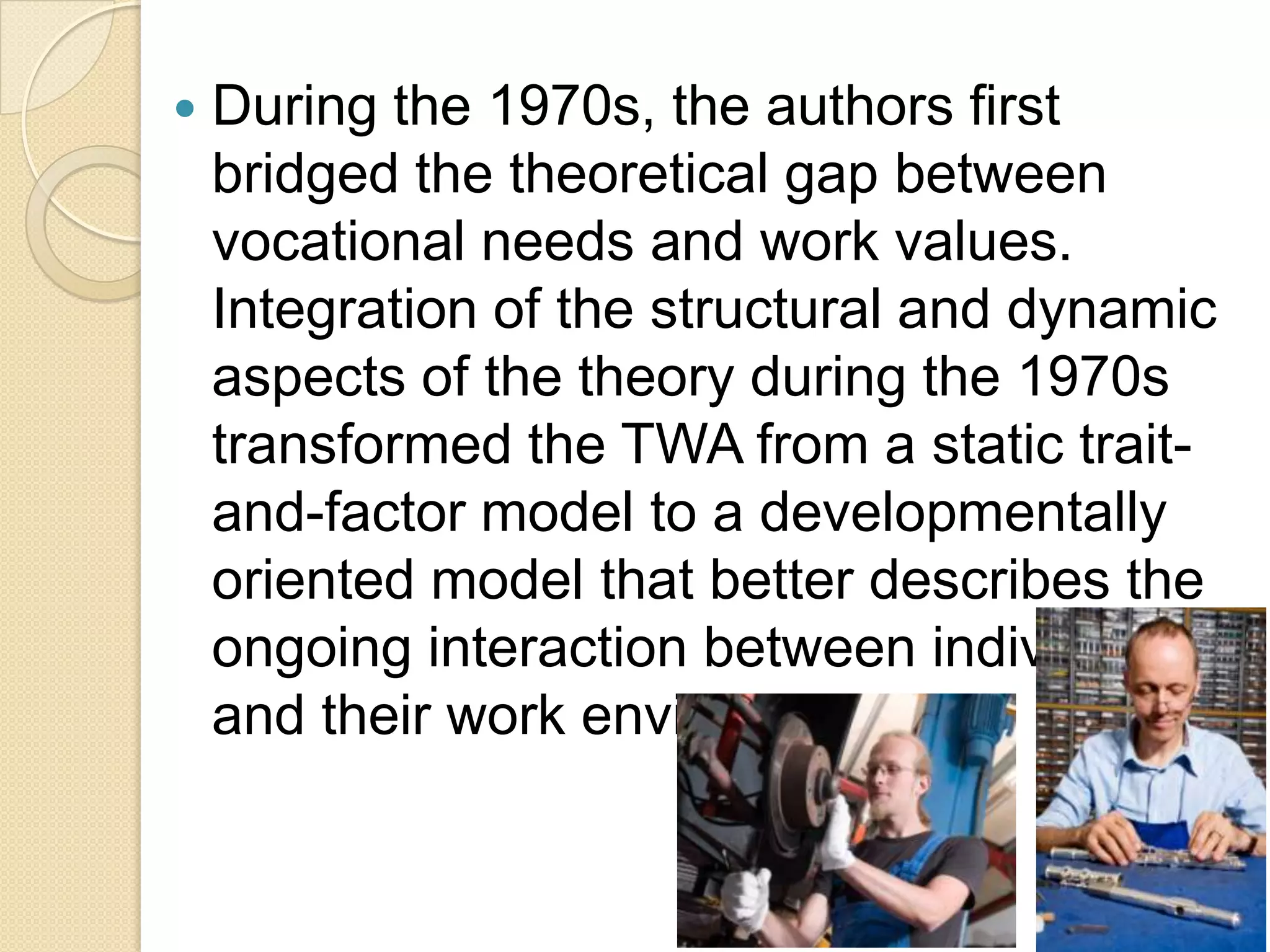
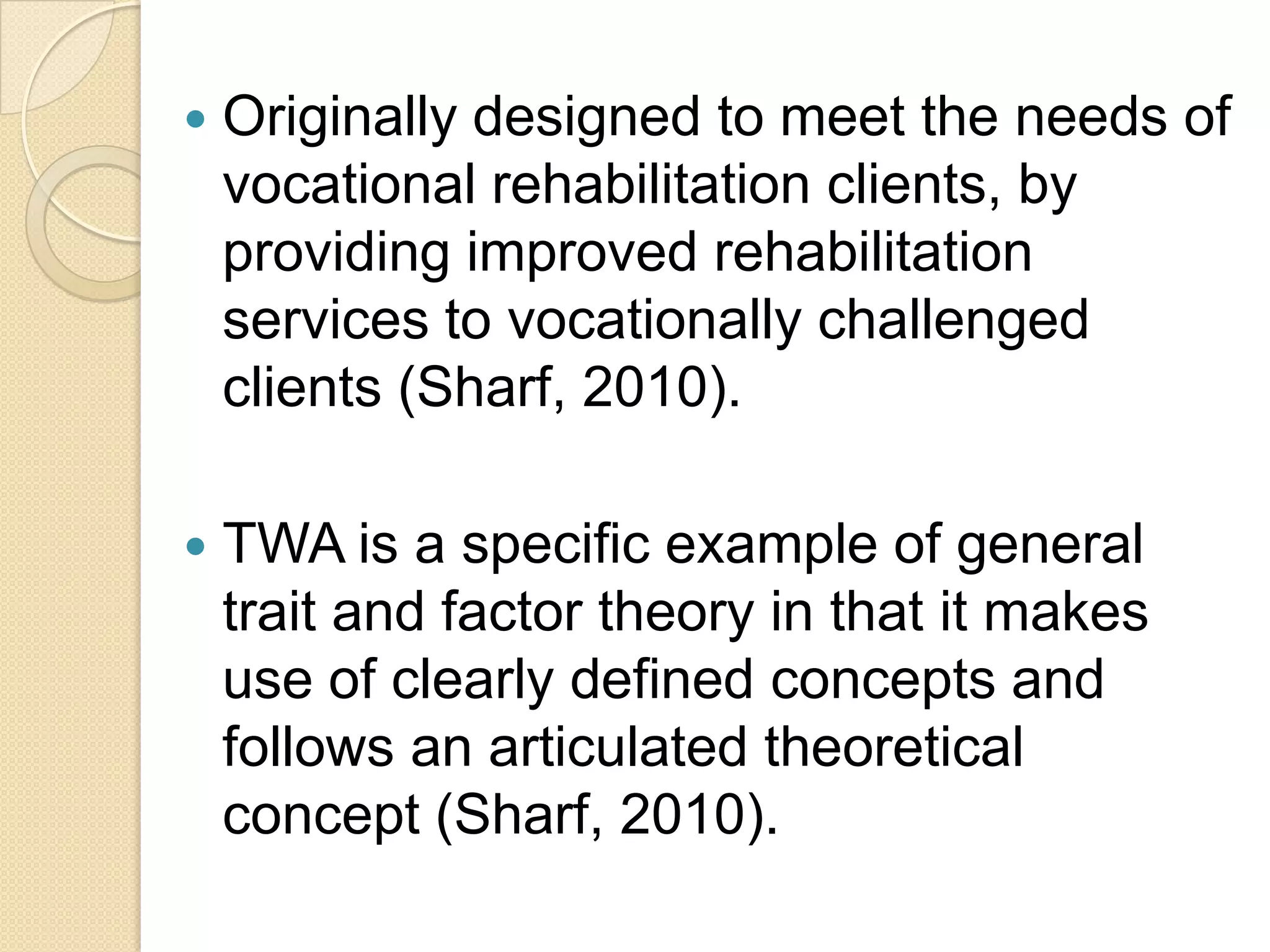
   During the 1970s, the authors first
    bridged the theoretical gap between
    vocational needs and work values.
    Integration of the structural and dynamic
    aspects of the theory during the 1970s
    transformed the TWA from a static trait-
    and-factor model to a developmentally
    oriented model that better describes the
    ongoing interaction between individuals
    and their work environments.
   Originally designed to meet the needs of
    vocational rehabilitation clients, by
    providing improved rehabilitation
    services to vocationally challenged
    clients (Sharf, 2010).

   TWA is a specific example of general
    trait and factor theory in that it makes
    use of clearly defined concepts and
    follows an articulated theoretical
    concept (Sharf, 2010).
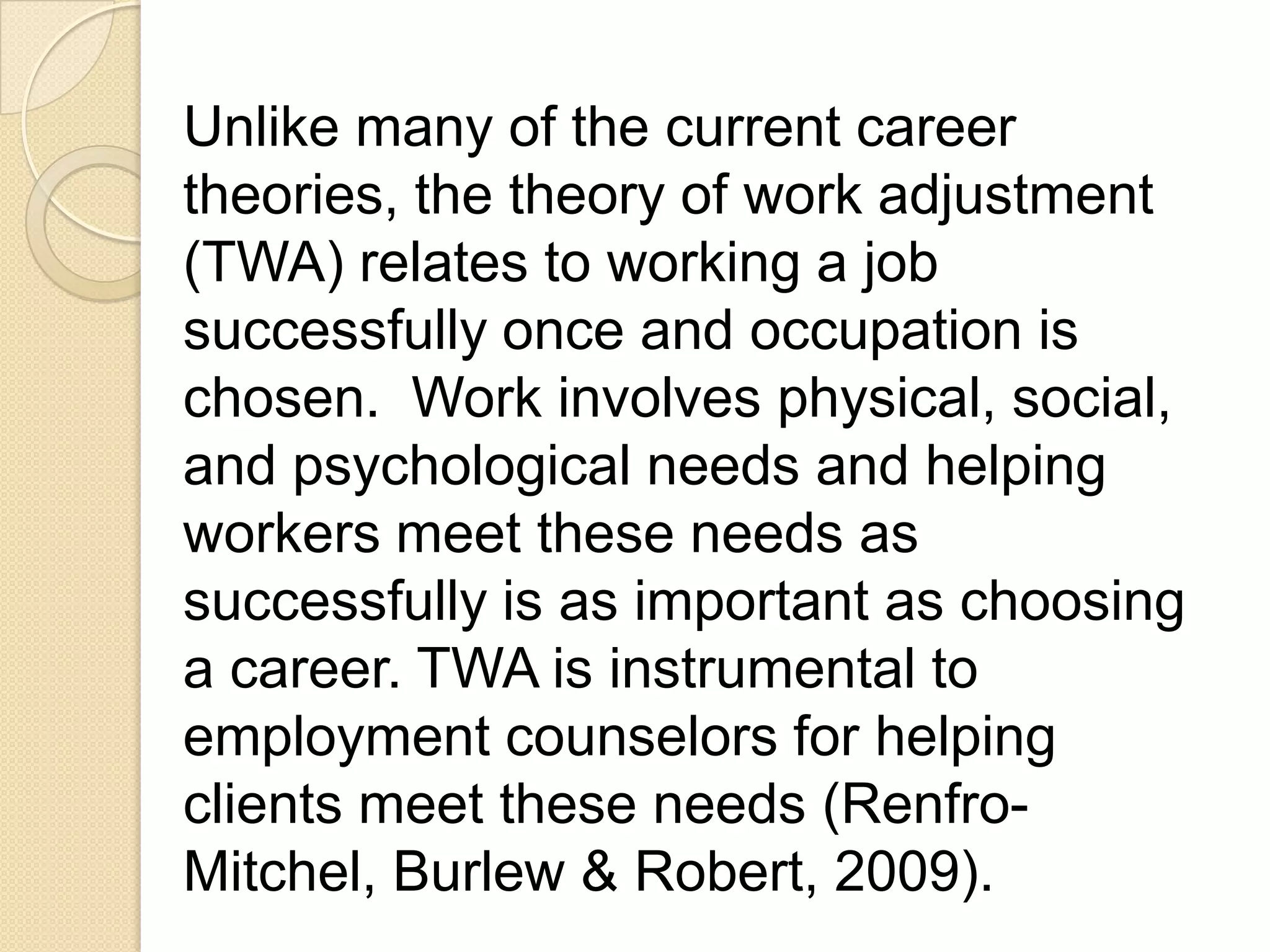
Unlike many of the current career
theories, the theory of work adjustment
(TWA) relates to working a job
successfully once and occupation is
chosen. Work involves physical, social,
and psychological needs and helping
workers meet these needs as
successfully is as important as choosing
a career. TWA is instrumental to
employment counselors for helping
clients meet these needs (Renfro-
Mitchel, Burlew & Robert, 2009).
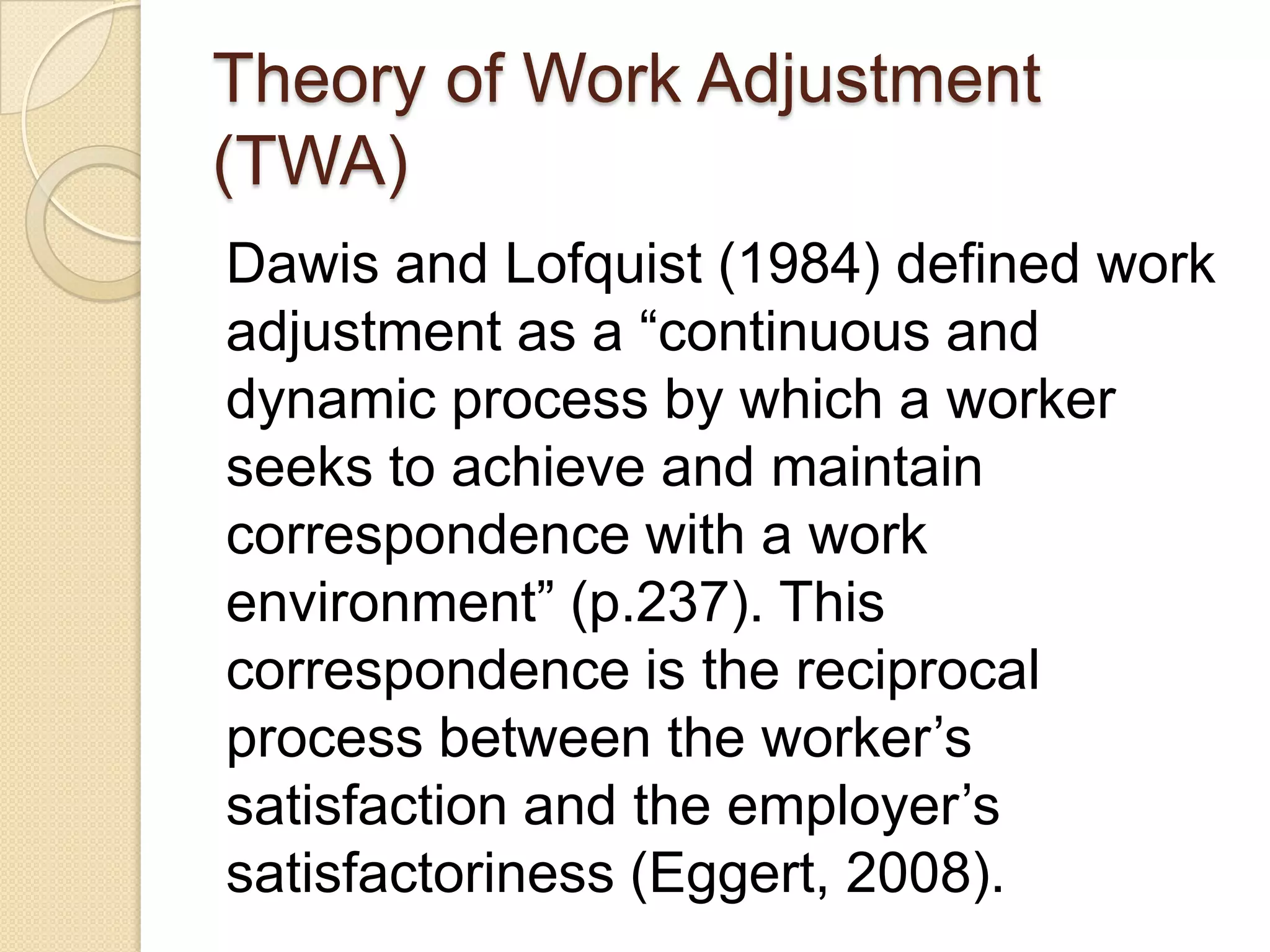
Theory of Work Adjustment
(TWA)
Dawis and Lofquist (1984) defined work
adjustment as a “continuous and
dynamic process by which a worker
seeks to achieve and maintain
correspondence with a work
environment” (p.237). This
correspondence is the reciprocal
process between the worker’s
satisfaction and the employer’s
satisfactoriness (Eggert, 2008).
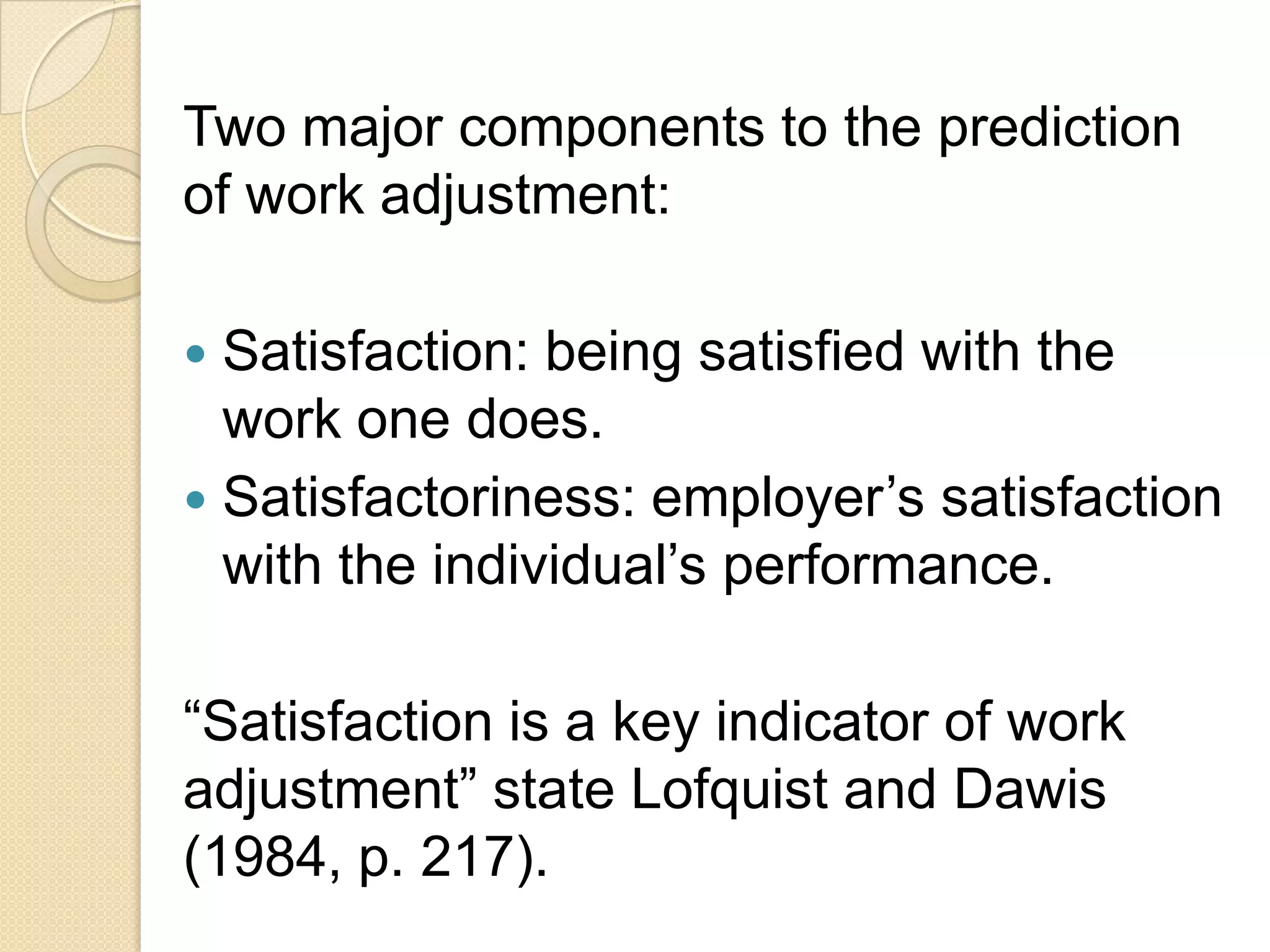
Two major components to the prediction
of work adjustment:

 Satisfaction: being satisfied with the
  work one does.
 Satisfactoriness: employer’s satisfaction
  with the individual’s performance.

“Satisfaction is a key indicator of work
adjustment” state Lofquist and Dawis
(1984, p. 217).
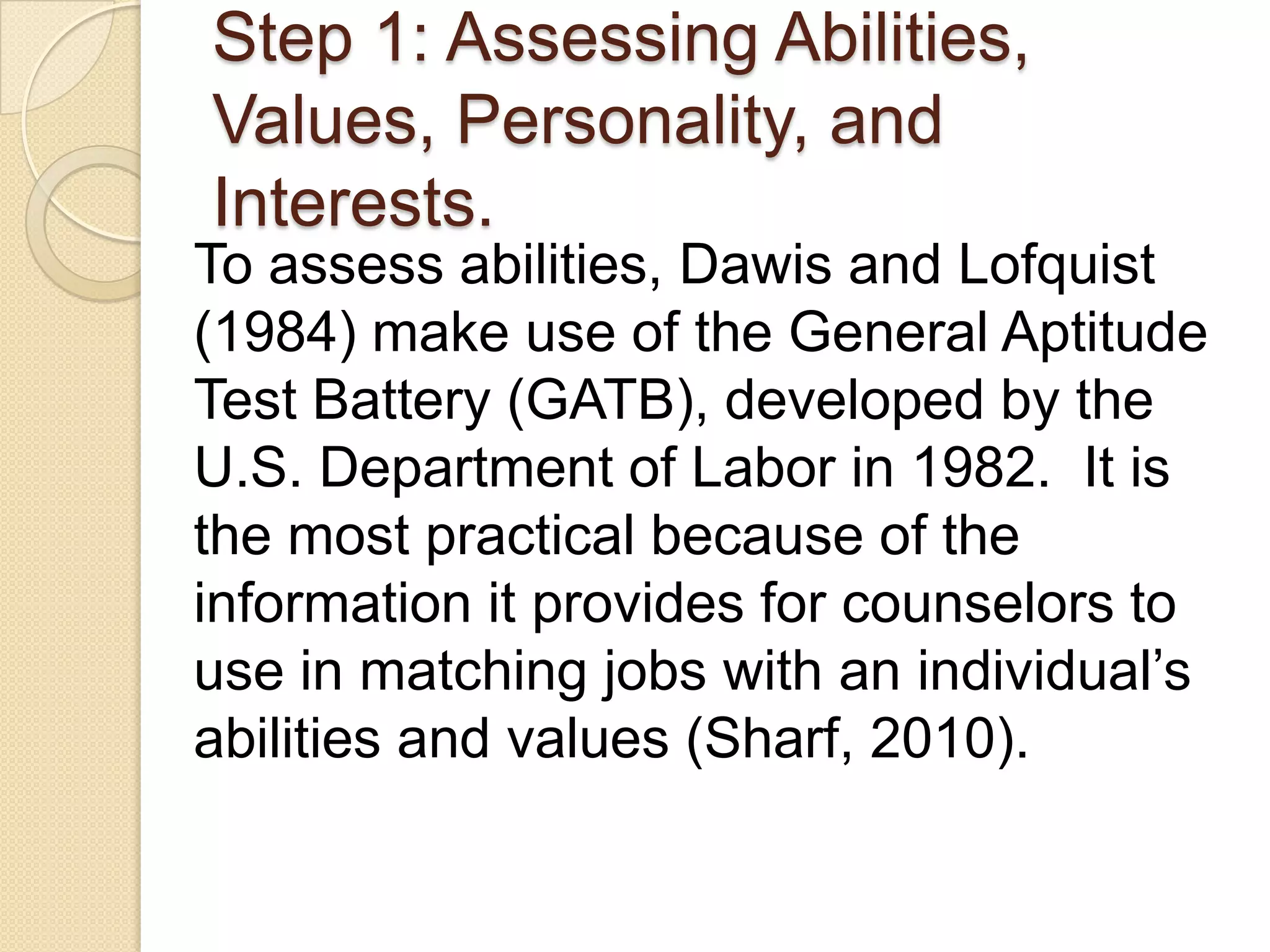
Step 1: Assessing Abilities,
Values, Personality, and
Interests.
To assess abilities, Dawis and Lofquist
(1984) make use of the General Aptitude
Test Battery (GATB), developed by the
U.S. Department of Labor in 1982. It is
the most practical because of the
information it provides for counselors to
use in matching jobs with an individual’s
abilities and values (Sharf, 2010).
General Aptitude Test Battery
(GATB).
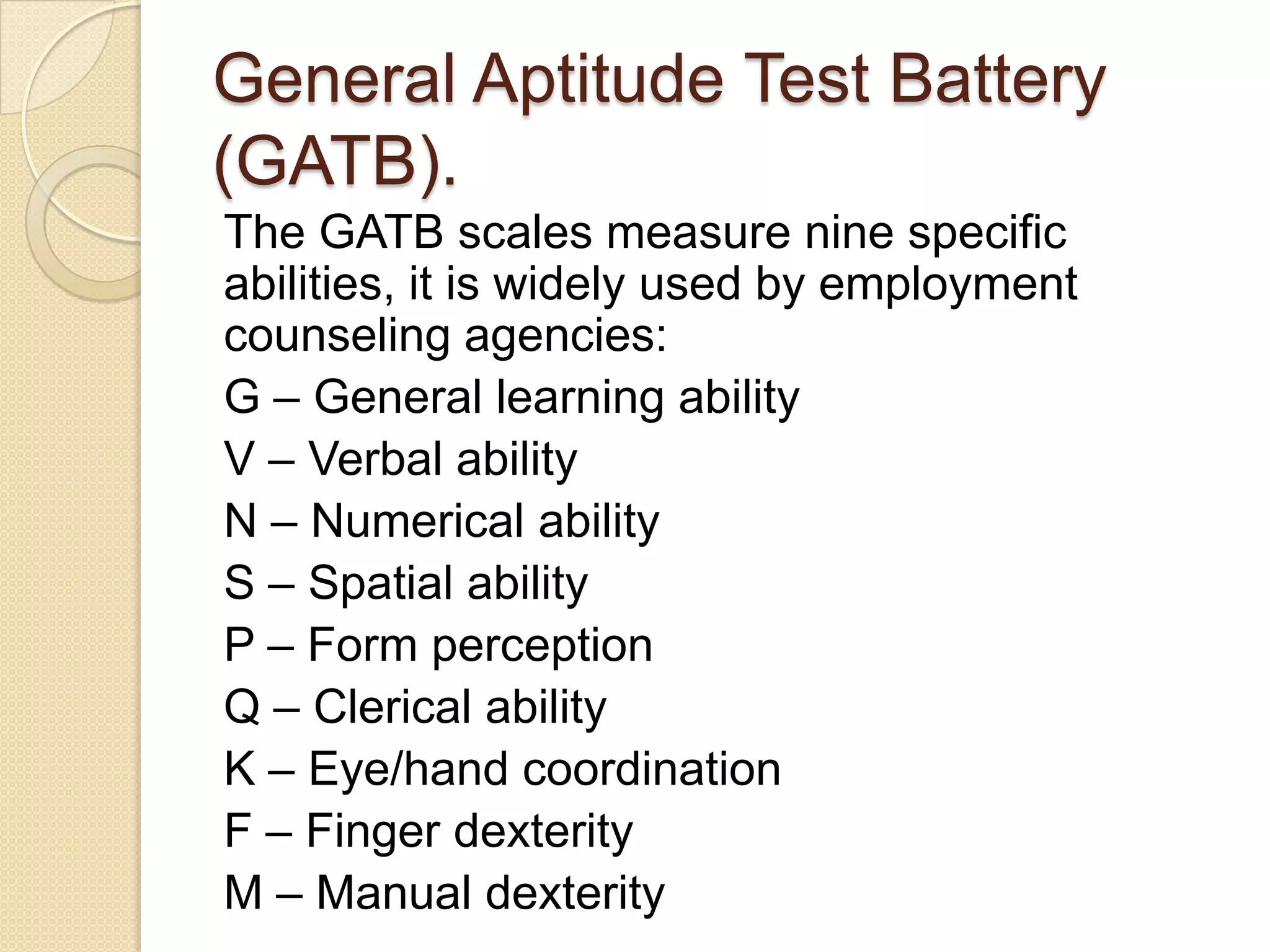
The GATB scales measure nine specific
abilities, it is widely used by employment
counseling agencies:
G – General learning ability
V – Verbal ability
N – Numerical ability
S – Spatial ability
P – Form perception
Q – Clerical ability
K – Eye/hand coordination
F – Finger dexterity
M – Manual dexterity
Minnesota Importance
 Questionnaire (MIQ)
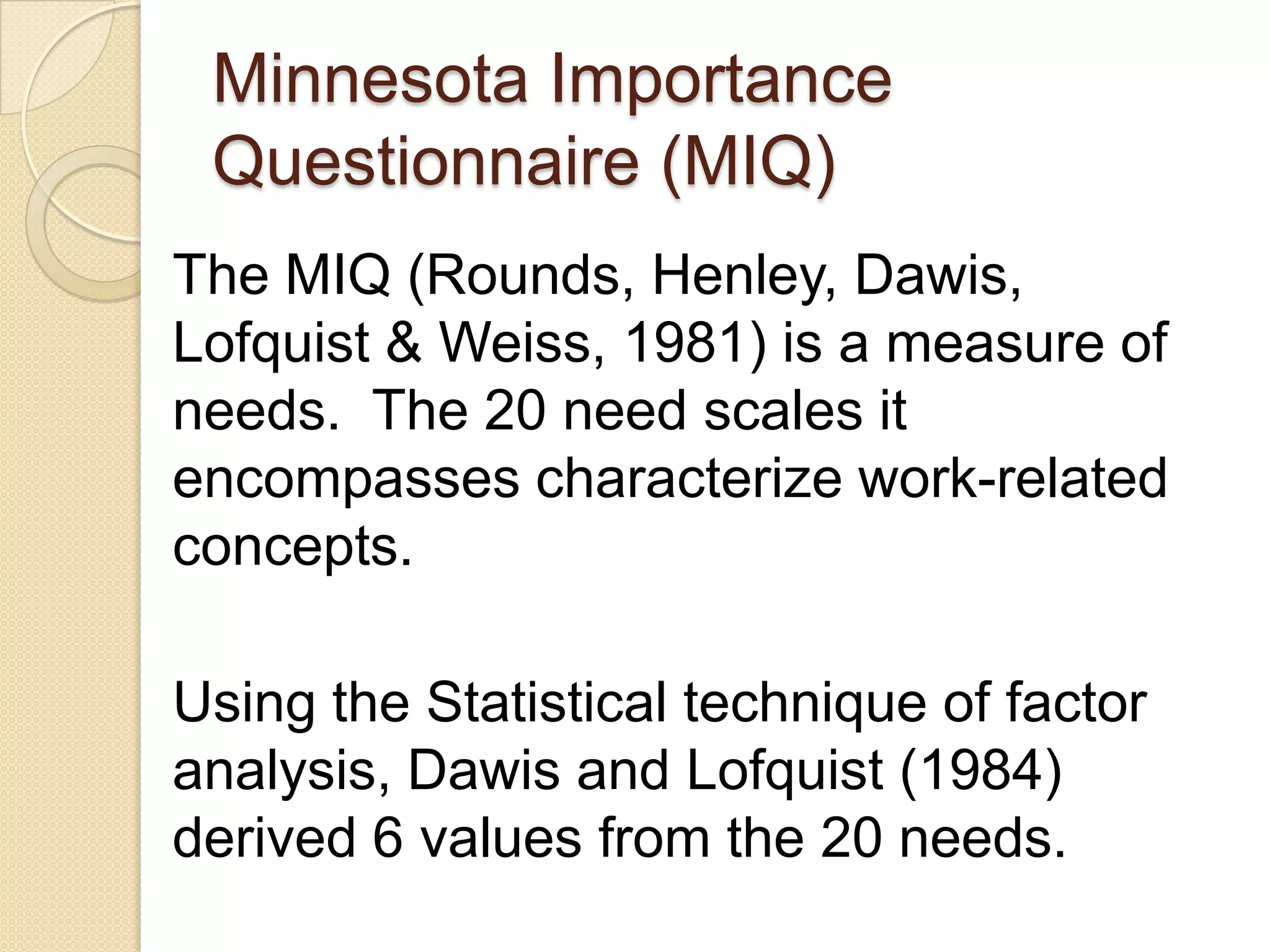
The MIQ (Rounds, Henley, Dawis,
Lofquist & Weiss, 1981) is a measure of
needs. The 20 need scales it
encompasses characterize work-related
concepts.

Using the Statistical technique of factor
analysis, Dawis and Lofquist (1984)
derived 6 values from the 20 needs.
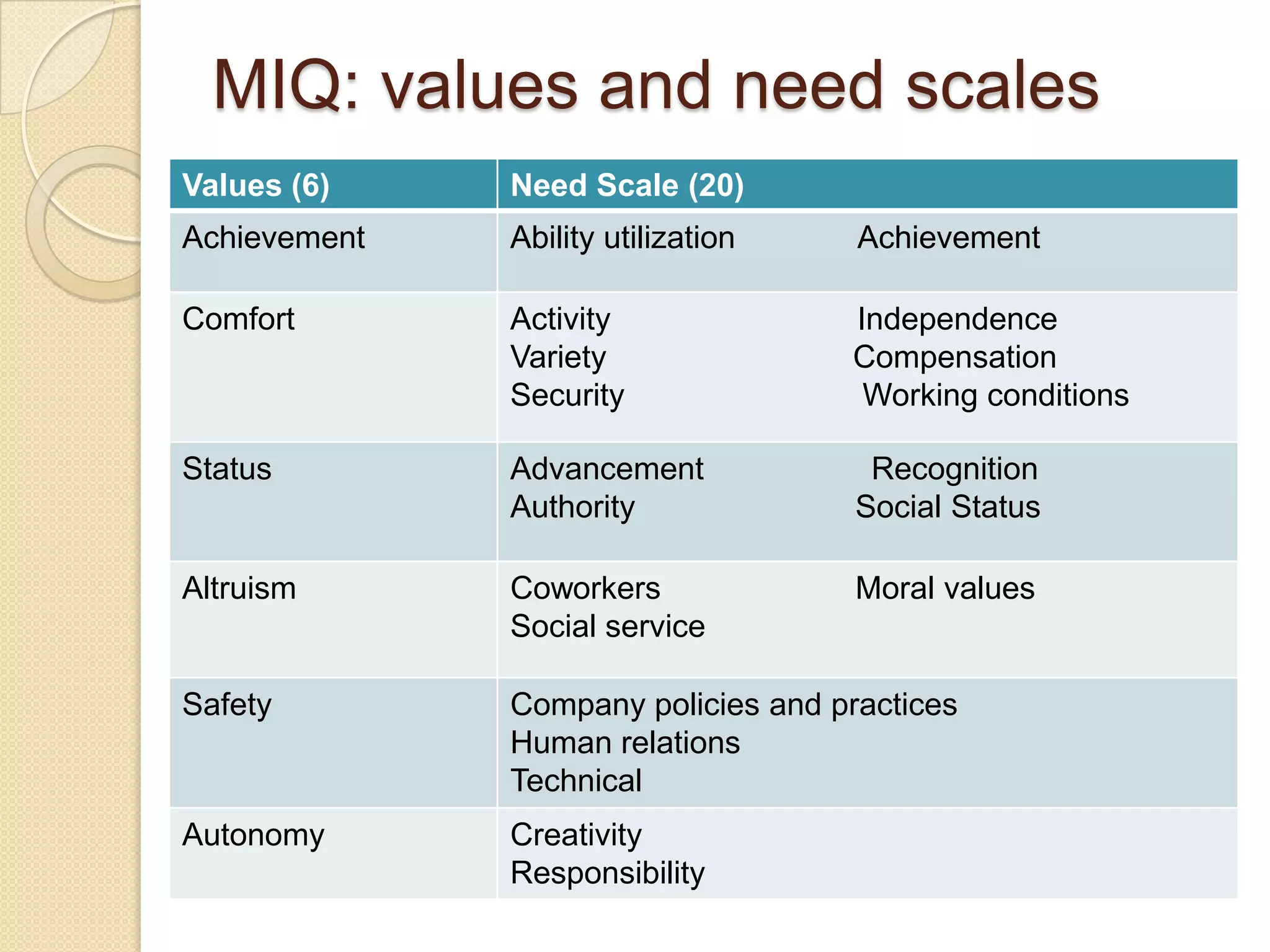
MIQ: values and need scales
Values (6)    Need Scale (20)
Achievement   Ability utilization    Achievement

Comfort       Activity              Independence
              Variety               Compensation
              Security               Working conditions

Status        Advancement             Recognition
              Authority              Social Status

Altruism      Coworkers              Moral values
              Social service

Safety        Company policies and practices
              Human relations
              Technical
Autonomy      Creativity
              Responsibility
Step 2: Measuring the
requirements and conditions of
occupations
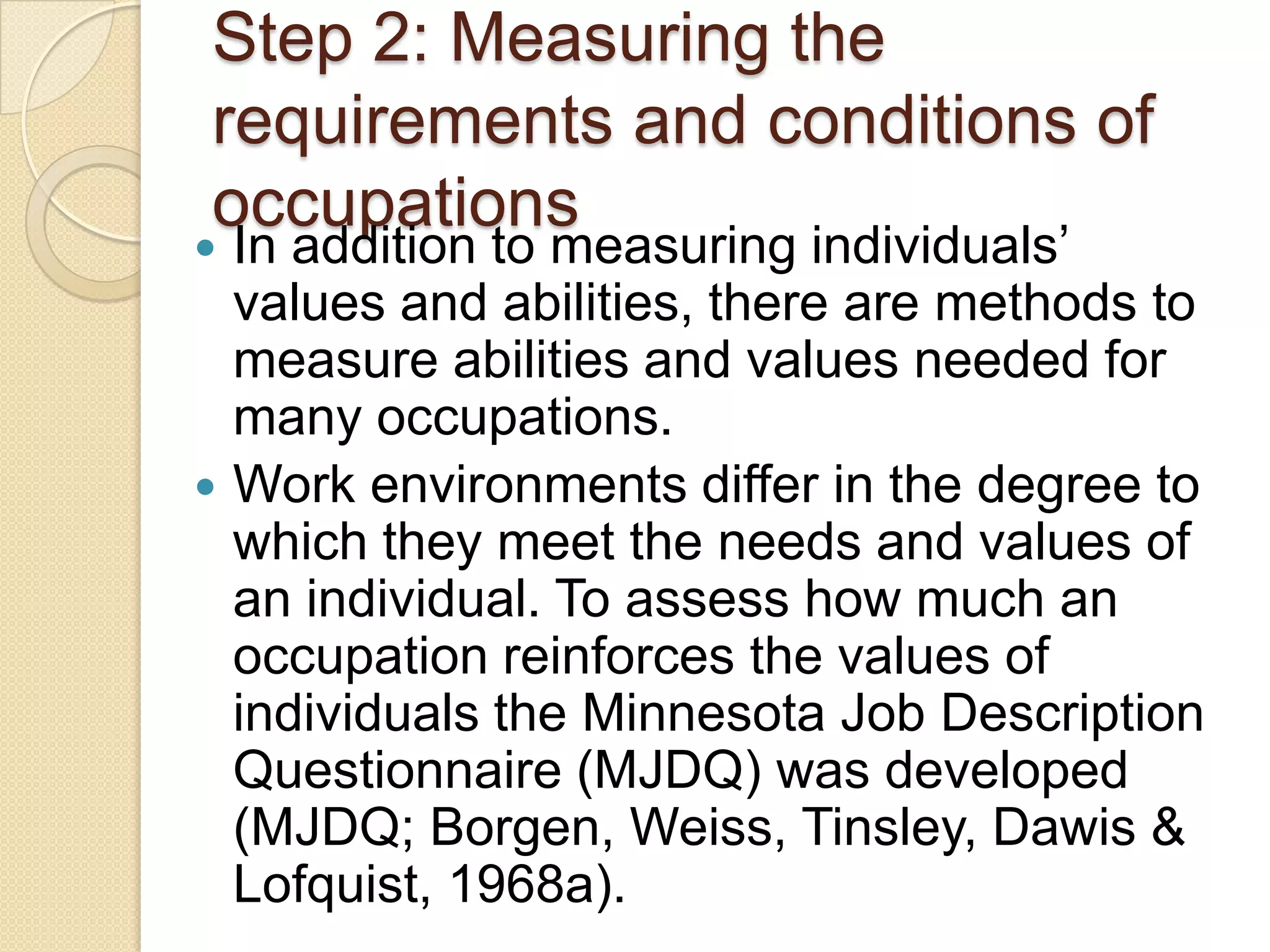
 In addition to measuring individuals’
  values and abilities, there are methods to
  measure abilities and values needed for
  many occupations.
 Work environments differ in the degree to
  which they meet the needs and values of
  an individual. To assess how much an
  occupation reinforces the values of
  individuals the Minnesota Job Description
  Questionnaire (MJDQ) was developed
  (MJDQ; Borgen, Weiss, Tinsley, Dawis &
  Lofquist, 1968a).
MJDQ Need Scales:
 The MJDQ uses the same 20 needs
  as the Minnesota Importance
  Questionnaire. Thus the needs of an
  individual are matched with reinforcers
  provided by the job.
 Using information about value patterns
  helps counselors to see how the
  values of their clients match the
  values that are met or reinforced by a
  large number of occupations (Sharf,
  2010).
Step 3: Matching Abilities, Values
and Reinforcers.
When matching values and abilities,
counselors have three tools available:
Minnesota Importance Questionnaire
(MIQ),
GATB mannual (US Dept. of Labor,
1982)
Minnesota Occupational Classification
System (MOCS).
All helpful in identifying occupations for
clients to explore further (Sharf, 2010).
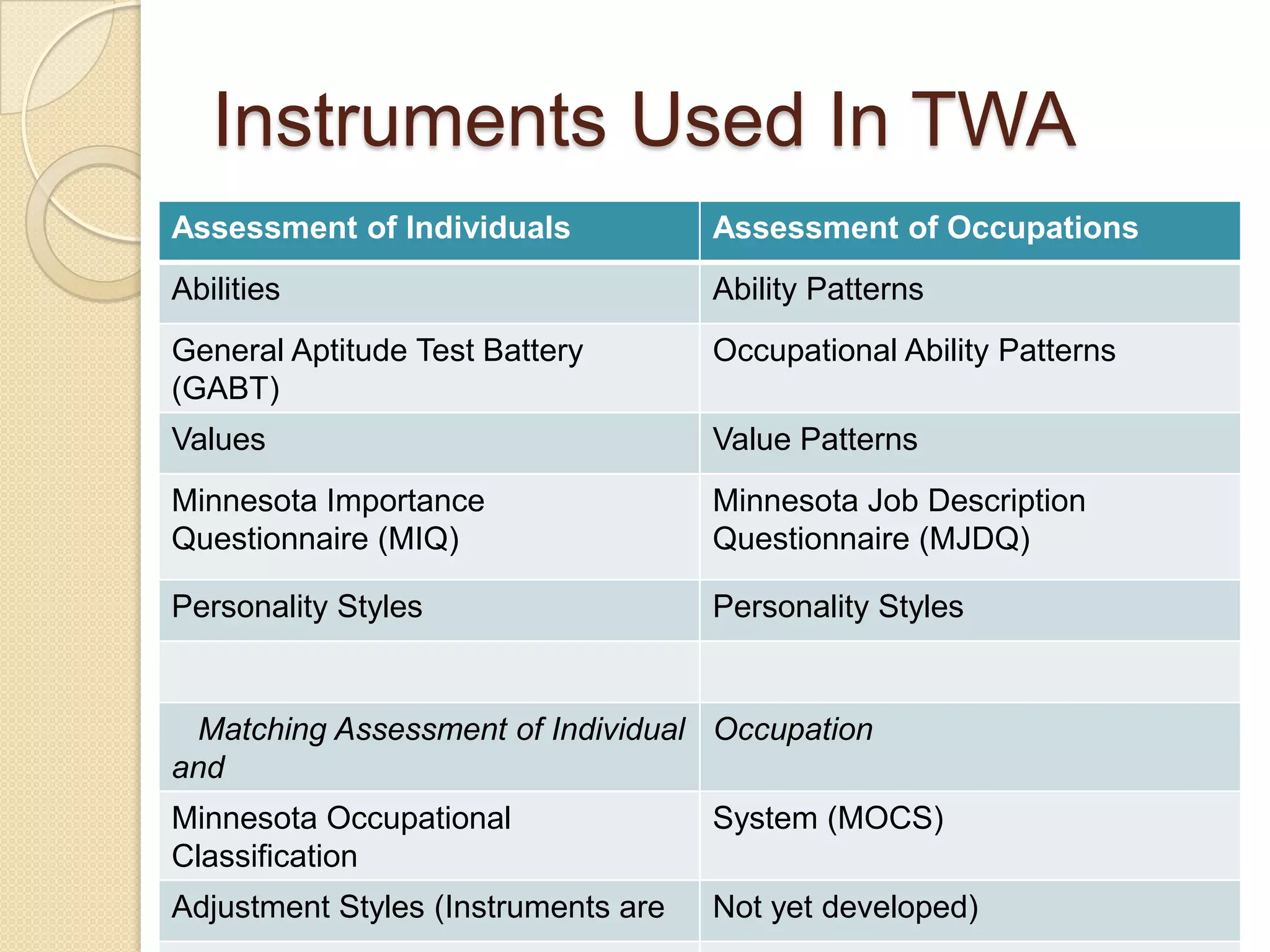
Instruments Used In TWA
Assessment of Individuals            Assessment of Occupations
Abilities                            Ability Patterns
General Aptitude Test Battery        Occupational Ability Patterns
(GABT)
Values                               Value Patterns
Minnesota Importance                 Minnesota Job Description
Questionnaire (MIQ)                  Questionnaire (MJDQ)

Personality Styles                   Personality Styles


 Matching Assessment of Individual Occupation
and
Minnesota Occupational               System (MOCS)
Classification
Adjustment Styles (Instruments are   Not yet developed)
Who could benefit by the use of
this theory?
Job Adjustment Counseling.
Theory of Work Adjustment is
applicable to adults:

 In the process of making career
  choices.
 Those experiencing work adjustment
  problems.
 Retirees who want to continue working
  but need to explore career choices.
Retirement
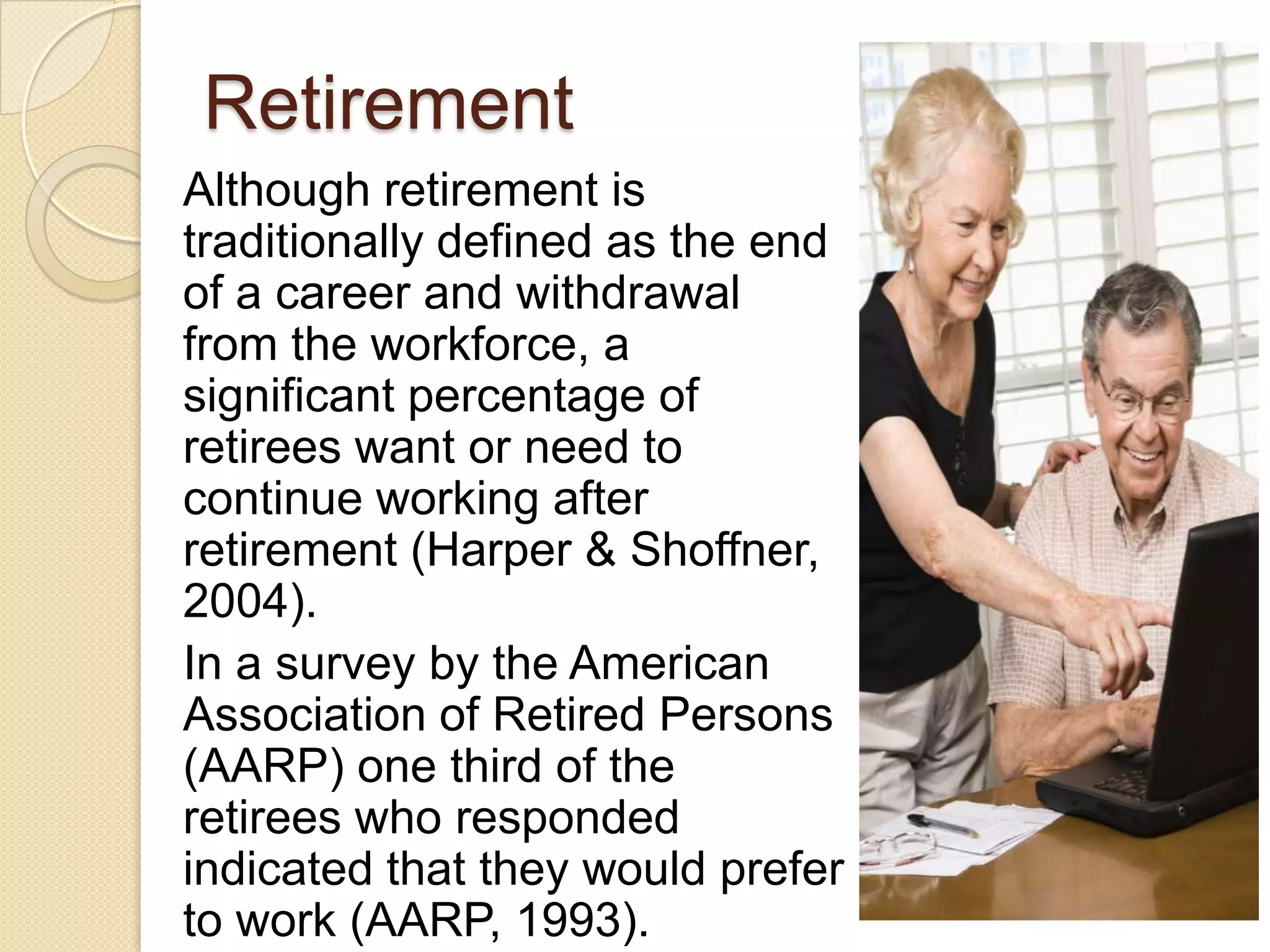
Although retirement is
traditionally defined as the end
of a career and withdrawal
from the workforce, a
significant percentage of
retirees want or need to
continue working after
retirement (Harper & Shoffner,
2004).
In a survey by the American
Association of Retired Persons
(AARP) one third of the
retirees who responded
indicated that they would prefer
to work (AARP, 1993).
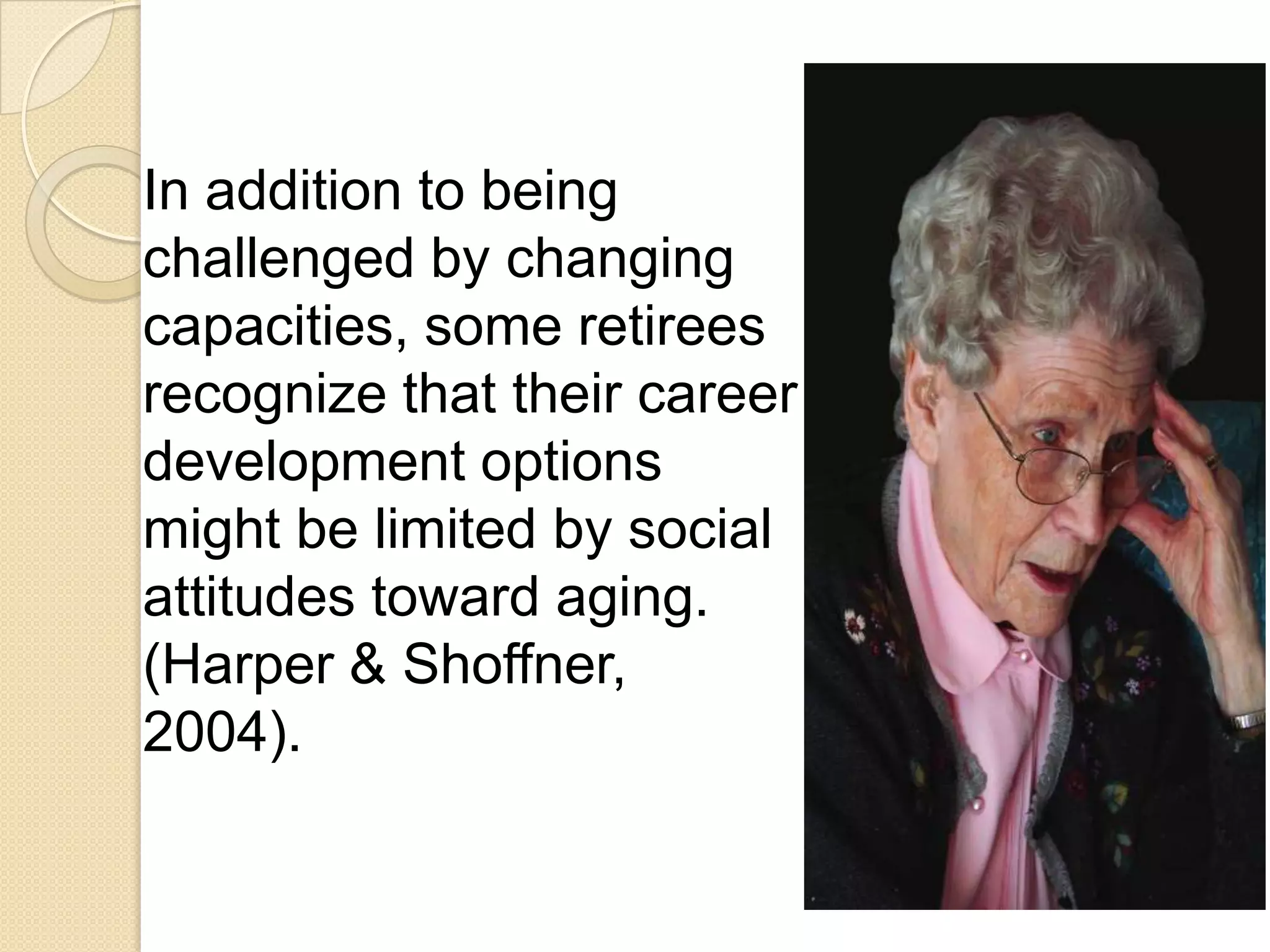
In addition to being
challenged by changing
capacities, some retirees
recognize that their career
development options
might be limited by social
attitudes toward aging.
(Harper & Shoffner,
2004).
TWA in Retirement
    Counseling
 Dawis and Lofquist (1984) stated that a
  primary objective in retirement counseling
  is for the retiree to achieve a level of
  individual-environment correspondence
  during retirement that is similar to what the
  retiree experienced before retirement.
 The counselor using TWA with a client who
  is planning for retirement attempts to help
  the client compare skills and abilities with
  the requirements of the environment,
  needs and values with reinforcers of the
  environment and personal style with the
  work environment style (Harper &
  Shoffner, 2004).
Application to Women and
Culturally Diverse Populations
 Group differences have not been a
  focus of TWA. Dawis and Lofquist
  (1984) have focused on the large
  differences within groups, rather than
  the small differences that might exist
  between groups.
 There are very few small differences
  between men and women on the
  achievement scale and some
  differences on various MIQ needs.
Culturally diverse populations
(continued).
 TWA can be applied to discrimination
  experienced by homosexual men and women
  as well as heterosexual women.
 TWA predicts job satisfaction of lesbian, gay,
  and bisexual individuals, despite the
  discrimination that they may experience in
  their workplace.
 Dawis (1994) states that “gender, ethnicity,
  national origin, religion, age, sexual
  orientation, and disability status are seen as
  inaccurate and unreliable bases for
  estimating the skills, abilities, needs, values,
  personality style and adjustment style of a
  particular person.”
Linear and Non-Linear clients
 Linear thinking clients could benefit
  from the step-by-step process of
  matching their own abilities, values
  and reinforcers to those required of a
  specific job.
 Non-linear clients could be guided in a
  general direction of what jobs they are
  a better match that will allow them to
  explore different careers.
Counselor Issues
 Lofquist and Dawis (undated) believe
  that it is necessary for the counselor to
  identify basic abilities and reinforcers
  within himself or herself and the client
  so that effective counseling can take
  place. A key characteristic for a
  counselor is flexibility.
 They suggested that it is helpful for
  counselors to see themselves, as well
  as their clients, as environments.
How might identifying his/her
own abilities and reinforcers help
a counselor be more effective in
counseling clients?
References
Borgen, F.H., Weiss, D.J, Tinsley, H.E., Dawis, R.V. & Lofquist, L.H. (1968a)
Minnesota Job Description Questionnaire. Minneapolis, MN: University of Minnesota,
Psychology Department, Vocational Psychology Research.


Dawis, R.V. (1994). The theory of work adjustment as a convergent theory. In M.L.
Savickas & R.W.Lent (Eds.), Convergence in career development theories (pp.33-
44). Palo Alto, CA: Consulting Psychologists Pres.


Dawis, R.V. and Lofquist, L.H. (1984) A psychological theory of work adjustment: An
individual-differences model and its applications. Minneapolis: University of
Minnesota.


Eggerth, D. E. (2008). From theory of work adjustment to person-environment
correspondence counseling: Vocational psychology as positive psychology
[Electronic Version]. Journal of Career Assessment, 16, 60-74.
References
Harper M.C. and Shoffner, M.F. (2004) Counseling for Continued
Career Development After Retirement: An Application of the Theory
of Work Adjustment. The Career Development Quarterly. Mar 2004
. Vol. 54.

Renfro-Mitchel, E.L., Burlew, L.D., and Robert, T. (2009) The
Interaction of Work Adjustment and Attachment Theory: Employment
Counseling Implications. Journal of Employment Counseling . Mar
2009. Vol 46.

Rounds, J.B., Henley, G.A., Dawis, R.V., Lofquist, L.H. & Weiss, D.J.
(1981) Manual for the Minnesota Importance Questionnaire.
Minneapolis, MN: University of Minnesota, Psychology Department,
Work Adjustment Project.

Sharf, R.S. (2010). Applying Career Development Theory to
Counseling. Fifth Edition. Brooks/Cole, Cengage Learning. University
of Delaware.

Tinsley, H. E. A., and Eggerth D. E. “Theory of Work Adjustment.”
Encyclopedia of Counseling. Ed. Thousand Oaks, CA: SAGE, 2008.
1656-58. SAGE Reference Online. Web. 7 Jun. 2012.

Theory of work adjustment

  • 1.
    Theory of Work Adjustment Jenny Dominguez University of Saint Thomas EDUC 5359
  • 2.
    Development  The Theoryof Work Adjustment (TWA) developed in two phases during the 1960s and 1970s.  During the 1960s, Lloyd H. Lofquist and Rene V. Dawis, University of Minnesota psychologists, formulated a trait-and- factor matching model and in collaboration with David J. Weiss developed instruments to measure the major constructs introduced by the theory (Eggerth & Tinsley, 2008).
  • 3.
    During the 1970s, the authors first bridged the theoretical gap between vocational needs and work values. Integration of the structural and dynamic aspects of the theory during the 1970s transformed the TWA from a static trait- and-factor model to a developmentally oriented model that better describes the ongoing interaction between individuals and their work environments.
  • 4.
    Originally designed to meet the needs of vocational rehabilitation clients, by providing improved rehabilitation services to vocationally challenged clients (Sharf, 2010).  TWA is a specific example of general trait and factor theory in that it makes use of clearly defined concepts and follows an articulated theoretical concept (Sharf, 2010).
  • 5.
    Unlike many ofthe current career theories, the theory of work adjustment (TWA) relates to working a job successfully once and occupation is chosen. Work involves physical, social, and psychological needs and helping workers meet these needs as successfully is as important as choosing a career. TWA is instrumental to employment counselors for helping clients meet these needs (Renfro- Mitchel, Burlew & Robert, 2009).
  • 6.
    Theory of WorkAdjustment (TWA) Dawis and Lofquist (1984) defined work adjustment as a “continuous and dynamic process by which a worker seeks to achieve and maintain correspondence with a work environment” (p.237). This correspondence is the reciprocal process between the worker’s satisfaction and the employer’s satisfactoriness (Eggert, 2008).
  • 7.
    Two major componentsto the prediction of work adjustment:  Satisfaction: being satisfied with the work one does.  Satisfactoriness: employer’s satisfaction with the individual’s performance. “Satisfaction is a key indicator of work adjustment” state Lofquist and Dawis (1984, p. 217).
  • 8.
    Step 1: AssessingAbilities, Values, Personality, and Interests. To assess abilities, Dawis and Lofquist (1984) make use of the General Aptitude Test Battery (GATB), developed by the U.S. Department of Labor in 1982. It is the most practical because of the information it provides for counselors to use in matching jobs with an individual’s abilities and values (Sharf, 2010).
  • 9.
    General Aptitude TestBattery (GATB). The GATB scales measure nine specific abilities, it is widely used by employment counseling agencies: G – General learning ability V – Verbal ability N – Numerical ability S – Spatial ability P – Form perception Q – Clerical ability K – Eye/hand coordination F – Finger dexterity M – Manual dexterity
  • 10.
    Minnesota Importance Questionnaire(MIQ) The MIQ (Rounds, Henley, Dawis, Lofquist & Weiss, 1981) is a measure of needs. The 20 need scales it encompasses characterize work-related concepts. Using the Statistical technique of factor analysis, Dawis and Lofquist (1984) derived 6 values from the 20 needs.
  • 11.
    MIQ: values andneed scales Values (6) Need Scale (20) Achievement Ability utilization Achievement Comfort Activity Independence Variety Compensation Security Working conditions Status Advancement Recognition Authority Social Status Altruism Coworkers Moral values Social service Safety Company policies and practices Human relations Technical Autonomy Creativity Responsibility
  • 12.
    Step 2: Measuringthe requirements and conditions of occupations  In addition to measuring individuals’ values and abilities, there are methods to measure abilities and values needed for many occupations.  Work environments differ in the degree to which they meet the needs and values of an individual. To assess how much an occupation reinforces the values of individuals the Minnesota Job Description Questionnaire (MJDQ) was developed (MJDQ; Borgen, Weiss, Tinsley, Dawis & Lofquist, 1968a).
  • 13.
    MJDQ Need Scales: The MJDQ uses the same 20 needs as the Minnesota Importance Questionnaire. Thus the needs of an individual are matched with reinforcers provided by the job.  Using information about value patterns helps counselors to see how the values of their clients match the values that are met or reinforced by a large number of occupations (Sharf, 2010).
  • 14.
    Step 3: MatchingAbilities, Values and Reinforcers. When matching values and abilities, counselors have three tools available: Minnesota Importance Questionnaire (MIQ), GATB mannual (US Dept. of Labor, 1982) Minnesota Occupational Classification System (MOCS). All helpful in identifying occupations for clients to explore further (Sharf, 2010).
  • 15.
    Instruments Used InTWA Assessment of Individuals Assessment of Occupations Abilities Ability Patterns General Aptitude Test Battery Occupational Ability Patterns (GABT) Values Value Patterns Minnesota Importance Minnesota Job Description Questionnaire (MIQ) Questionnaire (MJDQ) Personality Styles Personality Styles Matching Assessment of Individual Occupation and Minnesota Occupational System (MOCS) Classification Adjustment Styles (Instruments are Not yet developed)
  • 16.
    Who could benefitby the use of this theory?
  • 17.
    Job Adjustment Counseling. Theoryof Work Adjustment is applicable to adults:  In the process of making career choices.  Those experiencing work adjustment problems.  Retirees who want to continue working but need to explore career choices.
  • 18.
    Retirement Although retirement is traditionallydefined as the end of a career and withdrawal from the workforce, a significant percentage of retirees want or need to continue working after retirement (Harper & Shoffner, 2004). In a survey by the American Association of Retired Persons (AARP) one third of the retirees who responded indicated that they would prefer to work (AARP, 1993).
  • 19.
    In addition tobeing challenged by changing capacities, some retirees recognize that their career development options might be limited by social attitudes toward aging. (Harper & Shoffner, 2004).
  • 20.
    TWA in Retirement Counseling  Dawis and Lofquist (1984) stated that a primary objective in retirement counseling is for the retiree to achieve a level of individual-environment correspondence during retirement that is similar to what the retiree experienced before retirement.  The counselor using TWA with a client who is planning for retirement attempts to help the client compare skills and abilities with the requirements of the environment, needs and values with reinforcers of the environment and personal style with the work environment style (Harper & Shoffner, 2004).
  • 21.
    Application to Womenand Culturally Diverse Populations  Group differences have not been a focus of TWA. Dawis and Lofquist (1984) have focused on the large differences within groups, rather than the small differences that might exist between groups.  There are very few small differences between men and women on the achievement scale and some differences on various MIQ needs.
  • 22.
    Culturally diverse populations (continued). TWA can be applied to discrimination experienced by homosexual men and women as well as heterosexual women.  TWA predicts job satisfaction of lesbian, gay, and bisexual individuals, despite the discrimination that they may experience in their workplace.  Dawis (1994) states that “gender, ethnicity, national origin, religion, age, sexual orientation, and disability status are seen as inaccurate and unreliable bases for estimating the skills, abilities, needs, values, personality style and adjustment style of a particular person.”
  • 23.
    Linear and Non-Linearclients  Linear thinking clients could benefit from the step-by-step process of matching their own abilities, values and reinforcers to those required of a specific job.  Non-linear clients could be guided in a general direction of what jobs they are a better match that will allow them to explore different careers.
  • 24.
    Counselor Issues  Lofquistand Dawis (undated) believe that it is necessary for the counselor to identify basic abilities and reinforcers within himself or herself and the client so that effective counseling can take place. A key characteristic for a counselor is flexibility.  They suggested that it is helpful for counselors to see themselves, as well as their clients, as environments.
  • 25.
    How might identifyinghis/her own abilities and reinforcers help a counselor be more effective in counseling clients?
  • 26.
    References Borgen, F.H., Weiss,D.J, Tinsley, H.E., Dawis, R.V. & Lofquist, L.H. (1968a) Minnesota Job Description Questionnaire. Minneapolis, MN: University of Minnesota, Psychology Department, Vocational Psychology Research. Dawis, R.V. (1994). The theory of work adjustment as a convergent theory. In M.L. Savickas & R.W.Lent (Eds.), Convergence in career development theories (pp.33- 44). Palo Alto, CA: Consulting Psychologists Pres. Dawis, R.V. and Lofquist, L.H. (1984) A psychological theory of work adjustment: An individual-differences model and its applications. Minneapolis: University of Minnesota. Eggerth, D. E. (2008). From theory of work adjustment to person-environment correspondence counseling: Vocational psychology as positive psychology [Electronic Version]. Journal of Career Assessment, 16, 60-74.
  • 27.
    References Harper M.C. andShoffner, M.F. (2004) Counseling for Continued Career Development After Retirement: An Application of the Theory of Work Adjustment. The Career Development Quarterly. Mar 2004 . Vol. 54. Renfro-Mitchel, E.L., Burlew, L.D., and Robert, T. (2009) The Interaction of Work Adjustment and Attachment Theory: Employment Counseling Implications. Journal of Employment Counseling . Mar 2009. Vol 46. Rounds, J.B., Henley, G.A., Dawis, R.V., Lofquist, L.H. & Weiss, D.J. (1981) Manual for the Minnesota Importance Questionnaire. Minneapolis, MN: University of Minnesota, Psychology Department, Work Adjustment Project. Sharf, R.S. (2010). Applying Career Development Theory to Counseling. Fifth Edition. Brooks/Cole, Cengage Learning. University of Delaware. Tinsley, H. E. A., and Eggerth D. E. “Theory of Work Adjustment.” Encyclopedia of Counseling. Ed. Thousand Oaks, CA: SAGE, 2008. 1656-58. SAGE Reference Online. Web. 7 Jun. 2012.