Formulating ResearchFormulating Research
Problems, QuestionsProblems, Questions
and Hypothesesand Hypotheses
SathiSh Rajamani m.ScSathiSh Rajamani m.Sc
(n)(n)
0968811545409688115454
201/28/15
Learning Objectives
 Describe the general
steps in the research
process
 Describe process of
identifying a research
problem
 Define research
questions, directional
and non-directional
hypotheses
 Describe the difference
between Level I, II, and
III studies
 Describe the use of
research questions vs.
hypotheses in a
research study
301/28/15
Research Defined
 Research is an organized and
systematic way to find answers to
questions
 Research is a creative process
401/28/15
Why is research important to the
profession of nursing?
 Nursing research provides a scientific
knowledge base for practice.
 Knowledge obtained from sound
research is transformed into clinical
practice, leading to nursing practice
that is evidence-based.
501/28/15
Research and Nursing
 “The nurse must be a knowledgeable
consumer of research, one who can
critique research and use existing
standards to determine the merit and
readiness for research use in clinical
practice” (ANA, 1997; AACN, 1998b).
 LB-W & H p. 7
601/28/15
Developing & Refining a
Research Problem
 Research study should include:
A specific problem area
Review of relevant literature
Significance to nursing
Feasibility
701/28/15
Research Topics
 Nursing research topics include
studies of patient populations, or an
individual’s response to health
problems, or potential health problems.
801/28/15
The Research Idea
 Professional experience
 Burning questions
Yours
Others
 Literature
 Professional meetings
 Discussions
901/28/15
Research Topics
 Observations
 Behaviors
 Concepts
 Theories
 Testing of assessment and intervention
strategies
1001/28/15
Criteria for developing a good
research question: FINER
 Feasibility
 Interesting
 Novel
 Ethical
 Relevant
 Cummings et al. 2001
1101/28/15
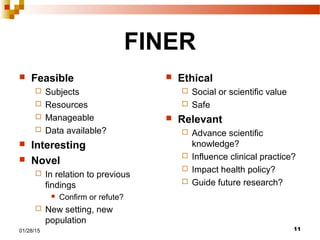
FINER
 Feasible
 Subjects
 Resources
 Manageable
 Data available?
 Interesting
 Novel
 In relation to previous
findings
 Confirm or refute?
 New setting, new
population
 Ethical
 Social or scientific value
 Safe
 Relevant
 Advance scientific
knowledge?
 Influence clinical practice?
 Impact health policy?
 Guide future research?
1201/28/15
Narrowing the research topic
 Idea → brainstorming
 Literature review
 Identify the variables for study
 Formulate research problems and
questions/hypotheses
 LB-W & H p. 51 – see fig. 3-1
1301/28/15
A Research Question Must
Identify
1. The variables under study
2. The population being studied
3. The testability of the question
1401/28/15
Variables in research
 Have 2 or more properties or qualities
 Age, sex, weight, height
 Is one variable related to another?
 “ Is X related to Y? What is the effect of X on Y?” etc.
1501/28/15
Variables in research
 Independent
variable:
 has a presumed effect
on the dependent
variable (outcome)
 May or may not be
manipulated
 Dependent variable:
 Something that varies
with a change in the
independent variable
 Outcome variable
1601/28/15
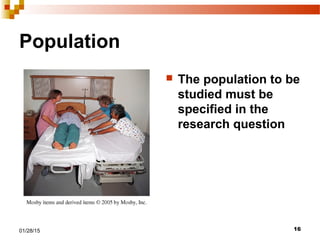
Population
 The population to be
studied must be
specified in the
research question
1701/28/15
Testability
 Research problem must imply that the
problem is measurable/testable
 Example of a poorly phrased research
question
“Should postoperative patients control how
much pain medication they receive?”
 How would you revise the question?
1801/28/15
Characteristics to Consider
 Research questions
Cannot be answered by yes/no
 Should ask:
What happens when?
What’s going on here?
How does this happen?
Why does one thing work better than
another?
1901/28/15
Examples
 What is the relationship between
effectiveness of pain management
strategies and quality of life?
 How do older adults adapt to living
with early stage dementia?
2001/28/15
Purpose Statement
 The purpose of the study encompasses
the aims or goals the investigator
wants to accomplish
 Purpose ≠ Question
LB-W & H p. 58 Box 3-2 2101/28/15
2201/28/15
Research Questions
 Research studies do not always
contain hypotheses
 Exploratory and descriptive studies
may pose research questions instead
2301/28/15
What is a researchable
question?
 Helps solve a problem, add to theory,
or improve nursing practice
 Needs to be usable, current, and clear
 Provides answers that will explain,
describe, identify, predict or qualify
2401/28/15
Guidelines for writing research
questions
 Start with a simple question
Has one stem and one topic
 Action-oriented
 The way you ask a question determines
how you will answer it
2501/28/15
Writing the research question
 Examples:
What are the health beliefs of the Amish?
What is the relationship between preoperative
teaching and postoperative pain?
Why does increased assertiveness in nurses
lead to lower nosocomial infection rates?
2601/28/15
Hypothesis
 Statement about the relationship
between 2 or more variables
 Converts the question into a statement
that predicts an expected outcome
 A unit or subset of the research
problem
2701/28/15
Characteristics of hypotheses
 Declarative statement that identifies the
predicted relationship between 2 or
more variables
 Testability
 Based on sound scientific
theory/rationale
2801/28/15
Hypotheses
 Hypotheses may not always be
explicitly stated
 Wording must include:
The variables
The population being studied
The predicted outcome of the hypothesis
2901/28/15
Directional vs. Non-Directional
Hypotheses
 Directional hypothesis
Specifies the direction of the relationship
between independent and dependent
variables
 Non-directional hypothesis
Shows the existence of a relationship
between variables but no direction is specified
3001/28/15
Examples
 Directional hypothesis
 Cardiac patients who receive support from former
patients have less anxiety and higher self-efficacy
than other patients
 Non-directional hypothesis
 There is a difference in anxiety and self-efficacy
between cardiac patients who receive support from
former patients and those who do not
3101/28/15
Research vs. Statistical
Hypotheses
 Research hypothesis = scientific hypothesis
 Statement about the expected relationship of the
variables
 Can be directional or nondirectional
 Statistical hypothesis = null hypothesis
 States there is no relationship between the variables
 L-B, W & H p. 66-67
3201/28/15
Example: Statistical Hypothesis
 Oxygen inhalation by nasal cannula of
up to 6L/min does not affectdoes not affect oral
temperature measurement taken with
an electronic thermometer.
Variables?
 other examples?
3301/28/15
Levels of Questions
 Level I
 Little to no literature is
available on the topic and
the purpose is to describe
what is found as it exists
naturally
 Level II
 There is knowledge about
the topic but relationships
among the variables are
not well known
 Level III
 There is a great deal of
knowledge about the topic
and the purpose of the
study is to test the theory
through direct manipulation
of the variables
3401/28/15
Level I Questions
 Lead to exploration and result in a
complete description of the topic
 Examples:
What are the characteristics of suicidal
patients?
What are the spiritual needs of transplant
patients?
3501/28/15
Level II Questions
 Build on the results of
Level I studies
 Look for relationships
between the variables
 Examples:
 What is the relationship
between relaxation and
pain in postoperative
patients?
 What is the relationship
among nutrition, birth
weight of the newborn, and
age of the mother?
3601/28/15
Level III Questions
 Builds on the results of previous
research
 Lead to experimental designs
 Examples:
Why does patient satisfaction increase with
positive attitudes toward self-care?
Why does increased vitamin C decrease skin
fragility in elderly people?
3701/28/15
Summary of Level I, II, and III
Questions
 Level I questions have only one
variable and one population
 Level II requires a minimum of 2
variables in one population
 At level III there must be 2 variables
that specify a cause and effect
3801/28/15
Examples
 What are the body positions into which
nurses place LBW intubated infants?
 What is the relationship between body
positions and heart rate in the LBW
intubated infants?
 Why does supine body positioning
decrease heart rate in the intubated
LBW infant?
3901/28/15
Summary Points
 Preliminary steps in the
research process
include forming a
research problem,
questions and
hypotheses
 A hypothesis attempts
to answer the question
posed by the research
question
 Research questions
illustrate a relationship
between variables,
identify independent
and dependent
variables, include a
population, and imply
that a problem is
testable
4001/28/15
Your questions?

Bestresearchqueshypoth f09

  • 1.
    Formulating ResearchFormulating Research Problems,QuestionsProblems, Questions and Hypothesesand Hypotheses SathiSh Rajamani m.ScSathiSh Rajamani m.Sc (n)(n) 0968811545409688115454
  • 2.
    201/28/15 Learning Objectives  Describethe general steps in the research process  Describe process of identifying a research problem  Define research questions, directional and non-directional hypotheses  Describe the difference between Level I, II, and III studies  Describe the use of research questions vs. hypotheses in a research study
  • 3.
    301/28/15 Research Defined  Researchis an organized and systematic way to find answers to questions  Research is a creative process
  • 4.
    401/28/15 Why is researchimportant to the profession of nursing?  Nursing research provides a scientific knowledge base for practice.  Knowledge obtained from sound research is transformed into clinical practice, leading to nursing practice that is evidence-based.
  • 5.
    501/28/15 Research and Nursing “The nurse must be a knowledgeable consumer of research, one who can critique research and use existing standards to determine the merit and readiness for research use in clinical practice” (ANA, 1997; AACN, 1998b).  LB-W & H p. 7
  • 6.
    601/28/15 Developing & Refininga Research Problem  Research study should include: A specific problem area Review of relevant literature Significance to nursing Feasibility
  • 7.
    701/28/15 Research Topics  Nursingresearch topics include studies of patient populations, or an individual’s response to health problems, or potential health problems.
  • 8.
    801/28/15 The Research Idea Professional experience  Burning questions Yours Others  Literature  Professional meetings  Discussions
  • 9.
    901/28/15 Research Topics  Observations Behaviors  Concepts  Theories  Testing of assessment and intervention strategies
  • 10.
    1001/28/15 Criteria for developinga good research question: FINER  Feasibility  Interesting  Novel  Ethical  Relevant  Cummings et al. 2001
  • 11.
    1101/28/15 FINER  Feasible  Subjects Resources  Manageable  Data available?  Interesting  Novel  In relation to previous findings  Confirm or refute?  New setting, new population  Ethical  Social or scientific value  Safe  Relevant  Advance scientific knowledge?  Influence clinical practice?  Impact health policy?  Guide future research?
  • 12.
    1201/28/15 Narrowing the researchtopic  Idea → brainstorming  Literature review  Identify the variables for study  Formulate research problems and questions/hypotheses  LB-W & H p. 51 – see fig. 3-1
  • 13.
    1301/28/15 A Research QuestionMust Identify 1. The variables under study 2. The population being studied 3. The testability of the question
  • 14.
    1401/28/15 Variables in research Have 2 or more properties or qualities  Age, sex, weight, height  Is one variable related to another?  “ Is X related to Y? What is the effect of X on Y?” etc.
  • 15.
    1501/28/15 Variables in research Independent variable:  has a presumed effect on the dependent variable (outcome)  May or may not be manipulated  Dependent variable:  Something that varies with a change in the independent variable  Outcome variable
  • 16.
    1601/28/15 Population  The populationto be studied must be specified in the research question
  • 17.
    1701/28/15 Testability  Research problemmust imply that the problem is measurable/testable  Example of a poorly phrased research question “Should postoperative patients control how much pain medication they receive?”  How would you revise the question?
  • 18.
    1801/28/15 Characteristics to Consider Research questions Cannot be answered by yes/no  Should ask: What happens when? What’s going on here? How does this happen? Why does one thing work better than another?
  • 19.
    1901/28/15 Examples  What isthe relationship between effectiveness of pain management strategies and quality of life?  How do older adults adapt to living with early stage dementia?
  • 20.
    2001/28/15 Purpose Statement  Thepurpose of the study encompasses the aims or goals the investigator wants to accomplish  Purpose ≠ Question
  • 21.
    LB-W & Hp. 58 Box 3-2 2101/28/15
  • 22.
    2201/28/15 Research Questions  Researchstudies do not always contain hypotheses  Exploratory and descriptive studies may pose research questions instead
  • 23.
    2301/28/15 What is aresearchable question?  Helps solve a problem, add to theory, or improve nursing practice  Needs to be usable, current, and clear  Provides answers that will explain, describe, identify, predict or qualify
  • 24.
    2401/28/15 Guidelines for writingresearch questions  Start with a simple question Has one stem and one topic  Action-oriented  The way you ask a question determines how you will answer it
  • 25.
    2501/28/15 Writing the researchquestion  Examples: What are the health beliefs of the Amish? What is the relationship between preoperative teaching and postoperative pain? Why does increased assertiveness in nurses lead to lower nosocomial infection rates?
  • 26.
    2601/28/15 Hypothesis  Statement aboutthe relationship between 2 or more variables  Converts the question into a statement that predicts an expected outcome  A unit or subset of the research problem
  • 27.
    2701/28/15 Characteristics of hypotheses Declarative statement that identifies the predicted relationship between 2 or more variables  Testability  Based on sound scientific theory/rationale
  • 28.
    2801/28/15 Hypotheses  Hypotheses maynot always be explicitly stated  Wording must include: The variables The population being studied The predicted outcome of the hypothesis
  • 29.
    2901/28/15 Directional vs. Non-Directional Hypotheses Directional hypothesis Specifies the direction of the relationship between independent and dependent variables  Non-directional hypothesis Shows the existence of a relationship between variables but no direction is specified
  • 30.
    3001/28/15 Examples  Directional hypothesis Cardiac patients who receive support from former patients have less anxiety and higher self-efficacy than other patients  Non-directional hypothesis  There is a difference in anxiety and self-efficacy between cardiac patients who receive support from former patients and those who do not
  • 31.
    3101/28/15 Research vs. Statistical Hypotheses Research hypothesis = scientific hypothesis  Statement about the expected relationship of the variables  Can be directional or nondirectional  Statistical hypothesis = null hypothesis  States there is no relationship between the variables  L-B, W & H p. 66-67
  • 32.
    3201/28/15 Example: Statistical Hypothesis Oxygen inhalation by nasal cannula of up to 6L/min does not affectdoes not affect oral temperature measurement taken with an electronic thermometer. Variables?  other examples?
  • 33.
    3301/28/15 Levels of Questions Level I  Little to no literature is available on the topic and the purpose is to describe what is found as it exists naturally  Level II  There is knowledge about the topic but relationships among the variables are not well known  Level III  There is a great deal of knowledge about the topic and the purpose of the study is to test the theory through direct manipulation of the variables
  • 34.
    3401/28/15 Level I Questions Lead to exploration and result in a complete description of the topic  Examples: What are the characteristics of suicidal patients? What are the spiritual needs of transplant patients?
  • 35.
    3501/28/15 Level II Questions Build on the results of Level I studies  Look for relationships between the variables  Examples:  What is the relationship between relaxation and pain in postoperative patients?  What is the relationship among nutrition, birth weight of the newborn, and age of the mother?
  • 36.
    3601/28/15 Level III Questions Builds on the results of previous research  Lead to experimental designs  Examples: Why does patient satisfaction increase with positive attitudes toward self-care? Why does increased vitamin C decrease skin fragility in elderly people?
  • 37.
    3701/28/15 Summary of LevelI, II, and III Questions  Level I questions have only one variable and one population  Level II requires a minimum of 2 variables in one population  At level III there must be 2 variables that specify a cause and effect
  • 38.
    3801/28/15 Examples  What arethe body positions into which nurses place LBW intubated infants?  What is the relationship between body positions and heart rate in the LBW intubated infants?  Why does supine body positioning decrease heart rate in the intubated LBW infant?
  • 39.
    3901/28/15 Summary Points  Preliminarysteps in the research process include forming a research problem, questions and hypotheses  A hypothesis attempts to answer the question posed by the research question  Research questions illustrate a relationship between variables, identify independent and dependent variables, include a population, and imply that a problem is testable
  • 40.