MOOD DISORDERS
PROF SATHISH RAJAMANI
DSCON - CUTTACK
1
INTRODUCTION
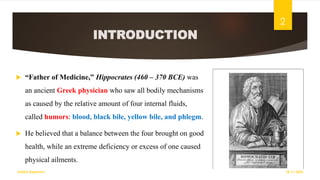
 “Father of Medicine,” Hippocrates (460 – 370 BCE) was
an ancient Greek physician who saw all bodily mechanisms
as caused by the relative amount of four internal fluids,
called humors: blood, black bile, yellow bile, and phlegm.
 He believed that a balance between the four brought on good
health, while an extreme deficiency or excess of one caused
physical ailments.
18-11-2022
Sathish Rajamani
2
INTRODUCTION
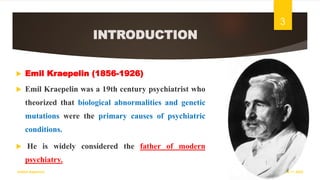
 Emil Kraepelin (1856-1926)
 Emil Kraepelin was a 19th century psychiatrist who
theorized that biological abnormalities and genetic
mutations were the primary causes of psychiatric
conditions.
 He is widely considered the father of modern
psychiatry.
18-11-2022
Sathish Rajamani
3
INTRODUCTION
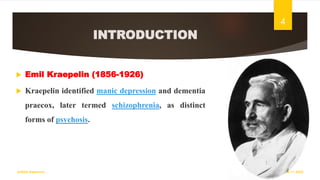
 Emil Kraepelin (1856-1926)
 Kraepelin identified manic depression and dementia
praecox, later termed schizophrenia, as distinct
forms of psychosis.
18-11-2022
Sathish Rajamani
4
MOOD & AFFECT
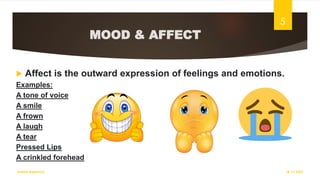
 Affect is the outward expression of feelings and emotions.
Examples:
A tone of voice
A smile
A frown
A laugh
A tear
Pressed Lips
A crinkled forehead
18-11-2022
Sathish Rajamani
5
MOOD & AFFECT
 There are different types of affect.
 Broad affect - Also known as full affect, describes the typical affect expected of the average person.
Examples: a student got 100% on an exam and appears happy and reports that she feels happy. The
student is exhibiting broad affect.
 Restricted affect - also known as constricted affect, describes a small reduction in affect. Example:
when in therapy, Sarah occasionally has difficulty expressing emotions and will have little
reaction to explaining sad or happy things. However, most of the time she is able to show emotions
through her affect. Therefore, Sarah is experiencing restricted affect.
 Blunted affect - occurs when an individual's emotions or expressions are less reactive
to stimuli than average. For example, Josh is told that his mother died, but does
not cry and appears to be minimally sad.
18-11-2022
Sathish Rajamani
6
MOOD & AFFECT
 There are different types of affect.
 Flat affect - Occurs when an individual has a complete lack of expression, feeling, or emotion,
regardless of the level of stimuli. For example, Steven is told by his doctor that he has stage 4
cancer, but he does not react at all. He seems neither sad nor happy and has a completely neutral
expression and tone of voice.
 Labile affect - occurs when a person's expressions shift unpredictably, frequently, and
excessively. Example: Josh appears happy and content after receiving ice cream at an
ice cream parlor. Suddenly, he drips a small drop of ice cream on his shoe and begins
yelling and screaming angrily, throwing his ice cream on the ground. Josh is
experiencing labile affect.
18-11-2022
Sathish Rajamani
7
MOOD & AFFECT
 Mood is a long term feeling state through which all experiences are
filtered.

 It is based on the individuals emotional background.
 It lasts for days to weeks.
 Changes spontaneously, not related to the internal or external
stimuli.
18-11-2022
Sathish Rajamani
8
DEFINITIONS
 A mood disorder is a mental health class that health professionals use to
broadly describe all types of depression and bipolar disorders.
 A mood disorder is a mental health condition that primarily affects your
emotional state. They can cause persistent and intense sadness, elation
and/or anger. Mood disorders are treatable — usually with a combination
of medication and psychotherapy (talk therapy).
18-11-2022
Sathish Rajamani
9
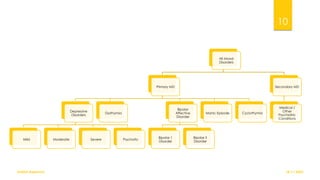
All Mood
Disorders
Primary MD
Depressive
Disorders
Mild Moderate Severe Psychotic
Dysthymia
Bipolar
Affective
Disorder
Bipolar 1
Disorder
Bipolar II
Disorder
Manic Episode Cyclothymia
Secondary MD
Medical /
Other
Psychiatric
Conditions
18-11-2022
Sathish Rajamani
10
CLASSIFICATIONS OF MOOD DISORDERS
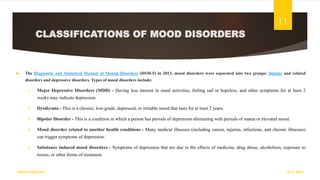
 The Diagnostic and Statistical Manual of Mental Disorders (DSM-5) in 2013, mood disorders were separated into two groups: bipolar and related
disorders and depressive disorders. Types of mood disorders include:
1. Major Depressive Disorders (MDD) - Having less interest in usual activities, feeling sad or hopeless, and other symptoms for at least 2
weeks may indicate depression.
2. Dysthymia - This is a chronic, low-grade, depressed, or irritable mood that lasts for at least 2 years.
3. Bipolar Disorder - This is a condition in which a person has periods of depression alternating with periods of mania or elevated mood.
4. Mood disorder related to another health conditions - Many medical illnesses (including cancer, injuries, infections, and chronic illnesses)
can trigger symptoms of depression.
5. Substance induced mood disorders - Symptoms of depression that are due to the effects of medicine, drug abuse, alcoholism, exposure to
toxins, or other forms of treatment.
18-11-2022
Sathish Rajamani
11
EPIDEMIOLOGY OF MOOD DISORDERS
 Major depression is one of the leading cause of disability in US (10 %) of the population.
 Depression is higher in young women (decrease with the age) and in old me (increases with age).
The median age for the onset of bipolar disorder is men was 18 and for women 20 years.
 Depression is “Common Cold” of Psychiatric disorders.
 Gender: Depression is higher in women than men (2: 1), where as bipolar disorder is almost equal
18-11-2022
Sathish Rajamani
12
EPIDEMIOLOGY OF MOOD DISORDERS
 Social class: Inverse relationship between depression and social class. While BPD is higher among
higher social classes (Professionals and Highly educated)
 Race: No consistent relationship was found with race and depreesion.
 Marital status: Depression is higher among divorced individual, separated, and individuals
without close interpersonal relations.
 Seasonal: During winter season rate of depression is high.
18-11-2022
Sathish Rajamani
13
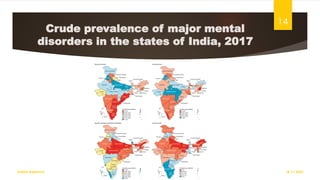
Crude prevalence of major mental
disorders in the states of India, 2017
18-11-2022
Sathish Rajamani
14
SIGNS AND SYMPTOMS OF
DEPRESSION
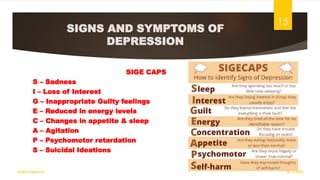
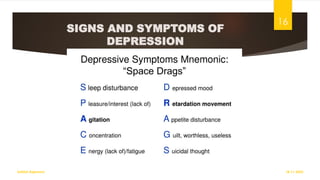
SIGE CAPS
S – Sadness
I – Loss of Interest
G – Inappropriate Guilty feelings
E – Reduced in energy levels
C – Changes in appetite & sleep
A – Agitation
P – Psychomotor retardation
S – Suicidal Ideations
18-11-2022
Sathish Rajamani
15
SIGNS AND SYMPTOMS OF
DEPRESSION
18-11-2022
Sathish Rajamani
16
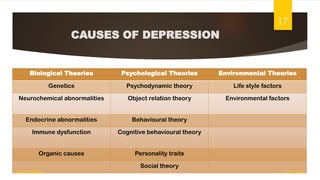
CAUSES OF DEPRESSION
Biological Theories Psychological Theories Environmental Theories
Genetics Psychodynamic theory Life style factors
Neurochemical abnormalities Object relation theory Environmental factors
Endocrine abnormalities Behavioural theory
Immune dysfunction Cognitive behavioural theory
Organic causes Personality traits
Social theory
18-11-2022
Sathish Rajamani
17
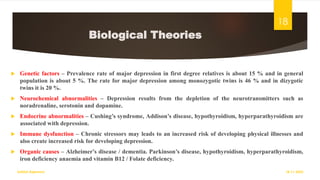
Biological Theories
 Genetic factors – Prevalence rate of major depression in first degree relatives is about 15 % and in general
population is about 5 %. The rate for major depression among monozygotic twins is 46 % and in dizygotic
twins it is 20 %.
 Neurochemical abnormalities – Depression results from the depletion of the neurotransmitters such as
noradrenaline, serotonin and dopamine.
 Endocrine abnormalities – Cushing’s syndrome, Addison’s disease, hypothyroidism, hyperparathyroidism are
associated with depression.
 Immune dysfunction – Chronic stressors may leads to an increased risk of developing physical illnesses and
also create increased risk for developing depression.
 Organic causes – Alzheimer's disease / dementia. Parkinson’s disease, hypothyroidism, hyperparathyroidism,
iron deficiency anaemia and vitamin B12 / Folate deficiency.
18-11-2022
Sathish Rajamani
18
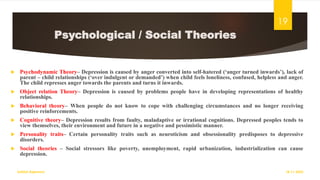
Psychological / Social Theories
 Psychodynamic Theory– Depression is caused by anger converted into self-hatered (‘anger turned inwards’), lack of
parent – child relationships (‘over indulgent or demanded’) when child feels loneliness, confused, helpless and anger.
The child represses anger towards the parents and turns it inwards.
 Object relation Theory– Depression is caused by problems people have in developing representations of healthy
relationships.
 Behavioral theory– When people do not know to cope with challenging circumstances and no longer receiving
positive reinforcements.
 Cognitive theory– Depression results from faulty, maladaptive or irrational cognitions. Depressed peoples tends to
view themselves, their environment and future in a negative and pessimistic manner.
 Personality traits– Certain personality traits such as neuroticism and obsessionality predisposes to depressive
disorders.
 Social theories – Social stressors like poverty, unemployment, rapid urbanization, industrialization can cause
depression.
18-11-2022
Sathish Rajamani
19
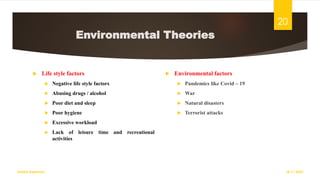
Environmental Theories
 Life style factors
 Negative life style factors
 Abusing drugs / alcohol
 Poor diet and sleep
 Poor hygiene
 Excessive workload
 Lack of leisure time and recreational
activities
 Environmental factors
 Pandemics like Covid – 19
 War
 Natural disasters
 Terrorist attacks
18-11-2022
Sathish Rajamani
20
18-11-2022
Sathish Rajamani
21
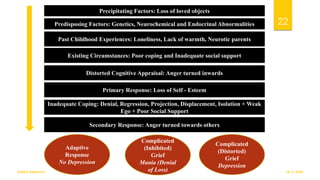
Precipitating Factors: Loss of loved objects
Predisposing Factors: Genetics, Neurochemical and Endocrinal Abnormalities
Past Childhood Experiences: Loneliness, Lack of warmth, Neurotic parents
Existing Circumstances: Poor coping and Inadequate social support
Distorted Cognitive Appraisal: Anger turned inwards
Primary Response: Loss of Self - Esteem
Inadequate Coping: Denial, Regression, Projection, Displacement, Isolation + Weak
Ego + Poor Social Support
Secondary Response: Anger turned towards others
Adaptive
Response
No Depression
Complicated
(Inhibited)
Grief
Mania (Denial
of Loss)
Complicated
(Distorted)
Grief
Depression
18-11-2022
Sathish Rajamani
22
18-11-2022
Sathish Rajamani
23
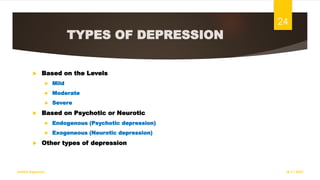
TYPES OF DEPRESSION
 Based on the Levels
 Mild
 Moderate
 Severe
 Based on Psychotic or Neurotic
 Endogenous (Psychotic depression)
 Exogeneous (Neurotic depression)
 Other types of depression
18-11-2022
Sathish Rajamani
24
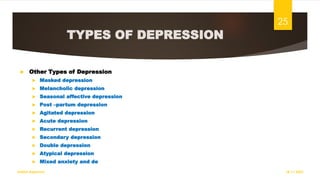
TYPES OF DEPRESSION
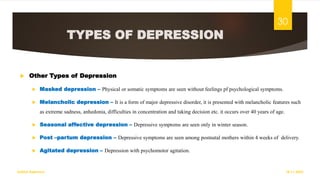
 Other Types of Depression
 Masked depression
 Melancholic depression
 Seasonal affective depression
 Post –partum depression
 Agitated depression
 Acute depression
 Recurrent depression
 Secondary depression
 Double depression
 Atypical depression
 Mixed anxiety and de
18-11-2022
Sathish Rajamani
25
TYPES OF DEPRESSION
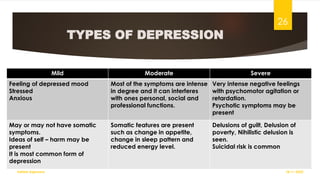
Mild Moderate Severe
Feeling of depressed mood
Stressed
Anxious
Most of the symptoms are intense
in degree and it can interferes
with ones personal, social and
professional functions.
Very intense negative feelings
with psychomotor agitation or
retardation.
Psychotic symptoms may be
present
May or may not have somatic
symptoms.
Ideas of self – harm may be
present
It is most common form of
depression
Somatic features are present
such as change in appetite,
change in sleep pattern and
reduced energy level.
Delusions of guilt, Delusion of
poverty, Nihilistic delusion is
seen.
Suicidal risk is common
18-11-2022
Sathish Rajamani
26
TYPES OF DEPRESSION
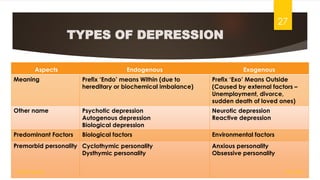
Aspects Endogenous Exogenous
Meaning Prefix ‘Endo’ means Within (due to
hereditary or biochemical imbalance)
Prefix ‘Exo’ Means Outside
(Caused by external factors –
Unemployment, divorce,
sudden death of loved ones)
Other name Psychotic depression
Autogenous depression
Biological depression
Neurotic depression
Reactive depression
Predominant Factors Biological factors Environmental factors
Premorbid personality Cyclothymic personality
Dysthymic personality
Anxious personality
Obsessive personality
18-11-2022
Sathish Rajamani
27
TYPES OF DEPRESSION
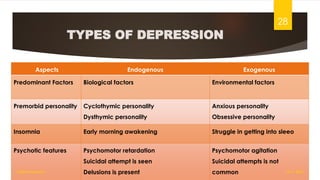
Aspects Endogenous Exogenous
Predominant Factors Biological factors Environmental factors
Premorbid personality Cyclothymic personality
Dysthymic personality
Anxious personality
Obsessive personality
Insomnia Early morning awakening Struggle in getting into sleeo
Psychotic features Psychomotor retardation
Suicidal attempt is seen
Delusions is present
Psychomotor agitation
Suicidal attempts is not
common 18-11-2022
Sathish Rajamani
28
TYPES OF DEPRESSION
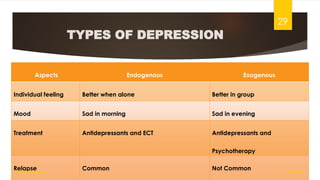
Aspects Endogenous Exogenous
Individual feeling Better when alone Better in group
Mood Sad in morning Sad in evening
Treatment Antidepressants and ECT Antidepressants and
Psychotherapy
Relapse Common Not Common 18-11-2022
Sathish Rajamani
29
TYPES OF DEPRESSION
 Other Types of Depression
 Masked depression – Physical or somatic symptoms are seen without feelings pf psychological symptoms.
 Melancholic depression – It is a form of major depressive disorder, it is presented with melancholic features such
as extreme sadness, anhedonia, difficulties in concentration and taking decision etc. it occurs over 40 years of age.
 Seasonal affective depression – Depressive symptoms are seen only in winter season.
 Post –partum depression – Depressive symptoms are seen among postnatal mothers within 4 weeks of delivery.
 Agitated depression – Depression with psychomotor agitation.
18-11-2022
Sathish Rajamani
30
TYPES OF DEPRESSION
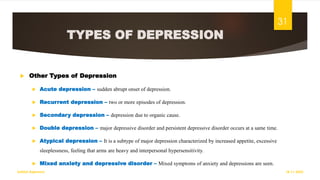
 Other Types of Depression
 Acute depression – sudden abrupt onset of depression.
 Recurrent depression – two or more episodes of depression.
 Secondary depression – depression due to organic cause.
 Double depression – major depressive disorder and persistent depressive disorder occurs at a same time.
 Atypical depression – It is a subtype of major depression characterized by increased appetite, excessive
sleeplessness, feeling that arms are heavy and interpersonal hypersensitivity.
 Mixed anxiety and depressive disorder – Mixed symptoms of anxiety and depressions are seen.
18-11-2022
Sathish Rajamani
31
DIAGNOSIS OF DEPRESSION
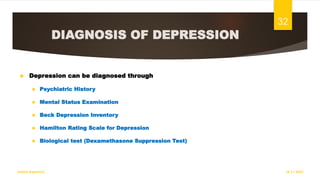
 Depression can be diagnosed through
 Psychiatric History
 Mental Status Examination
 Beck Depression Inventory
 Hamilton Rating Scale for Depression
 Biological test (Dexamethasone Suppression Test)
18-11-2022
Sathish Rajamani
32
MANAGEMENT
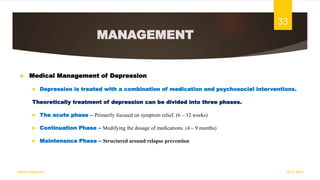
 Medical Management of Depression
 Depression is treated with a combination of medication and psychosocial interventions.
Theoretically treatment of depression can be divided into three phases.
 The acute phase – Primarily focused on symptom relief. (6 – 12 weeks)
 Continuation Phase – Modifying the dosage of medications. (4 – 9 months)
 Maintenance Phase – Structured around relapse prevention
18-11-2022
Sathish Rajamani
33
MANAGEMENT
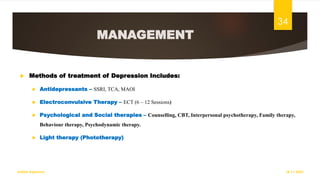
 Methods of treatment of Depression Includes:
 Antidepressants – SSRI, TCA, MAOI
 Electroconvulsive Therapy – ECT (6 – 12 Sessions)
 Psychological and Social therapies – Counselling, CBT, Interpersonal psychotherapy, Family therapy,
Behaviour therapy, Psychodynamic therapy.
 Light therapy (Phototherapy)
18-11-2022
Sathish Rajamani
34
IMPORTANT CONSIDERATIONS
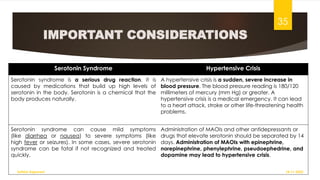
Serotonin Syndrome Hypertensive Crisis
Serotonin syndrome is a serious drug reaction. It is
caused by medications that build up high levels of
serotonin in the body. Serotonin is a chemical that the
body produces naturally.
A hypertensive crisis is a sudden, severe increase in
blood pressure. The blood pressure reading is 180/120
millimeters of mercury (mm Hg) or greater. A
hypertensive crisis is a medical emergency. It can lead
to a heart attack, stroke or other life-threatening health
problems.
Serotonin syndrome can cause mild symptoms
(like diarrhea or nausea) to severe symptoms (like
high fever or seizures). In some cases, severe serotonin
syndrome can be fatal if not recognized and treated
quickly.
Administration of MAOIs and other antidepressants or
drugs that elevate serotonin should be separated by 14
days. Administration of MAOIs with epinephrine,
norepinephrine, phenylephrine, pseudoephedrine, and
dopamine may lead to hypertensive crisis.
18-11-2022
Sathish Rajamani
35
PROGNOSIS OF DEPRESSION
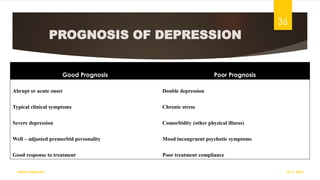
Good Prognosis Poor Prognosis
Abrupt or acute onset
Typical clinical symptoms
Severe depression
Well – adjusted premorbid personality
Good response to treatment
Double depression
Chronic stress
Comorbidity (other physical illness)
Mood incongruent psychotic symptoms
Poor treatment compliance
18-11-2022
Sathish Rajamani
36
18-11-2022
Sathish Rajamani
37

Depression.pdf

  • 1.
    MOOD DISORDERS PROF SATHISHRAJAMANI DSCON - CUTTACK 1
  • 2.
    INTRODUCTION  “Father ofMedicine,” Hippocrates (460 – 370 BCE) was an ancient Greek physician who saw all bodily mechanisms as caused by the relative amount of four internal fluids, called humors: blood, black bile, yellow bile, and phlegm.  He believed that a balance between the four brought on good health, while an extreme deficiency or excess of one caused physical ailments. 18-11-2022 Sathish Rajamani 2
  • 3.
    INTRODUCTION  Emil Kraepelin(1856-1926)  Emil Kraepelin was a 19th century psychiatrist who theorized that biological abnormalities and genetic mutations were the primary causes of psychiatric conditions.  He is widely considered the father of modern psychiatry. 18-11-2022 Sathish Rajamani 3
  • 4.
    INTRODUCTION  Emil Kraepelin(1856-1926)  Kraepelin identified manic depression and dementia praecox, later termed schizophrenia, as distinct forms of psychosis. 18-11-2022 Sathish Rajamani 4
  • 5.
    MOOD & AFFECT Affect is the outward expression of feelings and emotions. Examples: A tone of voice A smile A frown A laugh A tear Pressed Lips A crinkled forehead 18-11-2022 Sathish Rajamani 5
  • 6.
    MOOD & AFFECT There are different types of affect.  Broad affect - Also known as full affect, describes the typical affect expected of the average person. Examples: a student got 100% on an exam and appears happy and reports that she feels happy. The student is exhibiting broad affect.  Restricted affect - also known as constricted affect, describes a small reduction in affect. Example: when in therapy, Sarah occasionally has difficulty expressing emotions and will have little reaction to explaining sad or happy things. However, most of the time she is able to show emotions through her affect. Therefore, Sarah is experiencing restricted affect.  Blunted affect - occurs when an individual's emotions or expressions are less reactive to stimuli than average. For example, Josh is told that his mother died, but does not cry and appears to be minimally sad. 18-11-2022 Sathish Rajamani 6
  • 7.
    MOOD & AFFECT There are different types of affect.  Flat affect - Occurs when an individual has a complete lack of expression, feeling, or emotion, regardless of the level of stimuli. For example, Steven is told by his doctor that he has stage 4 cancer, but he does not react at all. He seems neither sad nor happy and has a completely neutral expression and tone of voice.  Labile affect - occurs when a person's expressions shift unpredictably, frequently, and excessively. Example: Josh appears happy and content after receiving ice cream at an ice cream parlor. Suddenly, he drips a small drop of ice cream on his shoe and begins yelling and screaming angrily, throwing his ice cream on the ground. Josh is experiencing labile affect. 18-11-2022 Sathish Rajamani 7
  • 8.
    MOOD & AFFECT Mood is a long term feeling state through which all experiences are filtered.  It is based on the individuals emotional background.  It lasts for days to weeks.  Changes spontaneously, not related to the internal or external stimuli. 18-11-2022 Sathish Rajamani 8
  • 9.
    DEFINITIONS  A mooddisorder is a mental health class that health professionals use to broadly describe all types of depression and bipolar disorders.  A mood disorder is a mental health condition that primarily affects your emotional state. They can cause persistent and intense sadness, elation and/or anger. Mood disorders are treatable — usually with a combination of medication and psychotherapy (talk therapy). 18-11-2022 Sathish Rajamani 9
  • 10.
    All Mood Disorders Primary MD Depressive Disorders MildModerate Severe Psychotic Dysthymia Bipolar Affective Disorder Bipolar 1 Disorder Bipolar II Disorder Manic Episode Cyclothymia Secondary MD Medical / Other Psychiatric Conditions 18-11-2022 Sathish Rajamani 10
  • 11.
    CLASSIFICATIONS OF MOODDISORDERS  The Diagnostic and Statistical Manual of Mental Disorders (DSM-5) in 2013, mood disorders were separated into two groups: bipolar and related disorders and depressive disorders. Types of mood disorders include: 1. Major Depressive Disorders (MDD) - Having less interest in usual activities, feeling sad or hopeless, and other symptoms for at least 2 weeks may indicate depression. 2. Dysthymia - This is a chronic, low-grade, depressed, or irritable mood that lasts for at least 2 years. 3. Bipolar Disorder - This is a condition in which a person has periods of depression alternating with periods of mania or elevated mood. 4. Mood disorder related to another health conditions - Many medical illnesses (including cancer, injuries, infections, and chronic illnesses) can trigger symptoms of depression. 5. Substance induced mood disorders - Symptoms of depression that are due to the effects of medicine, drug abuse, alcoholism, exposure to toxins, or other forms of treatment. 18-11-2022 Sathish Rajamani 11
  • 12.
    EPIDEMIOLOGY OF MOODDISORDERS  Major depression is one of the leading cause of disability in US (10 %) of the population.  Depression is higher in young women (decrease with the age) and in old me (increases with age). The median age for the onset of bipolar disorder is men was 18 and for women 20 years.  Depression is “Common Cold” of Psychiatric disorders.  Gender: Depression is higher in women than men (2: 1), where as bipolar disorder is almost equal 18-11-2022 Sathish Rajamani 12
  • 13.
    EPIDEMIOLOGY OF MOODDISORDERS  Social class: Inverse relationship between depression and social class. While BPD is higher among higher social classes (Professionals and Highly educated)  Race: No consistent relationship was found with race and depreesion.  Marital status: Depression is higher among divorced individual, separated, and individuals without close interpersonal relations.  Seasonal: During winter season rate of depression is high. 18-11-2022 Sathish Rajamani 13
  • 14.
    Crude prevalence ofmajor mental disorders in the states of India, 2017 18-11-2022 Sathish Rajamani 14
  • 15.
    SIGNS AND SYMPTOMSOF DEPRESSION SIGE CAPS S – Sadness I – Loss of Interest G – Inappropriate Guilty feelings E – Reduced in energy levels C – Changes in appetite & sleep A – Agitation P – Psychomotor retardation S – Suicidal Ideations 18-11-2022 Sathish Rajamani 15
  • 16.
    SIGNS AND SYMPTOMSOF DEPRESSION 18-11-2022 Sathish Rajamani 16
  • 17.
    CAUSES OF DEPRESSION BiologicalTheories Psychological Theories Environmental Theories Genetics Psychodynamic theory Life style factors Neurochemical abnormalities Object relation theory Environmental factors Endocrine abnormalities Behavioural theory Immune dysfunction Cognitive behavioural theory Organic causes Personality traits Social theory 18-11-2022 Sathish Rajamani 17
  • 18.
    Biological Theories  Geneticfactors – Prevalence rate of major depression in first degree relatives is about 15 % and in general population is about 5 %. The rate for major depression among monozygotic twins is 46 % and in dizygotic twins it is 20 %.  Neurochemical abnormalities – Depression results from the depletion of the neurotransmitters such as noradrenaline, serotonin and dopamine.  Endocrine abnormalities – Cushing’s syndrome, Addison’s disease, hypothyroidism, hyperparathyroidism are associated with depression.  Immune dysfunction – Chronic stressors may leads to an increased risk of developing physical illnesses and also create increased risk for developing depression.  Organic causes – Alzheimer's disease / dementia. Parkinson’s disease, hypothyroidism, hyperparathyroidism, iron deficiency anaemia and vitamin B12 / Folate deficiency. 18-11-2022 Sathish Rajamani 18
  • 19.
    Psychological / SocialTheories  Psychodynamic Theory– Depression is caused by anger converted into self-hatered (‘anger turned inwards’), lack of parent – child relationships (‘over indulgent or demanded’) when child feels loneliness, confused, helpless and anger. The child represses anger towards the parents and turns it inwards.  Object relation Theory– Depression is caused by problems people have in developing representations of healthy relationships.  Behavioral theory– When people do not know to cope with challenging circumstances and no longer receiving positive reinforcements.  Cognitive theory– Depression results from faulty, maladaptive or irrational cognitions. Depressed peoples tends to view themselves, their environment and future in a negative and pessimistic manner.  Personality traits– Certain personality traits such as neuroticism and obsessionality predisposes to depressive disorders.  Social theories – Social stressors like poverty, unemployment, rapid urbanization, industrialization can cause depression. 18-11-2022 Sathish Rajamani 19
  • 20.
    Environmental Theories  Lifestyle factors  Negative life style factors  Abusing drugs / alcohol  Poor diet and sleep  Poor hygiene  Excessive workload  Lack of leisure time and recreational activities  Environmental factors  Pandemics like Covid – 19  War  Natural disasters  Terrorist attacks 18-11-2022 Sathish Rajamani 20
  • 21.
  • 22.
    Precipitating Factors: Lossof loved objects Predisposing Factors: Genetics, Neurochemical and Endocrinal Abnormalities Past Childhood Experiences: Loneliness, Lack of warmth, Neurotic parents Existing Circumstances: Poor coping and Inadequate social support Distorted Cognitive Appraisal: Anger turned inwards Primary Response: Loss of Self - Esteem Inadequate Coping: Denial, Regression, Projection, Displacement, Isolation + Weak Ego + Poor Social Support Secondary Response: Anger turned towards others Adaptive Response No Depression Complicated (Inhibited) Grief Mania (Denial of Loss) Complicated (Distorted) Grief Depression 18-11-2022 Sathish Rajamani 22
  • 23.
  • 24.
    TYPES OF DEPRESSION Based on the Levels  Mild  Moderate  Severe  Based on Psychotic or Neurotic  Endogenous (Psychotic depression)  Exogeneous (Neurotic depression)  Other types of depression 18-11-2022 Sathish Rajamani 24
  • 25.
    TYPES OF DEPRESSION Other Types of Depression  Masked depression  Melancholic depression  Seasonal affective depression  Post –partum depression  Agitated depression  Acute depression  Recurrent depression  Secondary depression  Double depression  Atypical depression  Mixed anxiety and de 18-11-2022 Sathish Rajamani 25
  • 26.
    TYPES OF DEPRESSION MildModerate Severe Feeling of depressed mood Stressed Anxious Most of the symptoms are intense in degree and it can interferes with ones personal, social and professional functions. Very intense negative feelings with psychomotor agitation or retardation. Psychotic symptoms may be present May or may not have somatic symptoms. Ideas of self – harm may be present It is most common form of depression Somatic features are present such as change in appetite, change in sleep pattern and reduced energy level. Delusions of guilt, Delusion of poverty, Nihilistic delusion is seen. Suicidal risk is common 18-11-2022 Sathish Rajamani 26
  • 27.
    TYPES OF DEPRESSION AspectsEndogenous Exogenous Meaning Prefix ‘Endo’ means Within (due to hereditary or biochemical imbalance) Prefix ‘Exo’ Means Outside (Caused by external factors – Unemployment, divorce, sudden death of loved ones) Other name Psychotic depression Autogenous depression Biological depression Neurotic depression Reactive depression Predominant Factors Biological factors Environmental factors Premorbid personality Cyclothymic personality Dysthymic personality Anxious personality Obsessive personality 18-11-2022 Sathish Rajamani 27
  • 28.
    TYPES OF DEPRESSION AspectsEndogenous Exogenous Predominant Factors Biological factors Environmental factors Premorbid personality Cyclothymic personality Dysthymic personality Anxious personality Obsessive personality Insomnia Early morning awakening Struggle in getting into sleeo Psychotic features Psychomotor retardation Suicidal attempt is seen Delusions is present Psychomotor agitation Suicidal attempts is not common 18-11-2022 Sathish Rajamani 28
  • 29.
    TYPES OF DEPRESSION AspectsEndogenous Exogenous Individual feeling Better when alone Better in group Mood Sad in morning Sad in evening Treatment Antidepressants and ECT Antidepressants and Psychotherapy Relapse Common Not Common 18-11-2022 Sathish Rajamani 29
  • 30.
    TYPES OF DEPRESSION Other Types of Depression  Masked depression – Physical or somatic symptoms are seen without feelings pf psychological symptoms.  Melancholic depression – It is a form of major depressive disorder, it is presented with melancholic features such as extreme sadness, anhedonia, difficulties in concentration and taking decision etc. it occurs over 40 years of age.  Seasonal affective depression – Depressive symptoms are seen only in winter season.  Post –partum depression – Depressive symptoms are seen among postnatal mothers within 4 weeks of delivery.  Agitated depression – Depression with psychomotor agitation. 18-11-2022 Sathish Rajamani 30
  • 31.
    TYPES OF DEPRESSION Other Types of Depression  Acute depression – sudden abrupt onset of depression.  Recurrent depression – two or more episodes of depression.  Secondary depression – depression due to organic cause.  Double depression – major depressive disorder and persistent depressive disorder occurs at a same time.  Atypical depression – It is a subtype of major depression characterized by increased appetite, excessive sleeplessness, feeling that arms are heavy and interpersonal hypersensitivity.  Mixed anxiety and depressive disorder – Mixed symptoms of anxiety and depressions are seen. 18-11-2022 Sathish Rajamani 31
  • 32.
    DIAGNOSIS OF DEPRESSION Depression can be diagnosed through  Psychiatric History  Mental Status Examination  Beck Depression Inventory  Hamilton Rating Scale for Depression  Biological test (Dexamethasone Suppression Test) 18-11-2022 Sathish Rajamani 32
  • 33.
    MANAGEMENT  Medical Managementof Depression  Depression is treated with a combination of medication and psychosocial interventions. Theoretically treatment of depression can be divided into three phases.  The acute phase – Primarily focused on symptom relief. (6 – 12 weeks)  Continuation Phase – Modifying the dosage of medications. (4 – 9 months)  Maintenance Phase – Structured around relapse prevention 18-11-2022 Sathish Rajamani 33
  • 34.
    MANAGEMENT  Methods oftreatment of Depression Includes:  Antidepressants – SSRI, TCA, MAOI  Electroconvulsive Therapy – ECT (6 – 12 Sessions)  Psychological and Social therapies – Counselling, CBT, Interpersonal psychotherapy, Family therapy, Behaviour therapy, Psychodynamic therapy.  Light therapy (Phototherapy) 18-11-2022 Sathish Rajamani 34
  • 35.
    IMPORTANT CONSIDERATIONS Serotonin SyndromeHypertensive Crisis Serotonin syndrome is a serious drug reaction. It is caused by medications that build up high levels of serotonin in the body. Serotonin is a chemical that the body produces naturally. A hypertensive crisis is a sudden, severe increase in blood pressure. The blood pressure reading is 180/120 millimeters of mercury (mm Hg) or greater. A hypertensive crisis is a medical emergency. It can lead to a heart attack, stroke or other life-threatening health problems. Serotonin syndrome can cause mild symptoms (like diarrhea or nausea) to severe symptoms (like high fever or seizures). In some cases, severe serotonin syndrome can be fatal if not recognized and treated quickly. Administration of MAOIs and other antidepressants or drugs that elevate serotonin should be separated by 14 days. Administration of MAOIs with epinephrine, norepinephrine, phenylephrine, pseudoephedrine, and dopamine may lead to hypertensive crisis. 18-11-2022 Sathish Rajamani 35
  • 36.
    PROGNOSIS OF DEPRESSION GoodPrognosis Poor Prognosis Abrupt or acute onset Typical clinical symptoms Severe depression Well – adjusted premorbid personality Good response to treatment Double depression Chronic stress Comorbidity (other physical illness) Mood incongruent psychotic symptoms Poor treatment compliance 18-11-2022 Sathish Rajamani 36
  • 37.