Research objective, Research
Questions, and Hypotheses
Dr.Naglaa Ibrahim Gida
-- IntroductionIntroduction
- Research aim- Research aim
- Research objective
-Research Questions
- Research Hypotheses
3
Introduction
• Any research must have clear aims and
objectives.
The aim (goal ) and objectives must be stated
at the very beginning of the study, since they
will guide the researcher during the process
formulating research questions and
hypothesis.
•They will enable the reader or consumer
of the work to judge whether the
researcher had achieved these objectives
or not.
What are aims
Aims are simple and broad
statements of intent that describe
what the study wants to achieve.
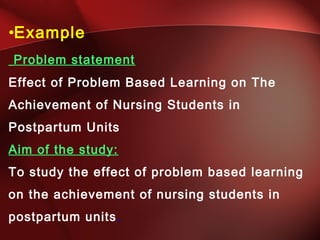
•Example
Problem statement
Effect of Problem Based Learning on The
Achievement of Nursing Students in
Postpartum Units
Aim of the study:
To study the effect of problem based learning
on the achievement of nursing students in
postpartum units.
Definition of Research Objective
• Objectives refer to expected or intended
researcher outcomes.
• Specific knowledge, skills, or attitudes that
researcher are expected to achieve through
their college experience.
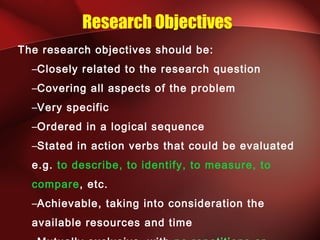
Research Objectives
The research objectives should be:
–Closely related to the research question
–Covering all aspects of the problem
–Very specific
–Ordered in a logical sequence
–Stated in action verbs that could be evaluated
e.g. to describe, to identify, to measure, to
compare, etc.
–Achievable, taking into consideration the
available resources and time
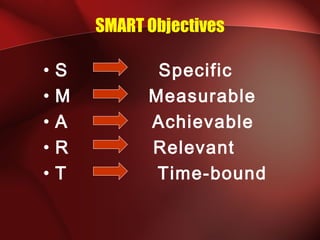
SMART Objectives
• S Specific
• M Measurable
• A Achievable
• R Relevant
• T Time-bound
Research objectives
•Properly formulated, specific objectives
will facilitate the development of the
research methodology and will help to
orient the collection, analysis,
interpretation and utilization of data.
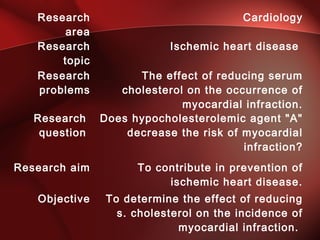
Research
area
Cardiology
Research
topic
Ischemic heart disease
Research
problems
The effect of reducing serum
cholesterol on the occurrence of
myocardial infraction.
Research
question
Does hypocholesterolemic agent "A"
decrease the risk of myocardial
infraction?
Research aim To contribute in prevention of
ischemic heart disease.
Objective To determine the effect of reducing
s. cholesterol on the incidence of
myocardial infraction.
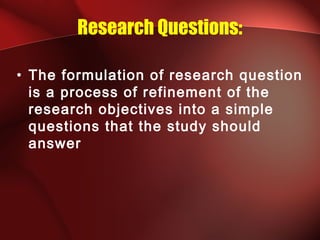
Research Questions:
• The formulation of research question
is a process of refinement of the
research objectives into a simple
questions that the study should
answer
1-Question is consider the fundamental of research , it1-Question is consider the fundamental of research , it
help the research to clarify in her mind thosehelp the research to clarify in her mind those
questions which need to be answer.questions which need to be answer.
2-Help to understand stage of the research process.2-Help to understand stage of the research process.
3-Variety of question formats reflects the type of3-Variety of question formats reflects the type of
research carried out and the personal preference ofresearch carried out and the personal preference of
researchers.researchers.
Purpose of Research Questions
3-The terms and concepts used by the3-The terms and concepts used by the
researcher must be defined in ways thatresearcher must be defined in ways that
can be understood by others who readcan be understood by others who read
the article or reportthe article or report..
Is a concise, interrogative statement that isIs a concise, interrogative statement that is
worded in the present tense and include one orworded in the present tense and include one or
more variables.more variables.
Formulation of Research Questions
CharacteristicCharacteristic
ss
Research question may be description of variable,Research question may be description of variable,
oror
Examination of relationship among variables, orExamination of relationship among variables, or
Determination of differences between two or moreDetermination of differences between two or more
For ExampleFor Example
1- How is a variable1- How is a variable “X”“X” described in a specifieddescribed in a specified
population? “description” .population? “description” .
2- What is the relationship between variable2- What is the relationship between variable “X”“X”
and,and, “Y”“Y” in a specified population?in a specified population?
“Relational”.“Relational”.
3- Is there difference between group3- Is there difference between group ”1”,”1”, andand
“2”“2” regarding variableregarding variable “X”“X” ? “difference”? “difference”
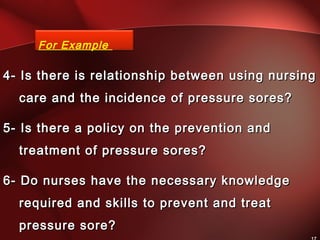
4- Is there is relationship between using nursing4- Is there is relationship between using nursing
care and the incidence of pressure sores?care and the incidence of pressure sores?
5- Is there a policy on the prevention and5- Is there a policy on the prevention and
treatment of pressure sores?treatment of pressure sores?
6- Do nurses have the necessary knowledge6- Do nurses have the necessary knowledge
required and skills to prevent and treatrequired and skills to prevent and treat
pressure sore?pressure sore?
For Example
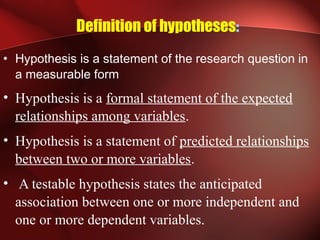
Definition of hypotheses:
• Hypothesis is a statement of the research question in
a measurable form
• Hypothesis is a formal statement of the expected
relationships among variables.
• Hypothesis is a statement of predicted relationships
between two or more variables.
• A testable hypothesis states the anticipated
association between one or more independent and
one or more dependent variables.
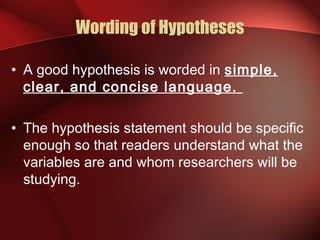
Wording of Hypotheses
• A good hypothesis is worded in simple,
clear, and concise language.
• The hypothesis statement should be specific
enough so that readers understand what the
variables are and whom researchers will be
studying.
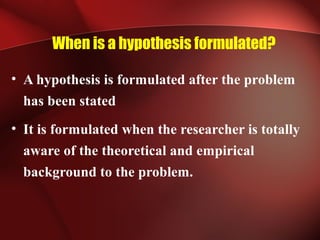
When is a hypothesis formulated?
• A hypothesis is formulated after the problem
has been stated
• It is formulated when the researcher is totally
aware of the theoretical and empirical
background to the problem.
The purpose and function of a hypothesis:
• It offers explanation for the relationships between
variables that can be tested.
• It Provides a proof that the researcher has sufficient
background knowledge to enable him/her to make
suggestions in order to extend existing knowledge.
• It gives direction to investigation.
• It structures the next phase in the examination of the
problems.
Characteristics of good
hypothesis:
• It is testable
• It is logical
• It is directly related to the research problem
• It is factually or theoretically based
• It states a relationship between variables
• It is stated in such a form that it can be accepted or
rejected.
1. Simple and Complex
a. Simple Hypothesis
contains one independent variable and one dependent
variable.
• Examples of a simple hypothesis:
1-There is relationship between smoking [IV] and lung cancer
[DV]
Simple and Complex
b. Complex Hypothesis
Predicts the relationship between 3 or more variables
• Example of a complex hypothesis—multiple
independent variables:
Among breast cancer survivors, emotional
wellbeing [DV] is influenced by the women’s self-
esteem [IV1], their resourcefulness [IV2] and their
degree of social support [IV3]
2- Directional and Non-Directional
a. Directional Hypothesis
Tells the reader the direction of the relationship between
the two variables = more specific about the nature of
the relationship
• Directional hypothesis may read,”…is more than..”,
“…will be lesser..”
• Example:
“Children with high IQ will exhibit more anxiety than
children with low IQ”
Directional and Non-Directional Hypothesis
b. Non-Directional Hypothesis
Do not specify the nature of the relationship between the
variables
• It may read, “..there is a difference between..”
Example:
“There is a difference in the anxiety level of the children of
high IQ and those of low IQ.”
3- Null Hypothesis
• A null hypothesis
Is a statement that there is no actual relationship
between variables.
• Example:
• “There is no significant difference in the anxiety
level of children of High IQ and those of low IQ.”
• Passive smoking has no relation to lung
cancer
LOCATING RELEVANT LITERATURE FOR A
RESEARCH REVIEW
1-Electronic resources
• The two electronic databases that are
most likely to be useful to nurse
researchers:
• 1- CINAHL (Cumulative Index to Nursing and
Allied Health Literature). WWW. Cinahl. com
• 2- MEDLINE (Medical Literature On-Line).
• 2-Print resources

6 research problem - copy - copy - copy (1)

  • 1.
    Research objective, Research Questions,and Hypotheses Dr.Naglaa Ibrahim Gida
  • 2.
    -- IntroductionIntroduction - Researchaim- Research aim - Research objective -Research Questions - Research Hypotheses
  • 3.
    3 Introduction • Any researchmust have clear aims and objectives. The aim (goal ) and objectives must be stated at the very beginning of the study, since they will guide the researcher during the process formulating research questions and hypothesis.
  • 4.
    •They will enablethe reader or consumer of the work to judge whether the researcher had achieved these objectives or not.
  • 5.
    What are aims Aimsare simple and broad statements of intent that describe what the study wants to achieve.
  • 6.
    •Example Problem statement Effect ofProblem Based Learning on The Achievement of Nursing Students in Postpartum Units Aim of the study: To study the effect of problem based learning on the achievement of nursing students in postpartum units.
  • 7.
    Definition of ResearchObjective • Objectives refer to expected or intended researcher outcomes. • Specific knowledge, skills, or attitudes that researcher are expected to achieve through their college experience.
  • 8.
    Research Objectives The researchobjectives should be: –Closely related to the research question –Covering all aspects of the problem –Very specific –Ordered in a logical sequence –Stated in action verbs that could be evaluated e.g. to describe, to identify, to measure, to compare, etc. –Achievable, taking into consideration the available resources and time
  • 9.
    SMART Objectives • SSpecific • M Measurable • A Achievable • R Relevant • T Time-bound
  • 10.
    Research objectives •Properly formulated,specific objectives will facilitate the development of the research methodology and will help to orient the collection, analysis, interpretation and utilization of data.
  • 11.
    Research area Cardiology Research topic Ischemic heart disease Research problems Theeffect of reducing serum cholesterol on the occurrence of myocardial infraction. Research question Does hypocholesterolemic agent "A" decrease the risk of myocardial infraction? Research aim To contribute in prevention of ischemic heart disease. Objective To determine the effect of reducing s. cholesterol on the incidence of myocardial infraction.
  • 12.
    Research Questions: • Theformulation of research question is a process of refinement of the research objectives into a simple questions that the study should answer
  • 13.
    1-Question is considerthe fundamental of research , it1-Question is consider the fundamental of research , it help the research to clarify in her mind thosehelp the research to clarify in her mind those questions which need to be answer.questions which need to be answer. 2-Help to understand stage of the research process.2-Help to understand stage of the research process. 3-Variety of question formats reflects the type of3-Variety of question formats reflects the type of research carried out and the personal preference ofresearch carried out and the personal preference of researchers.researchers. Purpose of Research Questions
  • 14.
    3-The terms andconcepts used by the3-The terms and concepts used by the researcher must be defined in ways thatresearcher must be defined in ways that can be understood by others who readcan be understood by others who read the article or reportthe article or report..
  • 15.
    Is a concise,interrogative statement that isIs a concise, interrogative statement that is worded in the present tense and include one orworded in the present tense and include one or more variables.more variables. Formulation of Research Questions CharacteristicCharacteristic ss Research question may be description of variable,Research question may be description of variable, oror Examination of relationship among variables, orExamination of relationship among variables, or Determination of differences between two or moreDetermination of differences between two or more
  • 16.
    For ExampleFor Example 1-How is a variable1- How is a variable “X”“X” described in a specifieddescribed in a specified population? “description” .population? “description” . 2- What is the relationship between variable2- What is the relationship between variable “X”“X” and,and, “Y”“Y” in a specified population?in a specified population? “Relational”.“Relational”. 3- Is there difference between group3- Is there difference between group ”1”,”1”, andand “2”“2” regarding variableregarding variable “X”“X” ? “difference”? “difference”
  • 17.
    4- Is thereis relationship between using nursing4- Is there is relationship between using nursing care and the incidence of pressure sores?care and the incidence of pressure sores? 5- Is there a policy on the prevention and5- Is there a policy on the prevention and treatment of pressure sores?treatment of pressure sores? 6- Do nurses have the necessary knowledge6- Do nurses have the necessary knowledge required and skills to prevent and treatrequired and skills to prevent and treat pressure sore?pressure sore? For Example
  • 18.
    Definition of hypotheses: •Hypothesis is a statement of the research question in a measurable form • Hypothesis is a formal statement of the expected relationships among variables. • Hypothesis is a statement of predicted relationships between two or more variables. • A testable hypothesis states the anticipated association between one or more independent and one or more dependent variables.
  • 19.
    Wording of Hypotheses •A good hypothesis is worded in simple, clear, and concise language. • The hypothesis statement should be specific enough so that readers understand what the variables are and whom researchers will be studying.
  • 20.
    When is ahypothesis formulated? • A hypothesis is formulated after the problem has been stated • It is formulated when the researcher is totally aware of the theoretical and empirical background to the problem.
  • 21.
    The purpose andfunction of a hypothesis: • It offers explanation for the relationships between variables that can be tested. • It Provides a proof that the researcher has sufficient background knowledge to enable him/her to make suggestions in order to extend existing knowledge. • It gives direction to investigation. • It structures the next phase in the examination of the problems.
  • 22.
    Characteristics of good hypothesis: •It is testable • It is logical • It is directly related to the research problem • It is factually or theoretically based • It states a relationship between variables • It is stated in such a form that it can be accepted or rejected.
  • 24.
    1. Simple andComplex a. Simple Hypothesis contains one independent variable and one dependent variable. • Examples of a simple hypothesis: 1-There is relationship between smoking [IV] and lung cancer [DV]
  • 25.
    Simple and Complex b.Complex Hypothesis Predicts the relationship between 3 or more variables • Example of a complex hypothesis—multiple independent variables: Among breast cancer survivors, emotional wellbeing [DV] is influenced by the women’s self- esteem [IV1], their resourcefulness [IV2] and their degree of social support [IV3]
  • 26.
    2- Directional andNon-Directional a. Directional Hypothesis Tells the reader the direction of the relationship between the two variables = more specific about the nature of the relationship • Directional hypothesis may read,”…is more than..”, “…will be lesser..” • Example: “Children with high IQ will exhibit more anxiety than children with low IQ”
  • 27.
    Directional and Non-DirectionalHypothesis b. Non-Directional Hypothesis Do not specify the nature of the relationship between the variables • It may read, “..there is a difference between..” Example: “There is a difference in the anxiety level of the children of high IQ and those of low IQ.”
  • 28.
    3- Null Hypothesis •A null hypothesis Is a statement that there is no actual relationship between variables. • Example: • “There is no significant difference in the anxiety level of children of High IQ and those of low IQ.” • Passive smoking has no relation to lung cancer
  • 30.
    LOCATING RELEVANT LITERATUREFOR A RESEARCH REVIEW 1-Electronic resources • The two electronic databases that are most likely to be useful to nurse researchers: • 1- CINAHL (Cumulative Index to Nursing and Allied Health Literature). WWW. Cinahl. com • 2- MEDLINE (Medical Literature On-Line). • 2-Print resources