
Drafting Research Proposal
By-
Prof.R.R.Borse,
Asst.Prof. & Head,
Eng.Dept.,
B.P.Arts,S.M.A.Sci.,K.K.C.Comm.College,Chalisgaon
ravindraborse1@gmail.com
Introduction
A Research Proposal:
 …is a format and detailed statement of
intent of the researcher
…..presents and justifies a plan of action
and shows the investigation plan
Introduction
Question to be asked Steps to be taken Elements of the step
What is the problem?
Why it should be
studied?
Selection and
statement of the
problem
- Problem identification
- Problem prioritization
- Justification
What information is
already available?
Literature review - Sources
- Reviewing
Why do conduct
research?
What is the achievement
of the research?
Formulation of aim
and objectives
- Aim, goals
- General and specific
objectives
- Hypothesis
How to carry out the
research?
How to collect data and
information?
Wherefrom to collect
data and information?
Research
methodology
- Variables
- Types of the research
- Data collection techniques
- Sampling
- Data analysis process, plan
- Data processing plan
- Data interpretation process,
plan
Introduction
Question to be asked Steps to be taken Elements of the step
Who will collect and when? Work plan - Self, Personnel
- Timetable
What and how much
resources are needed?
Who will provide the
resources ?
Budget
Funding Organizations
- 3 Ms: Men, materials,
money
- Fund collection, fund raising
Who will submit?
How to submit?
Where to submit?
Proposal preparation
Proposal presentation
Appropriate authority
- Researcher
- Proposal / Draft
- Presentation techniques
What is a research proposal?
 Various terminologies are used to mean a research
proposal depending on why the research is carried
out?
 Research outline
 Synopsis of research
 Plan of research
 Research/project proposal
 Thesis plan
 Etc
 …a blue print of future activities of a research project
 …some sort of preconceived framework for starting the
activities
 …a work plan, prospectus, outline, and statement of
intent ahead.
What is a research proposal?
…deals with ideas of researcher about
what research he/she wants to do
what objectives and methodology he/she has set
how much time and resources are required to complete it
how the research finding are to be reported
and so on.
…is an individual’s or a research institute's
formal offer to produce a product or render
service to a client in response to a request
from the client
In short, a proposal of a work frame for
completing the research
How to write research proposal?
 A research proposal is intended to convince others that you have a
worthwhile research project and that you have the competence and
the work-plan to complete it.
 Readers’ Evaluation: The proposal should have sufficient
information to convince your readers that you have an important
research idea, that you have a good grasp of the relevant literature
and the major issues, and that your methodology is sound.
 Regardless of your research area and the methodology you
choose, all research proposals must address the following
questions:
 What you plan to accomplish
 Why you want to do it
 How you are going to do it
Components of research proposal
Title
Concise and descriptive
Functional relationship
Informative but catchy
Introduction
Necessary background or context
Placement of research question
a current "hot" area, or an older area that remains viable.
Appropriate historical backdrop
Contemporary context in which your proposed research question
occupies the central stage
Identification of "key players" and refer to the most relevant and
representative publications (if any).
Components of research proposal
The introduction generally covers the following elements:
 State the research problem, which is often referred to as the
purpose of the study
 Provide the context and set the stage for your research question
in such a way as to show its necessity and importance
 Present the rationale of your proposed study and clearly
indicate why it is worth doing
 Briefly describe the major issues and sub-problems to be
addressed by your research.
 Identify the key independent and dependent variables of your
experiment. Alternatively, specify the phenomenon you want to
study
 Set the delimitation or boundaries of your proposed research in
order to provide a clear focus.
 Provide definitions of key concepts(This is optional).
Components of research proposal
 Literature Review (Important functions):
 Reinventing the wheel / Credits to deserved ones
 Demonstration of knowledge and understanding of the
theoretical and research issues
 Demonstration of ability to critically evaluate
 Indicates your ability to integrate and synthesize the
existing literature
 Development of a new model as the conceptual
framework
 Convinces reader regarding significance and
substantial contribution to the literature
Components of research proposal
Methods
The Method section is very important because it tells your
Research Committee how you plan to tackle your research problem.
It will provide your work plan and describe the activities necessary for
the completion of your project
 The guiding principle for writing the Method section is that it should
contain sufficient information for the reader to determine whether
methodology is sound
 Furthermore, since there are no well-established and widely
accepted canons in qualitative analysis, your method section
needs to be more elaborative than what is required for traditional
quantitative research
 More importantly, the data collection process in qualitative
research has a far greater impact on the results as compared to
quantitative research.
Components of research proposal
For quantitative studies, the method section typically consists of the
following sections:
 Design
Is it a questionnaire study or a laboratory experiment? What kind of
design do you choose?
 Subjects or participants
Who will take part in your study ? What kind of sampling procedure
do you use?
 Instruments
What kind of measuring instruments or questionnaires do you use?
Why do you choose them? Are they valid and reliable?
 Procedure
How do you plan to carry out your study? What activities are
involved? How long does it take?
Components of research proposal
Results
Obviously you do not have results at the proposal stage.
However, you need to have some idea about what kind of data
you will be collecting, and what statistical procedures will be
used in order to answer your research question or test you
hypothesis.
Discussion
It is important to convince your reader of the potential impact of
your proposed research. You need to communicate a sense of
enthusiasm and confidence without exaggerating the merits of
your proposal. That is why you also need to mention the
limitations and weaknesses of the proposed research, which
may be justified by time and financial constraints as well as by
the early developmental stage of your research area.
Common Mistakes in Proposal Writing
 Failure to provide the proper context to frame the research
question
 Failure to delimit the boundary conditions for your research
 Failure to cite landmark studies
 Failure to accurately present the theoretical and empirical
contributions by other researchers
 Failure to stay focused on the research question
 Failure to develop a coherent and persuasive argument for the
proposed research
 Too much detail on minor issues, but not enough detail on
major issues
 Too much rambling -- going "all over the map" without a clear
sense of direction. (The best proposals move forward with
ease and grace like a seamless river.)
 Too many citation lapses and incorrect references
 Too long or too short.
Guidelines on writing a research proposal
 Proposal writing is important to your pursuit of a graduate degree.
The proposal is, in effect, an intellectual scholastic (not legal) contract
between you and your supervisor/committee.
 It specifies what you will do, how you will do it, and how you will
interpret the results. Being clear about these things from the
beginning will help you complete your thesis in a timely fashion.
 A vague, weak or fuzzy proposal can lead to a long, painful, and often
unsuccessful thesis writing exercise.
 A clean, well thought-out, proposal forms the backbone for the thesis
itself. The structures are identical and through the miracle of word-
processing, your proposal will probably become your thesis.
 A good thesis proposal hinges on a good idea. Once you have a
good idea, you can draft the proposal in an evening.
 Proposals help you estimate the size of a project. Don't make the
project too big.
Guidelines on writing a research proposal
The (Longer) Standard Model
A Basic Proposal Outline:
Introduction
 Topic area
 Research question
 Significance to knowledge
Literature review
 Previous research others & yours
 Interlocking findings and Unanswered questions
 Your preliminary work on the topic
 The remaining questions and inter-locking logic
 Reprise of your research question(s) in this context
Guidelines on writing a research proposal
Methodology
 Approach
 Data needs
 Analytic techniques
 Plan for interpreting results
Expected results
Budget
Bibliography (or References)
Guidelines on writing a research proposal
The Basic Thesis Outline
Introduction
 Topic area
 Research question (finding?)
 Significance to knowledge
Literature review
 Previous research others & yours
 Interlocking findings and Unanswered questions
 Your preliminary work on the topic
 The remaining questions and inter-locking logic
 Reprise of your research question(s) in this context
Guidelines on writing a research proposal
Methodology
 Approach
 Data needs
 Analytic techniques
 Plan for interpreting results
Results
Discussion and Conclusions
Bibliography
Elements of research proposal
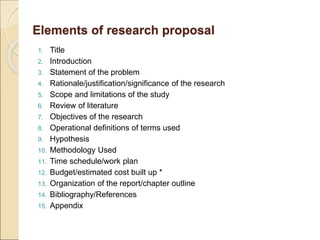
1. Title
2. Introduction
3. Statement of the problem
4. Rationale/justification/significance of the research
5. Scope and limitations of the study
6. Review of literature
7. Objectives of the research
8. Operational definitions of terms used
9. Hypothesis
10. Methodology Used
11. Time schedule/work plan
12. Budget/estimated cost built up *
13. Organization of the report/chapter outline
14. Bibliography/References
15. Appendix
Elements of research proposal
Title
 First page – title of the research; researcher’s name; name of
institute/organization where the researcher belongs; name of the
sponsoring organization, name of the supervisor, co-supervisor; date; etc
 In selecting the title, the following points should be taken care of:
Reflect the theme of the research
Be self-explanatory
Be brief
Language be simple and unambiguous
Be specific to a particular domain
Bracket; arithmetic figures, etc be avoided
Avoid confusing meaning
Elements of research proposal
Introduction
 Thereoretical background
 Background of the problem
 Etc
Statement of the problem
 Definition
 Nature
 Extent
Elements of research proposal
Rationale/justification/significance of the research
 Importance
 Addressing the national context problem
 Bridging the knowledge gaps
 Useful to the society/community
 Present state of affairs
 Affected stakeholders
Scope and limitations of the study
 Boundaries of the research
 Aspects and issues addressed
 Shortcomings of the research – resource and time constraints
Elements of research proposal
Review of literature
 Researches so conducted; vital information
 Issues discussed; unaddressed issues
 Relevancy to the present research
 Finding out information/knowledge gaps
Objectives of the research
 Contextual/consistent to the title
 Concise, clear-cut, expressed in simple language, precise, self-
explanatory
 Distinctive, quantifiable , measurable
 Two types of objectives : general/broad/overall; specific
Elements of research proposal
Operational definitions of terms used
 Clear-cut meaning of the terms used
Hypothesis
 Proposition subject to verification
 May be null, accepted, rejected
 Guide/lead the research
Methodology Used
 Selection of appropriate approach
 Tools/techniques to be used
 Data collection techniques
 Data processing, analysis, interpretation techniques
 Data/information presentation techniques
Elements of research proposal
Time schedule/work plan
 Time line of the assigned tasks
 Time line of the resource flow – 3Ms
Budget/estimated cost built up
 Cost built up – resource personnel, support staff, stationery, transport, utilities, house
rents, miscellaneous, etc
Organization of the report/chapter outline
 Outline of the dissertation/report
 Four major parts of the report: introductory, findings and discussion, summary, and
conclusion
Part Desired share (%) Acceptable share (%)
Introductory 10 15
Findings and Discussion 80 70
Summary and Conclusion 10 15
Total 100 100
Elements of research proposal
Bibliography/References
 Related documents to be consulted/studies
 Follow technicalities in writing bibliography/references
 To be presented in alphabetic order
 To be presented in classified manner viz., manuscripts, books, journals,
commission reports, newspapers, etc
Conclusion
 State about the feasibility of the proposed research/study
 Upcoming challenges
 Upcoming treats, difficulties, hindrances
 Make a conclusive remark
Tips and Tricks
 Read, read and read
 Take notes
 Talk to supervisors, experts, fellows
 Write topics and topics
 Get confused, get afraid
 Generate a number of research questions
 Systematize research questions
 Cut down these in line with your coherent thinking
DOs and DO NOTs
 DO
 Produce/prepare a professional looking proposal
 Make it interesting
 Make it informative, meaningful
 Write easy way to read
 Present content in a page
 Use clear headings/sub-headings
 Be concise, precise
 Check spelling, grammar
 Present in accurate/acceptable format
 DO NOTs
 Use no word which you do not understand
 Use of difficult word unimpressive to the readers/ supervisor/
authority

Research Proposal

  • 1.
    Drafting Research Proposal By- Prof.R.R.Borse, Asst.Prof.& Head, Eng.Dept., B.P.Arts,S.M.A.Sci.,K.K.C.Comm.College,Chalisgaon ravindraborse1@gmail.com
  • 2.
    Introduction A Research Proposal: …is a format and detailed statement of intent of the researcher …..presents and justifies a plan of action and shows the investigation plan
  • 3.
    Introduction Question to beasked Steps to be taken Elements of the step What is the problem? Why it should be studied? Selection and statement of the problem - Problem identification - Problem prioritization - Justification What information is already available? Literature review - Sources - Reviewing Why do conduct research? What is the achievement of the research? Formulation of aim and objectives - Aim, goals - General and specific objectives - Hypothesis How to carry out the research? How to collect data and information? Wherefrom to collect data and information? Research methodology - Variables - Types of the research - Data collection techniques - Sampling - Data analysis process, plan - Data processing plan - Data interpretation process, plan
  • 4.
    Introduction Question to beasked Steps to be taken Elements of the step Who will collect and when? Work plan - Self, Personnel - Timetable What and how much resources are needed? Who will provide the resources ? Budget Funding Organizations - 3 Ms: Men, materials, money - Fund collection, fund raising Who will submit? How to submit? Where to submit? Proposal preparation Proposal presentation Appropriate authority - Researcher - Proposal / Draft - Presentation techniques
  • 5.
    What is aresearch proposal?  Various terminologies are used to mean a research proposal depending on why the research is carried out?  Research outline  Synopsis of research  Plan of research  Research/project proposal  Thesis plan  Etc  …a blue print of future activities of a research project  …some sort of preconceived framework for starting the activities  …a work plan, prospectus, outline, and statement of intent ahead.
  • 6.
    What is aresearch proposal? …deals with ideas of researcher about what research he/she wants to do what objectives and methodology he/she has set how much time and resources are required to complete it how the research finding are to be reported and so on. …is an individual’s or a research institute's formal offer to produce a product or render service to a client in response to a request from the client In short, a proposal of a work frame for completing the research
  • 7.
    How to writeresearch proposal?  A research proposal is intended to convince others that you have a worthwhile research project and that you have the competence and the work-plan to complete it.  Readers’ Evaluation: The proposal should have sufficient information to convince your readers that you have an important research idea, that you have a good grasp of the relevant literature and the major issues, and that your methodology is sound.  Regardless of your research area and the methodology you choose, all research proposals must address the following questions:  What you plan to accomplish  Why you want to do it  How you are going to do it
  • 8.
    Components of researchproposal Title Concise and descriptive Functional relationship Informative but catchy Introduction Necessary background or context Placement of research question a current "hot" area, or an older area that remains viable. Appropriate historical backdrop Contemporary context in which your proposed research question occupies the central stage Identification of "key players" and refer to the most relevant and representative publications (if any).
  • 9.
    Components of researchproposal The introduction generally covers the following elements:  State the research problem, which is often referred to as the purpose of the study  Provide the context and set the stage for your research question in such a way as to show its necessity and importance  Present the rationale of your proposed study and clearly indicate why it is worth doing  Briefly describe the major issues and sub-problems to be addressed by your research.  Identify the key independent and dependent variables of your experiment. Alternatively, specify the phenomenon you want to study  Set the delimitation or boundaries of your proposed research in order to provide a clear focus.  Provide definitions of key concepts(This is optional).
  • 10.
    Components of researchproposal  Literature Review (Important functions):  Reinventing the wheel / Credits to deserved ones  Demonstration of knowledge and understanding of the theoretical and research issues  Demonstration of ability to critically evaluate  Indicates your ability to integrate and synthesize the existing literature  Development of a new model as the conceptual framework  Convinces reader regarding significance and substantial contribution to the literature
  • 11.
    Components of researchproposal Methods The Method section is very important because it tells your Research Committee how you plan to tackle your research problem. It will provide your work plan and describe the activities necessary for the completion of your project  The guiding principle for writing the Method section is that it should contain sufficient information for the reader to determine whether methodology is sound  Furthermore, since there are no well-established and widely accepted canons in qualitative analysis, your method section needs to be more elaborative than what is required for traditional quantitative research  More importantly, the data collection process in qualitative research has a far greater impact on the results as compared to quantitative research.
  • 12.
    Components of researchproposal For quantitative studies, the method section typically consists of the following sections:  Design Is it a questionnaire study or a laboratory experiment? What kind of design do you choose?  Subjects or participants Who will take part in your study ? What kind of sampling procedure do you use?  Instruments What kind of measuring instruments or questionnaires do you use? Why do you choose them? Are they valid and reliable?  Procedure How do you plan to carry out your study? What activities are involved? How long does it take?
  • 13.
    Components of researchproposal Results Obviously you do not have results at the proposal stage. However, you need to have some idea about what kind of data you will be collecting, and what statistical procedures will be used in order to answer your research question or test you hypothesis. Discussion It is important to convince your reader of the potential impact of your proposed research. You need to communicate a sense of enthusiasm and confidence without exaggerating the merits of your proposal. That is why you also need to mention the limitations and weaknesses of the proposed research, which may be justified by time and financial constraints as well as by the early developmental stage of your research area.
  • 14.
    Common Mistakes inProposal Writing  Failure to provide the proper context to frame the research question  Failure to delimit the boundary conditions for your research  Failure to cite landmark studies  Failure to accurately present the theoretical and empirical contributions by other researchers  Failure to stay focused on the research question  Failure to develop a coherent and persuasive argument for the proposed research  Too much detail on minor issues, but not enough detail on major issues  Too much rambling -- going "all over the map" without a clear sense of direction. (The best proposals move forward with ease and grace like a seamless river.)  Too many citation lapses and incorrect references  Too long or too short.
  • 15.
    Guidelines on writinga research proposal  Proposal writing is important to your pursuit of a graduate degree. The proposal is, in effect, an intellectual scholastic (not legal) contract between you and your supervisor/committee.  It specifies what you will do, how you will do it, and how you will interpret the results. Being clear about these things from the beginning will help you complete your thesis in a timely fashion.  A vague, weak or fuzzy proposal can lead to a long, painful, and often unsuccessful thesis writing exercise.  A clean, well thought-out, proposal forms the backbone for the thesis itself. The structures are identical and through the miracle of word- processing, your proposal will probably become your thesis.  A good thesis proposal hinges on a good idea. Once you have a good idea, you can draft the proposal in an evening.  Proposals help you estimate the size of a project. Don't make the project too big.
  • 16.
    Guidelines on writinga research proposal The (Longer) Standard Model A Basic Proposal Outline: Introduction  Topic area  Research question  Significance to knowledge Literature review  Previous research others & yours  Interlocking findings and Unanswered questions  Your preliminary work on the topic  The remaining questions and inter-locking logic  Reprise of your research question(s) in this context
  • 17.
    Guidelines on writinga research proposal Methodology  Approach  Data needs  Analytic techniques  Plan for interpreting results Expected results Budget Bibliography (or References)
  • 18.
    Guidelines on writinga research proposal The Basic Thesis Outline Introduction  Topic area  Research question (finding?)  Significance to knowledge Literature review  Previous research others & yours  Interlocking findings and Unanswered questions  Your preliminary work on the topic  The remaining questions and inter-locking logic  Reprise of your research question(s) in this context
  • 19.
    Guidelines on writinga research proposal Methodology  Approach  Data needs  Analytic techniques  Plan for interpreting results Results Discussion and Conclusions Bibliography
  • 20.
    Elements of researchproposal 1. Title 2. Introduction 3. Statement of the problem 4. Rationale/justification/significance of the research 5. Scope and limitations of the study 6. Review of literature 7. Objectives of the research 8. Operational definitions of terms used 9. Hypothesis 10. Methodology Used 11. Time schedule/work plan 12. Budget/estimated cost built up * 13. Organization of the report/chapter outline 14. Bibliography/References 15. Appendix
  • 21.
    Elements of researchproposal Title  First page – title of the research; researcher’s name; name of institute/organization where the researcher belongs; name of the sponsoring organization, name of the supervisor, co-supervisor; date; etc  In selecting the title, the following points should be taken care of: Reflect the theme of the research Be self-explanatory Be brief Language be simple and unambiguous Be specific to a particular domain Bracket; arithmetic figures, etc be avoided Avoid confusing meaning
  • 22.
    Elements of researchproposal Introduction  Thereoretical background  Background of the problem  Etc Statement of the problem  Definition  Nature  Extent
  • 23.
    Elements of researchproposal Rationale/justification/significance of the research  Importance  Addressing the national context problem  Bridging the knowledge gaps  Useful to the society/community  Present state of affairs  Affected stakeholders Scope and limitations of the study  Boundaries of the research  Aspects and issues addressed  Shortcomings of the research – resource and time constraints
  • 24.
    Elements of researchproposal Review of literature  Researches so conducted; vital information  Issues discussed; unaddressed issues  Relevancy to the present research  Finding out information/knowledge gaps Objectives of the research  Contextual/consistent to the title  Concise, clear-cut, expressed in simple language, precise, self- explanatory  Distinctive, quantifiable , measurable  Two types of objectives : general/broad/overall; specific
  • 25.
    Elements of researchproposal Operational definitions of terms used  Clear-cut meaning of the terms used Hypothesis  Proposition subject to verification  May be null, accepted, rejected  Guide/lead the research Methodology Used  Selection of appropriate approach  Tools/techniques to be used  Data collection techniques  Data processing, analysis, interpretation techniques  Data/information presentation techniques
  • 26.
    Elements of researchproposal Time schedule/work plan  Time line of the assigned tasks  Time line of the resource flow – 3Ms Budget/estimated cost built up  Cost built up – resource personnel, support staff, stationery, transport, utilities, house rents, miscellaneous, etc Organization of the report/chapter outline  Outline of the dissertation/report  Four major parts of the report: introductory, findings and discussion, summary, and conclusion Part Desired share (%) Acceptable share (%) Introductory 10 15 Findings and Discussion 80 70 Summary and Conclusion 10 15 Total 100 100
  • 27.
    Elements of researchproposal Bibliography/References  Related documents to be consulted/studies  Follow technicalities in writing bibliography/references  To be presented in alphabetic order  To be presented in classified manner viz., manuscripts, books, journals, commission reports, newspapers, etc Conclusion  State about the feasibility of the proposed research/study  Upcoming challenges  Upcoming treats, difficulties, hindrances  Make a conclusive remark
  • 28.
    Tips and Tricks Read, read and read  Take notes  Talk to supervisors, experts, fellows  Write topics and topics  Get confused, get afraid  Generate a number of research questions  Systematize research questions  Cut down these in line with your coherent thinking
  • 29.
    DOs and DONOTs  DO  Produce/prepare a professional looking proposal  Make it interesting  Make it informative, meaningful  Write easy way to read  Present content in a page  Use clear headings/sub-headings  Be concise, precise  Check spelling, grammar  Present in accurate/acceptable format  DO NOTs  Use no word which you do not understand  Use of difficult word unimpressive to the readers/ supervisor/ authority